Actuators
Supervisor:-
Dr. Jagadish Chandra Mohanta
Presented By:-
Anurag Chaudhary
Atul Kushwaha
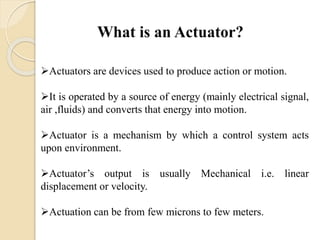
Actuators are devices used to produce action or motion.
It is operated by a source of energy (mainly electrical signal,
air ,fluids) and converts that energy into motion.
Actuator is a mechanism by which a control system acts
upon environment.
Actuator’s output is usually Mechanical i.e. linear
displacement or velocity.
Actuation can be from few microns to few meters.
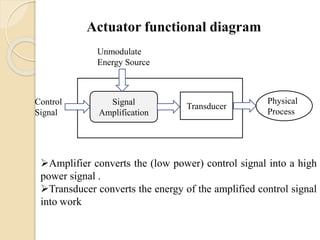
A
Signal
Amplification
Transducer
Control
Signal
Physical
Process
Unmodulate
Energy Source
Amplifier converts the (low power) control signal into a high
power signal .
Transducer converts the energy of the amplified control signal
into work
Main Attributes Of Actuators
 The size of operating forces and torques.
 The operating environment.
 Linear or rotational movement.
 The energy source.
 Speed of response and motion.
 The amount of movement needed.
 The degree of precision needed.
 The method of control and monitoring.
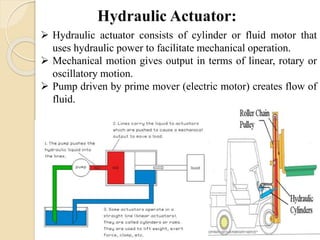
 Hydraulic actuator consists of cylinder or fluid motor that
uses hydraulic power to facilitate mechanical operation.
 Mechanical motion gives output in terms of linear, rotary or
oscillatory motion.
 Pump driven by prime mover (electric motor) creates flow of
fluid.
 Linear actuator (Hydraulic cylinder)-
 Provides motion in straight line.
 Linear displacement depends on stroke length.
 Usually referred to as cylinders, rams (single acting
cylinders) or jacks.
 Rotary actuators (Hydraulic motors)-
 Produces continuous rotational motion.
 Pump shaft is rotated to generate flow.
 Motor shaft is caused to rotate by fluid being forced into
driving chambers.
Types Of Hydraulic Actuator
Hydraulic jack.
Hydraulic brake.
Hydraulic ram.
Used as sensor.
Close loop velocity controlling.
Highly precise positioning for heavy loads.
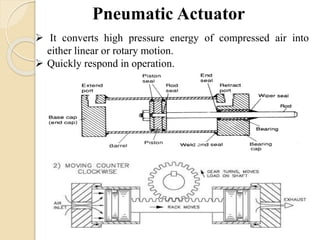
 It converts high pressure energy of compressed air into
either linear or rotary motion.
 Quickly respond in operation.
Pneumatic Actuator
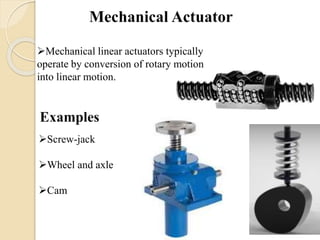
Mechanical linear actuators typically
operate by conversion of rotary motion
into linear motion.
Screw-jack
Wheel and axle
Cam
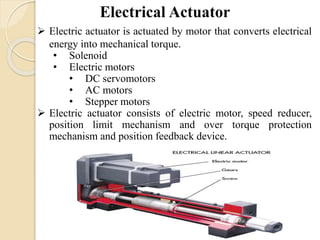
 Electric actuator is actuated by motor that converts electrical
energy into mechanical torque.
• Solenoid
• Electric motors
• DC servomotors
• AC motors
• Stepper motors
 Electric actuator consists of electric motor, speed reducer,
position limit mechanism and over torque protection
mechanism and position feedback device.
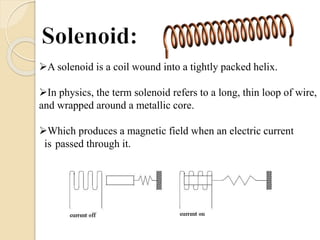
A solenoid is a coil wound into a tightly packed helix.
In physics, the term solenoid refers to a long, thin loop of wire,
and wrapped around a metallic core.
Which produces a magnetic field when an electric current
is passed through it.
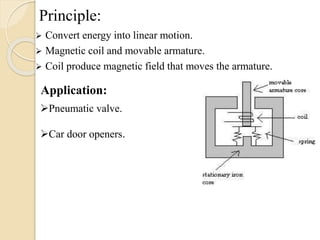
Principle:
 Convert energy into linear motion.
 Magnetic coil and movable armature.
 Coil produce magnetic field that moves the armature.
Application:
Pneumatic valve.
Car door openers.
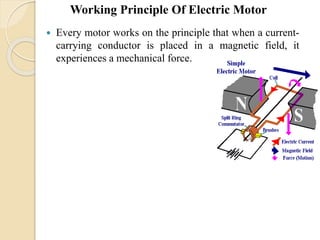
 Every motor works on the principle that when a current-
carrying conductor is placed in a magnetic field, it
experiences a mechanical force.
Working Principle Of Electric Motor
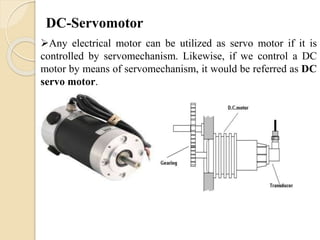
DC-Servomotor
Any electrical motor can be utilized as servo motor if it is
controlled by servomechanism. Likewise, if we control a DC
motor by means of servomechanism, it would be referred as DC
servo motor.
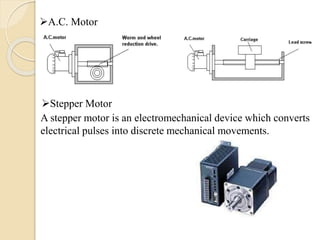
A.C. Motor
Stepper Motor
A stepper motor is an electromechanical device which converts
electrical pulses into discrete mechanical movements.
 Piezoelectric actuator is a device that makes use of the
inverse piezoelectric effect (generates mechanical energy
when subjected to electrical energy).
 Piezoelectric materials are: Quartz, Ceramics, PZT(lead
zirconate titanate).
Advantages:
Short response time.
Ability to create high forces.
Higher displacement accuracy.
High energy efficiency.
Disadvantage:
Have small strains. (0.1-.2%)
High supply voltage needed.(60-1000V)
 Large hysteresis.(actuator doesn’t go back to exactly where it
started).
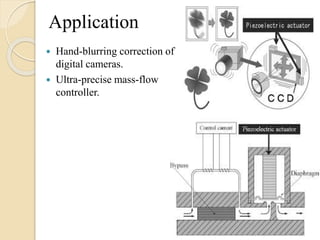
Application
 Hand-blurring correction of
digital cameras.
 Ultra-precise mass-flow
controller.
Thermal/ Magnetic Actuator
 These Actuators are actuated by applying thermal or Magnetic
energy.
 These use shape memory materials (shape memory alloys
or magnetic shape-memory alloys).
 They tend to be compact, lightweight, economical and with high
power density.
 MEMS(Micro-Electro-Mechanical Systems) thermal
actuator where small amount of thermal expansion of one part of
the device translates to a large amount of deflection of the overall
device.
 A device is considered to be MEMS device if its size is between
0.1 µm and hundreds of micrometers.
 MEMS Magnetic Actuator is device that uses
microelectromechanical systems (MEMS) to convert an electric
current into a mechanical output.
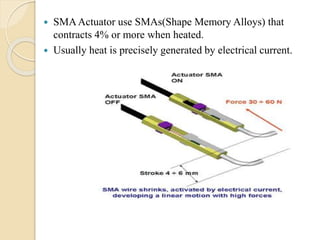
 SMAActuator use SMAs(Shape Memory Alloys) that
contracts 4% or more when heated.
 Usually heat is precisely generated by electrical current.
Actuators

Actuators

  • 1.
    Actuators Supervisor:- Dr. Jagadish ChandraMohanta Presented By:- Anurag Chaudhary Atul Kushwaha
  • 2.
    Actuators are devicesused to produce action or motion. It is operated by a source of energy (mainly electrical signal, air ,fluids) and converts that energy into motion. Actuator is a mechanism by which a control system acts upon environment. Actuator’s output is usually Mechanical i.e. linear displacement or velocity. Actuation can be from few microns to few meters.
  • 3.
    A Signal Amplification Transducer Control Signal Physical Process Unmodulate Energy Source Amplifier convertsthe (low power) control signal into a high power signal . Transducer converts the energy of the amplified control signal into work
  • 4.
    Main Attributes OfActuators  The size of operating forces and torques.  The operating environment.  Linear or rotational movement.  The energy source.  Speed of response and motion.  The amount of movement needed.  The degree of precision needed.  The method of control and monitoring.
  • 6.
     Hydraulic actuatorconsists of cylinder or fluid motor that uses hydraulic power to facilitate mechanical operation.  Mechanical motion gives output in terms of linear, rotary or oscillatory motion.  Pump driven by prime mover (electric motor) creates flow of fluid.
  • 7.
     Linear actuator(Hydraulic cylinder)-  Provides motion in straight line.  Linear displacement depends on stroke length.  Usually referred to as cylinders, rams (single acting cylinders) or jacks.  Rotary actuators (Hydraulic motors)-  Produces continuous rotational motion.  Pump shaft is rotated to generate flow.  Motor shaft is caused to rotate by fluid being forced into driving chambers. Types Of Hydraulic Actuator
  • 8.
    Hydraulic jack. Hydraulic brake. Hydraulicram. Used as sensor. Close loop velocity controlling. Highly precise positioning for heavy loads.
  • 9.
     It convertshigh pressure energy of compressed air into either linear or rotary motion.  Quickly respond in operation. Pneumatic Actuator
  • 10.
    Mechanical linear actuatorstypically operate by conversion of rotary motion into linear motion. Screw-jack Wheel and axle Cam
  • 11.
     Electric actuatoris actuated by motor that converts electrical energy into mechanical torque. • Solenoid • Electric motors • DC servomotors • AC motors • Stepper motors  Electric actuator consists of electric motor, speed reducer, position limit mechanism and over torque protection mechanism and position feedback device.
  • 12.
    A solenoid isa coil wound into a tightly packed helix. In physics, the term solenoid refers to a long, thin loop of wire, and wrapped around a metallic core. Which produces a magnetic field when an electric current is passed through it.
  • 13.
    Principle:  Convert energyinto linear motion.  Magnetic coil and movable armature.  Coil produce magnetic field that moves the armature. Application: Pneumatic valve. Car door openers.
  • 14.
     Every motorworks on the principle that when a current- carrying conductor is placed in a magnetic field, it experiences a mechanical force. Working Principle Of Electric Motor
  • 15.
    DC-Servomotor Any electrical motorcan be utilized as servo motor if it is controlled by servomechanism. Likewise, if we control a DC motor by means of servomechanism, it would be referred as DC servo motor.
  • 16.
    A.C. Motor Stepper Motor Astepper motor is an electromechanical device which converts electrical pulses into discrete mechanical movements.
  • 17.
     Piezoelectric actuatoris a device that makes use of the inverse piezoelectric effect (generates mechanical energy when subjected to electrical energy).  Piezoelectric materials are: Quartz, Ceramics, PZT(lead zirconate titanate). Advantages: Short response time. Ability to create high forces. Higher displacement accuracy. High energy efficiency. Disadvantage: Have small strains. (0.1-.2%) High supply voltage needed.(60-1000V)  Large hysteresis.(actuator doesn’t go back to exactly where it started).
  • 18.
    Application  Hand-blurring correctionof digital cameras.  Ultra-precise mass-flow controller.
  • 19.
    Thermal/ Magnetic Actuator These Actuators are actuated by applying thermal or Magnetic energy.  These use shape memory materials (shape memory alloys or magnetic shape-memory alloys).  They tend to be compact, lightweight, economical and with high power density.  MEMS(Micro-Electro-Mechanical Systems) thermal actuator where small amount of thermal expansion of one part of the device translates to a large amount of deflection of the overall device.  A device is considered to be MEMS device if its size is between 0.1 µm and hundreds of micrometers.  MEMS Magnetic Actuator is device that uses microelectromechanical systems (MEMS) to convert an electric current into a mechanical output.
  • 20.
     SMAActuator useSMAs(Shape Memory Alloys) that contracts 4% or more when heated.  Usually heat is precisely generated by electrical current.