ADAPTIVE NOISE
CANCELLATION
Group No. 01
Name: Robin Ray
Student ID: 1406066
Name: Mahmud Mohaimin
Student ID: 1406067
Name: Rafat Jamal Tazim
Student ID: 1406068
Name: Md. Mohiuddin Sumon
Student ID: 1406069
Motivation
Limitations of Fixed Filters
Time-varying Noise Frequency
Overlapping Bands of Signal & Noise
Digital Filter
A system that performs mathematical operations on
a sampled, discrete-time signal to reduce or enhance
certain aspects of that signal
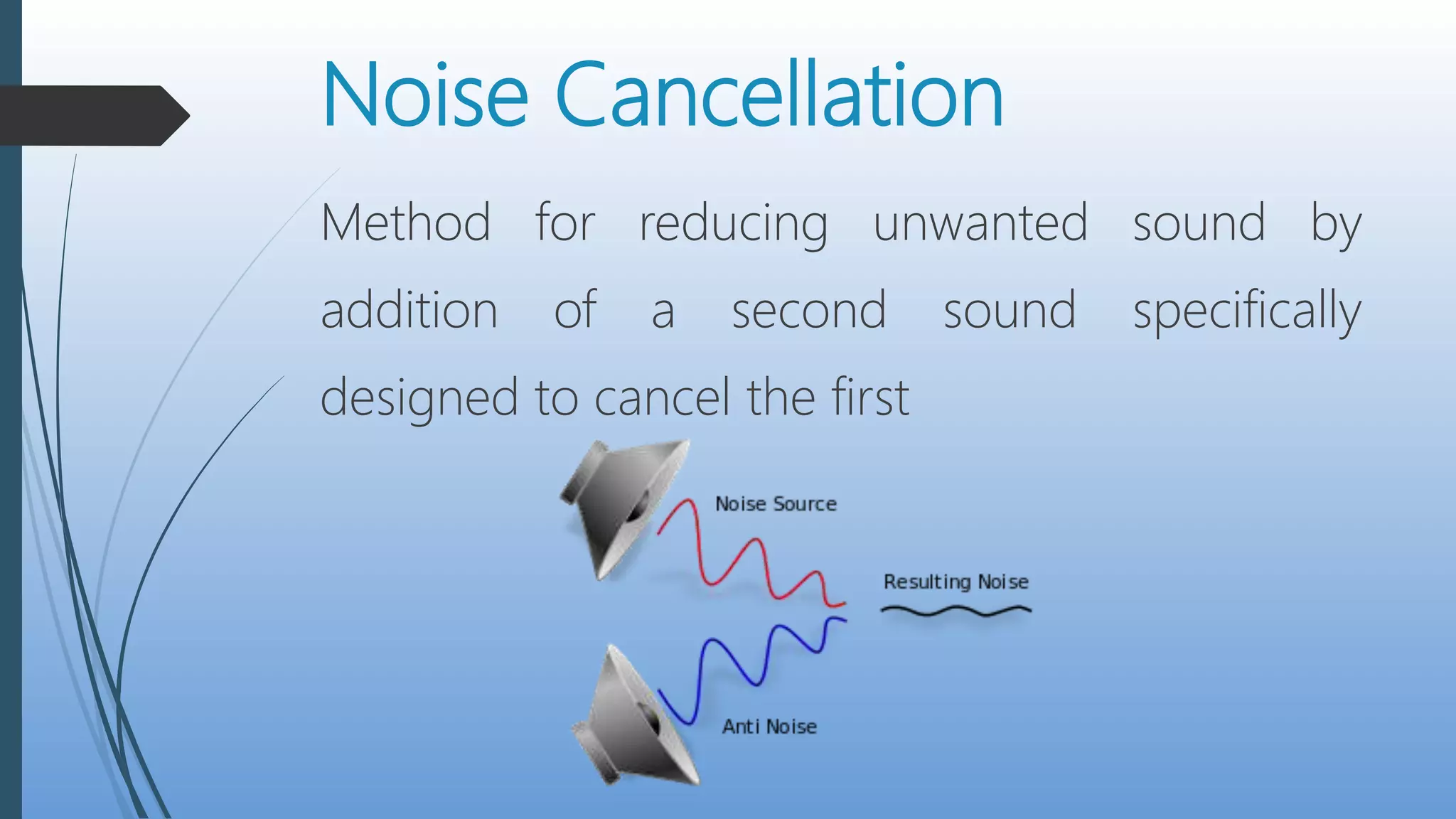
Noise Cancellation
Method for reducing unwanted sound by
addition of a second sound specifically
designed to cancel the first
Adaptive Filter
A system with a linear filter that has a transfer function
controlled by variable parameters and a means to
adjust those parameters according to an optimization
algorithm
Adaptive Noise Cancellation
Input x(n), a noise source N1(n), is compared with a desired
signal d(n), which consists of a signal s(n) corrupted by another
noise N0(n). The adaptive filter coefficients adapt to cause the
error signal to be a noiseless version of the signal s(n)
LMS Algorithm
 An adaptive filtering algorithm used to mimic a desired filter
by finding the filter coefficients that relate to producing the
least mean square of the error signal
 Consists of 2 basic processes,
1. Filtering Process
2. Adaptive Process
LMS: Gradient Approximation Method
 2 Input Signals,
 yk = sk + nk
Where sk is desired signal
& nk is noise
 xk, is a measure of contaminating signal which
is someway correlated with nk
 xk gives estimate of nk, consider it 𝑛 𝑘
 Estimating sk, by subtracting the noise estimate,
𝑠 𝑘 = 𝑦 𝑘 − 𝑛 𝑘
LMS: Algorithm
𝑥 𝑘 =
𝑥 𝑘
𝑥 𝑘−1
⋮
⋮
𝑥 𝑘−(𝑁−1)
, vector correlated with
noise
𝑤 =
𝑤0
𝑤1
⋮
⋮
𝑤 𝑁−1
, set of adjustable weights with
N coefficients
• Approximations to
minimum mean
square error gives,
𝑠 𝑘 = 𝑒 𝑘 = 𝑦 𝑘 − 𝑛 𝑘
= 𝑦 𝑘 − 𝑤 𝑇 𝑥 𝑘
• Using methods of
steepest descent
method we get,
𝑤 𝑛+1 = 𝑤 𝑛 + 𝜇𝑒 𝑘 𝑥 𝑘
Code: Initial Part
Code: Main Body
Code: Displaying Results
Results
Results
Results
Advantages over Other Algorithms
Simplicity
Doesn’t require pertinent correlation function
Doesn’t require matrix inversion
Efficiency
Applications of Adaptive Noise
Cancellation
Echo & Noise Cancellation for Long Distance
Transmission
Applications of Adaptive Noise
Cancellation
Acoustic Echo Cancellation
Applications of Adaptive Noise
Cancellation
System Identification
Applications of Adaptive
Noise Cancellation
Noise Removal from ECG Signal
Limitations of this Project
Works only on real valued signals, not on complex
valued signals
Noise is taken as reference
Reference
 “Adaptive Filtering: Fundamentals of Least Mean Squares with
MATLAB” by Alexander D. Poularikas
 “Adaptive Filter Theory” by Symon Haykin
 DSP System Toolbox
(https://www.mathworks.com/help/dsp/adaptive-filters.html)
Thank You

Adaptive Noise Cancellation

  • 1.
  • 2.
    Group No. 01 Name:Robin Ray Student ID: 1406066 Name: Mahmud Mohaimin Student ID: 1406067 Name: Rafat Jamal Tazim Student ID: 1406068 Name: Md. Mohiuddin Sumon Student ID: 1406069
  • 3.
    Motivation Limitations of FixedFilters Time-varying Noise Frequency Overlapping Bands of Signal & Noise
  • 4.
    Digital Filter A systemthat performs mathematical operations on a sampled, discrete-time signal to reduce or enhance certain aspects of that signal
  • 5.
    Noise Cancellation Method forreducing unwanted sound by addition of a second sound specifically designed to cancel the first
  • 6.
    Adaptive Filter A systemwith a linear filter that has a transfer function controlled by variable parameters and a means to adjust those parameters according to an optimization algorithm
  • 7.
    Adaptive Noise Cancellation Inputx(n), a noise source N1(n), is compared with a desired signal d(n), which consists of a signal s(n) corrupted by another noise N0(n). The adaptive filter coefficients adapt to cause the error signal to be a noiseless version of the signal s(n)
  • 8.
    LMS Algorithm  Anadaptive filtering algorithm used to mimic a desired filter by finding the filter coefficients that relate to producing the least mean square of the error signal  Consists of 2 basic processes, 1. Filtering Process 2. Adaptive Process
  • 9.
    LMS: Gradient ApproximationMethod  2 Input Signals,  yk = sk + nk Where sk is desired signal & nk is noise  xk, is a measure of contaminating signal which is someway correlated with nk  xk gives estimate of nk, consider it 𝑛 𝑘  Estimating sk, by subtracting the noise estimate, 𝑠 𝑘 = 𝑦 𝑘 − 𝑛 𝑘
  • 10.
    LMS: Algorithm 𝑥 𝑘= 𝑥 𝑘 𝑥 𝑘−1 ⋮ ⋮ 𝑥 𝑘−(𝑁−1) , vector correlated with noise 𝑤 = 𝑤0 𝑤1 ⋮ ⋮ 𝑤 𝑁−1 , set of adjustable weights with N coefficients • Approximations to minimum mean square error gives, 𝑠 𝑘 = 𝑒 𝑘 = 𝑦 𝑘 − 𝑛 𝑘 = 𝑦 𝑘 − 𝑤 𝑇 𝑥 𝑘 • Using methods of steepest descent method we get, 𝑤 𝑛+1 = 𝑤 𝑛 + 𝜇𝑒 𝑘 𝑥 𝑘
  • 11.
  • 12.
  • 13.
  • 14.
  • 15.
  • 16.
  • 17.
    Advantages over OtherAlgorithms Simplicity Doesn’t require pertinent correlation function Doesn’t require matrix inversion Efficiency
  • 18.
    Applications of AdaptiveNoise Cancellation Echo & Noise Cancellation for Long Distance Transmission
  • 19.
    Applications of AdaptiveNoise Cancellation Acoustic Echo Cancellation
  • 20.
    Applications of AdaptiveNoise Cancellation System Identification
  • 21.
    Applications of Adaptive NoiseCancellation Noise Removal from ECG Signal
  • 22.
    Limitations of thisProject Works only on real valued signals, not on complex valued signals Noise is taken as reference
  • 23.
    Reference  “Adaptive Filtering:Fundamentals of Least Mean Squares with MATLAB” by Alexander D. Poularikas  “Adaptive Filter Theory” by Symon Haykin  DSP System Toolbox (https://www.mathworks.com/help/dsp/adaptive-filters.html)
  • 24.