Digital Communication
Pritam S. Langde
Asst. Prof.
( Dept. Of E&TC Engg.)
Digital
Communication
•DPCM
•DM
•ADM
Content
Differential Pulse
Code Modulation
• The samples that are highly correlated,
when encoded by PCM technique, leave
redundant information behind. To
process this redundant information and to
have a better output,
• It is a wise decision to take a predicted
sampled value, assumed from its
previous output and summarize them
with the quantized values.
• Such a process is called as Differential
PCM (DPCM)technique.
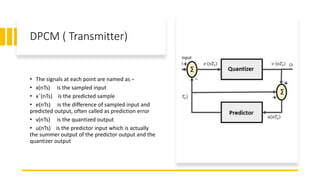
DPCM ( Transmitter)
• The signals at each point are named as −
• x(nTs) is the sampled input
• xˆ(nTs) is the predicted sample
• e(nTs) is the difference of sampled input and
predicted output, often called as prediction error
• v(nTs) is the quantized output
• u(nTs) is the predictor input which is actually
the summer output of the predictor output and the
quantizer output
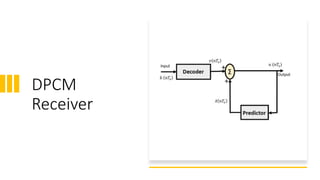
DPCM
Receiver
DM (Delta
Modulation)
The sampling rate of a signal should be higher than the
Nyquist rate, to achieve better sampling.
If this sampling interval in Differential PCM is reduced
considerably, the sampleto-sample amplitude
difference is very small, as if the difference is 1-bit
quantization
then the step-size will be very small i.e., Δ delta.
Delta Modulation
The type of modulation, where the sampling rate is
much higher and in which the stepsize after
quantization is of a smaller value Δ,
such a modulation is termed as delta modulation.
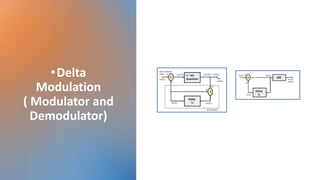
•Delta
Modulation
( Modulator and
Demodulator)
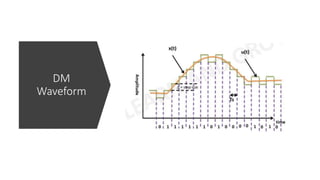
DM
Waveform
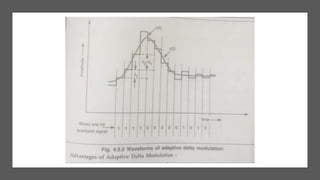
Adaptive Delta
Modulation
• In digital modulation, we have come across
certain problem of determining the step-
size, which influences the quality of the
output wave.
• A larger step-size is needed in the steep
slope of modulating signal and a smaller
stepsize is needed where the message has a
small slope. The minute details get missed
in the process. So, it would be better if we
can control the adjustment of step-size,
according to our requirement in order to
obtain the sampling in a desired fashion.
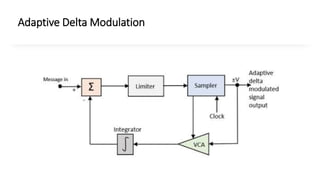
This is the concept of Adaptive Delta
Modulation.
Adaptive Delta Modulation
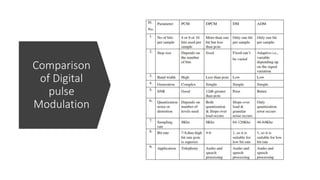
Comparison
of Digital
pulse
Modulation

Digital Communication Essentials: DPCM, DM, and ADM .pptx

  • 1.
    Digital Communication Pritam S.Langde Asst. Prof. ( Dept. Of E&TC Engg.)
  • 2.
  • 3.
    Differential Pulse Code Modulation •The samples that are highly correlated, when encoded by PCM technique, leave redundant information behind. To process this redundant information and to have a better output, • It is a wise decision to take a predicted sampled value, assumed from its previous output and summarize them with the quantized values. • Such a process is called as Differential PCM (DPCM)technique.
  • 4.
    DPCM ( Transmitter) •The signals at each point are named as − • x(nTs) is the sampled input • xˆ(nTs) is the predicted sample • e(nTs) is the difference of sampled input and predicted output, often called as prediction error • v(nTs) is the quantized output • u(nTs) is the predictor input which is actually the summer output of the predictor output and the quantizer output
  • 5.
  • 6.
    DM (Delta Modulation) The samplingrate of a signal should be higher than the Nyquist rate, to achieve better sampling. If this sampling interval in Differential PCM is reduced considerably, the sampleto-sample amplitude difference is very small, as if the difference is 1-bit quantization then the step-size will be very small i.e., Δ delta. Delta Modulation The type of modulation, where the sampling rate is much higher and in which the stepsize after quantization is of a smaller value Δ, such a modulation is termed as delta modulation.
  • 7.
  • 8.
  • 9.
    Adaptive Delta Modulation • Indigital modulation, we have come across certain problem of determining the step- size, which influences the quality of the output wave. • A larger step-size is needed in the steep slope of modulating signal and a smaller stepsize is needed where the message has a small slope. The minute details get missed in the process. So, it would be better if we can control the adjustment of step-size, according to our requirement in order to obtain the sampling in a desired fashion. This is the concept of Adaptive Delta Modulation.
  • 10.
  • 12.