Delta modulation is a simplified form of differential PCM where a 1-bit word indicates if the current sample is greater than or less than the previous sample. This results in a staircase approximation of the input signal. The step size Δ is important, as too large causes granular noise when the input changes slowly, and too small causes slope overload distortion when the input changes rapidly. In this lab, the student investigated these effects of delta modulation using PSpice simulations. Both sine and square wave inputs were tested, and the results showed the tradeoff between large and small Δ values. The student learned that the best choice for Δ is a medium value that avoids both types of distortion.


![JunaidMalik,
DT008/2, GroupA
Method:
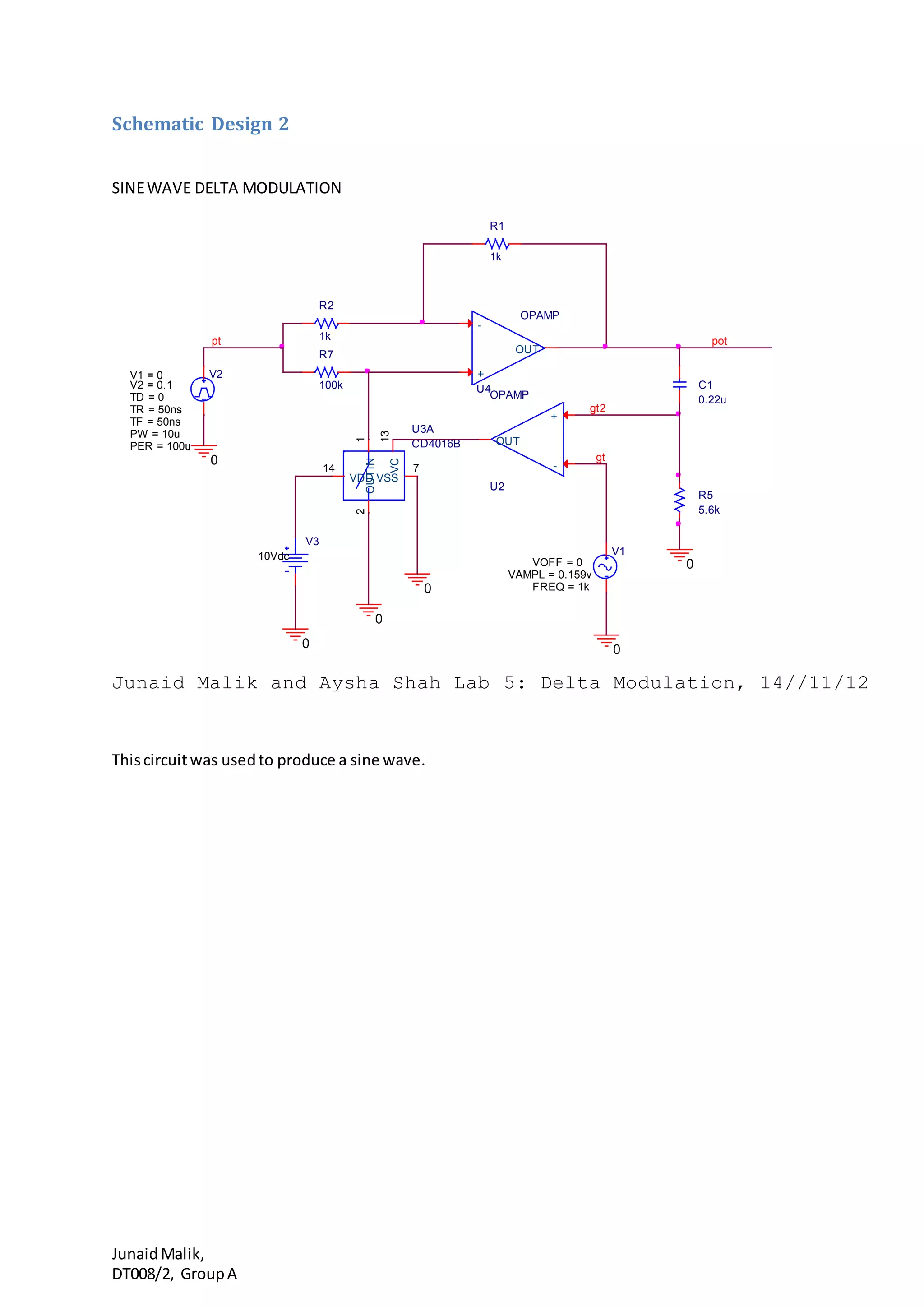
In this laboratory we validated our design of the delta modulation systemusing Pspice and
obtained results with transient analysis.
In deltamodulationastaircase approximationis generatedateachtime interval.
The predictionerrorisgivenbythe followingequation:
𝜖( 𝑘𝑇𝑠) = 𝑔( 𝑘𝑇𝑠) − 𝑔′(𝑘𝑇𝑠)
Andthe quantizedpredictionerrorisgivenby:
𝜖 𝑞 ( 𝑘𝑇𝑠) = ∆𝑠𝑔𝑛[𝜖(𝑘𝑇𝑠)
At the receiver the sampled waveform is then reconstructed by:
𝑔( 𝑘𝑇𝑠) = 𝑔′(𝑘𝑇𝑠) + 𝜖 𝑞 ( 𝑘𝑇𝑠)
= 𝑔((𝑘 − 1)𝑇𝑠) ± ∆
A reconstruction filter recovers the analogue waveform g(t) from the reconstructed
waveform signal g( 𝑘𝑇𝑠)
The two typed of quantization errors that we came across were, slope overload distortion
and granular noise.
To avoid slope overload distortion we used the following equation:
𝛿
𝑇𝑠
≥ max [
𝑑𝑔( 𝑡)
𝑑𝑡
]
We avoided slope overload distortion by using a large value for ∆ or by using a small value
for 𝑇𝑠
In this lab we also encountered granular noise which occurs when we increased the step
size ∆, relative to the slope of the input waveform signal.
The waveform that resulted was a square wave with a period half that of the sampling
period.
We have observed that too large a step size causes granular noise and too small step size
results in slope-overload distortion. This means that a good choice for is a “medium” value,
but in some cases the performance of the best medium value (i.e., the one minimizing the](https://image.slidesharecdn.com/06926ec5-c9fd-4556-92af-bc779d93f90d-160926185746/75/Junaid-Malik-Formal-Element-5-2048.jpg)






![RF Module Design - [Chapter 1] From Basics to RF Transceivers](https://cdn.slidesharecdn.com/ss_thumbnails/rfch1-150613070344-lva1-app6892-thumbnail.jpg?width=640&height=640&fit=bounds)


