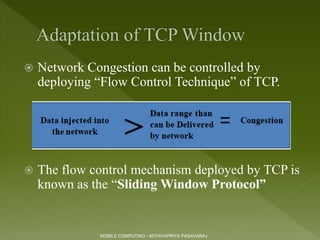
 Network Congestion can be controlled by
deploying “Flow Control Technique” of TCP.
 The flow control mechanism deployed by TCP is
known as the “Sliding Window Protocol”
MOBILE COMPUTING - NITHIYAPRIYA PASAVARAJ
• TCP sliding Window controls the flow & communication
which allows multiple packet to be sent and confirmed
with Single acknowledgement packet.
• TCP Sliding Window protocol helps adapt the rate of data
transmission by the TCP at the sending host end.
• The flow control technique helps TCP dynamically adjust
the transmission rate :
 Reducing the transmission rate , when congestion
starts to develop
 Increasing the transmission rate , when congestion
starts to disappear
 The size of the TCP window determine the number
of acknowledgements sent for data transfer.
MOBILE COMPUTING - NITHIYAPRIYA PASAVARAJ
 Basic Concepts of The Sliding Window Protocol
1. Congestion window
2. Advertised window
MOBILE COMPUTING - NITHIYAPRIYA PASAVARAJ
The Advertised Window
 The advertised window is usually set to the size
of the receive buffer at the receiver.
 The sender uses the advertised window size of
the receiver, to determine the maximum amount
of data can transmit.
MOBILE COMPUTING - NITHIYAPRIYA PASAVARAJ
The Congestion Window
› A congestion window indicates the maximum number of
outstanding segments and waits for an acknowledgement
to arrive.
› The TCP at a sender’s end pauses , if the no. of segments
outstanding becomes equal to the congestion window.
› A sender sets the congestion window size to “1” and keeps
on increasing it until :
 Duplicate ack. Are received (or)
 The no. of outstanding segments = The Size of the
Advertised Window
 TCP detects packets loss using Retransmission timeout
(RTO) and Duplicate acknowledgements .
 RTO is Dynamically calculated.
MOBILE COMPUTING - NITHIYAPRIYA PASAVARAJ

Adaptation of tcp window

  • 2.
     Network Congestioncan be controlled by deploying “Flow Control Technique” of TCP.  The flow control mechanism deployed by TCP is known as the “Sliding Window Protocol” MOBILE COMPUTING - NITHIYAPRIYA PASAVARAJ
  • 3.
    • TCP slidingWindow controls the flow & communication which allows multiple packet to be sent and confirmed with Single acknowledgement packet. • TCP Sliding Window protocol helps adapt the rate of data transmission by the TCP at the sending host end. • The flow control technique helps TCP dynamically adjust the transmission rate :  Reducing the transmission rate , when congestion starts to develop  Increasing the transmission rate , when congestion starts to disappear  The size of the TCP window determine the number of acknowledgements sent for data transfer. MOBILE COMPUTING - NITHIYAPRIYA PASAVARAJ
  • 4.
     Basic Conceptsof The Sliding Window Protocol 1. Congestion window 2. Advertised window MOBILE COMPUTING - NITHIYAPRIYA PASAVARAJ
  • 5.
    The Advertised Window The advertised window is usually set to the size of the receive buffer at the receiver.  The sender uses the advertised window size of the receiver, to determine the maximum amount of data can transmit. MOBILE COMPUTING - NITHIYAPRIYA PASAVARAJ
  • 6.
    The Congestion Window ›A congestion window indicates the maximum number of outstanding segments and waits for an acknowledgement to arrive. › The TCP at a sender’s end pauses , if the no. of segments outstanding becomes equal to the congestion window. › A sender sets the congestion window size to “1” and keeps on increasing it until :  Duplicate ack. Are received (or)  The no. of outstanding segments = The Size of the Advertised Window  TCP detects packets loss using Retransmission timeout (RTO) and Duplicate acknowledgements .  RTO is Dynamically calculated. MOBILE COMPUTING - NITHIYAPRIYA PASAVARAJ