Zakariya Al-nuaimi
*
*
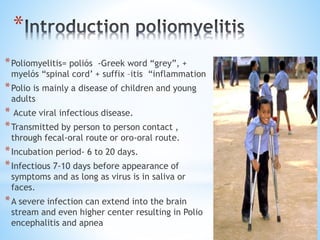
*Poliomyelitis= poliós -Greek word “grey”, +
myelós “spinal cord’ + suffix –itis “inflammation
*Polio is mainly a disease of children and young
adults
* Acute viral infectious disease.
*Transmitted by person to person contact ,
through fecal-oral route or oro-oral route.
*Incubation period- 6 to 20 days.
*Infectious 7-10 days before appearance of
symptoms and as long as virus is in saliva or
faces.
*A severe infection can extend into the brain
stream and even higher center resulting in Polio
encephalitis and apnea
*
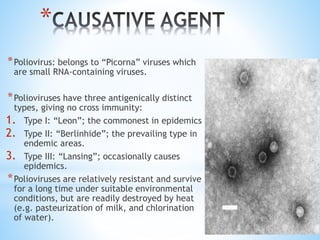
*Poliovirus: belongs to “Picorna” viruses which
are small RNA-containing viruses.
*Polioviruses have three antigenically distinct
types, giving no cross immunity:
1. Type I: “Leon”; the commonest in epidemics
2. Type II: “Berlinhide”; the prevailing type in
endemic areas.
3. Type III: “Lansing”; occasionally causes
epidemics.
*Polioviruses are relatively resistant and survive
for a long time under suitable environmental
conditions, but are readily destroyed by heat
(e.g. pasteurization of milk, and chlorination
of water).
*
*Age: more than 95% reported in infancy and childhood
with over 50% of them in infancy.
*Sex: no sex ratio differences, but in some countries,
males are infected more frequently than females in a
ratio 3:1.
*Risk factors: (provocative factors of paralytic polio in
individuals infected with polio virus): fatigue, trauma,
intramuscular injections, operative procedures,
pregnancy, excessive muscular exercise…
*Immunity: The maternal antibodies gradually
disappear during the first 6 months of life. Immunity
following infection is fairly solid, although infection
with other types of polio virus can still occur.
*
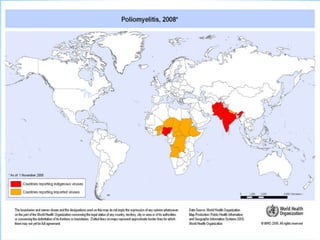
*According to the WHO; Three epidemiological patterns have now been
delineated:
1. Countries with no immunization: the virus infects all children, and by
age 5 years almost all children develop antibodies to at least one of the
3 types of polio virus. In that pattern paralytic polio cases are frequent
in infants.
2. Countries with partial immunization: In these countries, wild polio
virus is largely replaced by vaccine virus in the environment.
3. Countries with almost total immunization coverage: in these countries
polio is becoming rare, however, sporadic cases do occur rarely.
*
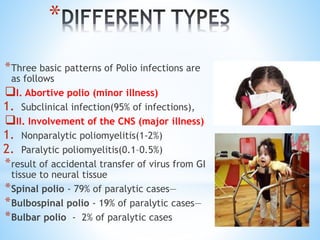
*Three basic patterns of Polio infections are
as follows
I. Abortive polio (minor illness)
1. Subclinical infection(95% of infections),
II. Involvement of the CNS (major illness)
1. Nonparalytic poliomyelitis(1-2%)
2. Paralytic poliomyelitis(0.1–0.5%)
*result of accidental transfer of virus from GI
tissue to neural tissue
*Spinal polio - 79% of paralytic cases—
*Bulbospinal polio - 19% of paralytic cases—
*Bulbar polio - 2% of paralytic cases
*
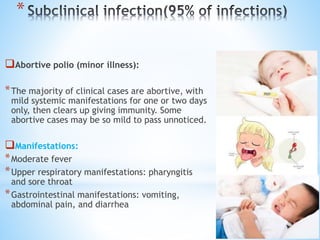
Abortive polio (minor illness):
*The majority of clinical cases are abortive, with
mild systemic manifestations for one or two days
only, then clears up giving immunity. Some
abortive cases may be so mild to pass unnoticed.
Manifestations:
*Moderate fever
*Upper respiratory manifestations: pharyngitis
and sore throat
*Gastrointestinal manifestations: vomiting,
abdominal pain, and diarrhea
*
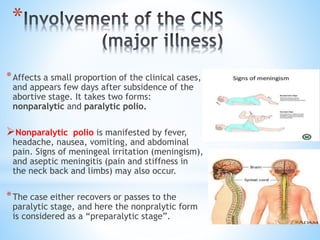
*Affects a small proportion of the clinical cases,
and appears few days after subsidence of the
abortive stage. It takes two forms:
nonparalytic and paralytic polio.
Nonparalytic polio is manifested by fever,
headache, nausea, vomiting, and abdominal
pain. Signs of meningeal irritation (meningism),
and aseptic meningitis (pain and stiffness in
the neck back and limbs) may also occur.
*The case either recovers or passes to the
paralytic stage, and here the nonpralytic form
is considered as a “preparalytic stage”.
*
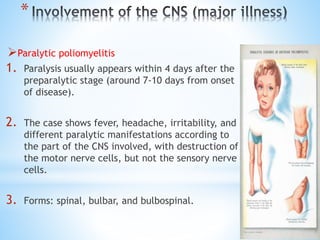
Paralytic poliomyelitis
1. Paralysis usually appears within 4 days after the
preparalytic stage (around 7-10 days from onset
of disease).
2. The case shows fever, headache, irritability, and
different paralytic manifestations according to
the part of the CNS involved, with destruction of
the motor nerve cells, but not the sensory nerve
cells.
3. Forms: spinal, bulbar, and bulbospinal.
*
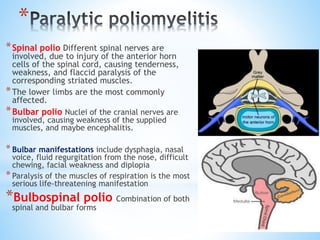
*Spinal polio Different spinal nerves are
involved, due to injury of the anterior horn
cells of the spinal cord, causing tenderness,
weakness, and flaccid paralysis of the
corresponding striated muscles.
*The lower limbs are the most commonly
affected.
*Bulbar polio Nuclei of the cranial nerves are
involved, causing weakness of the supplied
muscles, and maybe encephalitis.
*Bulbar manifestations include dysphagia, nasal
voice, fluid regurgitation from the nose, difficult
chewing, facial weakness and diplopia
*Paralysis of the muscles of respiration is the most
serious life-threatening manifestation
*Bulbospinal polio Combination of both
spinal and bulbar forms
*
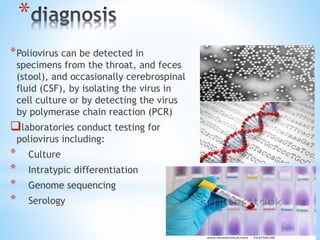
*Poliovirus can be detected in
specimens from the throat, and feces
(stool), and occasionally cerebrospinal
fluid (CSF), by isolating the virus in
cell culture or by detecting the virus
by polymerase chain reaction (PCR)
laboratories conduct testing for
poliovirus including:
* Culture
* Intratypic differentiation
* Genome sequencing
* Serology
*
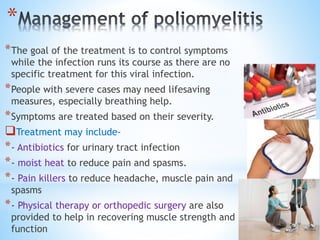
*The goal of the treatment is to control symptoms
while the infection runs its course as there are no
specific treatment for this viral infection.
*People with severe cases may need lifesaving
measures, especially breathing help.
*Symptoms are treated based on their severity.
Treatment may include-
*- Antibiotics for urinary tract infection
*- moist heat to reduce pain and spasms.
*- Pain killers to reduce headache, muscle pain and
spasms
*- Physical therapy or orthopedic surgery are also
provided to help in recovering muscle strength and
function
*
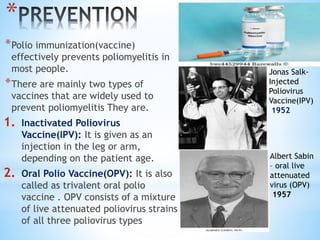
*Polio immunization(vaccine)
effectively prevents poliomyelitis in
most people.
*There are mainly two types of
vaccines that are widely used to
prevent poliomyelitis They are.
1. Inactivated Poliovirus
Vaccine(IPV): It is given as an
injection in the leg or arm,
depending on the patient age.
2. Oral Polio Vaccine(OPV): It is also
called as trivalent oral polio
vaccine . OPV consists of a mixture
of live attenuated poliovirus strains
of all three poliovirus types
Albert Sabin
– oral live
attenuated
virus (OPV)
1957
Jonas Salk-
Injected
Poliovirus
Vaccine(IPV)
1952
*
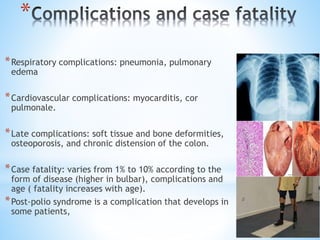
*Respiratory complications: pneumonia, pulmonary
edema
*Cardiovascular complications: myocarditis, cor
pulmonale.
*Late complications: soft tissue and bone deformities,
osteoporosis, and chronic distension of the colon.
*Case fatality: varies from 1% to 10% according to the
form of disease (higher in bulbar), complications and
age ( fatality increases with age).
*Post-polio syndrome is a complication that develops in
some patients,
*
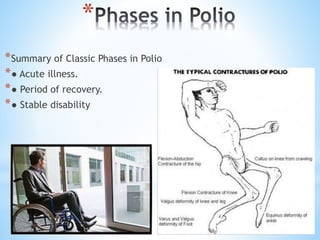
*Summary of Classic Phases in Polio
*● Acute illness.
*● Period of recovery.
*● Stable disability
*
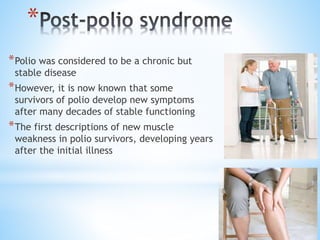
*Polio was considered to be a chronic but
stable disease
*However, it is now known that some
survivors of polio develop new symptoms
after many decades of stable functioning
*The first descriptions of new muscle
weakness in polio survivors, developing years
after the initial illness
*
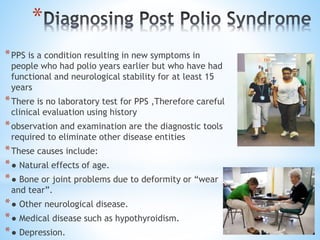
*PPS is a condition resulting in new symptoms in
people who had polio years earlier but who have had
functional and neurological stability for at least 15
years
*There is no laboratory test for PPS ,Therefore careful
clinical evaluation using history
*observation and examination are the diagnostic tools
required to eliminate other disease entities
*These causes include:
*● Natural effects of age.
*● Bone or joint problems due to deformity or “wear
and tear”.
*● Other neurological disease.
*● Medical disease such as hypothyroidism.
*● Depression.
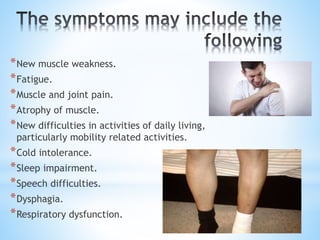
*New muscle weakness.
*Fatigue.
*Muscle and joint pain.
*Atrophy of muscle.
*New difficulties in activities of daily living,
particularly mobility related activities.
*Cold intolerance.
*Sleep impairment.
*Speech difficulties.
*Dysphagia.
*Respiratory dysfunction.
*
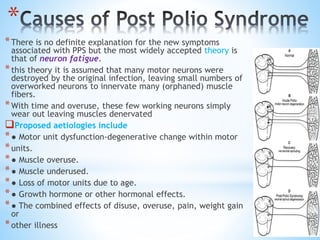
*There is no definite explanation for the new symptoms
associated with PPS but the most widely accepted theory is
that of neuron fatigue.
*this theory it is assumed that many motor neurons were
destroyed by the original infection, leaving small numbers of
overworked neurons to innervate many (orphaned) muscle
fibers.
*With time and overuse, these few working neurons simply
wear out leaving muscles denervated
Proposed aetiologies include
*● Motor unit dysfunction-degenerative change within motor
*units.
*● Muscle overuse.
*● Muscle underused.
*● Loss of motor units due to age.
*● Growth hormone or other hormonal effects.
*● The combined effects of disuse, overuse, pain, weight gain
or
*other illness
*The three main symptoms which need
evaluation, treatment and monitoring are
muscle weakness, fatigue and pain.
*Other problems which require specific care and
management are dysphagia and speech
problems, which must be referred to a speech
and language therapist.
Pain specialists
Physiotherapy
Occupational Therapy.
Speech and Language Therapy.
Respiratory medicine.
REFERENCE
• i. A Textbook of Microbiology by R. Ananthanarayan, C K Jayaram Paniker,
seventh edition, 2005, Page no: 491-494.
• ii. A Textbook of Microbiology by P. Chakraborty, 3rd edition, 2013, Page No:
555-559.
• Halbritter T. (2001). Management of a patient with post-polio syndrome.
Journal of the American Academy of Nurse Practitioners, 13(12), 555-559
• Westbrook M, McIIwain D. (1996). Living with the late effects of disability: a
five year follow-up study of coping among post-polio survivors. Australian
Occupational Therapy Journal, 43, 60-71.

Poliomyelitis and post polio syndrome

  • 1.
  • 2.
    * *Poliomyelitis= poliós -Greekword “grey”, + myelós “spinal cord’ + suffix –itis “inflammation *Polio is mainly a disease of children and young adults * Acute viral infectious disease. *Transmitted by person to person contact , through fecal-oral route or oro-oral route. *Incubation period- 6 to 20 days. *Infectious 7-10 days before appearance of symptoms and as long as virus is in saliva or faces. *A severe infection can extend into the brain stream and even higher center resulting in Polio encephalitis and apnea
  • 3.
    * *Poliovirus: belongs to“Picorna” viruses which are small RNA-containing viruses. *Polioviruses have three antigenically distinct types, giving no cross immunity: 1. Type I: “Leon”; the commonest in epidemics 2. Type II: “Berlinhide”; the prevailing type in endemic areas. 3. Type III: “Lansing”; occasionally causes epidemics. *Polioviruses are relatively resistant and survive for a long time under suitable environmental conditions, but are readily destroyed by heat (e.g. pasteurization of milk, and chlorination of water).
  • 4.
    * *Age: more than95% reported in infancy and childhood with over 50% of them in infancy. *Sex: no sex ratio differences, but in some countries, males are infected more frequently than females in a ratio 3:1. *Risk factors: (provocative factors of paralytic polio in individuals infected with polio virus): fatigue, trauma, intramuscular injections, operative procedures, pregnancy, excessive muscular exercise… *Immunity: The maternal antibodies gradually disappear during the first 6 months of life. Immunity following infection is fairly solid, although infection with other types of polio virus can still occur.
  • 5.
    * *According to theWHO; Three epidemiological patterns have now been delineated: 1. Countries with no immunization: the virus infects all children, and by age 5 years almost all children develop antibodies to at least one of the 3 types of polio virus. In that pattern paralytic polio cases are frequent in infants. 2. Countries with partial immunization: In these countries, wild polio virus is largely replaced by vaccine virus in the environment. 3. Countries with almost total immunization coverage: in these countries polio is becoming rare, however, sporadic cases do occur rarely.
  • 7.
    * *Three basic patternsof Polio infections are as follows I. Abortive polio (minor illness) 1. Subclinical infection(95% of infections), II. Involvement of the CNS (major illness) 1. Nonparalytic poliomyelitis(1-2%) 2. Paralytic poliomyelitis(0.1–0.5%) *result of accidental transfer of virus from GI tissue to neural tissue *Spinal polio - 79% of paralytic cases— *Bulbospinal polio - 19% of paralytic cases— *Bulbar polio - 2% of paralytic cases
  • 8.
    * Abortive polio (minorillness): *The majority of clinical cases are abortive, with mild systemic manifestations for one or two days only, then clears up giving immunity. Some abortive cases may be so mild to pass unnoticed. Manifestations: *Moderate fever *Upper respiratory manifestations: pharyngitis and sore throat *Gastrointestinal manifestations: vomiting, abdominal pain, and diarrhea
  • 9.
    * *Affects a smallproportion of the clinical cases, and appears few days after subsidence of the abortive stage. It takes two forms: nonparalytic and paralytic polio. Nonparalytic polio is manifested by fever, headache, nausea, vomiting, and abdominal pain. Signs of meningeal irritation (meningism), and aseptic meningitis (pain and stiffness in the neck back and limbs) may also occur. *The case either recovers or passes to the paralytic stage, and here the nonpralytic form is considered as a “preparalytic stage”.
  • 10.
    * Paralytic poliomyelitis 1. Paralysisusually appears within 4 days after the preparalytic stage (around 7-10 days from onset of disease). 2. The case shows fever, headache, irritability, and different paralytic manifestations according to the part of the CNS involved, with destruction of the motor nerve cells, but not the sensory nerve cells. 3. Forms: spinal, bulbar, and bulbospinal.
  • 11.
    * *Spinal polio Differentspinal nerves are involved, due to injury of the anterior horn cells of the spinal cord, causing tenderness, weakness, and flaccid paralysis of the corresponding striated muscles. *The lower limbs are the most commonly affected. *Bulbar polio Nuclei of the cranial nerves are involved, causing weakness of the supplied muscles, and maybe encephalitis. *Bulbar manifestations include dysphagia, nasal voice, fluid regurgitation from the nose, difficult chewing, facial weakness and diplopia *Paralysis of the muscles of respiration is the most serious life-threatening manifestation *Bulbospinal polio Combination of both spinal and bulbar forms
  • 12.
    * *Poliovirus can bedetected in specimens from the throat, and feces (stool), and occasionally cerebrospinal fluid (CSF), by isolating the virus in cell culture or by detecting the virus by polymerase chain reaction (PCR) laboratories conduct testing for poliovirus including: * Culture * Intratypic differentiation * Genome sequencing * Serology
  • 13.
    * *The goal ofthe treatment is to control symptoms while the infection runs its course as there are no specific treatment for this viral infection. *People with severe cases may need lifesaving measures, especially breathing help. *Symptoms are treated based on their severity. Treatment may include- *- Antibiotics for urinary tract infection *- moist heat to reduce pain and spasms. *- Pain killers to reduce headache, muscle pain and spasms *- Physical therapy or orthopedic surgery are also provided to help in recovering muscle strength and function
  • 14.
    * *Polio immunization(vaccine) effectively preventspoliomyelitis in most people. *There are mainly two types of vaccines that are widely used to prevent poliomyelitis They are. 1. Inactivated Poliovirus Vaccine(IPV): It is given as an injection in the leg or arm, depending on the patient age. 2. Oral Polio Vaccine(OPV): It is also called as trivalent oral polio vaccine . OPV consists of a mixture of live attenuated poliovirus strains of all three poliovirus types Albert Sabin – oral live attenuated virus (OPV) 1957 Jonas Salk- Injected Poliovirus Vaccine(IPV) 1952
  • 15.
    * *Respiratory complications: pneumonia,pulmonary edema *Cardiovascular complications: myocarditis, cor pulmonale. *Late complications: soft tissue and bone deformities, osteoporosis, and chronic distension of the colon. *Case fatality: varies from 1% to 10% according to the form of disease (higher in bulbar), complications and age ( fatality increases with age). *Post-polio syndrome is a complication that develops in some patients,
  • 16.
    * *Summary of ClassicPhases in Polio *● Acute illness. *● Period of recovery. *● Stable disability
  • 17.
    * *Polio was consideredto be a chronic but stable disease *However, it is now known that some survivors of polio develop new symptoms after many decades of stable functioning *The first descriptions of new muscle weakness in polio survivors, developing years after the initial illness
  • 18.
    * *PPS is acondition resulting in new symptoms in people who had polio years earlier but who have had functional and neurological stability for at least 15 years *There is no laboratory test for PPS ,Therefore careful clinical evaluation using history *observation and examination are the diagnostic tools required to eliminate other disease entities *These causes include: *● Natural effects of age. *● Bone or joint problems due to deformity or “wear and tear”. *● Other neurological disease. *● Medical disease such as hypothyroidism. *● Depression.
  • 19.
    *New muscle weakness. *Fatigue. *Muscleand joint pain. *Atrophy of muscle. *New difficulties in activities of daily living, particularly mobility related activities. *Cold intolerance. *Sleep impairment. *Speech difficulties. *Dysphagia. *Respiratory dysfunction.
  • 20.
    * *There is nodefinite explanation for the new symptoms associated with PPS but the most widely accepted theory is that of neuron fatigue. *this theory it is assumed that many motor neurons were destroyed by the original infection, leaving small numbers of overworked neurons to innervate many (orphaned) muscle fibers. *With time and overuse, these few working neurons simply wear out leaving muscles denervated Proposed aetiologies include *● Motor unit dysfunction-degenerative change within motor *units. *● Muscle overuse. *● Muscle underused. *● Loss of motor units due to age. *● Growth hormone or other hormonal effects. *● The combined effects of disuse, overuse, pain, weight gain or *other illness
  • 21.
    *The three mainsymptoms which need evaluation, treatment and monitoring are muscle weakness, fatigue and pain. *Other problems which require specific care and management are dysphagia and speech problems, which must be referred to a speech and language therapist. Pain specialists Physiotherapy Occupational Therapy. Speech and Language Therapy. Respiratory medicine.
  • 22.
    REFERENCE • i. ATextbook of Microbiology by R. Ananthanarayan, C K Jayaram Paniker, seventh edition, 2005, Page no: 491-494. • ii. A Textbook of Microbiology by P. Chakraborty, 3rd edition, 2013, Page No: 555-559. • Halbritter T. (2001). Management of a patient with post-polio syndrome. Journal of the American Academy of Nurse Practitioners, 13(12), 555-559 • Westbrook M, McIIwain D. (1996). Living with the late effects of disability: a five year follow-up study of coping among post-polio survivors. Australian Occupational Therapy Journal, 43, 60-71.