Acute Meningoencephalitis
Intern. Sunder Chapagain
1
Acute Meningoencephalitis
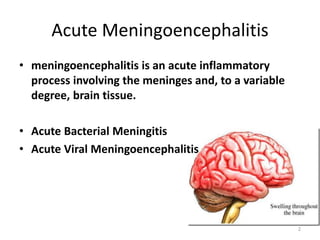
• meningoencephalitis is an acute inflammatory
process involving the meninges and, to a variable
degree, brain tissue.
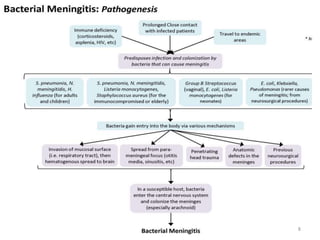
• Acute Bacterial Meningitis
• Acute Viral Meningoencephalitis
2
3
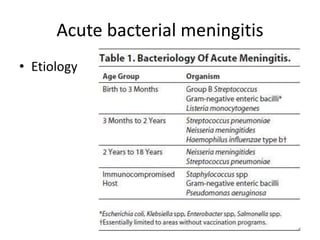
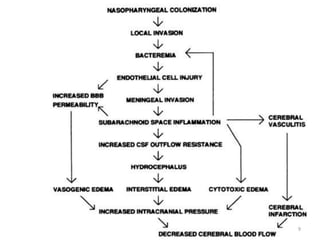
Acute bacterial meningitis
• Etiology
4
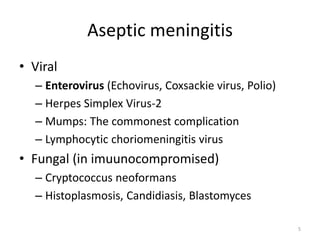
Aseptic meningitis
• Viral
– Enterovirus (Echovirus, Coxsackie virus, Polio)
– Herpes Simplex Virus-2
– Mumps: The commonest complication
– Lymphocytic choriomeningitis virus
• Fungal (in imuunocompromised)
– Cryptococcus neoformans
– Histoplasmosis, Candidiasis, Blastomyces
5
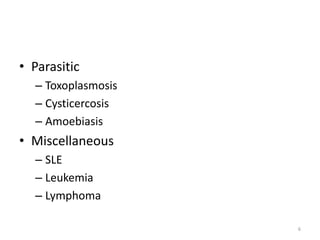
• Parasitic
– Toxoplasmosis
– Cysticercosis
– Amoebiasis
• Miscellaneous
– SLE
– Leukemia
– Lymphoma
6
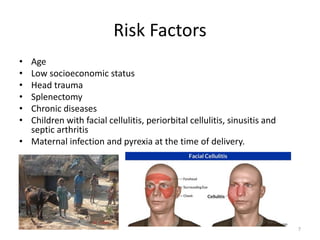
Risk Factors
• Age
• Low socioeconomic status
• Head trauma
• Splenectomy
• Chronic diseases
• Children with facial cellulitis, periorbital cellulitis, sinusitis and
septic arthritis
• Maternal infection and pyrexia at the time of delivery.
7
8
9
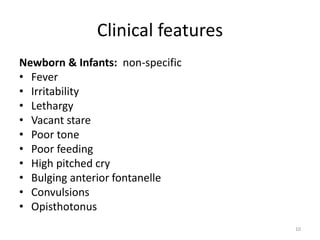
Clinical features
Newborn & Infants: non-specific
• Fever
• Irritability
• Lethargy
• Vacant stare
• Poor tone
• Poor feeding
• High pitched cry
• Bulging anterior fontanelle
• Convulsions
• Opisthotonus
10
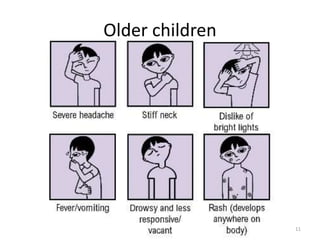
Older children
11
• Seizures
• Alteration in mental status
• Hypotension, fever or Hypothermia,
Tachycardia (Septic shock)
• Bleeding, Renal dysfunction (DIC)
12
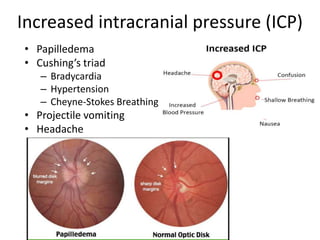
Increased intracranial pressure (ICP)
• Papilledema
• Cushing’s triad
– Bradycardia
– Hypertension
– Cheyne-Stokes Breathing
• Projectile vomiting
• Headache
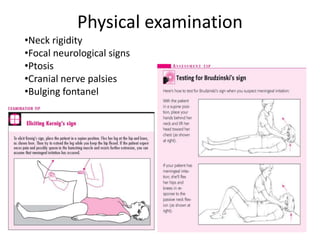
Physical examination
•Neck rigidity
•Focal neurological signs
•Ptosis
•Cranial nerve palsies
•Bulging fontanel
TB meningitis
• Children 6 months – 5 years
• Local microscopic granulomas on meninges
• Meningitis may present weeks to months after
primary pulmonary process
• CSF:
– Profoundly low glucose
– High protein
– Acid-fast bacteria (AFB stain)
– PCR
• Steroids + antitubercular agents
– (2HRZE+ 10 HR) WITH steroid for 4-6 weeks
15
Stages
• Stage 1: stage of invasion
– Low grade fever, loss of appetite, vomiting,
headache, photophobia, irritable, restless
• Stage 2: Stage of meningitis
– Neck rigidity, focal neurological deficits, isolated
cranial nerve palsies, loss of sphincter control
• Stage 3: Stage of coma
– Loss of consciousness, altered respiratory pattern,
dilated pupils, ptosis, ophthalmoplegia, coma
16
Neisseria meningitis
(Meningococcemia)
• Neisseria meningitidis: serotype Grp B
commonest
• Endotoxin causes vascular damage
vasodilatation, third spacing, severe shock
• Severe complication:
Waterhouse-Friderichsen syndrome: massive
haemorrhage of adrenal glands secondary to
sepsis: adrenal crisis-low B.P, shock, DIC,
purpura, adreno-cortical insufficiency
17
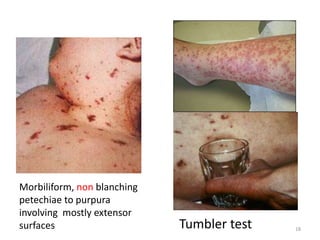
Morbiliform, non blanching
petechiae to purpura
involving mostly extensor
surfaces Tumbler test 18
Investigations
• Complete blood count
• C- Reactive Protein
• Renal function test
• Serum glucose
• Blood culture and
sensitivity
• If tubercular suspected
– PCR
– Chest X-ray
– Mantoux test
• Arterial blood gas
• Fundoscopy
• CT scan
19
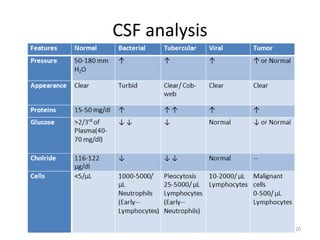
CSF analysis
20
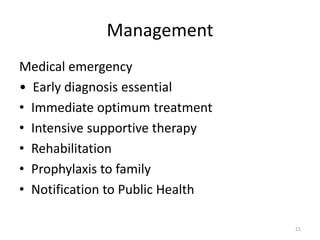
Management
Medical emergency
• Early diagnosis essential
• Immediate optimum treatment
• Intensive supportive therapy
• Rehabilitation
• Prophylaxis to family
• Notification to Public Health
21
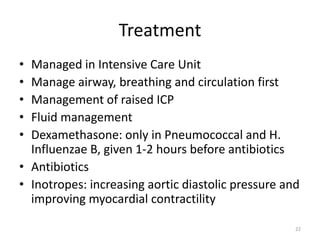
Treatment
• Managed in Intensive Care Unit
• Manage airway, breathing and circulation first
• Management of raised ICP
• Fluid management
• Dexamethasone: only in Pneumococcal and H.
Influenzae B, given 1-2 hours before antibiotics
• Antibiotics
• Inotropes: increasing aortic diastolic pressure and
improving myocardial contractility
22
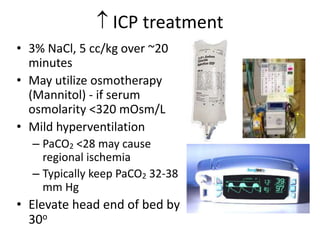
 ICP treatment
• 3% NaCl, 5 cc/kg over ~20
minutes
• May utilize osmotherapy
(Mannitol) - if serum
osmolarity <320 mOsm/L
• Mild hyperventilation
– PaCO2 <28 may cause
regional ischemia
– Typically keep PaCO2 32-38
mm Hg
• Elevate head end of bed by
30o
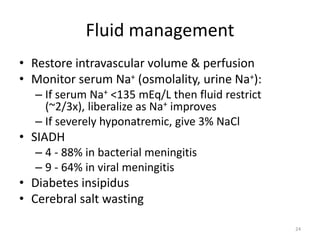
Fluid management
• Restore intravascular volume & perfusion
• Monitor serum Na+ (osmolality, urine Na+):
– If serum Na+ <135 mEq/L then fluid restrict
(~2/3x), liberalize as Na+ improves
– If severely hyponatremic, give 3% NaCl
• SIADH
– 4 - 88% in bacterial meningitis
– 9 - 64% in viral meningitis
• Diabetes insipidus
• Cerebral salt wasting
24
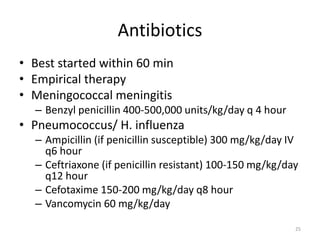
Antibiotics
• Best started within 60 min
• Empirical therapy
• Meningococcal meningitis
– Benzyl penicillin 400-500,000 units/kg/day q 4 hour
• Pneumococcus/ H. influenza
– Ampicillin (if penicillin susceptible) 300 mg/kg/day IV
q6 hour
– Ceftriaxone (if penicillin resistant) 100-150 mg/kg/day
q12 hour
– Cefotaxime 150-200 mg/kg/day q8 hour
– Vancomycin 60 mg/kg/day
25
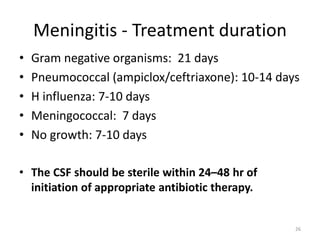
Meningitis - Treatment duration
• Gram negative organisms: 21 days
• Pneumococcal (ampiclox/ceftriaxone): 10-14 days
• H influenza: 7-10 days
• Meningococcal: 7 days
• No growth: 7-10 days
• The CSF should be sterile within 24–48 hr of
initiation of appropriate antibiotic therapy.
26
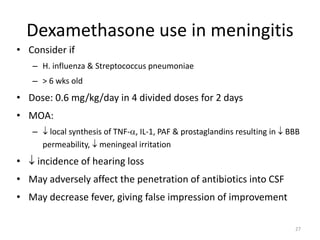
Dexamethasone use in meningitis
• Consider if
– H. influenza & Streptococcus pneumoniae
– > 6 wks old
• Dose: 0.6 mg/kg/day in 4 divided doses for 2 days
• MOA:
–  local synthesis of TNF-, IL-1, PAF & prostaglandins resulting in  BBB
permeability,  meningeal irritation
•  incidence of hearing loss
• May adversely affect the penetration of antibiotics into CSF
• May decrease fever, giving false impression of improvement
27
Prophylaxis
• Rifampicin:
– Children 5mg/kg bd x 2 days
– Adults: 600 mg bd x 2 days
• Pregnant contact:
– Cefuroxime IM x 1 dose
28
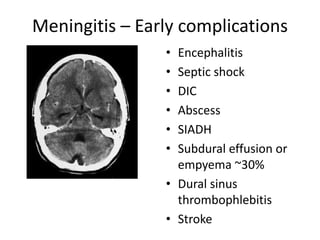
Meningitis – Early complications
• Encephalitis
• Septic shock
• DIC
• Abscess
• SIADH
• Subdural effusion or
empyema ~30%
• Dural sinus
thrombophlebitis
• Stroke
Intermediate
• Hydrocephalus
• Cranial nerve palsy
Late
• Cerebral palsy
• Hearing loss
• Learning disability
30
Acute Encephalitis
• Encephalitis is an acute inflammatory process
affecting the brain
• Viral infection is the most common and important
cause, with over 100 viruses implicated worldwide
• Symptoms
– Fever
– Headache
– Behavioral changes
– Altered level of consciousness
– Focal neurologic deficits
– Seizures
31
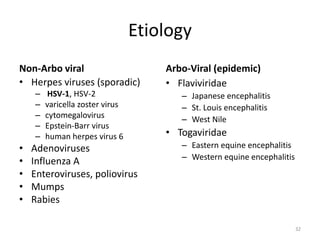
Etiology
Non-Arbo viral
• Herpes viruses (sporadic)
– HSV-1, HSV-2
– varicella zoster virus
– cytomegalovirus
– Epstein-Barr virus
– human herpes virus 6
• Adenoviruses
• Influenza A
• Enteroviruses, poliovirus
• Mumps
• Rabies
Arbo-Viral (epidemic)
• Flaviviridae
– Japanese encephalitis
– St. Louis encephalitis
– West Nile
• Togaviridae
– Eastern equine encephalitis
– Western equine encephalitis
32
– Herpes simplex virus (HSV)
• the most common etiology of acute sporadic
encephalitis
– Arboviruses – arthropod-borne virus
• outbreaks in summer time…mosquitos and ticks
– Varicella zoster virus (VZV)
• immunosuppressed patients
33
Japanese encephalitis
• Most important cause of arboviral
encephalitis worldwide
• Transmitted by culex mosquito, which breeds
in rice fields
• Commonly involve Basal ganglia: Extra
pyradimal symptoms
• Post-immunization: Measles, Mumps
34
Herpes Simplex Encephalitis
• Primary infection: On the mucosa of
oropharynx, mostly asymptomatic
• Following primary infection, a latent
infection in trigeminal ganglion
• Inflammation and necrotizing lesions in
– Inferior and medial temporal lobe
– Orbito-frontal lobe
– Limbic structures
35
• Evolve over several days or acutely
• Fever, headache, confusion, stupor, coma,
seizures, status epilepticus
• Personality changes, irritability, delirium
• Temporal lobe seizures: Gustatory or olfactory
hallucinations, anosmia
36
CSF Analysis
• Increases CSF pressure
• Cell count: 10-500 cells/mm3
• Lymphocyte predominance
• Erythrocytes (in 80% of the cases)
• Normal CSF findings in 10%
• Xanthochromia: Due to lysis of RBC
• Glucose (mg/dl): normal or low
• Protein (mg/dl): >50 mg/dl
• HSV PCR: For the first 24-48 hours, detecting HSV DNA
by PCR in CSF:
– specific (100%) and
– sensitive (75-98%)
37
Neuroimaging
• Contrast Enhanced MRI
• Sensitive for early period HSV encephalitis
• Edema in orbitofrontal and temporal regions
• CT Scan
– Less sensitive than MRI
• EEG
– If seizures are the features
38
Treatment
• If shock/hypotension exists, crystalloid
infusion
• If unconscious, provide airway/breathing
• Seizure, lorazepam 0.1 mg/kg, IV
• Acyclovir IV, 14 – 21 days
– Neonates and infant: 60 mg/kg/day in 3
divided doses
– Children: 30 mg/kg in 3 divided doses
• Reduce ICP: restrict fluid, hyperventilation
• Acute psychosis: Haloperidol 39
References
• Nelson Textbook of Pediatrics 20th edition
• Essential Pediatrics, OP Ghai, 8th Edition
• Harrisons textbook of Internal Medicine
• AAP Guidelines 2016
40
Thank You
41

Acute meningoencephalitis

  • 1.
  • 2.
    Acute Meningoencephalitis • meningoencephalitisis an acute inflammatory process involving the meninges and, to a variable degree, brain tissue. • Acute Bacterial Meningitis • Acute Viral Meningoencephalitis 2
  • 3.
  • 4.
  • 5.
    Aseptic meningitis • Viral –Enterovirus (Echovirus, Coxsackie virus, Polio) – Herpes Simplex Virus-2 – Mumps: The commonest complication – Lymphocytic choriomeningitis virus • Fungal (in imuunocompromised) – Cryptococcus neoformans – Histoplasmosis, Candidiasis, Blastomyces 5
  • 6.
    • Parasitic – Toxoplasmosis –Cysticercosis – Amoebiasis • Miscellaneous – SLE – Leukemia – Lymphoma 6
  • 7.
    Risk Factors • Age •Low socioeconomic status • Head trauma • Splenectomy • Chronic diseases • Children with facial cellulitis, periorbital cellulitis, sinusitis and septic arthritis • Maternal infection and pyrexia at the time of delivery. 7
  • 8.
  • 9.
  • 10.
    Clinical features Newborn &Infants: non-specific • Fever • Irritability • Lethargy • Vacant stare • Poor tone • Poor feeding • High pitched cry • Bulging anterior fontanelle • Convulsions • Opisthotonus 10
  • 11.
  • 12.
    • Seizures • Alterationin mental status • Hypotension, fever or Hypothermia, Tachycardia (Septic shock) • Bleeding, Renal dysfunction (DIC) 12
  • 13.
    Increased intracranial pressure(ICP) • Papilledema • Cushing’s triad – Bradycardia – Hypertension – Cheyne-Stokes Breathing • Projectile vomiting • Headache
  • 14.
    Physical examination •Neck rigidity •Focalneurological signs •Ptosis •Cranial nerve palsies •Bulging fontanel
  • 15.
    TB meningitis • Children6 months – 5 years • Local microscopic granulomas on meninges • Meningitis may present weeks to months after primary pulmonary process • CSF: – Profoundly low glucose – High protein – Acid-fast bacteria (AFB stain) – PCR • Steroids + antitubercular agents – (2HRZE+ 10 HR) WITH steroid for 4-6 weeks 15
  • 16.
    Stages • Stage 1:stage of invasion – Low grade fever, loss of appetite, vomiting, headache, photophobia, irritable, restless • Stage 2: Stage of meningitis – Neck rigidity, focal neurological deficits, isolated cranial nerve palsies, loss of sphincter control • Stage 3: Stage of coma – Loss of consciousness, altered respiratory pattern, dilated pupils, ptosis, ophthalmoplegia, coma 16
  • 17.
    Neisseria meningitis (Meningococcemia) • Neisseriameningitidis: serotype Grp B commonest • Endotoxin causes vascular damage vasodilatation, third spacing, severe shock • Severe complication: Waterhouse-Friderichsen syndrome: massive haemorrhage of adrenal glands secondary to sepsis: adrenal crisis-low B.P, shock, DIC, purpura, adreno-cortical insufficiency 17
  • 18.
    Morbiliform, non blanching petechiaeto purpura involving mostly extensor surfaces Tumbler test 18
  • 19.
    Investigations • Complete bloodcount • C- Reactive Protein • Renal function test • Serum glucose • Blood culture and sensitivity • If tubercular suspected – PCR – Chest X-ray – Mantoux test • Arterial blood gas • Fundoscopy • CT scan 19
  • 20.
  • 21.
    Management Medical emergency • Earlydiagnosis essential • Immediate optimum treatment • Intensive supportive therapy • Rehabilitation • Prophylaxis to family • Notification to Public Health 21
  • 22.
    Treatment • Managed inIntensive Care Unit • Manage airway, breathing and circulation first • Management of raised ICP • Fluid management • Dexamethasone: only in Pneumococcal and H. Influenzae B, given 1-2 hours before antibiotics • Antibiotics • Inotropes: increasing aortic diastolic pressure and improving myocardial contractility 22
  • 23.
     ICP treatment •3% NaCl, 5 cc/kg over ~20 minutes • May utilize osmotherapy (Mannitol) - if serum osmolarity <320 mOsm/L • Mild hyperventilation – PaCO2 <28 may cause regional ischemia – Typically keep PaCO2 32-38 mm Hg • Elevate head end of bed by 30o
  • 24.
    Fluid management • Restoreintravascular volume & perfusion • Monitor serum Na+ (osmolality, urine Na+): – If serum Na+ <135 mEq/L then fluid restrict (~2/3x), liberalize as Na+ improves – If severely hyponatremic, give 3% NaCl • SIADH – 4 - 88% in bacterial meningitis – 9 - 64% in viral meningitis • Diabetes insipidus • Cerebral salt wasting 24
  • 25.
    Antibiotics • Best startedwithin 60 min • Empirical therapy • Meningococcal meningitis – Benzyl penicillin 400-500,000 units/kg/day q 4 hour • Pneumococcus/ H. influenza – Ampicillin (if penicillin susceptible) 300 mg/kg/day IV q6 hour – Ceftriaxone (if penicillin resistant) 100-150 mg/kg/day q12 hour – Cefotaxime 150-200 mg/kg/day q8 hour – Vancomycin 60 mg/kg/day 25
  • 26.
    Meningitis - Treatmentduration • Gram negative organisms: 21 days • Pneumococcal (ampiclox/ceftriaxone): 10-14 days • H influenza: 7-10 days • Meningococcal: 7 days • No growth: 7-10 days • The CSF should be sterile within 24–48 hr of initiation of appropriate antibiotic therapy. 26
  • 27.
    Dexamethasone use inmeningitis • Consider if – H. influenza & Streptococcus pneumoniae – > 6 wks old • Dose: 0.6 mg/kg/day in 4 divided doses for 2 days • MOA: –  local synthesis of TNF-, IL-1, PAF & prostaglandins resulting in  BBB permeability,  meningeal irritation •  incidence of hearing loss • May adversely affect the penetration of antibiotics into CSF • May decrease fever, giving false impression of improvement 27
  • 28.
    Prophylaxis • Rifampicin: – Children5mg/kg bd x 2 days – Adults: 600 mg bd x 2 days • Pregnant contact: – Cefuroxime IM x 1 dose 28
  • 29.
    Meningitis – Earlycomplications • Encephalitis • Septic shock • DIC • Abscess • SIADH • Subdural effusion or empyema ~30% • Dural sinus thrombophlebitis • Stroke
  • 30.
    Intermediate • Hydrocephalus • Cranialnerve palsy Late • Cerebral palsy • Hearing loss • Learning disability 30
  • 31.
    Acute Encephalitis • Encephalitisis an acute inflammatory process affecting the brain • Viral infection is the most common and important cause, with over 100 viruses implicated worldwide • Symptoms – Fever – Headache – Behavioral changes – Altered level of consciousness – Focal neurologic deficits – Seizures 31
  • 32.
    Etiology Non-Arbo viral • Herpesviruses (sporadic) – HSV-1, HSV-2 – varicella zoster virus – cytomegalovirus – Epstein-Barr virus – human herpes virus 6 • Adenoviruses • Influenza A • Enteroviruses, poliovirus • Mumps • Rabies Arbo-Viral (epidemic) • Flaviviridae – Japanese encephalitis – St. Louis encephalitis – West Nile • Togaviridae – Eastern equine encephalitis – Western equine encephalitis 32
  • 33.
    – Herpes simplexvirus (HSV) • the most common etiology of acute sporadic encephalitis – Arboviruses – arthropod-borne virus • outbreaks in summer time…mosquitos and ticks – Varicella zoster virus (VZV) • immunosuppressed patients 33
  • 34.
    Japanese encephalitis • Mostimportant cause of arboviral encephalitis worldwide • Transmitted by culex mosquito, which breeds in rice fields • Commonly involve Basal ganglia: Extra pyradimal symptoms • Post-immunization: Measles, Mumps 34
  • 35.
    Herpes Simplex Encephalitis •Primary infection: On the mucosa of oropharynx, mostly asymptomatic • Following primary infection, a latent infection in trigeminal ganglion • Inflammation and necrotizing lesions in – Inferior and medial temporal lobe – Orbito-frontal lobe – Limbic structures 35
  • 36.
    • Evolve overseveral days or acutely • Fever, headache, confusion, stupor, coma, seizures, status epilepticus • Personality changes, irritability, delirium • Temporal lobe seizures: Gustatory or olfactory hallucinations, anosmia 36
  • 37.
    CSF Analysis • IncreasesCSF pressure • Cell count: 10-500 cells/mm3 • Lymphocyte predominance • Erythrocytes (in 80% of the cases) • Normal CSF findings in 10% • Xanthochromia: Due to lysis of RBC • Glucose (mg/dl): normal or low • Protein (mg/dl): >50 mg/dl • HSV PCR: For the first 24-48 hours, detecting HSV DNA by PCR in CSF: – specific (100%) and – sensitive (75-98%) 37
  • 38.
    Neuroimaging • Contrast EnhancedMRI • Sensitive for early period HSV encephalitis • Edema in orbitofrontal and temporal regions • CT Scan – Less sensitive than MRI • EEG – If seizures are the features 38
  • 39.
    Treatment • If shock/hypotensionexists, crystalloid infusion • If unconscious, provide airway/breathing • Seizure, lorazepam 0.1 mg/kg, IV • Acyclovir IV, 14 – 21 days – Neonates and infant: 60 mg/kg/day in 3 divided doses – Children: 30 mg/kg in 3 divided doses • Reduce ICP: restrict fluid, hyperventilation • Acute psychosis: Haloperidol 39
  • 40.
    References • Nelson Textbookof Pediatrics 20th edition • Essential Pediatrics, OP Ghai, 8th Edition • Harrisons textbook of Internal Medicine • AAP Guidelines 2016 40
  • 41.