ATT Induced Hepatitis
@
DRUG INDUCED LIVER INJUTY(DILI)
BY
LAKSHMI NARAYANAN
GM-IV
Definition
• In the absence of symptoms, elevation of
transaminases up to 5 times the upper limit of
normal (ULN) and in the presence of
symptoms up to three times the ULN or twice
the ULN of bilirubin
• Risk of TB DILI ranges from 5 to as high as
33%. [ATS 2006]
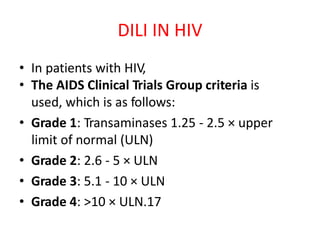
• In patients with HIV,
• The AIDS Clinical Trials Group criteria is
used, which is as follows:
• Grade 1: Transaminases 1.25 - 2.5 × upper
limit of normal (ULN)
• Grade 2: 2.6 - 5 × ULN
• Grade 3: 5.1 - 10 × ULN
• Grade 4: >10 × ULN.17
DILI IN HIV
• Definition of hepatotoxicity in patients with
previous liver diseases is controversial
• Schenker et al reported that elevations in the
ALT and/or AST levels to 50-100 IU/L more
than the baseline levels might define toxicity
]
DILI in LIVER DISEASE
Clinical Spectrum
• Asymptomatic elevation to acute liver failure
• All age groups including children
MECHANISMS
(i) Idiosyncratic damage : Most Common
(ii) Dose-dependent toxicity;
(iii) Induction of hepatic enzymes;
(iv) Drug-induced acute hepatitis;
(v) Allergic reactions
(vi) Drug induce autoimmune like hepatitis
Specific patterns of hepatic damage
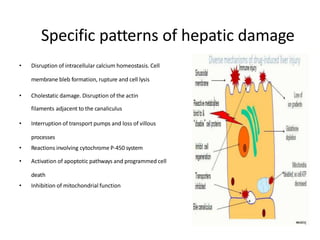
• Disruption of intracellular calcium homeostasis. Cell
membrane bleb formation, rupture and cell lysis
• Cholestatic damage. Disruption of the actin
filaments adjacent to the canaliculus
• Interruption of transport pumps and loss of villous
processes
• Reactions involving cytochrome P-450 system
• Activation of apoptotic pathways and programmed cell
death
• Inhibition of mitochondrial function
Types of DIH
• A variety of clinical syndromes may be seen with DIH,
even with a single drug.
1. Hepatic adaptation.
2. Drug-induced acute hepatitis or hepatocellular injury.
3. Nonalcoholic fatty liver disease.
4. Cholestasis.
5. Granulomatous hepatitis.
Risk factors for TB DILI
1. Age: older than 35 years are at 4 times
increased risk.
2. TB meningitis more chances .
3. Gender: female gender is a positive predictor
of more severe liver disease including death
• 3. Organ involvement / extent of TB disease
cavitory disease, multibacillary TB and
extrapulmonary organ esp meningitis
4. Malnutrition:
• Patients with low albumin (<3.5 mg/dl) had
three fold higher risk
• weight loss
5. Alcohol:
6. Hepatitis B:4 fold in HBsAg carriers compared to
non-carriers (Korean Study)
7.Hepatitis C. Coinfection with both hepatitis C
and HIV elevated the risk of hepatotoxicity more
than 14-fold.
8. Presence of HLA-DQB1*0201 and the absence
of HLA-DQA1*0102 with AT DILI
10. Ethnic variations: higher risk of DIH has been
reported in Indian patients than in patients from
the West
Poor prognostic
markers
• Jaundice
• Hypoalbuminemia
• Ascites
• Encephalopathy
• High prothrombin time
• Mild toxicity: If the AST level is less than 5
times the upper limit of normal
• Moderate toxicity: AST level 5--10 times
normal defines
• Severe toxicity: AST level greater than 10
times normal
WHO - STAGING
Causative Agents
• INH + rifampin > INH alone >> PZA alone > rifampin alone >
ethionamide > PAS
•Potentially hepatotoxic drugs
Isoniazid
Rifampicin, Rifabutin
Pyrazinamide
Ethionamide, Prothionamide
Para-aminosalicylic acid
•Drugs with much lower or little potential for hepatotoxicity
Streptomycin, Kanamycin, Amikacin, Capreomycin
Ethambutol
Ofloxacin, Levofloxacin, Ciprofloxacin
Cycloserine
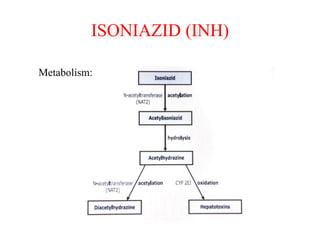
ISONIAZID (INH)
Metabolism:
Mechanism of injury
• Injury is mostly
– acute hepatocellular in type,
– mixed hepatocellular-cholestatic
.
• Histopahology:
– Nonzonal necrosis in up to 10% of severe cases as seen in viral
hepatitis
– Subacute hepatic necrosis can be seen in 30% of cases.
Clinical presentation of hepatotoxicity
• May be asymptomatic,
• Constitutional symptoms may be seen early in severe hepatotoxicity, and
may last from days to weeks.
– Nausea,
– Vomiting,
– Abdominal pain are seen in 50 to 75%
– Fever is noted in 10%
– Rash in 5% of patients.
• late signs of clinical worsening
– Overt jaundice,
– dark urine,
– clay-colored stools are.
• life-threatening hepatic dysfunction.
– Coagulopathy,
– Hypoalbuminemia,
– Hypoglycemia
• The regression of isoniazid hepatotoxicity usually takes weeks. Recovery
is complete in most after discontinuation of isoniazid
RIFAMPICIN (RMP)
Mechanisms of hepatotoxicity:
• Rifampicin probably inhibit the major bile salt exporter pump and
cause Conjugated hyperbilirubinemia.
• Occasionally, subclinical, unconjugated hyperbilirubinemia or
jaundice without hepatocellular damage may also result from
dose-dependent competition with bilirubin for clearance at the
sinusoidal membrane or from impeded secretion at the canalicular
level.
• This may be transient and occur early in treatment or in some
individuals with preexisting liver disease.
• Rifampicin occasionally can cause hepatocellular injury which
appears to be a hypersensitivity reaction, and it may be more
common with large, intermittent doses.
• Rifampicin potentiate hepatotoxicities of other anti-TB
medications. This effect is thought to be due to enzyme induction.
PYRAZINAMIDE (PZA)
Metabolism:
• Pyrazinamide is de-amidated to pyrazinoic acid in the
liver and subsequently metabolized to 5-hydroxy-
pyrazinoic acid by xanthine oxidase, aldehyde oxidase,
and xanthine dehydrogenase.
• The half-life (t1/2) of pyrazinamide is notably longer
than that of either isoniazid or rifampin, approximately
10 hours.
• In patients with preexisting hepatic disease, t1/2 is
increased to 15 hours.
• The kidneys clear metabolites of pyrazinamide, requiring
intermittent dosing in patients with renal insufficiency
Mechanism of injury
• Pyrazinamide exhibit both dose dependent and idiosyncratic
hepatotoxicity.
• Pyrazinamide alters nicotinamide acetyl dehydrogenase levels
in liver  result in generation of free radical species.
• There may be shared mechanisms of injury for isoniazid and
pyrazinamide, because there is some similarity in molecular
structure.
• Patients who previously had hepatotoxic reactions with
isoniazid have had more severe reactions with rifampin and
pyrazinamide.
• Pyrazinamide may induce hypersensitivity reactions with
eosinophilia and liver injury or granulomatous hepatitis.
Prothionamide and ethionamide
• DIH is uncommon
• May produce elevated serum transaminases in about 10%
of recipients, usually after 8–12 weeks.
• Usually resolves after drug discontinuation.
Para-aminosalicyclic acid (PAS)
• Hypersensitivity to PAS has been recorded in up to 5%.
• Onset usually between 2–6 weeks after commencing
treatment.
• Rechallenge may result in recurrence of the abnormal
response.
Fluoroquinolones
• DIH is very Rare.
• The mechanism of fluoroquinolone hepatotoxicity is believed
to be a hypersensitivity reaction, often manifested by
eosinophilia.
• Reversible transaminase elevation among the
fluoroquinolones may occur in up to 2 to 3% of cases.
• Severe hepatocellular injury and cholestasis have been
reported to occur in less than 1% of all fluoroquinolone
recipients, excluding trovafloxacin, which was withdrawn due
to its hepatotoxicity.
• For levofloxacin, the rate of severe hepatotoxicity was
reported to be less than 1 per 1,000,000.
Routine Monitoring for
Hepatotoxicity in Adults
1. Obtain baseline liver function tests (LFTs)
2. Obtain follow-up LFTs:
a. patients < 35 years old with normal baseline LFTs and without a
history of hepatic disease: follow-up are not required unless the
patient becomes symptomatic.
b. patient > 35 years old, daily alcohol consumption, abnormal baseline
LFTs, taking other potentially hepatotoxic medications, or who have
viral hepatitis or history of liver disease, HIV infection, or prior TB
DIH. obtain LFTs every 4-6 weeks.
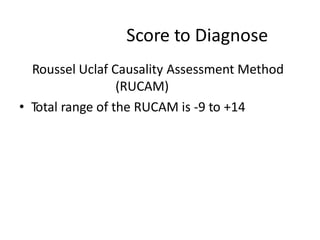
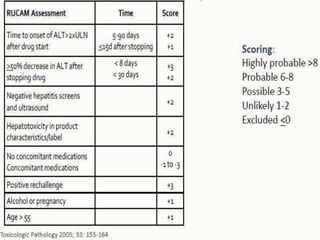
Score to Diagnose
Roussel Uclaf Causality Assessment Method
(RUCAM)
• Total range of the RUCAM is -9 to +14
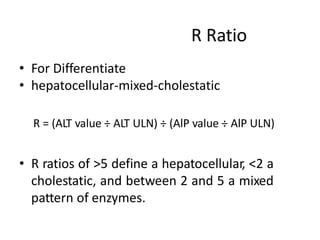
R Ratio
• For Differentiate
• hepatocellular-mixed-cholestatic
R = (ALT value ÷ ALT ULN) ÷ (AlP value ÷ AlP ULN)
• R ratios of >5 define a hepatocellular, <2 a
cholestatic, and between 2 and 5 a mixed
pattern of enzymes.
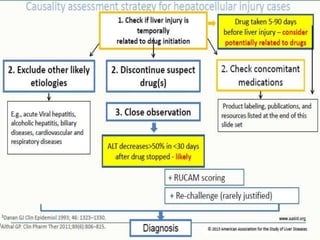
• Medications should be restarted after the
AST/ALT concentration returns to less than
two times the upper limit of normal.
Reintroduction anti tuberculosis regimens
• 3 Arms
1. Patients received maximum doses of INH, RIF,
PZA simultaneously
2. ATS guideline RIF followed by INH after 7
days, followed by PZA after 7 days, all with
maximum doses
3. BTS guideline. INH, RIF and PZA were
gradually escalated sequentially after the
maximum dose of the preceding drugs
• Recurrence of DILI was similar between the
three treatment arms (p=0.69)
• Randomized study by Tahaoglu and associates
on 45 patients concluded that reintroduction
regimens containing maximum dose of
antituberculosis drugs including pyrazinamide
(group 1, n=25) caused more hepatotoxicity
than gradual reintroduction without
pyrazinamide
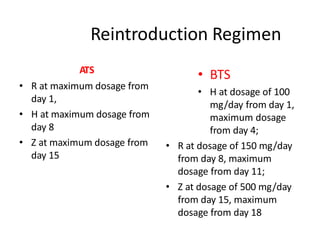
Reintroduction Regimen
ATS
• R at maximum dosage from
day 1,
• H at maximum dosage from
day 8
• Z at maximum dosage from
day 15
• BTS
• H at dosage of 100
mg/day from day 1,
maximum dosage
from day 4;
• R at dosage of 150 mg/day
from day 8, maximum
dosage from day 11;
• Z at dosage of 500 mg/day
from day 15, maximum
dosage from day 18
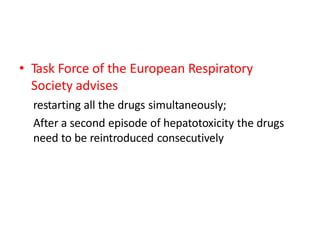
• Task Force of the European Respiratory
Society advises
restarting all the drugs simultaneously;
After a second episode of hepatotoxicity the drugs
need to be reintroduced consecutively
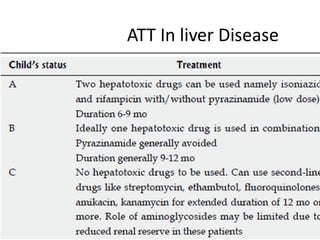
ATT In liver Disease
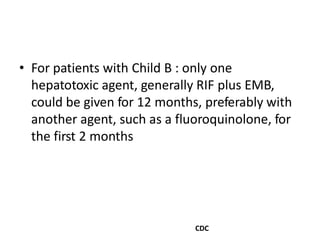
• For patients with Child B : only one
hepatotoxic agent, generally RIF plus EMB,
could be given for 12 months, preferably with
another agent, such as a fluoroquinolone, for
the first 2 months
CDC
Att induced hepatitis.pptx new

Att induced hepatitis.pptx new

  • 1.
    ATT Induced Hepatitis @ DRUGINDUCED LIVER INJUTY(DILI) BY LAKSHMI NARAYANAN GM-IV
  • 2.
    Definition • In theabsence of symptoms, elevation of transaminases up to 5 times the upper limit of normal (ULN) and in the presence of symptoms up to three times the ULN or twice the ULN of bilirubin • Risk of TB DILI ranges from 5 to as high as 33%. [ATS 2006]
  • 3.
    • In patientswith HIV, • The AIDS Clinical Trials Group criteria is used, which is as follows: • Grade 1: Transaminases 1.25 - 2.5 × upper limit of normal (ULN) • Grade 2: 2.6 - 5 × ULN • Grade 3: 5.1 - 10 × ULN • Grade 4: >10 × ULN.17 DILI IN HIV
  • 4.
    • Definition ofhepatotoxicity in patients with previous liver diseases is controversial • Schenker et al reported that elevations in the ALT and/or AST levels to 50-100 IU/L more than the baseline levels might define toxicity ] DILI in LIVER DISEASE
  • 6.
    Clinical Spectrum • Asymptomaticelevation to acute liver failure • All age groups including children
  • 7.
    MECHANISMS (i) Idiosyncratic damage: Most Common (ii) Dose-dependent toxicity; (iii) Induction of hepatic enzymes; (iv) Drug-induced acute hepatitis; (v) Allergic reactions (vi) Drug induce autoimmune like hepatitis
  • 8.
    Specific patterns ofhepatic damage • Disruption of intracellular calcium homeostasis. Cell membrane bleb formation, rupture and cell lysis • Cholestatic damage. Disruption of the actin filaments adjacent to the canaliculus • Interruption of transport pumps and loss of villous processes • Reactions involving cytochrome P-450 system • Activation of apoptotic pathways and programmed cell death • Inhibition of mitochondrial function
  • 9.
    Types of DIH •A variety of clinical syndromes may be seen with DIH, even with a single drug. 1. Hepatic adaptation. 2. Drug-induced acute hepatitis or hepatocellular injury. 3. Nonalcoholic fatty liver disease. 4. Cholestasis. 5. Granulomatous hepatitis.
  • 10.
    Risk factors forTB DILI 1. Age: older than 35 years are at 4 times increased risk. 2. TB meningitis more chances . 3. Gender: female gender is a positive predictor of more severe liver disease including death
  • 11.
    • 3. Organinvolvement / extent of TB disease cavitory disease, multibacillary TB and extrapulmonary organ esp meningitis 4. Malnutrition: • Patients with low albumin (<3.5 mg/dl) had three fold higher risk • weight loss 5. Alcohol:
  • 12.
    6. Hepatitis B:4fold in HBsAg carriers compared to non-carriers (Korean Study) 7.Hepatitis C. Coinfection with both hepatitis C and HIV elevated the risk of hepatotoxicity more than 14-fold. 8. Presence of HLA-DQB1*0201 and the absence of HLA-DQA1*0102 with AT DILI
  • 13.
    10. Ethnic variations:higher risk of DIH has been reported in Indian patients than in patients from the West
  • 14.
    Poor prognostic markers • Jaundice •Hypoalbuminemia • Ascites • Encephalopathy • High prothrombin time
  • 15.
    • Mild toxicity:If the AST level is less than 5 times the upper limit of normal • Moderate toxicity: AST level 5--10 times normal defines • Severe toxicity: AST level greater than 10 times normal WHO - STAGING
  • 16.
    Causative Agents • INH+ rifampin > INH alone >> PZA alone > rifampin alone > ethionamide > PAS •Potentially hepatotoxic drugs Isoniazid Rifampicin, Rifabutin Pyrazinamide Ethionamide, Prothionamide Para-aminosalicylic acid •Drugs with much lower or little potential for hepatotoxicity Streptomycin, Kanamycin, Amikacin, Capreomycin Ethambutol Ofloxacin, Levofloxacin, Ciprofloxacin Cycloserine
  • 17.
  • 18.
    Mechanism of injury •Injury is mostly – acute hepatocellular in type, – mixed hepatocellular-cholestatic . • Histopahology: – Nonzonal necrosis in up to 10% of severe cases as seen in viral hepatitis – Subacute hepatic necrosis can be seen in 30% of cases.
  • 19.
    Clinical presentation ofhepatotoxicity • May be asymptomatic, • Constitutional symptoms may be seen early in severe hepatotoxicity, and may last from days to weeks. – Nausea, – Vomiting, – Abdominal pain are seen in 50 to 75% – Fever is noted in 10% – Rash in 5% of patients. • late signs of clinical worsening – Overt jaundice, – dark urine, – clay-colored stools are. • life-threatening hepatic dysfunction. – Coagulopathy, – Hypoalbuminemia, – Hypoglycemia • The regression of isoniazid hepatotoxicity usually takes weeks. Recovery is complete in most after discontinuation of isoniazid
  • 20.
    RIFAMPICIN (RMP) Mechanisms ofhepatotoxicity: • Rifampicin probably inhibit the major bile salt exporter pump and cause Conjugated hyperbilirubinemia. • Occasionally, subclinical, unconjugated hyperbilirubinemia or jaundice without hepatocellular damage may also result from dose-dependent competition with bilirubin for clearance at the sinusoidal membrane or from impeded secretion at the canalicular level. • This may be transient and occur early in treatment or in some individuals with preexisting liver disease. • Rifampicin occasionally can cause hepatocellular injury which appears to be a hypersensitivity reaction, and it may be more common with large, intermittent doses. • Rifampicin potentiate hepatotoxicities of other anti-TB medications. This effect is thought to be due to enzyme induction.
  • 21.
    PYRAZINAMIDE (PZA) Metabolism: • Pyrazinamideis de-amidated to pyrazinoic acid in the liver and subsequently metabolized to 5-hydroxy- pyrazinoic acid by xanthine oxidase, aldehyde oxidase, and xanthine dehydrogenase. • The half-life (t1/2) of pyrazinamide is notably longer than that of either isoniazid or rifampin, approximately 10 hours. • In patients with preexisting hepatic disease, t1/2 is increased to 15 hours. • The kidneys clear metabolites of pyrazinamide, requiring intermittent dosing in patients with renal insufficiency
  • 22.
    Mechanism of injury •Pyrazinamide exhibit both dose dependent and idiosyncratic hepatotoxicity. • Pyrazinamide alters nicotinamide acetyl dehydrogenase levels in liver  result in generation of free radical species. • There may be shared mechanisms of injury for isoniazid and pyrazinamide, because there is some similarity in molecular structure. • Patients who previously had hepatotoxic reactions with isoniazid have had more severe reactions with rifampin and pyrazinamide. • Pyrazinamide may induce hypersensitivity reactions with eosinophilia and liver injury or granulomatous hepatitis.
  • 23.
    Prothionamide and ethionamide •DIH is uncommon • May produce elevated serum transaminases in about 10% of recipients, usually after 8–12 weeks. • Usually resolves after drug discontinuation.
  • 24.
    Para-aminosalicyclic acid (PAS) •Hypersensitivity to PAS has been recorded in up to 5%. • Onset usually between 2–6 weeks after commencing treatment. • Rechallenge may result in recurrence of the abnormal response.
  • 25.
    Fluoroquinolones • DIH isvery Rare. • The mechanism of fluoroquinolone hepatotoxicity is believed to be a hypersensitivity reaction, often manifested by eosinophilia. • Reversible transaminase elevation among the fluoroquinolones may occur in up to 2 to 3% of cases. • Severe hepatocellular injury and cholestasis have been reported to occur in less than 1% of all fluoroquinolone recipients, excluding trovafloxacin, which was withdrawn due to its hepatotoxicity. • For levofloxacin, the rate of severe hepatotoxicity was reported to be less than 1 per 1,000,000.
  • 26.
    Routine Monitoring for Hepatotoxicityin Adults 1. Obtain baseline liver function tests (LFTs) 2. Obtain follow-up LFTs: a. patients < 35 years old with normal baseline LFTs and without a history of hepatic disease: follow-up are not required unless the patient becomes symptomatic. b. patient > 35 years old, daily alcohol consumption, abnormal baseline LFTs, taking other potentially hepatotoxic medications, or who have viral hepatitis or history of liver disease, HIV infection, or prior TB DIH. obtain LFTs every 4-6 weeks.
  • 27.
    Score to Diagnose RousselUclaf Causality Assessment Method (RUCAM) • Total range of the RUCAM is -9 to +14
  • 29.
    R Ratio • ForDifferentiate • hepatocellular-mixed-cholestatic R = (ALT value ÷ ALT ULN) ÷ (AlP value ÷ AlP ULN) • R ratios of >5 define a hepatocellular, <2 a cholestatic, and between 2 and 5 a mixed pattern of enzymes.
  • 31.
    • Medications shouldbe restarted after the AST/ALT concentration returns to less than two times the upper limit of normal.
  • 32.
    Reintroduction anti tuberculosisregimens • 3 Arms 1. Patients received maximum doses of INH, RIF, PZA simultaneously 2. ATS guideline RIF followed by INH after 7 days, followed by PZA after 7 days, all with maximum doses 3. BTS guideline. INH, RIF and PZA were gradually escalated sequentially after the maximum dose of the preceding drugs
  • 33.
    • Recurrence ofDILI was similar between the three treatment arms (p=0.69)
  • 34.
    • Randomized studyby Tahaoglu and associates on 45 patients concluded that reintroduction regimens containing maximum dose of antituberculosis drugs including pyrazinamide (group 1, n=25) caused more hepatotoxicity than gradual reintroduction without pyrazinamide
  • 35.
    Reintroduction Regimen ATS • Rat maximum dosage from day 1, • H at maximum dosage from day 8 • Z at maximum dosage from day 15 • BTS • H at dosage of 100 mg/day from day 1, maximum dosage from day 4; • R at dosage of 150 mg/day from day 8, maximum dosage from day 11; • Z at dosage of 500 mg/day from day 15, maximum dosage from day 18
  • 36.
    • Task Forceof the European Respiratory Society advises restarting all the drugs simultaneously; After a second episode of hepatotoxicity the drugs need to be reintroduced consecutively
  • 37.
    ATT In liverDisease
  • 38.
    • For patientswith Child B : only one hepatotoxic agent, generally RIF plus EMB, could be given for 12 months, preferably with another agent, such as a fluoroquinolone, for the first 2 months CDC