Brain Attack Stroke is a Medical Emergency
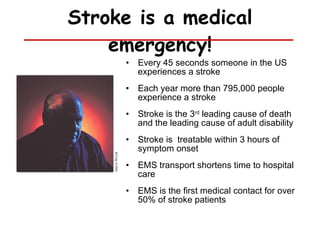
Stroke is a medical emergency! Every 45 seconds someone in the US experiences a stroke Each year more than 795,000 people experience a stroke Stroke is the 3 rd  leading cause of death and the leading cause of adult disability Stroke is  treatable within 3 hours of symptom onset  EMS transport shortens time to hospital care EMS is the first medical contact for over 50% of stroke patients
STROKE IS TREATABLE Early recognition of stroke signs and symptoms Timely access to 9-1-1 Deployment of informed EMS personnel Delivery to a primary stroke center Time Lost is Brain Lost
What is a  stroke? People experience stroke when the blood flow to the brain is interrupted or severely limited, cutting off oxygen and nutrients from brain tissue.  Brain cells start dying minutes after a stroke. There are two types of strokes:  Ischemic stroke , caused when blood clots cause the brain to get too little blood Hemorrhagic stroke , when there is too much blood within the skull.  Caused by hypertension (uncontrolled high blood pressure), aneurysms or head injuries
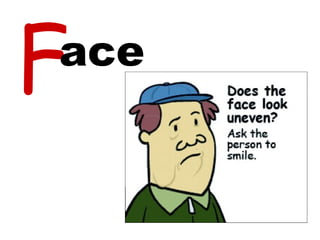
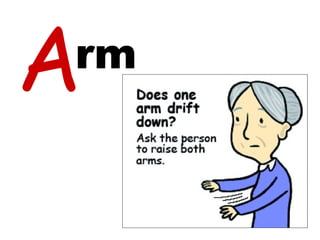
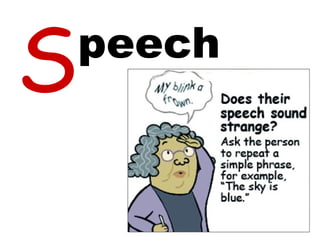
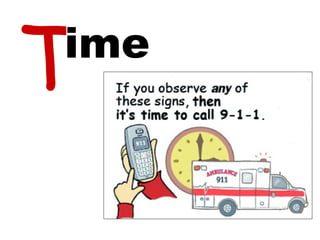
What are the warning signs of stroke? Think  F.A.S.T. Sudden weakness or numbness of the face, arm or leg, especially on one side of the body Sudden confusion, trouble speaking or understanding Sudden trouble seeing in one or both eyes Sudden trouble walking, dizziness, loss of balance or coordination Sudden, severe headaches with no known cause
F ace
A rm
peech S
T ime
Upon arrival at  Primary Stroke Center You can expect an expert team of physicians, nurses and other health care providers to further evaluate your symptoms allowing for  a quick diagnosis and early treatment
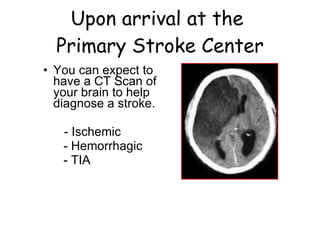
Upon arrival at the  Primary Stroke Center You can expect to have a CT Scan of your brain to help diagnose a stroke. - Ischemic - Hemorrhagic - TIA
Last Known Well Knowing when the person having a stroke was  last known to be well  is important for the physicians and nurses in determining treatment There is a 3 hour window of time from when the patient was last known well to the time we can administer the clot buster drug, t-PA
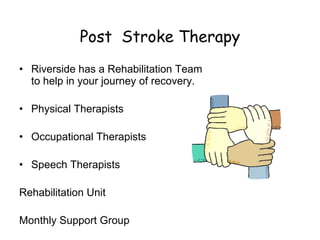
Post  Stroke Therapy Riverside has a Rehabilitation Team to help in your journey of recovery. Physical Therapists Occupational Therapists Speech Therapists Rehabilitation Unit Monthly Support Group
Are you at risk for stroke?
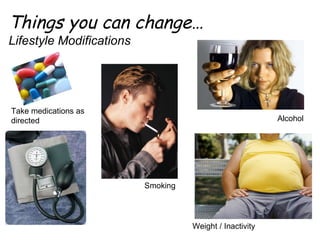
Things you can change… Lifestyle Modifications Alcohol Smoking Weight / Inactivity Take medications as  directed
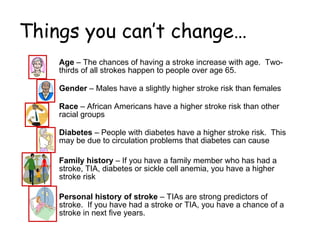
Things you can’t change… Age  – The chances of having a stroke increase with age.  Two-thirds of all strokes happen to people over age 65. Gender  – Males have a slightly higher stroke risk than females Race  – African Americans have a higher stroke risk than other racial groups Diabetes  – People with diabetes have a higher stroke risk.  This may be due to circulation problems that diabetes can cause Family history  – If you have a family member who has had a stroke, TIA, diabetes or sickle cell anemia, you have a higher stroke risk Personal history of stroke  – TIAs are strong predictors of stroke.  If you have had a stroke or TIA, you have a chance of a stroke in next five years.
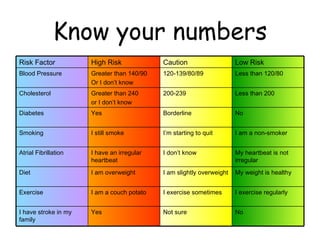
Know your numbers Risk Factor High Risk Caution Low Risk Blood Pressure Greater than 140/90  Or I don’t know 120-139/80/89 Less than 120/80 Cholesterol Greater than 240  or I don’t know 200-239 Less than 200 Diabetes Yes Borderline No Smoking I still smoke I’m starting to quit I am a non-smoker Atrial Fibrillation I have an irregular heartbeat I don’t know My heartbeat is not irregular Diet I am overweight I am slightly overweight My weight is healthy Exercise I am a couch potato I exercise sometimes I exercise regularly I have stroke in my family Yes  Not sure No
Things to remember Stroke is treatable Face – Arm – Speech – Time (F.A.S.T.) 9-1-1 Know your numbers Time is Brain

Brain Attack

  • 1.
    Brain Attack Strokeis a Medical Emergency
  • 2.
    Stroke is amedical emergency! Every 45 seconds someone in the US experiences a stroke Each year more than 795,000 people experience a stroke Stroke is the 3 rd leading cause of death and the leading cause of adult disability Stroke is treatable within 3 hours of symptom onset EMS transport shortens time to hospital care EMS is the first medical contact for over 50% of stroke patients
  • 3.
    STROKE IS TREATABLEEarly recognition of stroke signs and symptoms Timely access to 9-1-1 Deployment of informed EMS personnel Delivery to a primary stroke center Time Lost is Brain Lost
  • 4.
    What is a stroke? People experience stroke when the blood flow to the brain is interrupted or severely limited, cutting off oxygen and nutrients from brain tissue. Brain cells start dying minutes after a stroke. There are two types of strokes: Ischemic stroke , caused when blood clots cause the brain to get too little blood Hemorrhagic stroke , when there is too much blood within the skull. Caused by hypertension (uncontrolled high blood pressure), aneurysms or head injuries
  • 5.
    What are thewarning signs of stroke? Think F.A.S.T. Sudden weakness or numbness of the face, arm or leg, especially on one side of the body Sudden confusion, trouble speaking or understanding Sudden trouble seeing in one or both eyes Sudden trouble walking, dizziness, loss of balance or coordination Sudden, severe headaches with no known cause
  • 6.
  • 7.
  • 8.
  • 9.
  • 10.
    Upon arrival at Primary Stroke Center You can expect an expert team of physicians, nurses and other health care providers to further evaluate your symptoms allowing for a quick diagnosis and early treatment
  • 11.
    Upon arrival atthe Primary Stroke Center You can expect to have a CT Scan of your brain to help diagnose a stroke. - Ischemic - Hemorrhagic - TIA
  • 12.
    Last Known WellKnowing when the person having a stroke was last known to be well is important for the physicians and nurses in determining treatment There is a 3 hour window of time from when the patient was last known well to the time we can administer the clot buster drug, t-PA
  • 13.
    Post StrokeTherapy Riverside has a Rehabilitation Team to help in your journey of recovery. Physical Therapists Occupational Therapists Speech Therapists Rehabilitation Unit Monthly Support Group
  • 14.
    Are you atrisk for stroke?
  • 15.
    Things you canchange… Lifestyle Modifications Alcohol Smoking Weight / Inactivity Take medications as directed
  • 16.
    Things you can’tchange… Age – The chances of having a stroke increase with age. Two-thirds of all strokes happen to people over age 65. Gender – Males have a slightly higher stroke risk than females Race – African Americans have a higher stroke risk than other racial groups Diabetes – People with diabetes have a higher stroke risk. This may be due to circulation problems that diabetes can cause Family history – If you have a family member who has had a stroke, TIA, diabetes or sickle cell anemia, you have a higher stroke risk Personal history of stroke – TIAs are strong predictors of stroke. If you have had a stroke or TIA, you have a chance of a stroke in next five years.
  • 17.
    Know your numbersRisk Factor High Risk Caution Low Risk Blood Pressure Greater than 140/90 Or I don’t know 120-139/80/89 Less than 120/80 Cholesterol Greater than 240 or I don’t know 200-239 Less than 200 Diabetes Yes Borderline No Smoking I still smoke I’m starting to quit I am a non-smoker Atrial Fibrillation I have an irregular heartbeat I don’t know My heartbeat is not irregular Diet I am overweight I am slightly overweight My weight is healthy Exercise I am a couch potato I exercise sometimes I exercise regularly I have stroke in my family Yes Not sure No
  • 18.
    Things to rememberStroke is treatable Face – Arm – Speech – Time (F.A.S.T.) 9-1-1 Know your numbers Time is Brain

Editor's Notes

  • #2 What do you think we mean when we say “brain attack”? Just as a heart attack affects the blood vessels of the heart, a stroke affects the blood vessels of the brain.
  • #3 Is there anyone here who does not know of someone who has had a stroke?
  • #4 Most people would tell you that they would like to keep whatever brain power they have. When you have a stroke, the tissues around the blood vessels in the affected area of the brain are deprived of nutrients and blood needed for normal function. The sooner a stroke is treated the less damage is done to the affected part of the brain. You need to call 9-11 and you need to get to a hospital immediately.
  • #5 Read the slide. An aneurysm occurs when there is weakness in a part of the blood vessel and that weakness causes the blood vessel to break.
  • #6 Read the slide
  • #7 Demonstrate That could be a sign of a stroke.
  • #8 Demonstrate. That could be the sign of a stroke.
  • #9 Read the slide. (Unclear, slurred, can’t get words out, can only say one word.) That could be the sign of a stroke.
  • #10 Even if the symptoms go away quickly or you’re not sure that what you’re dealing with is a stroke, go to the hospital immediately.
  • #11 Prior to your arrival at Riverside, the stroke team will have been activated by the ambulance staff and will be waiting for your arrival. This is because time is important. There will be a lot of people giving you a lot of attention very quickly. The Neurologist (a physician specializing in the diagnosis and treatment of strokes and other diseases of the brain and nerves) has been notified and will see you in the ER. Because once again… time is important.
  • #12 You will receive a rapid CT scan, a special x-ray of your brain that helps identify the type of stroke you may be having. Because all of this takes time to complete, it’s important to come to the hospital as soon as the symptoms appear. Ischemic strokes may be treated with the clot busting drug within 3 hours of symptom onset. A TIA is is a transient ischemic attack. The symptoms may disappear quickly, and you may feel absolutely fine, but it is not to be ignored. This is a stroke indicator of a future stroke.
  • #14 Stroke can be a life changing event for an individual and their family and friends. Riverside recognizes this and has a support group for those individuals who need ongoing support after hospitalization.
  • #16 Take your medicine. Control your blood pressure. If you smoke, stop. Limit your alcohol consumption to no more than 1–2 drinks a day. Get 30 minutes of exercise per day. Walking is the best, and if you can’t walk - swim.
  • #17 Diabetes - even if diabetes is controlled, you are still considered diabetic.
  • #18 Stop and let audience complete their stroke risk scorecard
  • #19 Stroke is a brain attack - but you can fight back.