HIV POST
EXPOSURE
REGIMEN:
LATEST
GUIDELINES
PRESENTED BY THE DEPARTMENT
OF FAMILY MEDICINE, GQEBERHA
INTRODUCTION
 Despite improved roll-out of antiretroviral treatment (ART), studies have
shown the incidence of HIV (new infections) has remained high in South
Africa.
 Let us explore a few disturbing trends:
 Current prevalence of HIV infection in South Africa, according to WHO is ~8
million
 There is an incidence of ~7 per 1000 among 15–49-year-olds. (new infections)
 It is unacceptable that there are these many new infections of HIV today.
INTRODUCTION /2
 Women:
 A quarter of women of reproductive age (15–49 years) are living with HIV
 Vertical transmission – the transmission rate is 3.5% – new infections among
young women during late pregnancy
 Women are also more exposed to a high risk of HIV transmission due to
South Africa’s high rate of sexual violence
INTRODUCTION /3
 Secondly: HALF of new infections occur among some young key populations
 These are people who have a high vulnerability to HIV due to 1, their
behaviours 2, potential sexual violence 3, those who experience barriers to
effective prevention services.
 Examples are 1, men who have sex with men (MSM). 2, transgender women
(TGW) – ie biological male. 3, people who sell sex, and 4, people who inject
drugs (PWID).
INTRODUCTION /4
 Thirdly: occupational exposure – The risk of HIV transmission in a healthcare
setting is 0.3% through percutaneous exposure (eg needle stick injury) and
0.09% after a mucous membrane exposure (eg splash injury)
 Fourthly, men are often reported to have a poorer health-seeking behaviour
including reluctance to engage in preventative measures such as condom use.
PRE & POST EXPOSURE PROPHYLAXIS (PEP & PREP)
 There are many methods of preventing new HIV infections . These include
safer sex, universal protection, the PMTCT program, adherence to ART,
condom use, sharp disposal, abstinence, faithfulness, and so forth.
 However, to curb the rate of new HIV infections, an effective prevention
method remain vial.
 Both pre- and post-exposure prophylaxis play central roles in this.
 That is, in addition to other tested and trusted preventative methods listed
above.
WHAT IS PEP (& PREP)
 Post-exposure prophylaxis (PEP): This is the
preventive medical treatment started
immediately after exposure to an infectious
agent to prevent infection.
 Pre-exposure prophylaxis (PrEP): This is the use
of antiretroviral drugs by HIV-negative people
before potential exposure to prevent the
acquisition of HIV.
HISTORICALLY:
 Post-exposure prophylaxis (PEP) has been in existence for decades, since it
was shown in a case-control study of occupational exposures among
healthcare workers that zidovudine reduced HIV acquisition by almost 80%.
 Pre-exposure prophylaxis (PrEP) is a more recent recommendation by WHO
and is based on clinical trials in men who have sex with men, transgender
women (biological males), discordant couples and heterosexual populations.
 We shall be focusing on PEP in this discussion.
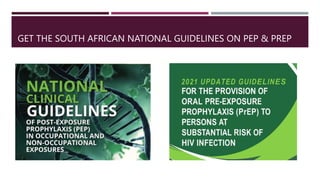
GET THE SOUTH AFRICAN NATIONAL GUIDELINES ON PEP & PREP
INTRODUCTION TO PEP
 PEP is used as a preventive intervention.
 PEP is an emergency intervention for all persons exposed to HIV.
 The exposure may be occupational or non-occupational.
 The route of exposure may be sexual, percutaneous or via non-genital
mucosal membranes.
 PEP can effectively prevent infection in a person exposed to HIV when
initiated as soon as possible and at least within 72 h post-exposure.
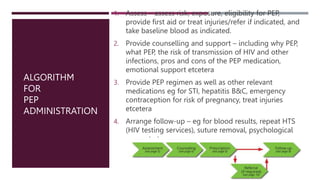
ALGORITHM
FOR
PEP
ADMINISTRATION
1. Assess – assess risk, exposure, eligibility for PEP,
provide first aid or treat injuries/refer if indicated, and
take baseline blood as indicated.
2. Provide counselling and support – including why PEP,
what PEP, the risk of transmission of HIV and other
infections, pros and cons of the PEP medication,
emotional support etcetera
3. Provide PEP regimen as well as other relevant
medications eg for STI, hepatitis B&C, emergency
contraception for risk of pregnancy, treat injuries
etcetera
4. Arrange follow-up – eg for blood results, repeat HTS
(HIV testing services), suture removal, psychological
support etc
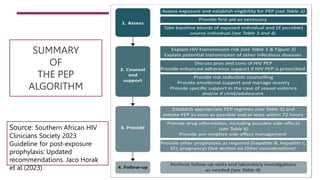
SUMMARY
OF
THE PEP
ALGORITHM
Source: Southern African HIV
Clinicians Society 2023
Guideline for post-exposure
prophylaxis: Updated
recommendations. Jaco Horak
et al (2023)
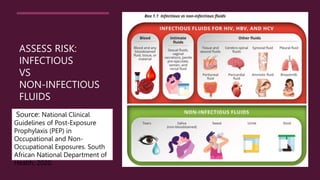
ASSESS RISK:
INFECTIOUS
VS
NON-INFECTIOUS
FLUIDS
Source: National Clinical
Guidelines of Post-Exposure
Prophylaxis (PEP) in
Occupational and Non-
Occupational Exposures. South
African National Department of
Health; 2020.
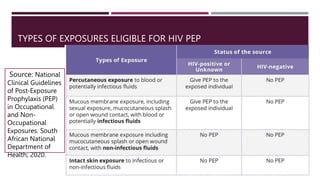
TYPES OF EXPOSURES ELIGIBLE FOR HIV PEP
Source: National
Clinical Guidelines
of Post-Exposure
Prophylaxis (PEP)
in Occupational
and Non-
Occupational
Exposures. South
African National
Department of
Health; 2020.
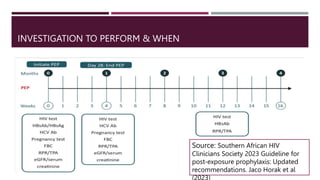
INVESTIGATION TO PERFORM & WHEN
Source: Southern African HIV
Clinicians Society 2023 Guideline for
post-exposure prophylaxis: Updated
recommendations. Jaco Horak et al
(2023)
WHAT TO DO FOR CLIENTS/PATIENTS WHO MIGHT NEED PEP
 HOLISTIC CARE, NOT JUST PEP SERVICES!
 Provide first aid (if required)
 Establish PEP eligibility
 Provide immediate PEP single dose as soon as possible
 Perform HIV test on exposed individual and (if possible)source individual
 Provide emergency contraception (if required)
 Provide counselling and emotional support
 Establish an appropriate PEP complete regimen and provide side-effect
management.
 Screen for potential gender-based/intimate partner violence.
PEP ADMINISTRATION
 The global recommendation for PEP is a 3-drug regimen involving an
integrase inhibitor – usually dolutegravir
 Integrase inhibitor-based regimens are very safe.
 The recommended duration of a course of PEP is 28 days.
 The full 28-day course should be provided at the time of PEP initiation.
 The recommended regimen for PEP is now 28 days of first-line ART – i.e.,
tenofovir disoproxil, lamivudine anddolutegravir [TLD]
 In instances of repeated PEP use in an individual, rather assess the potential
benefit of PrEPfor such an individual going forward.
 Side effects must be monitored and managed appropriately to promote
adherence
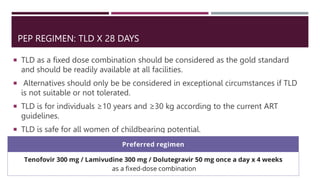
PEP REGIMEN: TLD X 28 DAYS
 TLD as a fixed dose combination should be considered as the gold standard
and should be readily available at all facilities.
 Alternatives should only be be considered in exceptional circumstances if TLD
is not suitable or not tolerated.
 TLD is for individuals ≥10 years and ≥30 kg according to the current ART
guidelines.
 TLD is safe for all women of childbearing potential.
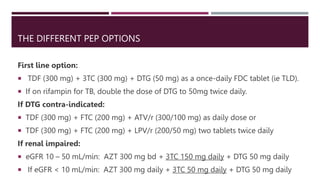
THE DIFFERENT PEP OPTIONS
First line option:
 TDF (300 mg) + 3TC (300 mg) + DTG (50 mg) as a once-daily FDC tablet (ie TLD).
 If on rifampin for TB, double the dose of DTG to 50mg twice daily.
If DTG contra-indicated:
 TDF (300 mg) + FTC (200 mg) + ATV/r (300/100 mg) as daily dose or
 TDF (300 mg) + FTC (200 mg) + LPV/r (200/50 mg) two tablets twice daily
If renal impaired:
 eGFR 10 – 50 mL/min: AZT 300 mg bd + 3TC 150 mg daily + DTG 50 mg daily
 If eGFR < 10 mL/min: AZT 300 mg daily + 3TC 50 mg daily + DTG 50 mg daily
PEP REGIMEN FOR CHILDREN/INDIVIDUALS < 10 YEARS OR < 30 KG
 Not included in the currentPEP Guideline
 According to the Southern African HIV Clinicians Society 2023 updates:
 Individuals < 10 years or < 30 kgDose as per latest paediatric dosing chart25
 First option: Zidovudine (AZT) + 3TC + DTG
 If DTG not available: Zidovudine (AZT) + 3TC + protease inhibitor (ATV/r or
LPV/r)
 Alternative option: Abacavir (ABC) + 3TC + DTG
 With a proviso that ABC should only be used if there is no alternative as there
is a risk of a hypersensitivity reaction to ABC.
REFERENCES & ACKNOWLEDGEMENT
 National Clinical Guidelines of Post-Exposure Prophylaxis (PEP) in Occupational
and Non-Occupational Exposures. South African National Department of Health;
2020. Available from: https://knowledgehub.health.gov.za
 2023 ART clinical guidelines for the management of HIV in adults, pregnancy and
breastfeeding, adolescents, children, infants and neonates. Republic of South
Africa National Department of Health; 2023. Available from:
https://knowledgehub.health.gov.za
 Southern African HIV Clinicians Society 2023 Guideline for post-exposure
prophylaxis: Updated recommendations. Jaco Horak et Al (2023) South Afr J HIV
Med. 2023; 24(1): 1522. doi: 10.4102/sajhivmed.v24i1.1522
 Acknowledge Dr Kemi Dele-Ijagbulu for her input in the slides preparation.
QUESTIONS
AND
COMMENTS

Post Exposure Prophylaxis by Dr Dele

  • 1.
    HIV POST EXPOSURE REGIMEN: LATEST GUIDELINES PRESENTED BYTHE DEPARTMENT OF FAMILY MEDICINE, GQEBERHA
  • 2.
    INTRODUCTION  Despite improvedroll-out of antiretroviral treatment (ART), studies have shown the incidence of HIV (new infections) has remained high in South Africa.  Let us explore a few disturbing trends:  Current prevalence of HIV infection in South Africa, according to WHO is ~8 million  There is an incidence of ~7 per 1000 among 15–49-year-olds. (new infections)  It is unacceptable that there are these many new infections of HIV today.
  • 3.
    INTRODUCTION /2  Women: A quarter of women of reproductive age (15–49 years) are living with HIV  Vertical transmission – the transmission rate is 3.5% – new infections among young women during late pregnancy  Women are also more exposed to a high risk of HIV transmission due to South Africa’s high rate of sexual violence
  • 4.
    INTRODUCTION /3  Secondly:HALF of new infections occur among some young key populations  These are people who have a high vulnerability to HIV due to 1, their behaviours 2, potential sexual violence 3, those who experience barriers to effective prevention services.  Examples are 1, men who have sex with men (MSM). 2, transgender women (TGW) – ie biological male. 3, people who sell sex, and 4, people who inject drugs (PWID).
  • 5.
    INTRODUCTION /4  Thirdly:occupational exposure – The risk of HIV transmission in a healthcare setting is 0.3% through percutaneous exposure (eg needle stick injury) and 0.09% after a mucous membrane exposure (eg splash injury)  Fourthly, men are often reported to have a poorer health-seeking behaviour including reluctance to engage in preventative measures such as condom use.
  • 6.
    PRE & POSTEXPOSURE PROPHYLAXIS (PEP & PREP)  There are many methods of preventing new HIV infections . These include safer sex, universal protection, the PMTCT program, adherence to ART, condom use, sharp disposal, abstinence, faithfulness, and so forth.  However, to curb the rate of new HIV infections, an effective prevention method remain vial.  Both pre- and post-exposure prophylaxis play central roles in this.  That is, in addition to other tested and trusted preventative methods listed above.
  • 7.
    WHAT IS PEP(& PREP)  Post-exposure prophylaxis (PEP): This is the preventive medical treatment started immediately after exposure to an infectious agent to prevent infection.  Pre-exposure prophylaxis (PrEP): This is the use of antiretroviral drugs by HIV-negative people before potential exposure to prevent the acquisition of HIV.
  • 8.
    HISTORICALLY:  Post-exposure prophylaxis(PEP) has been in existence for decades, since it was shown in a case-control study of occupational exposures among healthcare workers that zidovudine reduced HIV acquisition by almost 80%.  Pre-exposure prophylaxis (PrEP) is a more recent recommendation by WHO and is based on clinical trials in men who have sex with men, transgender women (biological males), discordant couples and heterosexual populations.  We shall be focusing on PEP in this discussion.
  • 9.
    GET THE SOUTHAFRICAN NATIONAL GUIDELINES ON PEP & PREP
  • 10.
    INTRODUCTION TO PEP PEP is used as a preventive intervention.  PEP is an emergency intervention for all persons exposed to HIV.  The exposure may be occupational or non-occupational.  The route of exposure may be sexual, percutaneous or via non-genital mucosal membranes.  PEP can effectively prevent infection in a person exposed to HIV when initiated as soon as possible and at least within 72 h post-exposure.
  • 11.
    ALGORITHM FOR PEP ADMINISTRATION 1. Assess –assess risk, exposure, eligibility for PEP, provide first aid or treat injuries/refer if indicated, and take baseline blood as indicated. 2. Provide counselling and support – including why PEP, what PEP, the risk of transmission of HIV and other infections, pros and cons of the PEP medication, emotional support etcetera 3. Provide PEP regimen as well as other relevant medications eg for STI, hepatitis B&C, emergency contraception for risk of pregnancy, treat injuries etcetera 4. Arrange follow-up – eg for blood results, repeat HTS (HIV testing services), suture removal, psychological support etc
  • 12.
    SUMMARY OF THE PEP ALGORITHM Source: SouthernAfrican HIV Clinicians Society 2023 Guideline for post-exposure prophylaxis: Updated recommendations. Jaco Horak et al (2023)
  • 13.
    ASSESS RISK: INFECTIOUS VS NON-INFECTIOUS FLUIDS Source: NationalClinical Guidelines of Post-Exposure Prophylaxis (PEP) in Occupational and Non- Occupational Exposures. South African National Department of Health; 2020.
  • 14.
    TYPES OF EXPOSURESELIGIBLE FOR HIV PEP Source: National Clinical Guidelines of Post-Exposure Prophylaxis (PEP) in Occupational and Non- Occupational Exposures. South African National Department of Health; 2020.
  • 15.
    INVESTIGATION TO PERFORM& WHEN Source: Southern African HIV Clinicians Society 2023 Guideline for post-exposure prophylaxis: Updated recommendations. Jaco Horak et al (2023)
  • 16.
    WHAT TO DOFOR CLIENTS/PATIENTS WHO MIGHT NEED PEP  HOLISTIC CARE, NOT JUST PEP SERVICES!  Provide first aid (if required)  Establish PEP eligibility  Provide immediate PEP single dose as soon as possible  Perform HIV test on exposed individual and (if possible)source individual  Provide emergency contraception (if required)  Provide counselling and emotional support  Establish an appropriate PEP complete regimen and provide side-effect management.  Screen for potential gender-based/intimate partner violence.
  • 17.
    PEP ADMINISTRATION  Theglobal recommendation for PEP is a 3-drug regimen involving an integrase inhibitor – usually dolutegravir  Integrase inhibitor-based regimens are very safe.  The recommended duration of a course of PEP is 28 days.  The full 28-day course should be provided at the time of PEP initiation.  The recommended regimen for PEP is now 28 days of first-line ART – i.e., tenofovir disoproxil, lamivudine anddolutegravir [TLD]  In instances of repeated PEP use in an individual, rather assess the potential benefit of PrEPfor such an individual going forward.  Side effects must be monitored and managed appropriately to promote adherence
  • 18.
    PEP REGIMEN: TLDX 28 DAYS  TLD as a fixed dose combination should be considered as the gold standard and should be readily available at all facilities.  Alternatives should only be be considered in exceptional circumstances if TLD is not suitable or not tolerated.  TLD is for individuals ≥10 years and ≥30 kg according to the current ART guidelines.  TLD is safe for all women of childbearing potential.
  • 19.
    THE DIFFERENT PEPOPTIONS First line option:  TDF (300 mg) + 3TC (300 mg) + DTG (50 mg) as a once-daily FDC tablet (ie TLD).  If on rifampin for TB, double the dose of DTG to 50mg twice daily. If DTG contra-indicated:  TDF (300 mg) + FTC (200 mg) + ATV/r (300/100 mg) as daily dose or  TDF (300 mg) + FTC (200 mg) + LPV/r (200/50 mg) two tablets twice daily If renal impaired:  eGFR 10 – 50 mL/min: AZT 300 mg bd + 3TC 150 mg daily + DTG 50 mg daily  If eGFR < 10 mL/min: AZT 300 mg daily + 3TC 50 mg daily + DTG 50 mg daily
  • 20.
    PEP REGIMEN FORCHILDREN/INDIVIDUALS < 10 YEARS OR < 30 KG  Not included in the currentPEP Guideline  According to the Southern African HIV Clinicians Society 2023 updates:  Individuals < 10 years or < 30 kgDose as per latest paediatric dosing chart25  First option: Zidovudine (AZT) + 3TC + DTG  If DTG not available: Zidovudine (AZT) + 3TC + protease inhibitor (ATV/r or LPV/r)  Alternative option: Abacavir (ABC) + 3TC + DTG  With a proviso that ABC should only be used if there is no alternative as there is a risk of a hypersensitivity reaction to ABC.
  • 21.
    REFERENCES & ACKNOWLEDGEMENT National Clinical Guidelines of Post-Exposure Prophylaxis (PEP) in Occupational and Non-Occupational Exposures. South African National Department of Health; 2020. Available from: https://knowledgehub.health.gov.za  2023 ART clinical guidelines for the management of HIV in adults, pregnancy and breastfeeding, adolescents, children, infants and neonates. Republic of South Africa National Department of Health; 2023. Available from: https://knowledgehub.health.gov.za  Southern African HIV Clinicians Society 2023 Guideline for post-exposure prophylaxis: Updated recommendations. Jaco Horak et Al (2023) South Afr J HIV Med. 2023; 24(1): 1522. doi: 10.4102/sajhivmed.v24i1.1522  Acknowledge Dr Kemi Dele-Ijagbulu for her input in the slides preparation.
  • 22.