Extern conference
Ext.ธนนันท ตันตยากร
CC: ปวดสะโพกขวา 5 ชั่วโมง
ชาย 41 ป
1977865
Primary survey, At ER
A: Can speak, no C-spine tenderness, full ROM of neck
B: Trachea in midline, Equal breath sound, both lungs
C: BP 132/77 mmHg, PR 86 bpm
D: E4V5M6, pupil 3 mm RTLBE
E: Rt. thigh flexion-adduction-internal rotation, Marked tender Rt.hip area, Abrasion
wound 2x2 cm Lt. knee
Secondary survey
A: none
M: none
P: none
L: NPO 6hr, อาหาร
E: ขับรถกระบะชนตนไม เขากระแทกคอนโซลรถ ไมมีศีรษะกระแทก ปฏิเสธประวัติหมดสติ
ไมมีคลื่นไสอาเจียน มีประวัติดื่มสุรา หลังเกิดเหตุปวดสะโพกขวามาก เดินไมได ขยับขาขวา
ไมได
Physical Examination
Extremity:
Rt.thigh flexion-adduction-internal rotation, Marked tender Rt.hip area, Limit
Active ROM Rt. hip due to pain
Rt.knee no external wound, no swelling, not tender, limit active ROM due to
Rt.hip pain, full passive ROM
Rt.ankle active dorsiflexion and plantar flexion
Rt.DPA 2+, Rt.PTA 2+
Intact pinprick sensation
Management
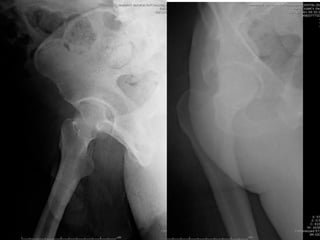
Set OR for Close reduction under GA
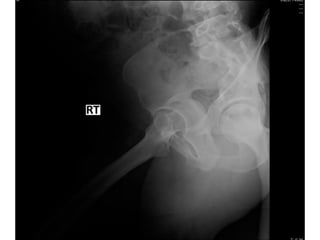
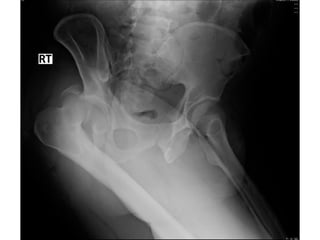
Posterior Hip Dislocation
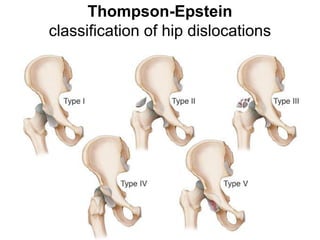
Thompson-Epstein
classification of hip dislocations
https://www.youtube.com/watch?v=eMVsjwAukU4
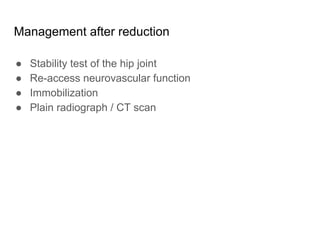
Management after reduction
● Stability test of the hip joint
● Re-access neurovascular function
● Immobilization
● Plain radiograph / CT scan
Indication for Open reduction
● Irreducible dislocation
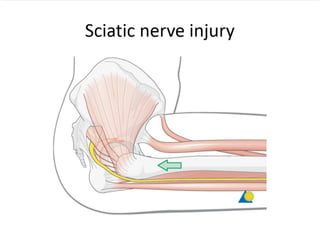
● Iatrogenic sciatic nerve injury
● Incongruent reduction with incarcerated fragment
● Incongruent reduction with soft tissue interposition
● Fracture dislocation of femoral head
The possible complication
● Osteonecrosis : reported 5 – 40 %
Directly relate with the time to reduce
Less than 6 hours : reported 0 - 7%
● Osteoarthritis : reported 26 – 50 %
● Sciatic nerve injury : reported 10 – 20 %

Posteriorhipdislocation

  • 1.
  • 2.
    CC: ปวดสะโพกขวา 5ชั่วโมง ชาย 41 ป 1977865
  • 3.
    Primary survey, AtER A: Can speak, no C-spine tenderness, full ROM of neck B: Trachea in midline, Equal breath sound, both lungs C: BP 132/77 mmHg, PR 86 bpm D: E4V5M6, pupil 3 mm RTLBE E: Rt. thigh flexion-adduction-internal rotation, Marked tender Rt.hip area, Abrasion wound 2x2 cm Lt. knee
  • 7.
    Secondary survey A: none M:none P: none L: NPO 6hr, อาหาร E: ขับรถกระบะชนตนไม เขากระแทกคอนโซลรถ ไมมีศีรษะกระแทก ปฏิเสธประวัติหมดสติ ไมมีคลื่นไสอาเจียน มีประวัติดื่มสุรา หลังเกิดเหตุปวดสะโพกขวามาก เดินไมได ขยับขาขวา ไมได
  • 8.
    Physical Examination Extremity: Rt.thigh flexion-adduction-internalrotation, Marked tender Rt.hip area, Limit Active ROM Rt. hip due to pain Rt.knee no external wound, no swelling, not tender, limit active ROM due to Rt.hip pain, full passive ROM Rt.ankle active dorsiflexion and plantar flexion Rt.DPA 2+, Rt.PTA 2+ Intact pinprick sensation
  • 12.
    Management Set OR forClose reduction under GA
  • 15.
  • 22.
  • 23.
  • 25.
    Management after reduction ●Stability test of the hip joint ● Re-access neurovascular function ● Immobilization ● Plain radiograph / CT scan
  • 26.
    Indication for Openreduction ● Irreducible dislocation ● Iatrogenic sciatic nerve injury ● Incongruent reduction with incarcerated fragment ● Incongruent reduction with soft tissue interposition ● Fracture dislocation of femoral head
  • 27.
    The possible complication ●Osteonecrosis : reported 5 – 40 % Directly relate with the time to reduce Less than 6 hours : reported 0 - 7% ● Osteoarthritis : reported 26 – 50 % ● Sciatic nerve injury : reported 10 – 20 %