Extern
Conference
Ext. ศิริลักษณ์ วศินะจินดาแก้ว
วันที่ 14 ธันวาคม 2559
Patient Profile
• ผู้ป่วยหญิง อายุ 54 ปี
• ภูมิลาเนา อาเภอพิมาย จังหวัดนครราชสีมา
• อาชีพ ค้าขาย
Chief complain
 ปวดขาซ้าย 4 ชั่วโมง ก่อนมาโรงพยาบาล
Present illness
4 ชั่วโมงก่อนมาโรงพยาบาล ขับ MC ถูกMC ชนที่บริเวณด้านข้าง
ล้ม ได้รับบาดเจ็บที่ขาซ้าย มีขาซ้ายผิดรูป ไม่มีแผลฉีกขาด หลังล้มไม่
สามารถยืนหรือเดินได้ ไม่สามารถงอเข่าซ้ายได้ ปวดที่ขาซ้ายมาก ไม่
ชา ไม่มีประวัติสลบ จาเหตุการณ์ได้ ผู้พบเหตุการณ์โทรแจ้งรถกู้ภัย
นาส่งโรงพยาบาล
Primary survey
A : Can speak , c-spine not tender, full ROM
B : Equal breath sound both lungs, CCT- neg
C : BP 122/75 mmHg , PR 72 bpm , PCT- neg
no active external hemorrhage
D : E4V5M6 , Pupil 3 mm RTLBE
E : Lt. thigh and Lt. knee swelling ,tenderness,
deformity,limit ROM of Lt.knee due to
pain,instability
Secondary survey
• A : No drugs and food allergy
• M : No current medication
• P : Unknown underlying disease
• L : 16.00 , 12/12/2559
• E : ขับ MC ถูกMC ชนที่บริเวณด้านข้างล้ม ได้รับบาดเจ็บที่ขาซ้าย
มีขาซ้ายผิดรูป คู่กรณีได้รับบาดเจ็บมีกระดูกแขนหัก รักษาที่รพช. ไม่มี
ผู้เสียชีวิตจากเหตุการณ์ดังกล่าว
Head to Toe examination
• Head and Maxillofacial :
– LW 0.5x2 cm at upper eyelid, not tear canaliculi,
no subconjunctival hemorrhage
– AW 5x5 cm at Lt.side of face , tenderness,swelling, no stepping
• Cervical spine and Neck :
– Not tender at posterior midline of neck
• Chest :
– Clear and Equal breath sound both lungs
• Abdomen :
– No distension,normoactive bowel sound soft,not tender
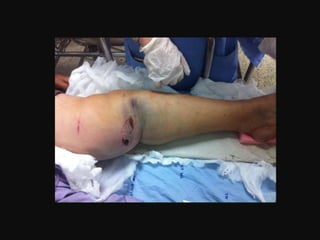
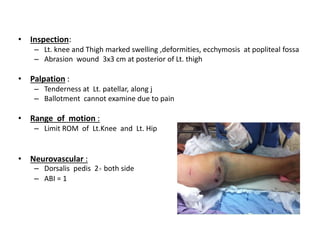
• Extremities : as picture
• Inspection:
– Lt. knee and Thigh marked swelling ,deformities, ecchymosis at popliteal fossa
– Abrasion wound 3x3 cm at posterior of Lt. thigh
• Palpation :
– Tenderness at Lt. patellar, along j
– Ballotment cannot examine due to pain
• Range of motion :
– Limit ROM of Lt.Knee and Lt. Hip
• Neurovascular :
– Dorsalis pedis 2+ both side
– ABI = 1
Problem lists
• Lt. knee fracture and deformity
• R/o vascular injury
• Mild head injury ( low risk )
• LW at Left upper eye lid
Differential diagnosis
• Fracture Left patella
• Fracture Left distal femur
• Fracture Left proximal tibia
• Left Knee dislocation
• Ligament injury
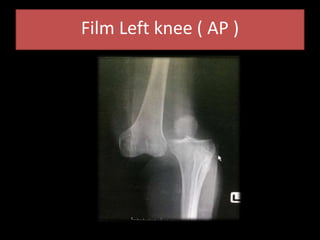
Film Left knee ( AP )
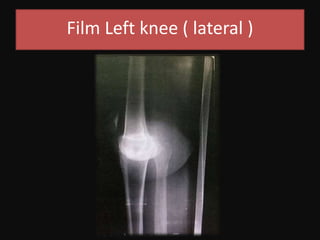
Film Left knee ( lateral )
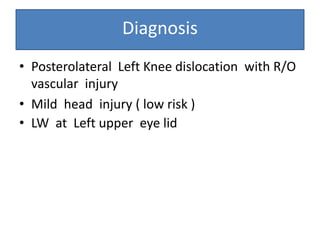
Diagnosis
• Posterolateral Left Knee dislocation with R/O
vascular injury
• Mild head injury ( low risk )
• LW at Left upper eye lid
Management
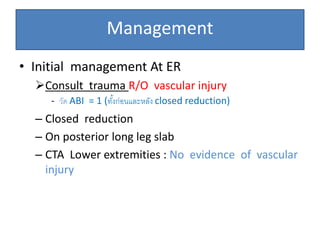
• Initial management At ER
Consult trauma R/O vascular injury
- วัด ABI = 1 (ทั้งก่อนและหลัง closed reduction)
– Closed reduction
– On posterior long leg slab
– CTA Lower extremities : No evidence of vascular
injury
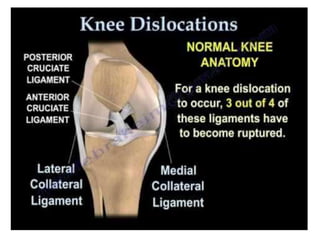
Knee Dislocation
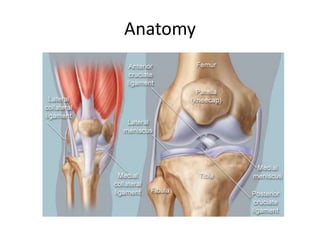
Anatomy
Epidemiology
• Rare
• high-energy :
– usually from MVC or fall from height
– commonly a dashboard injury resulting in axial
load to flexed knee
• Low – energy:
– Athletic injury
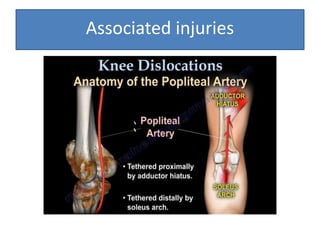
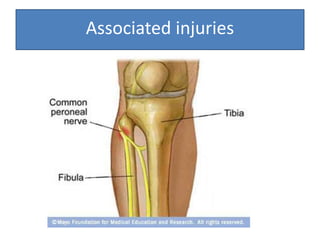
Associated injuries
Associated injuries
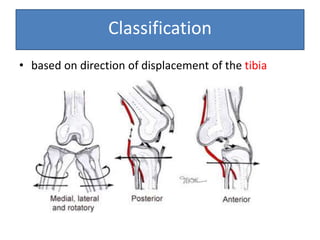
Classification
• based on direction of displacement of the tibia
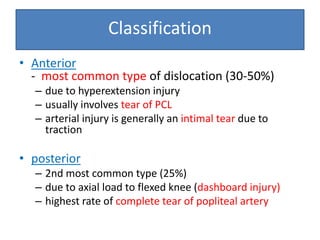
• Anterior
- most common type of dislocation (30-50%)
– due to hyperextension injury
– usually involves tear of PCL
– arterial injury is generally an intimal tear due to
traction
• posterior
– 2nd most common type (25%)
– due to axial load to flexed knee (dashboard injury)
– highest rate of complete tear of popliteal artery
Classification
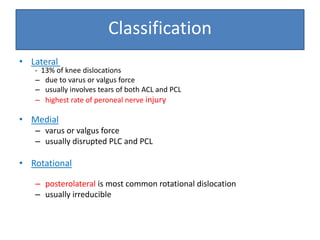
• Lateral
- 13% of knee dislocations
– due to varus or valgus force
– usually involves tears of both ACL and PCL
– highest rate of peroneal nerve injury
• Medial
– varus or valgus force
– usually disrupted PLC and PCL
• Rotational
– posterolateral is most common rotational dislocation
– usually irreducible
Classification
Presentation
• Symptoms
– history of trauma and deformity of the knee
– knee pain & instability
Sign
• appearance
• 50% spontaneously reduce before arrival to ED
(therefore underdiagnosed)
• swelling, effusion, abrasions
• Deformity (do not wait for radiographs, reduce
immediately, especially if absent pulses )
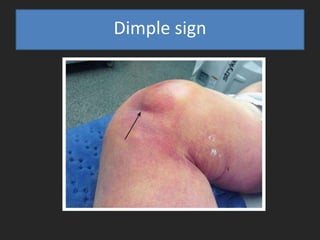
• "dimple sign"
Dimple sign
Sign
• vascular exam
– palpate the dorsalis pedis and posterior tibial pulses
• if pulses are present and normal
– does not indicate absence of arterial injury
– measure Ankle-Brachial Index (ABI)
• If pulses are absent or diminished
– perform immediate reduction and reassessment
– immediate surgical exploration if pulses are still absent
following reduction
ischemia time >8 hours has
amputation rates as high as 86%
Imaging
• Radiographs
– may be normal if spontaneous reduction
• look for asymmetric or irregular joint space
• look for avulsion fxs (Segond sign - lateral tibial condyle
avulsion fx)
• osteochondral defects
• MRI
– required to evaluate soft tissue injury (ligaments,
meniscus) and for surgical planning
– obtain MRI after acute treatment
Managemant
• Initial Treatment
– reduce knee and re-examine vascular status
• considered an orthopedic emergency
• splint knee in 20-30 degrees of flexion
• confirm reduction is held with repeat radiographs in
brace/splint
• Operative
– emergent surgical intervention
• indications
– vascular injury repair (takes precedence)
– open fx and open dislocation
– irreducible dislocation
– compartment syndrome
Managemant
Delayed ligamentous reconstruction/repair
• indications
– patients can be placed in a knee immobilizer for 6 weeks for
initial stabilization
» improved outcomes with early treatment (within 3
weeks)
Managemant
ขอบคุณค่ะ

Noon conference

  • 1.
  • 2.
    Patient Profile • ผู้ป่วยหญิงอายุ 54 ปี • ภูมิลาเนา อาเภอพิมาย จังหวัดนครราชสีมา • อาชีพ ค้าขาย
  • 3.
    Chief complain  ปวดขาซ้าย4 ชั่วโมง ก่อนมาโรงพยาบาล
  • 4.
    Present illness 4 ชั่วโมงก่อนมาโรงพยาบาลขับ MC ถูกMC ชนที่บริเวณด้านข้าง ล้ม ได้รับบาดเจ็บที่ขาซ้าย มีขาซ้ายผิดรูป ไม่มีแผลฉีกขาด หลังล้มไม่ สามารถยืนหรือเดินได้ ไม่สามารถงอเข่าซ้ายได้ ปวดที่ขาซ้ายมาก ไม่ ชา ไม่มีประวัติสลบ จาเหตุการณ์ได้ ผู้พบเหตุการณ์โทรแจ้งรถกู้ภัย นาส่งโรงพยาบาล
  • 6.
    Primary survey A :Can speak , c-spine not tender, full ROM B : Equal breath sound both lungs, CCT- neg C : BP 122/75 mmHg , PR 72 bpm , PCT- neg no active external hemorrhage D : E4V5M6 , Pupil 3 mm RTLBE E : Lt. thigh and Lt. knee swelling ,tenderness, deformity,limit ROM of Lt.knee due to pain,instability
  • 7.
    Secondary survey • A: No drugs and food allergy • M : No current medication • P : Unknown underlying disease • L : 16.00 , 12/12/2559 • E : ขับ MC ถูกMC ชนที่บริเวณด้านข้างล้ม ได้รับบาดเจ็บที่ขาซ้าย มีขาซ้ายผิดรูป คู่กรณีได้รับบาดเจ็บมีกระดูกแขนหัก รักษาที่รพช. ไม่มี ผู้เสียชีวิตจากเหตุการณ์ดังกล่าว
  • 8.
    Head to Toeexamination • Head and Maxillofacial : – LW 0.5x2 cm at upper eyelid, not tear canaliculi, no subconjunctival hemorrhage – AW 5x5 cm at Lt.side of face , tenderness,swelling, no stepping • Cervical spine and Neck : – Not tender at posterior midline of neck • Chest : – Clear and Equal breath sound both lungs • Abdomen : – No distension,normoactive bowel sound soft,not tender • Extremities : as picture
  • 9.
    • Inspection: – Lt.knee and Thigh marked swelling ,deformities, ecchymosis at popliteal fossa – Abrasion wound 3x3 cm at posterior of Lt. thigh • Palpation : – Tenderness at Lt. patellar, along j – Ballotment cannot examine due to pain • Range of motion : – Limit ROM of Lt.Knee and Lt. Hip • Neurovascular : – Dorsalis pedis 2+ both side – ABI = 1
  • 10.
    Problem lists • Lt.knee fracture and deformity • R/o vascular injury • Mild head injury ( low risk ) • LW at Left upper eye lid
  • 11.
    Differential diagnosis • FractureLeft patella • Fracture Left distal femur • Fracture Left proximal tibia • Left Knee dislocation • Ligament injury
  • 12.
  • 13.
    Film Left knee( lateral )
  • 14.
    Diagnosis • Posterolateral LeftKnee dislocation with R/O vascular injury • Mild head injury ( low risk ) • LW at Left upper eye lid
  • 15.
    Management • Initial managementAt ER Consult trauma R/O vascular injury - วัด ABI = 1 (ทั้งก่อนและหลัง closed reduction) – Closed reduction – On posterior long leg slab – CTA Lower extremities : No evidence of vascular injury
  • 16.
  • 17.
  • 19.
    Epidemiology • Rare • high-energy: – usually from MVC or fall from height – commonly a dashboard injury resulting in axial load to flexed knee • Low – energy: – Athletic injury
  • 20.
  • 21.
  • 22.
    Classification • based ondirection of displacement of the tibia
  • 23.
    • Anterior - mostcommon type of dislocation (30-50%) – due to hyperextension injury – usually involves tear of PCL – arterial injury is generally an intimal tear due to traction • posterior – 2nd most common type (25%) – due to axial load to flexed knee (dashboard injury) – highest rate of complete tear of popliteal artery Classification
  • 24.
    • Lateral - 13%of knee dislocations – due to varus or valgus force – usually involves tears of both ACL and PCL – highest rate of peroneal nerve injury • Medial – varus or valgus force – usually disrupted PLC and PCL • Rotational – posterolateral is most common rotational dislocation – usually irreducible Classification
  • 25.
    Presentation • Symptoms – historyof trauma and deformity of the knee – knee pain & instability
  • 26.
    Sign • appearance • 50%spontaneously reduce before arrival to ED (therefore underdiagnosed) • swelling, effusion, abrasions • Deformity (do not wait for radiographs, reduce immediately, especially if absent pulses ) • "dimple sign"
  • 27.
  • 28.
    Sign • vascular exam –palpate the dorsalis pedis and posterior tibial pulses • if pulses are present and normal – does not indicate absence of arterial injury – measure Ankle-Brachial Index (ABI) • If pulses are absent or diminished – perform immediate reduction and reassessment – immediate surgical exploration if pulses are still absent following reduction ischemia time >8 hours has amputation rates as high as 86%
  • 29.
    Imaging • Radiographs – maybe normal if spontaneous reduction • look for asymmetric or irregular joint space • look for avulsion fxs (Segond sign - lateral tibial condyle avulsion fx) • osteochondral defects • MRI – required to evaluate soft tissue injury (ligaments, meniscus) and for surgical planning – obtain MRI after acute treatment
  • 30.
    Managemant • Initial Treatment –reduce knee and re-examine vascular status • considered an orthopedic emergency • splint knee in 20-30 degrees of flexion • confirm reduction is held with repeat radiographs in brace/splint
  • 31.
    • Operative – emergentsurgical intervention • indications – vascular injury repair (takes precedence) – open fx and open dislocation – irreducible dislocation – compartment syndrome Managemant
  • 32.
    Delayed ligamentous reconstruction/repair •indications – patients can be placed in a knee immobilizer for 6 weeks for initial stabilization » improved outcomes with early treatment (within 3 weeks) Managemant
  • 33.