Acids Bases
&
Salts
CONTENTS
01 02
Introduction Acids
PART 01
Introductio
n
Introduction
Acids Bases Salts
PART 02
Acids
Acids
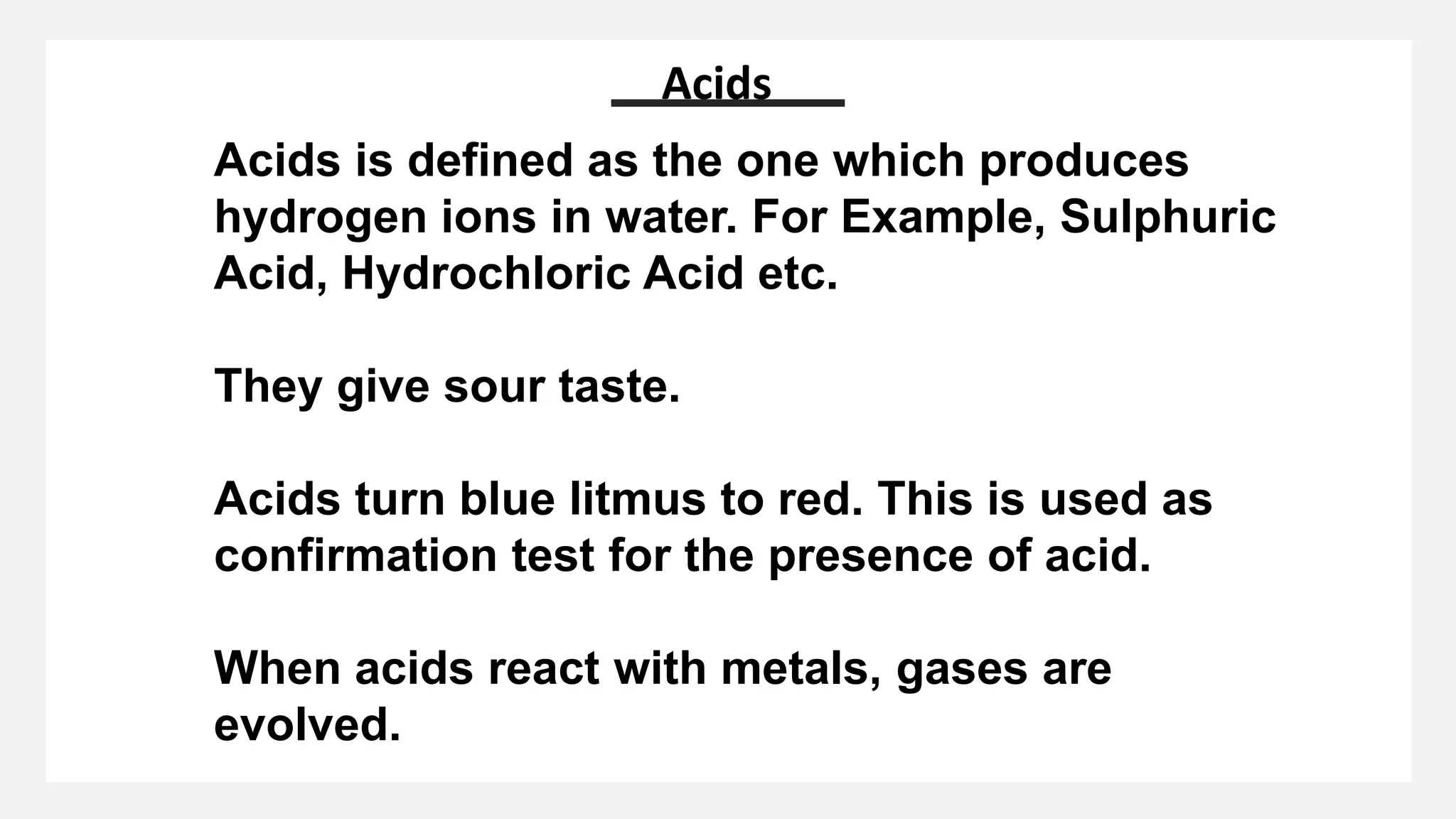
Acids is defined as the one which produces
hydrogen ions in water. For Example, Sulphuric
Acid, Hydrochloric Acid etc.
They give sour taste.
Acids turn blue litmus to red. This is used as
confirmation test for the presence of acid.
When acids react with metals, gases are
evolved.
Reactions with Acids
1. Reaction of Acid with Metal
Acid + Metal → Salt + Hydrogen gas
Mg + H2 SO4 → H2 + Mg SO4
2. Reaction of Acid with Carbonates
Na2 CO3 (s) + 2 HCl (aq) → 2NaCl (aq) + H2O(l) + CO2(g)
3. Reaction of Acid with Bicarbonates
NaHCO3 (s) + HCl (aq) → NaCl(aq) + H2O (l) + CO2 (g)
Acids
These are the substances which have
sour taste.
• They turn blue litmus solution red.
• They give H+
ions in aqueous solution.
• The term ‘acid’ has been derived
from the Latin word, acidus, which
means
sour.
Reactions with Acids
1. Reaction of Acid with Metal
Acid + Metal → Salt + Hydrogen gas
Mg + H2 SO4 → H2 + Mg SO4
2. Reaction of Acid with Carbonates
Na2 CO3 (s) + 2 HCl (aq) → 2NaCl (aq) + H2O(l) + CO2(g)
3. Reaction of Acid with Bicarbonates
NaHCO3 (s) + HCl (aq) → NaCl(aq) + H2O (l) + CO2 (g)
Acids
Reactions with Acids
1. Reaction of Acid with Metal
Acid + Metal → Salt + Hydrogen gas
Mg + H2 SO4 → H2 + Mg SO4
2. Reaction of Acid with Carbonates
Na2 CO3 (s) + 2 HCl (aq) → 2NaCl (aq) + H2O(l) + CO2(g)
3. Reaction of Acid with Bicarbonates
NaHCO3 (s) + HCl (aq) → NaCl(aq) + H2O (l) + CO2 (g)
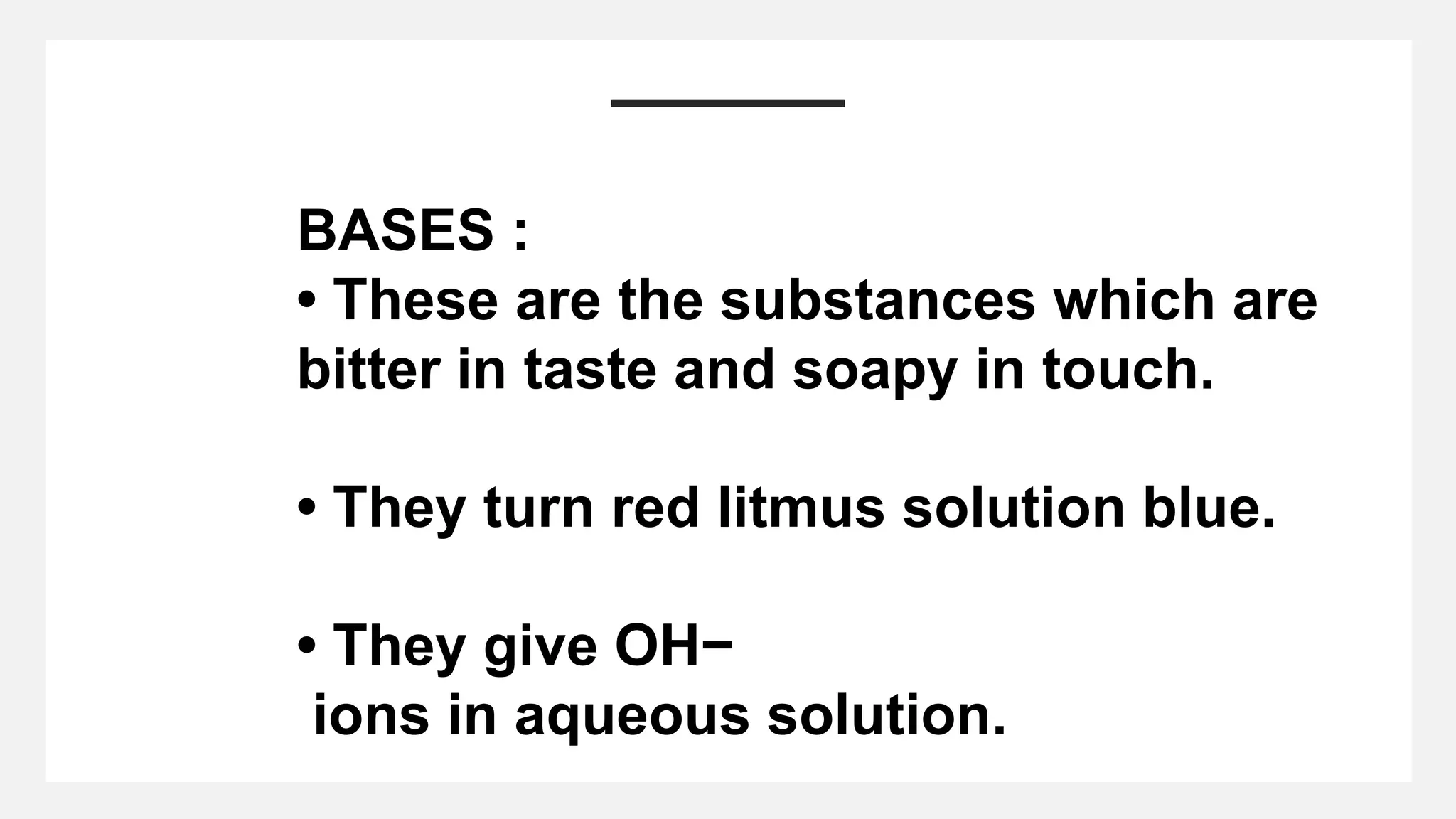
BASES :
• These are the substances which are
bitter in taste and soapy in touch.
• They turn red litmus solution blue.
• They give OH−
ions in aqueous solution.
Reactions with Acids
1. Reaction of Acid with Metal
Acid + Metal → Salt + Hydrogen gas
Mg + H2 SO4 → H2 + Mg SO4
2. Reaction of Acid with Carbonates
Na2 CO3 (s) + 2 HCl (aq) → 2NaCl (aq) + H2O(l) + CO2(g)
3. Reaction of Acid with Bicarbonates
NaHCO3 (s) + HCl (aq) → NaCl(aq) + H2O (l) + CO2 (g)
Strong Bases : NaOH, KOH, Ca(OH) 2
Weak Bases : NH4OH
Alkalis : These are bases which are soluble
in water [NaOH, KOH, Ca(OH) 2].
Reactions with Acids
1. Reaction of Acid with Metal
Acid + Metal → Salt + Hydrogen gas
Mg + H2 SO4 → H2 + Mg SO4
2. Reaction of Acid with Carbonates
Na2 CO3 (s) + 2 HCl (aq) → 2NaCl (aq) + H2O(l) + CO2(g)
3. Reaction of Acid with Bicarbonates
NaHCO3 (s) + HCl (aq) → NaCl(aq) + H2O (l) + CO2 (g)
SALTS :
These are the compounds formed from
reaction of acid and base
Example :
INDICATORS :
NaCl, KCl.
Reactions with Acids
1. Reaction of Acid with Metal
Acid + Metal → Salt + Hydrogen gas
Mg + H2 SO4 → H2 + Mg SO4
2. Reaction of Acid with Carbonates
Na2 CO3 (s) + 2 HCl (aq) → 2NaCl (aq) + H2O(l) + CO2(g)
3. Reaction of Acid with Bicarbonates
NaHCO3 (s) + HCl (aq) → NaCl(aq) + H2O (l) + CO2 (g)
INDICATORS :
These are the substances which change their
colour/smell in different types of
substances.
TYPES OF INDICATORS
Natural indicators
Synthetic
indicators
Olfactory
Reactions with Acids
1. Reaction of Acid with Metal
Acid + Metal → Salt + Hydrogen gas
Mg + H2 SO4 → H2 + Mg SO4
2. Reaction of Acid with Carbonates
Na2 CO3 (s) + 2 HCl (aq) → 2NaCl (aq) + H2O(l) + CO2(g)
3. Reaction of Acid with Bicarbonates
NaHCO3 (s) + HCl (aq) → NaCl(aq) + H2O (l) + CO2 (g)
Natural indicators
— Found in nature
in plants. substances.
Litmus, red
cabbage leaves phenolphthalein
extract, flowers
of hydrangea
plant, turmeric
Reactions with Acids
1. Reaction of Acid with Metal
Acid + Metal → Salt + Hydrogen gas
Mg + H2 SO4 → H2 + Mg SO4
2. Reaction of Acid with Carbonates
Na2 CO3 (s) + 2 HCl (aq) → 2NaCl (aq) + H2O(l) + CO2(g)
3. Reaction of Acid with Bicarbonates
NaHCO3 (s) + HCl (aq) → NaCl(aq) + H2O (l) + CO2 (g)
INDICATORS :
These are the substances which change their
colour/smell in different types of
substances.
TYPES OF INDICATORS
Natural indicators
Synthetic
indicators
Olfactory
Reactions with Acids
1. Reaction of Acid with Metal
Acid + Metal → Salt + Hydrogen gas
Mg + H2 SO4 → H2 + Mg SO4
2. Reaction of Acid with Carbonates
Na2 CO3 (s) + 2 HCl (aq) → 2NaCl (aq) + H2O(l) + CO2(g)
3. Reaction of Acid with Bicarbonates
NaHCO3 (s) + HCl (aq) → NaCl(aq) + H2O (l) + CO2 (g)
INDICATORS :
These are the substances which change their
colour/smell in different types of
substances.
TYPES OF INDICATORS
Natural indicators
Synthetic
indicators
Olfactory
Enter title
Enter your text here, or paste your text here.
Enter text
Enter your text here, or paste your text here.
Enter text
Enter your text here, or paste your text here.
Enter text
Enter your text here, or paste your
text here.
INNOVATE
Enter your text here, or paste your
text here.
INNOVATE
Enter your text here, or paste your
text here.
INNOVATE
Enter your text here, or paste your
text here.
INNOVATE
PART 03
Enter title
Enter your text here, or paste your text here.
Enter text
01 02 03
Enter your text here, or paste your text here.
Enter text
Enter your text here, or paste your text here.
Enter text
Enter your text here, or paste your text here.
Enter text
Enter your text here, or paste your text here.
Enter text
Click here to add content of the text,and briefly explain your point of view.
Enter title
Enter your text here, or paste your text here.
Enter text
2019
2020
Click here to add
content of the text,
and briefly explain
your point of view.
Click here to add
content of the text,
and briefly explain
your point of view.
PART 04
Enter title
01 02 03 04 05
Enter your text
here, or paste
your text here.
Enter your text
here, or paste
your text here.
Enter your text
here, or paste
your text here.
Enter your text
here, or paste
your text here.
Enter your text
here, or paste
your text here.
THANK YOU
`

Acid base and salt class 10 science|| what are indicators

  • 1.
  • 2.
  • 3.
  • 4.
  • 5.
  • 6.
    Acids Acids is definedas the one which produces hydrogen ions in water. For Example, Sulphuric Acid, Hydrochloric Acid etc. They give sour taste. Acids turn blue litmus to red. This is used as confirmation test for the presence of acid. When acids react with metals, gases are evolved.
  • 7.
    Reactions with Acids 1.Reaction of Acid with Metal Acid + Metal → Salt + Hydrogen gas Mg + H2 SO4 → H2 + Mg SO4 2. Reaction of Acid with Carbonates Na2 CO3 (s) + 2 HCl (aq) → 2NaCl (aq) + H2O(l) + CO2(g) 3. Reaction of Acid with Bicarbonates NaHCO3 (s) + HCl (aq) → NaCl(aq) + H2O (l) + CO2 (g) Acids These are the substances which have sour taste. • They turn blue litmus solution red. • They give H+ ions in aqueous solution. • The term ‘acid’ has been derived from the Latin word, acidus, which means sour.
  • 8.
    Reactions with Acids 1.Reaction of Acid with Metal Acid + Metal → Salt + Hydrogen gas Mg + H2 SO4 → H2 + Mg SO4 2. Reaction of Acid with Carbonates Na2 CO3 (s) + 2 HCl (aq) → 2NaCl (aq) + H2O(l) + CO2(g) 3. Reaction of Acid with Bicarbonates NaHCO3 (s) + HCl (aq) → NaCl(aq) + H2O (l) + CO2 (g) Acids
  • 9.
    Reactions with Acids 1.Reaction of Acid with Metal Acid + Metal → Salt + Hydrogen gas Mg + H2 SO4 → H2 + Mg SO4 2. Reaction of Acid with Carbonates Na2 CO3 (s) + 2 HCl (aq) → 2NaCl (aq) + H2O(l) + CO2(g) 3. Reaction of Acid with Bicarbonates NaHCO3 (s) + HCl (aq) → NaCl(aq) + H2O (l) + CO2 (g) BASES : • These are the substances which are bitter in taste and soapy in touch. • They turn red litmus solution blue. • They give OH− ions in aqueous solution.
  • 10.
    Reactions with Acids 1.Reaction of Acid with Metal Acid + Metal → Salt + Hydrogen gas Mg + H2 SO4 → H2 + Mg SO4 2. Reaction of Acid with Carbonates Na2 CO3 (s) + 2 HCl (aq) → 2NaCl (aq) + H2O(l) + CO2(g) 3. Reaction of Acid with Bicarbonates NaHCO3 (s) + HCl (aq) → NaCl(aq) + H2O (l) + CO2 (g) Strong Bases : NaOH, KOH, Ca(OH) 2 Weak Bases : NH4OH Alkalis : These are bases which are soluble in water [NaOH, KOH, Ca(OH) 2].
  • 11.
    Reactions with Acids 1.Reaction of Acid with Metal Acid + Metal → Salt + Hydrogen gas Mg + H2 SO4 → H2 + Mg SO4 2. Reaction of Acid with Carbonates Na2 CO3 (s) + 2 HCl (aq) → 2NaCl (aq) + H2O(l) + CO2(g) 3. Reaction of Acid with Bicarbonates NaHCO3 (s) + HCl (aq) → NaCl(aq) + H2O (l) + CO2 (g) SALTS : These are the compounds formed from reaction of acid and base Example : INDICATORS : NaCl, KCl.
  • 12.
    Reactions with Acids 1.Reaction of Acid with Metal Acid + Metal → Salt + Hydrogen gas Mg + H2 SO4 → H2 + Mg SO4 2. Reaction of Acid with Carbonates Na2 CO3 (s) + 2 HCl (aq) → 2NaCl (aq) + H2O(l) + CO2(g) 3. Reaction of Acid with Bicarbonates NaHCO3 (s) + HCl (aq) → NaCl(aq) + H2O (l) + CO2 (g) INDICATORS : These are the substances which change their colour/smell in different types of substances. TYPES OF INDICATORS Natural indicators Synthetic indicators Olfactory
  • 13.
    Reactions with Acids 1.Reaction of Acid with Metal Acid + Metal → Salt + Hydrogen gas Mg + H2 SO4 → H2 + Mg SO4 2. Reaction of Acid with Carbonates Na2 CO3 (s) + 2 HCl (aq) → 2NaCl (aq) + H2O(l) + CO2(g) 3. Reaction of Acid with Bicarbonates NaHCO3 (s) + HCl (aq) → NaCl(aq) + H2O (l) + CO2 (g) Natural indicators — Found in nature in plants. substances. Litmus, red cabbage leaves phenolphthalein extract, flowers of hydrangea plant, turmeric
  • 14.
    Reactions with Acids 1.Reaction of Acid with Metal Acid + Metal → Salt + Hydrogen gas Mg + H2 SO4 → H2 + Mg SO4 2. Reaction of Acid with Carbonates Na2 CO3 (s) + 2 HCl (aq) → 2NaCl (aq) + H2O(l) + CO2(g) 3. Reaction of Acid with Bicarbonates NaHCO3 (s) + HCl (aq) → NaCl(aq) + H2O (l) + CO2 (g) INDICATORS : These are the substances which change their colour/smell in different types of substances. TYPES OF INDICATORS Natural indicators Synthetic indicators Olfactory
  • 15.
    Reactions with Acids 1.Reaction of Acid with Metal Acid + Metal → Salt + Hydrogen gas Mg + H2 SO4 → H2 + Mg SO4 2. Reaction of Acid with Carbonates Na2 CO3 (s) + 2 HCl (aq) → 2NaCl (aq) + H2O(l) + CO2(g) 3. Reaction of Acid with Bicarbonates NaHCO3 (s) + HCl (aq) → NaCl(aq) + H2O (l) + CO2 (g) INDICATORS : These are the substances which change their colour/smell in different types of substances. TYPES OF INDICATORS Natural indicators Synthetic indicators Olfactory
  • 16.
    Enter title Enter yourtext here, or paste your text here. Enter text Enter your text here, or paste your text here. Enter text Enter your text here, or paste your text here. Enter text Enter your text here, or paste your text here. INNOVATE Enter your text here, or paste your text here. INNOVATE Enter your text here, or paste your text here. INNOVATE Enter your text here, or paste your text here. INNOVATE
  • 17.
  • 18.
    Enter title Enter yourtext here, or paste your text here. Enter text 01 02 03 Enter your text here, or paste your text here. Enter text Enter your text here, or paste your text here. Enter text Enter your text here, or paste your text here. Enter text Enter your text here, or paste your text here. Enter text
  • 19.
    Click here toadd content of the text,and briefly explain your point of view. Enter title Enter your text here, or paste your text here. Enter text 2019 2020 Click here to add content of the text, and briefly explain your point of view. Click here to add content of the text, and briefly explain your point of view.
  • 20.
  • 21.
    Enter title 01 0203 04 05 Enter your text here, or paste your text here. Enter your text here, or paste your text here. Enter your text here, or paste your text here. Enter your text here, or paste your text here. Enter your text here, or paste your text here.
  • 22.