Hepatology lectures for
5th Sem;MBBS
Pratap Sagar Tiwari
MBBS,MD (Medicine),DM (Hepatology)
PORTAL HYPERTENSION
Ascites
1
2
3
Refractory Ascites
4 Hepatorenal Syndrome
Spontaneous bacterial Peritonitis
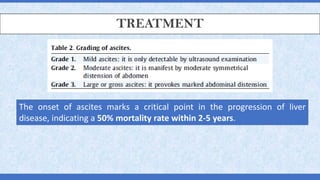
TREATMENT
The onset of ascites marks a critical point in the progression of liver
disease, indicating a 50% mortality rate within 2-5 years.
TREATMENT MODALITIES
➢ Sodium and water restriction
➢ Diuretics
➢ Paracentesis
➢ TIPSS
➢ Liver Transplantation
➢ OTHERS;
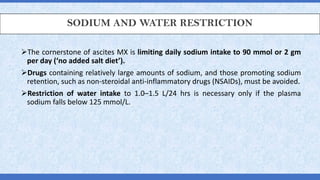
SODIUM AND WATER RESTRICTION
➢The cornerstone of ascites MX is limiting daily sodium intake to 90 mmol or 2 gm
per day (‘no added salt diet’).
➢Drugs containing relatively large amounts of sodium, and those promoting sodium
retention, such as non-steroidal anti-inflammatory drugs (NSAIDs), must be avoided.
➢Restriction of water intake to 1.0–1.5 L/24 hrs is necessary only if the plasma
sodium falls below 125 mmol/L.
SODIUM AND WATER RESTRICTION
DIURETICS
➢Diuretic: Combination of furosemide and spironolactone
Amiloride (5-40 mg ) if spironolactone causes gynaecomastia
Maximum daily dose of spironolactone is 400 mg and furosemide is 160 mg
➢ The negative fluid balance induced by diuretics should not lead to a body weight
loss exceeding 0.5 kg/day in pts without peripheral oedema and 1 kg/day in the
presence of peripheral oedema to avoid plasma volume contraction, ultimately
leading to renal failure and hyponatraemia.
PARACENTESIS
➢ LVP is defined as a paracentesis of ascitic volume of > 5 L.
➢ 6-8 gram of albumin per litre of ascitic fluid removed should be infused.
➢ Intravenous human albumin (HAS) infusions is recommended after LVP to prevent
the development of paracentesis-induced circulatory dysfunction (PICD), a
condition a/with rapid re-accumulation of ascites, and a 20% risk of developing
renal dysfunction.
TIPSS
➢ A transjugular intrahepatic portosystemic stent shunt (TIPSS) can relieve resistant
ascites but does not prolong life.
➢ it may be an option where the only alternative is frequent ie LVP
➢ TIPSS can be used in patients awaiting liver transplantation or in those with
reasonable liver function, but can aggravate HE in those with poor function.
REFRACTORY ASCITES
• Refractory ascites is defined as fluid overload that is unresponsive to high-dose diuretics
(spironolactone 400 mg/d and furosemide 160 mg/d) and sodium-restrictive diets,
recurring rapidly after therapeutic paracentesis.
• Diuretic therapy is considered to have failed when there is minimal or no weight loss
(Mean weight loss of <0.8 kg over 4 days) and urinary sodium output less than the
sodium intake or when there are clinical complications of
➢HE,
➢serum Cr > 2.0 mg/dL,
➢serum sodium < 120 mmol/L, or
➢serum potassium > 6.0 mmol/L.
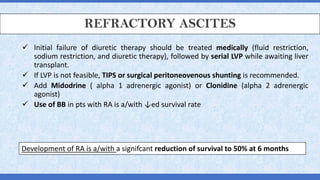
REFRACTORY ASCITES
✓ Initial failure of diuretic therapy should be treated medically (fluid restriction,
sodium restriction, and diuretic therapy), followed by serial LVP while awaiting liver
transplant.
✓ If LVP is not feasible, TIPS or surgical peritoneovenous shunting is recommended.
✓ Add Midodrine ( alpha 1 adrenergic agonist) or Clonidine (alpha 2 adrenergic
agonist)
✓ Use of BB in pts with RA is a/with ↓ed survival rate
Development of RA is a/with a signifcant reduction of survival to 50% at 6 months
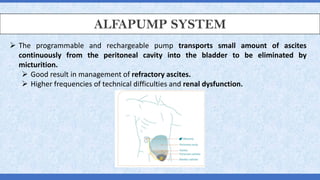
ALFAPUMP SYSTEM
➢ The programmable and rechargeable pump transports small amount of ascites
continuously from the peritoneal cavity into the bladder to be eliminated by
micturition.
➢ Good result in management of refractory ascites.
➢ Higher frequencies of technical difficulties and renal dysfunction.
MANAGEMENT IN CASES OF EXUDATIVE ASCITES
➢Malignant ascites
• Doesnot respond to sodium restriction and diuretic
• Treat the cause
➢Tuberculous ascites- standard anti-tuberculosis therapy
➢ LVP/SVP to relieve symptoms.
SPONTANEOUS BACTERIAL PERITONITIS
➢Third-generation cephalosporins are recommended as first-line antibiotic treatment
for SBP in countries with low rates of bacterial resistance.
➢In countries with high rates of bacterial resistance piperacillin/tazobactam or
carbapenem should be considered.
➢The efficacy of antibiotic therapy should be checked with a second paracentesis at 48
h from starting treatment.
➢Failure of first-line antibiotic therapy should be suspected if there is worsening of
clinical signs and symptoms and/or increase or no marked reduction in leucocyte
count (at least 25%) in 48 h.
➢The duration of treatment should be at least 5–7 days.
HEPATIC HYDROTHORAX
➢HH :accumulation of transudate in the pleural space of pts with decompensated
cirrhosis in the absence of cardiac, pulmonary or pleural disease.
➢Its formation is secondary to small diaphragmatic defects, more often located in the
right side, through which ascites moves into the pleural space because of the negative
intrathoracic pressure induced by inspiration.
➢Hepatic hydrothorax can lead to respiratory failure and can be complicated by
spontaneous bacterial infections (empyema).
➢Its appearance is associated with poor prognosis, as the median survival :8–12 months.
HEPATIC HYDROTHORAX
• Diagnosis: The protein content of pleural effusion in uncomplicated hepatic
hydrothorax is low and the serum to pleural fluid albumin gradient is greater than 1.1
g/dl.
• The first-line management relies on the treatment of ascites with diuretics and/or LVP
as discussed earlier.
• Therapeutic thoracentesis is required to relieve dyspnoea.
• Other management: TIPSS, PLEURODESIS, LT
HEPATORENAL SYNDROME
• Ascites is the accumulation of fluid within the peritoneal
cavity.
• Healthy men have no intraperitoneal fluid.
• However, female may have up to 25 ml of fluid depending
on the phase of their menstrual cycle.
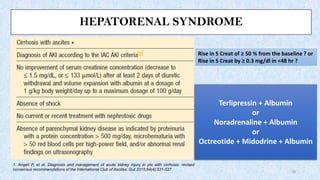
HEPATORENAL SYNDROME
1. Angeli P, et al. Diagnosis and management of acute kidney injury in pts with cirrhosis: revised
consensus recommendations of the International Club of Ascites. Gut 2015;64(4):531-537.
18
*
Terlipressin + Albumin
or
Noradrenaline + Albumin
or
Octreotide + Midodrine + Albumin
Rise in S Creat of ≥ 50 % from the baseline ? or
Rise in S Creat by ≥ 0.3 mg/dl in <48 hr ?

4. ASCITES part 2.pdf

  • 1.
    Hepatology lectures for 5thSem;MBBS Pratap Sagar Tiwari MBBS,MD (Medicine),DM (Hepatology)
  • 2.
    PORTAL HYPERTENSION Ascites 1 2 3 Refractory Ascites 4Hepatorenal Syndrome Spontaneous bacterial Peritonitis
  • 3.
    TREATMENT The onset ofascites marks a critical point in the progression of liver disease, indicating a 50% mortality rate within 2-5 years.
  • 4.
    TREATMENT MODALITIES ➢ Sodiumand water restriction ➢ Diuretics ➢ Paracentesis ➢ TIPSS ➢ Liver Transplantation ➢ OTHERS;
  • 5.
    SODIUM AND WATERRESTRICTION ➢The cornerstone of ascites MX is limiting daily sodium intake to 90 mmol or 2 gm per day (‘no added salt diet’). ➢Drugs containing relatively large amounts of sodium, and those promoting sodium retention, such as non-steroidal anti-inflammatory drugs (NSAIDs), must be avoided. ➢Restriction of water intake to 1.0–1.5 L/24 hrs is necessary only if the plasma sodium falls below 125 mmol/L.
  • 6.
    SODIUM AND WATERRESTRICTION
  • 7.
    DIURETICS ➢Diuretic: Combination offurosemide and spironolactone Amiloride (5-40 mg ) if spironolactone causes gynaecomastia Maximum daily dose of spironolactone is 400 mg and furosemide is 160 mg ➢ The negative fluid balance induced by diuretics should not lead to a body weight loss exceeding 0.5 kg/day in pts without peripheral oedema and 1 kg/day in the presence of peripheral oedema to avoid plasma volume contraction, ultimately leading to renal failure and hyponatraemia.
  • 8.
    PARACENTESIS ➢ LVP isdefined as a paracentesis of ascitic volume of > 5 L. ➢ 6-8 gram of albumin per litre of ascitic fluid removed should be infused. ➢ Intravenous human albumin (HAS) infusions is recommended after LVP to prevent the development of paracentesis-induced circulatory dysfunction (PICD), a condition a/with rapid re-accumulation of ascites, and a 20% risk of developing renal dysfunction.
  • 9.
    TIPSS ➢ A transjugularintrahepatic portosystemic stent shunt (TIPSS) can relieve resistant ascites but does not prolong life. ➢ it may be an option where the only alternative is frequent ie LVP ➢ TIPSS can be used in patients awaiting liver transplantation or in those with reasonable liver function, but can aggravate HE in those with poor function.
  • 10.
    REFRACTORY ASCITES • Refractoryascites is defined as fluid overload that is unresponsive to high-dose diuretics (spironolactone 400 mg/d and furosemide 160 mg/d) and sodium-restrictive diets, recurring rapidly after therapeutic paracentesis. • Diuretic therapy is considered to have failed when there is minimal or no weight loss (Mean weight loss of <0.8 kg over 4 days) and urinary sodium output less than the sodium intake or when there are clinical complications of ➢HE, ➢serum Cr > 2.0 mg/dL, ➢serum sodium < 120 mmol/L, or ➢serum potassium > 6.0 mmol/L.
  • 11.
    REFRACTORY ASCITES ✓ Initialfailure of diuretic therapy should be treated medically (fluid restriction, sodium restriction, and diuretic therapy), followed by serial LVP while awaiting liver transplant. ✓ If LVP is not feasible, TIPS or surgical peritoneovenous shunting is recommended. ✓ Add Midodrine ( alpha 1 adrenergic agonist) or Clonidine (alpha 2 adrenergic agonist) ✓ Use of BB in pts with RA is a/with ↓ed survival rate Development of RA is a/with a signifcant reduction of survival to 50% at 6 months
  • 12.
    ALFAPUMP SYSTEM ➢ Theprogrammable and rechargeable pump transports small amount of ascites continuously from the peritoneal cavity into the bladder to be eliminated by micturition. ➢ Good result in management of refractory ascites. ➢ Higher frequencies of technical difficulties and renal dysfunction.
  • 13.
    MANAGEMENT IN CASESOF EXUDATIVE ASCITES ➢Malignant ascites • Doesnot respond to sodium restriction and diuretic • Treat the cause ➢Tuberculous ascites- standard anti-tuberculosis therapy ➢ LVP/SVP to relieve symptoms.
  • 14.
    SPONTANEOUS BACTERIAL PERITONITIS ➢Third-generationcephalosporins are recommended as first-line antibiotic treatment for SBP in countries with low rates of bacterial resistance. ➢In countries with high rates of bacterial resistance piperacillin/tazobactam or carbapenem should be considered. ➢The efficacy of antibiotic therapy should be checked with a second paracentesis at 48 h from starting treatment. ➢Failure of first-line antibiotic therapy should be suspected if there is worsening of clinical signs and symptoms and/or increase or no marked reduction in leucocyte count (at least 25%) in 48 h. ➢The duration of treatment should be at least 5–7 days.
  • 15.
    HEPATIC HYDROTHORAX ➢HH :accumulationof transudate in the pleural space of pts with decompensated cirrhosis in the absence of cardiac, pulmonary or pleural disease. ➢Its formation is secondary to small diaphragmatic defects, more often located in the right side, through which ascites moves into the pleural space because of the negative intrathoracic pressure induced by inspiration. ➢Hepatic hydrothorax can lead to respiratory failure and can be complicated by spontaneous bacterial infections (empyema). ➢Its appearance is associated with poor prognosis, as the median survival :8–12 months.
  • 16.
    HEPATIC HYDROTHORAX • Diagnosis:The protein content of pleural effusion in uncomplicated hepatic hydrothorax is low and the serum to pleural fluid albumin gradient is greater than 1.1 g/dl. • The first-line management relies on the treatment of ascites with diuretics and/or LVP as discussed earlier. • Therapeutic thoracentesis is required to relieve dyspnoea. • Other management: TIPSS, PLEURODESIS, LT
  • 17.
    HEPATORENAL SYNDROME • Ascitesis the accumulation of fluid within the peritoneal cavity. • Healthy men have no intraperitoneal fluid. • However, female may have up to 25 ml of fluid depending on the phase of their menstrual cycle.
  • 18.
    HEPATORENAL SYNDROME 1. AngeliP, et al. Diagnosis and management of acute kidney injury in pts with cirrhosis: revised consensus recommendations of the International Club of Ascites. Gut 2015;64(4):531-537. 18 * Terlipressin + Albumin or Noradrenaline + Albumin or Octreotide + Midodrine + Albumin Rise in S Creat of ≥ 50 % from the baseline ? or Rise in S Creat by ≥ 0.3 mg/dl in <48 hr ?