Hepatology lectures for
5th Sem;MBBS
Pratap Sagar Tiwari
MBBS,MD (Medicine),DM (Hepatology)
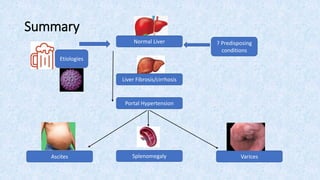
Summary
? Predisposing
conditions
Etiologies
Liver Fibrosis/cirrhosis
Portal Hypertension
Varices
Splenomegaly
Ascites
Normal Liver
PORTAL HYPERTENSION
Ascites
1
2
3
Causes
4 Management
Approach
DEFINITION: ASCITES
H/o VH
VH prevention measures
for pts with a known
H/o VH
Secondary Prophylaxis
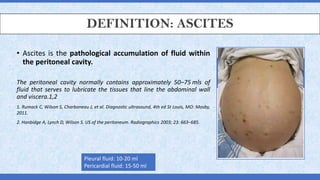
• Ascites is the pathological accumulation of fluid within
the peritoneal cavity.
The peritoneal cavity normally contains approximately 50–75 mls of
fluid that serves to lubricate the tissues that line the abdominal wall
and viscera.1,2
1. Rumack C, Wilson S, Charboneau J, et al. Diagnostic ultrasound, 4th ed St Louis, MO: Mosby,
2011.
2. Hanbidge A, Lynch D, Wilson S. US of the peritoneum. Radiographics 2003; 23: 663–685.
Pleural fluid: 10-20 ml
Pericardial fluid: 15-50 ml
CAUSES OF ASCITES
Causes of ascites can be categorized on basis of several aspects like
• etiology (infection, malignancy),
• pathophysiology (portal hypertension-related, non-PHTN related),
• organ/system specific (cirrhotic, cardiac, renal )
• others (exudative vs transudative: (protein < 25 g/L) )
However the common causes of ascites are;
CAUSES OF ASCITES
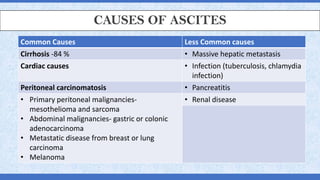
Common Causes Less Common causes
Cirrhosis -84 % • Massive hepatic metastasis
Cardiac causes • Infection (tuberculosis, chlamydia
infection)
Peritoneal carcinomatosis • Pancreatitis
• Primary peritoneal malignancies-
mesothelioma and sarcoma
• Abdominal malignancies- gastric or colonic
adenocarcinoma
• Metastatic disease from breast or lung
carcinoma
• Melanoma
• Renal disease
RARE CAUSES OF ASCITES
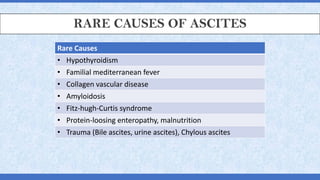
Rare Causes
• Hypothyroidism
• Familial mediterranean fever
• Collagen vascular disease
• Amyloidosis
• Fitz-hugh-Curtis syndrome
• Protein-loosing enteropathy, malnutrition
• Trauma (Bile ascites, urine ascites), Chylous ascites
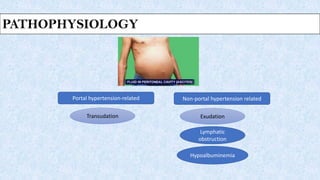
PATHOPHYSIOLOGY
Portal hypertension-related Non-portal hypertension related
Exudation
Lymphatic
obstruction
Hypoalbuminemia
Transudation
PATHOPHYSIOLOGY
PATHOPHYSIOLOGY
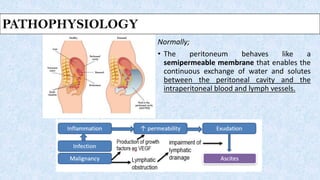
Normally;
• The peritoneum behaves like a
semipermeable membrane that enables the
continuous exchange of water and solutes
between the peritoneal cavity and the
intraperitoneal blood and lymph vessels.
PATHOPHYSIOLOGY
PATHOPHYSIOLOGY
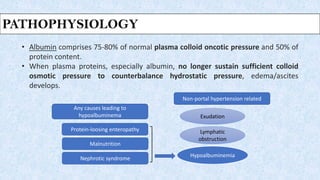
Non-portal hypertension related
Exudation
Lymphatic
obstruction
Hypoalbuminemia
Any causes leading to
hypoalbuminema
Protein-loosing enteropathy
Malnutrition
Nephrotic syndrome
• Albumin comprises 75-80% of normal plasma colloid oncotic pressure and 50% of
protein content.
• When plasma proteins, especially albumin, no longer sustain sufficient colloid
osmotic pressure to counterbalance hydrostatic pressure, edema/ascites
develops.
PATHOPHYSIOLOGY
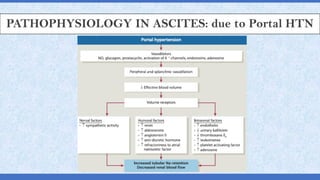
PATHOPHYSIOLOGY IN ASCITES: due to Portal HTN
APPROACH
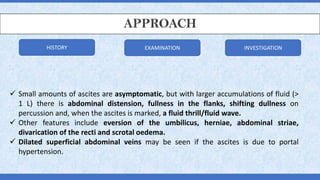
✓ Small amounts of ascites are asymptomatic, but with larger accumulations of fluid (>
1 L) there is abdominal distension, fullness in the flanks, shifting dullness on
percussion and, when the ascites is marked, a fluid thrill/fluid wave.
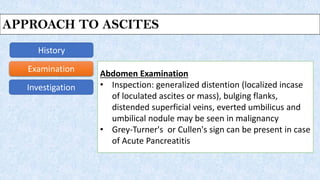
✓ Other features include eversion of the umbilicus, herniae, abdominal striae,
divarication of the recti and scrotal oedema.
✓ Dilated superficial abdominal veins may be seen if the ascites is due to portal
hypertension.
HISTORY EXAMINATION INVESTIGATION
Approach to Ascites
History
Examination
Investigation
• Bowel obstruction, severe constipation and ileus- inability to
pass stool and flatus together with nausea/ vomiting
• Weight loss, night sweats and anorexia
• ↑ eructation or flatus- aerophagia or ↑ intestinal production
of gas
• Symptoms of other medical conditions- heart failure and tb
• Question about risk factors like excessive alcohol use, iv drug
abuse, chronic viral infection and jaundice
APPROACH TO ASCITES
Approach to Ascites
History
Examination
Investigation
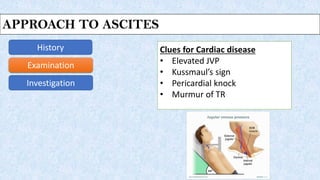
Clues for Cardiac disease
• Elevated JVP
• Kussmaul’s sign
• Pericardial knock
• Murmur of TR
APPROACH TO ASCITES
Approach to Ascites
History
Examination
Investigation
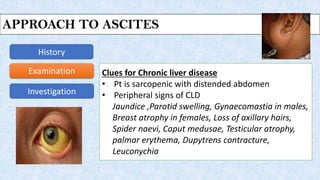
Clues for Chronic liver disease
• Pt is sarcopenic with distended abdomen
• Peripheral signs of CLD
Jaundice ,Parotid swelling, Gynaecomastia in males,
Breast atrophy in females, Loss of axillary hairs,
Spider naevi, Caput medusae, Testicular atrophy,
palmar erythema, Dupytrens contracture,
Leuconychia
APPROACH TO ASCITES
Approach to Ascites
History
Examination
Investigation
Abdomen Examination
• Inspection: generalized distention (localized incase
of loculated ascites or mass), bulging flanks,
distended superficial veins, everted umbilicus and
umbilical nodule may be seen in malignancy
• Grey-Turner's or Cullen's sign can be present in case
of Acute Pancreatitis
APPROACH TO ASCITES
Approach to Ascites
History
Examination
Investigation
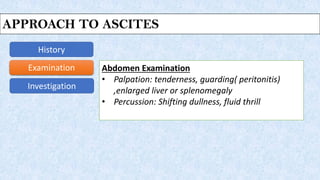
Abdomen Examination
• Palpation: tenderness, guarding( peritonitis)
,enlarged liver or splenomegaly
• Percussion: Shifting dullness, fluid thrill
APPROACH TO ASCITES
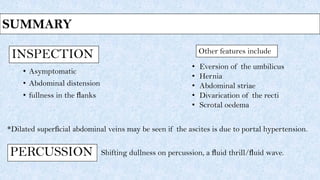
INSPECTION
• Asymptomatic
• Abdominal distension
• fullness in the flanks
Shifting dullness on percussion, a fluid thrill/fluid wave.
• Eversion of the umbilicus
• Hernia
• Abdominal striae
• Divarication of the recti
• Scrotal oedema
Other features include
*Dilated superficial abdominal veins may be seen if the ascites is due to portal hypertension.
PERCUSSION
SUMMARY
Approach to Ascites
History
Examination
Investigation
Imaging, eg USG
Ascites fluid
Evaluation
Others; like ECHO
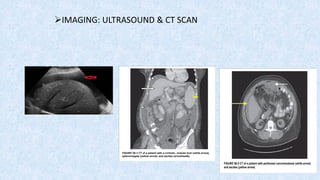
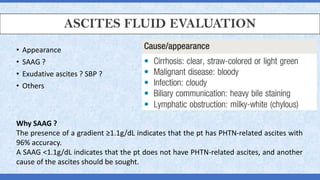
➢IMAGING: ULTRASOUND & CT SCAN
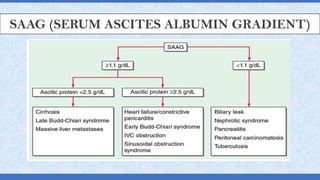
ASCITES FLUID EVALUATION
• Appearance
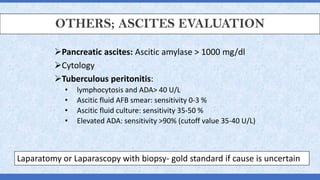
• SAAG ?
• Exudative ascites ? SBP ?
• Others
Why SAAG ?
The presence of a gradient ≥1.1g/dL indicates that the pt has PHTN-related ascites with
96% accuracy.
A SAAG <1.1g/dL indicates that the pt does not have PHTN-related ascites, and another
cause of the ascites should be sought.
SAAG (SERUM ASCITES ALBUMIN GRADIENT)
OTHERS; ASCITES EVALUATION
➢Pancreatic ascites: Ascitic amylase > 1000 mg/dl
➢Cytology
➢Tuberculous peritonitis:
• lymphocytosis and ADA> 40 U/L
• Ascitic fluid AFB smear: sensitivity 0-3 %
• Ascitic fluid culture: sensitivity 35-50 %
• Elevated ADA: sensitivity >90% (cutoff value 35-40 U/L)
Laparatomy or Laparascopy with biopsy- gold standard if cause is uncertain
OTHERS; LABORATORY EVALUATION
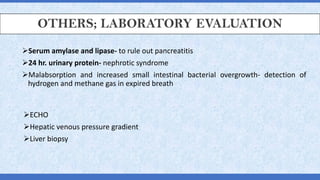
➢Serum amylase and lipase- to rule out pancreatitis
➢24 hr. urinary protein- nephrotic syndrome
➢Malabsorption and increased small intestinal bacterial overgrowth- detection of
hydrogen and methane gas in expired breath
➢ECHO
➢Hepatic venous pressure gradient
➢Liver biopsy
SPONTANOUS BACTERIAL PERITONITIS
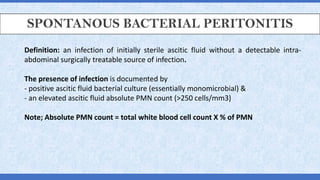
Definition: an infection of initially sterile ascitic fluid without a detectable intra-
abdominal surgically treatable source of infection.
The presence of infection is documented by
- positive ascitic fluid bacterial culture (essentially monomicrobial) &
- an elevated ascitic fluid absolute PMN count (>250 cells/mm3)
Note; Absolute PMN count = total white blood cell count X % of PMN
SECONDARY BACTERIAL PERITONITIS
TREATMENT
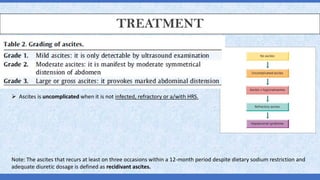
Note: The ascites that recurs at least on three occasions within a 12-month period despite dietary sodium restriction and
adequate diuretic dosage is defined as recidivant ascites.
➢ Ascites is uncomplicated when it is not infected, refractory or a/with HRS.
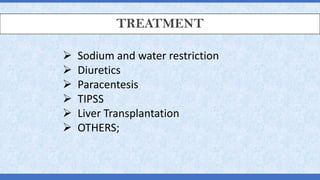
TREATMENT
➢ Sodium and water restriction
➢ Diuretics
➢ Paracentesis
➢ TIPSS
➢ Liver Transplantation
➢ OTHERS;

3. ASCITES part 1.pdf

  • 1.
    Hepatology lectures for 5thSem;MBBS Pratap Sagar Tiwari MBBS,MD (Medicine),DM (Hepatology)
  • 2.
    Summary ? Predisposing conditions Etiologies Liver Fibrosis/cirrhosis PortalHypertension Varices Splenomegaly Ascites Normal Liver
  • 3.
  • 4.
    DEFINITION: ASCITES H/o VH VHprevention measures for pts with a known H/o VH Secondary Prophylaxis • Ascites is the pathological accumulation of fluid within the peritoneal cavity. The peritoneal cavity normally contains approximately 50–75 mls of fluid that serves to lubricate the tissues that line the abdominal wall and viscera.1,2 1. Rumack C, Wilson S, Charboneau J, et al. Diagnostic ultrasound, 4th ed St Louis, MO: Mosby, 2011. 2. Hanbidge A, Lynch D, Wilson S. US of the peritoneum. Radiographics 2003; 23: 663–685. Pleural fluid: 10-20 ml Pericardial fluid: 15-50 ml
  • 5.
    CAUSES OF ASCITES Causesof ascites can be categorized on basis of several aspects like • etiology (infection, malignancy), • pathophysiology (portal hypertension-related, non-PHTN related), • organ/system specific (cirrhotic, cardiac, renal ) • others (exudative vs transudative: (protein < 25 g/L) ) However the common causes of ascites are;
  • 6.
    CAUSES OF ASCITES CommonCauses Less Common causes Cirrhosis -84 % • Massive hepatic metastasis Cardiac causes • Infection (tuberculosis, chlamydia infection) Peritoneal carcinomatosis • Pancreatitis • Primary peritoneal malignancies- mesothelioma and sarcoma • Abdominal malignancies- gastric or colonic adenocarcinoma • Metastatic disease from breast or lung carcinoma • Melanoma • Renal disease
  • 7.
    RARE CAUSES OFASCITES Rare Causes • Hypothyroidism • Familial mediterranean fever • Collagen vascular disease • Amyloidosis • Fitz-hugh-Curtis syndrome • Protein-loosing enteropathy, malnutrition • Trauma (Bile ascites, urine ascites), Chylous ascites
  • 8.
    PATHOPHYSIOLOGY Portal hypertension-related Non-portalhypertension related Exudation Lymphatic obstruction Hypoalbuminemia Transudation PATHOPHYSIOLOGY
  • 9.
    PATHOPHYSIOLOGY Normally; • The peritoneumbehaves like a semipermeable membrane that enables the continuous exchange of water and solutes between the peritoneal cavity and the intraperitoneal blood and lymph vessels. PATHOPHYSIOLOGY
  • 10.
    PATHOPHYSIOLOGY Non-portal hypertension related Exudation Lymphatic obstruction Hypoalbuminemia Anycauses leading to hypoalbuminema Protein-loosing enteropathy Malnutrition Nephrotic syndrome • Albumin comprises 75-80% of normal plasma colloid oncotic pressure and 50% of protein content. • When plasma proteins, especially albumin, no longer sustain sufficient colloid osmotic pressure to counterbalance hydrostatic pressure, edema/ascites develops. PATHOPHYSIOLOGY
  • 11.
    PATHOPHYSIOLOGY IN ASCITES:due to Portal HTN
  • 12.
    APPROACH ✓ Small amountsof ascites are asymptomatic, but with larger accumulations of fluid (> 1 L) there is abdominal distension, fullness in the flanks, shifting dullness on percussion and, when the ascites is marked, a fluid thrill/fluid wave. ✓ Other features include eversion of the umbilicus, herniae, abdominal striae, divarication of the recti and scrotal oedema. ✓ Dilated superficial abdominal veins may be seen if the ascites is due to portal hypertension. HISTORY EXAMINATION INVESTIGATION
  • 13.
    Approach to Ascites History Examination Investigation •Bowel obstruction, severe constipation and ileus- inability to pass stool and flatus together with nausea/ vomiting • Weight loss, night sweats and anorexia • ↑ eructation or flatus- aerophagia or ↑ intestinal production of gas • Symptoms of other medical conditions- heart failure and tb • Question about risk factors like excessive alcohol use, iv drug abuse, chronic viral infection and jaundice APPROACH TO ASCITES
  • 14.
    Approach to Ascites History Examination Investigation Cluesfor Cardiac disease • Elevated JVP • Kussmaul’s sign • Pericardial knock • Murmur of TR APPROACH TO ASCITES
  • 15.
    Approach to Ascites History Examination Investigation Cluesfor Chronic liver disease • Pt is sarcopenic with distended abdomen • Peripheral signs of CLD Jaundice ,Parotid swelling, Gynaecomastia in males, Breast atrophy in females, Loss of axillary hairs, Spider naevi, Caput medusae, Testicular atrophy, palmar erythema, Dupytrens contracture, Leuconychia APPROACH TO ASCITES
  • 16.
    Approach to Ascites History Examination Investigation AbdomenExamination • Inspection: generalized distention (localized incase of loculated ascites or mass), bulging flanks, distended superficial veins, everted umbilicus and umbilical nodule may be seen in malignancy • Grey-Turner's or Cullen's sign can be present in case of Acute Pancreatitis APPROACH TO ASCITES
  • 17.
    Approach to Ascites History Examination Investigation AbdomenExamination • Palpation: tenderness, guarding( peritonitis) ,enlarged liver or splenomegaly • Percussion: Shifting dullness, fluid thrill APPROACH TO ASCITES
  • 18.
    INSPECTION • Asymptomatic • Abdominaldistension • fullness in the flanks Shifting dullness on percussion, a fluid thrill/fluid wave. • Eversion of the umbilicus • Hernia • Abdominal striae • Divarication of the recti • Scrotal oedema Other features include *Dilated superficial abdominal veins may be seen if the ascites is due to portal hypertension. PERCUSSION SUMMARY
  • 19.
    Approach to Ascites History Examination Investigation Imaging,eg USG Ascites fluid Evaluation Others; like ECHO
  • 20.
  • 21.
    ASCITES FLUID EVALUATION •Appearance • SAAG ? • Exudative ascites ? SBP ? • Others Why SAAG ? The presence of a gradient ≥1.1g/dL indicates that the pt has PHTN-related ascites with 96% accuracy. A SAAG <1.1g/dL indicates that the pt does not have PHTN-related ascites, and another cause of the ascites should be sought.
  • 22.
    SAAG (SERUM ASCITESALBUMIN GRADIENT)
  • 23.
    OTHERS; ASCITES EVALUATION ➢Pancreaticascites: Ascitic amylase > 1000 mg/dl ➢Cytology ➢Tuberculous peritonitis: • lymphocytosis and ADA> 40 U/L • Ascitic fluid AFB smear: sensitivity 0-3 % • Ascitic fluid culture: sensitivity 35-50 % • Elevated ADA: sensitivity >90% (cutoff value 35-40 U/L) Laparatomy or Laparascopy with biopsy- gold standard if cause is uncertain
  • 24.
    OTHERS; LABORATORY EVALUATION ➢Serumamylase and lipase- to rule out pancreatitis ➢24 hr. urinary protein- nephrotic syndrome ➢Malabsorption and increased small intestinal bacterial overgrowth- detection of hydrogen and methane gas in expired breath ➢ECHO ➢Hepatic venous pressure gradient ➢Liver biopsy
  • 25.
    SPONTANOUS BACTERIAL PERITONITIS Definition:an infection of initially sterile ascitic fluid without a detectable intra- abdominal surgically treatable source of infection. The presence of infection is documented by - positive ascitic fluid bacterial culture (essentially monomicrobial) & - an elevated ascitic fluid absolute PMN count (>250 cells/mm3) Note; Absolute PMN count = total white blood cell count X % of PMN
  • 26.
  • 27.
    TREATMENT Note: The ascitesthat recurs at least on three occasions within a 12-month period despite dietary sodium restriction and adequate diuretic dosage is defined as recidivant ascites. ➢ Ascites is uncomplicated when it is not infected, refractory or a/with HRS.
  • 28.
    TREATMENT ➢ Sodium andwater restriction ➢ Diuretics ➢ Paracentesis ➢ TIPSS ➢ Liver Transplantation ➢ OTHERS;