Hepatology lectures for
5th Sem;MBBS
Pratap Sagar Tiwari
MBBS,MD (Medicine),DM (Hepatology)
HEPATIC ENCEPHALOPATHY
DEFINITION
1
2
3
PATHOPHYSIOLOGY
4 DIFFERENTIALS
MANAGEMENT
INTRODUCTION
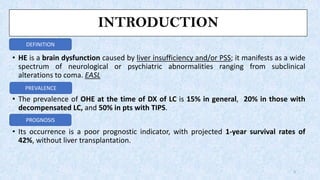
• HE is a brain dysfunction caused by liver insufficiency and/or PSS; it manifests as a wide
spectrum of neurological or psychiatric abnormalities ranging from subclinical
alterations to coma. EASL
• The prevalence of OHE at the time of DX of LC is 15% in general, 20% in those with
decompensated LC, and 50% in pts with TIPS.
• Its occurrence is a poor prognostic indicator, with projected 1-year survival rates of
42%, without liver transplantation.
3
DEFINITION
PREVALENCE
PROGNOSIS
CLASSIFICATION: ACC TO UNDERLYING DISEASE
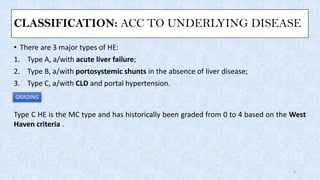
• There are 3 major types of HE:
1. Type A, a/with acute liver failure;
2. Type B, a/with portosystemic shunts in the absence of liver disease;
3. Type C, a/with CLD and portal hypertension.
4
GRADING
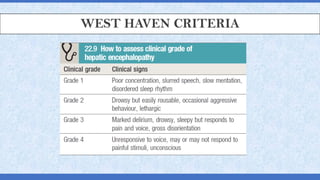
Type C HE is the MC type and has historically been graded from 0 to 4 based on the West
Haven criteria .
WEST HAVEN CRITERIA
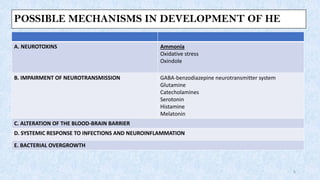
POSSIBLE MECHANISMS IN DEVELOPMENT OF HE
A. NEUROTOXINS Ammonia
Oxidative stress
Oxindole
B. IMPAIRMENT OF NEUROTRANSMISSION GABA-benzodiazepine neurotransmitter system
Glutamine
Catecholamines
Serotonin
Histamine
Melatonin
C. ALTERATION OF THE BLOOD-BRAIN BARRIER
D. SYSTEMIC RESPONSE TO INFECTIONS AND NEUROINFLAMMATION
E. BACTERIAL OVERGROWTH
6
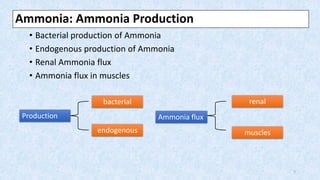
Ammonia: Ammonia Production
• Bacterial production of Ammonia
• Endogenous production of Ammonia
• Renal Ammonia flux
• Ammonia flux in muscles
7
Production Ammonia flux
endogenous
bacterial
muscles
renal
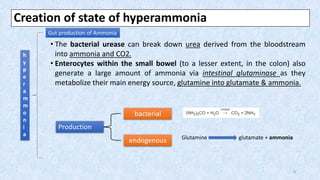
Creation of state of hyperammonia
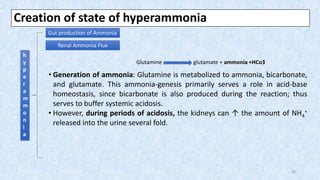
Gut production of Ammonia
• The bacterial urease can break down urea derived from the bloodstream
into ammonia and CO2.
• Enterocytes within the small bowel (to a lesser extent, in the colon) also
generate a large amount of ammonia via intestinal glutaminase as they
metabolize their main energy source, glutamine into glutamate & ammonia.
h
y
p
e
r
a
m
m
o
n
i
a
8
Glutamine glutamate + ammonia
Creation of state of hyperammonia
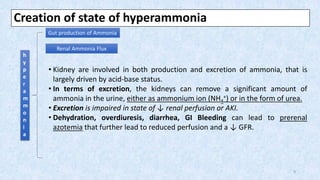
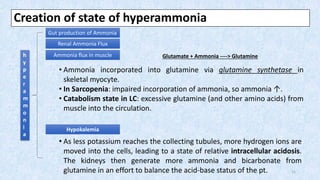
Renal Ammonia Flux
• Kidney are involved in both production and excretion of ammonia, that is
largely driven by acid-base status.
• In terms of excretion, the kidneys can remove a significant amount of
ammonia in the urine, either as ammonium ion (NH4
+) or in the form of urea.
• Excretion is impaired in state of ↓ renal perfusion or AKI.
• Dehydration, overdiuresis, diarrhea, GI Bleeding can lead to prerenal
azotemia that further lead to reduced perfusion and a ↓ GFR.
Gut production of Ammonia
h
y
p
e
r
a
m
m
o
n
i
a
9
Creation of state of hyperammonia
Renal Ammonia Flux
• Generation of ammonia: Glutamine is metabolized to ammonia, bicarbonate,
and glutamate. This ammonia-genesis primarily serves a role in acid-base
homeostasis, since bicarbonate is also produced during the reaction; thus
serves to buffer systemic acidosis.
• However, during periods of acidosis, the kidneys can ↑ the amount of NH4
+
released into the urine several fold.
Gut production of Ammonia
h
y
p
e
r
a
m
m
o
n
i
a
10
Glutamine glutamate + ammonia +HCo3
Creation of state of hyperammonia
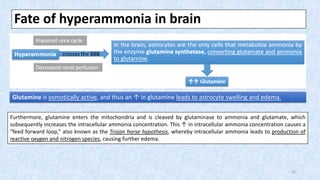
• Ammonia incorporated into glutamine via glutamine synthetase in
skeletal myocyte.
• In Sarcopenia: impaired incorporation of ammonia, so ammonia ↑.
• Catabolism state in LC: excessive glutamine (and other amino acids) from
muscle into the circulation.
Hypokalemia
Ammonia flux in muscle
• As less potassium reaches the collecting tubules, more hydrogen ions are
moved into the cells, leading to a state of relative intracellular acidosis.
The kidneys then generate more ammonia and bicarbonate from
glutamine in an effort to balance the acid-base status of the pt.
Renal Ammonia Flux
Gut production of Ammonia
h
y
p
e
r
a
m
m
o
n
i
a
11
Glutamate + Ammonia ----> Glutamine
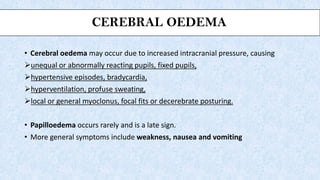
Fate of hyperammonia in brain
Furthermore, glutamine enters the mitochondria and is cleaved by glutaminase to ammonia and glutamate, which
subsequently increases the intracellular ammonia concentration. This ↑ in intracellular ammonia concentration causes a
“feed forward loop,” also known as the Trojan horse hypothesis, whereby intracellular ammonia leads to production of
reactive oxygen and nitrogen species, causing further edema.
Glutamine is osmotically active, and thus an ↑ in glutamine leads to astrocyte swelling and edema.
12
CEREBRAL OEDEMA
• Cerebral oedema may occur due to increased intracranial pressure, causing
➢unequal or abnormally reacting pupils, fixed pupils,
➢hypertensive episodes, bradycardia,
➢hyperventilation, profuse sweating,
➢local or general myoclonus, focal fits or decerebrate posturing.
• Papilloedema occurs rarely and is a late sign.
• More general symptoms include weakness, nausea and vomiting
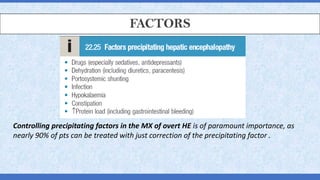
FACTORS
Controlling precipitating factors in the MX of overt HE is of paramount importance, as
nearly 90% of pts can be treated with just correction of the precipitating factor .
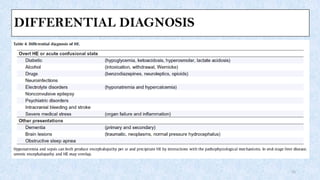
DIFFERENTIAL DIAGNOSIS
15
Diagnosis
• No specific laboratory findings indicate the presence of HE definitively.
• Blood ammonia levels are commonly measured in pts with cirrhosis and
PHTN but are not sensitive or specific for the presence of HE.
Blood ammonia levels may be a useful indicator of HE in the absence of cirrhosis and PHTN, as in pts with metabolic
disorders that influence ammonia generation or metabolism, such as urea cycle disorders
16
MANAGEMENT OF OHE:
• OHE therapy follows a four-pronged approach
(i) Excluding other causes of altered mental status
(ii) Caring for the unconscious patient
(iii) Determining and treating precipitating factors
(iv) Initiating empiric therapy.
17
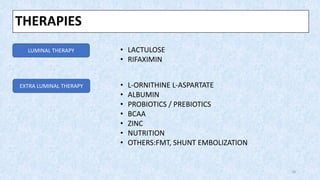
THERAPIES
18
LUMINAL THERAPY
EXTRA LUMINAL THERAPY
• LACTULOSE
• RIFAXIMIN
• L-ORNITHINE L-ASPARTATE
• ALBUMIN
• PROBIOTICS / PREBIOTICS
• BCAA
• ZINC
• NUTRITION
• OTHERS:FMT, SHUNT EMBOLIZATION
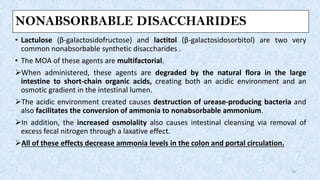
NONABSORBABLE DISACCHARIDES
• Lactulose (β-galactosidofructose) and lactitol (β-galactosidosorbitol) are two very
common nonabsorbable synthetic disaccharides .
• The MOA of these agents are multifactorial.
➢When administered, these agents are degraded by the natural flora in the large
intestine to short-chain organic acids, creating both an acidic environment and an
osmotic gradient in the intestinal lumen.
➢The acidic environment created causes destruction of urease-producing bacteria and
also facilitates the conversion of ammonia to nonabsorbable ammonium.
➢In addition, the increased osmolality also causes intestinal cleansing via removal of
excess fecal nitrogen through a laxative effect.
➢All of these effects decrease ammonia levels in the colon and portal circulation.
19
NONABSORBABLE DISACCHARIDES
• It is usually administered as an oral syrup with dosages being based on
clinical response for a goal of 2-3 soft bowel movements a day.
• Lactulose can also be given rectally, which is preferred in those in whom
oral administration is CI.
• Common side effects : flatulence, abdominal discomfort, and diarrhea.
• Lactitol : better tolerated than and as efficacious as lactulose.
20
RIFAXIMIN
• Rifaximin is a nonabsorbable antibiotic belonging to the rifamycin class.
• Its antibiotic action is due to the inhibition of chain formation in RNA
synthesis. It has a broad spectrum of action against several aerobic and
anaerobic gram-positive and gram-negative bacteria and does not have
any interactions with the cytochrome P450 substrates.
• The most common side effects reported include flatulence, abdominal
pain, headaches, and constipation.
• Dosing : 550 mg twice per day
21
PROBIOTICS AND PREBIOTICS
• Probiotics are live microbiologic dietary supplements that are intended to
have health benefits when consumed.
• Prebiotics are nondigestable food ingredients that selectively stimulate
the growth of bacteria in the colon.
• The combination of prebiotics and probiotics is called synbiotics.
22
ALBUMIN
• Albumin infusion has been used for the treatment of OHE, specifically
diuretic-induced OHE.
• In addition to volume expansion, albumin has antiinflammatory,
detoxifying, and immune modulating properties.
23
NUTRITION
• The current recommendations per the International Society for Hepatic
Encephalopathy and Nitrogen Metabolism -to have protein intake of 1.2
g/kg to 1.5 g/kg ideal body weight.
• In addition, it is also recommended for HE pts to consume 35-40 kcal/kg by
eating smalls meals that are evenly distributed throughout the day as well
as to have a late-night snack of complex carbohydrate to help minimize
protein utilization.
24
REASONS FOR HE RESISTANT TO RX
1. End-stage liver disease .
2. Excessive purgation leading to dehydration/free water loss
3. Failure to identify and treat sepsis
4. Ileus, especially in association with azotemia
5. Long-acting sedative drug intake
6. Undiagnosed concomitant CNS problem
7. Too-effective portosystemic shunt procedure
8. Profound zinc deficiency
25
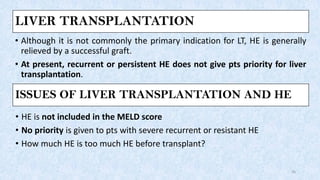
LIVER TRANSPLANTATION
• Although it is not commonly the primary indication for LT, HE is generally
relieved by a successful graft.
• At present, recurrent or persistent HE does not give pts priority for liver
transplantation.
26
ISSUES OF LIVER TRANSPLANTATION AND HE
• HE is not included in the MELD score
• No priority is given to pts with severe recurrent or resistant HE
• How much HE is too much HE before transplant?
END OF SLIDES

6. HEPATIC ENCEPHALOPATHY

  • 1.
    Hepatology lectures for 5thSem;MBBS Pratap Sagar Tiwari MBBS,MD (Medicine),DM (Hepatology)
  • 2.
  • 3.
    INTRODUCTION • HE isa brain dysfunction caused by liver insufficiency and/or PSS; it manifests as a wide spectrum of neurological or psychiatric abnormalities ranging from subclinical alterations to coma. EASL • The prevalence of OHE at the time of DX of LC is 15% in general, 20% in those with decompensated LC, and 50% in pts with TIPS. • Its occurrence is a poor prognostic indicator, with projected 1-year survival rates of 42%, without liver transplantation. 3 DEFINITION PREVALENCE PROGNOSIS
  • 4.
    CLASSIFICATION: ACC TOUNDERLYING DISEASE • There are 3 major types of HE: 1. Type A, a/with acute liver failure; 2. Type B, a/with portosystemic shunts in the absence of liver disease; 3. Type C, a/with CLD and portal hypertension. 4 GRADING Type C HE is the MC type and has historically been graded from 0 to 4 based on the West Haven criteria .
  • 5.
  • 6.
    POSSIBLE MECHANISMS INDEVELOPMENT OF HE A. NEUROTOXINS Ammonia Oxidative stress Oxindole B. IMPAIRMENT OF NEUROTRANSMISSION GABA-benzodiazepine neurotransmitter system Glutamine Catecholamines Serotonin Histamine Melatonin C. ALTERATION OF THE BLOOD-BRAIN BARRIER D. SYSTEMIC RESPONSE TO INFECTIONS AND NEUROINFLAMMATION E. BACTERIAL OVERGROWTH 6
  • 7.
    Ammonia: Ammonia Production •Bacterial production of Ammonia • Endogenous production of Ammonia • Renal Ammonia flux • Ammonia flux in muscles 7 Production Ammonia flux endogenous bacterial muscles renal
  • 8.
    Creation of stateof hyperammonia Gut production of Ammonia • The bacterial urease can break down urea derived from the bloodstream into ammonia and CO2. • Enterocytes within the small bowel (to a lesser extent, in the colon) also generate a large amount of ammonia via intestinal glutaminase as they metabolize their main energy source, glutamine into glutamate & ammonia. h y p e r a m m o n i a 8 Glutamine glutamate + ammonia
  • 9.
    Creation of stateof hyperammonia Renal Ammonia Flux • Kidney are involved in both production and excretion of ammonia, that is largely driven by acid-base status. • In terms of excretion, the kidneys can remove a significant amount of ammonia in the urine, either as ammonium ion (NH4 +) or in the form of urea. • Excretion is impaired in state of ↓ renal perfusion or AKI. • Dehydration, overdiuresis, diarrhea, GI Bleeding can lead to prerenal azotemia that further lead to reduced perfusion and a ↓ GFR. Gut production of Ammonia h y p e r a m m o n i a 9
  • 10.
    Creation of stateof hyperammonia Renal Ammonia Flux • Generation of ammonia: Glutamine is metabolized to ammonia, bicarbonate, and glutamate. This ammonia-genesis primarily serves a role in acid-base homeostasis, since bicarbonate is also produced during the reaction; thus serves to buffer systemic acidosis. • However, during periods of acidosis, the kidneys can ↑ the amount of NH4 + released into the urine several fold. Gut production of Ammonia h y p e r a m m o n i a 10 Glutamine glutamate + ammonia +HCo3
  • 11.
    Creation of stateof hyperammonia • Ammonia incorporated into glutamine via glutamine synthetase in skeletal myocyte. • In Sarcopenia: impaired incorporation of ammonia, so ammonia ↑. • Catabolism state in LC: excessive glutamine (and other amino acids) from muscle into the circulation. Hypokalemia Ammonia flux in muscle • As less potassium reaches the collecting tubules, more hydrogen ions are moved into the cells, leading to a state of relative intracellular acidosis. The kidneys then generate more ammonia and bicarbonate from glutamine in an effort to balance the acid-base status of the pt. Renal Ammonia Flux Gut production of Ammonia h y p e r a m m o n i a 11 Glutamate + Ammonia ----> Glutamine
  • 12.
    Fate of hyperammoniain brain Furthermore, glutamine enters the mitochondria and is cleaved by glutaminase to ammonia and glutamate, which subsequently increases the intracellular ammonia concentration. This ↑ in intracellular ammonia concentration causes a “feed forward loop,” also known as the Trojan horse hypothesis, whereby intracellular ammonia leads to production of reactive oxygen and nitrogen species, causing further edema. Glutamine is osmotically active, and thus an ↑ in glutamine leads to astrocyte swelling and edema. 12
  • 13.
    CEREBRAL OEDEMA • Cerebraloedema may occur due to increased intracranial pressure, causing ➢unequal or abnormally reacting pupils, fixed pupils, ➢hypertensive episodes, bradycardia, ➢hyperventilation, profuse sweating, ➢local or general myoclonus, focal fits or decerebrate posturing. • Papilloedema occurs rarely and is a late sign. • More general symptoms include weakness, nausea and vomiting
  • 14.
    FACTORS Controlling precipitating factorsin the MX of overt HE is of paramount importance, as nearly 90% of pts can be treated with just correction of the precipitating factor .
  • 15.
  • 16.
    Diagnosis • No specificlaboratory findings indicate the presence of HE definitively. • Blood ammonia levels are commonly measured in pts with cirrhosis and PHTN but are not sensitive or specific for the presence of HE. Blood ammonia levels may be a useful indicator of HE in the absence of cirrhosis and PHTN, as in pts with metabolic disorders that influence ammonia generation or metabolism, such as urea cycle disorders 16
  • 17.
    MANAGEMENT OF OHE: •OHE therapy follows a four-pronged approach (i) Excluding other causes of altered mental status (ii) Caring for the unconscious patient (iii) Determining and treating precipitating factors (iv) Initiating empiric therapy. 17
  • 18.
    THERAPIES 18 LUMINAL THERAPY EXTRA LUMINALTHERAPY • LACTULOSE • RIFAXIMIN • L-ORNITHINE L-ASPARTATE • ALBUMIN • PROBIOTICS / PREBIOTICS • BCAA • ZINC • NUTRITION • OTHERS:FMT, SHUNT EMBOLIZATION
  • 19.
    NONABSORBABLE DISACCHARIDES • Lactulose(β-galactosidofructose) and lactitol (β-galactosidosorbitol) are two very common nonabsorbable synthetic disaccharides . • The MOA of these agents are multifactorial. ➢When administered, these agents are degraded by the natural flora in the large intestine to short-chain organic acids, creating both an acidic environment and an osmotic gradient in the intestinal lumen. ➢The acidic environment created causes destruction of urease-producing bacteria and also facilitates the conversion of ammonia to nonabsorbable ammonium. ➢In addition, the increased osmolality also causes intestinal cleansing via removal of excess fecal nitrogen through a laxative effect. ➢All of these effects decrease ammonia levels in the colon and portal circulation. 19
  • 20.
    NONABSORBABLE DISACCHARIDES • Itis usually administered as an oral syrup with dosages being based on clinical response for a goal of 2-3 soft bowel movements a day. • Lactulose can also be given rectally, which is preferred in those in whom oral administration is CI. • Common side effects : flatulence, abdominal discomfort, and diarrhea. • Lactitol : better tolerated than and as efficacious as lactulose. 20
  • 21.
    RIFAXIMIN • Rifaximin isa nonabsorbable antibiotic belonging to the rifamycin class. • Its antibiotic action is due to the inhibition of chain formation in RNA synthesis. It has a broad spectrum of action against several aerobic and anaerobic gram-positive and gram-negative bacteria and does not have any interactions with the cytochrome P450 substrates. • The most common side effects reported include flatulence, abdominal pain, headaches, and constipation. • Dosing : 550 mg twice per day 21
  • 22.
    PROBIOTICS AND PREBIOTICS •Probiotics are live microbiologic dietary supplements that are intended to have health benefits when consumed. • Prebiotics are nondigestable food ingredients that selectively stimulate the growth of bacteria in the colon. • The combination of prebiotics and probiotics is called synbiotics. 22
  • 23.
    ALBUMIN • Albumin infusionhas been used for the treatment of OHE, specifically diuretic-induced OHE. • In addition to volume expansion, albumin has antiinflammatory, detoxifying, and immune modulating properties. 23
  • 24.
    NUTRITION • The currentrecommendations per the International Society for Hepatic Encephalopathy and Nitrogen Metabolism -to have protein intake of 1.2 g/kg to 1.5 g/kg ideal body weight. • In addition, it is also recommended for HE pts to consume 35-40 kcal/kg by eating smalls meals that are evenly distributed throughout the day as well as to have a late-night snack of complex carbohydrate to help minimize protein utilization. 24
  • 25.
    REASONS FOR HERESISTANT TO RX 1. End-stage liver disease . 2. Excessive purgation leading to dehydration/free water loss 3. Failure to identify and treat sepsis 4. Ileus, especially in association with azotemia 5. Long-acting sedative drug intake 6. Undiagnosed concomitant CNS problem 7. Too-effective portosystemic shunt procedure 8. Profound zinc deficiency 25
  • 26.
    LIVER TRANSPLANTATION • Althoughit is not commonly the primary indication for LT, HE is generally relieved by a successful graft. • At present, recurrent or persistent HE does not give pts priority for liver transplantation. 26 ISSUES OF LIVER TRANSPLANTATION AND HE • HE is not included in the MELD score • No priority is given to pts with severe recurrent or resistant HE • How much HE is too much HE before transplant?
  • 27.