Disorders of potassium metabolism Yu-Hong Jia, Ph.D Department of pathophysiology Dalian medical university
Potassium function Participates in many metabolic processes, e.g. regulation of protein and glycogen synthesis.  Maintain osmotic and acid-base balance between intra- and extra- cell. Maintain resting membrane potential (RMP) of cellular membrane.
Ⅰ . Normal potassium metabolism
K + Na + ATPase K + H + K +  channel 140-160 mmol/L 4.2±0.3mmol/L 50-200mmol/day  K +  ingestion Kidney colon skin (90%) insulin β-adrenergic agonist ECF [K + ] K + : 50-55mmol/kg B.W toxin (Ba) acid-base state Pump-leak
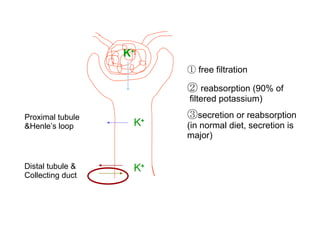
①  free filtration   ②  reabsorption (90% of  filtered potassium) ③ secretion or reabsorption (in normal diet, secretion is major) K + K + K + Proximal tubule &Henle’s loop Distal tubule & Collecting duct
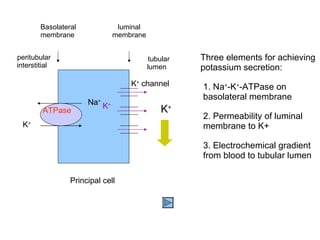
Three elements for achieving potassium secretion: 1. Na + -K + -ATPase on basolateral membrane 2. Permeability of luminal membrane to K+ 3. Electrochemical gradient from blood to tubular lumen ATPase Na + K + K +  channel K + Principal cell Basolateral  membrane luminal membrane peritubular interstitial  tubular lumen K +
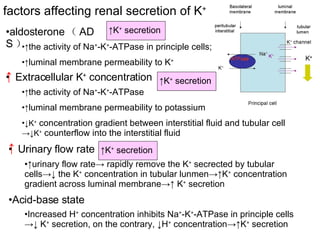
factors affecting renal secretion of K + ↑ the activity of Na + -K + -ATPase in principle cells; ↑ luminal membrane permeability to K + ↑ the activity of Na + -K + -ATPase ↑ luminal membrane permeability to potassium ↓ K +  concentration gradient between interstitial fluid and tubular cell  ->↓K +  counterflow into the interstitial fluid ↑ urinary flow rate-> rapidly remove the K +  secrected by tubular cells->↓ the K +  concentration in tubular lunmen->↑K +  concentration gradient across luminal membrane->↑ K +  secretion Increased H +  concentration inhibits Na + -K + -ATPase in principle cells ->↓ K +  secretion, on the contrary, ↓H +  concentration->↑K +  secretion aldosterone ( ADS ) Extracellular K +  concentration  Urinary flow rate Acid-base state ↑ ↑ ↑ K +  secretion ↑ K +  secretion ↑ K +  secretion
K + Na + ATPase K + H + K +  channel 140-160 mmol/L 4.2±0.3mmol/L 50-200mmol K +  ingestion Kidney colon skin (90%) insulin β-adrenergic agonist ECF [K + ] 50-55mmol/kg B.W ADS ECF K +  concentration Urinary flow rate acid-base state toxin drug acid-base state
Ⅱ . Disorders of potassium metabolism
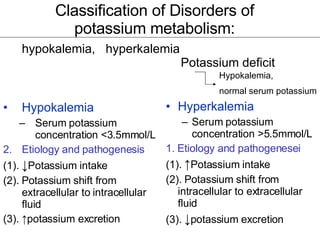
Classification of Disorders of potassium metabolism: Hypokalemia Serum potassium concentration <3.5mmol/L Etiology and pathogenesis (1).  ↓ Potassium intake (2). Potassium shift from extracellular to intracellular fluid (3). ↑potassium excretion Hyperkalemia Serum potassium concentration >5.5mmol/L 1. Etiology and  pathogenesei (1).  ↑ Potassium intake (2). Potassium shift from intracellular to extracellular fluid (3).  ↓ potassium excretion hypokalemia,  hyperkalemia Potassium deficit Hypokalemia, normal serum potassium
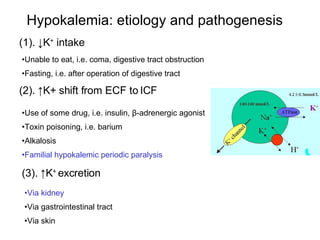
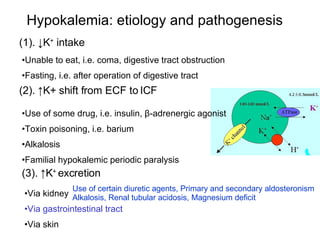
Hypokalemia: etiology and pathogenesis (3). ↑K +  excretion Unable to eat, i.e. coma, digestive tract obstruction Fasting, i.e. after operation of digestive tract (1). ↓K +  intake (2). ↑K+ shift from ECF to ICF Use of some drug, i.e. insulin,  β -adrenergic agonist Toxin poisoning, i.e. barium Alkalosis Familial  hypokalemic  periodic paralysis Via kidney Via gastrointestinal tract Via skin
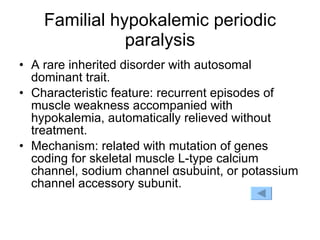
Familial hypokalemic periodic paralysis A rare inherited disorder with autosomal dominant trait. Characteristic feature: recurrent episodes of muscle weakness accompanied with hypokalemia, automatically relieved without treatment. Mechanism: related with mutation of genes coding for skeletal muscle L-type calcium channel, sodium channel  α subuint,  or potassium channel accessory subunit.
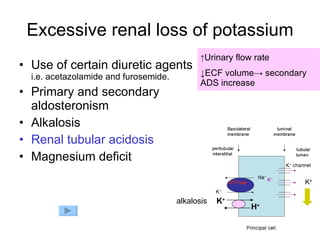
Excessive renal loss of potassium Use of certain diuretic agents  i.e. acetazolamide and furosemide. Primary and secondary aldosteronism Alkalosis Renal tubular acidosis Magnesium deficit K + H + alkalosis ↑ Urinary flow rate ↓ ECF volume-> secondary ADS increase
Renal tubular acidosis (RTA) Acidosis caused by renal tubular dysfunction. Type ⅠRTA: distal renal tubular acidosis, caused by reduced H +  secretion in the distal nephron  Type ⅡRTA: proximal renal tubular acidosis, caused by impaired reabsorption of HCO 3 -  in the proximal tubule.
Hypokalemia: etiology and pathogenesis (3). ↑K +  excretion Unable to eat, i.e. coma, digestive tract obstruction Fasting, i.e. after operation of digestive tract (1). ↓K +  intake (2). ↑K+ shift from ECF to ICF Use of some drug, i.e. insulin,  β -adrenergic agonist Toxin poisoning, i.e. barium Alkalosis Familial hypokalemic periodic paralysis Via kidney Via gastrointestinal tract Via skin Use of certain diuretic agents, Primary and secondary aldosteronism Alkalosis, Renal tubular acidosis, Magnesium deficit
Excessive gastrointestinal loss of K +  — vomit, diarrhea, gastric suction Direct K +  loss through gastrointestinal juice Gastrointestinal juice loss-> extracellular fluid volume decrease-> ADS secretion increase-> renal excretion of K +  increase vomiting-> gastric acid (HCl) loss -> alkalosis is resulted in ->K +  shift into cells via H + -K +  exchange and increased renal excretion of K +
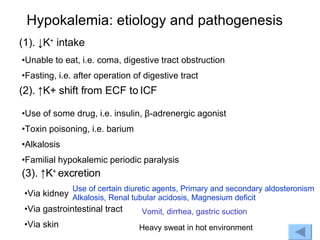
Hypokalemia: etiology and pathogenesis (3). ↑K +  excretion Unable to eat, i.e. coma, digestive tract obstruction Fasting, i.e. after operation of digestive tract (1). ↓K +  intake (2). ↑K+ shift from ECF to ICF Use of some drug, i.e. insulin,  β -adrenergic agonist Toxin poisoning, i.e. barium Alkalosis Familial hypokalemic periodic paralysis Via kidney Via gastrointestinal tract Via skin Use of certain diuretic agents, Primary and secondary aldosteronism Alkalosis, Renal tubular acidosis, Magnesium deficit Vomit, dirrhea, gastric suction Heavy sweat in hot environment
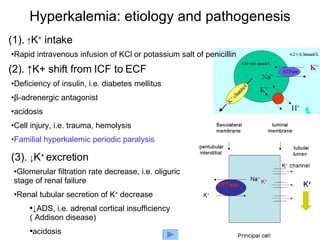
Hyperkalemia: etiology and pathogenesis (3).  ↓ K +  excretion Rapid intravenous infusion of KCl or potassium salt of penicillin (1).  ↑ K +  intake (2). ↑K+ shift from ICF to ECF Deficiency of insulin, i.e. diabetes mellitus β -adrenergic antagonist acidosis Cell injury, i.e. trauma, hemolysis Familial  hyperkalemic  periodic paralysis Glomerular filtration rate decrease, i.e. oliguric stage of renal failure Renal tubular secretion of K +  decrease ↓ ADS, i.e. adrenal cortical insufficiency ( Addison disease) acidosis
Familial hyperkalemia periodic paralysis A rare inherited disorder with autosomal dominant trait. A sudden increase in serum potassium concentration and muscle paralysis
2. Alterations of metabolism and function Dysfunction related with abnormal resting membrane potential Damage related with cellular metabolism dysfunction Effect on acid-base balance
Permeability  RMP negative value ↓  ->  ↓  i.e. normal -90mv -> -70mv Extracellular K +  concentration   [K + ] e  RMP negative value  ↓  ->  ↑ ↑  ->  ↓   Electrical gradient Chemical gradient K + 140-160mmmol/L 4.2±0.3mmol/L Resting membrane potential (RMP) Excitable cell Cell membrane permeability to K + K +  transmembrane concentration gradient - - - - - + + + + + Na + ATPase RMP ≈ ﹣ 59.5lg Intracellular K +  concentration extracellular K +  concentration
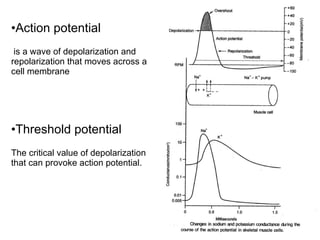
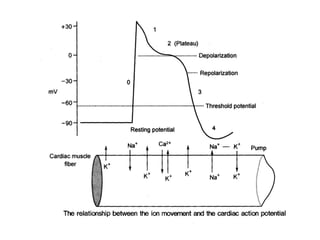
Action potential is a wave of depolarization and repolarization that moves across a cell membrane Threshold potential The critical value of depolarization that can provoke action potential.
 
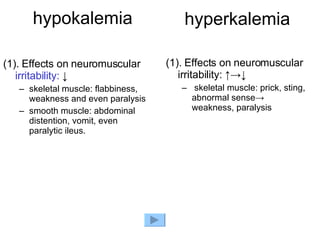
hypokalemia (1). Effects on neuromuscular  irritability:  ↓ skeletal muscle: flabbiness, weakness and even paralysis smooth muscle: abdominal distention, vomit, even paralytic ileus. (1). Effects on neuromuscular irritability: ↑->↓ skeletal muscle: prick, sting, abnormal sense-> weakness, paralysis hyperkalemia
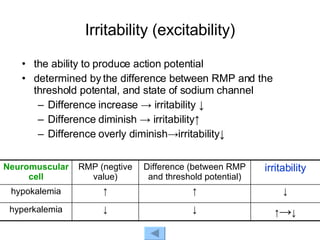
Irritability (excitability) the ability to produce action potential determined by the difference between RMP and the threshold potental, and state of sodium channel Difference increase -> irritability ↓ Difference diminish -> irritability↑  Difference overly diminish->irritability↓ ↑ -> ↓ ↓ ↓ hyperkalemia ↓ ↑ ↑ hypokalemia irritability Difference (between RMP and threshold potential) RMP (negtive value) Neuromuscular cell
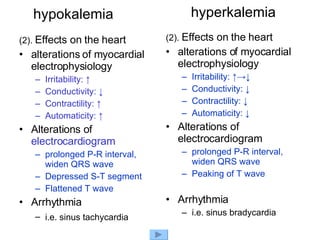
hypokalemia (2).  Effects on the heart alterations of myocardial electrophysiology Irritability: ↑ Conductivity: ↓ Contractility: ↑ Automaticity : ↑ Alterations of  electrocardiogram prolonged P-R interval, widen QRS wave Depressed S-T segment Flattened T wave Arrhythmia i.e. sinus tachycardia   (2).  Effects on the heart alterations of myocardial electrophysiology Irritability: ↑->↓ Conductivity: ↓ Contractility: ↓ Automaticity: ↓ Alterations of electrocardiogram prolonged P-R interval, widen QRS wave Peaking of T wave Arrhythmia i.e. sinus bradycardia hyperkalemia
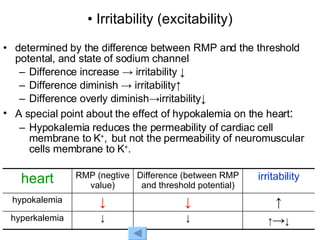
Irritability (excitability) determined by the difference between RMP and the threshold potental, and state of sodium channel Difference increase -> irritability ↓ Difference diminish -> irritability↑  Difference overly diminish->irritability↓ A special point about the effect of hypokalemia on the heart : Hypokalemia reduces the permeability of cardiac cell membrane to K + ,  but not the permeability of neuromuscular cells membrane to K + . ↑ -> ↓ ↓ ↓ hyperkalemia ↑ ↓ ↓ hypokalemia irritability Difference (between RMP and threshold potential) RMP (negtive value) heart
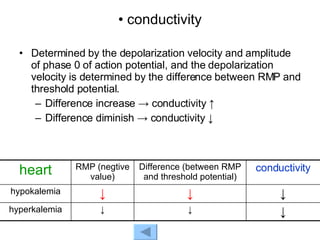
conductivity Determined by the depolarization velocity and amplitude of phase 0 of action potential, and the depolarization velocity is determined by the difference between RMP and threshold potential. Difference increase -> conductivity ↑ Difference diminish -> conductivity ↓ ↓ ↓ ↓ hyperkalemia ↓ ↓ ↓ hypokalemia conductivity Difference (between RMP and threshold potential) RMP (negtive value) heart
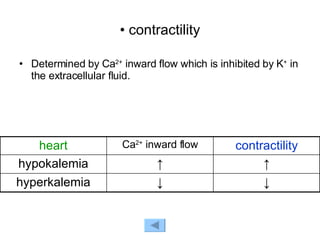
contractility Determined by Ca 2+  inward flow which is inhibited by K +  in the extracellular fluid. ↓ ↓ hyperkalemia ↑ ↑ hypokalemia contractility Ca 2+  inward flow heart
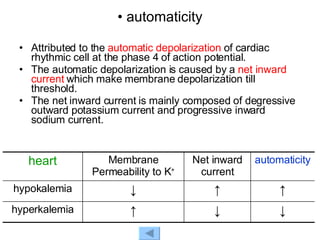
automaticity Attributed to the  automatic depolarization  of cardiac rhythmic cell at the phase 4 of action potential. The automatic depolarization is caused by a  net inward current  which make membrane depolarization till threshold. The net inward current is mainly composed of degressive outward potassium current and progressive inward sodium current. ↓ ↓ ↑ hyperkalemia ↑ ↑ ↓ hypokalemia automaticity Net inward current Membrane Permeability to K + heart
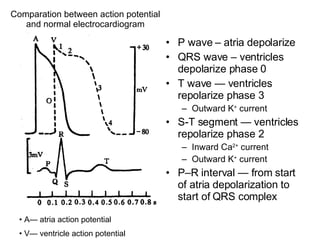
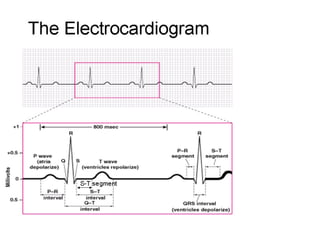
P wave – atria depolarize QRS wave – ventricles depolarize phase 0 T wave — ventricles repolarize phase 3 Outward K +  current S-T segment — ventricles repolarize phase 2 Inward Ca 2+  current Outward K +  current P–R interval — from start of atria depolarization to start of QRS complex Comparation between action potential and normal electrocardiogram A— atria action potential V— ventricle action potential
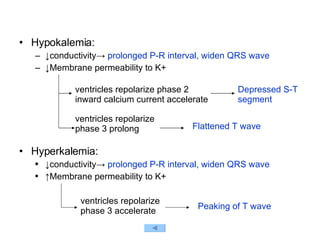
Hypokalemia: ↓ conductivity->  prolonged P-R interval, widen QRS wave ↓ Membrane permeability to K+ Hyperkalemia: ↓ conductivity->  prolonged P-R interval, widen QRS wave ↑ Membrane permeability to K+ ventricles repolarize phase 3 accelerate Peaking of T wave ventricles repolarize phase 3 prolong ventricles repolarize phase 2 inward calcium current accelerate Depressed S-T segment Flattened T wave
hypokalemia (3).  Effects on acid-base balance alkalosis Paradoxical aciduria (3).  Effects on acid-base balance acidosis Paradoxical alkaline urine hyperkalemia ↓[K + ] ECF H + -K +  exchange ↓[H + ] ECF ↑[H + ] ICF ↑Renal excretion of H +   aciduria K +  shift out of cells H +  shift into cells alkalosis (Paradoxical aciduria) ↑[K + ] ECF H + -K +  exchange ↑[H + ] ECF ↓[H + ] ICF ↓Renal excretion of H +   Alkaline urine K +  shift into cells H +  shift out of cells acidosis (Paradoxical alkaline urine)
hypokalemia (4). Damage related with metabolism dysfunction polyuria Renal tubulointerstitial damage


Potassium Imbalance

  • 1.
    Disorders of potassiummetabolism Yu-Hong Jia, Ph.D Department of pathophysiology Dalian medical university
  • 2.
    Potassium function Participatesin many metabolic processes, e.g. regulation of protein and glycogen synthesis. Maintain osmotic and acid-base balance between intra- and extra- cell. Maintain resting membrane potential (RMP) of cellular membrane.
  • 3.
    Ⅰ . Normalpotassium metabolism
  • 4.
    K + Na+ ATPase K + H + K + channel 140-160 mmol/L 4.2±0.3mmol/L 50-200mmol/day K + ingestion Kidney colon skin (90%) insulin β-adrenergic agonist ECF [K + ] K + : 50-55mmol/kg B.W toxin (Ba) acid-base state Pump-leak
  • 5.
    ① freefiltration ② reabsorption (90% of filtered potassium) ③ secretion or reabsorption (in normal diet, secretion is major) K + K + K + Proximal tubule &Henle’s loop Distal tubule & Collecting duct
  • 6.
    Three elements forachieving potassium secretion: 1. Na + -K + -ATPase on basolateral membrane 2. Permeability of luminal membrane to K+ 3. Electrochemical gradient from blood to tubular lumen ATPase Na + K + K + channel K + Principal cell Basolateral membrane luminal membrane peritubular interstitial tubular lumen K +
  • 7.
    factors affecting renalsecretion of K + ↑ the activity of Na + -K + -ATPase in principle cells; ↑ luminal membrane permeability to K + ↑ the activity of Na + -K + -ATPase ↑ luminal membrane permeability to potassium ↓ K + concentration gradient between interstitial fluid and tubular cell ->↓K + counterflow into the interstitial fluid ↑ urinary flow rate-> rapidly remove the K + secrected by tubular cells->↓ the K + concentration in tubular lunmen->↑K + concentration gradient across luminal membrane->↑ K + secretion Increased H + concentration inhibits Na + -K + -ATPase in principle cells ->↓ K + secretion, on the contrary, ↓H + concentration->↑K + secretion aldosterone ( ADS ) Extracellular K + concentration Urinary flow rate Acid-base state ↑ ↑ ↑ K + secretion ↑ K + secretion ↑ K + secretion
  • 8.
    K + Na+ ATPase K + H + K + channel 140-160 mmol/L 4.2±0.3mmol/L 50-200mmol K + ingestion Kidney colon skin (90%) insulin β-adrenergic agonist ECF [K + ] 50-55mmol/kg B.W ADS ECF K + concentration Urinary flow rate acid-base state toxin drug acid-base state
  • 9.
    Ⅱ . Disordersof potassium metabolism
  • 10.
    Classification of Disordersof potassium metabolism: Hypokalemia Serum potassium concentration <3.5mmol/L Etiology and pathogenesis (1). ↓ Potassium intake (2). Potassium shift from extracellular to intracellular fluid (3). ↑potassium excretion Hyperkalemia Serum potassium concentration >5.5mmol/L 1. Etiology and pathogenesei (1). ↑ Potassium intake (2). Potassium shift from intracellular to extracellular fluid (3). ↓ potassium excretion hypokalemia, hyperkalemia Potassium deficit Hypokalemia, normal serum potassium
  • 11.
    Hypokalemia: etiology andpathogenesis (3). ↑K + excretion Unable to eat, i.e. coma, digestive tract obstruction Fasting, i.e. after operation of digestive tract (1). ↓K + intake (2). ↑K+ shift from ECF to ICF Use of some drug, i.e. insulin, β -adrenergic agonist Toxin poisoning, i.e. barium Alkalosis Familial hypokalemic periodic paralysis Via kidney Via gastrointestinal tract Via skin
  • 12.
    Familial hypokalemic periodicparalysis A rare inherited disorder with autosomal dominant trait. Characteristic feature: recurrent episodes of muscle weakness accompanied with hypokalemia, automatically relieved without treatment. Mechanism: related with mutation of genes coding for skeletal muscle L-type calcium channel, sodium channel α subuint, or potassium channel accessory subunit.
  • 13.
    Excessive renal lossof potassium Use of certain diuretic agents i.e. acetazolamide and furosemide. Primary and secondary aldosteronism Alkalosis Renal tubular acidosis Magnesium deficit K + H + alkalosis ↑ Urinary flow rate ↓ ECF volume-> secondary ADS increase
  • 14.
    Renal tubular acidosis(RTA) Acidosis caused by renal tubular dysfunction. Type ⅠRTA: distal renal tubular acidosis, caused by reduced H + secretion in the distal nephron Type ⅡRTA: proximal renal tubular acidosis, caused by impaired reabsorption of HCO 3 - in the proximal tubule.
  • 15.
    Hypokalemia: etiology andpathogenesis (3). ↑K + excretion Unable to eat, i.e. coma, digestive tract obstruction Fasting, i.e. after operation of digestive tract (1). ↓K + intake (2). ↑K+ shift from ECF to ICF Use of some drug, i.e. insulin, β -adrenergic agonist Toxin poisoning, i.e. barium Alkalosis Familial hypokalemic periodic paralysis Via kidney Via gastrointestinal tract Via skin Use of certain diuretic agents, Primary and secondary aldosteronism Alkalosis, Renal tubular acidosis, Magnesium deficit
  • 16.
    Excessive gastrointestinal lossof K + — vomit, diarrhea, gastric suction Direct K + loss through gastrointestinal juice Gastrointestinal juice loss-> extracellular fluid volume decrease-> ADS secretion increase-> renal excretion of K + increase vomiting-> gastric acid (HCl) loss -> alkalosis is resulted in ->K + shift into cells via H + -K + exchange and increased renal excretion of K +
  • 17.
    Hypokalemia: etiology andpathogenesis (3). ↑K + excretion Unable to eat, i.e. coma, digestive tract obstruction Fasting, i.e. after operation of digestive tract (1). ↓K + intake (2). ↑K+ shift from ECF to ICF Use of some drug, i.e. insulin, β -adrenergic agonist Toxin poisoning, i.e. barium Alkalosis Familial hypokalemic periodic paralysis Via kidney Via gastrointestinal tract Via skin Use of certain diuretic agents, Primary and secondary aldosteronism Alkalosis, Renal tubular acidosis, Magnesium deficit Vomit, dirrhea, gastric suction Heavy sweat in hot environment
  • 18.
    Hyperkalemia: etiology andpathogenesis (3). ↓ K + excretion Rapid intravenous infusion of KCl or potassium salt of penicillin (1). ↑ K + intake (2). ↑K+ shift from ICF to ECF Deficiency of insulin, i.e. diabetes mellitus β -adrenergic antagonist acidosis Cell injury, i.e. trauma, hemolysis Familial hyperkalemic periodic paralysis Glomerular filtration rate decrease, i.e. oliguric stage of renal failure Renal tubular secretion of K + decrease ↓ ADS, i.e. adrenal cortical insufficiency ( Addison disease) acidosis
  • 19.
    Familial hyperkalemia periodicparalysis A rare inherited disorder with autosomal dominant trait. A sudden increase in serum potassium concentration and muscle paralysis
  • 20.
    2. Alterations ofmetabolism and function Dysfunction related with abnormal resting membrane potential Damage related with cellular metabolism dysfunction Effect on acid-base balance
  • 21.
    Permeability RMPnegative value ↓ -> ↓ i.e. normal -90mv -> -70mv Extracellular K + concentration [K + ] e RMP negative value ↓ -> ↑ ↑ -> ↓ Electrical gradient Chemical gradient K + 140-160mmmol/L 4.2±0.3mmol/L Resting membrane potential (RMP) Excitable cell Cell membrane permeability to K + K + transmembrane concentration gradient - - - - - + + + + + Na + ATPase RMP ≈ ﹣ 59.5lg Intracellular K + concentration extracellular K + concentration
  • 22.
    Action potential isa wave of depolarization and repolarization that moves across a cell membrane Threshold potential The critical value of depolarization that can provoke action potential.
  • 23.
  • 24.
    hypokalemia (1). Effectson neuromuscular irritability: ↓ skeletal muscle: flabbiness, weakness and even paralysis smooth muscle: abdominal distention, vomit, even paralytic ileus. (1). Effects on neuromuscular irritability: ↑->↓ skeletal muscle: prick, sting, abnormal sense-> weakness, paralysis hyperkalemia
  • 25.
    Irritability (excitability) theability to produce action potential determined by the difference between RMP and the threshold potental, and state of sodium channel Difference increase -> irritability ↓ Difference diminish -> irritability↑ Difference overly diminish->irritability↓ ↑ -> ↓ ↓ ↓ hyperkalemia ↓ ↑ ↑ hypokalemia irritability Difference (between RMP and threshold potential) RMP (negtive value) Neuromuscular cell
  • 26.
    hypokalemia (2). Effects on the heart alterations of myocardial electrophysiology Irritability: ↑ Conductivity: ↓ Contractility: ↑ Automaticity : ↑ Alterations of electrocardiogram prolonged P-R interval, widen QRS wave Depressed S-T segment Flattened T wave Arrhythmia i.e. sinus tachycardia (2). Effects on the heart alterations of myocardial electrophysiology Irritability: ↑->↓ Conductivity: ↓ Contractility: ↓ Automaticity: ↓ Alterations of electrocardiogram prolonged P-R interval, widen QRS wave Peaking of T wave Arrhythmia i.e. sinus bradycardia hyperkalemia
  • 27.
    Irritability (excitability) determinedby the difference between RMP and the threshold potental, and state of sodium channel Difference increase -> irritability ↓ Difference diminish -> irritability↑ Difference overly diminish->irritability↓ A special point about the effect of hypokalemia on the heart : Hypokalemia reduces the permeability of cardiac cell membrane to K + , but not the permeability of neuromuscular cells membrane to K + . ↑ -> ↓ ↓ ↓ hyperkalemia ↑ ↓ ↓ hypokalemia irritability Difference (between RMP and threshold potential) RMP (negtive value) heart
  • 28.
    conductivity Determined bythe depolarization velocity and amplitude of phase 0 of action potential, and the depolarization velocity is determined by the difference between RMP and threshold potential. Difference increase -> conductivity ↑ Difference diminish -> conductivity ↓ ↓ ↓ ↓ hyperkalemia ↓ ↓ ↓ hypokalemia conductivity Difference (between RMP and threshold potential) RMP (negtive value) heart
  • 29.
    contractility Determined byCa 2+ inward flow which is inhibited by K + in the extracellular fluid. ↓ ↓ hyperkalemia ↑ ↑ hypokalemia contractility Ca 2+ inward flow heart
  • 30.
    automaticity Attributed tothe automatic depolarization of cardiac rhythmic cell at the phase 4 of action potential. The automatic depolarization is caused by a net inward current which make membrane depolarization till threshold. The net inward current is mainly composed of degressive outward potassium current and progressive inward sodium current. ↓ ↓ ↑ hyperkalemia ↑ ↑ ↓ hypokalemia automaticity Net inward current Membrane Permeability to K + heart
  • 31.
    P wave –atria depolarize QRS wave – ventricles depolarize phase 0 T wave — ventricles repolarize phase 3 Outward K + current S-T segment — ventricles repolarize phase 2 Inward Ca 2+ current Outward K + current P–R interval — from start of atria depolarization to start of QRS complex Comparation between action potential and normal electrocardiogram A— atria action potential V— ventricle action potential
  • 32.
    Hypokalemia: ↓ conductivity-> prolonged P-R interval, widen QRS wave ↓ Membrane permeability to K+ Hyperkalemia: ↓ conductivity-> prolonged P-R interval, widen QRS wave ↑ Membrane permeability to K+ ventricles repolarize phase 3 accelerate Peaking of T wave ventricles repolarize phase 3 prolong ventricles repolarize phase 2 inward calcium current accelerate Depressed S-T segment Flattened T wave
  • 33.
    hypokalemia (3). Effects on acid-base balance alkalosis Paradoxical aciduria (3). Effects on acid-base balance acidosis Paradoxical alkaline urine hyperkalemia ↓[K + ] ECF H + -K + exchange ↓[H + ] ECF ↑[H + ] ICF ↑Renal excretion of H + aciduria K + shift out of cells H + shift into cells alkalosis (Paradoxical aciduria) ↑[K + ] ECF H + -K + exchange ↑[H + ] ECF ↓[H + ] ICF ↓Renal excretion of H + Alkaline urine K + shift into cells H + shift out of cells acidosis (Paradoxical alkaline urine)
  • 34.
    hypokalemia (4). Damagerelated with metabolism dysfunction polyuria Renal tubulointerstitial damage
  • 35.
  • 36.