Institute on Asian
Consumer Insight (ACI)
Creativity and Design
http://www.aci-institute.com
1
Key concepts from Day 1 shared by you
• Creativity is diverse, no ideal form
• More crucially: creativity needs
diversity
• “It takes different people to identify
problems and generate solutions”
• “Different ways of looking at things”
• From “everybody can be creative”
to “creativity needs everybody”
• Creators need information and
feedback
• Creativity can come from anyone
• “Creativity is everywhere”
• (r)evolutionary
• Do not wait for ideas to arrive, take
action
• Use proposed solutions to reframe
problems
• People can use their talents and
experiences to be uniquely creative
• Perseverance is key. Iteration.
• Design with others, not for them
• DIY activity placed the ball in our
court, give us confidence
Possible actions
• Identify and understand the
problems before looking for
solutions
• Use solution ideas to explore and
reframe the problem; review
constantly
• Use the word “creativity” more
often at work
• “There should be better ways of
doing what I do”
• “I need to be more open”
• Practice putting on a “creative hat”,
change attitude
• Change my routine
• Seek ideas from colleagues in other
departments. “I need to team up
with people”
• Give people space to reflect and
create
• Create a fun environment
• Frame questions differently
• Look for opportunities. Look for the
boundaries
• Put humans in the centre
• What else should I unlearn? What
other myths do I believe?
• “This is something I can start
working on immediately”
Questions
• How to convince/motivate/support others to embrace creativity?
(especially…)
• The cultural shaping of creativity
• Contradiction: everyone is creative… but children aren’t creative?
• What are my real motivations (to be creative)?
• Do creative ideas always lead to +profits? +success? +value?
• If everyone can be creative, then what is not creative?
• How to evaluate potential (of new ideas)?
• How do I free myself (from myths, the past, the context)?
• How to frame questions so that new perspectives can be generated?
• How to sell a creative idea? How can I know if my ideas are creative?
• Is there a process/template/methodology that can be followed?
• Who determines what is creative or isn’t?
Activity 2.1: A memorable time when
you resisted change, or saw someone
resisting change
Duration: 15 minutes
Mode: Individual
6
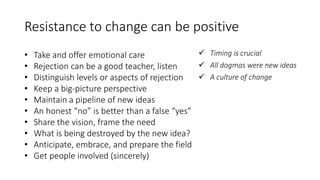
Resistance to change can be positive
• Take and offer emotional care
• Rejection can be a good teacher, listen
• Distinguish levels or aspects of rejection
• Keep a big-picture perspective
• Maintain a pipeline of new ideas
• An honest “no” is better than a false “yes”
• Share the vision, frame the need
• What is being destroyed by the new idea?
• Anticipate, embrace, and prepare the field
• Get people involved (sincerely)
 Timing is crucial
 All dogmas were new ideas
 A culture of change
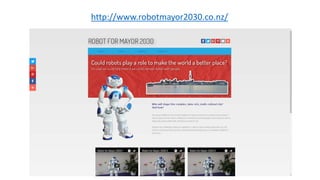
http://www.robotmayor2030.co.nz/
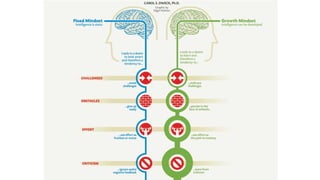
Activity 2.2: Growth mindset
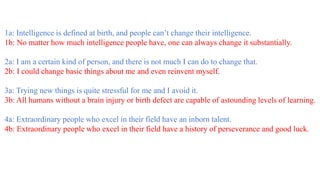
1a: Intelligence is defined at birth, and people can’t change their intelligence.
1b: No matter how much intelligence people have, one can always change it substantially.
2a: I am a certain kind of person, and there is not much I can do to change that.
2b: I could change basic things about me and even reinvent myself.
3a: Trying new things is quite stressful for me and I avoid it.
3b: All humans without a brain injury or birth defect are capable of astounding levels of learning.
4a: Extraordinary people who excel in their field have an inborn talent.
4b: Extraordinary people who excel in their field have a history of perseverance and good luck.
http://www.wall321.com/
WRONG
16
http://www.salzburgglobal.org/topics/imagination/article/arne-dietrich-various-forms-of-creativity-are-governed-by-two-different-brain-systems.html
Morning tea
15 minutes
18
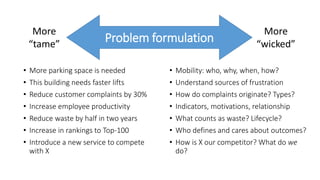
Problem formulation
More
“tame”
More
“wicked”
• More parking space is needed
• This building needs faster lifts
• Reduce customer complaints by 30%
• Increase employee productivity
• Reduce waste by half in two years
• Increase in rankings to Top-100
• Introduce a new service to compete
with X
• Mobility: who, why, when, how?
• Understand sources of frustration
• How do complaints originate? Types?
• Indicators, motivations, relationship
• What counts as waste? Lifecycle?
• Who defines and cares about outcomes?
• How is X our competitor? What do we
do?
22
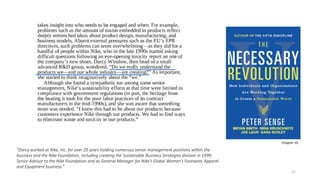
“Darcy worked at Nike, Inc. for over 20 years holding numerous senior management positions within the
business and the Nike Foundation, including creating the Sustainable Business Strategies division in 1999,
Senior Advisor to the Nike Foundation and as General Manager for Nike’s Global Women’s Footwear, Apparel
and Equipment business.”
Chapter 16
Activity 2.3: Wicked framings
Mode: Think, Pair, Share
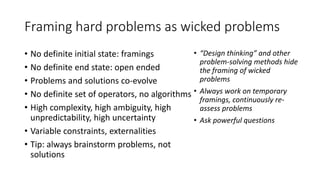
Framing hard problems as wicked problems
• No definite initial state: framings
• No definite end state: open ended
• Problems and solutions co-evolve
• No definite set of operators, no algorithms
• High complexity, high ambiguity, high
unpredictability, high uncertainty
• Variable constraints, externalities
• Tip: always brainstorm problems, not
solutions
• “Design thinking” and other
problem-solving methods hide
the framing of wicked
problems
• Always work on temporary
framings, continuously re-
assess problems
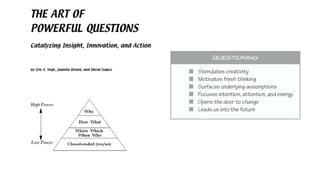
• Ask powerful questions
25
https://www.youtube.com/watch?v=5ALlGU2GYbk
Activity 2.4: Powerful questions
Duration: 15 minutes
Mode: Think, Pair, Share
Lunch
1 hour
28
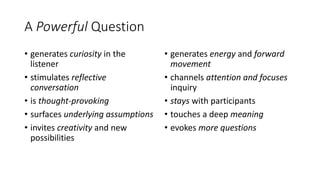
A Powerful Question
• generates curiosity in the
listener
• stimulates reflective
conversation
• is thought-provoking
• surfaces underlying assumptions
• invites creativity and new
possibilities
• generates energy and forward
movement
• channels attention and focuses
inquiry
• stays with participants
• touches a deep meaning
• evokes more questions
Creative people
• Do not fit into a single profile
• Are not ‘special’ at birth
• They become ‘special’ through
hard work
• They don’t have mental disorders
(at least not before being
creative, perhaps society ‘drives
them crazy’ by rejecting their
ideas)
• “Creative people” are those
individuals who exercise their
creative capacities and build
confidence
• “Not creative people” are those
who oversee, neglect, or restrain
their creativity
• Not so useful to focus on
“creative people” as much as
“creative interactions” between
people
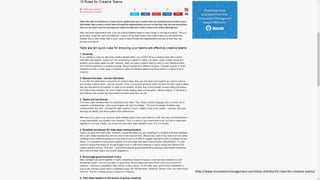
Creative teams
Art & Science of creative collaborations
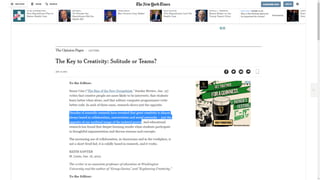
http://www.innovationmanagement.se/imtool-articles/10-rules-for-creative-teams/
Activity 2.6: Creative teams
What type of creativity may fit your
team and organisation? What needs
to change?
Duration: 15 minutes
http://www.debonogroup.com/six_thinking_hats.php
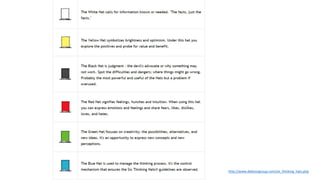
• The White Hat calls for information known or needed. "The facts, just
the facts."
• The Yellow Hat symbolizes brightness and optimism. Under this hat
you explore the positives and probe for value and benefit.
• The Black Hat is judgment - the devil's advocate or why something
may not work. Spot the difficulties and dangers; where things might
go wrong. Probably the most powerful and useful of the Hats but a
problem if overused.
• The Red Hat signifies feelings, hunches and intuition. When using this
hat you can express emotions and feelings and share fears, likes,
dislikes, loves, and hates.
• The Green Hat focuses on creativity; the possibilities, alternatives,
and new ideas. It's an opportunity to express new concepts and new
perceptions.
• The Blue Hat is used to manage the thinking process. It's the control
mechanism that ensures the Six Thinking Hats® guidelines are
observed.
Activity 2.7: Six hats
Duration: 15 minutes
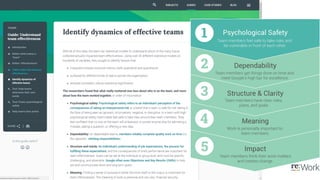
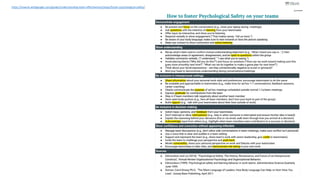
https://rework.withgoogle.com/guides/understanding-team-effectiveness/steps/foster-psychological-safety/
Key factors to consider…
• Diversity
• Autonomy
• Knowledge
• Culture change
• Breadth-depth trade-off
• Strength of weak ties
• Hierarchies
• Synergies in collaboration
• Sharing: giving and taking
• Exploration-exploitation modes
• Physical space
• Internal, not external motivation
• Walk the talk
• Playful sandbox attitude
• Document success & failure as
learning opportunities
• Stimulate reflection
Afternoon tea
15 minutes
43
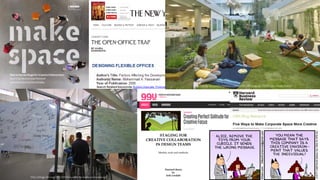
Creative spaces
Principles to design spaces and organisations that promote creativity
Premises and definition
Creative spaces are those that support
appropriate individual, group and cultural
processes to create a multi-level system or
environment where creativity can originate,
develop and lead to innovation (implementation
of novel, valuable and surprising ideas)
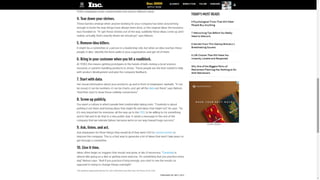
http://www.inc.com/ss/jessica-stillman/10-office-design-tips-foster-creativity#10
http://blogs.hbr.org/2012/03/five-ways-to-make-corporate-sp/
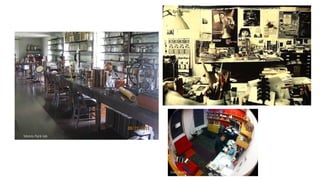
Menlo Park lab
Ray Eames
Dan Ariely
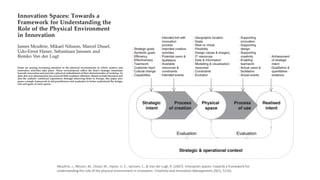
Moultrie, J., Nilsson, M., Dissel, M., Haner, U. E., Janssen, S., & Van der Lugt, R. (2007). Innovation spaces: towards a framework for
understanding the role of the physical environment in innovation. Creativity and Innovation Management,16(1), 53-65.
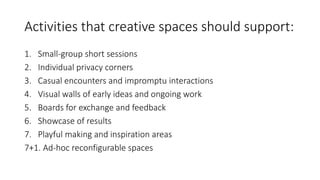
Activities that creative spaces should support:
1. Small-group short sessions
2. Individual privacy corners
3. Casual encounters and impromptu interactions
4. Visual walls of early ideas and ongoing work
5. Boards for exchange and feedback
6. Showcase of results
7. Playful making and inspiration areas
7+1. Ad-hoc reconfigurable spaces
Activity 2.8: Creative spaces
How would you start
reconfiguring your spaces?
Duration: 15 minutes
Prepare a DIY Activity…
Duration: 15 + 15 minutes
51
Alt Activity 2.9: CMV about creativity
& design in my organisation, and who
are involved (roles, responsibilities)
Duration: 15 minutes
DIY Activity Day 2
Duration: 15 to 30 minutes
53
Creativity & Design. End of Day 2
• Individual mode
• Write down ONE key concept that you learned today
• Write an action item that you can put into practice
derived from that key concept or idea
• Write down your most pressing question today
54

ACI Creativity and Design Day 2 (2018)

  • 1.
    Institute on Asian ConsumerInsight (ACI) Creativity and Design http://www.aci-institute.com 1
  • 2.
    Key concepts fromDay 1 shared by you • Creativity is diverse, no ideal form • More crucially: creativity needs diversity • “It takes different people to identify problems and generate solutions” • “Different ways of looking at things” • From “everybody can be creative” to “creativity needs everybody” • Creators need information and feedback • Creativity can come from anyone • “Creativity is everywhere” • (r)evolutionary • Do not wait for ideas to arrive, take action • Use proposed solutions to reframe problems • People can use their talents and experiences to be uniquely creative • Perseverance is key. Iteration. • Design with others, not for them • DIY activity placed the ball in our court, give us confidence
  • 3.
    Possible actions • Identifyand understand the problems before looking for solutions • Use solution ideas to explore and reframe the problem; review constantly • Use the word “creativity” more often at work • “There should be better ways of doing what I do” • “I need to be more open” • Practice putting on a “creative hat”, change attitude • Change my routine • Seek ideas from colleagues in other departments. “I need to team up with people” • Give people space to reflect and create • Create a fun environment • Frame questions differently • Look for opportunities. Look for the boundaries • Put humans in the centre • What else should I unlearn? What other myths do I believe? • “This is something I can start working on immediately”
  • 4.
    Questions • How toconvince/motivate/support others to embrace creativity? (especially…) • The cultural shaping of creativity • Contradiction: everyone is creative… but children aren’t creative? • What are my real motivations (to be creative)? • Do creative ideas always lead to +profits? +success? +value? • If everyone can be creative, then what is not creative? • How to evaluate potential (of new ideas)? • How do I free myself (from myths, the past, the context)? • How to frame questions so that new perspectives can be generated? • How to sell a creative idea? How can I know if my ideas are creative? • Is there a process/template/methodology that can be followed? • Who determines what is creative or isn’t?
  • 6.
    Activity 2.1: Amemorable time when you resisted change, or saw someone resisting change Duration: 15 minutes Mode: Individual 6
  • 8.
    Resistance to changecan be positive • Take and offer emotional care • Rejection can be a good teacher, listen • Distinguish levels or aspects of rejection • Keep a big-picture perspective • Maintain a pipeline of new ideas • An honest “no” is better than a false “yes” • Share the vision, frame the need • What is being destroyed by the new idea? • Anticipate, embrace, and prepare the field • Get people involved (sincerely)  Timing is crucial  All dogmas were new ideas  A culture of change
  • 11.
  • 12.
  • 13.
    1a: Intelligence isdefined at birth, and people can’t change their intelligence. 1b: No matter how much intelligence people have, one can always change it substantially. 2a: I am a certain kind of person, and there is not much I can do to change that. 2b: I could change basic things about me and even reinvent myself. 3a: Trying new things is quite stressful for me and I avoid it. 3b: All humans without a brain injury or birth defect are capable of astounding levels of learning. 4a: Extraordinary people who excel in their field have an inborn talent. 4b: Extraordinary people who excel in their field have a history of perseverance and good luck.
  • 15.
  • 16.
  • 18.
  • 21.
    Problem formulation More “tame” More “wicked” • Moreparking space is needed • This building needs faster lifts • Reduce customer complaints by 30% • Increase employee productivity • Reduce waste by half in two years • Increase in rankings to Top-100 • Introduce a new service to compete with X • Mobility: who, why, when, how? • Understand sources of frustration • How do complaints originate? Types? • Indicators, motivations, relationship • What counts as waste? Lifecycle? • Who defines and cares about outcomes? • How is X our competitor? What do we do?
  • 22.
    22 “Darcy worked atNike, Inc. for over 20 years holding numerous senior management positions within the business and the Nike Foundation, including creating the Sustainable Business Strategies division in 1999, Senior Advisor to the Nike Foundation and as General Manager for Nike’s Global Women’s Footwear, Apparel and Equipment business.” Chapter 16
  • 23.
    Activity 2.3: Wickedframings Mode: Think, Pair, Share
  • 24.
    Framing hard problemsas wicked problems • No definite initial state: framings • No definite end state: open ended • Problems and solutions co-evolve • No definite set of operators, no algorithms • High complexity, high ambiguity, high unpredictability, high uncertainty • Variable constraints, externalities • Tip: always brainstorm problems, not solutions • “Design thinking” and other problem-solving methods hide the framing of wicked problems • Always work on temporary framings, continuously re- assess problems • Ask powerful questions
  • 25.
  • 26.
    Activity 2.4: Powerfulquestions Duration: 15 minutes Mode: Think, Pair, Share
  • 28.
  • 29.
    A Powerful Question •generates curiosity in the listener • stimulates reflective conversation • is thought-provoking • surfaces underlying assumptions • invites creativity and new possibilities • generates energy and forward movement • channels attention and focuses inquiry • stays with participants • touches a deep meaning • evokes more questions
  • 31.
    Creative people • Donot fit into a single profile • Are not ‘special’ at birth • They become ‘special’ through hard work • They don’t have mental disorders (at least not before being creative, perhaps society ‘drives them crazy’ by rejecting their ideas) • “Creative people” are those individuals who exercise their creative capacities and build confidence • “Not creative people” are those who oversee, neglect, or restrain their creativity • Not so useful to focus on “creative people” as much as “creative interactions” between people
  • 32.
    Creative teams Art &Science of creative collaborations
  • 34.
  • 36.
    Activity 2.6: Creativeteams What type of creativity may fit your team and organisation? What needs to change? Duration: 15 minutes
  • 37.
  • 38.
    • The WhiteHat calls for information known or needed. "The facts, just the facts." • The Yellow Hat symbolizes brightness and optimism. Under this hat you explore the positives and probe for value and benefit. • The Black Hat is judgment - the devil's advocate or why something may not work. Spot the difficulties and dangers; where things might go wrong. Probably the most powerful and useful of the Hats but a problem if overused. • The Red Hat signifies feelings, hunches and intuition. When using this hat you can express emotions and feelings and share fears, likes, dislikes, loves, and hates. • The Green Hat focuses on creativity; the possibilities, alternatives, and new ideas. It's an opportunity to express new concepts and new perceptions. • The Blue Hat is used to manage the thinking process. It's the control mechanism that ensures the Six Thinking Hats® guidelines are observed.
  • 39.
    Activity 2.7: Sixhats Duration: 15 minutes
  • 40.
  • 42.
    Key factors toconsider… • Diversity • Autonomy • Knowledge • Culture change • Breadth-depth trade-off • Strength of weak ties • Hierarchies • Synergies in collaboration • Sharing: giving and taking • Exploration-exploitation modes • Physical space • Internal, not external motivation • Walk the talk • Playful sandbox attitude • Document success & failure as learning opportunities • Stimulate reflection
  • 43.
  • 44.
    Creative spaces Principles todesign spaces and organisations that promote creativity
  • 45.
    Premises and definition Creativespaces are those that support appropriate individual, group and cultural processes to create a multi-level system or environment where creativity can originate, develop and lead to innovation (implementation of novel, valuable and surprising ideas)
  • 46.
  • 47.
    Menlo Park lab RayEames Dan Ariely
  • 48.
    Moultrie, J., Nilsson,M., Dissel, M., Haner, U. E., Janssen, S., & Van der Lugt, R. (2007). Innovation spaces: towards a framework for understanding the role of the physical environment in innovation. Creativity and Innovation Management,16(1), 53-65.
  • 49.
    Activities that creativespaces should support: 1. Small-group short sessions 2. Individual privacy corners 3. Casual encounters and impromptu interactions 4. Visual walls of early ideas and ongoing work 5. Boards for exchange and feedback 6. Showcase of results 7. Playful making and inspiration areas 7+1. Ad-hoc reconfigurable spaces
  • 50.
    Activity 2.8: Creativespaces How would you start reconfiguring your spaces? Duration: 15 minutes
  • 51.
    Prepare a DIYActivity… Duration: 15 + 15 minutes 51
  • 52.
    Alt Activity 2.9:CMV about creativity & design in my organisation, and who are involved (roles, responsibilities) Duration: 15 minutes
  • 53.
    DIY Activity Day2 Duration: 15 to 30 minutes 53
  • 54.
    Creativity & Design.End of Day 2 • Individual mode • Write down ONE key concept that you learned today • Write an action item that you can put into practice derived from that key concept or idea • Write down your most pressing question today 54