





















Hello, this is me
and what I do (-;
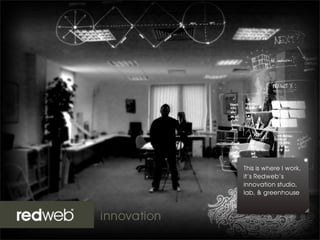
This is where I work,
it’s Redweb’s
innovation studio,
lab, & greenhouse
Let’s start with a
definition of
Creativity.
And a definition of
innovation too.

...it’s about making
ideas become real
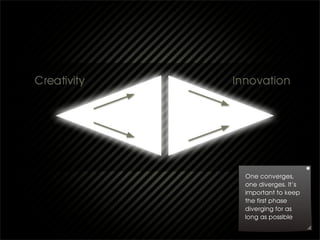
One converges,
one diverges. It’s
important to keep
the first phase
diverging for as
long as possible
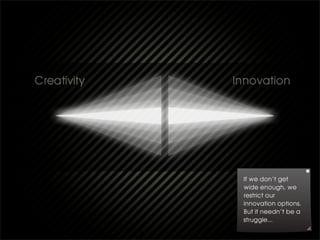
If we don’t get
wide enough, we
restrict our
innovation options.
But it needn’t be a
struggle...
Let’s have a look at 5
Creative Behaviours
(Gardner). Some
people describe these
as windows as they’re
also ways in which we
view the world
Some people thrive in
research,
comp analysis
collating data, testing
or finding trends
Some like structure,
sorting, filtering and
auditing, seeing
what they have and
rearranging
Or is your idea of fun
doing something
totally free form,with
no rules whatsoever?
Do you look for
meaning, significance &
purpose in your actions?
(Great for interface &
brand designers)
Some have skills in
reconstructing, being
detached and asking
difficult & challenging
questions.
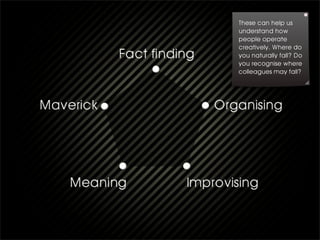
These can help us
understand how
people operate
creatively. Where do
you naturally fall? Do
you recognise where
colleagues may fall?
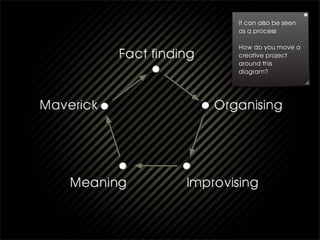
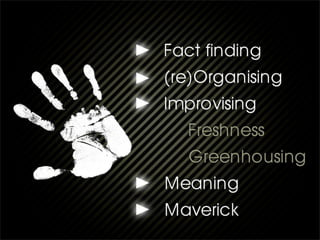
It can also be seen
as a process

How do you move a
creative project
around this
diagram?
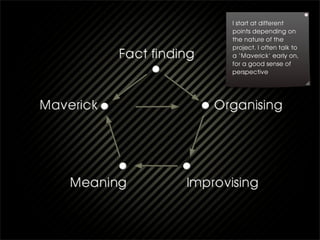
I start at different
points depending on
the nature of the
project. I often talk to
a ‘Maverick’ early on,
for a good sense of
perspective
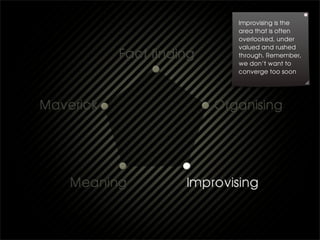
Improvising is the
area that is often
overlooked, under
valued and rushed
through. Remember,
we don’t want to
converge too soon
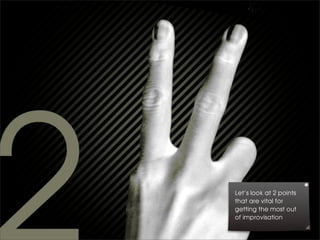
Let’s look at 2 points
that are vital for
getting the most out
of improvisation
We recognise things by
association with past
experiences - we don’t
need to think about
getting dressed, we
recognise clothes
shaped items and we
instantly know what to
do with them
(thankfully)
It’s so natural & so
important day to day,
we just go with the
flow. But it’s difficult to
break when we want
to be creative. We
get stuck in a
particular river of
thought because of
our past experiences
We need to jump into
different rivers. From
there we can make
connections back to
the original scenario

Ideas come when you
take a break, go
outside, take a shower
etc, because you’re
letting you’re mind flow
down different rivers
As individuals, we
have unique
experiences. These
provide unique rivers
and unique
connection potential.

the creative point is
where you meet the
world
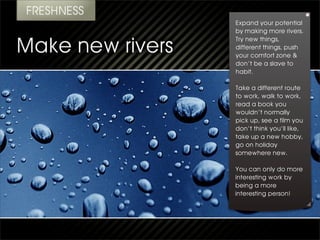
Expand your potential
by making more rivers.
Try new things,
different things, push
your comfort zone &
don’t be a slave to
habit.

Take a different route
to work, walk to work,
read a book you
wouldn’t normally
pick up, see a film you
don’t think you’ll like,
take up a new hobby,
go on holiday
somewhere new.

You can only do more
interesting work by
being a more
interesting person!
Freshness & jumping
rivers is down to
breaking habits. try
stand up meetings,
meetings with no
table, meetings in the
pub, in the coffee
shop, at the beach (it
is good being in
Bournemouth!)
There books full of
brainstorming tools &
techniques. They’re
keys to open doors,
tools to help break
habits and help
make unexpected
connections
Ideas are very fragile
in their early stages.
We need to nurture &
encourage them.

We need to let ideas
grow before we can
see what they could
grow into
Everyday business is
harsh, decisions are
made quickly based
on value judgements.
Brainstorming is
different, ideas need
protection. If we judge
too quickly, great
ideas can be lost for
ever
Fear holds us back
from voicing our ideas.
We don’t want to look
silly in front of our
peers. We’re afraid
our idea is wrong, or
not good enough, or
not fully formed, or too
similar to something
else.

At this stage there are
no wrong answers
We need to build
courage through
permission to speak up
& acceptance of any
point of view.

If we don’t hold back
our judgement and
banish fear, people
may never speak up
Try changing “no
but...” into “yes and...”

We need to build a
constructive culture,
we must accept &
build in creative
conversations
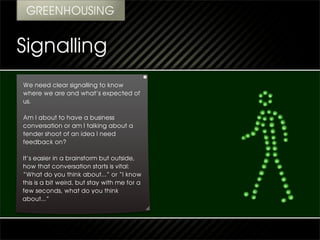
We need clear signalling to know
where we are and what’s expected of
us.

Am I about to have a business
conversation or am I talking about a
tender shoot of an idea I need
feedback on?

It’s easier in a brainstorm but outside,
how that conversation starts is vital:
“What do you think about...” or “I know
this is a bit weird, but stay with me for a
few seconds, what do you think
about...”
Once you have
momentum, enjoy it,
stay in the flow and
have fun. Don’t start
looking for meaning or
judging too early.

Listen to everything,
don’t get hung up on
those ideas that seem
better, park them and
keep moving
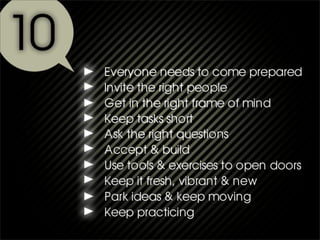
Engage people before hand by
asking them to bring along
research, examples, print outs,
experiences, etc. They’ll be more
engaged, contribute more value
and hit the ground running.
Aim for a good mix of creative
behaviours and a good mix from all
departments or disciplines.

All need to be willing to help, have
fun, be positive, and be creative
Just like physical exercise you’ll need to
warm up, & get yourself in gear. Try a
few mental & team building games to
get energised. Monday mornings and
sessions straight after lunch might need
more work to get going
Split long sessions into smaller tasks.
Creativity can be exhausting, 1 hour
is better as 3 x 20 mins. It’s easier to
keep things fresh, energised, more
fun & less stressful. Short sessions are
also easier to fit in more often!
Looking at the question from
different angles can lead to new
questions, unseen problems & more
creative solutions. There are a lot of
brainstorming techniques that work
on this premise.
Remember greenhousing? “no
but...” becomes “yes and...”
Permission & acceptance
encourages building ideas vertically
rather than just jumping horizontally
from one idea to another
Use them within a creative
framework to get a different angle,
jump into new rivers and make
connections
Break behaviours, habits and
mental barriers. Keep changing
things.

Environment is key to changing
behaviour and being creative
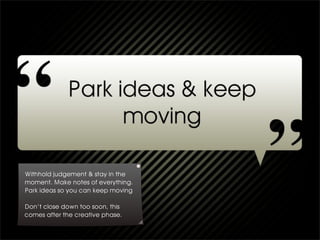
Withhold judgement & stay in the
moment. Make notes of everything.
Park ideas so you can keep moving

Don’t close down too soon, this
comes after the creative phase.
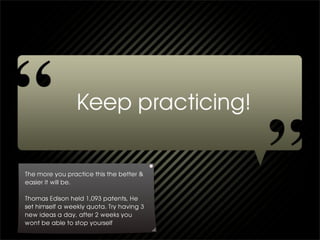
The more you practice this the better &
easier it will be.

Thomas Edison held 1,093 patents, He
set himself a weekly quota. Try having 3
new ideas a day, after 2 weeks you
wont be able to stop yourself
Creativity & 10 tips for better brainstorming

Creativity & 10 tips for better brainstorming

  • 2.
    Hello, this isme and what I do (-;
  • 3.
    This is whereI work, it’s Redweb’s innovation studio, lab, & greenhouse
  • 6.
    Let’s start witha definition of Creativity.
  • 7.
    And a definitionof innovation too. ...it’s about making ideas become real
  • 9.
    One converges, one diverges.It’s important to keep the first phase diverging for as long as possible
  • 10.
    If we don’tget wide enough, we restrict our innovation options. But it needn’t be a struggle...
  • 11.
    Let’s have alook at 5 Creative Behaviours (Gardner). Some people describe these as windows as they’re also ways in which we view the world
  • 12.
    Some people thrivein research, comp analysis collating data, testing or finding trends
  • 13.
    Some like structure, sorting,filtering and auditing, seeing what they have and rearranging
  • 14.
    Or is youridea of fun doing something totally free form,with no rules whatsoever?
  • 15.
    Do you lookfor meaning, significance & purpose in your actions? (Great for interface & brand designers)
  • 16.
    Some have skillsin reconstructing, being detached and asking difficult & challenging questions.
  • 17.
    These can helpus understand how people operate creatively. Where do you naturally fall? Do you recognise where colleagues may fall?
  • 18.
    It can alsobe seen as a process How do you move a creative project around this diagram?
  • 19.
    I start atdifferent points depending on the nature of the project. I often talk to a ‘Maverick’ early on, for a good sense of perspective
  • 20.
    Improvising is the areathat is often overlooked, under valued and rushed through. Remember, we don’t want to converge too soon
  • 21.
    Let’s look at2 points that are vital for getting the most out of improvisation
  • 23.
    We recognise thingsby association with past experiences - we don’t need to think about getting dressed, we recognise clothes shaped items and we instantly know what to do with them (thankfully)
  • 24.
    It’s so natural& so important day to day, we just go with the flow. But it’s difficult to break when we want to be creative. We get stuck in a particular river of thought because of our past experiences
  • 25.
    We need tojump into different rivers. From there we can make connections back to the original scenario Ideas come when you take a break, go outside, take a shower etc, because you’re letting you’re mind flow down different rivers
  • 26.
    As individuals, we haveunique experiences. These provide unique rivers and unique connection potential. the creative point is where you meet the world
  • 27.
    Expand your potential bymaking more rivers. Try new things, different things, push your comfort zone & don’t be a slave to habit. Take a different route to work, walk to work, read a book you wouldn’t normally pick up, see a film you don’t think you’ll like, take up a new hobby, go on holiday somewhere new. You can only do more interesting work by being a more interesting person!
  • 29.
    Freshness & jumping riversis down to breaking habits. try stand up meetings, meetings with no table, meetings in the pub, in the coffee shop, at the beach (it is good being in Bournemouth!)
  • 30.
    There books fullof brainstorming tools & techniques. They’re keys to open doors, tools to help break habits and help make unexpected connections
  • 33.
    Ideas are veryfragile in their early stages. We need to nurture & encourage them. We need to let ideas grow before we can see what they could grow into
  • 34.
    Everyday business is harsh,decisions are made quickly based on value judgements. Brainstorming is different, ideas need protection. If we judge too quickly, great ideas can be lost for ever
  • 35.
    Fear holds usback from voicing our ideas. We don’t want to look silly in front of our peers. We’re afraid our idea is wrong, or not good enough, or not fully formed, or too similar to something else. At this stage there are no wrong answers
  • 36.
    We need tobuild courage through permission to speak up & acceptance of any point of view. If we don’t hold back our judgement and banish fear, people may never speak up
  • 37.
    Try changing “no but...”into “yes and...” We need to build a constructive culture, we must accept & build in creative conversations
  • 38.
    We need clearsignalling to know where we are and what’s expected of us. Am I about to have a business conversation or am I talking about a tender shoot of an idea I need feedback on? It’s easier in a brainstorm but outside, how that conversation starts is vital: “What do you think about...” or “I know this is a bit weird, but stay with me for a few seconds, what do you think about...”
  • 39.
    Once you have momentum,enjoy it, stay in the flow and have fun. Don’t start looking for meaning or judging too early. Listen to everything, don’t get hung up on those ideas that seem better, park them and keep moving
  • 45.
    Engage people beforehand by asking them to bring along research, examples, print outs, experiences, etc. They’ll be more engaged, contribute more value and hit the ground running.
  • 46.
    Aim for agood mix of creative behaviours and a good mix from all departments or disciplines. All need to be willing to help, have fun, be positive, and be creative
  • 47.
    Just like physicalexercise you’ll need to warm up, & get yourself in gear. Try a few mental & team building games to get energised. Monday mornings and sessions straight after lunch might need more work to get going
  • 48.
    Split long sessionsinto smaller tasks. Creativity can be exhausting, 1 hour is better as 3 x 20 mins. It’s easier to keep things fresh, energised, more fun & less stressful. Short sessions are also easier to fit in more often!
  • 49.
    Looking at thequestion from different angles can lead to new questions, unseen problems & more creative solutions. There are a lot of brainstorming techniques that work on this premise.
  • 50.
    Remember greenhousing? “no but...”becomes “yes and...” Permission & acceptance encourages building ideas vertically rather than just jumping horizontally from one idea to another
  • 51.
    Use them withina creative framework to get a different angle, jump into new rivers and make connections
  • 52.
    Break behaviours, habitsand mental barriers. Keep changing things. Environment is key to changing behaviour and being creative
  • 53.
    Withhold judgement &stay in the moment. Make notes of everything. Park ideas so you can keep moving Don’t close down too soon, this comes after the creative phase.
  • 54.
    The more youpractice this the better & easier it will be. Thomas Edison held 1,093 patents, He set himself a weekly quota. Try having 3 new ideas a day, after 2 weeks you wont be able to stop yourself