ABDM4233 ENTREPRENEURSHIP

   From Ideas to Social
       Enterprise


                  by
             Stephen Ong


     Principal Lecturer (Specialist)
Visiting Professor, Shenzhen University
Creativity and Innovation
 Creativity – the ability to develop
 new ideas and to discover new ways
 of looking at problems and
 opportunities; thinking new things
 Innovation – the ability to apply
 creative solutions to problems or
 opportunities to enhance or to enrich
 people’s lives; doing new things.


                                         2-2
Entrepreneurship
   Entrepreneurship – the result of a
    disciplined, systematic process of
    applying creativity and innovation to
    the needs and opportunities in the
    marketplace.
   Entrepreneurs connect their creative
    ideas with the purposeful action and
    structure of a business.

                                            2-3
Failure: Part of the
             Creative Process!
   For every 3,000 new product ideas:
       Four make it to the development stage.
       Two are actually launched.
       One becomes a success in the market.
   On average, new products account for 40%
    of companies’ sales!!
   Creativity is an important source of building
    a competitive advantage.

                                                    2-4
Can We Learn to Be Creative?


             Yes!
 By overcoming paradigms and by suspending
     conventional thinking long enough to
    consider new and different alternatives!


                                               2-5
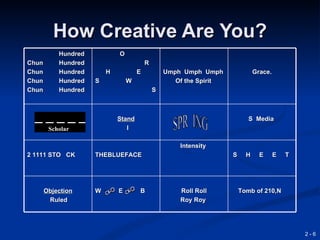
How Creative Are You?
           Hundred           O
Chun       Hundred                       R
Chun       Hundred       H           E           Umph Umph Umph               Grace.
Chun       Hundred   S           W                  Of the Spirit
Chun       Hundred                           S


                             Stand                                         S Media
        Scholar                 I

                                                     Intensity
2 1111 STO CK        THEBLUEFACE                                    S     H     E      E   T


       Objection     W       E       B               Roll Roll          Tomb of 210,N
        Ruled                                        Roy Roy


                                                                                               2-6
Right-Brained,
          Creative Thinkers
   Always ask: “Is there a better way?”
   Challenge custom, routine, and
    tradition.
   Are reflective.
   Are prolific thinkers.
   Play mental games.

                                           2-7
Right-Brained,
          Creative Thinkers
   Realize that there may be more than one
    “right” answer.
   Know that mistakes are pit stops on the
    way to success.
   Recognize that problems are
    springboards for new ideas.


                                              2-8
Right-Brained,
           Creative Thinkers
   Understand that failure is a natural part
    of the creative process.
   Relate seemingly unrelated ideas to a
    problem.
   Have “helicopter skills.”


                                                2-9
Left-Brained or
             Right-Brained?
Entrepreneurship requires both left-and
right-brained thinking.
     Right-brained thinking draws on divergent
      reasoning, the ability to create a multitude
      of original, diverse ideas.
     Left-brained thinking counts on
      convergent reasoning, the ability to
      evaluate multiple ideas and to choose the
      best solution to a problem.
                                                     2 - 10
Barriers to Creativity
   Searching for the one “right” answer
   Focusing on “being logical”
   Blindly following the rules
   Constantly being practical
   Viewing play as frivolous


                                           2 - 11
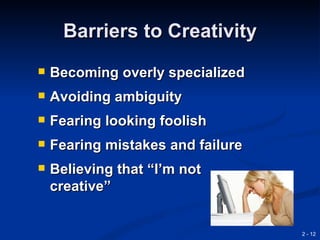
Barriers to Creativity
   Becoming overly specialized
   Avoiding ambiguity
   Fearing looking foolish
   Fearing mistakes and failure
   Believing that “I’m not
    creative”


                                   2 - 12
Questions to Spur the
            Imagination
   Is there a new way to do it?
   Can you borrow or adapt it?
   Can you give it a new twist?
   Do you merely need more of the same?
   Do you need less of the same?


                                           2 - 13
Questions to Spur the
            Imagination
                    (continued)


   Is there a substitute?
   Can you rearrange the parts?
   What if you do just the opposite?
   Can you combine ideas?
   Can you put it to other uses?


                                        2 - 14
Questions to Spur the
            Imagination
                    (continued)

   What else could you make from this?
   Are there other markets for it?
   Can you reverse it?
   Can you eliminate it?
   Can you put it to another use?
   What idea seems impossible, but if
    executed, would revolutionize your
    business?
                                          2 - 15
Tips for Enhancing
      Organizational Creativity
   Include creativity as a core company
    value
   Embrace diversity
   Expect creativity
   Expect and tolerate failure
   Create an organizational structure that
    nourishes creativity
                                              2 - 16
Tips for Enhancing
      Organizational Creativity
                    (continued)


   Encourage curiosity
   Create a change of scenery periodically
   View problems as opportunities
   Provide creativity training
   Provide support
   Develop a procedure for capturing
    ideas
                                              2 - 17
Tips for Enhancing
     Organizational Creativity
   Talk and interact with customers
   Look for uses for your company’s
    products or services in other markets
   Reward creativity
   Model creative behavior


                                            2 - 18
Tips for Enhancing
         Individual Creativity
   Allow yourself to be creative
   Give your mind fresh input every day
   Observe the products and services
    of other companies, especially
    those in completely different markets
   Recognize the creative
    power of mistakes
   Notice what is missing

                                            2 - 19
Tips for Enhancing
        Individual Creativity
   Keep a journal to record your thoughts
    and ideas
   Listen to other people
   Listen to customers
   Talk to a child
   Do something ordinary in an unusual
    way

                                             2 - 20
Tips for Enhancing
        Individual Creativity
   Keep a toy box in your office
   Do not throw away seeming “bad”
    ideas
   Read books on stimulating creativity or
    take a class on creativity
   Take some time off
   Be persistent

                                              2 - 21
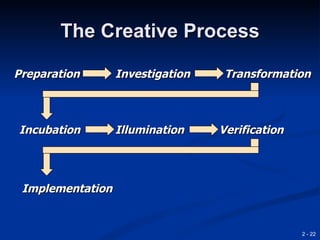
The Creative Process

Preparation       Investigation    Transformation


Incubation        Illumination    Verification


 Implementation


                                                 2 - 22
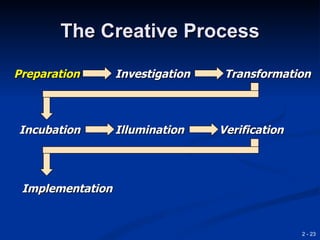
The Creative Process

Preparation       Investigation    Transformation


Incubation        Illumination    Verification


 Implementation


                                                 2 - 23
Preparation
Get your mind ready for creative thinking.
    Adopt the attitude of a lifelong student.
    Read … a lot … and not just in your field of
     expertise.
    Clip articles of interest to you and save
     them.
    Take time to discuss your ideas with other
     people.

                                                 2 - 24
Preparation
Get your mind ready for creative thinking.
     Join professional or trade associations
      and attend their meetings.
     Study other countries and their cultures.
     Travel to new places.
     Develop your listening skills.
     Eliminate creative distractions.


                                                  2 - 25
The Creative Process

Preparation       Investigation    Transformation


Incubation        Illumination    Verification


 Implementation


                                                 2 - 26
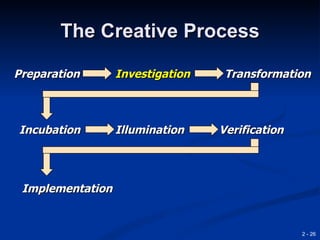
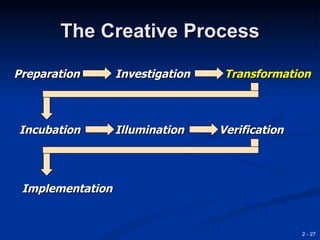
The Creative Process

Preparation       Investigation    Transformation


Incubation        Illumination    Verification


 Implementation


                                                 2 - 27
Transformation
   Involves viewing both the similarities and the
    differences among the information collected.
   Two types of thinking are required:
       Convergent – the ability to see the
        similarities and the connections among
        various and often diverse data and events.
       Divergent – the ability to see the
        differences among various data and
        events.

                                                     2 - 28
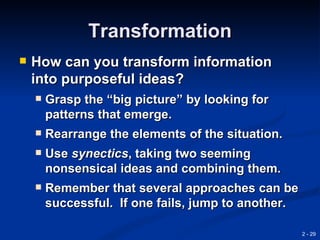
Transformation
   How can you transform information
    into purposeful ideas?
       Grasp the “big picture” by looking for
        patterns that emerge.
       Rearrange the elements of the situation.
       Use synectics, taking two seeming
        nonsensical ideas and combining them.
       Remember that several approaches can be
        successful. If one fails, jump to another.

                                                     2 - 29
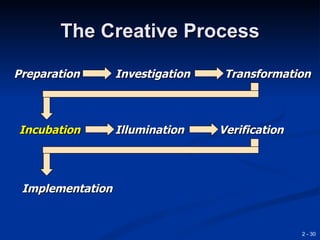
The Creative Process

Preparation       Investigation    Transformation


Incubation        Illumination    Verification


 Implementation


                                                 2 - 30
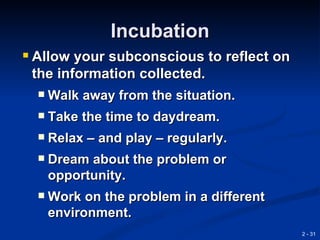
Incubation
 Allow your subconscious to reflect on
 the information collected.
     Walk away from the situation.
     Take the time to daydream.
     Relax – and play – regularly.
     Dream about the problem or
      opportunity.
     Work on the problem in a different
      environment.
                                           2 - 31
The Creative Process

Preparation       Investigation    Transformation


Incubation        Illumination    Verification


 Implementation


                                                 2 - 32
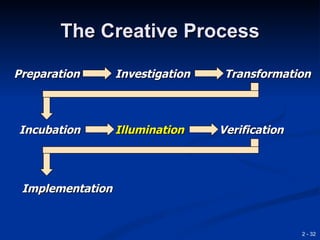
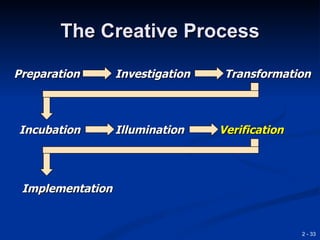
The Creative Process

Preparation       Investigation    Transformation


Incubation        Illumination    Verification


 Implementation


                                                 2 - 33
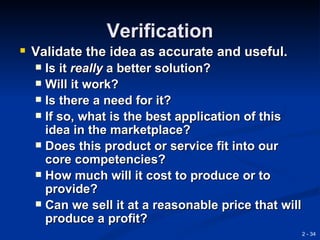
Verification
 Validate the idea as accurate and useful.
   Is it really a better solution?
   Will it work?
   Is there a need for it?
   If so, what is the best application of this
    idea in the marketplace?
   Does this product or service fit into our
    core competencies?
   How much will it cost to produce or to
    provide?
   Can we sell it at a reasonable price that will
    produce a profit?
                                                     2 - 34
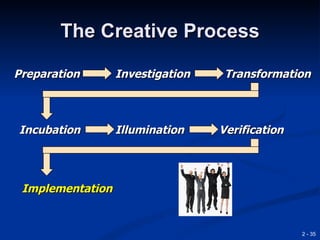
The Creative Process

Preparation       Investigation    Transformation


Incubation        Illumination    Verification


 Implementation


                                                 2 - 35
Techniques for Improving
   the Creative Process

Brainstorming:
 The goal is to create a large quantity
 of novel and imaginative ideas.


                                          2 - 36
Brainstorming Guidelines
   Keep the group small – “Two pizza rule.”
   Make the group as diverse as possible.
   Emphasize that company rank is
    irrelevant.
   Have a well-defined problem, but don’t
    reveal it ahead of time.
   Limit the session to 40 to 60 minutes.
   Take a field trip.
   Appoint a recorder.
                                               2 - 37
Brainstorming Guidelines
   Use a seating pattern that encourages
    interaction.
   Throw logic out the window.
   Encourage all ideas from the team.
   Shoot for quantity of ideas over quality of
    ideas.
   Forbid criticism.
   Encourage idea “hitch-hiking.”
   Dare to imagine the unreasonable.
                                                  2 - 38
Techniques for Improving the
     Creative Process
   Brainstorming
       The goal is to create a large quantity of
        novel and imaginative ideas.

   Mind-mapping
       A graphical technique that encourages
        thinking on both sides of the brain,
        visually displays relationships among
        ideas, and improves the ability to see a
        problem from many sides.

                                                    2 - 39
Techniques for Improving the
     Creative Process
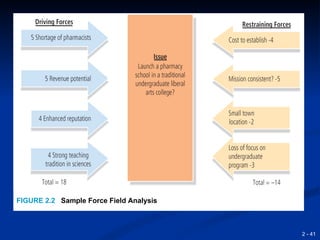
   Force Field Analysis
     A useful technique for evaluating the
      forces that support and oppose a
      proposed change.
     Three columns:

        Center: Problem to be addressed

        Left: Driving forces

        Right: Restraining forces

     Score each force (-1 to +4) and add them.

                                                  2 - 40
FIGURE 2.2 Sample Force Field Analysis


                                         2 - 41
Techniques for Improving the
     Creative Process
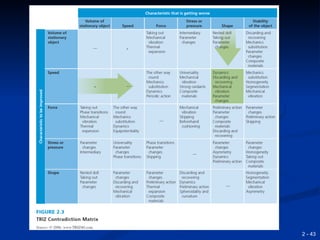
   TRIZ
     A systematic approach designed to solve
      any technical problem.
     Relies on 40 principles and left-brained
      thinking to solve problems.


                                                 2 - 42
2 - 43
Techniques for Improving the
     Creative Process
   TRIZ
     A systematic approach designed to solve
      any technical problem.
     Relies on 40 principles and left-brained
      thinking to solve problems.

   Rapid Prototyping
       Transforming an idea into an actual model
        that will point out flaws and lead to design
        improvements.
                                                       2 - 44
Conclusion
   The creative process is a tenant of the
    entrepreneurial experience.
   Success, and even survival itself, requires
    entrepreneurs to tap their creativity.
   The seven steps of the creative process
    transform an idea into a business reality.
   Creativity results in value, and value
    provides a competitive advantage.
   Entrepreneurs protect their creative ideas
    with patents, trademarks, servicemarks, and
    copyrights to sustain a competitive edge.

                                                  2 - 45
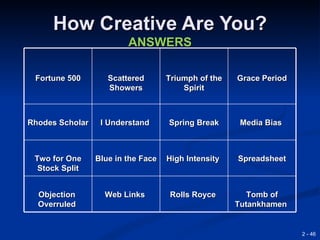
How Creative Are You?
                         ANSWERS

 Fortune 500        Scattered       Triumph of the   Grace Period
                    Showers             Spirit


Rhodes Scholar    I Understand      Spring Break      Media Bias


 Two for One     Blue in the Face   High Intensity   Spreadsheet
  Stock Split


  Objection        Web Links         Rolls Royce        Tomb of
  Overruled                                          Tutankhamen


                                                                    2 - 46

Abdm4223 lecture week 2 part 1 110512

  • 1.
    ABDM4233 ENTREPRENEURSHIP From Ideas to Social Enterprise by Stephen Ong Principal Lecturer (Specialist) Visiting Professor, Shenzhen University
  • 2.
    Creativity and Innovation Creativity – the ability to develop new ideas and to discover new ways of looking at problems and opportunities; thinking new things  Innovation – the ability to apply creative solutions to problems or opportunities to enhance or to enrich people’s lives; doing new things. 2-2
  • 3.
    Entrepreneurship  Entrepreneurship – the result of a disciplined, systematic process of applying creativity and innovation to the needs and opportunities in the marketplace.  Entrepreneurs connect their creative ideas with the purposeful action and structure of a business. 2-3
  • 4.
    Failure: Part ofthe Creative Process!  For every 3,000 new product ideas:  Four make it to the development stage.  Two are actually launched.  One becomes a success in the market.  On average, new products account for 40% of companies’ sales!!  Creativity is an important source of building a competitive advantage. 2-4
  • 5.
    Can We Learnto Be Creative? Yes! By overcoming paradigms and by suspending conventional thinking long enough to consider new and different alternatives! 2-5
  • 6.
    How Creative AreYou? Hundred O Chun Hundred R Chun Hundred H E Umph Umph Umph Grace. Chun Hundred S W Of the Spirit Chun Hundred S Stand S Media Scholar I Intensity 2 1111 STO CK THEBLUEFACE S H E E T Objection W E B Roll Roll Tomb of 210,N Ruled Roy Roy 2-6
  • 7.
    Right-Brained, Creative Thinkers  Always ask: “Is there a better way?”  Challenge custom, routine, and tradition.  Are reflective.  Are prolific thinkers.  Play mental games. 2-7
  • 8.
    Right-Brained, Creative Thinkers  Realize that there may be more than one “right” answer.  Know that mistakes are pit stops on the way to success.  Recognize that problems are springboards for new ideas. 2-8
  • 9.
    Right-Brained, Creative Thinkers  Understand that failure is a natural part of the creative process.  Relate seemingly unrelated ideas to a problem.  Have “helicopter skills.” 2-9
  • 10.
    Left-Brained or Right-Brained? Entrepreneurship requires both left-and right-brained thinking.  Right-brained thinking draws on divergent reasoning, the ability to create a multitude of original, diverse ideas.  Left-brained thinking counts on convergent reasoning, the ability to evaluate multiple ideas and to choose the best solution to a problem. 2 - 10
  • 11.
    Barriers to Creativity  Searching for the one “right” answer  Focusing on “being logical”  Blindly following the rules  Constantly being practical  Viewing play as frivolous 2 - 11
  • 12.
    Barriers to Creativity  Becoming overly specialized  Avoiding ambiguity  Fearing looking foolish  Fearing mistakes and failure  Believing that “I’m not creative” 2 - 12
  • 13.
    Questions to Spurthe Imagination  Is there a new way to do it?  Can you borrow or adapt it?  Can you give it a new twist?  Do you merely need more of the same?  Do you need less of the same? 2 - 13
  • 14.
    Questions to Spurthe Imagination (continued)  Is there a substitute?  Can you rearrange the parts?  What if you do just the opposite?  Can you combine ideas?  Can you put it to other uses? 2 - 14
  • 15.
    Questions to Spurthe Imagination (continued)  What else could you make from this?  Are there other markets for it?  Can you reverse it?  Can you eliminate it?  Can you put it to another use?  What idea seems impossible, but if executed, would revolutionize your business? 2 - 15
  • 16.
    Tips for Enhancing Organizational Creativity  Include creativity as a core company value  Embrace diversity  Expect creativity  Expect and tolerate failure  Create an organizational structure that nourishes creativity 2 - 16
  • 17.
    Tips for Enhancing Organizational Creativity (continued)  Encourage curiosity  Create a change of scenery periodically  View problems as opportunities  Provide creativity training  Provide support  Develop a procedure for capturing ideas 2 - 17
  • 18.
    Tips for Enhancing Organizational Creativity  Talk and interact with customers  Look for uses for your company’s products or services in other markets  Reward creativity  Model creative behavior 2 - 18
  • 19.
    Tips for Enhancing Individual Creativity  Allow yourself to be creative  Give your mind fresh input every day  Observe the products and services of other companies, especially those in completely different markets  Recognize the creative power of mistakes  Notice what is missing 2 - 19
  • 20.
    Tips for Enhancing Individual Creativity  Keep a journal to record your thoughts and ideas  Listen to other people  Listen to customers  Talk to a child  Do something ordinary in an unusual way 2 - 20
  • 21.
    Tips for Enhancing Individual Creativity  Keep a toy box in your office  Do not throw away seeming “bad” ideas  Read books on stimulating creativity or take a class on creativity  Take some time off  Be persistent 2 - 21
  • 22.
    The Creative Process Preparation Investigation Transformation Incubation Illumination Verification Implementation 2 - 22
  • 23.
    The Creative Process Preparation Investigation Transformation Incubation Illumination Verification Implementation 2 - 23
  • 24.
    Preparation Get your mindready for creative thinking.  Adopt the attitude of a lifelong student.  Read … a lot … and not just in your field of expertise.  Clip articles of interest to you and save them.  Take time to discuss your ideas with other people. 2 - 24
  • 25.
    Preparation Get your mindready for creative thinking.  Join professional or trade associations and attend their meetings.  Study other countries and their cultures.  Travel to new places.  Develop your listening skills.  Eliminate creative distractions. 2 - 25
  • 26.
    The Creative Process Preparation Investigation Transformation Incubation Illumination Verification Implementation 2 - 26
  • 27.
    The Creative Process Preparation Investigation Transformation Incubation Illumination Verification Implementation 2 - 27
  • 28.
    Transformation  Involves viewing both the similarities and the differences among the information collected.  Two types of thinking are required:  Convergent – the ability to see the similarities and the connections among various and often diverse data and events.  Divergent – the ability to see the differences among various data and events. 2 - 28
  • 29.
    Transformation  How can you transform information into purposeful ideas?  Grasp the “big picture” by looking for patterns that emerge.  Rearrange the elements of the situation.  Use synectics, taking two seeming nonsensical ideas and combining them.  Remember that several approaches can be successful. If one fails, jump to another. 2 - 29
  • 30.
    The Creative Process Preparation Investigation Transformation Incubation Illumination Verification Implementation 2 - 30
  • 31.
    Incubation  Allow yoursubconscious to reflect on the information collected.  Walk away from the situation.  Take the time to daydream.  Relax – and play – regularly.  Dream about the problem or opportunity.  Work on the problem in a different environment. 2 - 31
  • 32.
    The Creative Process Preparation Investigation Transformation Incubation Illumination Verification Implementation 2 - 32
  • 33.
    The Creative Process Preparation Investigation Transformation Incubation Illumination Verification Implementation 2 - 33
  • 34.
    Verification  Validate theidea as accurate and useful.  Is it really a better solution?  Will it work?  Is there a need for it?  If so, what is the best application of this idea in the marketplace?  Does this product or service fit into our core competencies?  How much will it cost to produce or to provide?  Can we sell it at a reasonable price that will produce a profit? 2 - 34
  • 35.
    The Creative Process Preparation Investigation Transformation Incubation Illumination Verification Implementation 2 - 35
  • 36.
    Techniques for Improving the Creative Process Brainstorming: The goal is to create a large quantity of novel and imaginative ideas. 2 - 36
  • 37.
    Brainstorming Guidelines  Keep the group small – “Two pizza rule.”  Make the group as diverse as possible.  Emphasize that company rank is irrelevant.  Have a well-defined problem, but don’t reveal it ahead of time.  Limit the session to 40 to 60 minutes.  Take a field trip.  Appoint a recorder. 2 - 37
  • 38.
    Brainstorming Guidelines  Use a seating pattern that encourages interaction.  Throw logic out the window.  Encourage all ideas from the team.  Shoot for quantity of ideas over quality of ideas.  Forbid criticism.  Encourage idea “hitch-hiking.”  Dare to imagine the unreasonable. 2 - 38
  • 39.
    Techniques for Improvingthe Creative Process  Brainstorming  The goal is to create a large quantity of novel and imaginative ideas.  Mind-mapping  A graphical technique that encourages thinking on both sides of the brain, visually displays relationships among ideas, and improves the ability to see a problem from many sides. 2 - 39
  • 40.
    Techniques for Improvingthe Creative Process  Force Field Analysis  A useful technique for evaluating the forces that support and oppose a proposed change.  Three columns:  Center: Problem to be addressed  Left: Driving forces  Right: Restraining forces  Score each force (-1 to +4) and add them. 2 - 40
  • 41.
    FIGURE 2.2 SampleForce Field Analysis 2 - 41
  • 42.
    Techniques for Improvingthe Creative Process  TRIZ  A systematic approach designed to solve any technical problem.  Relies on 40 principles and left-brained thinking to solve problems. 2 - 42
  • 43.
  • 44.
    Techniques for Improvingthe Creative Process  TRIZ  A systematic approach designed to solve any technical problem.  Relies on 40 principles and left-brained thinking to solve problems.  Rapid Prototyping  Transforming an idea into an actual model that will point out flaws and lead to design improvements. 2 - 44
  • 45.
    Conclusion  The creative process is a tenant of the entrepreneurial experience.  Success, and even survival itself, requires entrepreneurs to tap their creativity.  The seven steps of the creative process transform an idea into a business reality.  Creativity results in value, and value provides a competitive advantage.  Entrepreneurs protect their creative ideas with patents, trademarks, servicemarks, and copyrights to sustain a competitive edge. 2 - 45
  • 46.
    How Creative AreYou? ANSWERS Fortune 500 Scattered Triumph of the Grace Period Showers Spirit Rhodes Scholar I Understand Spring Break Media Bias Two for One Blue in the Face High Intensity Spreadsheet Stock Split Objection Web Links Rolls Royce Tomb of Overruled Tutankhamen 2 - 46

Editor's Notes

  • #2 This "Deco" border was drawn on the Slide master using PowerPoint's Rectangle and Line tools. A smaller version was placed on the Notes Master by selecting all of the elements (using Select All from the Edit menu), deselecting the unwanted elements such as the Title (holding down the Shift key and clicking on the unwanted elements), and then using Paste as Picture from the Edit menu to place the border on the Notes Master. After pasting as a picture, we used the resize handles (with Shift to maintain the proportions) to reduce it to the size you see. Be sure to delete this word processing box before using this template for your own presentation.