Creativity and Design 2017
Day 4: Experience creativity
Comments from Day 3
Ideation and facilitation
Ideation golden rules
1. Take turns, contribute and let encourage others to contribute
2. Go for quantity: a stream a storm a typhoon of ideas “think aloud”
3. Don’t criticise ideas, avoid any reference to their feasibility at this
stage
4. Bad ideas are allowed are welcome are encouraged
5. Practice active listening: rephrase, inquire, build-upon, combine
Activity 4.1: Brainstorming
“Not my problem” problem
Duration: 15 minutes
Ideation recommendations
• Introduce/amplify diversity
• Explore the problems as well as the solutions
• Don’t praise ideas either, accept and “plus” them
• Document, capture ideas
• Look for gaps in the sequence of ideas, themes, types of ideas
• It’s not a competition, it’s not a place to shine, avoid ownership of ideas
• Create mutual trust, a safe space: no hierarchies, level playing field
• Model the process, walk the talk
• Don’t overdo it: 20 minute blocks with breaks
• Be mindful of the “second half gain”: less obvious ideas emerge after the box has been
defined with commonplace ideas
• Don’t expect every session to be successful
• Ideation is like Karaoke: https://www.timeout.com/los-angeles/clubs/the-10-rules-of-
karaoke
Morning break
Duration: 15 minutes
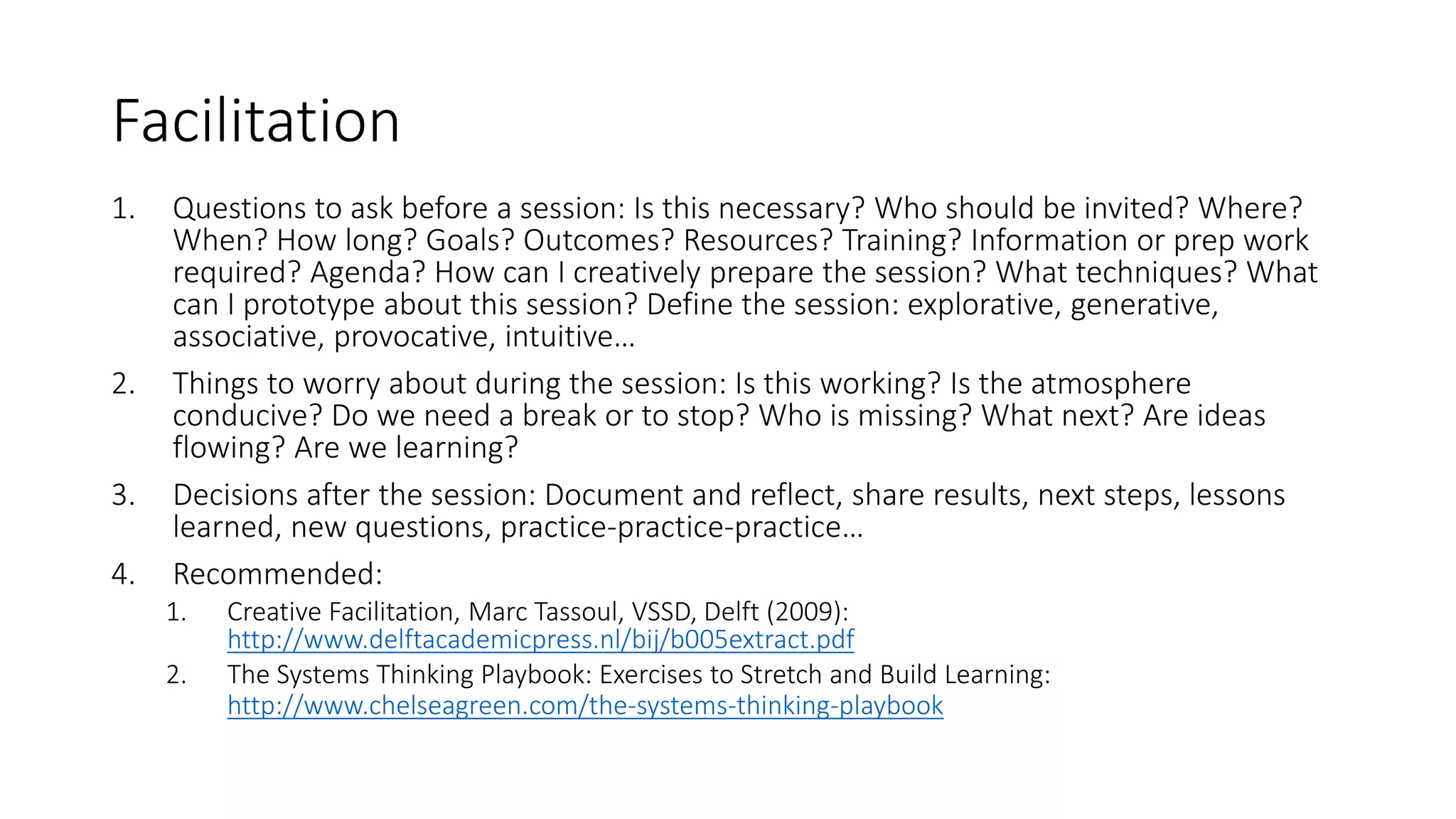
Facilitation
1. Questions to ask before a session: Is this necessary? Who should be invited? Where?
When? How long? Goals? Outcomes? Resources? Training? Information or prep work
required? Agenda? How can I creatively prepare the session? What techniques? What
can I prototype about this session? Define the session: explorative, generative,
associative, provocative, intuitive…
2. Things to worry about during the session: Is this working? Is the atmosphere
conducive? Do we need a break or to stop? Who is missing? What next? Are ideas
flowing? Are we learning?
3. Decisions after the session: Document and reflect, share results, next steps, lessons
learned, new questions, practice-practice-practice…
4. Recommended:
1. Creative Facilitation, Marc Tassoul, VSSD, Delft (2009):
http://www.delftacademicpress.nl/bij/b005extract.pdf
2. The Systems Thinking Playbook: Exercises to Stretch and Build Learning:
http://www.chelseagreen.com/the-systems-thinking-playbook
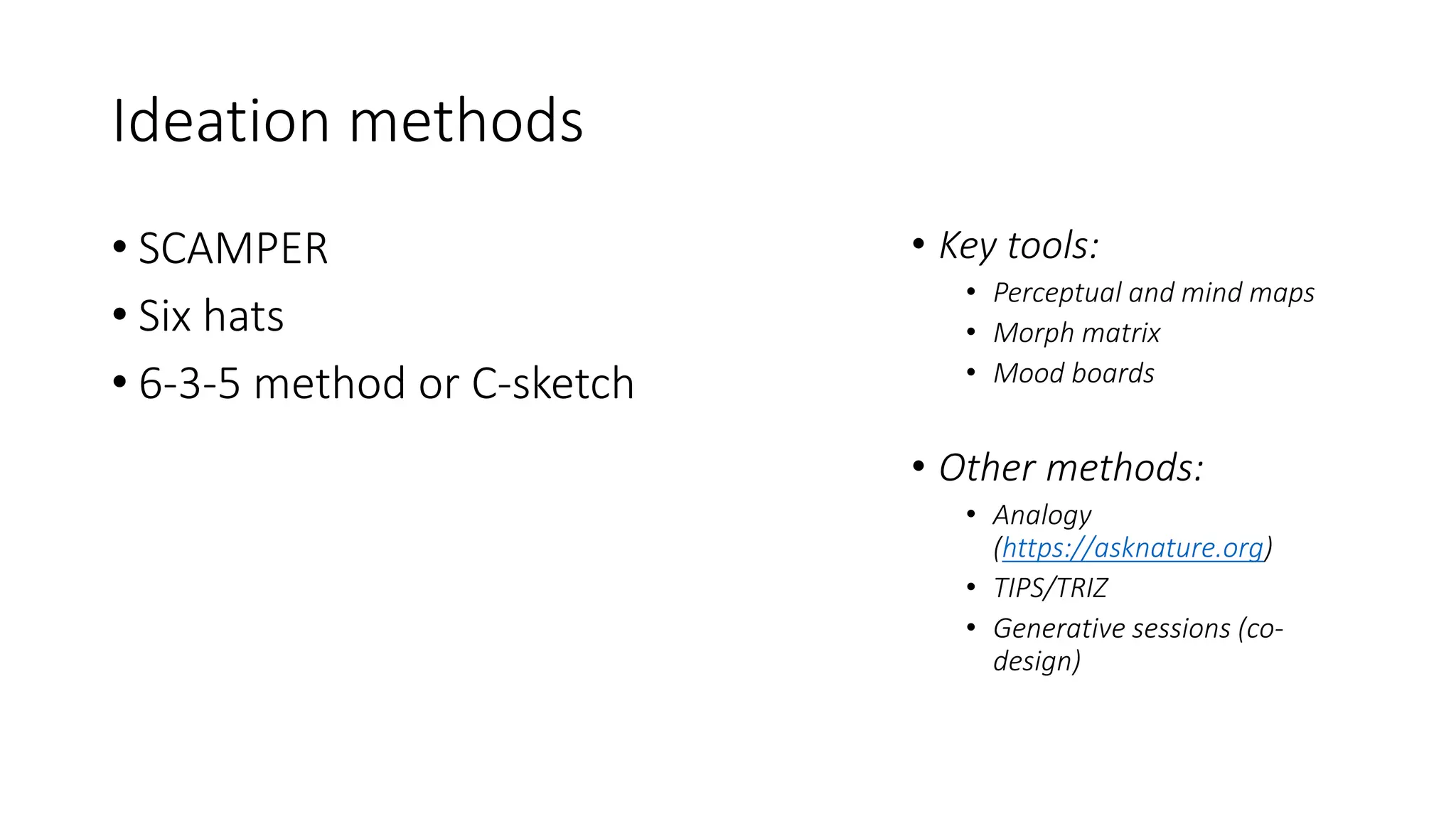
Ideation methods
• SCAMPER
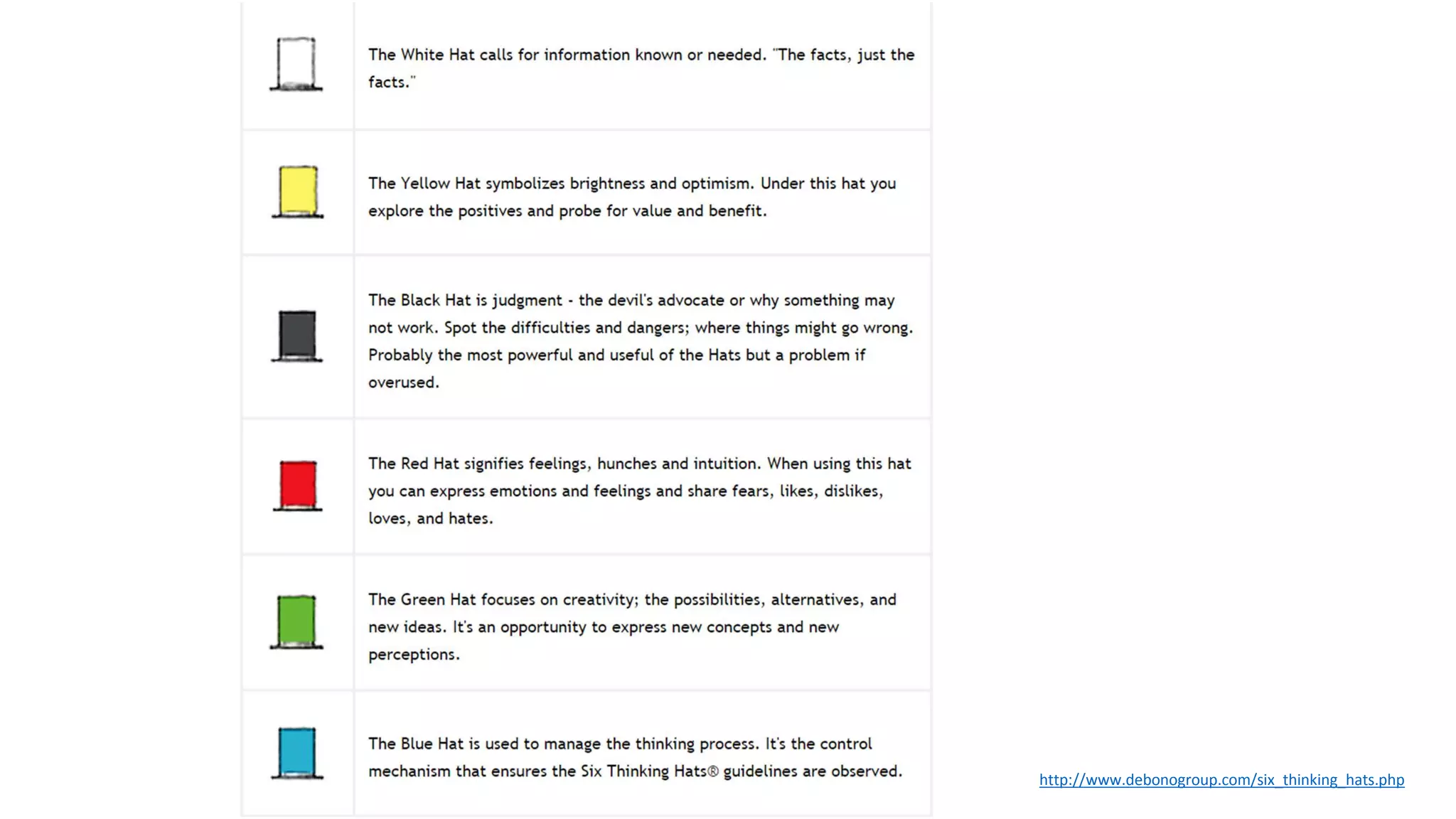
• Six hats
• 6-3-5 method or C-sketch
• Key tools:
• Perceptual and mind maps
• Morph matrix
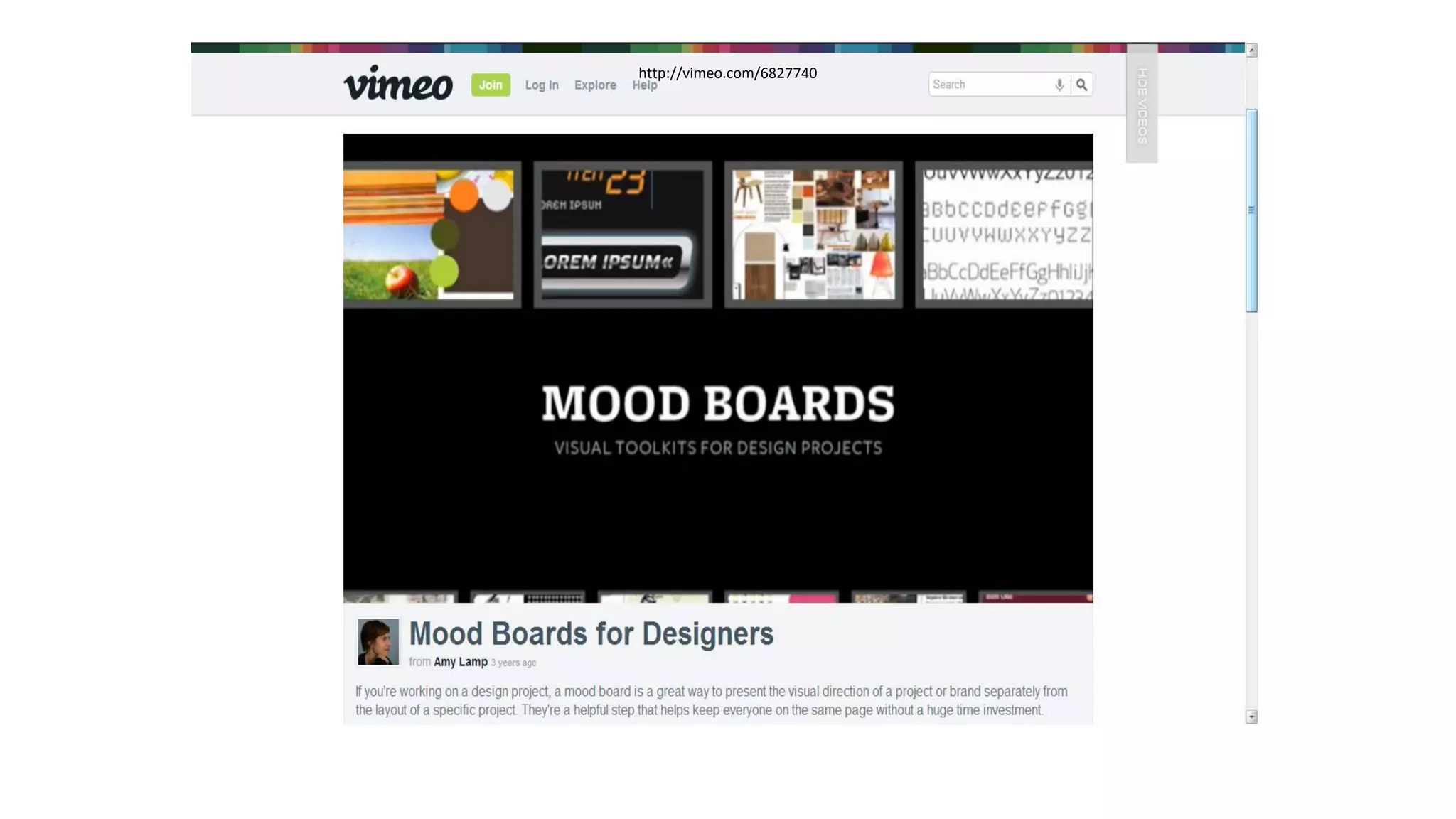
• Mood boards
• Other methods:
• Analogy
(https://asknature.org)
• TIPS/TRIZ
• Generative sessions (co-
design)
Activity 4.2: SCAMPER
Duration: 15 minutes
Lunch
1 hour
http://www.debonogroup.com/six_thinking_hats.php
Activity 4.3: Six hats
Duration: 15 minutes
Activity 4.4: 6-3-5 method
Duration: 30 minutes
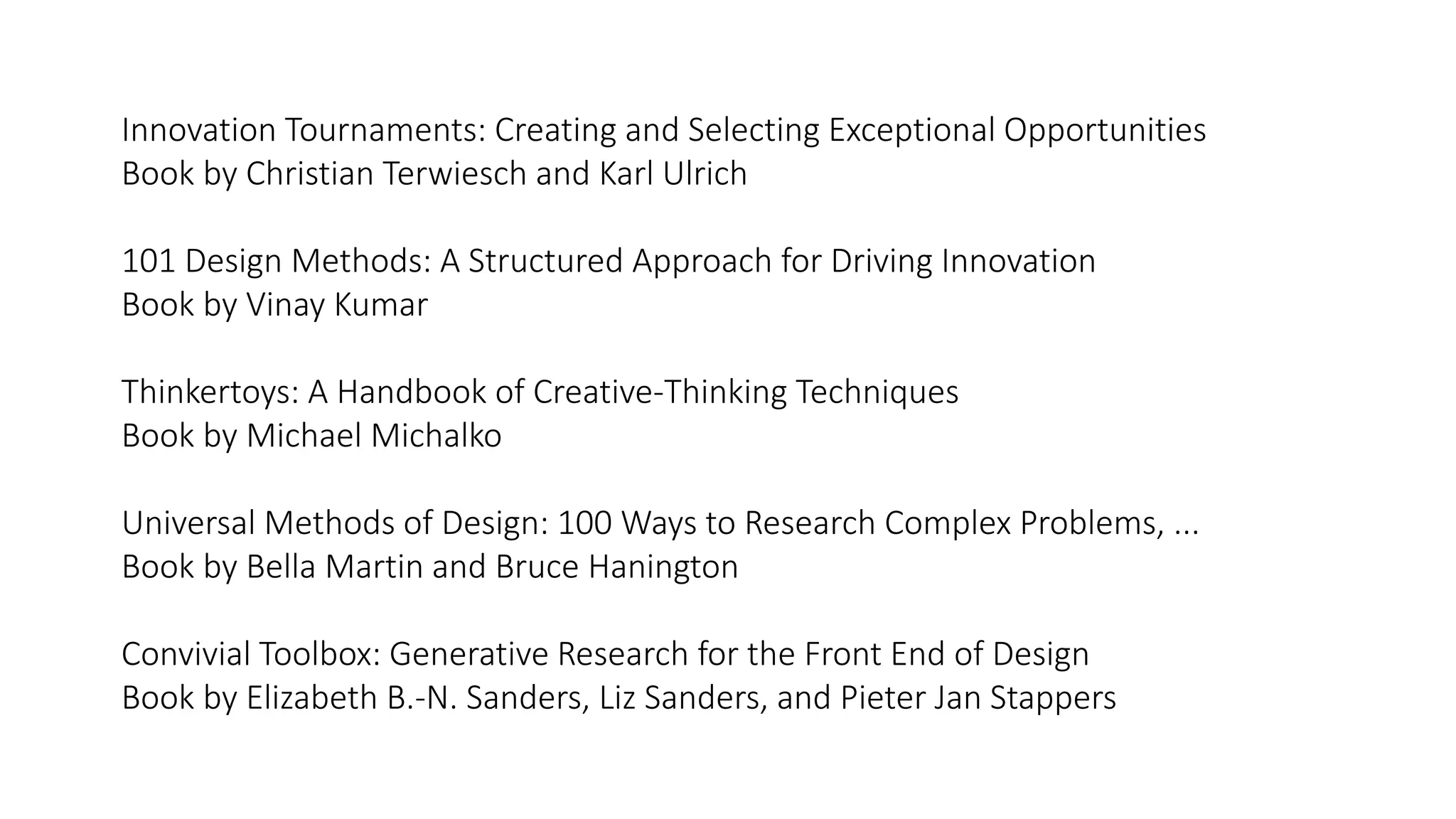
Innovation Tournaments: Creating and Selecting Exceptional Opportunities
Book by Christian Terwiesch and Karl Ulrich
101 Design Methods: A Structured Approach for Driving Innovation
Book by Vinay Kumar
Thinkertoys: A Handbook of Creative-Thinking Techniques
Book by Michael Michalko
Universal Methods of Design: 100 Ways to Research Complex Problems, ...
Book by Bella Martin and Bruce Hanington
Convivial Toolbox: Generative Research for the Front End of Design
Book by Elizabeth B.-N. Sanders, Liz Sanders, and Pieter Jan Stappers
Activity 4.5: Idea development
and idea evaluation
Duration: 15 minutes
Effectuation logic
http://www.fastcompany.com/pivot
http://www.fastcompany.com/1836238/how-eric-ries-coined-pivot-and-what-your-business-can-learn-it
Afternoon break
15 minutes
Creativity in Asia
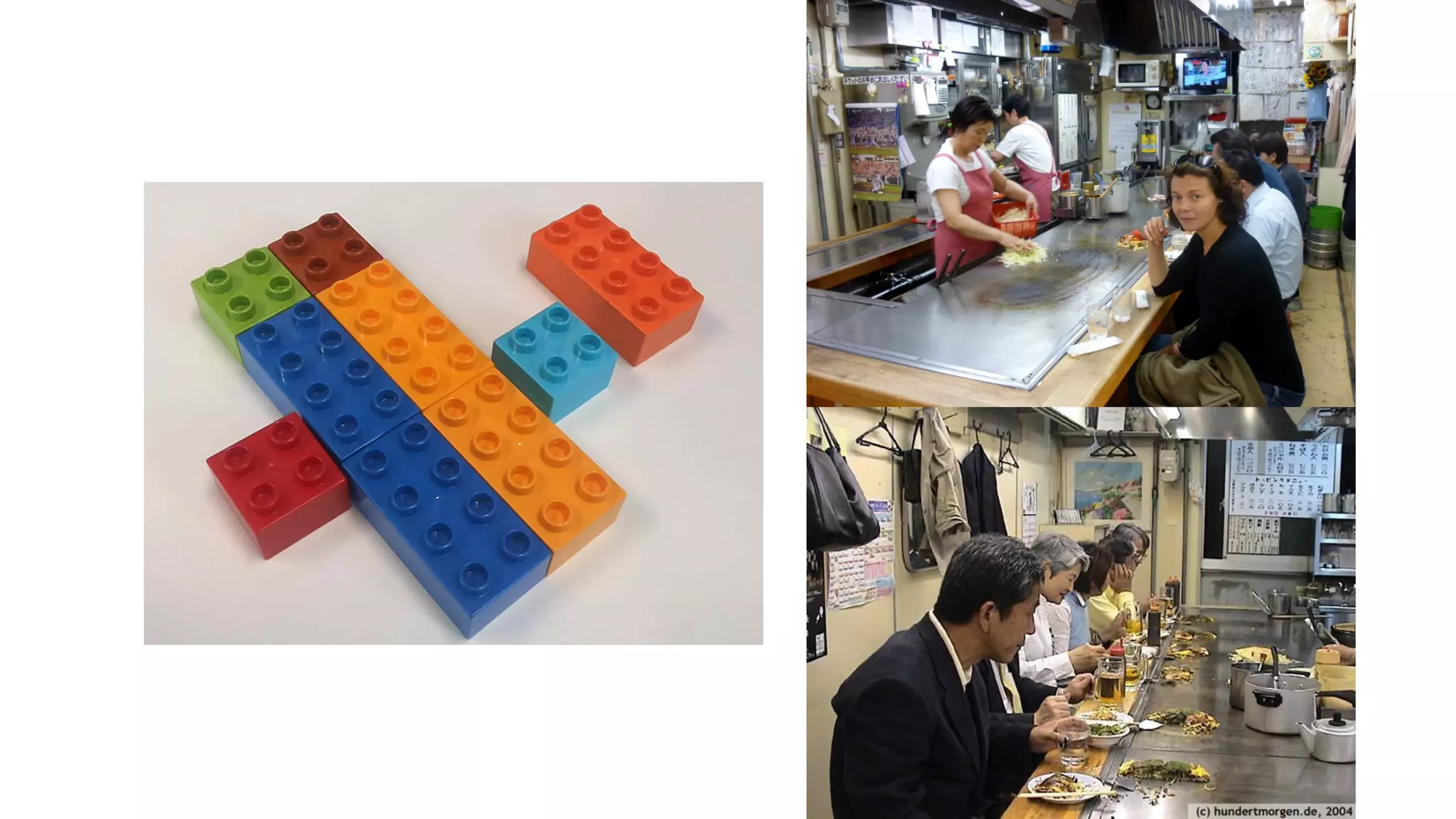
DIY Activity: ____________
Duration:
Mode:
Form, function, meaning in
services and products
Duration:
http://www.ijdesign.org/ojs/index.php/IJDesign/article/view/170/146
Perceptual Maps
http://www.core77.com/reactor/04.06_xbox.asp
http://vimeo.com/6827740
Activity 4.6: Post-survey
Duration: 15 minutes
Mode: Individual
Grading
• Individual:
• Class participation: 10%
• End of Session Activities: 20%
• Final Reflection (Individual): 40%
• Team:
• Final Reflection (Team): 30%
• Total: 100%
Individual Report
Weight: 40%
Due: Sunday 02 April noon
Individual report
1. Explain in your own words the most important lessons learned during this
module (suggested: 3)
2. Choose one and apply it in your workplace (alternatively at home)
3. Reflect on what happened: what was successful, what failed, what did you learn,
what may you do next, etc.
4. Free format, free extension. Keep a high standard of quality, communication,
and integrity
5. Build strong arguments and robust decisions (connect to context: references to
studies, published experts’ advice, case studies, statistics, etc.)
6. Submit your report as a pdf file to: rsosa@aut.ac.nz with “ACI Individual Report”
and your name in the Subject of the email
7. Hard deadline: Sunday 02 April noon
Individual report
Grading rubric:
1. Accuracy of the concepts, ideas, techniques learned in the module
2. Clarity of communication: grammar, spelling, presentation
3. Effort in applying at least one key idea learned in the module to your job
4. Original contributions and authoritative connections to the context
Each dimension is ranked on a scale of 100
Team Report
Weight: 30%
Due: Sunday 09 April noon
Team report
• Once you have submitted your individual report to us, arrange to share
it with one or two classmates. In exchange, read their individual
reports
• The team report is a joint co-authored reflection of your experiences:
• Your learning experiences during and after the module
• Your experiences applying your new ideas/skills/initiatives at work
• What was similar/different, what stood out, how does their work
inform yours, what feedback/advice can you give them?
• Hard deadline: Sunday 09 April noon
Team report
Grading rubric:
1. Evidence of meaningful discussion and understanding each other’s work
2. Insightful comparisons, conclusions, questions built collaboratively
3. Critical and constructive feedback to teammates (not trivial praising)
Each dimension is ranked on a scale of 100
Creativity and Design 2017
Day 4: Hands-On!
Thank you!
Keep in touch:
Creativity and Design 2017
Day 5: Prof. Kris Wood @ SUTD campus
Alt. DIY Activity
• Form “listening triads”, iterate
swapping roles
• Discussion theme: “Most valuable idea
today, and why?”
• Write your own key learning, submit
before you leave today
 Active listening
 Empathize with others
 Reflect and synthesize

Creativity and design 2017 day 4

  • 1.
    Creativity and Design2017 Day 4: Experience creativity
  • 2.
  • 3.
  • 4.
    Ideation golden rules 1.Take turns, contribute and let encourage others to contribute 2. Go for quantity: a stream a storm a typhoon of ideas “think aloud” 3. Don’t criticise ideas, avoid any reference to their feasibility at this stage 4. Bad ideas are allowed are welcome are encouraged 5. Practice active listening: rephrase, inquire, build-upon, combine
  • 5.
    Activity 4.1: Brainstorming “Notmy problem” problem Duration: 15 minutes
  • 6.
    Ideation recommendations • Introduce/amplifydiversity • Explore the problems as well as the solutions • Don’t praise ideas either, accept and “plus” them • Document, capture ideas • Look for gaps in the sequence of ideas, themes, types of ideas • It’s not a competition, it’s not a place to shine, avoid ownership of ideas • Create mutual trust, a safe space: no hierarchies, level playing field • Model the process, walk the talk • Don’t overdo it: 20 minute blocks with breaks • Be mindful of the “second half gain”: less obvious ideas emerge after the box has been defined with commonplace ideas • Don’t expect every session to be successful • Ideation is like Karaoke: https://www.timeout.com/los-angeles/clubs/the-10-rules-of- karaoke
  • 7.
  • 8.
    Facilitation 1. Questions toask before a session: Is this necessary? Who should be invited? Where? When? How long? Goals? Outcomes? Resources? Training? Information or prep work required? Agenda? How can I creatively prepare the session? What techniques? What can I prototype about this session? Define the session: explorative, generative, associative, provocative, intuitive… 2. Things to worry about during the session: Is this working? Is the atmosphere conducive? Do we need a break or to stop? Who is missing? What next? Are ideas flowing? Are we learning? 3. Decisions after the session: Document and reflect, share results, next steps, lessons learned, new questions, practice-practice-practice… 4. Recommended: 1. Creative Facilitation, Marc Tassoul, VSSD, Delft (2009): http://www.delftacademicpress.nl/bij/b005extract.pdf 2. The Systems Thinking Playbook: Exercises to Stretch and Build Learning: http://www.chelseagreen.com/the-systems-thinking-playbook
  • 9.
    Ideation methods • SCAMPER •Six hats • 6-3-5 method or C-sketch • Key tools: • Perceptual and mind maps • Morph matrix • Mood boards • Other methods: • Analogy (https://asknature.org) • TIPS/TRIZ • Generative sessions (co- design)
  • 11.
  • 12.
  • 13.
  • 14.
    Activity 4.3: Sixhats Duration: 15 minutes
  • 15.
    Activity 4.4: 6-3-5method Duration: 30 minutes
  • 16.
    Innovation Tournaments: Creatingand Selecting Exceptional Opportunities Book by Christian Terwiesch and Karl Ulrich 101 Design Methods: A Structured Approach for Driving Innovation Book by Vinay Kumar Thinkertoys: A Handbook of Creative-Thinking Techniques Book by Michael Michalko Universal Methods of Design: 100 Ways to Research Complex Problems, ... Book by Bella Martin and Bruce Hanington Convivial Toolbox: Generative Research for the Front End of Design Book by Elizabeth B.-N. Sanders, Liz Sanders, and Pieter Jan Stappers
  • 17.
    Activity 4.5: Ideadevelopment and idea evaluation Duration: 15 minutes
  • 18.
  • 19.
  • 20.
  • 21.
  • 22.
  • 23.
    Form, function, meaningin services and products Duration:
  • 24.
  • 25.
  • 27.
    Activity 4.6: Post-survey Duration:15 minutes Mode: Individual
  • 28.
    Grading • Individual: • Classparticipation: 10% • End of Session Activities: 20% • Final Reflection (Individual): 40% • Team: • Final Reflection (Team): 30% • Total: 100%
  • 29.
  • 30.
    Individual report 1. Explainin your own words the most important lessons learned during this module (suggested: 3) 2. Choose one and apply it in your workplace (alternatively at home) 3. Reflect on what happened: what was successful, what failed, what did you learn, what may you do next, etc. 4. Free format, free extension. Keep a high standard of quality, communication, and integrity 5. Build strong arguments and robust decisions (connect to context: references to studies, published experts’ advice, case studies, statistics, etc.) 6. Submit your report as a pdf file to: rsosa@aut.ac.nz with “ACI Individual Report” and your name in the Subject of the email 7. Hard deadline: Sunday 02 April noon
  • 31.
    Individual report Grading rubric: 1.Accuracy of the concepts, ideas, techniques learned in the module 2. Clarity of communication: grammar, spelling, presentation 3. Effort in applying at least one key idea learned in the module to your job 4. Original contributions and authoritative connections to the context Each dimension is ranked on a scale of 100
  • 32.
    Team Report Weight: 30% Due:Sunday 09 April noon
  • 33.
    Team report • Onceyou have submitted your individual report to us, arrange to share it with one or two classmates. In exchange, read their individual reports • The team report is a joint co-authored reflection of your experiences: • Your learning experiences during and after the module • Your experiences applying your new ideas/skills/initiatives at work • What was similar/different, what stood out, how does their work inform yours, what feedback/advice can you give them? • Hard deadline: Sunday 09 April noon
  • 34.
    Team report Grading rubric: 1.Evidence of meaningful discussion and understanding each other’s work 2. Insightful comparisons, conclusions, questions built collaboratively 3. Critical and constructive feedback to teammates (not trivial praising) Each dimension is ranked on a scale of 100
  • 35.
    Creativity and Design2017 Day 4: Hands-On!
  • 36.
  • 37.
    Creativity and Design2017 Day 5: Prof. Kris Wood @ SUTD campus
  • 38.
    Alt. DIY Activity •Form “listening triads”, iterate swapping roles • Discussion theme: “Most valuable idea today, and why?” • Write your own key learning, submit before you leave today  Active listening  Empathize with others  Reflect and synthesize