Creativity#8: Creative Organizations
Tathagat Varma
Knowledgepreneur
http://thoughtleadership.in
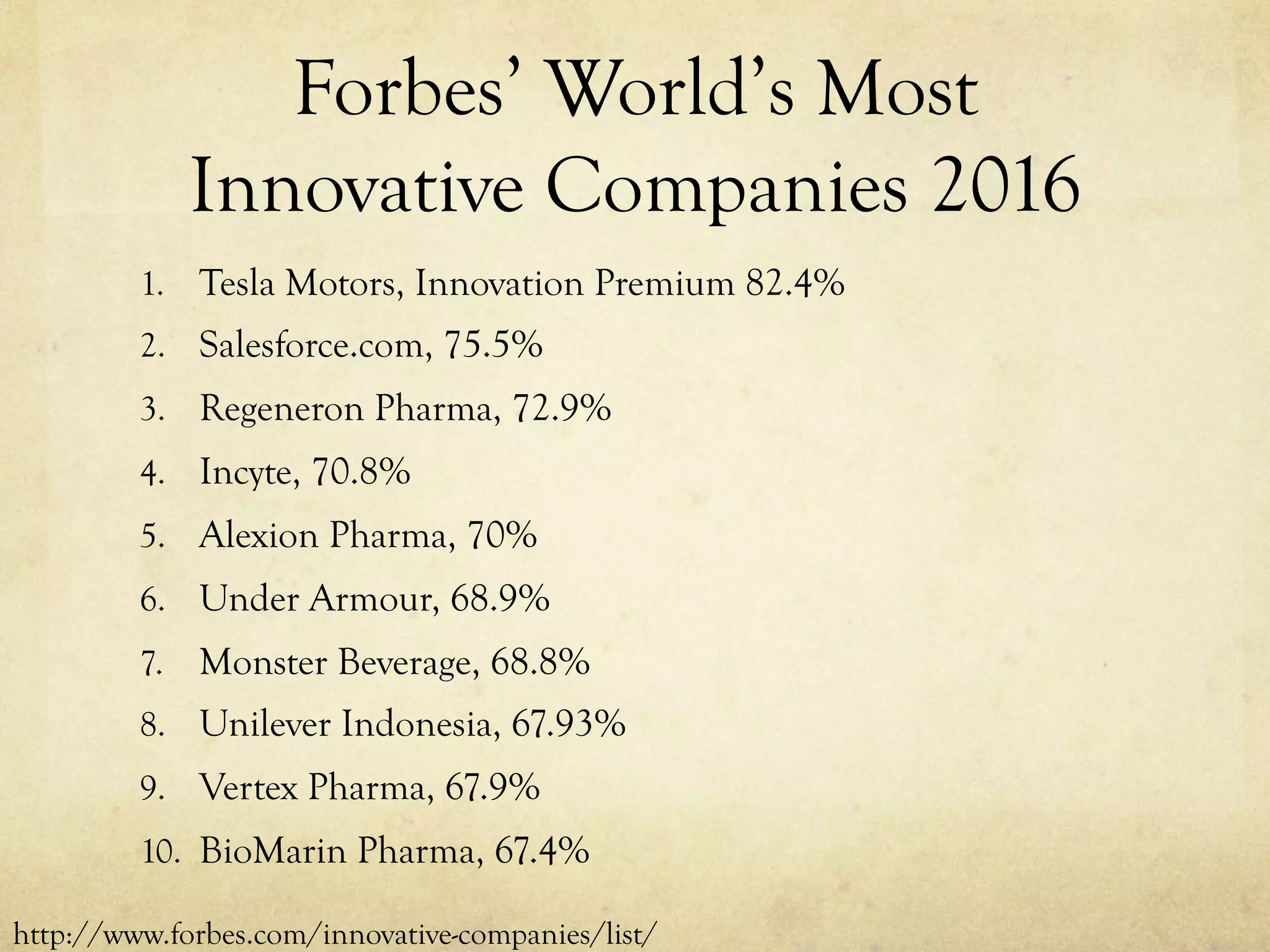
Forbes’ World’s Most
Innovative Companies 2016
1.  Tesla Motors, Innovation Premium 82.4%
2.  Salesforce.com, 75.5%
3.  Regeneron Pharma, 72.9%
4.  Incyte, 70.8%
5.  Alexion Pharma, 70%
6.  Under Armour, 68.9%
7.  Monster Beverage, 68.8%
8.  Unilever Indonesia, 67.93%
9.  Vertex Pharma, 67.9%
10.  BioMarin Pharma, 67.4%
http://www.forbes.com/innovative-companies/list/
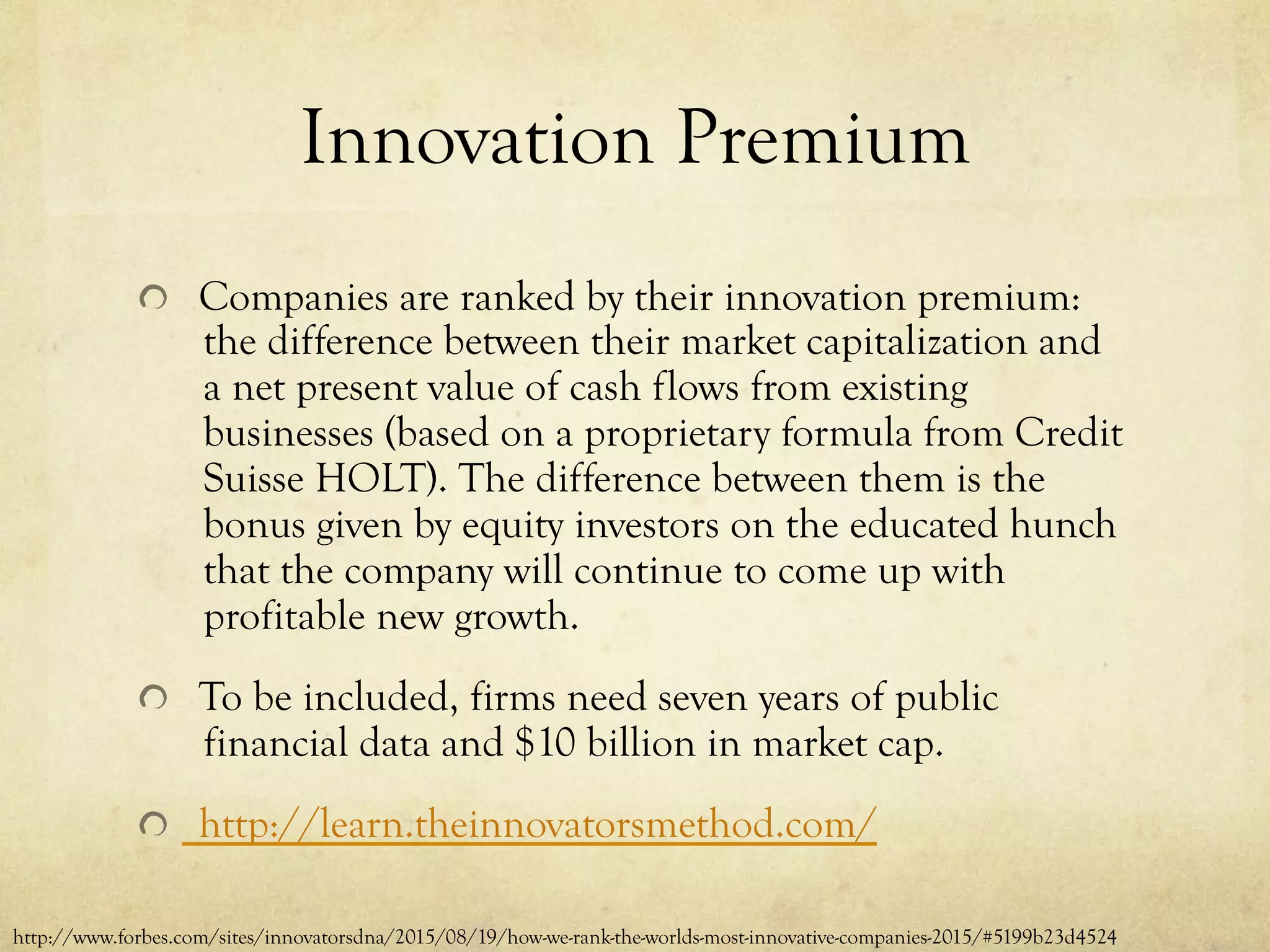
Innovation Premium
  Companies are ranked by their innovation premium:
the difference between their market capitalization and
a net present value of cash flows from existing
businesses (based on a proprietary formula from Credit
Suisse HOLT). The difference between them is the
bonus given by equity investors on the educated hunch
that the company will continue to come up with
profitable new growth.
  To be included, firms need seven years of public
financial data and $10 billion in market cap.
http://learn.theinnovatorsmethod.com/
http://www.forbes.com/sites/innovatorsdna/2015/08/19/how-we-rank-the-worlds-most-innovative-companies-2015/#5199b23d4524
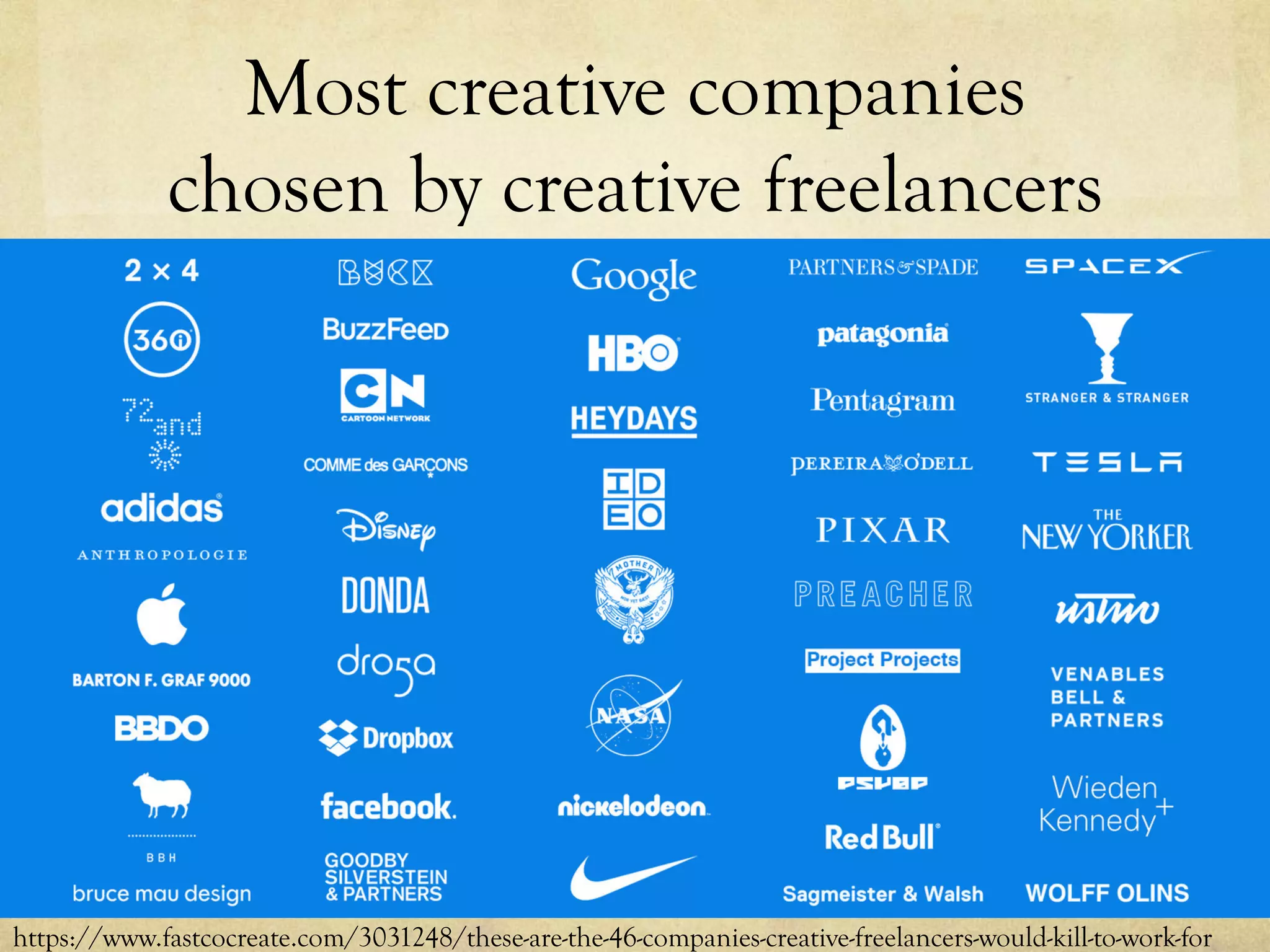
Most creative companies
chosen by creative freelancers
https://www.fastcocreate.com/3031248/these-are-the-46-companies-creative-freelancers-would-kill-to-work-for
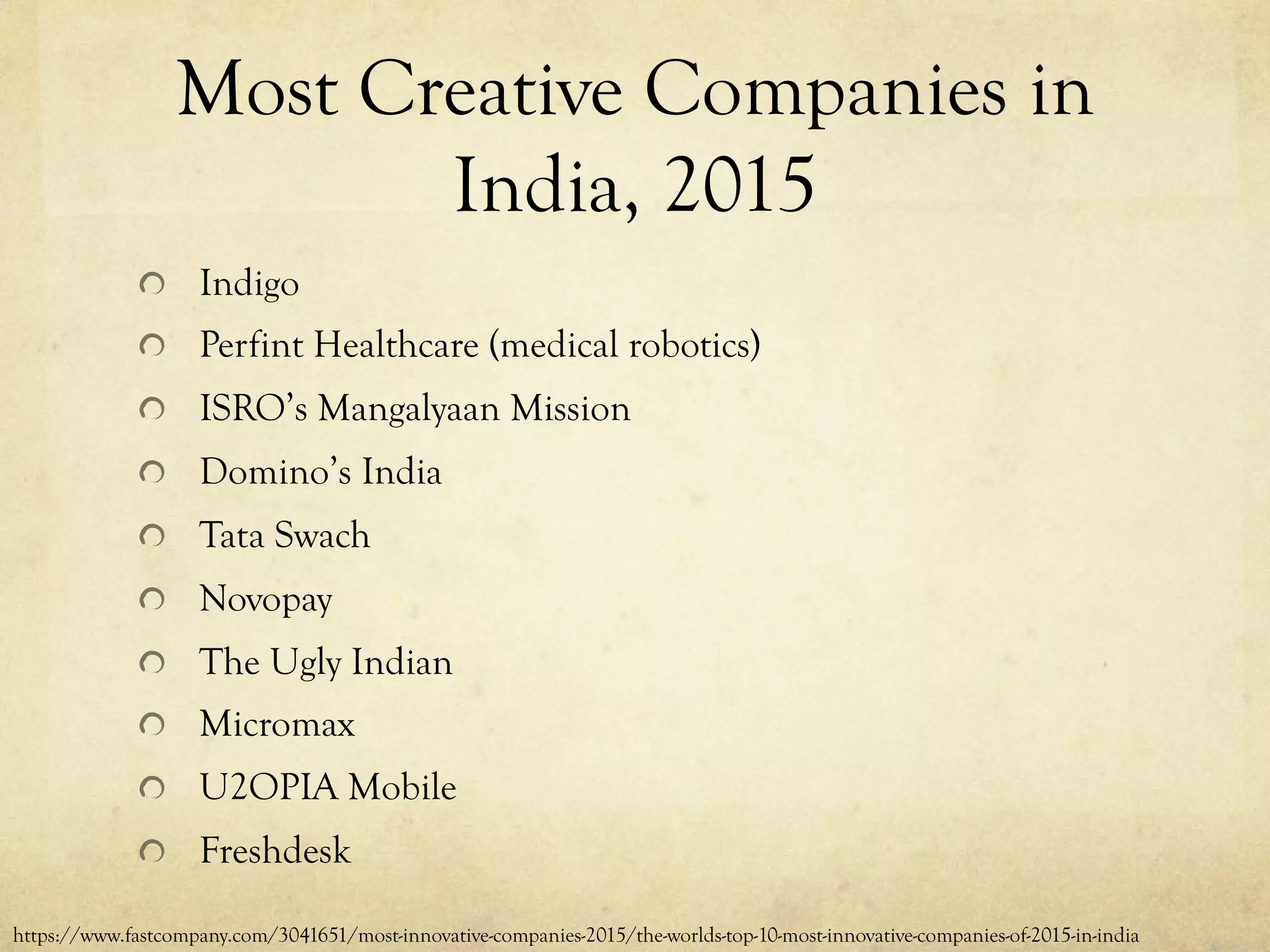
Most Creative Companies in
India, 2015
  Indigo
Perfint Healthcare (medical robotics)
  ISRO’s Mangalyaan Mission
  Domino’s India
  Tata Swach
Novopay
  The Ugly Indian
Micromax
  U2OPIA Mobile
Freshdesk
https://www.fastcompany.com/3041651/most-innovative-companies-2015/the-worlds-top-10-most-innovative-companies-of-2015-in-india
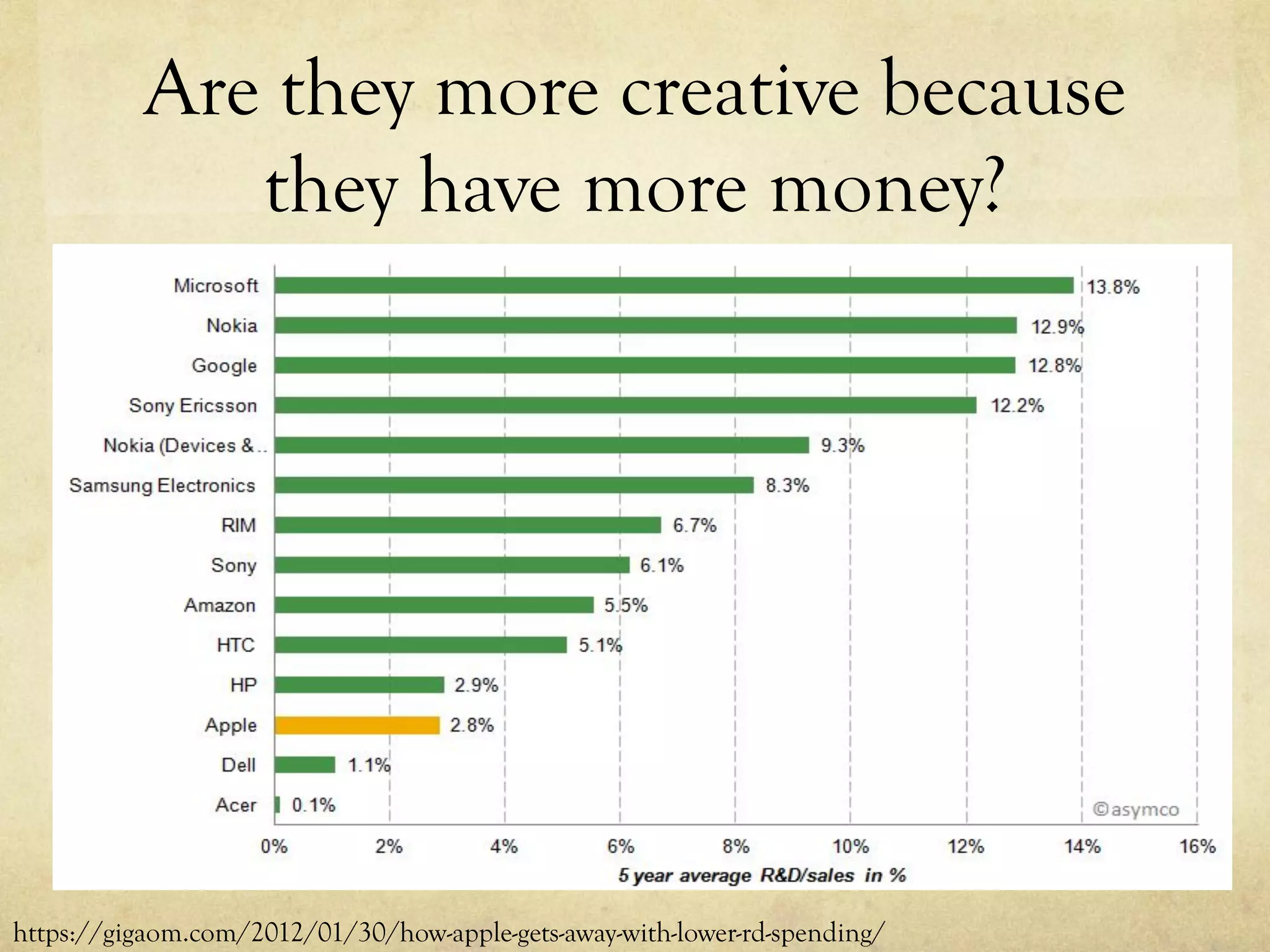
Are they more creative because
they have more money?
https://gigaom.com/2012/01/30/how-apple-gets-away-with-lower-rd-spending/
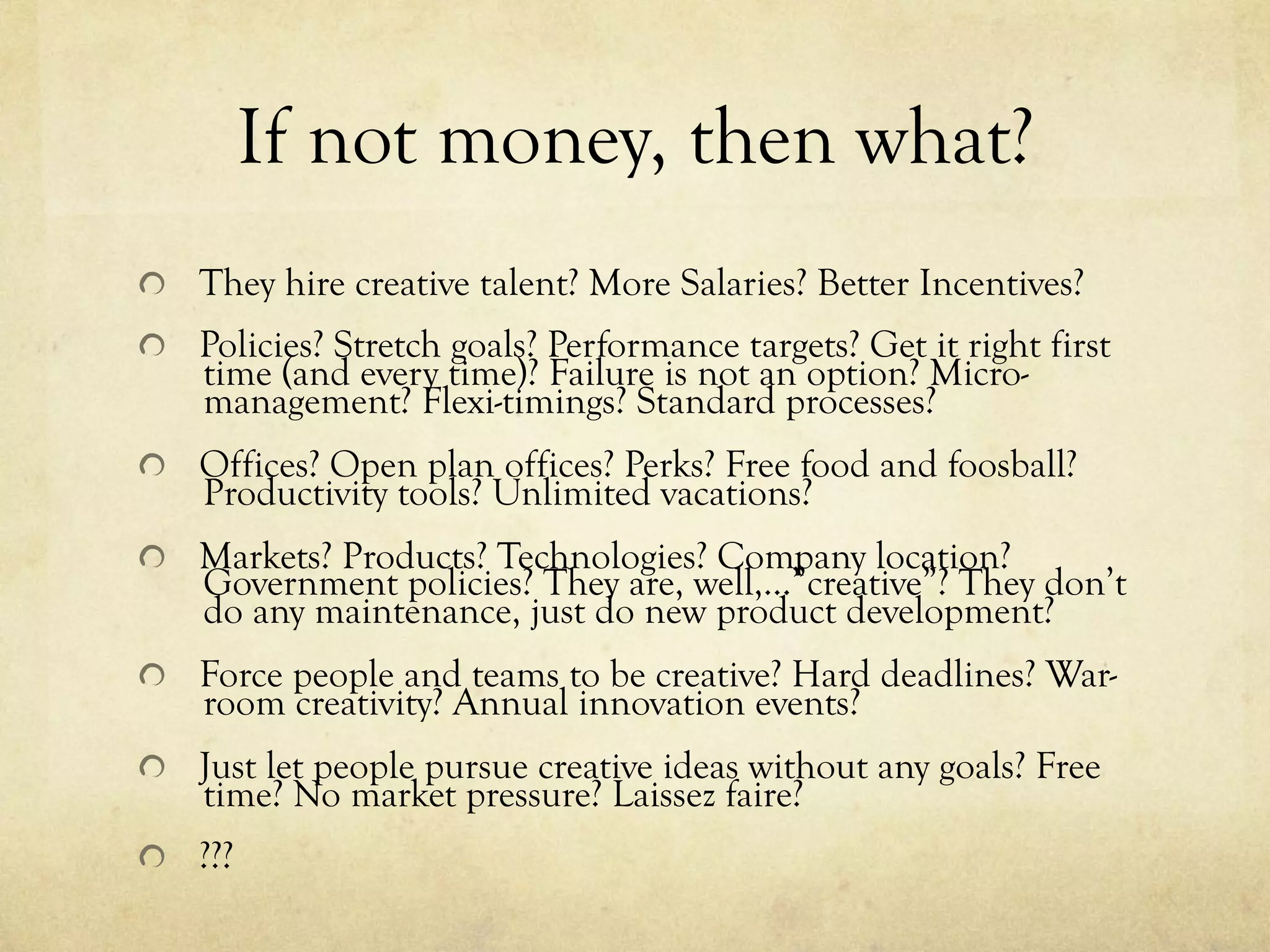
If not money, then what?
  They hire creative talent? More Salaries? Better Incentives?
  Policies? Stretch goals? Performance targets? Get it right first
time (and every time)? Failure is not an option? Micro-
management? Flexi-timings? Standard processes?
  Offices? Open plan offices? Perks? Free food and foosball?
Productivity tools? Unlimited vacations?
  Markets? Products? Technologies? Company location?
Government policies? They are, well,…”creative”? They don’t
do any maintenance, just do new product development?
  Force people and teams to be creative? Hard deadlines? War-
room creativity? Annual innovation events?
  Just let people pursue creative ideas without any goals? Free
time? No market pressure? Laissez faire?
  ???
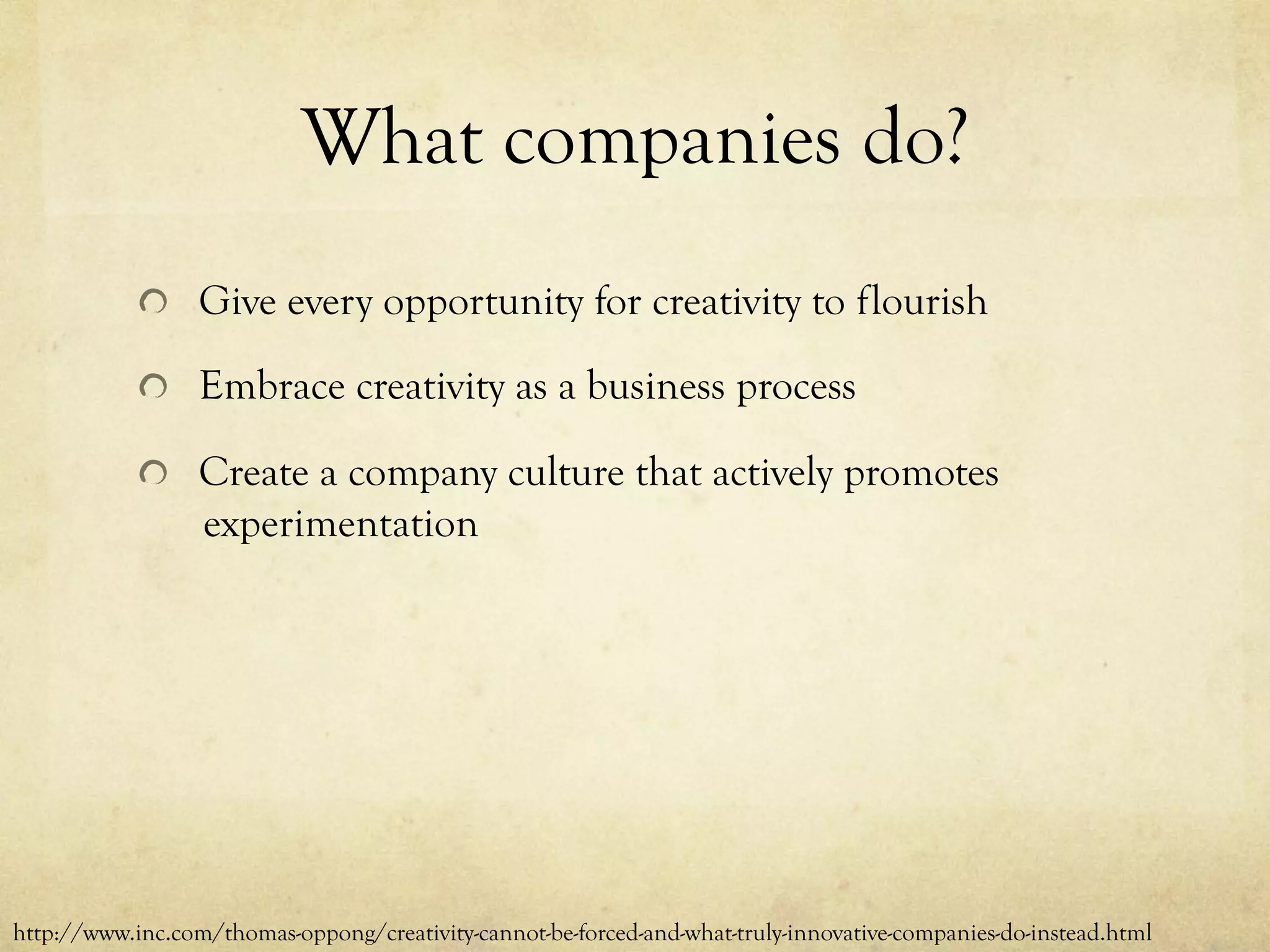
What companies do?
  Give every opportunity for creativity to flourish
  Embrace creativity as a business process
  Create a company culture that actively promotes
experimentation
http://www.inc.com/thomas-oppong/creativity-cannot-be-forced-and-what-truly-innovative-companies-do-instead.html
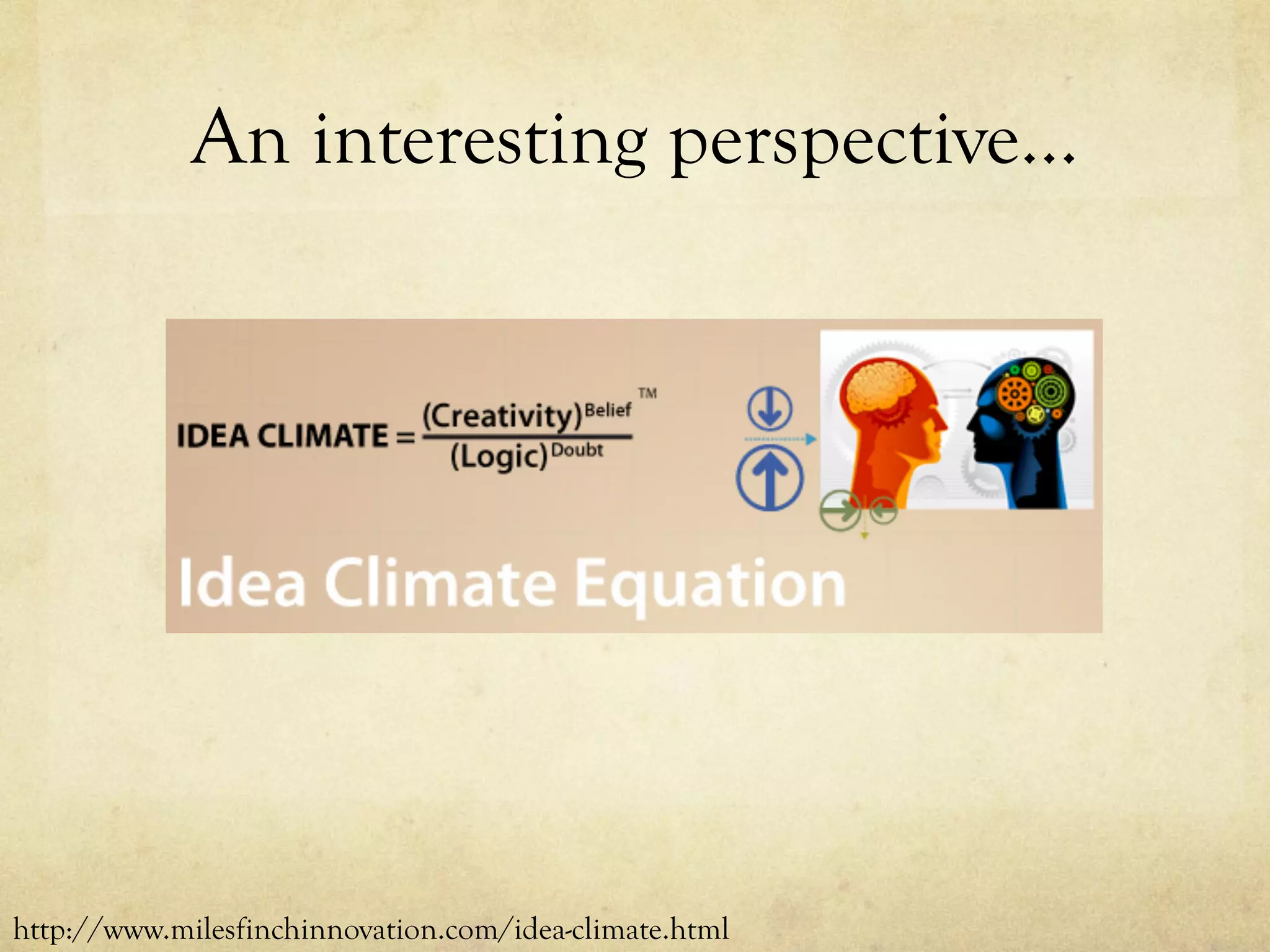
An interesting perspective…
http://www.milesfinchinnovation.com/idea-climate.html
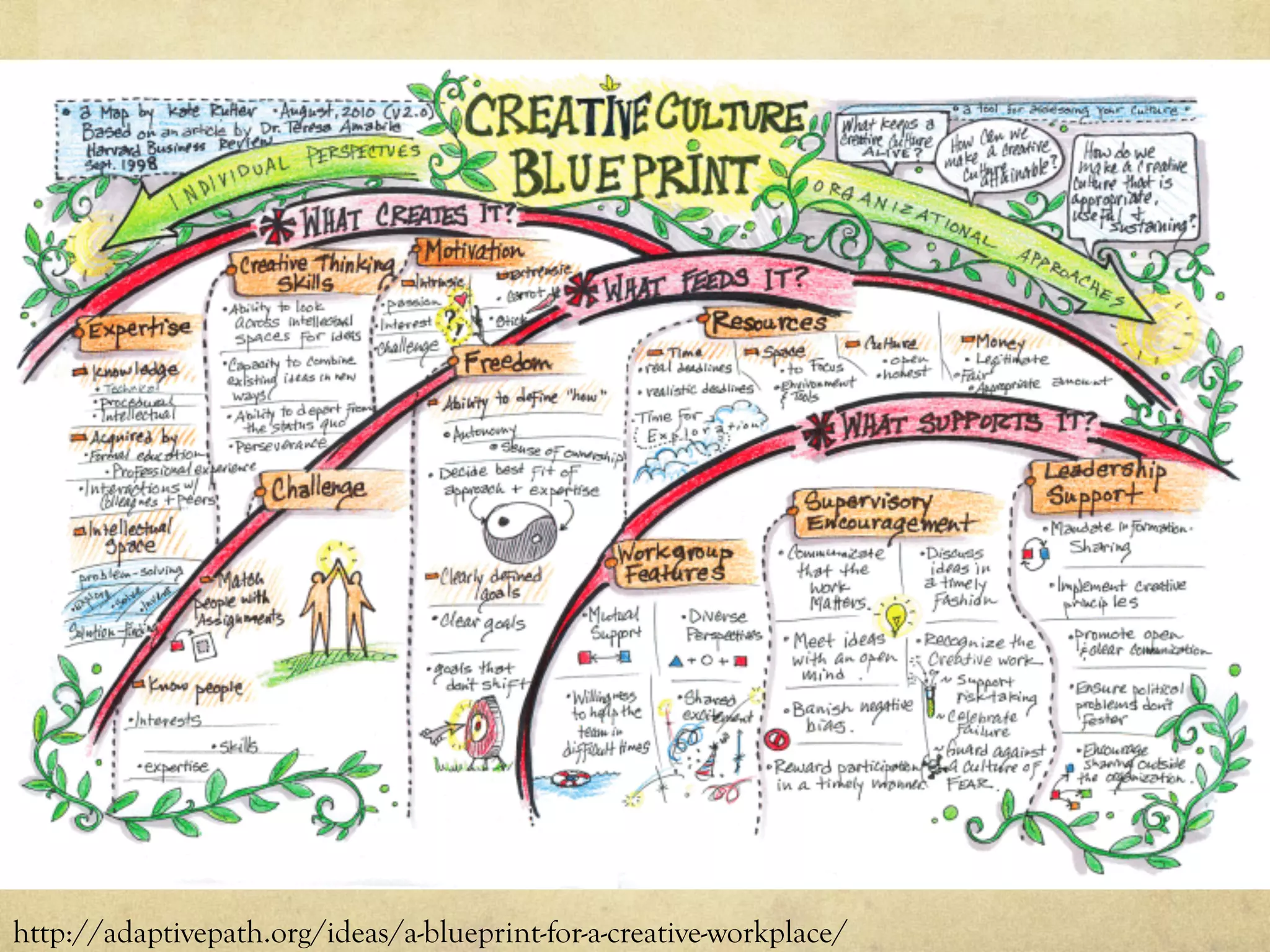
http://adaptivepath.org/ideas/a-blueprint-for-a-creative-workplace/
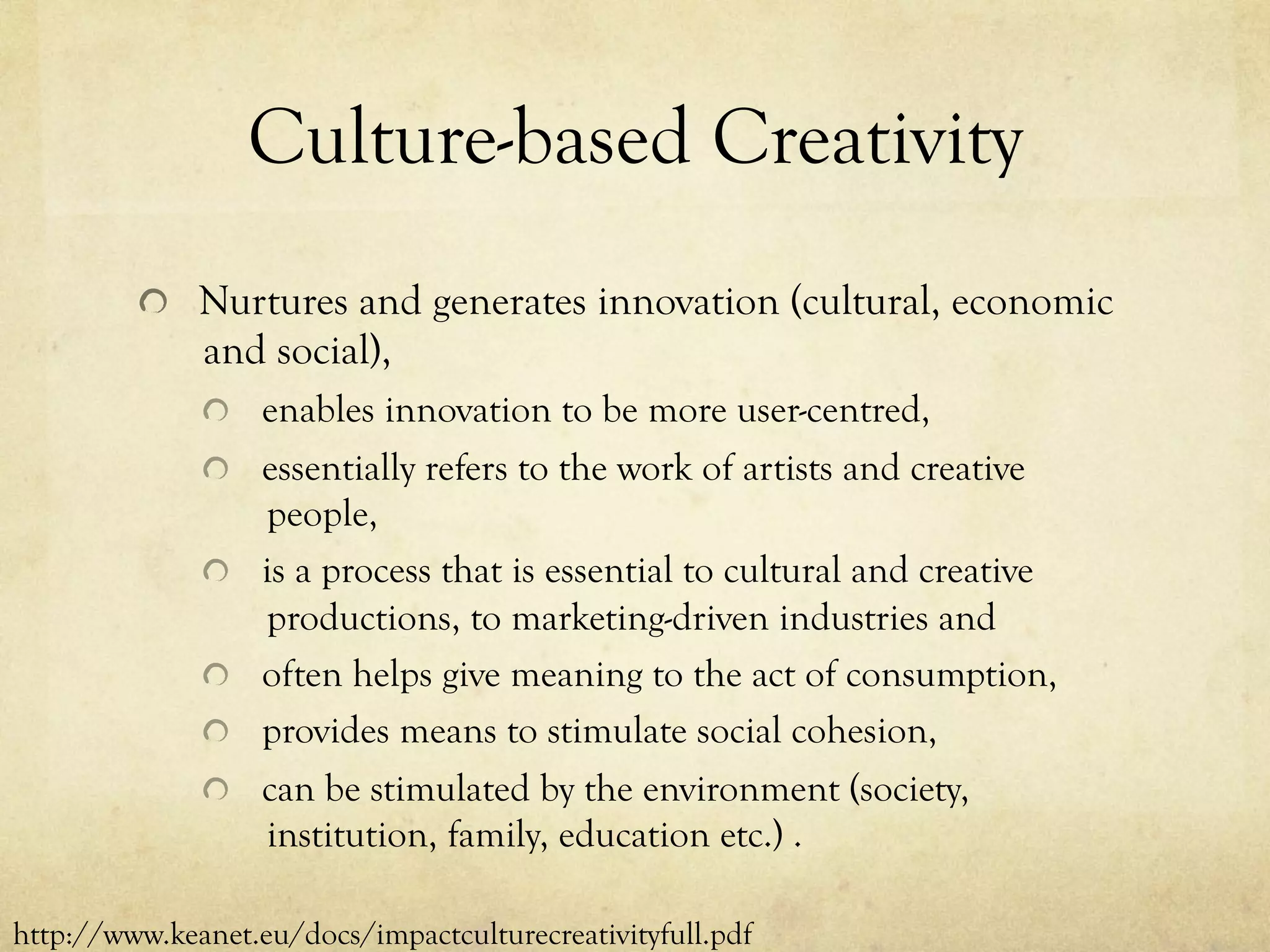
Culture-based Creativity
  Nurtures and generates innovation (cultural, economic
and social),
  enables innovation to be more user-centred,
  essentially refers to the work of artists and creative
people,
  is a process that is essential to cultural and creative
productions, to marketing-driven industries and
  often helps give meaning to the act of consumption,
  provides means to stimulate social cohesion,
  can be stimulated by the environment (society,
institution, family, education etc.) .
http://www.keanet.eu/docs/impactculturecreativityfull.pdf
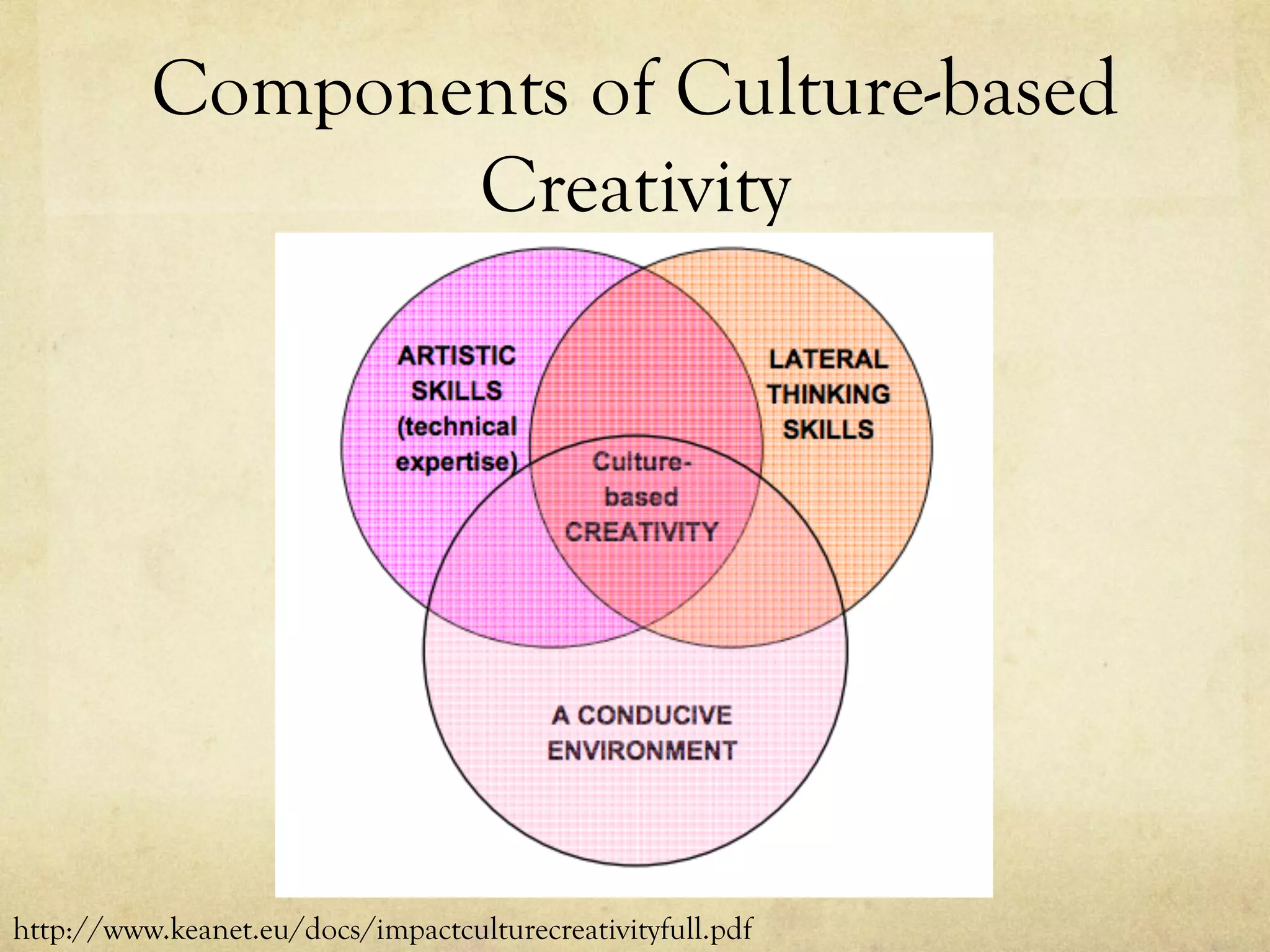
Components of Culture-based
Creativity
http://www.keanet.eu/docs/impactculturecreativityfull.pdf
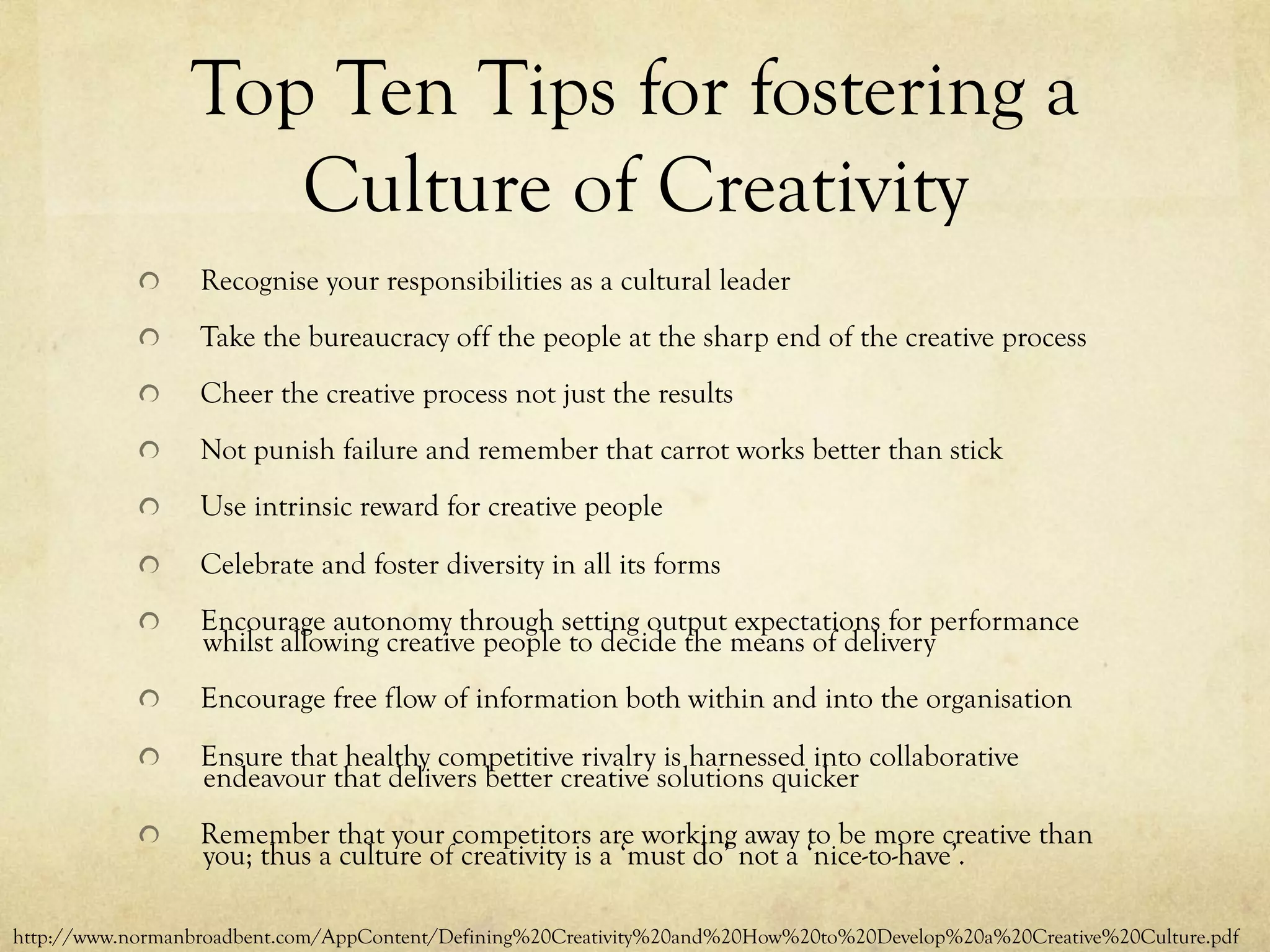
Top Ten Tips for fostering a
Culture of Creativity
  Recognise your responsibilities as a cultural leader
  Take the bureaucracy off the people at the sharp end of the creative process
  Cheer the creative process not just the results
  Not punish failure and remember that carrot works better than stick
  Use intrinsic reward for creative people
  Celebrate and foster diversity in all its forms
  Encourage autonomy through setting output expectations for performance
whilst allowing creative people to decide the means of delivery
  Encourage free flow of information both within and into the organisation
  Ensure that healthy competitive rivalry is harnessed into collaborative
endeavour that delivers better creative solutions quicker
  Remember that your competitors are working away to be more creative than
you; thus a culture of creativity is a ‘must do’ not a ‘nice-to-have’.
http://www.normanbroadbent.com/AppContent/Defining%20Creativity%20and%20How%20to%20Develop%20a%20Creative%20Culture.pdf
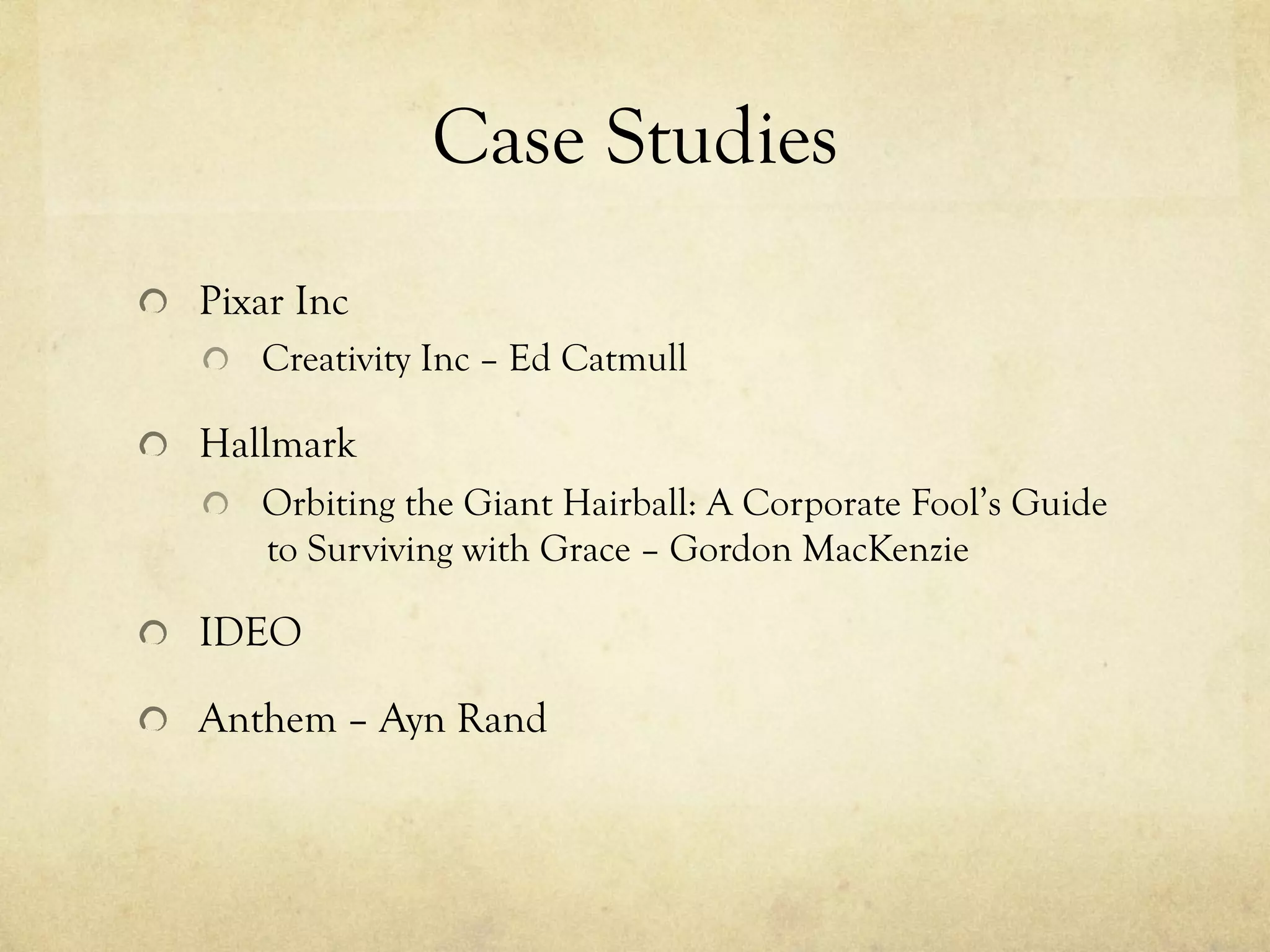
Case Studies
  Pixar Inc
  Creativity Inc – Ed Catmull
  Hallmark
  Orbiting the Giant Hairball: A Corporate Fool’s Guide
to Surviving with Grace – Gordon MacKenzie
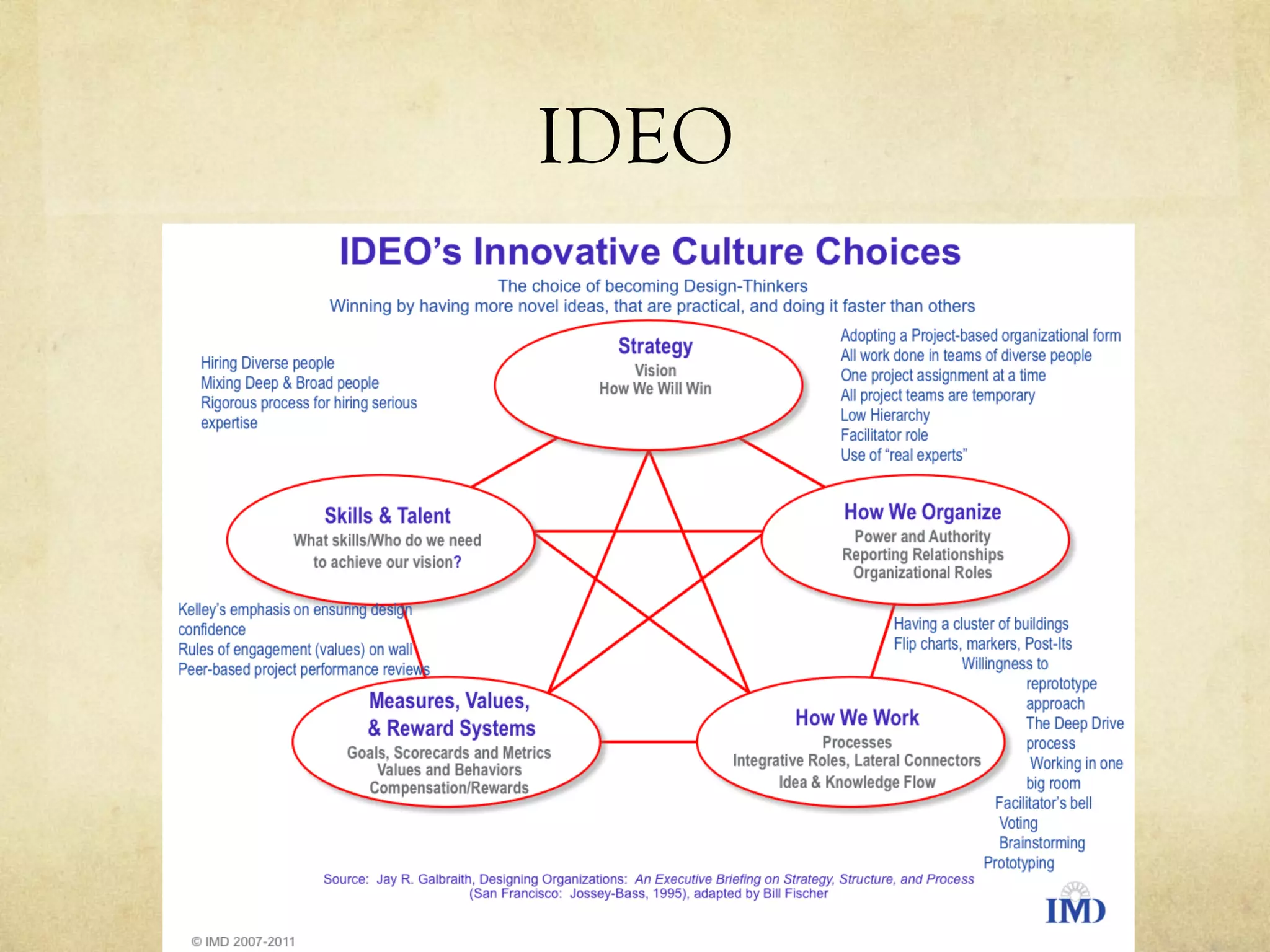
  IDEO
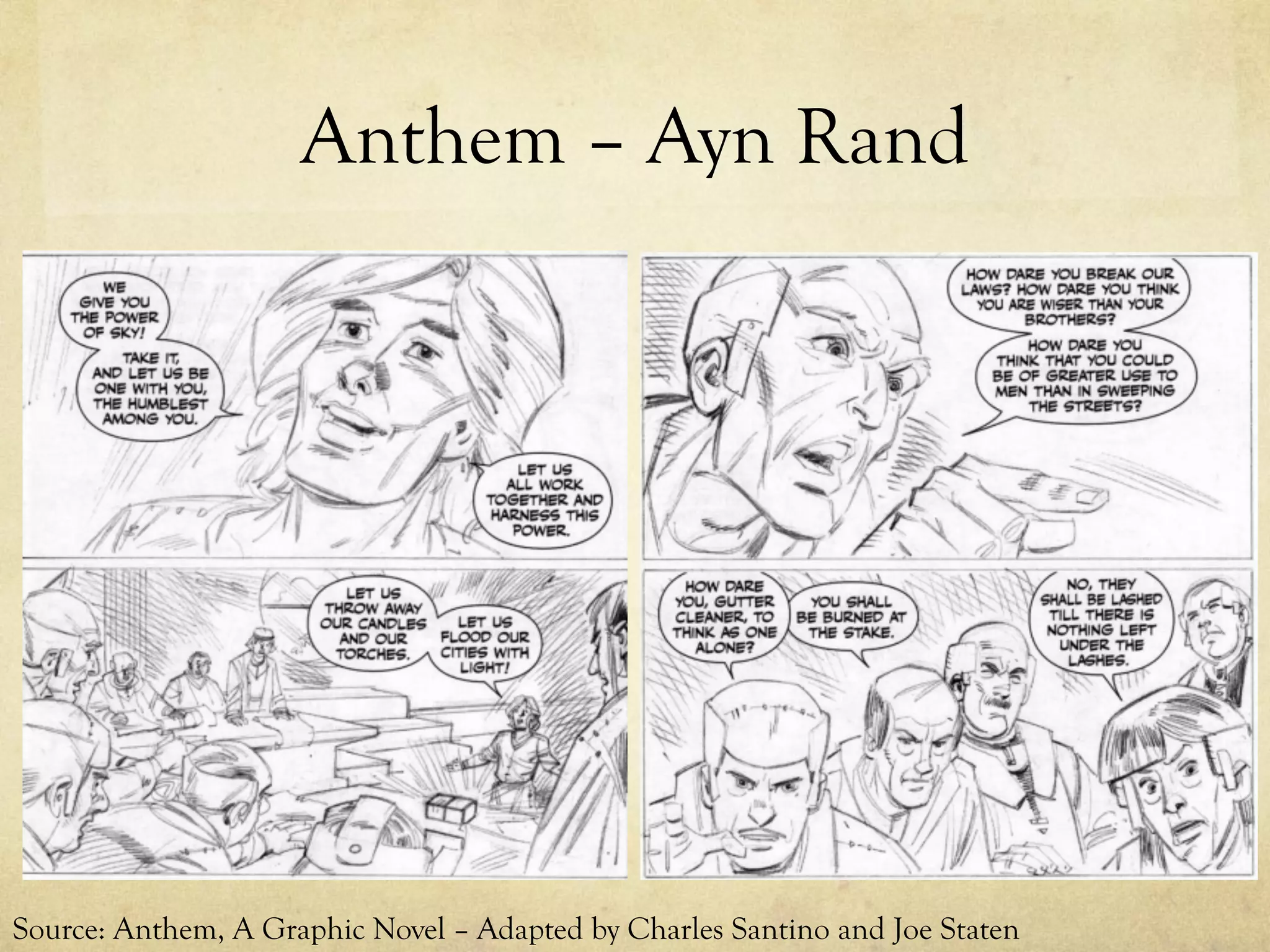
  Anthem – Ayn Rand
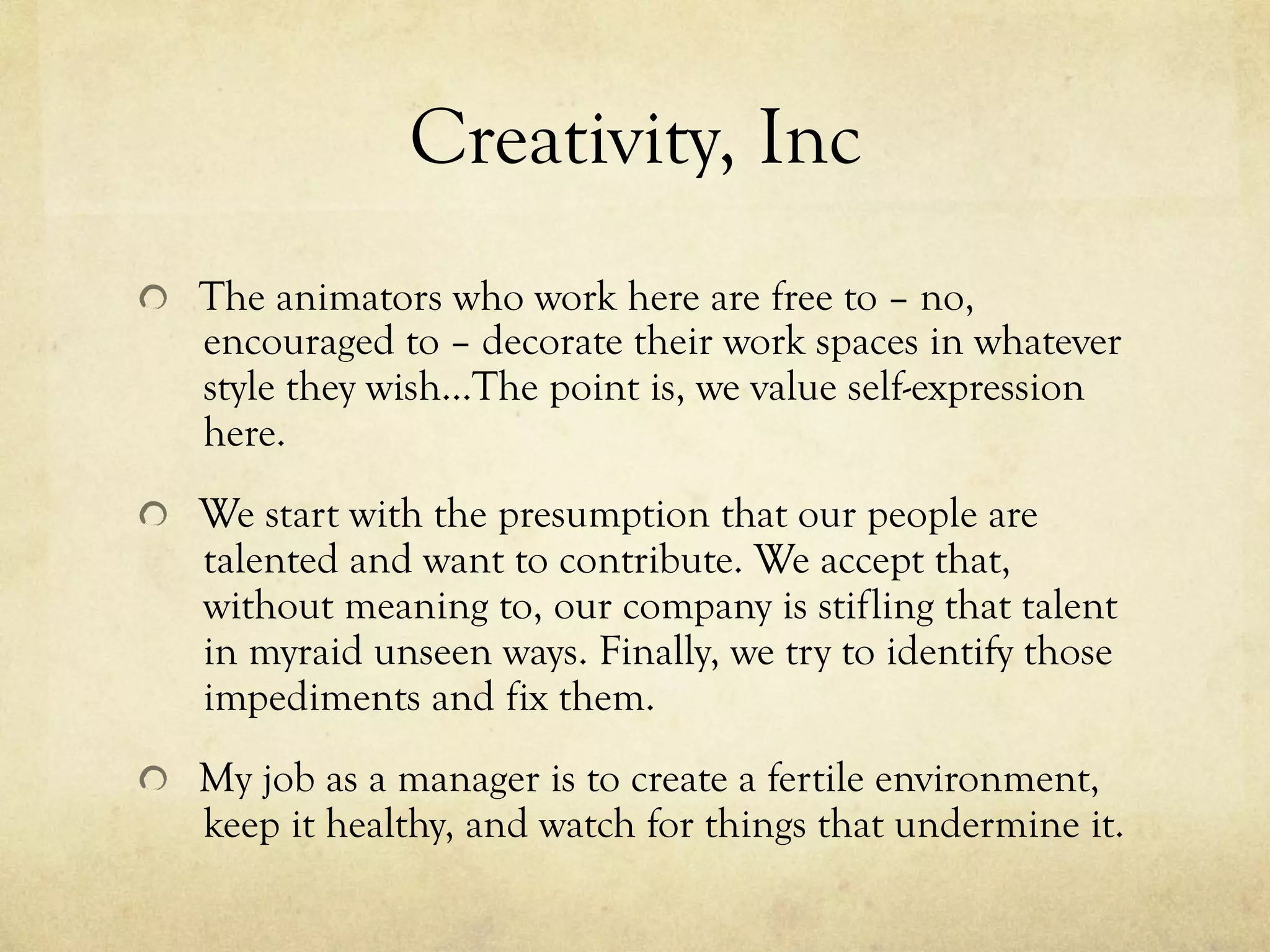
Creativity, Inc
  The animators who work here are free to – no,
encouraged to – decorate their work spaces in whatever
style they wish…The point is, we value self-expression
here.
  We start with the presumption that our people are
talented and want to contribute. We accept that,
without meaning to, our company is stifling that talent
in myraid unseen ways. Finally, we try to identify those
impediments and fix them.
  My job as a manager is to create a fertile environment,
keep it healthy, and watch for things that undermine it.
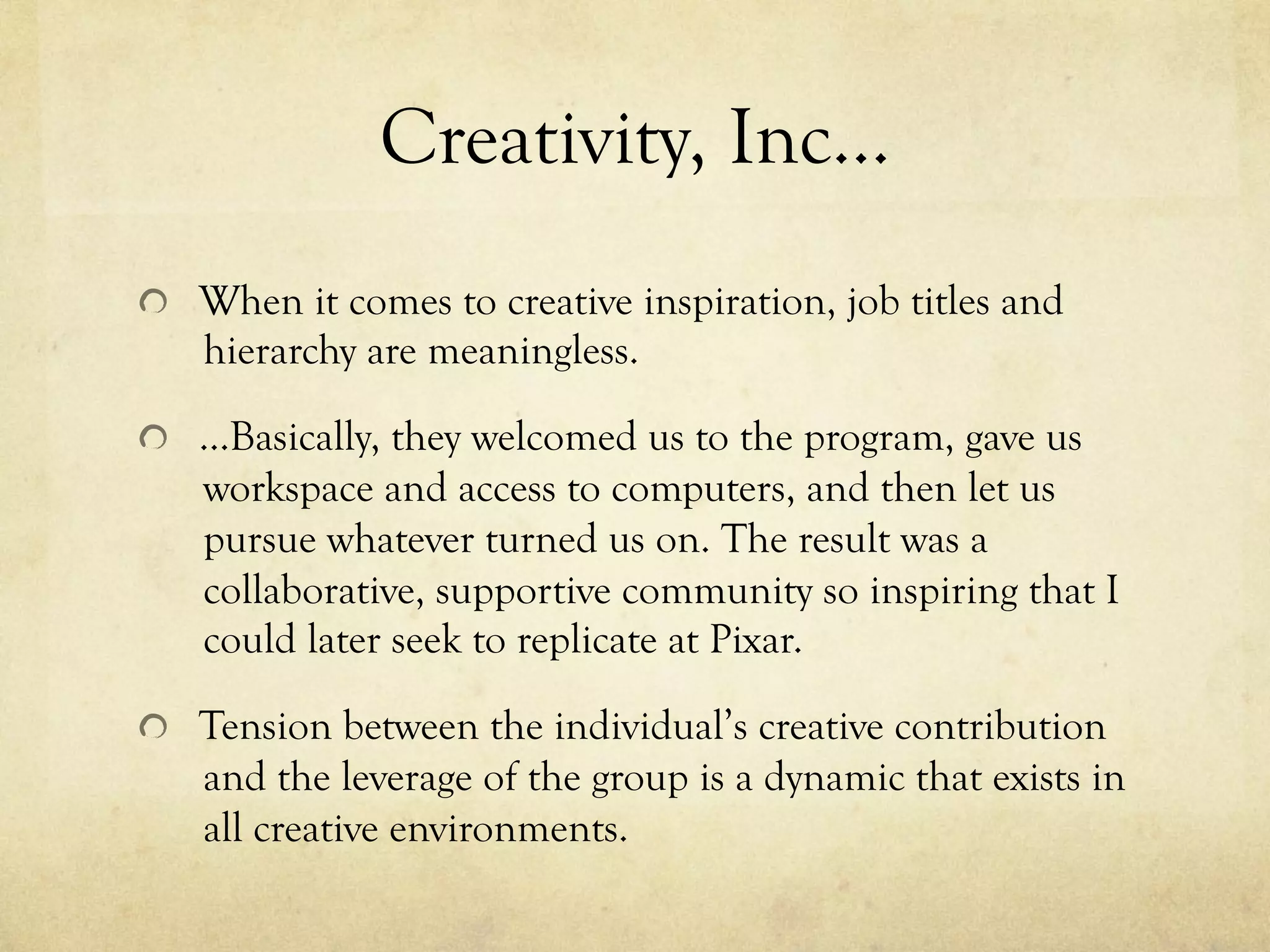
Creativity, Inc…
  When it comes to creative inspiration, job titles and
hierarchy are meaningless.
  …Basically, they welcomed us to the program, gave us
workspace and access to computers, and then let us
pursue whatever turned us on. The result was a
collaborative, supportive community so inspiring that I
could later seek to replicate at Pixar.
  Tension between the individual’s creative contribution
and the leverage of the group is a dynamic that exists in
all creative environments.
Creativity, Inc…
  ARPA’s mandate - to support smart people in a variety of
areas – was carried out based on the unwavering
presumption that researchers would try to do the right thing
and, in ARPA’s view, overmanaging them was
counterproductive. ARPA’s administrators did not hover
over the shoulders of those of us working on the project they
funded, nor did they demand that our work have direct
military applications. They simply trusted us to innovate.
  Prof Sutherland used to say that he loved his graduate
students at Utah because we didn’t know what was
impossible…When one of my colleagues at the U of U
invented something, the rest of us would immediately
piggyback on it, pushing the new idea forward.
Creativity, Inc…
  I created a flat organizational structure, much like I’d
experienced in academia, largely because I naively
thought that if I put together a hierarchical structure –
assigning a bunch of managers to report to me – I
would have to spend too much time managing and not
enough time on my own work. This structure – in
which I entrusted everybody to drive their own projects
forward, at their own pace – had its limits, but the fact
is, giving a ton of freedom to highly self-motivated
people enabled us ti make some significant
technological leaps in a short time.
Creativity, Inc…
  Experimentation was highly valued, but the urgency of for-
profit enterprise was definitely in the air.
Alvy and I decided to do the opposite – to share our work
with the outside world
  The only problem was, I had no idea what I was doing.
  His (Steve Jobs) method for taking the measure of a room
was saying something definitive and outrageous, and
watching people react. If you were brave enough to come
back at him, he often respected it – poking at you, then
registering your response, was his way of deducing what you
thought and whether you had the guts to champion it.
Creativity, Inc
  Deming’s approach – and Toyota’s too – gave
ownership of and responsibility for a product’s quality
to the people who were most involved in its creation.
Instead of merely repeating an action, workers could
suggest changes, call out problems – feel the pride that
came when they helped fix what was broken.
  Because making a movie involves hundreds of people, a
chain of command is essential…we had made the
mistake of confusing the communication structure
with the organizational structure.
Creativity, Inc
  The first principle was “Story is King”, by which we
meant that we would let nothing – not the technology,
not the merchandising possibilities – get in the way of
our story.
  The other principle we depended on was “Trust the
Process”. We liked this one because it was so
reassuring: while there are inevitably difficulties and
missteps in any complex creative endeavor, you can
trust that “the process” will carry you through.
Managing a Creative Culture
Think of each statement as a starting point, as prompt
toward deeper inquiry, and not a conclusion!
  If you get the team right, chances are that they’ll get
ideas right.
  When hiring people, give more weightage to their
potential than the current skill level.
  Hire people smarter than you.
  People across the organization should be free to suggest
ideas.
Source: Creativity, Inc
…
  As a manager, you must coax ideas out of your staff and
constantly push them to contribute.
  Measuring the process without evaluating the process is
deceiving.
  The cost of preventing errors is often far greater than
the cost of fixing them.
  Change and uncertainty are part of life. Our job is not
to resist them but to build the capability to recover
when unexpected things occur.
…
  Manager’s job is not to prevent risks, but make it safe to
take them.
  Failure isn’t a necessary evil. In fact, it isn’t evil at all. It
is a necessary consequence of doing something new.
  Trust doesn’t mean that you trust that someone won’t
screw up – it means you trust them when they do screw
up.
  The people ultimately responsible for implementing a
plan must be empowered to make decisions when
things go wrong, even before getting approval.
…
  The desire for everything to run smoothly is a false goal – it
leads to measuring people by the mistakes they make rather
than by their ability to solve problems.
  Don’t wait for things to be perfect before you share them
with others.
  Everybody should be able to talk to anybody.
  Be wary of making too many rules.
  Imposing limits can encourage a creative response.
  Engaging with exceptionally hard problems forces us to think
differently.
…
  An organization, as a whole, is more conservative and
resistant to change than the individuals who comprise
it.
  The healthiest organizations are made up of
departments whose agendas differ but whose goals are
interdependent.
  Our jobs as managers in creative environments is to
protect new ideas from those who don’t understand
that in order for greatness to emerge, there must be
phases of not-so-greatness. Protect the future, not the
past.
…
  New crises test and demonstrate a company’s values.
  Excellence, quality and good should be earned words,
attributed by others to us, not proclaimed by us about
ourselves.
  Do not accidentally make stability a goal. Balance is
more important than stability.
  Don’t confuse the process with the goal. Making the
product great is the goal.
The Hairball!
  “There’s a time when there is no hairball. So, where do
hairballs come from?”
  Every new policy is another hair for the Hairball. Hairs
are never taken away, only added.
  To tap the ability to create, you must spiritually soar
into the thin air of the stratosphere – blue sky – where
it is possible “to bring into existence” from nothing an
original concept.
Orbiting
  …Then there are those few who manage to actively
engage the opportunities Hallmark presents without
being sucked into the Hairball of Hallmark. This is
accomplished by Orbiting.
  Orbiting is responsible creativity: vigorously exploring
and operating beyond the Hairball of the corporate
mindset, beyond “accepted models, patterns, or
standards” – all the while remaining connected to the
spirit of the corporate mission
  To find orbit around a corporate Hairball is to find a
place of balance when you benefit from the physical,
intellectual and philosophical resources of the
organization without becoming entombed in the
bureaucracy of the institution.
  If you are interested (and it is not for everyone), you can
achieve Orbit by finding the personal courage to be
genuine and to take the best course of action to get the
job done rather than following the pallid path of
corporate appropriateness.
  To be of optimum value to the corporate endeavor, you
must invest enough individually to counteract the pull
of Corporate Gravity, but not so much that you escape
the pull altogether. Just enough to stay out of the
Hairball.
  Through this measured assertion of your own
uniqueness, it is possible to establish a dynamic
relationship with the Hairball – to Orbit around the
institutional mass. If you do this, you make an asset of
the gravity in that it becomes a force that keeps you
from flying out into the overwhelming nothingness of
deep space.
Orbiting the Hairball
  Hairball is policy, procedure, conformity, compliance,
rigidity and submission to status quo, while Orbiting is
originality, rules-breaking, non-conformity,
experimentation, and innovation.
  …People who have a deep passion for their ideas don’t
need a lot of encouragement. One ‘yes’ in a sea of
‘no’s’ can make the difference
IDEO
Anthem – Ayn Rand
Source: Anthem, A Graphic Novel – Adapted by Charles Santino and Joe Staten
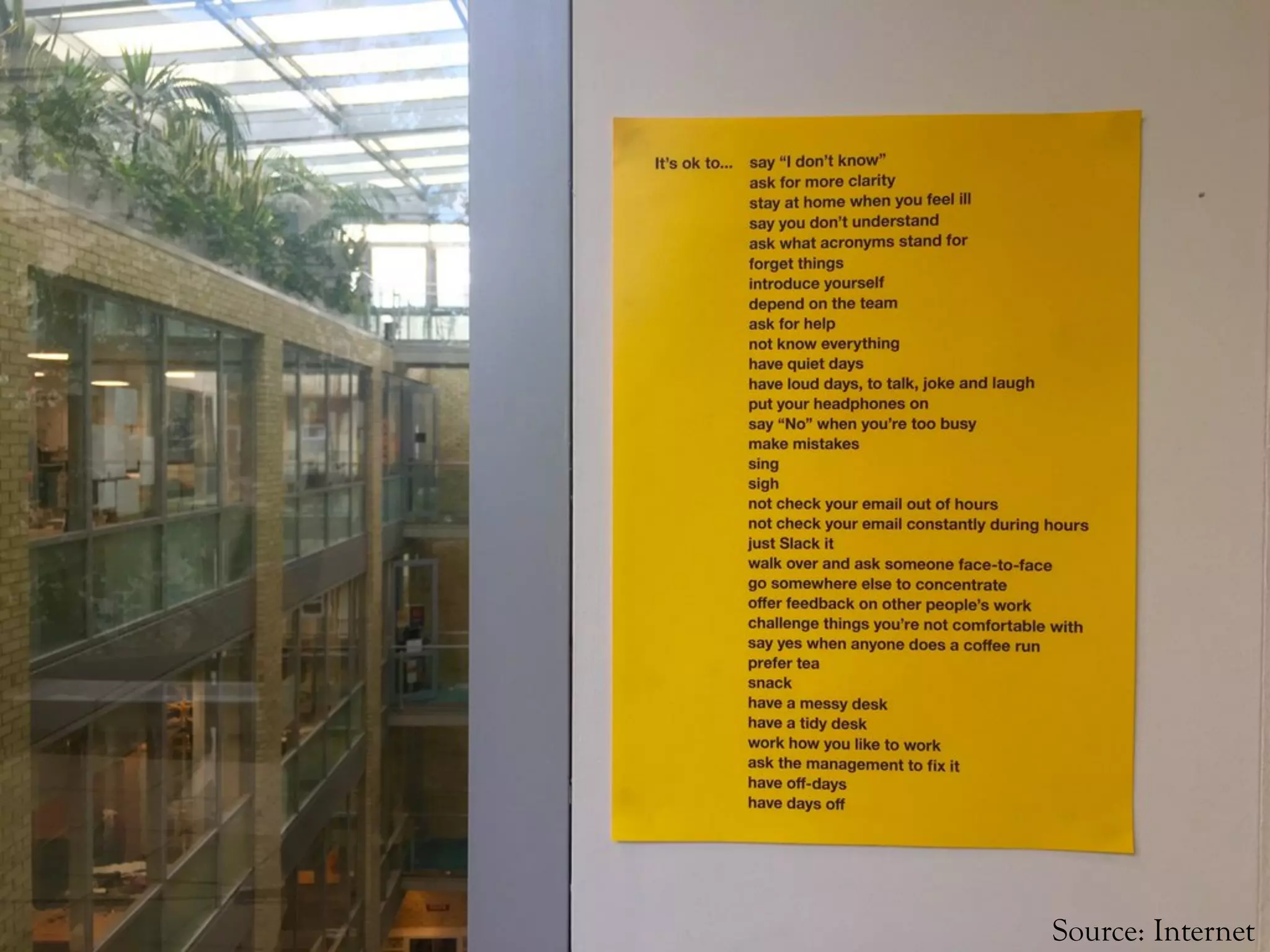
Source: Internet
Recap
  Organizations need to innovative in today’s ever-
evolving world. To be innovative, they need to be
creative first!
  The most successful creative organizations don’t impose
measures of creativity as an outcome, but rather create
a culture that fosters individual creativity and harnesses
collective creativity of their teams. They tolerate, even
celebrate failures, and make it safe for employees to
experiment.
  In next class, we shall explore Creativity in Industries.
Further Reading
http://www.legofoundation.com/it-it/research-and-learning/
foundation-research/cultures-creativity
http://www.nobelmuseum.se/en/exhibitions/cultures-of-creativity
https://hbr.org/2014/12/how-to-tell-if-your-company-has-a-creative-
culture
http://hbswk.hbs.edu/item/getting-to-eureka-how-companies-can-
promote-creativity
https://www.entrepreneur.com/article/241260
http://bestthenews.com/article/what-do-creative-companies-do-
differently-wed-03022016-0454.html
http://philmckinney.com/leaders-innovation-theyre-creating-
cultures-creativity/

Lecture 8: Creative Organizations

  • 1.
    Creativity#8: Creative Organizations TathagatVarma Knowledgepreneur http://thoughtleadership.in
  • 2.
    Forbes’ World’s Most InnovativeCompanies 2016 1.  Tesla Motors, Innovation Premium 82.4% 2.  Salesforce.com, 75.5% 3.  Regeneron Pharma, 72.9% 4.  Incyte, 70.8% 5.  Alexion Pharma, 70% 6.  Under Armour, 68.9% 7.  Monster Beverage, 68.8% 8.  Unilever Indonesia, 67.93% 9.  Vertex Pharma, 67.9% 10.  BioMarin Pharma, 67.4% http://www.forbes.com/innovative-companies/list/
  • 3.
    Innovation Premium   Companiesare ranked by their innovation premium: the difference between their market capitalization and a net present value of cash flows from existing businesses (based on a proprietary formula from Credit Suisse HOLT). The difference between them is the bonus given by equity investors on the educated hunch that the company will continue to come up with profitable new growth.   To be included, firms need seven years of public financial data and $10 billion in market cap. http://learn.theinnovatorsmethod.com/ http://www.forbes.com/sites/innovatorsdna/2015/08/19/how-we-rank-the-worlds-most-innovative-companies-2015/#5199b23d4524
  • 4.
    Most creative companies chosenby creative freelancers https://www.fastcocreate.com/3031248/these-are-the-46-companies-creative-freelancers-would-kill-to-work-for
  • 5.
    Most Creative Companiesin India, 2015   Indigo Perfint Healthcare (medical robotics)   ISRO’s Mangalyaan Mission   Domino’s India   Tata Swach Novopay   The Ugly Indian Micromax   U2OPIA Mobile Freshdesk https://www.fastcompany.com/3041651/most-innovative-companies-2015/the-worlds-top-10-most-innovative-companies-of-2015-in-india
  • 6.
    Are they morecreative because they have more money? https://gigaom.com/2012/01/30/how-apple-gets-away-with-lower-rd-spending/
  • 7.
    If not money,then what?   They hire creative talent? More Salaries? Better Incentives?   Policies? Stretch goals? Performance targets? Get it right first time (and every time)? Failure is not an option? Micro- management? Flexi-timings? Standard processes?   Offices? Open plan offices? Perks? Free food and foosball? Productivity tools? Unlimited vacations?   Markets? Products? Technologies? Company location? Government policies? They are, well,…”creative”? They don’t do any maintenance, just do new product development?   Force people and teams to be creative? Hard deadlines? War- room creativity? Annual innovation events?   Just let people pursue creative ideas without any goals? Free time? No market pressure? Laissez faire?   ???
  • 8.
    What companies do?  Give every opportunity for creativity to flourish   Embrace creativity as a business process   Create a company culture that actively promotes experimentation http://www.inc.com/thomas-oppong/creativity-cannot-be-forced-and-what-truly-innovative-companies-do-instead.html
  • 9.
  • 10.
  • 11.
    Culture-based Creativity   Nurturesand generates innovation (cultural, economic and social),   enables innovation to be more user-centred,   essentially refers to the work of artists and creative people,   is a process that is essential to cultural and creative productions, to marketing-driven industries and   often helps give meaning to the act of consumption,   provides means to stimulate social cohesion,   can be stimulated by the environment (society, institution, family, education etc.) . http://www.keanet.eu/docs/impactculturecreativityfull.pdf
  • 12.
  • 13.
    Top Ten Tipsfor fostering a Culture of Creativity   Recognise your responsibilities as a cultural leader   Take the bureaucracy off the people at the sharp end of the creative process   Cheer the creative process not just the results   Not punish failure and remember that carrot works better than stick   Use intrinsic reward for creative people   Celebrate and foster diversity in all its forms   Encourage autonomy through setting output expectations for performance whilst allowing creative people to decide the means of delivery   Encourage free flow of information both within and into the organisation   Ensure that healthy competitive rivalry is harnessed into collaborative endeavour that delivers better creative solutions quicker   Remember that your competitors are working away to be more creative than you; thus a culture of creativity is a ‘must do’ not a ‘nice-to-have’. http://www.normanbroadbent.com/AppContent/Defining%20Creativity%20and%20How%20to%20Develop%20a%20Creative%20Culture.pdf
  • 14.
    Case Studies   PixarInc   Creativity Inc – Ed Catmull   Hallmark   Orbiting the Giant Hairball: A Corporate Fool’s Guide to Surviving with Grace – Gordon MacKenzie   IDEO   Anthem – Ayn Rand
  • 15.
    Creativity, Inc   Theanimators who work here are free to – no, encouraged to – decorate their work spaces in whatever style they wish…The point is, we value self-expression here.   We start with the presumption that our people are talented and want to contribute. We accept that, without meaning to, our company is stifling that talent in myraid unseen ways. Finally, we try to identify those impediments and fix them.   My job as a manager is to create a fertile environment, keep it healthy, and watch for things that undermine it.
  • 16.
    Creativity, Inc…   Whenit comes to creative inspiration, job titles and hierarchy are meaningless.   …Basically, they welcomed us to the program, gave us workspace and access to computers, and then let us pursue whatever turned us on. The result was a collaborative, supportive community so inspiring that I could later seek to replicate at Pixar.   Tension between the individual’s creative contribution and the leverage of the group is a dynamic that exists in all creative environments.
  • 17.
    Creativity, Inc…   ARPA’smandate - to support smart people in a variety of areas – was carried out based on the unwavering presumption that researchers would try to do the right thing and, in ARPA’s view, overmanaging them was counterproductive. ARPA’s administrators did not hover over the shoulders of those of us working on the project they funded, nor did they demand that our work have direct military applications. They simply trusted us to innovate.   Prof Sutherland used to say that he loved his graduate students at Utah because we didn’t know what was impossible…When one of my colleagues at the U of U invented something, the rest of us would immediately piggyback on it, pushing the new idea forward.
  • 18.
    Creativity, Inc…   Icreated a flat organizational structure, much like I’d experienced in academia, largely because I naively thought that if I put together a hierarchical structure – assigning a bunch of managers to report to me – I would have to spend too much time managing and not enough time on my own work. This structure – in which I entrusted everybody to drive their own projects forward, at their own pace – had its limits, but the fact is, giving a ton of freedom to highly self-motivated people enabled us ti make some significant technological leaps in a short time.
  • 19.
    Creativity, Inc…   Experimentationwas highly valued, but the urgency of for- profit enterprise was definitely in the air. Alvy and I decided to do the opposite – to share our work with the outside world   The only problem was, I had no idea what I was doing.   His (Steve Jobs) method for taking the measure of a room was saying something definitive and outrageous, and watching people react. If you were brave enough to come back at him, he often respected it – poking at you, then registering your response, was his way of deducing what you thought and whether you had the guts to champion it.
  • 20.
    Creativity, Inc   Deming’sapproach – and Toyota’s too – gave ownership of and responsibility for a product’s quality to the people who were most involved in its creation. Instead of merely repeating an action, workers could suggest changes, call out problems – feel the pride that came when they helped fix what was broken.   Because making a movie involves hundreds of people, a chain of command is essential…we had made the mistake of confusing the communication structure with the organizational structure.
  • 21.
    Creativity, Inc   Thefirst principle was “Story is King”, by which we meant that we would let nothing – not the technology, not the merchandising possibilities – get in the way of our story.   The other principle we depended on was “Trust the Process”. We liked this one because it was so reassuring: while there are inevitably difficulties and missteps in any complex creative endeavor, you can trust that “the process” will carry you through.
  • 22.
    Managing a CreativeCulture Think of each statement as a starting point, as prompt toward deeper inquiry, and not a conclusion!   If you get the team right, chances are that they’ll get ideas right.   When hiring people, give more weightage to their potential than the current skill level.   Hire people smarter than you.   People across the organization should be free to suggest ideas. Source: Creativity, Inc
  • 23.
    …   As amanager, you must coax ideas out of your staff and constantly push them to contribute.   Measuring the process without evaluating the process is deceiving.   The cost of preventing errors is often far greater than the cost of fixing them.   Change and uncertainty are part of life. Our job is not to resist them but to build the capability to recover when unexpected things occur.
  • 24.
    …   Manager’s jobis not to prevent risks, but make it safe to take them.   Failure isn’t a necessary evil. In fact, it isn’t evil at all. It is a necessary consequence of doing something new.   Trust doesn’t mean that you trust that someone won’t screw up – it means you trust them when they do screw up.   The people ultimately responsible for implementing a plan must be empowered to make decisions when things go wrong, even before getting approval.
  • 25.
    …   The desirefor everything to run smoothly is a false goal – it leads to measuring people by the mistakes they make rather than by their ability to solve problems.   Don’t wait for things to be perfect before you share them with others.   Everybody should be able to talk to anybody.   Be wary of making too many rules.   Imposing limits can encourage a creative response.   Engaging with exceptionally hard problems forces us to think differently.
  • 26.
    …   An organization,as a whole, is more conservative and resistant to change than the individuals who comprise it.   The healthiest organizations are made up of departments whose agendas differ but whose goals are interdependent.   Our jobs as managers in creative environments is to protect new ideas from those who don’t understand that in order for greatness to emerge, there must be phases of not-so-greatness. Protect the future, not the past.
  • 27.
    …   New crisestest and demonstrate a company’s values.   Excellence, quality and good should be earned words, attributed by others to us, not proclaimed by us about ourselves.   Do not accidentally make stability a goal. Balance is more important than stability.   Don’t confuse the process with the goal. Making the product great is the goal.
  • 28.
    The Hairball!   “There’sa time when there is no hairball. So, where do hairballs come from?”   Every new policy is another hair for the Hairball. Hairs are never taken away, only added.   To tap the ability to create, you must spiritually soar into the thin air of the stratosphere – blue sky – where it is possible “to bring into existence” from nothing an original concept.
  • 29.
    Orbiting   …Then thereare those few who manage to actively engage the opportunities Hallmark presents without being sucked into the Hairball of Hallmark. This is accomplished by Orbiting.   Orbiting is responsible creativity: vigorously exploring and operating beyond the Hairball of the corporate mindset, beyond “accepted models, patterns, or standards” – all the while remaining connected to the spirit of the corporate mission
  • 30.
      To findorbit around a corporate Hairball is to find a place of balance when you benefit from the physical, intellectual and philosophical resources of the organization without becoming entombed in the bureaucracy of the institution.   If you are interested (and it is not for everyone), you can achieve Orbit by finding the personal courage to be genuine and to take the best course of action to get the job done rather than following the pallid path of corporate appropriateness.
  • 31.
      To beof optimum value to the corporate endeavor, you must invest enough individually to counteract the pull of Corporate Gravity, but not so much that you escape the pull altogether. Just enough to stay out of the Hairball.   Through this measured assertion of your own uniqueness, it is possible to establish a dynamic relationship with the Hairball – to Orbit around the institutional mass. If you do this, you make an asset of the gravity in that it becomes a force that keeps you from flying out into the overwhelming nothingness of deep space.
  • 32.
    Orbiting the Hairball  Hairball is policy, procedure, conformity, compliance, rigidity and submission to status quo, while Orbiting is originality, rules-breaking, non-conformity, experimentation, and innovation.   …People who have a deep passion for their ideas don’t need a lot of encouragement. One ‘yes’ in a sea of ‘no’s’ can make the difference
  • 33.
  • 34.
    Anthem – AynRand Source: Anthem, A Graphic Novel – Adapted by Charles Santino and Joe Staten
  • 35.
  • 36.
    Recap   Organizations needto innovative in today’s ever- evolving world. To be innovative, they need to be creative first!   The most successful creative organizations don’t impose measures of creativity as an outcome, but rather create a culture that fosters individual creativity and harnesses collective creativity of their teams. They tolerate, even celebrate failures, and make it safe for employees to experiment.   In next class, we shall explore Creativity in Industries.
  • 37.