Seven Crazy Creativity
methods
Generate 25 ideas in 5 minutes
@CyrielKortleven
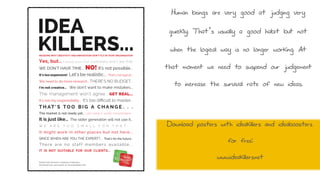
Download posters with ideakillers and ideaboosters
for free:
www.ideakillers.net
Human beings are very good at judging very
quickly. That’s usually a good habit but not
when the logical way is no longer working. At
that moment we need to suspend our judgement
to increase the survival rate of new ideas.
Basic guidelines for a brainstorming session* Suspend judgement - all ideas are welcome
* Quantity breeds quality - the more ideas, the better
* Pay attention to naive ideas - might lead to a breakthrough
* No hierarchy, no arrogance - everybody is equal during the session
* Hitch-hike on each other ideas - use ideas as a stepping stone
* Concrete ideas - make sure that every idea that is written down gives an
answer on the how-question
* Every idea should be a stand-alone idea (1 post-it = 1 idea)

(Eg the words ‘social media’ don’t count as an idea - ‘We are going to send 3 tweets with a motivational quote a day
to engage with people’ or ‘Create a youtube video where we interview the CEO about engagement’ is a concrete idea)
To make this document more concrete, we will introduce a very concrete
challenge which we’ll use to generate some example ideas while applying the
creativity methods. Engaging employees or colleagues to be more creative is a
big issue for many companies so let’s use that challenge:
How can I stimulate the creativity of my colleagues?
PS: this is a document with some basic guidelines to facilitate the diverging parts of a brainstorming session. There are many more things to keep in mind
(like group dynamics, and if you’re having a bigger or very important brainstorming session, I would definitely advise working with a professional creative
facilitator to make sure that you get high-quality ideas and actions.
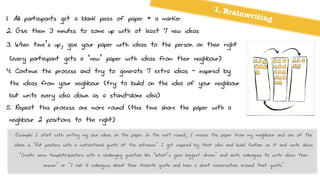
1. All participants get a blank piece of paper + a marker
2. Give them 3 minutes to come up with at least 7 new ideas
3. When time’s up, give your paper with ideas to the person on their right
(every participant gets a ‘new’ paper with ideas from their neighbour)
4. Continue the process and try to generate 7 extra ideas - inspired by
the ideas from your neighbour (try to build on the idea of your neighbour
but write every idea down as a stand-alone idea)
5. Repeat this process one more round (this time share the paper with a
neighbour 2 positions to the right)
1. Brainwriting
Example: I start with writing my own ideas on the paper. In the next round, I receive the paper from my meighbour and one of the
ideas is ‘Put posters with a motivational quote at the entrance.’ I get inspired by that idea and build further on it and write down
‘Create some template-posters with a challenging question like ‘What’s your biggest dream’ and invite colleagues to write down their
answer’ or ‘I ask 5 colleagues about their favorite quote and have a short conversation around that quote.’
MacGuyver was a very inventive secret agent in the TVseries MacGuyver - he
always carried a Swiss army knife & duct-tape and he always found a clever
solution based on the available resources when he was locked up somewhere.
For this method, we also use ‘random stimuli’ to generate new ideas.
1. Let the participants form pairs + give them some post-its + marker
2. The pairs walk around in the room (or outside) and 1 person points to a
random object
3. The participants form a number of associations around that object
4. Re-associate - connect one of the associations back to the original
challenge
2. Mac Guyver method
Example: I walk with a participant outside and she points to a statue of the founder of the company. We use ‘statue’ as an object
and come up with a few associations: stone, formal, respect, pedestal. Then we write our new ideas on post-it notes starting from the
associations. ‘Formal’ can lead to an idea like ‘We create a formal procedure that every employee has to generate 3 ideas a day’; or
‘Respect’ can be transformed into an idea like ‘People who share their ideas with colleagues will get more respect’.
1. Let the participants form pairs + give them some post-its + marker
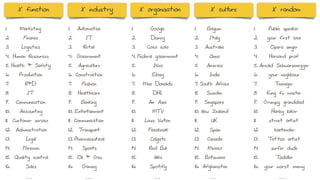
2. Use the ‘Crossing borders’ sheet (next page) as inspiration.
3. You start with column 1 and one participant chooses a number between 1
and 16 - then you use the function that corresponds with that number
as inspiration - how would somebody from … solve your problem? This
idea is written on a post-it. Try to come up with 2 or 3 ideas /
function.
4. Repeat the same process for the other columns (industry, organisation,
culture and random).
3. Crossing borders
Example: We pick number 12 from column one: Aministration. Possible ideas could be: ‘For one week, all emails from administration will start
with a creative movie of 30 seconds before the real message becomes visible’. Column 2 - number 13: Pharmaceutical - ‘We develop a pill
that makes people more creative’. Column 5 - number 10: Harley biker - ‘People who come up with a great idea get a temporary tattoo
with the message ‘I am a very creative person’ …
1. Marketing
2. Finance
3. Logistics
4. Human Resources
5. Health & Safety
6. Production
7. R&D
8. IT
9. Communication
10. Accounting
11. Customer service
12. Administration
13. Legal
14. Foreman
15. Quality control
16. Sales
…
1. Automotive
2. IT
3. Retail
4. Government
5. Agriculture
6. Construction
7. Fashion
8. Healthcare
9. Banking
10. Entertainment
11. Communication
12. Transport
13. Pharmaceutical
14. Sports
15. Oil & Gas
16. Gaming
…
1. Belgium
2. Italy
3. Australia
4. China
5. America
6. India
7. South Africa
8. Sweden
9. Singapore
10. New Zealand
11. UK
12. Spain
13. Canada
14. Mexico
15. Botswana
16. Afghanistan
…
X industry X randomX cultureX function X organisation
1. Public speaker
2. your first love
3. Opera singer
4. Harvard prof
5. Arnold Schwarzenegger
6. your neighbour
7. Teenager
8. Kung fu master
9. Grumpy granddad
10. Harley biker
11. street artist
12. bartender
13. Tattoo artist
14. surfer dude
15. Toddler
16. your worst enemy
…
1. Google
2. Disney
3. Coca cola
4. Federal government
5. Ikea
6. Ebay
7. Mac Donalds
8. DHL
9. Air Asia
10. MTV
11. Louis Vuiton
12. Facebook
13. Colgate
14. Red Bull
15. Nike
16. Spotify
…
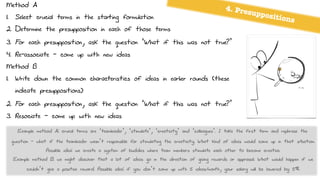
Method A
1. Select crucial terms in the starting formulation
2. Determine the presupposition in each of those terms
3. For each presupposition, ask the question ‘What if this was not true?’
4. Re-associate - come up with new ideas
Method B
1. Write down the common characteristics of ideas in earlier rounds (these
indicate presuppositions)
2. For each presupposition, ask the question ‘What if this was not true?’
3. Resociate - come up with new ideas
4. Presuppositions
Example method A: crucal terms are ‘teamleader’, ‘stimulate’, ‘creativity’ and ‘colleagues’. I take the first term and rephrase the
question - what if the teamleader wasn’t responsible for stimulating the creativity. What kind of ideas would come up in that situation.
Possible idea: we create a system of buddies where team members stimulate each other to become creative.
Example method B: we might discover that a lot of ideas go in the direction of giving rewards or appraisal. What would happen if we
couldn’t give a positive reward. Possible idea: if you don’t come up with 5 ideas/month, your salary will be lowered by 5%.
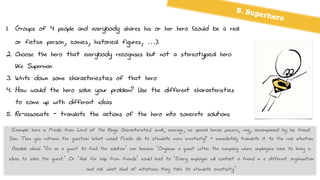
1. Groups of 4 people and everybody shares his or her hero (could be a real
or fictive person, comics, historical figures, …).
2. Choose the hero that everybody recognises but not a stereotypical hero
like Superman
3. Write down some charactericstics of that hero
4. How would the hero solve your problem? Use the different characteristics
to come up with different ideas
5. Re-associate - translate the actions of the hero into concrete solutions
5. Superhero
Example: hero is Frodo from Lord of the Rings. Characteristics: small, courage, no special heroic powers, ring, accompanied by his friend
Sam. Then you reframe the question: What would Frodo do to stimulate more creativity? + immediately translate it to the real situation.
Possible ideas: ‘Go on a quest to find the solution’ can become ‘Organise a quest within the company where employees have to bring in
ideas to solve the quest.’ Or ‘Ask for help from friends’ could lead to ‘Every employee will contact a friend in a different organisation
and ask what kind of initiatives they take to stimulate creativity.’
1. A group of max 8 people gather around a table and one person has a
piece of paper and will write
2. Everybody can add a trend in society and the writer creates a mindmap
with all suggestions (go as broad as possible in terms of trends - don’t
stick to your own industry) - 3 minutes to get as many associations as
possible
3. Put mindmap in the middle & divide group in pairs. Every pair picks an
association that has nothing to do with original question
4. Use that trend as inspiration to generate new ideas. Switch trend after 2
or 3 ideas.
6. Trends society
Example: we pick the trend ‘globalisation’. Possible ideas: ‘Take 10 minutes to do a google search on how other companies are stimulating
creativity.’ or ‘let employees who come back from a holiday share some innovations or bizarre things they have learned abroad.’ Trend
‘Artificial Intelligence’. Possible ideas: ‘All employees get an AI chip to generate more ideas.’ or ‘Invite a trend-watcher for a speech.’
1. Reverse the question

In this case: ‘How can I make sure that nobody in my team will come up
with new ideas?’
2. Invent ideas for the new problem statement on a seperate sheet
3. Reverse every idea on the list and re-associate. Go to the extremes -
don’t just reverse the negative idea into a positive one. How would the
extreme positive side look like, + also explore if you can stay on the
negative side and turn that into something positive.
7. Reverse thinking
Example: a ‘negative’ idea could be: ‘If you have an idea, you have to fill out 7 documents and get 4 signatures before you can share
it’. If you reverse this idea, you could get the following ‘real ideas’:

‘Create a very easy process to share ideas - in every meeting we allocate 10 minutes for new ideas’, or you stay on the negative side
‘You have to follow a difficult process to make sure that you are really motivated to share that idea.’ or ’Make it very exclusive -
only the top 10% of the best employees can come up with new ideas’.
I hope that you’ve enjoyed these 7 Crazy Creativity methods and apply them in your own
professional or personal lives. If you liked this, then chances are quite high that you would get a
lot of added value from my 9 week inspiration boost where I share all kind of tips & tricks
to boost your creative & entrepreneurial mindset. I create one or two blogs around these topics
every month.
Just click on the button to register for the 9 week
inspiration boost and/or you can also subscribe to my
blog.
Yes, give me more inspiration
Cyriel Kortleven is a global keynote speaker
on the Change Mindset
Cyriel' in 25 words: global speaker,
author, Change Mindset, inspirator,
Certified Speaking Professional (CSP),
digital nomad, interaction, less is
beautiful, Yes And Act, obstacle run,
burning man, loves Liane, present.
www.cyrielkortleven.com
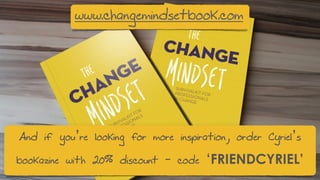
And if you’re looking for more inspiration, order Cyriel’s
bookazine with 20% discount - code ‘FRIENDCYRIEL’
www.changemindsetbook.com

7 crazy creativity methods [cyriel kortleven]

  • 1.
    Seven Crazy Creativity methods Generate25 ideas in 5 minutes @CyrielKortleven
  • 2.
    Download posters withideakillers and ideaboosters for free: www.ideakillers.net Human beings are very good at judging very quickly. That’s usually a good habit but not when the logical way is no longer working. At that moment we need to suspend our judgement to increase the survival rate of new ideas.
  • 3.
    Basic guidelines fora brainstorming session* Suspend judgement - all ideas are welcome * Quantity breeds quality - the more ideas, the better * Pay attention to naive ideas - might lead to a breakthrough * No hierarchy, no arrogance - everybody is equal during the session * Hitch-hike on each other ideas - use ideas as a stepping stone * Concrete ideas - make sure that every idea that is written down gives an answer on the how-question * Every idea should be a stand-alone idea (1 post-it = 1 idea)
 (Eg the words ‘social media’ don’t count as an idea - ‘We are going to send 3 tweets with a motivational quote a day to engage with people’ or ‘Create a youtube video where we interview the CEO about engagement’ is a concrete idea)
  • 4.
    To make thisdocument more concrete, we will introduce a very concrete challenge which we’ll use to generate some example ideas while applying the creativity methods. Engaging employees or colleagues to be more creative is a big issue for many companies so let’s use that challenge: How can I stimulate the creativity of my colleagues? PS: this is a document with some basic guidelines to facilitate the diverging parts of a brainstorming session. There are many more things to keep in mind (like group dynamics, and if you’re having a bigger or very important brainstorming session, I would definitely advise working with a professional creative facilitator to make sure that you get high-quality ideas and actions.
  • 5.
    1. All participantsget a blank piece of paper + a marker 2. Give them 3 minutes to come up with at least 7 new ideas 3. When time’s up, give your paper with ideas to the person on their right (every participant gets a ‘new’ paper with ideas from their neighbour) 4. Continue the process and try to generate 7 extra ideas - inspired by the ideas from your neighbour (try to build on the idea of your neighbour but write every idea down as a stand-alone idea) 5. Repeat this process one more round (this time share the paper with a neighbour 2 positions to the right) 1. Brainwriting Example: I start with writing my own ideas on the paper. In the next round, I receive the paper from my meighbour and one of the ideas is ‘Put posters with a motivational quote at the entrance.’ I get inspired by that idea and build further on it and write down ‘Create some template-posters with a challenging question like ‘What’s your biggest dream’ and invite colleagues to write down their answer’ or ‘I ask 5 colleagues about their favorite quote and have a short conversation around that quote.’
  • 6.
    MacGuyver was avery inventive secret agent in the TVseries MacGuyver - he always carried a Swiss army knife & duct-tape and he always found a clever solution based on the available resources when he was locked up somewhere. For this method, we also use ‘random stimuli’ to generate new ideas. 1. Let the participants form pairs + give them some post-its + marker 2. The pairs walk around in the room (or outside) and 1 person points to a random object 3. The participants form a number of associations around that object 4. Re-associate - connect one of the associations back to the original challenge 2. Mac Guyver method Example: I walk with a participant outside and she points to a statue of the founder of the company. We use ‘statue’ as an object and come up with a few associations: stone, formal, respect, pedestal. Then we write our new ideas on post-it notes starting from the associations. ‘Formal’ can lead to an idea like ‘We create a formal procedure that every employee has to generate 3 ideas a day’; or ‘Respect’ can be transformed into an idea like ‘People who share their ideas with colleagues will get more respect’.
  • 7.
    1. Let theparticipants form pairs + give them some post-its + marker 2. Use the ‘Crossing borders’ sheet (next page) as inspiration. 3. You start with column 1 and one participant chooses a number between 1 and 16 - then you use the function that corresponds with that number as inspiration - how would somebody from … solve your problem? This idea is written on a post-it. Try to come up with 2 or 3 ideas / function. 4. Repeat the same process for the other columns (industry, organisation, culture and random). 3. Crossing borders Example: We pick number 12 from column one: Aministration. Possible ideas could be: ‘For one week, all emails from administration will start with a creative movie of 30 seconds before the real message becomes visible’. Column 2 - number 13: Pharmaceutical - ‘We develop a pill that makes people more creative’. Column 5 - number 10: Harley biker - ‘People who come up with a great idea get a temporary tattoo with the message ‘I am a very creative person’ …
  • 8.
    1. Marketing 2. Finance 3.Logistics 4. Human Resources 5. Health & Safety 6. Production 7. R&D 8. IT 9. Communication 10. Accounting 11. Customer service 12. Administration 13. Legal 14. Foreman 15. Quality control 16. Sales … 1. Automotive 2. IT 3. Retail 4. Government 5. Agriculture 6. Construction 7. Fashion 8. Healthcare 9. Banking 10. Entertainment 11. Communication 12. Transport 13. Pharmaceutical 14. Sports 15. Oil & Gas 16. Gaming … 1. Belgium 2. Italy 3. Australia 4. China 5. America 6. India 7. South Africa 8. Sweden 9. Singapore 10. New Zealand 11. UK 12. Spain 13. Canada 14. Mexico 15. Botswana 16. Afghanistan … X industry X randomX cultureX function X organisation 1. Public speaker 2. your first love 3. Opera singer 4. Harvard prof 5. Arnold Schwarzenegger 6. your neighbour 7. Teenager 8. Kung fu master 9. Grumpy granddad 10. Harley biker 11. street artist 12. bartender 13. Tattoo artist 14. surfer dude 15. Toddler 16. your worst enemy … 1. Google 2. Disney 3. Coca cola 4. Federal government 5. Ikea 6. Ebay 7. Mac Donalds 8. DHL 9. Air Asia 10. MTV 11. Louis Vuiton 12. Facebook 13. Colgate 14. Red Bull 15. Nike 16. Spotify …
  • 9.
    Method A 1. Selectcrucial terms in the starting formulation 2. Determine the presupposition in each of those terms 3. For each presupposition, ask the question ‘What if this was not true?’ 4. Re-associate - come up with new ideas Method B 1. Write down the common characteristics of ideas in earlier rounds (these indicate presuppositions) 2. For each presupposition, ask the question ‘What if this was not true?’ 3. Resociate - come up with new ideas 4. Presuppositions Example method A: crucal terms are ‘teamleader’, ‘stimulate’, ‘creativity’ and ‘colleagues’. I take the first term and rephrase the question - what if the teamleader wasn’t responsible for stimulating the creativity. What kind of ideas would come up in that situation. Possible idea: we create a system of buddies where team members stimulate each other to become creative. Example method B: we might discover that a lot of ideas go in the direction of giving rewards or appraisal. What would happen if we couldn’t give a positive reward. Possible idea: if you don’t come up with 5 ideas/month, your salary will be lowered by 5%.
  • 10.
    1. Groups of4 people and everybody shares his or her hero (could be a real or fictive person, comics, historical figures, …). 2. Choose the hero that everybody recognises but not a stereotypical hero like Superman 3. Write down some charactericstics of that hero 4. How would the hero solve your problem? Use the different characteristics to come up with different ideas 5. Re-associate - translate the actions of the hero into concrete solutions 5. Superhero Example: hero is Frodo from Lord of the Rings. Characteristics: small, courage, no special heroic powers, ring, accompanied by his friend Sam. Then you reframe the question: What would Frodo do to stimulate more creativity? + immediately translate it to the real situation. Possible ideas: ‘Go on a quest to find the solution’ can become ‘Organise a quest within the company where employees have to bring in ideas to solve the quest.’ Or ‘Ask for help from friends’ could lead to ‘Every employee will contact a friend in a different organisation and ask what kind of initiatives they take to stimulate creativity.’
  • 11.
    1. A groupof max 8 people gather around a table and one person has a piece of paper and will write 2. Everybody can add a trend in society and the writer creates a mindmap with all suggestions (go as broad as possible in terms of trends - don’t stick to your own industry) - 3 minutes to get as many associations as possible 3. Put mindmap in the middle & divide group in pairs. Every pair picks an association that has nothing to do with original question 4. Use that trend as inspiration to generate new ideas. Switch trend after 2 or 3 ideas. 6. Trends society Example: we pick the trend ‘globalisation’. Possible ideas: ‘Take 10 minutes to do a google search on how other companies are stimulating creativity.’ or ‘let employees who come back from a holiday share some innovations or bizarre things they have learned abroad.’ Trend ‘Artificial Intelligence’. Possible ideas: ‘All employees get an AI chip to generate more ideas.’ or ‘Invite a trend-watcher for a speech.’
  • 12.
    1. Reverse thequestion
 In this case: ‘How can I make sure that nobody in my team will come up with new ideas?’ 2. Invent ideas for the new problem statement on a seperate sheet 3. Reverse every idea on the list and re-associate. Go to the extremes - don’t just reverse the negative idea into a positive one. How would the extreme positive side look like, + also explore if you can stay on the negative side and turn that into something positive. 7. Reverse thinking Example: a ‘negative’ idea could be: ‘If you have an idea, you have to fill out 7 documents and get 4 signatures before you can share it’. If you reverse this idea, you could get the following ‘real ideas’:
 ‘Create a very easy process to share ideas - in every meeting we allocate 10 minutes for new ideas’, or you stay on the negative side ‘You have to follow a difficult process to make sure that you are really motivated to share that idea.’ or ’Make it very exclusive - only the top 10% of the best employees can come up with new ideas’.
  • 13.
    I hope thatyou’ve enjoyed these 7 Crazy Creativity methods and apply them in your own professional or personal lives. If you liked this, then chances are quite high that you would get a lot of added value from my 9 week inspiration boost where I share all kind of tips & tricks to boost your creative & entrepreneurial mindset. I create one or two blogs around these topics every month. Just click on the button to register for the 9 week inspiration boost and/or you can also subscribe to my blog. Yes, give me more inspiration
  • 14.
    Cyriel Kortleven isa global keynote speaker on the Change Mindset Cyriel' in 25 words: global speaker, author, Change Mindset, inspirator, Certified Speaking Professional (CSP), digital nomad, interaction, less is beautiful, Yes And Act, obstacle run, burning man, loves Liane, present. www.cyrielkortleven.com
  • 15.
    And if you’relooking for more inspiration, order Cyriel’s bookazine with 20% discount - code ‘FRIENDCYRIEL’ www.changemindsetbook.com