The University ofSydney
Design: Thinking & Practice
Ricardo Sosa, PhD SFHEA
2.
The University ofSydney
We acknowledge the tradition of
custodianship and law of the Country on
which the University of Sydney campuses
stand. We pay our respects to those who
have cared and continue to care for Country.
“Always Was, Always Will Be”
The University ofSydney
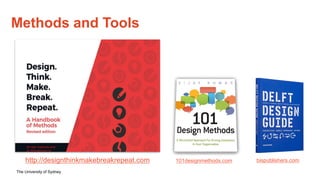
Methods and Tools
http://designthinkmakebreakrepeat.com 101designmethods.com bispublishers.com
5.
The University ofSydney
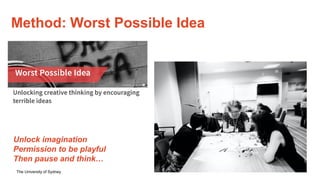
Method: Worst Possible Idea
Unlock imagination
Permission to be playful
Then pause and think…
6.
The University ofSydney
Method: Worst Possible Idea
Step 1: Choose the problem space you’re addressing.
Step 2: Think of worst possible ideas to solve the problem and record them on a
sticky note. Try to think of ideas that are extremely bad, terrible, silly,
impossible, and possibly illegal!
Step 3: Share your ideas with your team.
Step 4: Review the ideas and use them to prompt a new way of thinking about the
problem. Consider:
• What are their attributes, and why do they make it a bad idea?
• What is the opposite of the bad ideas?
• How can the ideas be merged or modified?
The University ofSydney
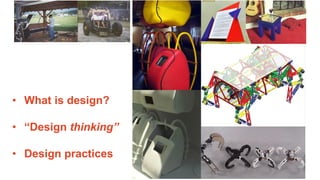
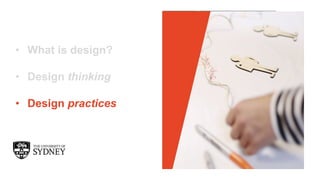
• What is design?
• “Design thinking”
• Design practices
9.
The University ofSydney
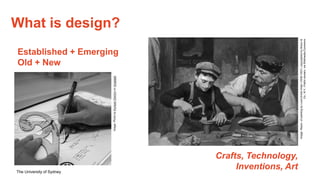
What is design?
Image:
Repro.
of
painting
by
Louis
Emile
Adan
(1839-1937),
copyrighted
by
Braun
&
Co.,
N.Y.,
Public
domain,
via
Wikimedia
Commons
Image:
Photo
by
Kumpan
Electric
on
Unsplash
Established + Emerging
Old + New
Crafts, Technology,
Inventions, Art
10.
The University ofSydney
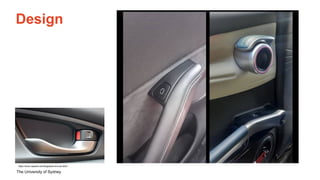
Design
https://www.carparts.com/blog/parts-of-a-car-door/
11.
The University ofSydney
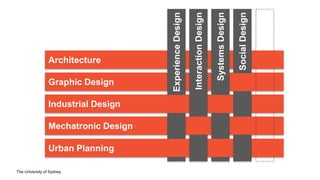
Urban Planning
Industrial Design
Architecture
Graphic Design
Mechatronic Design
Experience
Design
Interaction
Design
Systems
Design
Social
Design
12.
The University ofSydney
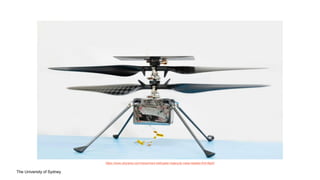
https://www.cbsnews.com/news/mars-helicopter-ingenuity-nasa-readies-first-flight/
The University ofSydney
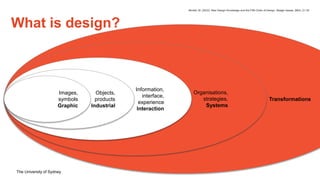
What is design?
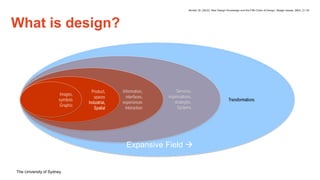
Mortati, M. (2022). New Design Knowledge and the Fifth Order of Design. Design Issues, 38(4), 21-34.
Expansive Field
15.
The University ofSydney
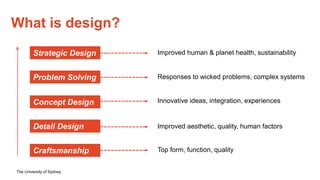
What is design?
Craftsmanship Top form, function, quality
Detail Design Improved aesthetic, quality, human factors
Concept Design Innovative ideas, integration, experiences
Problem Solving Responses to wicked problems, complex systems
Strategic Design Improved human & planet health, sustainability
16.
The University ofSydney
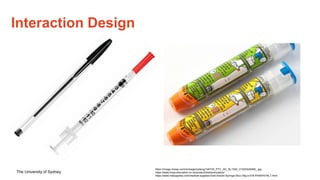
Interaction Design
https://image.chewy.com/is/image/catalog/146735_PT3._AC_SL1500_V1525449469_.jpg
https://www.hope-education.co.uk/product/stationery/pens/
https://www.mdsupplies.com/medical-supplies-Exel-Insulin-Syringe-05cc-30g-x-516-FKK6HV74LT.html
17.
The University ofSydney
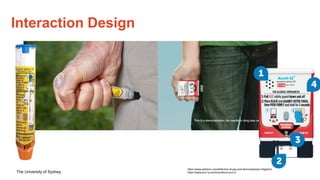
Interaction Design
https://www.weitzlux.com/defective-drugs-and-devices/epipen-litigation/
https://www.auvi-q.com/hcp/about-auvi-q
18.
The University ofSydney
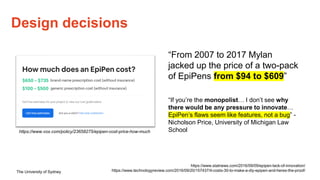
Design decisions
https://www.statnews.com/2016/09/09/epipen-lack-of-innovation/
https://www.technologyreview.com/2016/09/20/157437/it-costs-30-to-make-a-diy-epipen-and-heres-the-proof/
“From 2007 to 2017 Mylan
jacked up the price of a two-pack
of EpiPens from $94 to $609”
“If you’re the monopolist… I don’t see why
there would be any pressure to innovate…
EpiPen’s flaws seem like features, not a bug” -
Nicholson Price, University of Michigan Law
School
https://www.vox.com/policy/23658275/epipen-cost-price-how-much
19.
The University ofSydney
Transformations
Organisations,
strategies,
Systems
Information,
interface,
experience
Interaction
Objects,
products
Industrial
What is design?
Mortati, M. (2022). New Design Knowledge and the Fifth Order of Design. Design Issues, 38(4), 21-34.
Images,
symbols
Graphic
20.
The University ofSydney
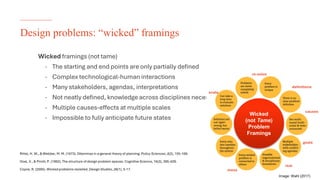
Design problems: “wicked” framings
Wicked framings (not tame)
- The starting and end points are only partially defined
- Complex technological-human interactions
- Many stakeholders, agendas, interpretations
- Not neatly defined, knowledge across disciplines necessary
- Multiple causes-effects at multiple scales
- Impossible to fully anticipate future states
Image: Wahl (2017)
Wicked
(not Tame)
Problem
Framings
scale
mess
real
goals
causes
definitions
re-solve
Rittel, H. W., & Webber, M. M. (1973). Dilemmas in a general theory of planning. Policy Sciences,4(2), 155-169.
Goel, V., & Pirolli, P. (1992). The structure of design problem spaces. Cognitive Science, 16(3), 395-429.
Coyne, R. (2005).Wicked problems revisited. Design Studies,26(1), 5-17.
21.
The University ofSydney
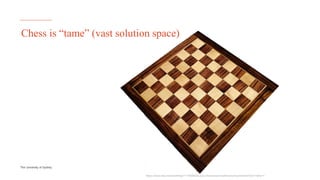
“Rocket Science” is tame (not easy!)
https://www.etsy.com/ca/listing/711790853/luxury-chess-board-solid-wood-tournament?pro=1&frs=1
Chess is “tame” (vast solution space)
The University ofSydney
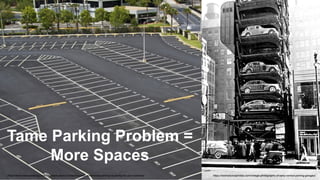
Tame Parking Problem =
More Spaces
https://rarehistoricalphotos.com/vintage-photographs-of-early-vertical-parking-garages/
https://www.melrosepaving.ca/4-important-steps-to-ensure-quality-commercial-parking-lot-paving-for-your-business/
24.
The University ofSydney
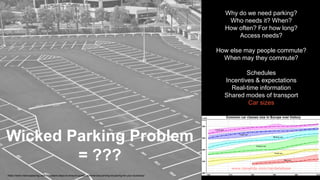
Why do we need parking?
Who needs it? When?
How often? For how long?
Access needs?
How else may people commute?
When may they commute?
Schedules
Incentives & expectations
Real-time information
Shared modes of transport
Car sizes
Wicked Parking Problem
= ???
https://rarehistoricalphotos.com/vintage-photographs-of-early-vertical-parking-garages/
https://www.melrosepaving.ca/4-important-steps-to-ensure-quality-commercial-parking-lot-paving-for-your-business/
The University ofSydney
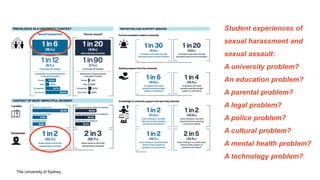
Student experiences of
sexual harassment and
sexual assault:
A university problem?
An education problem?
A parental problem?
A legal problem?
A police problem?
A cultural problem?
A mental health problem?
A technology problem?
The University ofSydney
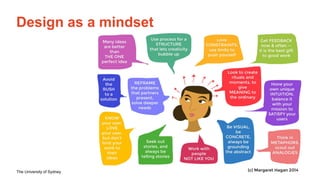
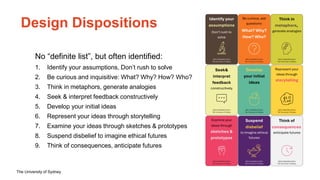
Design Dispositions
No “definite list”, but often identified:
1. Identify your assumptions, Don’t rush to solve
2. Be curious and inquisitive: What? Why? How? Who?
3. Think in metaphors, generate analogies
4. Seek & interpret feedback constructively
5. Develop your initial ideas
6. Represent your ideas through storytelling
7. Examine your ideas through sketches & prototypes
8. Suspend disbelief to imagine ethical futures
9. Think of consequences, anticipate futures
The University ofSydney
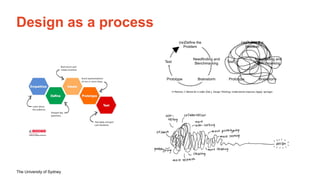
Design as a process
H Plattner, C Meinel & LJ Leifer (Eds.), Design Thinking: Understand–Improve–Apply. Springer.
32.
The University ofSydney
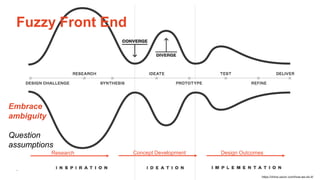
Fuzzy Front End
https://china.xavor.com/how-we-do-it/
Research Concept Development Design Outcomes
Embrace
ambiguity
Question
assumptions
33.
The University ofSydney
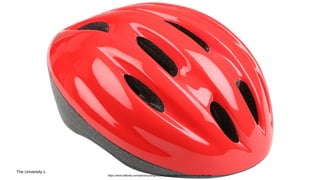
https://www.halfords.com/advice/cycling/buyers-guides/bike-helmets-buyers-guide-video
The University ofSydney
• What is design?
• Design thinking
• Design practices
36.
The University ofSydney
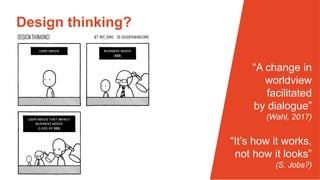
Design thinking?
“A change in
worldview
facilitated
by dialogue”
(Wahl, 2017)
“It’s how it works,
not how it looks”
(S. Jobs?)
37.
The University ofSydney
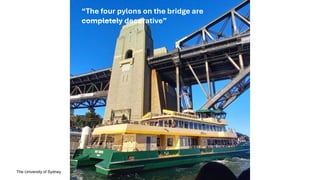
“The four pylons on the bridge are
completely decorative”
38.
The University ofSydney
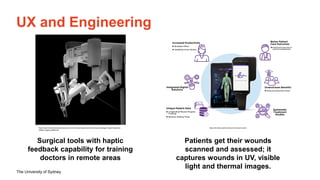
UX and Engineering
https://www.roboticsbusinessreview.com/on-demand-webinars/overcoming-challenges-haptic-feedback-
robotic-surgery-platforms/
https://kronikare.ai/kronikare-how-does-it-work/
Surgical tools with haptic
feedback capability for training
doctors in remote areas
Patients get their wounds
scanned and assessed; it
captures wounds in UV, visible
light and thermal images.
The University ofSydney
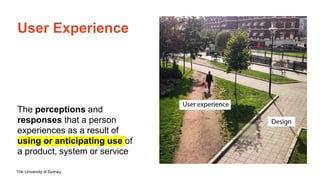
User Experience
The perceptions and
responses that a person
experiences as a result of
using or anticipating use of
a product, system or service
41.
The University ofSydney
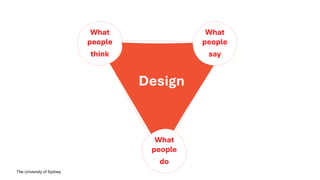
What
people
do
What
people
say
What
people
think
Design
42.
The University ofSydney
Dr. Ian Malcolm:
“Yeah, but your scientists were so
preoccupied with whether or not they could,
they didn't stop to think if they should.”
https://geektyrant.com/news/jeff-goldblum-says-dr-ian-malcolm-was-nearly-cut-from-jurassic-park
http://pluspng.com/jurassic-park-png-3840.html
43.
The University ofSydney
Chindōgu (珍道具) are ingenious and humorous
solutions to everyday problems. They are “un-
useless” because they are intentionally absurd
but point to real problems. Chindōgu - Wikipedia
https://www.kickstarter.com/projects/yukaienginnering/nekojita-fufu
44.
The University ofSydney
• What is design?
• Design thinking
• Design practices
45.
The University ofSydney
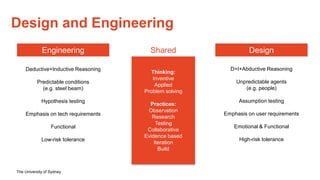
Thinking:
Inventive
Applied
Problem solving
Practices:
Observation
Research
Testing
Collaborative
Evidence based
Iteration
Build
Design and Engineering
Engineering Design
Shared
Deductive+Inductive Reasoning
Predictable conditions
(e.g. steel beam)
Hypothesis testing
Emphasis on tech requirements
Functional
Low-risk tolerance
D+I+Abductive Reasoning
Unpredictable agents
(e.g. people)
Assumption testing
Emphasis on user requirements
Emotional & Functional
High-risk tolerance
46.
The University ofSydney
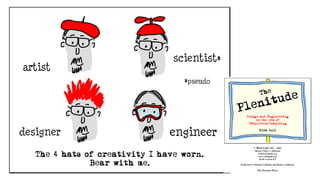
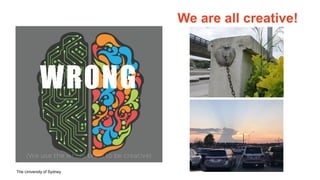
WRONG
(We use the whole brain to be creative)
We are all creative!
47.
The University ofSydney
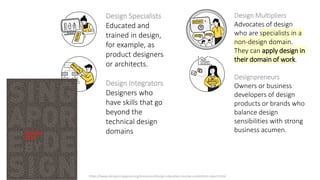
Design Specialists
Educated and
trained in design,
for example, as
product designers
or architects.
Design Integrators
Designers who
have skills that go
beyond the
technical design
domains
Design Multipliers
Advocates of design
who are specialists in a
non-design domain.
They can apply design in
their domain of work.
Designpreneurs
Owners or business
developers of design
products or brands who
balance design
sensibilities with strong
business acumen.
https://www.designsingapore.org/resources/design-education-review-committee-report.html
48.
Page 48
The Universityof Sydney
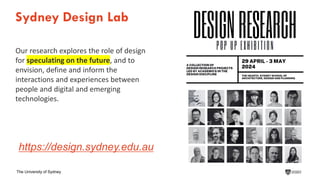
Sydney Design Lab
Our research explores the role of design
for speculating on the future, and to
envision, define and inform the
interactions and experiences between
people and digital and emerging
technologies.
https://design.sydney.edu.au