Excerpts from:
Kutach, D. (2014). Causation.
John Wiley & Sons.
https://www.politybooks.com/bookdetail?book_
slug=causation--9780745659954
by: Ricardo Sosa ricardo.sosa@sydney.edu.au
I do not think we will ever find any
comprehensive, adequate, and
tractable rule of the form,
“c is a cause of e if and only if…”
One can distinguish between:
• Background and foreground causes
• Proximal (proximate) and distal causes
• Enabling and activating causes
We have a tendency to deny the status of cause to the
background, distal, and enabling causes
Productive vs Difference-Making
Causation
We sometimes think of a cause as somehow
generating or producing its effect, and at
other times we think of a cause as
something that makes a difference as to
whether or how its effect comes about.
Debates about fairness (and
other ethical issues) share
important features with
debates about causation.
The main similarity I want to point out is
the nonlinear causal relationship
Once upon a time, there were two nearby islands. Paul was the lone
inhabitant of one island, and he had a small boat for fishing. Vivian was
the lone inhabitant of the other island, which hosted abundant stringy
plants that she harvested for rope fiber. By working alone, each collected
1 kg each. By cooperating, however, they could gather 100 kg.
In this sense, each person individually made a 99
percent difference in the amount of fish caught.
This is the problem of cooperative
surplus: that it is impossible for
both of them to get 99 percent of
the fish.
Some treatments emphasize that causation is
productive.
Causes make their effects happen. Causes bring about their effects.
Causes give rise to their effects. Causes alter and change the world.
Other accounts emphasize that causation affects.
Causes are difference-makers. Without the cause, the effect would not
have happened. Causation is recognized by intervening in the world and
manipulating causes.
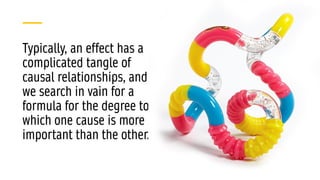
Typically, an effect has a
complicated tangle of
causal relationships, and
we search in vain for a
formula for the degree to
which one cause is more
important than the other.
Michael Dummett’s (1964) article “Bringing about the Past.”
He agrees with the widely held view that we should not deny
our ability to influence the future just because a single
determinate future will eventually occur.
By parity of reasoning, we should not dismiss
the possibility of influencing the past.
He thinks the stock argument – that we cannot affect the past
because it has already happened – is just as bad as the
argument that we cannot affect the future because it will
eventually happen.
An influence-based conception of causation is
one that incorporates some component related
to influence or agency or manipulation or
intervention.
A pattern-based conception of causation
concerns only the patterns in the tapestry of
space-time, which comprises everything that
has occurred and will occur throughout the
history of the universe.
Productive theories postulate rules
for how a given collection of
causes at one time give rise to
what happens at other times,
whereas difference-making
accounts incorporate comparisons
between two or more possible
arrangements of causes.
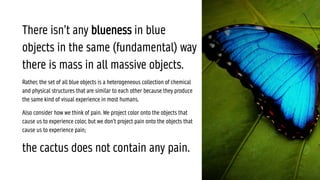
There isn’t any blueness in blue
objects in the same (fundamental) way
there is mass in all massive objects.
Rather, the set of all blue objects is a heterogeneous collection of chemical
and physical structures that are similar to each other because they produce
the same kind of visual experience in most humans.
Also consider how we think of pain. We project color onto the objects that
cause us to experience color, but we don’t project pain onto the objects that
cause us to experience pain;
the cactus does not contain any pain.
A natural kind is a category whose extent is not
entirely determined by the linguistic or conceptual
choices we humans make. A paradigmatic example of a
natural kind is gold.
What makes a game an artificial kind is that we know
from the outset that no scientific investigation is going
to identify the hidden nature of games. Games
constitute a category that cannot have a hidden nature.
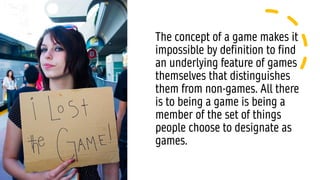
The concept of a game makes it
impossible by definition to find
an underlying feature of games
themselves that distinguishes
them from non-games. All there
is to being a game is being a
member of the set of things
people choose to designate as
games.
When just about any slight hypothetical alteration to
an event makes it count as “not the same” event, we
say the event is extremely fragile. When an event can
be altered somewhat but not too much and still count
as “the same” event, we say it is moderately fragile.
When an event can be altered significantly in many
diverse respects, we say it is not fragile.
The relevance of fragility to causation, at least insofar as standard
counterfactual accounts are concerned, is that effects need to be
characterized at a moderate level of fragility: too fragile and virtually every
previous event will count as a cause; not fragile enough and there will be
scenarios where too few causes are identified correctly as genuine causes.
A distinction between changing the
future and affecting the future.
For some event c to affect the future is (by definition) for c to help
make the future different from the way the future would have
been if c had not happened.
For some event c to change the future is (by definition) for c to
make the future different from the way the future will actually be.
Productive theories postulate rules
for how a given collection of
causes at one time give rise to
what happens at other times,
whereas difference-making
accounts incorporate comparisons
between two or more possible
arrangements of causes.
Redundant causation occurs when
there is a backup cause or multiple
causes in position to bring about the
effect if one of the potential causes
fails.
In cases of symmetric overdetermination, the causes are
the same in all relevant respects.
In cases of asymmetric overdetermination, there are
differences among the causes that motivate us to distribute
causal responsibility unevenly.
No one knows whether the
actual world is deterministic.
Regardless of what we think about the fundamental nature
of causation, we need to be able to make sense of how the
world can behave in a chancy way at the human scale.
We need some reasonable explanation of how
the chanciness of dice and cards and coin flips
can coexist with our ignorance of whether the
world is fundamentally chancy.
“How the mind of a human being can
determine the bodily spirit in producing
voluntary actions, being only a thinking
substance. For it appears that all
determination of movement is produced
by the pushing of the thing being moved,
by the manner in which it is pushed by
that which moves it, or else by the
qualification and figure of the surface of
the latter. Contact is required for the first
two conditions, and extension for the
third. [But] you entirely exclude the latter
from the notion you have of body, and the
former seems incompatible with an
immaterial thing.” (Princess Elisabeth to
Descartes, May 1643)
You would do well to be mindful of the large variety of
pitfalls that make causal inferences treacherous.
For example, some of the statistical tools used in sciences where data is expensive to gather,
like medical science, are conceptually suspect and frequently misunderstood even by leading
experts. And the institutional structure of science leads to bias in ways that have been
publicly recognized but not adequately addressed. For all its shortcomings, science in its
current form is still far superior (in intellectual rigor and trustworthiness) to other
institutions like private business, governments, militaries, and religion, but science has room
for improvement too.
Scientific use of the concept of causality, for example, is still
embarrassingly imprecise even though science gets along fairly well
without being clear about its causal notions.
Maybe you can help to improve conceptual hygiene in your future workplace.
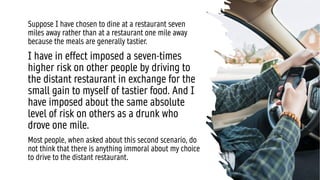
Suppose I have chosen to dine at a restaurant seven
miles away rather than at a restaurant one mile away
because the meals are generally tastier.
I have in effect imposed a seven-times
higher risk on other people by driving to
the distant restaurant in exchange for the
small gain to myself of tastier food. And I
have imposed about the same absolute
level of risk on others as a drunk who
drove one mile.
Most people, when asked about this second scenario, do
not think that there is anything immoral about my choice
to drive to the distant restaurant.
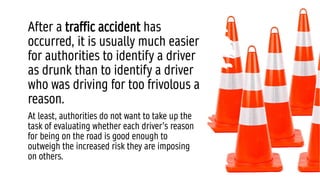
After a traffic accident has
occurred, it is usually much easier
for authorities to identify a driver
as drunk than to identify a driver
who was driving for too frivolous a
reason.
At least, authorities do not want to take up the
task of evaluating whether each driver’s reason
for being on the road is good enough to
outweigh the increased risk they are imposing
on others.
We do not have
morally neutral
assessments of
causation
We ignore the kinds of causes that are hard to adjudicate
I do not think we will ever find any
comprehensive, adequate, and
tractable rule of the form,
“c is a cause of e if and only if…”
Excerpts from:
Kutach, D. (2014). Causation.
John Wiley & Sons.
https://www.youtube.com/watch?v=jeI2KS3KLIs
by: Ricardo Sosa ricardo.sosa@sydney.edu.au

Causation

  • 1.
    Excerpts from: Kutach, D.(2014). Causation. John Wiley & Sons. https://www.politybooks.com/bookdetail?book_ slug=causation--9780745659954 by: Ricardo Sosa ricardo.sosa@sydney.edu.au
  • 3.
    I do notthink we will ever find any comprehensive, adequate, and tractable rule of the form, “c is a cause of e if and only if…”
  • 4.
    One can distinguishbetween: • Background and foreground causes • Proximal (proximate) and distal causes • Enabling and activating causes We have a tendency to deny the status of cause to the background, distal, and enabling causes
  • 7.
    Productive vs Difference-Making Causation Wesometimes think of a cause as somehow generating or producing its effect, and at other times we think of a cause as something that makes a difference as to whether or how its effect comes about.
  • 8.
    Debates about fairness(and other ethical issues) share important features with debates about causation. The main similarity I want to point out is the nonlinear causal relationship
  • 9.
    Once upon atime, there were two nearby islands. Paul was the lone inhabitant of one island, and he had a small boat for fishing. Vivian was the lone inhabitant of the other island, which hosted abundant stringy plants that she harvested for rope fiber. By working alone, each collected 1 kg each. By cooperating, however, they could gather 100 kg. In this sense, each person individually made a 99 percent difference in the amount of fish caught. This is the problem of cooperative surplus: that it is impossible for both of them to get 99 percent of the fish.
  • 10.
    Some treatments emphasizethat causation is productive. Causes make their effects happen. Causes bring about their effects. Causes give rise to their effects. Causes alter and change the world. Other accounts emphasize that causation affects. Causes are difference-makers. Without the cause, the effect would not have happened. Causation is recognized by intervening in the world and manipulating causes.
  • 11.
    Typically, an effecthas a complicated tangle of causal relationships, and we search in vain for a formula for the degree to which one cause is more important than the other.
  • 12.
    Michael Dummett’s (1964)article “Bringing about the Past.” He agrees with the widely held view that we should not deny our ability to influence the future just because a single determinate future will eventually occur. By parity of reasoning, we should not dismiss the possibility of influencing the past. He thinks the stock argument – that we cannot affect the past because it has already happened – is just as bad as the argument that we cannot affect the future because it will eventually happen.
  • 13.
    An influence-based conceptionof causation is one that incorporates some component related to influence or agency or manipulation or intervention. A pattern-based conception of causation concerns only the patterns in the tapestry of space-time, which comprises everything that has occurred and will occur throughout the history of the universe.
  • 14.
    Productive theories postulaterules for how a given collection of causes at one time give rise to what happens at other times, whereas difference-making accounts incorporate comparisons between two or more possible arrangements of causes.
  • 15.
    There isn’t anyblueness in blue objects in the same (fundamental) way there is mass in all massive objects. Rather, the set of all blue objects is a heterogeneous collection of chemical and physical structures that are similar to each other because they produce the same kind of visual experience in most humans. Also consider how we think of pain. We project color onto the objects that cause us to experience color, but we don’t project pain onto the objects that cause us to experience pain; the cactus does not contain any pain.
  • 16.
    A natural kindis a category whose extent is not entirely determined by the linguistic or conceptual choices we humans make. A paradigmatic example of a natural kind is gold. What makes a game an artificial kind is that we know from the outset that no scientific investigation is going to identify the hidden nature of games. Games constitute a category that cannot have a hidden nature.
  • 17.
    The concept ofa game makes it impossible by definition to find an underlying feature of games themselves that distinguishes them from non-games. All there is to being a game is being a member of the set of things people choose to designate as games.
  • 19.
    When just aboutany slight hypothetical alteration to an event makes it count as “not the same” event, we say the event is extremely fragile. When an event can be altered somewhat but not too much and still count as “the same” event, we say it is moderately fragile. When an event can be altered significantly in many diverse respects, we say it is not fragile. The relevance of fragility to causation, at least insofar as standard counterfactual accounts are concerned, is that effects need to be characterized at a moderate level of fragility: too fragile and virtually every previous event will count as a cause; not fragile enough and there will be scenarios where too few causes are identified correctly as genuine causes.
  • 20.
    A distinction betweenchanging the future and affecting the future. For some event c to affect the future is (by definition) for c to help make the future different from the way the future would have been if c had not happened. For some event c to change the future is (by definition) for c to make the future different from the way the future will actually be.
  • 21.
    Productive theories postulaterules for how a given collection of causes at one time give rise to what happens at other times, whereas difference-making accounts incorporate comparisons between two or more possible arrangements of causes.
  • 22.
    Redundant causation occurswhen there is a backup cause or multiple causes in position to bring about the effect if one of the potential causes fails. In cases of symmetric overdetermination, the causes are the same in all relevant respects. In cases of asymmetric overdetermination, there are differences among the causes that motivate us to distribute causal responsibility unevenly.
  • 23.
    No one knowswhether the actual world is deterministic. Regardless of what we think about the fundamental nature of causation, we need to be able to make sense of how the world can behave in a chancy way at the human scale. We need some reasonable explanation of how the chanciness of dice and cards and coin flips can coexist with our ignorance of whether the world is fundamentally chancy.
  • 24.
    “How the mindof a human being can determine the bodily spirit in producing voluntary actions, being only a thinking substance. For it appears that all determination of movement is produced by the pushing of the thing being moved, by the manner in which it is pushed by that which moves it, or else by the qualification and figure of the surface of the latter. Contact is required for the first two conditions, and extension for the third. [But] you entirely exclude the latter from the notion you have of body, and the former seems incompatible with an immaterial thing.” (Princess Elisabeth to Descartes, May 1643)
  • 25.
    You would dowell to be mindful of the large variety of pitfalls that make causal inferences treacherous. For example, some of the statistical tools used in sciences where data is expensive to gather, like medical science, are conceptually suspect and frequently misunderstood even by leading experts. And the institutional structure of science leads to bias in ways that have been publicly recognized but not adequately addressed. For all its shortcomings, science in its current form is still far superior (in intellectual rigor and trustworthiness) to other institutions like private business, governments, militaries, and religion, but science has room for improvement too. Scientific use of the concept of causality, for example, is still embarrassingly imprecise even though science gets along fairly well without being clear about its causal notions. Maybe you can help to improve conceptual hygiene in your future workplace.
  • 26.
    Suppose I havechosen to dine at a restaurant seven miles away rather than at a restaurant one mile away because the meals are generally tastier. I have in effect imposed a seven-times higher risk on other people by driving to the distant restaurant in exchange for the small gain to myself of tastier food. And I have imposed about the same absolute level of risk on others as a drunk who drove one mile. Most people, when asked about this second scenario, do not think that there is anything immoral about my choice to drive to the distant restaurant.
  • 27.
    After a trafficaccident has occurred, it is usually much easier for authorities to identify a driver as drunk than to identify a driver who was driving for too frivolous a reason. At least, authorities do not want to take up the task of evaluating whether each driver’s reason for being on the road is good enough to outweigh the increased risk they are imposing on others.
  • 28.
    We do nothave morally neutral assessments of causation We ignore the kinds of causes that are hard to adjudicate
  • 29.
    I do notthink we will ever find any comprehensive, adequate, and tractable rule of the form, “c is a cause of e if and only if…”
  • 30.
    Excerpts from: Kutach, D.(2014). Causation. John Wiley & Sons. https://www.youtube.com/watch?v=jeI2KS3KLIs by: Ricardo Sosa ricardo.sosa@sydney.edu.au