3 Chapter   Achieving Competitive Advantage with Information Systems
STUDENT  LEARNING OBJECTIVES Essentials of Business Information Systems Chapter 3 Achieving Competitive Advantage with Information Systems How does Porter’s competitive forces model help companies develop competitive strategies using information systems? How do the value chain and value web models help businesses identify opportunities for strategic information system applications? How do information systems help businesses use synergies, core competencies, and network-based strategies to achieve competitive advantage?
How do competing on a global scale and promoting quality enhance competitive advantage? Evaluate the role of business process reengineering (BPR) in enhancing competitiveness. STUDENT LEARNING OBJECTIVES (Continued) Essentials of Business Information Systems Chapter 3 Achieving Competitive Advantage with Information Systems
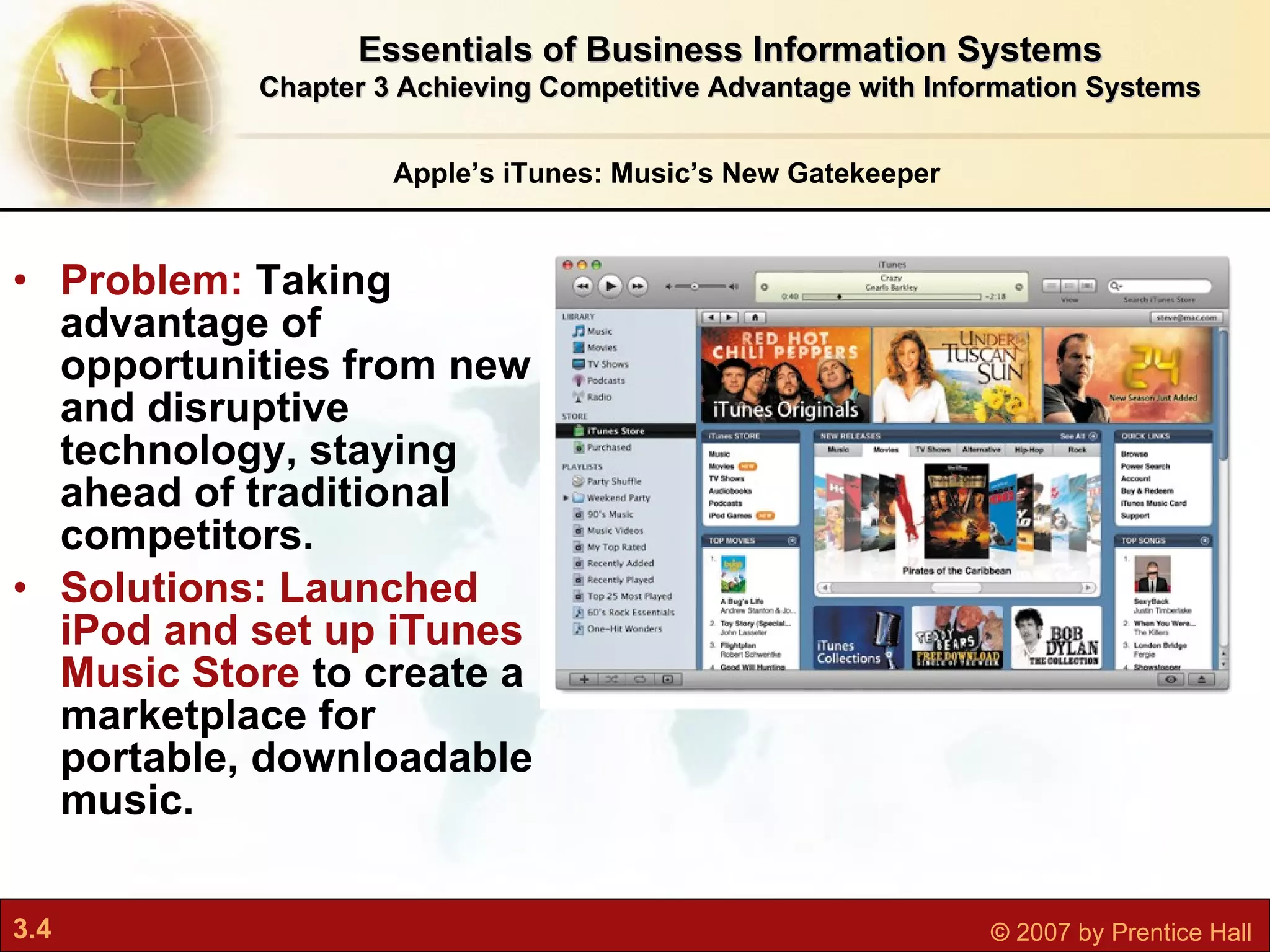
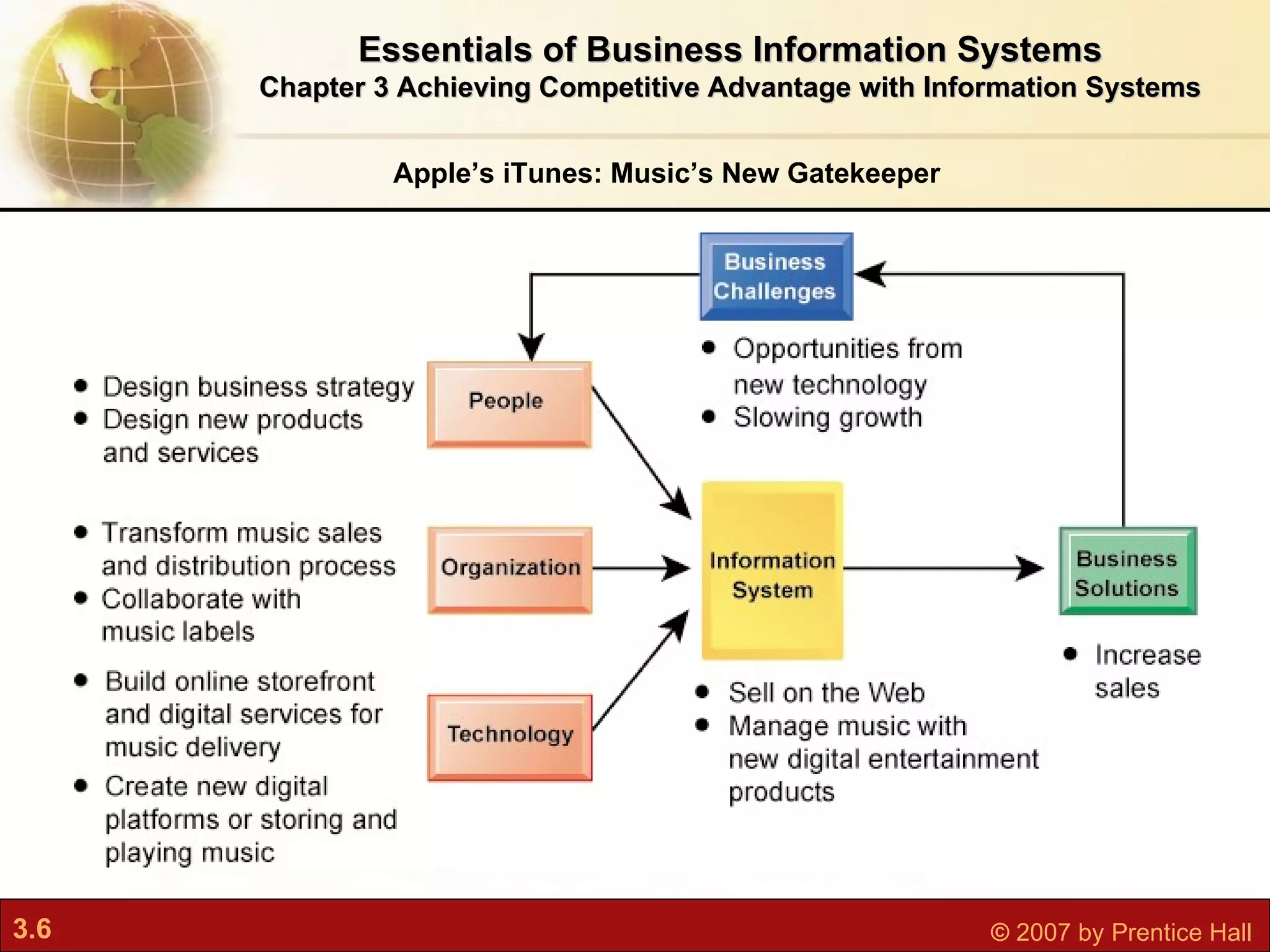
Problem:  Taking advantage of opportunities from new and disruptive technology, staying ahead of traditional competitors. Solutions: Launched iPod and set up iTunes Music Store  to create a marketplace for portable, downloadable music. Apple’s iTunes: Music’s New Gatekeeper Essentials of Business Information Systems Chapter 3 Achieving Competitive Advantage with Information Systems
Partnerships with artists and recording labels  allow iTunes to supply exclusive content in return for driving sales and increasing groups’ popularity. Illustrates digital technology’s role in gaining and maintaining a competitive advantage. Apple’s iTunes: Music’s New Gatekeeper Essentials of Business Information Systems Chapter 3 Achieving Competitive Advantage with Information Systems
Apple’s iTunes: Music’s New Gatekeeper Essentials of Business Information Systems Chapter 3 Achieving Competitive Advantage with Information Systems
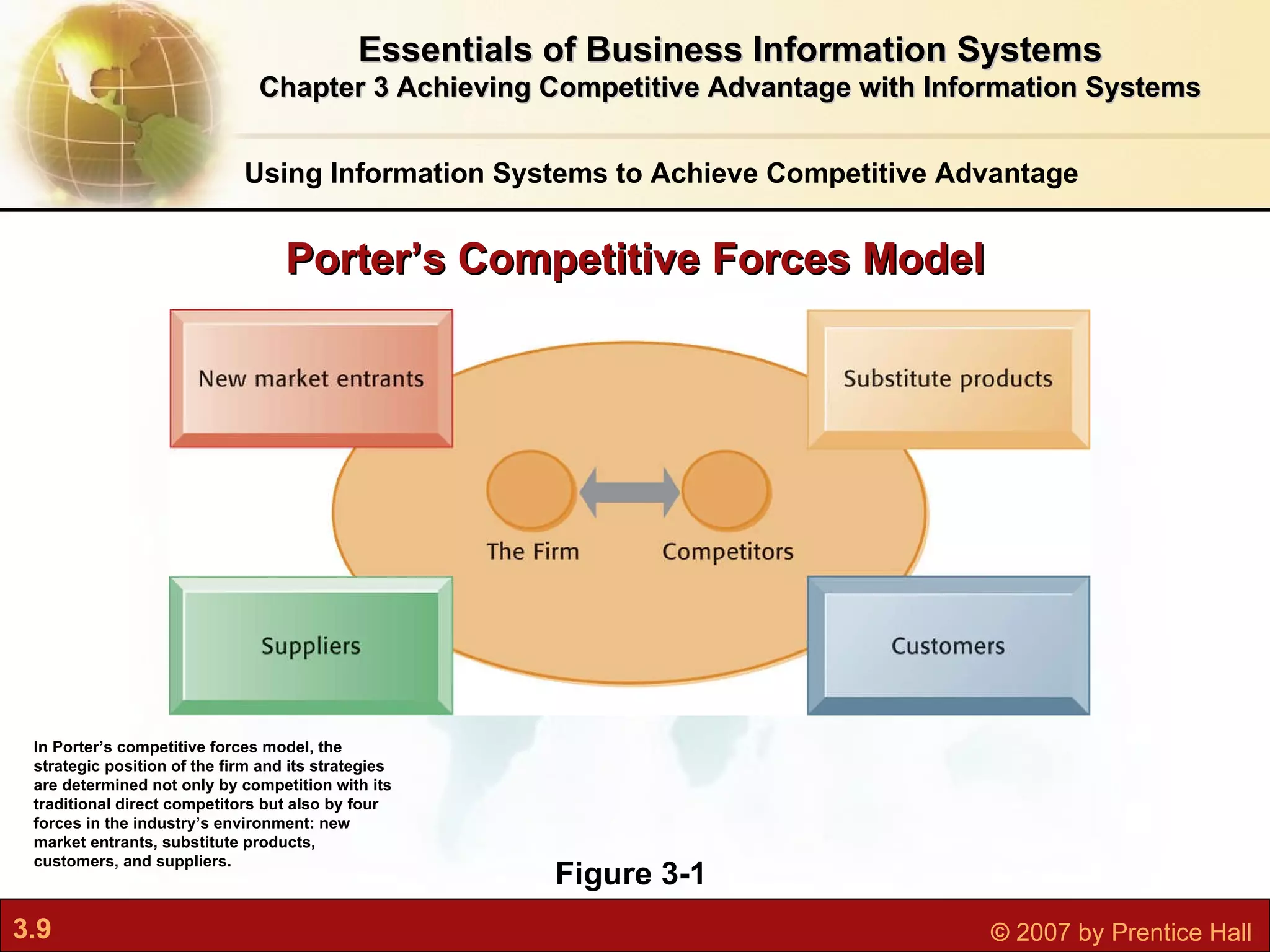
Way to understand competitive advantage Five competitive forces shape fate of firm Traditional competitors Competitors in market space continuously devise new products, new efficiencies, switching costs New market entrants Some industries have low barriers to entry E.g. food industry vs. microchip industry Newer companies may have advantages  Newer equipment, younger workforce, etc. Porter’s Competitive Forces Model Using Information Systems to Achieve Competitive Advantage Essentials of Business Information Systems Chapter 3 Achieving Competitive Advantage with Information Systems
Substitute products and services Substitutes customers can purchase if your prices too high E.g. Internet music service vs. CDs Customers Can customers easily switch to competitor’s products? Can customers force firm and competitors to compete on price alone (transparent marketplace) Suppliers The more suppliers a firm has, the greater control it can exercise over suppliers Porter’s Competitive Forces Model Using Information Systems to Achieve Competitive Advantage Essentials of Business Information Systems Chapter 3 Achieving Competitive Advantage with Information Systems
Figure 3-1 In Porter’s competitive forces model, the strategic position of the firm and its strategies are determined not only by competition with its traditional direct competitors but also by four forces in the industry’s environment: new market entrants, substitute products, customers, and suppliers. Porter’s Competitive Forces Model Using Information Systems to Achieve Competitive Advantage Essentials of Business Information Systems Chapter 3 Achieving Competitive Advantage with Information Systems
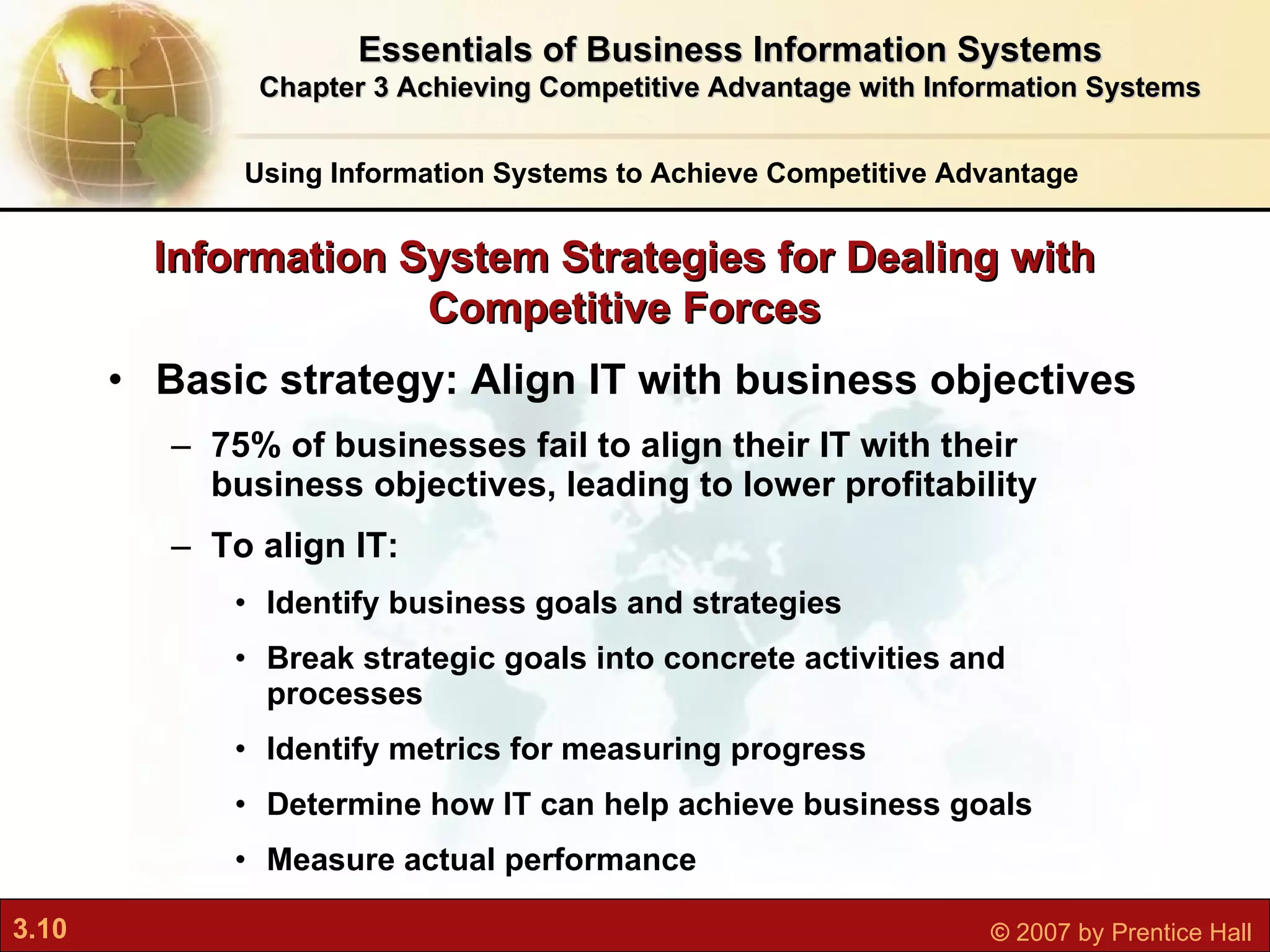
Basic strategy: Align IT with business objectives  75% of businesses fail to align their IT with their business objectives, leading to lower profitability To align IT: Identify business goals and strategies Break strategic goals into concrete activities and processes Identify metrics for measuring progress Determine how IT can help achieve business goals Measure actual performance Information System Strategies for Dealing with Competitive Forces Using Information Systems to Achieve Competitive Advantage Essentials of Business Information Systems Chapter 3 Achieving Competitive Advantage with Information Systems
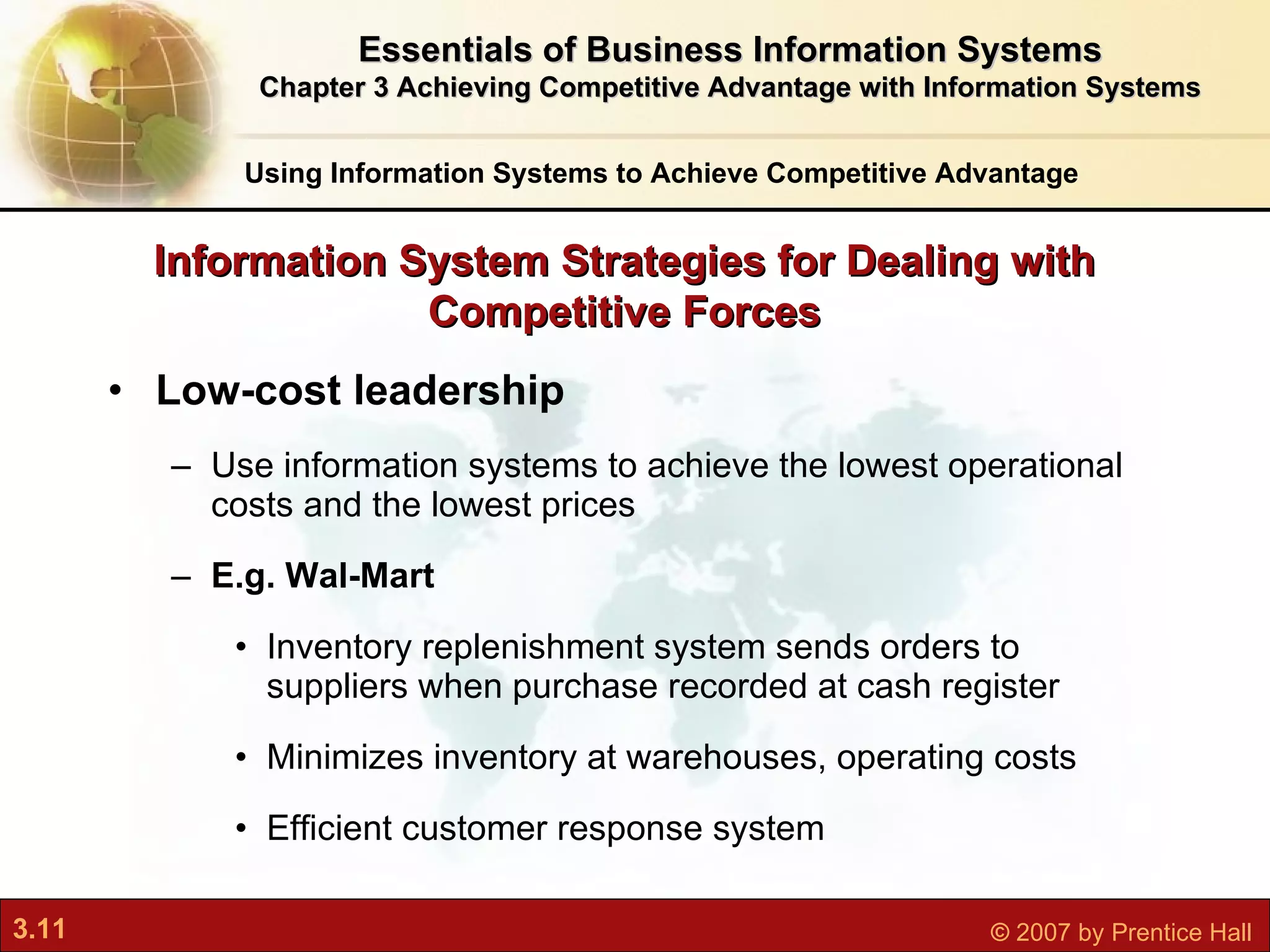
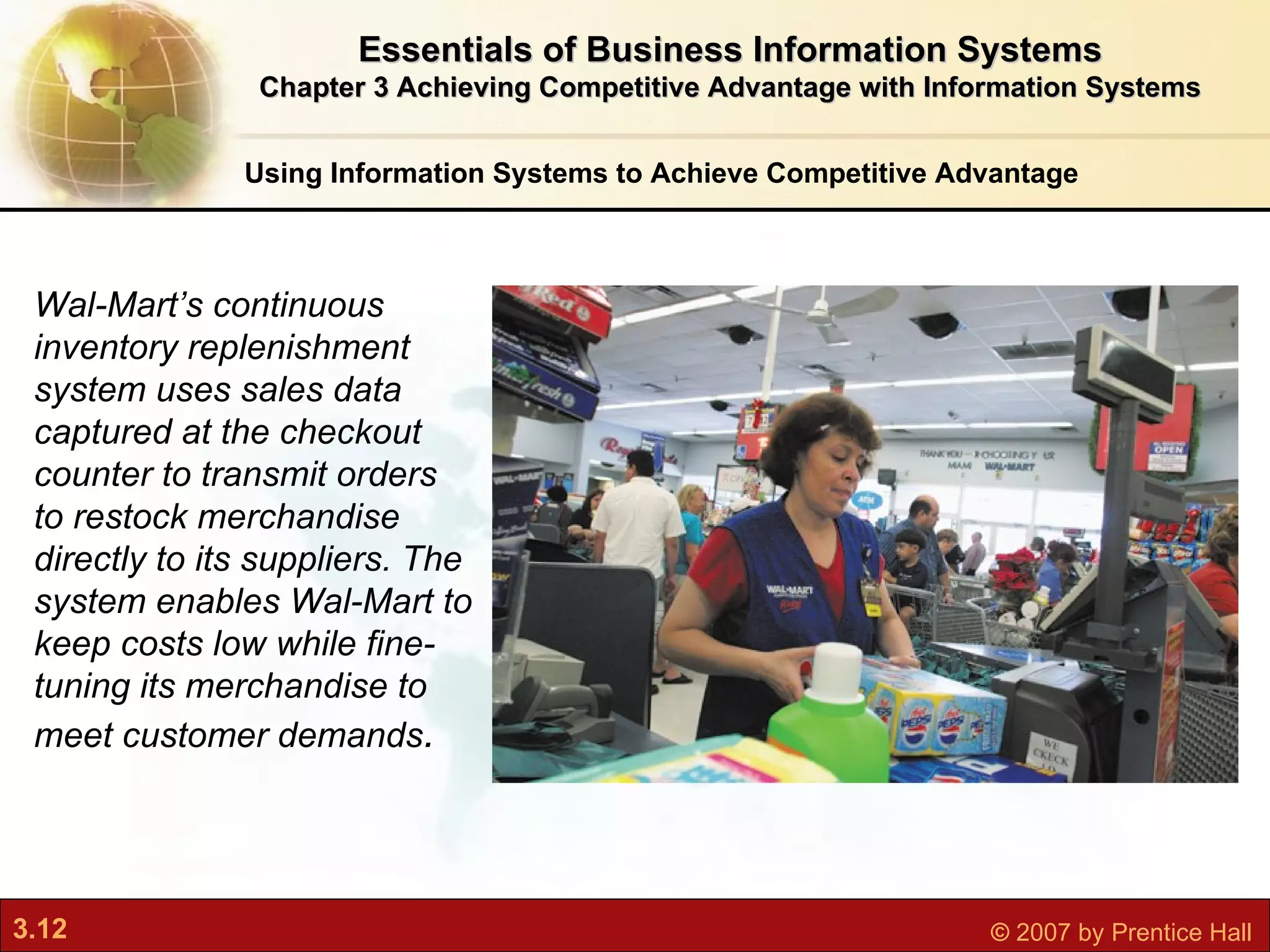
Low-cost leadership Use information systems to achieve the lowest operational costs and the lowest prices E.g. Wal-Mart Inventory replenishment system sends orders to suppliers when purchase recorded at cash register Minimizes inventory at warehouses, operating costs Efficient customer response system Information System Strategies for Dealing with Competitive Forces Using Information Systems to Achieve Competitive Advantage Essentials of Business Information Systems Chapter 3 Achieving Competitive Advantage with Information Systems
Using Information Systems to Achieve Competitive Advantage Essentials of Business Information Systems Chapter 3 Achieving Competitive Advantage with Information Systems Wal-Mart’s continuous inventory replenishment system uses sales data captured at the checkout counter to transmit orders to restock merchandise directly to its suppliers. The system enables Wal-Mart to keep costs low while fine-tuning its merchandise to meet customer demands .
Product differentiation Use information systems to enable new products and services, or greatly change the customer convenience in using your existing products and services E.g. Google’s continuous innovations, Apple’s iPhone Use information systems to customize, personalize products to fit specifications of individual consumers Dell Land’s End’s mass customization Information System Strategies for Dealing with Competitive Forces Using Information Systems to Achieve Competitive Advantage Essentials of Business Information Systems Chapter 3 Achieving Competitive Advantage with Information Systems
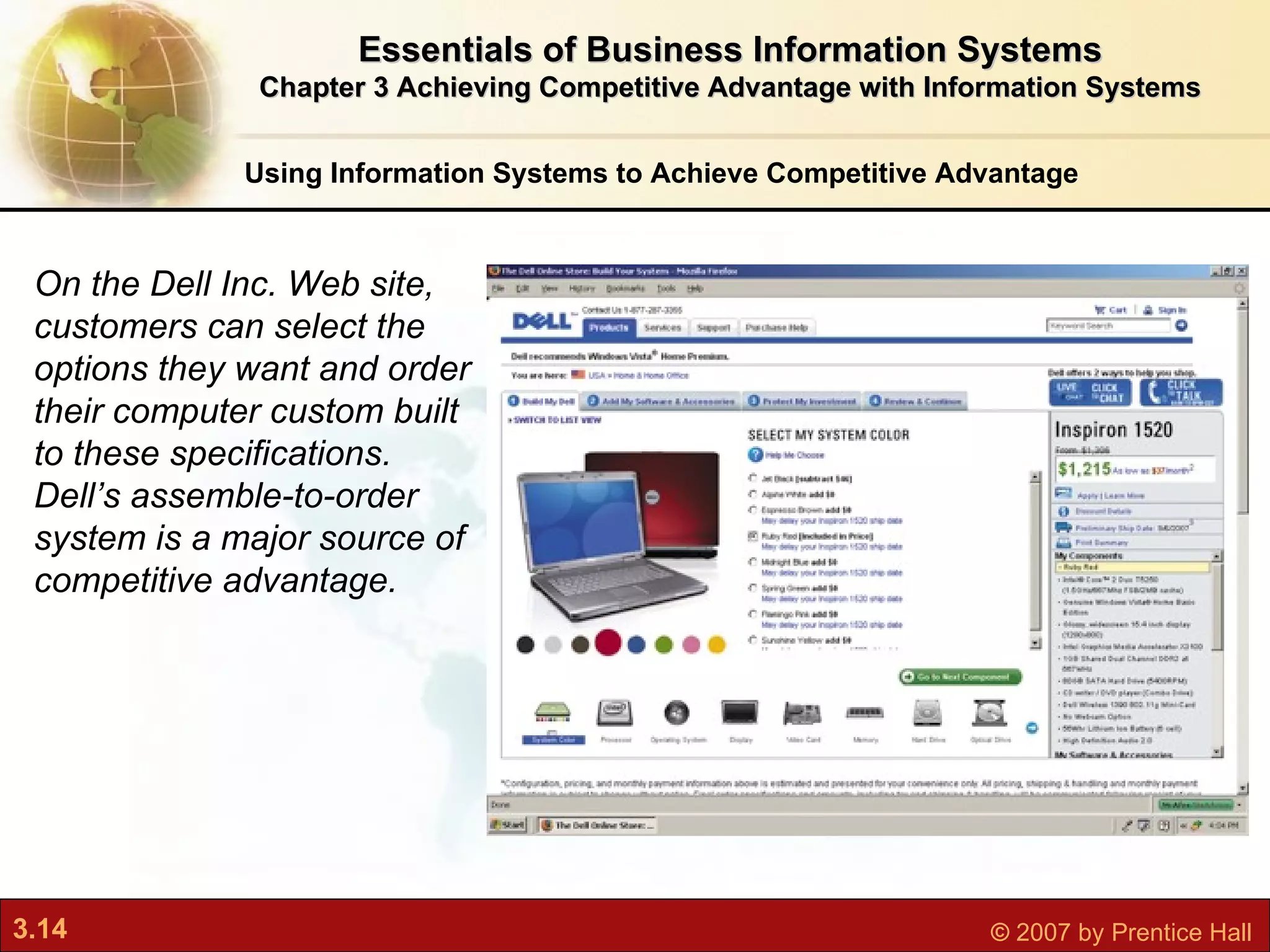
Using Information Systems to Achieve Competitive Advantage Essentials of Business Information Systems Chapter 3 Achieving Competitive Advantage with Information Systems On the Dell Inc. Web site, customers can select the options they want and order their computer custom built to these specifications. Dell’s assemble-to-order system is a major source of competitive advantage.
Focus on market niche Use information systems to enable specific market focus, and serve narrow target market better than competitors Analyzes customer buying habits, preferences Advertising pitches to smaller and smaller target markets E.g. Hilton Hotel’s OnQ System Analyzes data collected on guests to determine preferences and guest’s profitability Information System Strategies for Dealing with Competitive Forces Using Information Systems to Achieve Competitive Advantage Essentials of Business Information Systems Chapter 3 Achieving Competitive Advantage with Information Systems
Read the Interactive Session and then discuss the following questions: Why is AutoNation having a problem with its inventory? Why is this also a problem for auto manufacturers such as GM, Ford, and Chrysler? How Is this problem impacting the business performance of AutoNation and of the auto manufacturers? Interactive Session: Organizations Can Detroit Make the Cars Customers Want? Using Information Systems to Achieve Competitive Advantage Essentials of Business Information Systems Chapter 3 Achieving Competitive Advantage with Information Systems
Interactive Session: Organizations Can Detroit Make the Cars Customers Want? Using Information Systems to Achieve Competitive Advantage What pieces of data does AutoNation need to determine which cars to stock in each of its dealerships? How can it obtain these data? What is AutoNation’s solution to its problem? What obstacles must AutoNation overcome to implement its solution? How effective will the solution be? Essentials of Business Information Systems Chapter 3 Achieving Competitive Advantage with Information Systems
Strengthen customer and supplier intimacy Strong linkages to customers and suppliers increase switching costs and loyalty Chrysler : Uses IS to f acilitate direct access from suppliers to production schedules Permits suppliers to decide how and when to ship suppliers to Chrysler factories, allowing more lead time in producing goods.  Amazon : Keeps track of user preferences for purchases, and recommends titles purchased by others Information System Strategies for Dealing with Competitive Forces Using Information Systems to Achieve Competitive Advantage Essentials of Business Information Systems Chapter 3 Achieving Competitive Advantage with Information Systems
Some companies pursue several strategies at same time Dell emphasizes low cost plus customization of products Parker Hannifin offers products with unique features but competes on price Successfully using IS to achieve competitive advantage requires precise coordination of technology, organizations, and people Information System Strategies for Dealing with Competitive Forces Using Information Systems to Achieve Competitive Advantage Essentials of Business Information Systems Chapter 3 Achieving Competitive Advantage with Information Systems
Interactive Session: People Parker Hannifin Finds the Right Price Using Information Systems to Achieve Competitive Advantage Read the Interactive Session and then discuss the following questions: What is strategic pricing? How does it work? What data are required? What role do information systems play in strategic pricing? What role do people play in getting a strategic pricing system to work? What kind of impact does strategic pricing have on a business such as Parker Hannifin? What other kinds of businesses could benefit from strategic pricing? How are value chain and competitive forces analysis related to Parker Hannifin’s strategic pricing? Essentials of Business Information Systems Chapter 3 Achieving Competitive Advantage with Information Systems
Enables new products and services Transforms industries Increases bargaining power of customers and suppliers Intensifies competitive rivalry Creates new opportunities for building brands and large customer bases The Internet’s Impact on Competitive Advantage Using Information Systems to Achieve Competitive Advantage Essentials of Business Information Systems Chapter 3 Achieving Competitive Advantage with Information Systems
Existing competitors:  Widens market, increasing competitors, reducing differences, pressure to compete on price New entrants:  Reduces barriers to entry (e.g. need for sales force declines), provides technology for driving business processes Substitute products and services:  Facilitates creation of new products and services Customers’ bargaining power:  Bargaining power shifts to customer Suppliers’ bargaining power:  Procurement over Internet raises power over suppliers, suppliers can benefit from reduced barriers to entry and elimination of intermediaries The Internet’s Impact on Competitive Advantage Using Information Systems to Achieve Competitive Advantage Essentials of Business Information Systems Chapter 3 Achieving Competitive Advantage with Information Systems
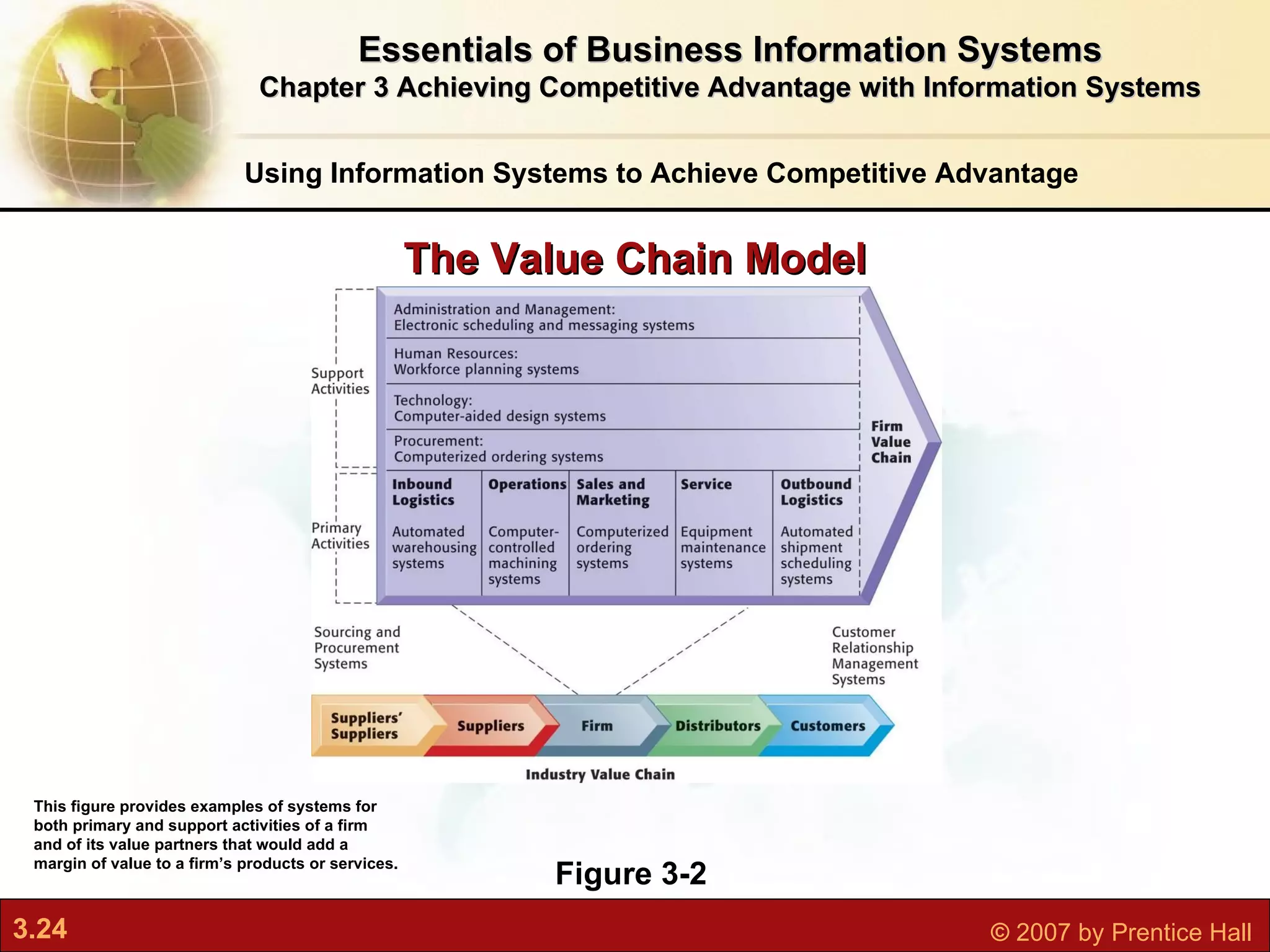
Highlights specific activities in a business where competitive strategies can best be applied and where information systems are likely to have a strategic impact   Primary activities   Support activities Benchmarking Best practices   The Business Value Chain Model Using Information Systems to Achieve Competitive Advantage Essentials of Business Information Systems Chapter 3 Achieving Competitive Advantage with Information Systems
Using Information Systems to Achieve Competitive Advantage Figure 3-2 This figure provides examples of systems for both primary and support activities of a firm and of its value partners that would add a margin of value to a firm’s products or services. The Value Chain Model Essentials of Business Information Systems Chapter 3 Achieving Competitive Advantage with Information Systems
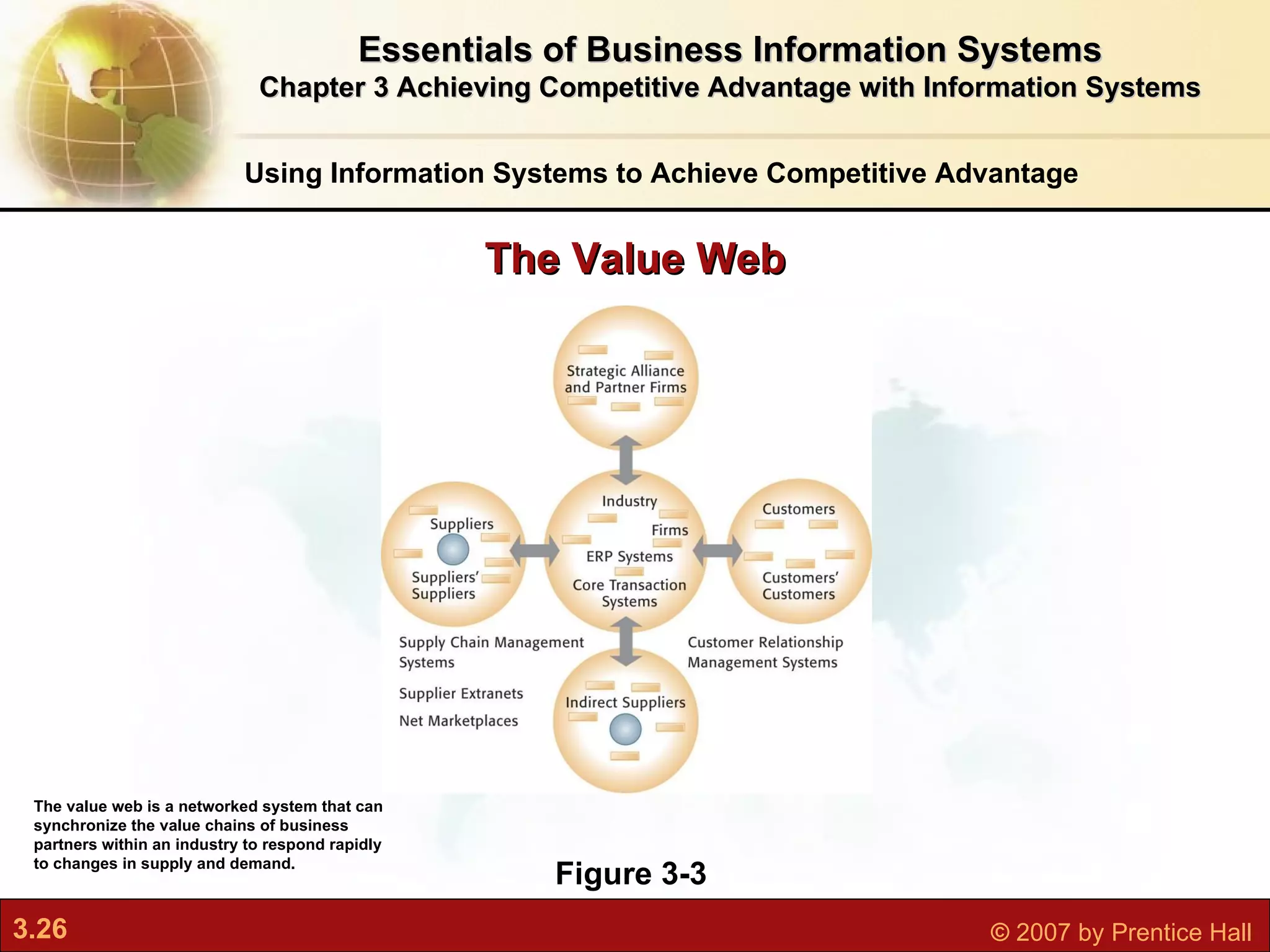
A firm’s value chain is linked to the value chains of its suppliers, distributors, and customers   A value web is a collection of independent firms that use information technology to coordinate their value chains to produce a product collectively Value webs are flexible and adapt to changes in supply and demand   Extending the Value Chain: The Value Web Using Information Systems to Achieve Competitive Advantage Essentials of Business Information Systems Chapter 3 Achieving Competitive Advantage with Information Systems
Using Information Systems to Achieve Competitive Advantage Figure 3-3 The value web is a networked system that can synchronize the value chains of business partners within an industry to respond rapidly to changes in supply and demand. The Value Web Essentials of Business Information Systems Chapter 3 Achieving Competitive Advantage with Information Systems
Synergies When o utput of some units can be used as inputs to other units When two firms can pool markets and expertise (e.g. recent bank mergers) Lower costs and generate profits Enabled by information systems that ties together disparate units so they act as whole Synergies, Core Competencies, and  Network-Based Strategies Using Information Systems to Achieve Competitive Advantage Essentials of Business Information Systems Chapter 3 Achieving Competitive Advantage with Information Systems
Core competency:  A ctivities for which firm is world-class leader E.g. world’s best miniature parts designer, best package delivery service Relies on knowledge that is gained over many years of experience as well as knowledge research Any information system that encourages the sharing of knowledge across business units enhances competency E.g. Procter & Gamble uses P&G uses intranet to help people working on similar problems share ideas and expertise Synergies, Core Competencies, and  Network-Based Strategies Using Information Systems to Achieve Competitive Advantage Essentials of Business Information Systems Chapter 3 Achieving Competitive Advantage with Information Systems
Network-based strategies Network economics M arginal costs of adding another participant are near zero, while marginal gain is much larger E.g. larger number of participants in Internet, greater value to all participants Virtual company Uses networks to link people, resources, and ally with other companies to create and distribute products without traditional organizational boundaries or physical locations Synergies, Core Competencies, and  Network-Based Strategies Using Information Systems to Achieve Competitive Advantage Essentials of Business Information Systems Chapter 3 Achieving Competitive Advantage with Information Systems
Disruptive technologies:  Technologies with disruptive impact on industries and businesses, rendering existing products, services and business models obsolete, e.g.: Personal computers World Wide Web Internet music services First movers vs. fast followers First movers of disruptive technologies may fail to see potential, allowing second movers to reap rewards (fast followers) Disruptive Technologies: Riding the Wave Essentials of Business Information Systems Chapter 3 Achieving Competitive Advantage with Information Systems Using Information Systems to Achieve Competitive Advantage
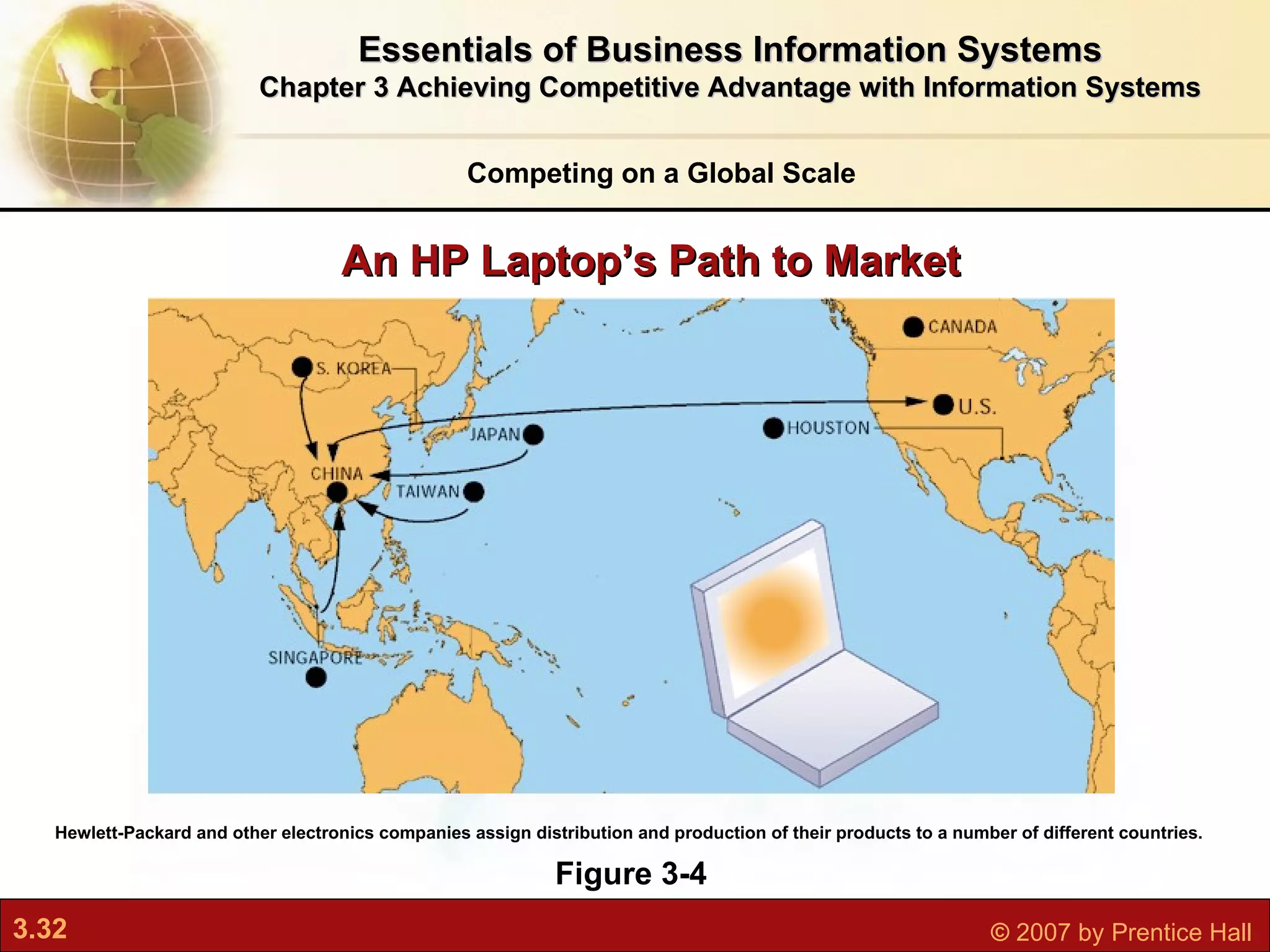
Prior to Internet, competing globally was only option for huge firms able to afford factories, warehouses, and distribution centers abroad The Internet drastically reduces costs of operating globally   Globalization benefits Scale economies and resource cost reduction Higher utilization rates, fixed capital costs, and lower cost per unit of production Speeding time to market The Internet and Globalization Competing on a Global Scale Essentials of Business Information Systems Chapter 3 Achieving Competitive Advantage with Information Systems
An HP Laptop’s Path to Market Competing on a Global Scale Essentials of Business Information Systems Chapter 3 Achieving Competitive Advantage with Information Systems Figure 3-4 Hewlett-Packard and other electronics companies assign distribution and production of their products to a number of different countries.
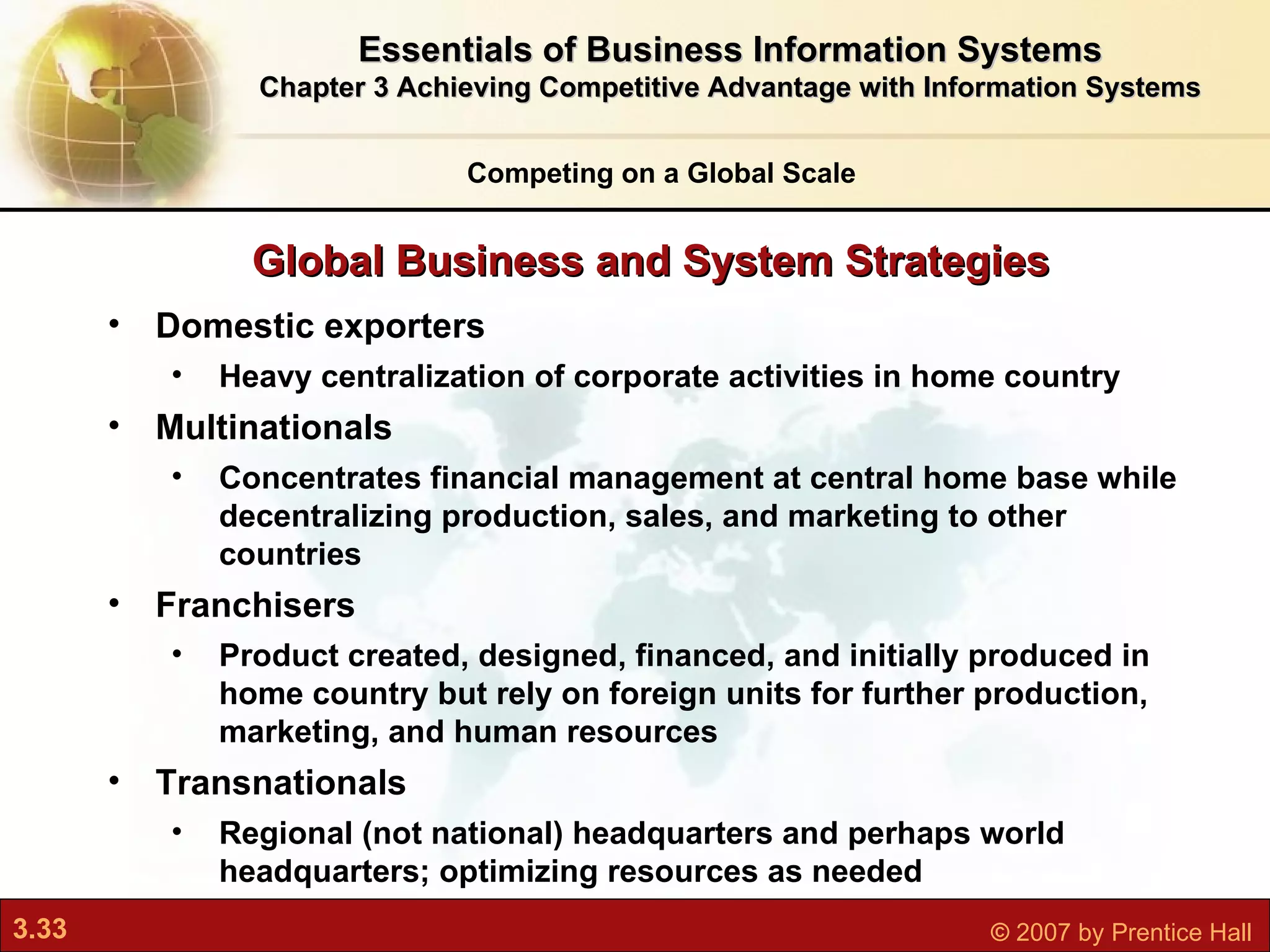
Global Business and System Strategies Competing on a Global Scale Domestic exporters Heavy centralization of corporate activities in home country Multinationals Concentrates financial management at central home base while decentralizing production, sales, and marketing to other countries Franchisers Product created, designed, financed, and initially produced in home country but rely on foreign units for further production, marketing, and human resources Transnationals Regional (not national) headquarters and perhaps world headquarters; optimizing resources as needed  Essentials of Business Information Systems Chapter 3 Achieving Competitive Advantage with Information Systems
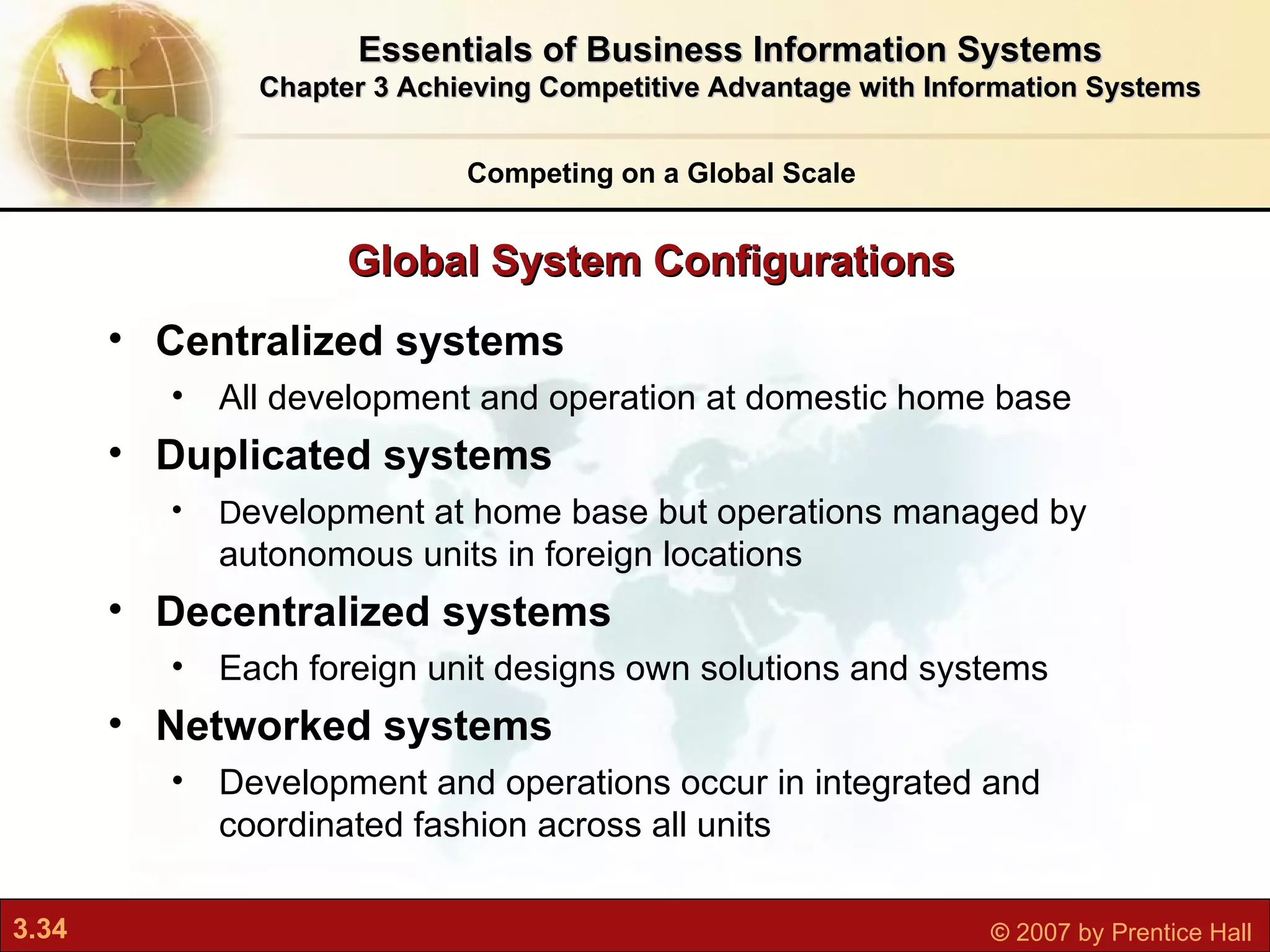
Global System Configurations Competing on a Global Scale Centralized systems All development and operation at domestic home base Duplicated systems D evelopment at home base but operations managed by autonomous units in foreign locations Decentralized systems Each foreign unit designs own solutions and systems Networked systems Development and operations occur in integrated and coordinated fashion across all units Essentials of Business Information Systems Chapter 3 Achieving Competitive Advantage with Information Systems
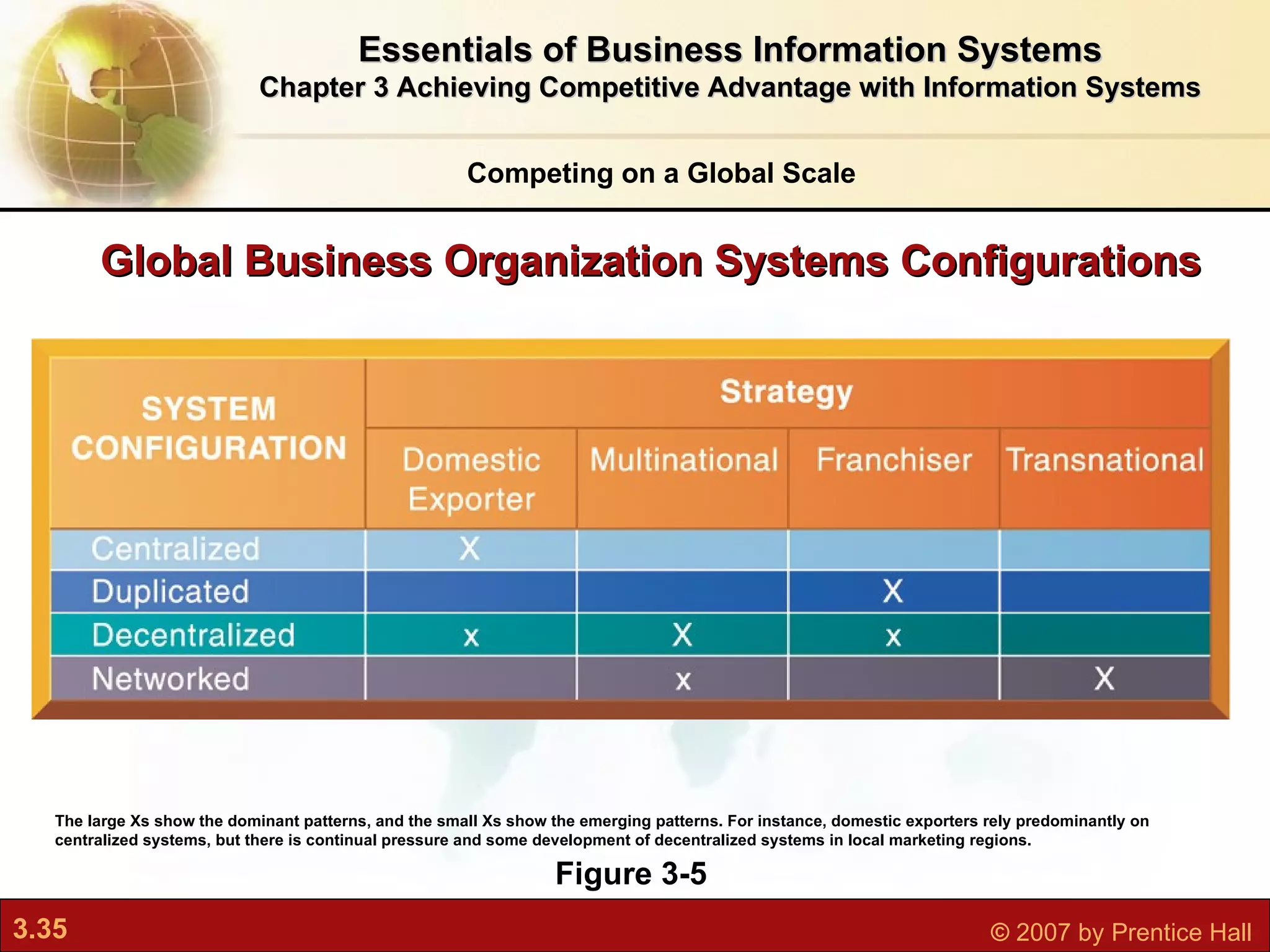
Global Business Organization Systems Configurations Competing on a Global Scale Essentials of Business Information Systems Chapter 3 Achieving Competitive Advantage with Information Systems Figure 3-5 The large Xs show the dominant patterns, and the small Xs show the emerging patterns. For instance, domestic exporters rely predominantly on centralized systems, but there is continual pressure and some development of decentralized systems in local marketing regions.
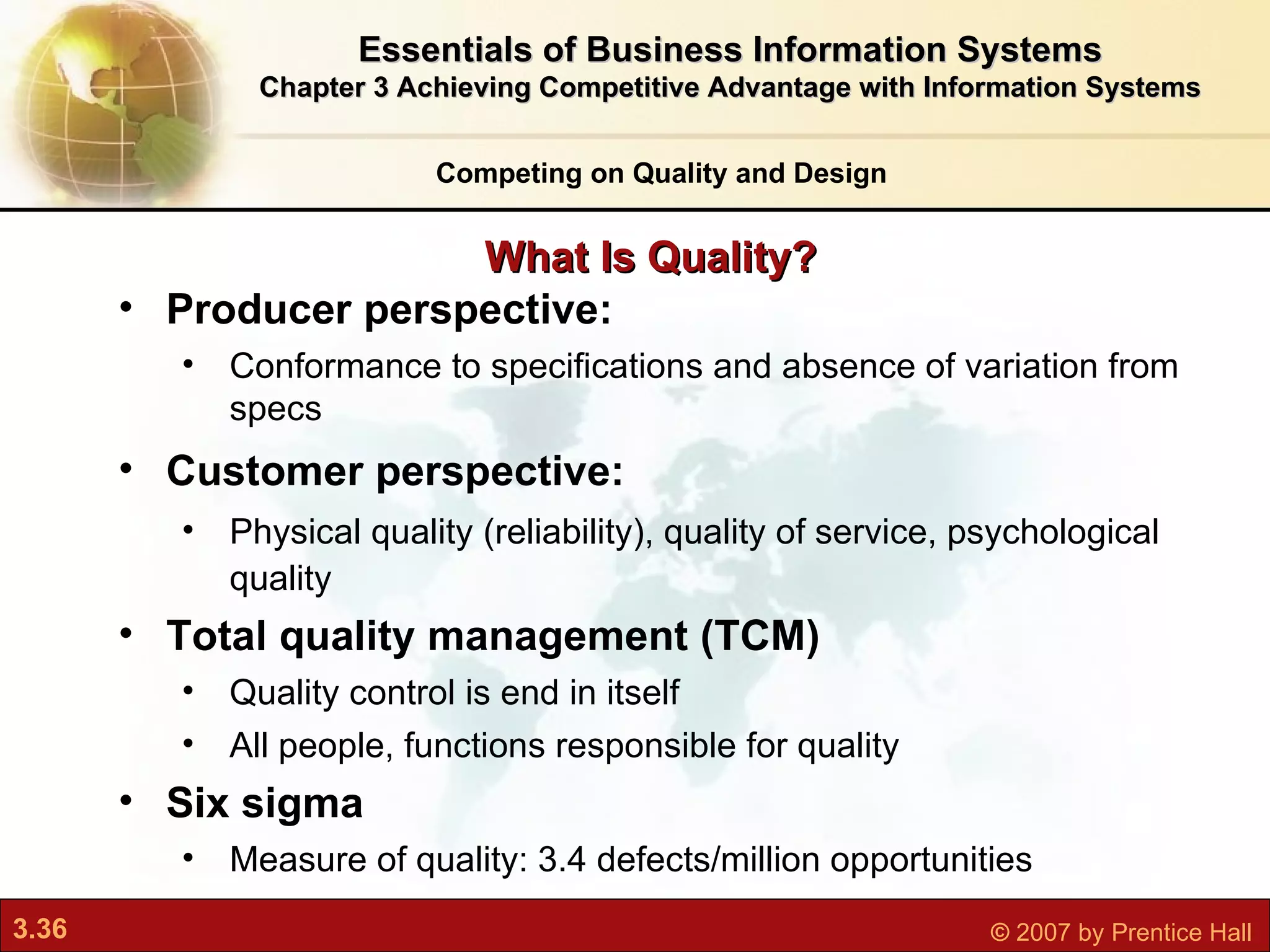
What Is Quality? Competing on Quality and Design Producer perspective:  Conformance to specifications and absence of variation from specs Customer perspective:  Physical quality (reliability), quality of service, psychological quality Total quality management (TCM)   Quality control is end in itself All people, functions responsible for quality Six sigma Measure of quality: 3.4 defects/million opportunities Essentials of Business Information Systems Chapter 3 Achieving Competitive Advantage with Information Systems
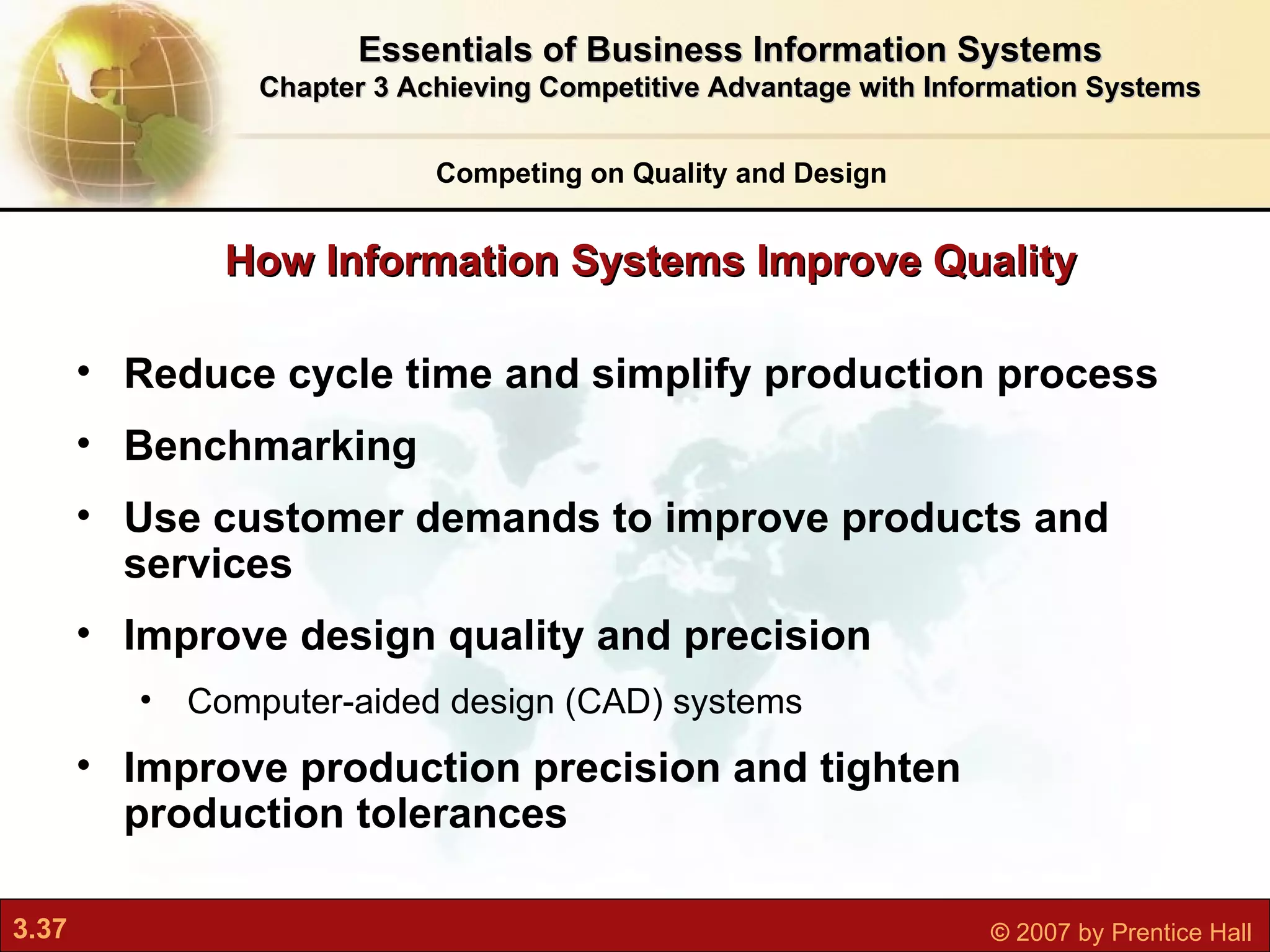
Reduce cycle time and simplify production process Benchmarking Use customer demands to improve products and services Improve design quality and precision Computer-aided design (CAD) systems Improve production precision and tighten production tolerances How Information Systems Improve Quality Competing on Quality and Design Essentials of Business Information Systems Chapter 3 Achieving Competitive Advantage with Information Systems
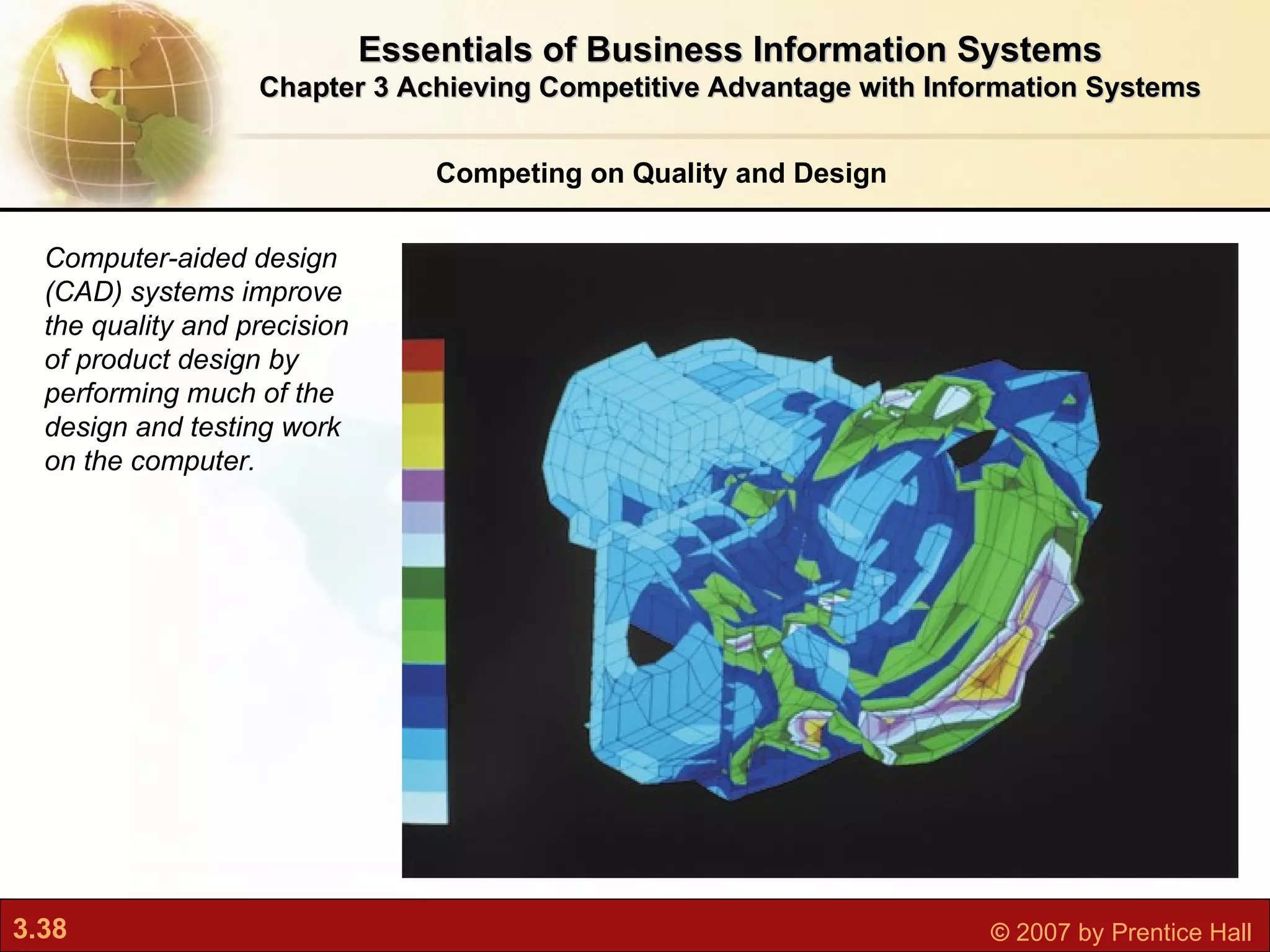
Essentials of Business Information Systems Chapter 3 Achieving Competitive Advantage with Information Systems Computer-aided design (CAD) systems improve the quality and precision of product design by performing much of the design and testing work on the computer. Competing on Quality and Design
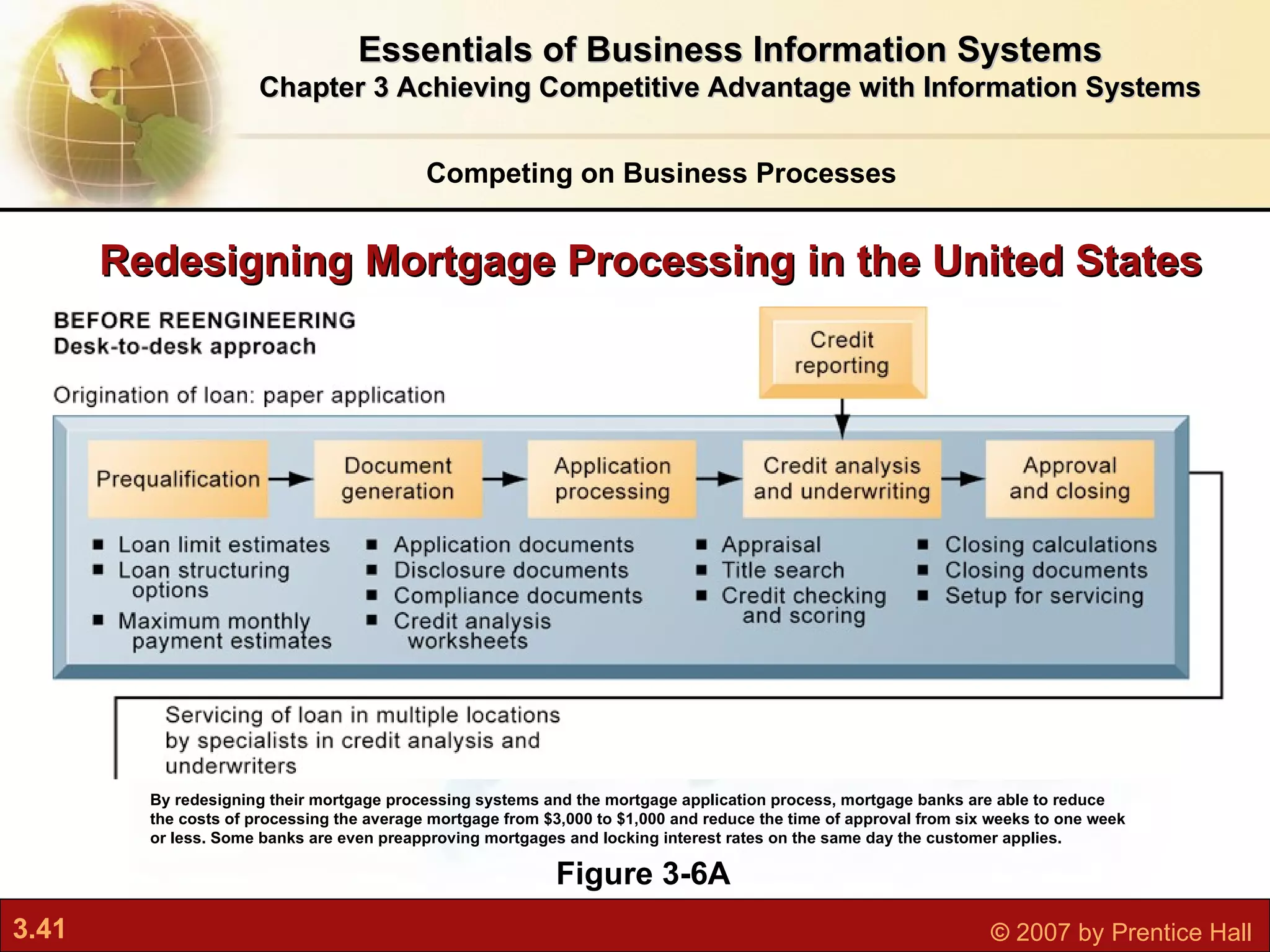
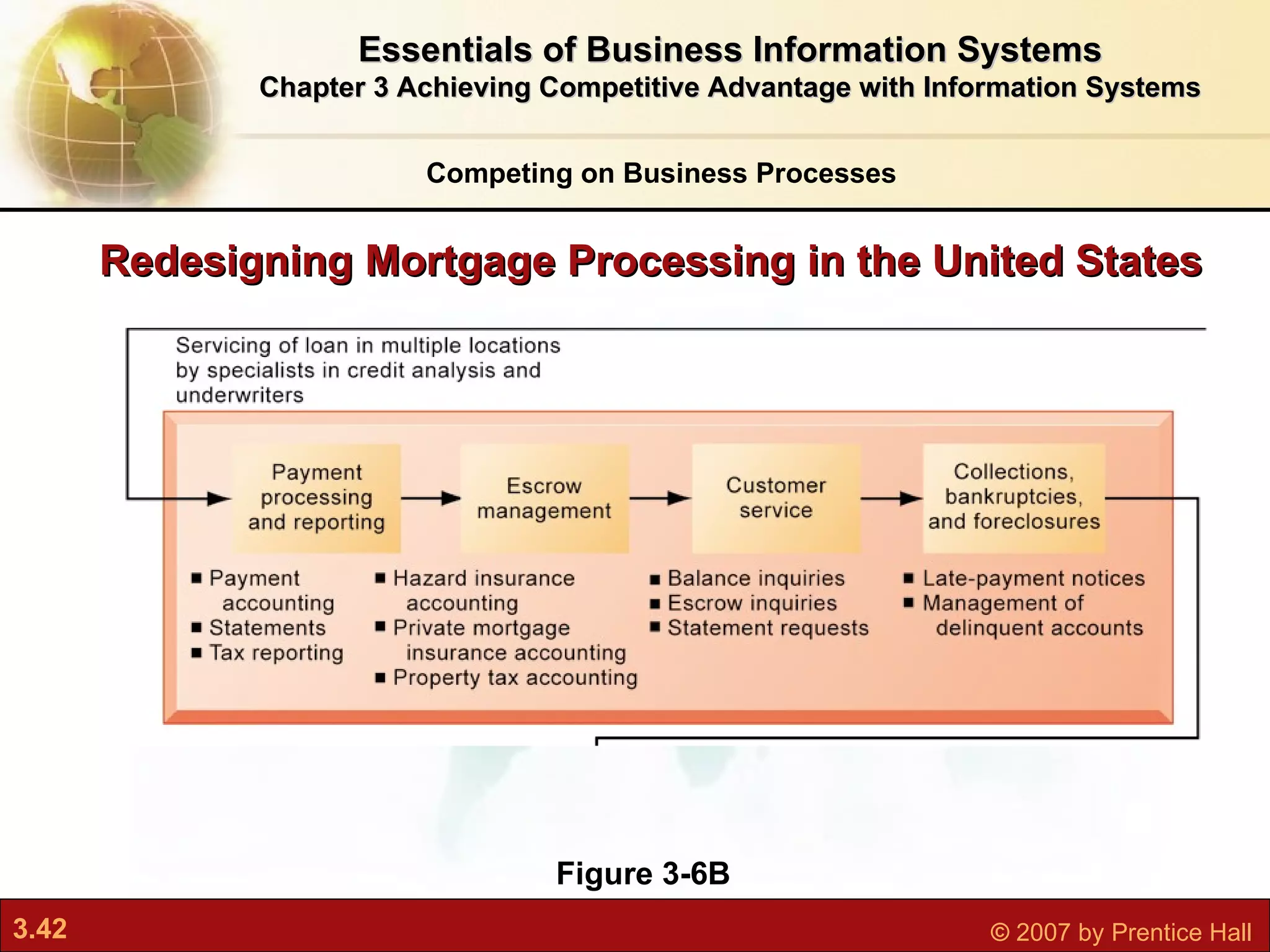
Tasks are streamlined to eliminate repetitive and redundant work Mortgage banks have been great beneficiaries of BPR, achieving remarkable leaps forward in efficiency  Workflow management: Streamlines business procedures so  documents can be moved easily and efficiently Automates processes Eliminates delays Allows simultaneous work Business Process Reengineering Competing on Business Processes Essentials of Business Information Systems Chapter 3 Achieving Competitive Advantage with Information Systems
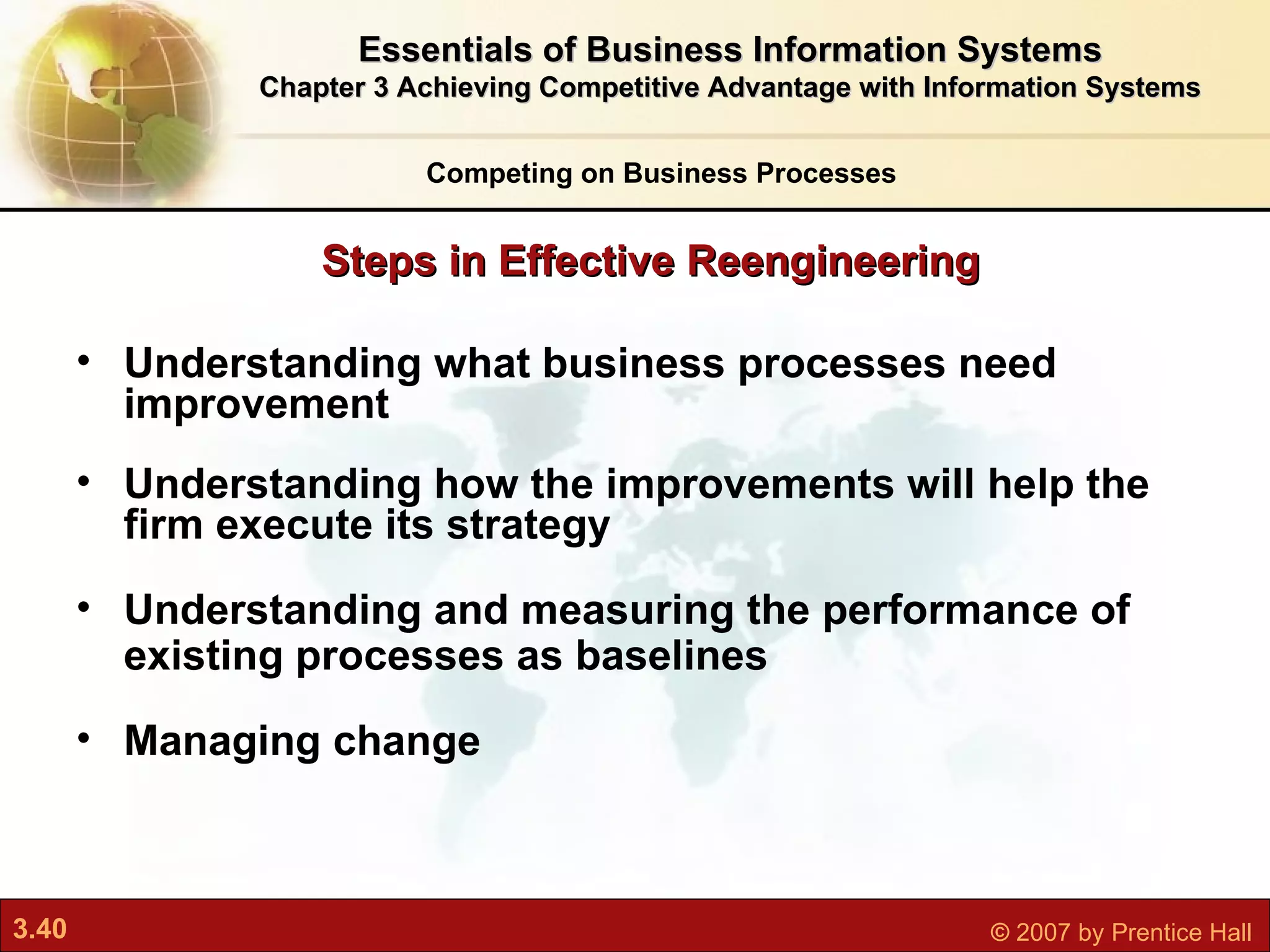
Understanding what business processes need improvement Understanding how the improvements will help the firm execute its strategy Understanding and measuring the performance of existing processes as baselines Managing change Steps in Effective Reengineering Competing on Business Processes Essentials of Business Information Systems Chapter 3 Achieving Competitive Advantage with Information Systems
Redesigning Mortgage Processing in the United States Essentials of Business Information Systems Chapter 3 Achieving Competitive Advantage with Information Systems Figure 3-6A By redesigning their mortgage processing systems and the mortgage application process, mortgage banks are able to reduce the costs of processing the average mortgage from $3,000 to $1,000 and reduce the time of approval from six weeks to one week or less. Some banks are even preapproving mortgages and locking interest rates on the same day the customer applies. Competing on Business Processes
Redesigning Mortgage Processing in the United States Essentials of Business Information Systems Chapter 3 Achieving Competitive Advantage with Information Systems Figure 3-6B Competing on Business Processes
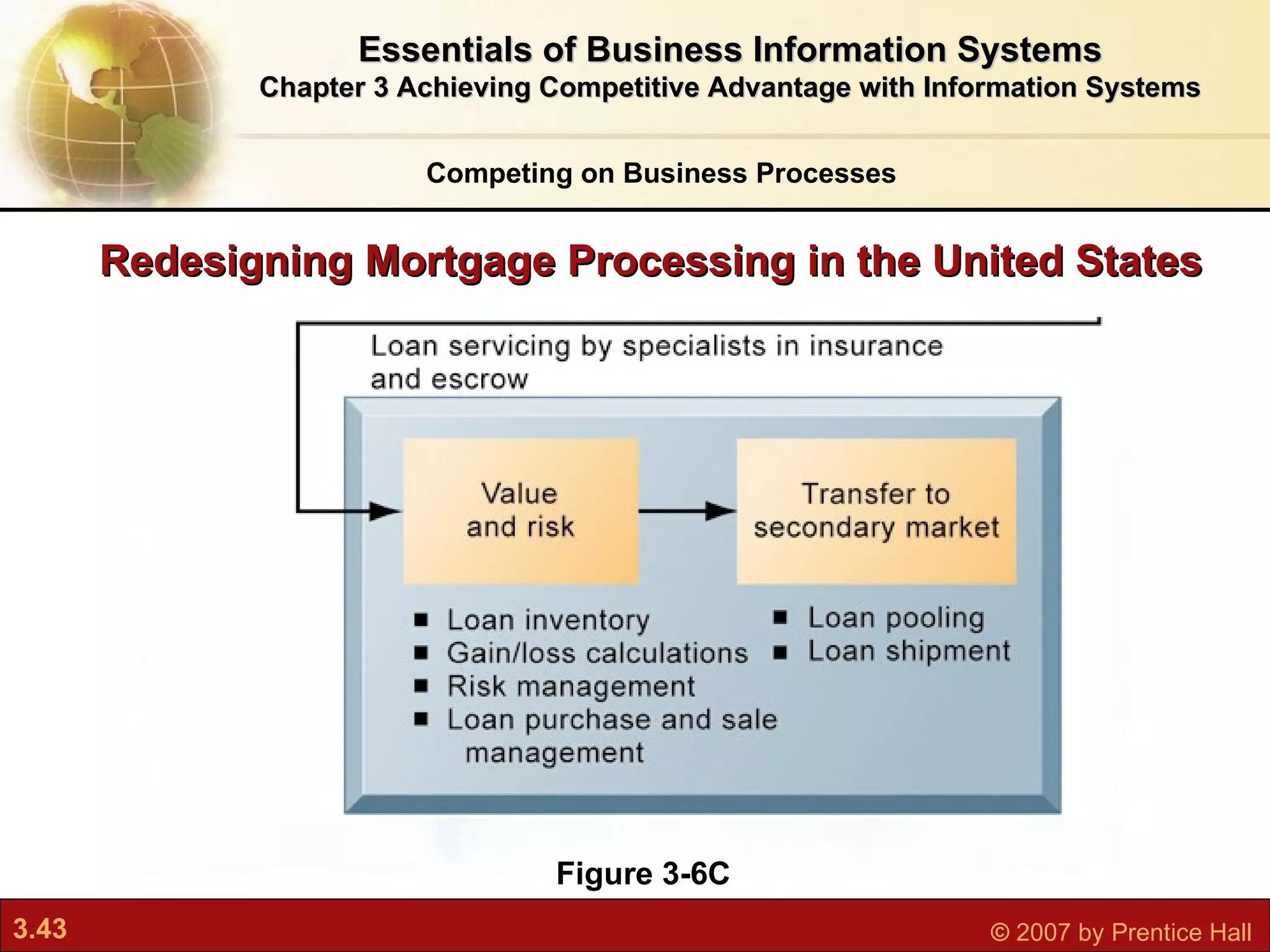
Redesigning Mortgage Processing in the United States Essentials of Business Information Systems Chapter 3 Achieving Competitive Advantage with Information Systems Figure 3-6C Competing on Business Processes
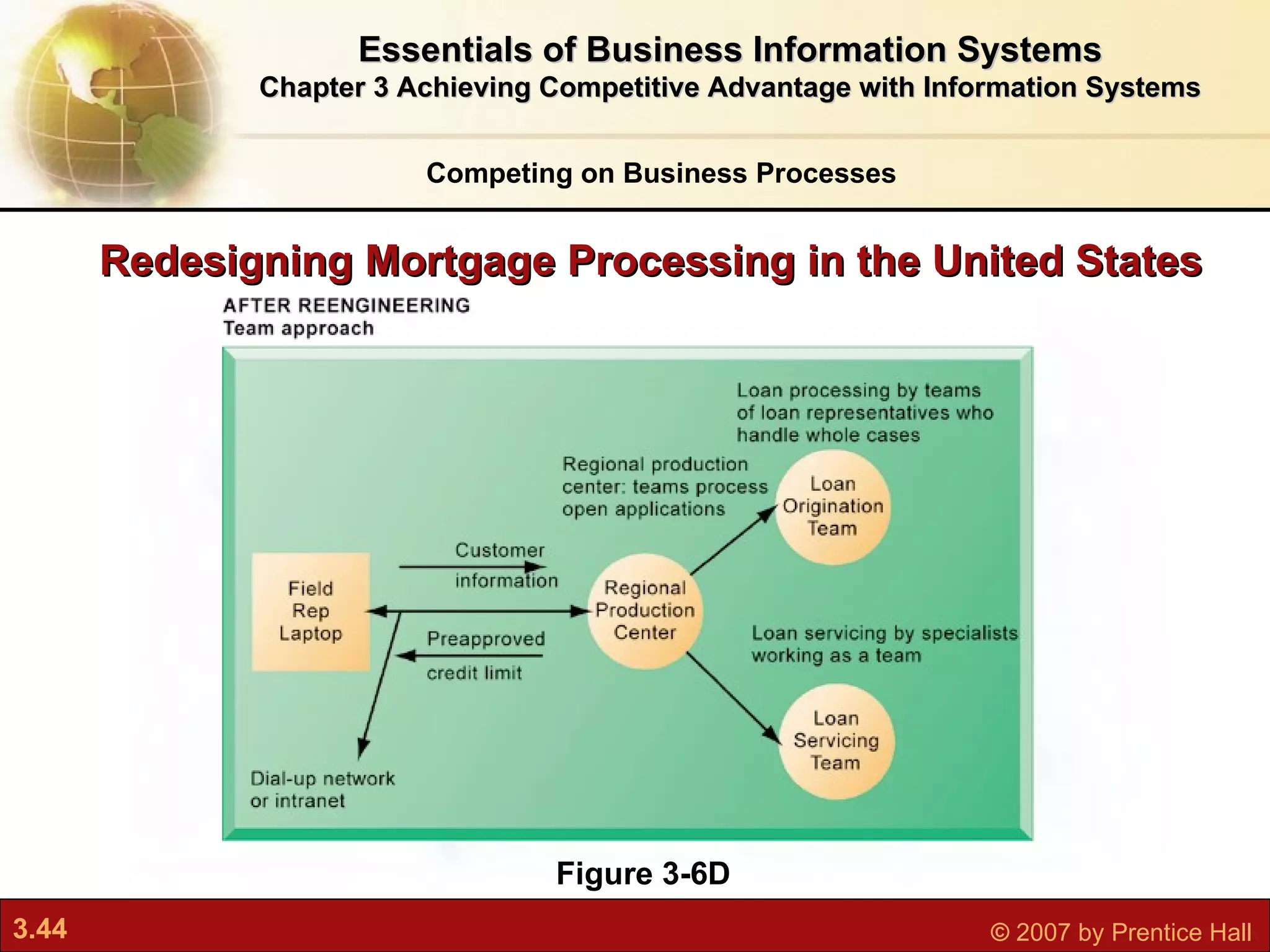
Redesigning Mortgage Processing in the United States Essentials of Business Information Systems Chapter 3 Achieving Competitive Advantage with Information Systems Figure 3-6D Competing on Business Processes

Achieving competitive advantage with information systems

  • 1.
    3 Chapter Achieving Competitive Advantage with Information Systems
  • 2.
    STUDENT LEARNINGOBJECTIVES Essentials of Business Information Systems Chapter 3 Achieving Competitive Advantage with Information Systems How does Porter’s competitive forces model help companies develop competitive strategies using information systems? How do the value chain and value web models help businesses identify opportunities for strategic information system applications? How do information systems help businesses use synergies, core competencies, and network-based strategies to achieve competitive advantage?
  • 3.
    How do competingon a global scale and promoting quality enhance competitive advantage? Evaluate the role of business process reengineering (BPR) in enhancing competitiveness. STUDENT LEARNING OBJECTIVES (Continued) Essentials of Business Information Systems Chapter 3 Achieving Competitive Advantage with Information Systems
  • 4.
    Problem: Takingadvantage of opportunities from new and disruptive technology, staying ahead of traditional competitors. Solutions: Launched iPod and set up iTunes Music Store to create a marketplace for portable, downloadable music. Apple’s iTunes: Music’s New Gatekeeper Essentials of Business Information Systems Chapter 3 Achieving Competitive Advantage with Information Systems
  • 5.
    Partnerships with artistsand recording labels allow iTunes to supply exclusive content in return for driving sales and increasing groups’ popularity. Illustrates digital technology’s role in gaining and maintaining a competitive advantage. Apple’s iTunes: Music’s New Gatekeeper Essentials of Business Information Systems Chapter 3 Achieving Competitive Advantage with Information Systems
  • 6.
    Apple’s iTunes: Music’sNew Gatekeeper Essentials of Business Information Systems Chapter 3 Achieving Competitive Advantage with Information Systems
  • 7.
    Way to understandcompetitive advantage Five competitive forces shape fate of firm Traditional competitors Competitors in market space continuously devise new products, new efficiencies, switching costs New market entrants Some industries have low barriers to entry E.g. food industry vs. microchip industry Newer companies may have advantages Newer equipment, younger workforce, etc. Porter’s Competitive Forces Model Using Information Systems to Achieve Competitive Advantage Essentials of Business Information Systems Chapter 3 Achieving Competitive Advantage with Information Systems
  • 8.
    Substitute products andservices Substitutes customers can purchase if your prices too high E.g. Internet music service vs. CDs Customers Can customers easily switch to competitor’s products? Can customers force firm and competitors to compete on price alone (transparent marketplace) Suppliers The more suppliers a firm has, the greater control it can exercise over suppliers Porter’s Competitive Forces Model Using Information Systems to Achieve Competitive Advantage Essentials of Business Information Systems Chapter 3 Achieving Competitive Advantage with Information Systems
  • 9.
    Figure 3-1 InPorter’s competitive forces model, the strategic position of the firm and its strategies are determined not only by competition with its traditional direct competitors but also by four forces in the industry’s environment: new market entrants, substitute products, customers, and suppliers. Porter’s Competitive Forces Model Using Information Systems to Achieve Competitive Advantage Essentials of Business Information Systems Chapter 3 Achieving Competitive Advantage with Information Systems
  • 10.
    Basic strategy: AlignIT with business objectives 75% of businesses fail to align their IT with their business objectives, leading to lower profitability To align IT: Identify business goals and strategies Break strategic goals into concrete activities and processes Identify metrics for measuring progress Determine how IT can help achieve business goals Measure actual performance Information System Strategies for Dealing with Competitive Forces Using Information Systems to Achieve Competitive Advantage Essentials of Business Information Systems Chapter 3 Achieving Competitive Advantage with Information Systems
  • 11.
    Low-cost leadership Useinformation systems to achieve the lowest operational costs and the lowest prices E.g. Wal-Mart Inventory replenishment system sends orders to suppliers when purchase recorded at cash register Minimizes inventory at warehouses, operating costs Efficient customer response system Information System Strategies for Dealing with Competitive Forces Using Information Systems to Achieve Competitive Advantage Essentials of Business Information Systems Chapter 3 Achieving Competitive Advantage with Information Systems
  • 12.
    Using Information Systemsto Achieve Competitive Advantage Essentials of Business Information Systems Chapter 3 Achieving Competitive Advantage with Information Systems Wal-Mart’s continuous inventory replenishment system uses sales data captured at the checkout counter to transmit orders to restock merchandise directly to its suppliers. The system enables Wal-Mart to keep costs low while fine-tuning its merchandise to meet customer demands .
  • 13.
    Product differentiation Useinformation systems to enable new products and services, or greatly change the customer convenience in using your existing products and services E.g. Google’s continuous innovations, Apple’s iPhone Use information systems to customize, personalize products to fit specifications of individual consumers Dell Land’s End’s mass customization Information System Strategies for Dealing with Competitive Forces Using Information Systems to Achieve Competitive Advantage Essentials of Business Information Systems Chapter 3 Achieving Competitive Advantage with Information Systems
  • 14.
    Using Information Systemsto Achieve Competitive Advantage Essentials of Business Information Systems Chapter 3 Achieving Competitive Advantage with Information Systems On the Dell Inc. Web site, customers can select the options they want and order their computer custom built to these specifications. Dell’s assemble-to-order system is a major source of competitive advantage.
  • 15.
    Focus on marketniche Use information systems to enable specific market focus, and serve narrow target market better than competitors Analyzes customer buying habits, preferences Advertising pitches to smaller and smaller target markets E.g. Hilton Hotel’s OnQ System Analyzes data collected on guests to determine preferences and guest’s profitability Information System Strategies for Dealing with Competitive Forces Using Information Systems to Achieve Competitive Advantage Essentials of Business Information Systems Chapter 3 Achieving Competitive Advantage with Information Systems
  • 16.
    Read the InteractiveSession and then discuss the following questions: Why is AutoNation having a problem with its inventory? Why is this also a problem for auto manufacturers such as GM, Ford, and Chrysler? How Is this problem impacting the business performance of AutoNation and of the auto manufacturers? Interactive Session: Organizations Can Detroit Make the Cars Customers Want? Using Information Systems to Achieve Competitive Advantage Essentials of Business Information Systems Chapter 3 Achieving Competitive Advantage with Information Systems
  • 17.
    Interactive Session: OrganizationsCan Detroit Make the Cars Customers Want? Using Information Systems to Achieve Competitive Advantage What pieces of data does AutoNation need to determine which cars to stock in each of its dealerships? How can it obtain these data? What is AutoNation’s solution to its problem? What obstacles must AutoNation overcome to implement its solution? How effective will the solution be? Essentials of Business Information Systems Chapter 3 Achieving Competitive Advantage with Information Systems
  • 18.
    Strengthen customer andsupplier intimacy Strong linkages to customers and suppliers increase switching costs and loyalty Chrysler : Uses IS to f acilitate direct access from suppliers to production schedules Permits suppliers to decide how and when to ship suppliers to Chrysler factories, allowing more lead time in producing goods. Amazon : Keeps track of user preferences for purchases, and recommends titles purchased by others Information System Strategies for Dealing with Competitive Forces Using Information Systems to Achieve Competitive Advantage Essentials of Business Information Systems Chapter 3 Achieving Competitive Advantage with Information Systems
  • 19.
    Some companies pursueseveral strategies at same time Dell emphasizes low cost plus customization of products Parker Hannifin offers products with unique features but competes on price Successfully using IS to achieve competitive advantage requires precise coordination of technology, organizations, and people Information System Strategies for Dealing with Competitive Forces Using Information Systems to Achieve Competitive Advantage Essentials of Business Information Systems Chapter 3 Achieving Competitive Advantage with Information Systems
  • 20.
    Interactive Session: PeopleParker Hannifin Finds the Right Price Using Information Systems to Achieve Competitive Advantage Read the Interactive Session and then discuss the following questions: What is strategic pricing? How does it work? What data are required? What role do information systems play in strategic pricing? What role do people play in getting a strategic pricing system to work? What kind of impact does strategic pricing have on a business such as Parker Hannifin? What other kinds of businesses could benefit from strategic pricing? How are value chain and competitive forces analysis related to Parker Hannifin’s strategic pricing? Essentials of Business Information Systems Chapter 3 Achieving Competitive Advantage with Information Systems
  • 21.
    Enables new productsand services Transforms industries Increases bargaining power of customers and suppliers Intensifies competitive rivalry Creates new opportunities for building brands and large customer bases The Internet’s Impact on Competitive Advantage Using Information Systems to Achieve Competitive Advantage Essentials of Business Information Systems Chapter 3 Achieving Competitive Advantage with Information Systems
  • 22.
    Existing competitors: Widens market, increasing competitors, reducing differences, pressure to compete on price New entrants: Reduces barriers to entry (e.g. need for sales force declines), provides technology for driving business processes Substitute products and services: Facilitates creation of new products and services Customers’ bargaining power: Bargaining power shifts to customer Suppliers’ bargaining power: Procurement over Internet raises power over suppliers, suppliers can benefit from reduced barriers to entry and elimination of intermediaries The Internet’s Impact on Competitive Advantage Using Information Systems to Achieve Competitive Advantage Essentials of Business Information Systems Chapter 3 Achieving Competitive Advantage with Information Systems
  • 23.
    Highlights specific activitiesin a business where competitive strategies can best be applied and where information systems are likely to have a strategic impact Primary activities Support activities Benchmarking Best practices The Business Value Chain Model Using Information Systems to Achieve Competitive Advantage Essentials of Business Information Systems Chapter 3 Achieving Competitive Advantage with Information Systems
  • 24.
    Using Information Systemsto Achieve Competitive Advantage Figure 3-2 This figure provides examples of systems for both primary and support activities of a firm and of its value partners that would add a margin of value to a firm’s products or services. The Value Chain Model Essentials of Business Information Systems Chapter 3 Achieving Competitive Advantage with Information Systems
  • 25.
    A firm’s valuechain is linked to the value chains of its suppliers, distributors, and customers A value web is a collection of independent firms that use information technology to coordinate their value chains to produce a product collectively Value webs are flexible and adapt to changes in supply and demand Extending the Value Chain: The Value Web Using Information Systems to Achieve Competitive Advantage Essentials of Business Information Systems Chapter 3 Achieving Competitive Advantage with Information Systems
  • 26.
    Using Information Systemsto Achieve Competitive Advantage Figure 3-3 The value web is a networked system that can synchronize the value chains of business partners within an industry to respond rapidly to changes in supply and demand. The Value Web Essentials of Business Information Systems Chapter 3 Achieving Competitive Advantage with Information Systems
  • 27.
    Synergies When output of some units can be used as inputs to other units When two firms can pool markets and expertise (e.g. recent bank mergers) Lower costs and generate profits Enabled by information systems that ties together disparate units so they act as whole Synergies, Core Competencies, and Network-Based Strategies Using Information Systems to Achieve Competitive Advantage Essentials of Business Information Systems Chapter 3 Achieving Competitive Advantage with Information Systems
  • 28.
    Core competency: A ctivities for which firm is world-class leader E.g. world’s best miniature parts designer, best package delivery service Relies on knowledge that is gained over many years of experience as well as knowledge research Any information system that encourages the sharing of knowledge across business units enhances competency E.g. Procter & Gamble uses P&G uses intranet to help people working on similar problems share ideas and expertise Synergies, Core Competencies, and Network-Based Strategies Using Information Systems to Achieve Competitive Advantage Essentials of Business Information Systems Chapter 3 Achieving Competitive Advantage with Information Systems
  • 29.
    Network-based strategies Networkeconomics M arginal costs of adding another participant are near zero, while marginal gain is much larger E.g. larger number of participants in Internet, greater value to all participants Virtual company Uses networks to link people, resources, and ally with other companies to create and distribute products without traditional organizational boundaries or physical locations Synergies, Core Competencies, and Network-Based Strategies Using Information Systems to Achieve Competitive Advantage Essentials of Business Information Systems Chapter 3 Achieving Competitive Advantage with Information Systems
  • 30.
    Disruptive technologies: Technologies with disruptive impact on industries and businesses, rendering existing products, services and business models obsolete, e.g.: Personal computers World Wide Web Internet music services First movers vs. fast followers First movers of disruptive technologies may fail to see potential, allowing second movers to reap rewards (fast followers) Disruptive Technologies: Riding the Wave Essentials of Business Information Systems Chapter 3 Achieving Competitive Advantage with Information Systems Using Information Systems to Achieve Competitive Advantage
  • 31.
    Prior to Internet,competing globally was only option for huge firms able to afford factories, warehouses, and distribution centers abroad The Internet drastically reduces costs of operating globally Globalization benefits Scale economies and resource cost reduction Higher utilization rates, fixed capital costs, and lower cost per unit of production Speeding time to market The Internet and Globalization Competing on a Global Scale Essentials of Business Information Systems Chapter 3 Achieving Competitive Advantage with Information Systems
  • 32.
    An HP Laptop’sPath to Market Competing on a Global Scale Essentials of Business Information Systems Chapter 3 Achieving Competitive Advantage with Information Systems Figure 3-4 Hewlett-Packard and other electronics companies assign distribution and production of their products to a number of different countries.
  • 33.
    Global Business andSystem Strategies Competing on a Global Scale Domestic exporters Heavy centralization of corporate activities in home country Multinationals Concentrates financial management at central home base while decentralizing production, sales, and marketing to other countries Franchisers Product created, designed, financed, and initially produced in home country but rely on foreign units for further production, marketing, and human resources Transnationals Regional (not national) headquarters and perhaps world headquarters; optimizing resources as needed Essentials of Business Information Systems Chapter 3 Achieving Competitive Advantage with Information Systems
  • 34.
    Global System ConfigurationsCompeting on a Global Scale Centralized systems All development and operation at domestic home base Duplicated systems D evelopment at home base but operations managed by autonomous units in foreign locations Decentralized systems Each foreign unit designs own solutions and systems Networked systems Development and operations occur in integrated and coordinated fashion across all units Essentials of Business Information Systems Chapter 3 Achieving Competitive Advantage with Information Systems
  • 35.
    Global Business OrganizationSystems Configurations Competing on a Global Scale Essentials of Business Information Systems Chapter 3 Achieving Competitive Advantage with Information Systems Figure 3-5 The large Xs show the dominant patterns, and the small Xs show the emerging patterns. For instance, domestic exporters rely predominantly on centralized systems, but there is continual pressure and some development of decentralized systems in local marketing regions.
  • 36.
    What Is Quality?Competing on Quality and Design Producer perspective: Conformance to specifications and absence of variation from specs Customer perspective: Physical quality (reliability), quality of service, psychological quality Total quality management (TCM) Quality control is end in itself All people, functions responsible for quality Six sigma Measure of quality: 3.4 defects/million opportunities Essentials of Business Information Systems Chapter 3 Achieving Competitive Advantage with Information Systems
  • 37.
    Reduce cycle timeand simplify production process Benchmarking Use customer demands to improve products and services Improve design quality and precision Computer-aided design (CAD) systems Improve production precision and tighten production tolerances How Information Systems Improve Quality Competing on Quality and Design Essentials of Business Information Systems Chapter 3 Achieving Competitive Advantage with Information Systems
  • 38.
    Essentials of BusinessInformation Systems Chapter 3 Achieving Competitive Advantage with Information Systems Computer-aided design (CAD) systems improve the quality and precision of product design by performing much of the design and testing work on the computer. Competing on Quality and Design
  • 39.
    Tasks are streamlinedto eliminate repetitive and redundant work Mortgage banks have been great beneficiaries of BPR, achieving remarkable leaps forward in efficiency Workflow management: Streamlines business procedures so documents can be moved easily and efficiently Automates processes Eliminates delays Allows simultaneous work Business Process Reengineering Competing on Business Processes Essentials of Business Information Systems Chapter 3 Achieving Competitive Advantage with Information Systems
  • 40.
    Understanding what businessprocesses need improvement Understanding how the improvements will help the firm execute its strategy Understanding and measuring the performance of existing processes as baselines Managing change Steps in Effective Reengineering Competing on Business Processes Essentials of Business Information Systems Chapter 3 Achieving Competitive Advantage with Information Systems
  • 41.
    Redesigning Mortgage Processingin the United States Essentials of Business Information Systems Chapter 3 Achieving Competitive Advantage with Information Systems Figure 3-6A By redesigning their mortgage processing systems and the mortgage application process, mortgage banks are able to reduce the costs of processing the average mortgage from $3,000 to $1,000 and reduce the time of approval from six weeks to one week or less. Some banks are even preapproving mortgages and locking interest rates on the same day the customer applies. Competing on Business Processes
  • 42.
    Redesigning Mortgage Processingin the United States Essentials of Business Information Systems Chapter 3 Achieving Competitive Advantage with Information Systems Figure 3-6B Competing on Business Processes
  • 43.
    Redesigning Mortgage Processingin the United States Essentials of Business Information Systems Chapter 3 Achieving Competitive Advantage with Information Systems Figure 3-6C Competing on Business Processes
  • 44.
    Redesigning Mortgage Processingin the United States Essentials of Business Information Systems Chapter 3 Achieving Competitive Advantage with Information Systems Figure 3-6D Competing on Business Processes