DATA MINING: KNOWING THE UNKNOWN
Contents What Is Data Mining? Data Mining and Business Intelligence Business Drivers Technical Drivers DM Virtuous Cycle Data Management DM in Practice Role of DM in Customer Relationship Management
What Is Data Mining? DEFINITIONS A body of scientific knowledge accumulated through decades of forming well-established disciplines, such as statistics, machine learning, and artificial intelligence A technology evolving from high volume transaction systems, data warehouses, and the Internet A business community forced by an intensive competitive environment to innovate and integrate new ideas, concepts, and tools to improve operations and DM quality
Alternative definitions The search for relationships and global patterns that exist in large databases but are hidden among the vast amount of data (Holsheimer and Kersyen 1994) A set of techniques used in an automated approach to exhaustively explore and bring to the surface complex relationships in very large data sets (Moxon 1996) The process of finding previously unknown and potentially interesting patterns and relations in large databases (Fayyad et al. 1996)
Business intelligence (BI) A global term for all processes, techniques, and  tools that support business decision making based on information technology Approaches can range from a simple spreadsheet to an advanced decision support system
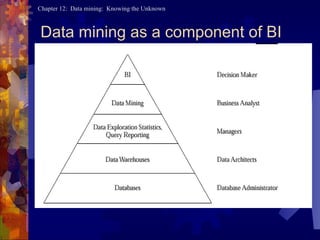
Data mining as a component of BI FIGURE 12.2:
Business Drivers Competition.   C ompeting in today’s economy requires an understanding of customer needs and behavior and flexibility to respond to market demands and competitors' challenges Information glut .  Today’s manager is confronted with increasingly large volumes of data, collected and stored in various databases and constitutes a challenge for decision making Serving knowledge workers efficiently .  Databases provide the firm with transactional memory. Memory is of little use without intelligence--capacity to acquire and apply knowledge
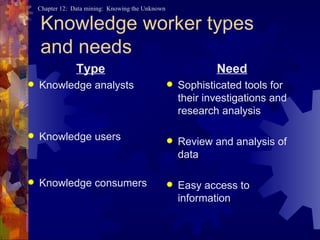
Knowledge worker types  and needs Type Knowledge analysts Knowledge users Knowledge consumers Need Sophisticated tools for their investigations and research analysis Review and analysis of data Easy access to information
Technical Drivers Objective of DM is to optimize use of available data and reduce risk of making wrong decisions Statistics and machine learning considered the analytical foundations upon which DM was developed
ROLE OF STATISTICS With databases organizing data records of hundreds of attributes, the statistics methodology of the hypothesize-and-test paradigm becomes a time-consuming process. DM helps automate formulation and discovery of new hypotheses MACHINE LEARNING A scientific discipline considered a sub-field of artificial intelligence. In contrast, data mining is a business process concerned with finding understandable knowledge from very large real-world databases
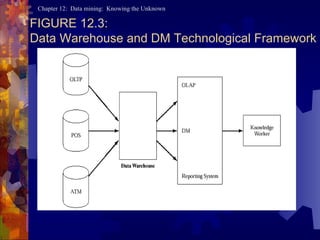
DATA WAREHOUSES Extracting and transforming operational data into informational or analytical data and loading it into a central data warehouse Major features of DW: Subject oriented Integration Time variant Nonvolatile
FIGURE 12.3:  Data Warehouse and DM Technological Framework
OLAP ( Online Analytical Processing)   Uses computing power and graphical interfaces to manipulate data easily and quickly at user’s convenience Focus is showing data along several dimensions.  Manager should be able to drill down into the ultimate detail of a transaction and zoom up for a general view
OLAP strengths: A powerful visualization tool An easy-to-use interactive tool Can be used as a first step in understanding the data OLAP   limitations: Does not find patterns automatically Does not have powerful analytical techniques
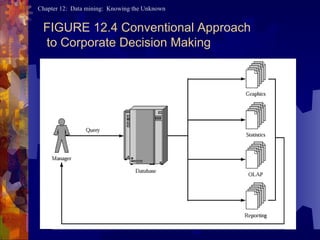
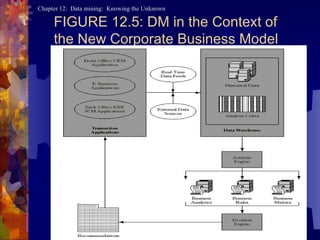
EVOLUTION OF THE DECISION MAKING ARCHITECTURE Integration of decision processing into the overall business process achieved by building a closed-loop system, where decision processing applications output delivered to users in the form of recommended actions In the e-business environment, many companies look to extend closed-loop processing to  automatically  adjust business operations based on messages generated by a decision engine
FIGURE 12.4 Conventional Approach to Corporate Decision Making
FIGURE 12.5: DM in the Context of  the New Corporate Business Model
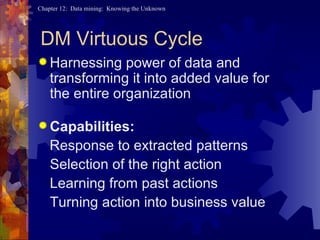
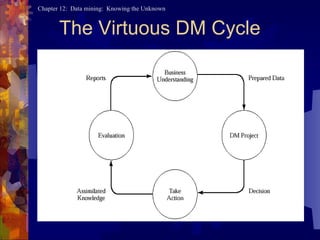
DM Virtuous Cycle Harnessing power of data and transforming it into added value for the entire organization Capabilities: Response to extracted patterns Selection of the right action Learning from past actions Turning action into business value
The Virtuous DM Cycle
BUSINESS UNDERSTANDING The first step in the virtuous DM cycle is identifying the business opportunity--defining the problems faced by the firm The goal is to identify areas where data can provide values  Defining the problem should involve technical and business experts
DEVELOP THE DM APPLICATION Define the adequate data-mining tasks Organize data for analysis Use the right DM technique to build the data model Validate the model
DM tasks Clustering : Clustering   finds groups that are very different from each other, but whose members are similar to each other  One does not know what the clusters will be at the start or by what attributes the data will be clustered
Classification The classification function identifies characteristics of the group to which each case belongs Affinity grouping A descriptive approach to exploring data that can help identify relationships among values in a database. The two most common approaches are: Association discovery  Sequence discovery
Different Industries and the DM Goals Customer services Business Challenge -- understanding that individual  preferences of customers is the key to satisfying them DM Goals
Financial services industry Business Challenge-- Retaining customer loyalty is of the utmost importance to this industry DM Goals   Focused statistical and DM applications are prevalent Risk management for all types of  credit and fraud detection
Health-care business Business Challenge Keeping pace with rate of technological and medical  advancement  Cost is a constant issue in ever-changing market DM Goals Early DM activities have focused on financially oriented applications  Predictive models have been applied to predict length of stay, total charges, and even mortality
Telecommunications industry Business Challenge   Keeping pace with rate of technological change Deregulation is changing business landscape, resulting in competition from a wide range of service providers Finding and retaining customers DM Goals Customer profiling Subscription fraud and credit applications are utilized throughout the industry Concerns about privacy and security are likely to result in DM applications targeted to these areas
Data Management The most challenging part of a DM project is the data management stage At least 40 percent of a DM project is spent on this stage
DATA SOURCES Examples : Flat files Relational databases Data warehouses Geographical databases Time series databases World Wide Web
TAXONOMY OF DATA Data can be found in several forms : Business transactions Scientific data Medical data Personal data Text and documents Web repositories
DATA PREPARATION Evaluating data quality Handling missing data Processing outliers Normalizing data Quantifying data
MODEL BUILDING The first step is to select the modeling technique. The most popular techniques: Association rules Classification trees Neural networks
PARAMETER SETTINGS AND TUNING The set of initial and intermediate parameters must be recorded for eventual use and comparison  The selection of parameters must also be explained The process of reaching the final values must be documented Testing and validating samples are used for this task
MODEL TESTING AND ANALYSIS OF RESULTS Reviewing business objectives and success criteria Assessing success of the DM project to ensure all business objectives have been incorporated  identifying factors that have been overlooked Understanding data-mining results Interpreting the results Comparing results with common sense and knowledge base to detect any worthwhile discoveries
TAKING ACTION AND DEPLOYMENT Summarizing deployable results Identifying users of the discovered knowledge and finding out how to deliver and propagate it Defining a performance measure to monitor obtained benefits by implementation of DM results
DM Applications Market management applications Sales applications Risk management applications Web applications Text mining
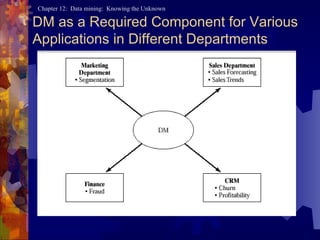
DM as a Required Component for Various Applications in Different Departments
Role of DM in Customer Relationship Management Customer Acquisition Campaign Optimization Customer Scoring Direct Marketing
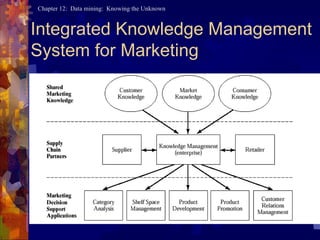
Integrated Knowledge Management  System for Marketing
INTEGRATING DM, CRM, AND  E-BUSINESS DM applications are the first line in understanding the customer and an integral key to segmenting the market An intelligent e-business system enhances CRM by enabling a level of responsiveness and proactive customer care not achievable through other channels Through personalization, corporations can build successful 1-to-1 relationships with customers
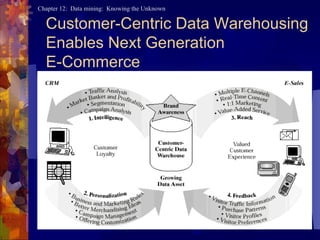
Customer-Centric Data Warehousing Enables Next Generation  E-Commerce
Implications for Knowledge Management A DM project is definitely not a straightforward project While conducting such a project, companies may face many problems, obstacles, and pitfalls that prevent them from gaining returns on investing in a DM project
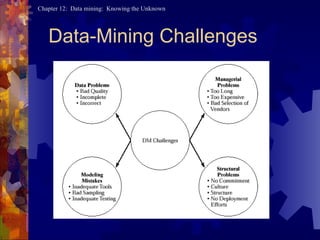
Data-Mining Challenges
Companies should have a business justification for DM The organization will only reap the benefits of DM if there is a real business case to answer It should not be an experiment for experiment’s sake Insufficient understanding  of business needs
Careless handling of data Overquantifying data Miscoding data Analyzing without taking precautions against sampling errors Loss of precision due to improper rounding of data values Incorrectly handling missing values
Invalidly validating the data-mining model Most data miners will face either abundant amounts of testing data or extremely scare amounts It is important to never ignore suspicious findings Haste can lead to believing everything data owners tell us about the data and, even worse, believing everything our own analysis tells us
Believing in alchemy Many data owners believe that data mining is a form of an alchemic process that will magically transform their straw databases into golden knowledge Failure may come from wrong suspicion, technology misapplication, or unsuitable information Managers should consider: Select the right application In-house development or outsourcing Assessing vendor selection Team building
Chapter 12 DATA MINING: KNOWING THE UNKNOWN

Data mining knowing the unknown

  • 1.
  • 2.
    Contents What IsData Mining? Data Mining and Business Intelligence Business Drivers Technical Drivers DM Virtuous Cycle Data Management DM in Practice Role of DM in Customer Relationship Management
  • 3.
    What Is DataMining? DEFINITIONS A body of scientific knowledge accumulated through decades of forming well-established disciplines, such as statistics, machine learning, and artificial intelligence A technology evolving from high volume transaction systems, data warehouses, and the Internet A business community forced by an intensive competitive environment to innovate and integrate new ideas, concepts, and tools to improve operations and DM quality
  • 4.
    Alternative definitions Thesearch for relationships and global patterns that exist in large databases but are hidden among the vast amount of data (Holsheimer and Kersyen 1994) A set of techniques used in an automated approach to exhaustively explore and bring to the surface complex relationships in very large data sets (Moxon 1996) The process of finding previously unknown and potentially interesting patterns and relations in large databases (Fayyad et al. 1996)
  • 5.
    Business intelligence (BI)A global term for all processes, techniques, and tools that support business decision making based on information technology Approaches can range from a simple spreadsheet to an advanced decision support system
  • 6.
    Data mining asa component of BI FIGURE 12.2:
  • 7.
    Business Drivers Competition. C ompeting in today’s economy requires an understanding of customer needs and behavior and flexibility to respond to market demands and competitors' challenges Information glut . Today’s manager is confronted with increasingly large volumes of data, collected and stored in various databases and constitutes a challenge for decision making Serving knowledge workers efficiently . Databases provide the firm with transactional memory. Memory is of little use without intelligence--capacity to acquire and apply knowledge
  • 8.
    Knowledge worker types and needs Type Knowledge analysts Knowledge users Knowledge consumers Need Sophisticated tools for their investigations and research analysis Review and analysis of data Easy access to information
  • 9.
    Technical Drivers Objectiveof DM is to optimize use of available data and reduce risk of making wrong decisions Statistics and machine learning considered the analytical foundations upon which DM was developed
  • 10.
    ROLE OF STATISTICSWith databases organizing data records of hundreds of attributes, the statistics methodology of the hypothesize-and-test paradigm becomes a time-consuming process. DM helps automate formulation and discovery of new hypotheses MACHINE LEARNING A scientific discipline considered a sub-field of artificial intelligence. In contrast, data mining is a business process concerned with finding understandable knowledge from very large real-world databases
  • 11.
    DATA WAREHOUSES Extractingand transforming operational data into informational or analytical data and loading it into a central data warehouse Major features of DW: Subject oriented Integration Time variant Nonvolatile
  • 12.
    FIGURE 12.3: Data Warehouse and DM Technological Framework
  • 13.
    OLAP ( OnlineAnalytical Processing) Uses computing power and graphical interfaces to manipulate data easily and quickly at user’s convenience Focus is showing data along several dimensions. Manager should be able to drill down into the ultimate detail of a transaction and zoom up for a general view
  • 14.
    OLAP strengths: Apowerful visualization tool An easy-to-use interactive tool Can be used as a first step in understanding the data OLAP limitations: Does not find patterns automatically Does not have powerful analytical techniques
  • 15.
    EVOLUTION OF THEDECISION MAKING ARCHITECTURE Integration of decision processing into the overall business process achieved by building a closed-loop system, where decision processing applications output delivered to users in the form of recommended actions In the e-business environment, many companies look to extend closed-loop processing to automatically adjust business operations based on messages generated by a decision engine
  • 16.
    FIGURE 12.4 ConventionalApproach to Corporate Decision Making
  • 17.
    FIGURE 12.5: DMin the Context of the New Corporate Business Model
  • 18.
    DM Virtuous CycleHarnessing power of data and transforming it into added value for the entire organization Capabilities: Response to extracted patterns Selection of the right action Learning from past actions Turning action into business value
  • 19.
  • 20.
    BUSINESS UNDERSTANDING Thefirst step in the virtuous DM cycle is identifying the business opportunity--defining the problems faced by the firm The goal is to identify areas where data can provide values Defining the problem should involve technical and business experts
  • 21.
    DEVELOP THE DMAPPLICATION Define the adequate data-mining tasks Organize data for analysis Use the right DM technique to build the data model Validate the model
  • 22.
    DM tasks Clustering: Clustering finds groups that are very different from each other, but whose members are similar to each other One does not know what the clusters will be at the start or by what attributes the data will be clustered
  • 23.
    Classification The classificationfunction identifies characteristics of the group to which each case belongs Affinity grouping A descriptive approach to exploring data that can help identify relationships among values in a database. The two most common approaches are: Association discovery Sequence discovery
  • 24.
    Different Industries andthe DM Goals Customer services Business Challenge -- understanding that individual preferences of customers is the key to satisfying them DM Goals
  • 25.
    Financial services industryBusiness Challenge-- Retaining customer loyalty is of the utmost importance to this industry DM Goals Focused statistical and DM applications are prevalent Risk management for all types of credit and fraud detection
  • 26.
    Health-care business BusinessChallenge Keeping pace with rate of technological and medical advancement Cost is a constant issue in ever-changing market DM Goals Early DM activities have focused on financially oriented applications Predictive models have been applied to predict length of stay, total charges, and even mortality
  • 27.
    Telecommunications industry BusinessChallenge Keeping pace with rate of technological change Deregulation is changing business landscape, resulting in competition from a wide range of service providers Finding and retaining customers DM Goals Customer profiling Subscription fraud and credit applications are utilized throughout the industry Concerns about privacy and security are likely to result in DM applications targeted to these areas
  • 28.
    Data Management Themost challenging part of a DM project is the data management stage At least 40 percent of a DM project is spent on this stage
  • 29.
    DATA SOURCES Examples: Flat files Relational databases Data warehouses Geographical databases Time series databases World Wide Web
  • 30.
    TAXONOMY OF DATAData can be found in several forms : Business transactions Scientific data Medical data Personal data Text and documents Web repositories
  • 31.
    DATA PREPARATION Evaluatingdata quality Handling missing data Processing outliers Normalizing data Quantifying data
  • 32.
    MODEL BUILDING Thefirst step is to select the modeling technique. The most popular techniques: Association rules Classification trees Neural networks
  • 33.
    PARAMETER SETTINGS ANDTUNING The set of initial and intermediate parameters must be recorded for eventual use and comparison The selection of parameters must also be explained The process of reaching the final values must be documented Testing and validating samples are used for this task
  • 34.
    MODEL TESTING ANDANALYSIS OF RESULTS Reviewing business objectives and success criteria Assessing success of the DM project to ensure all business objectives have been incorporated identifying factors that have been overlooked Understanding data-mining results Interpreting the results Comparing results with common sense and knowledge base to detect any worthwhile discoveries
  • 35.
    TAKING ACTION ANDDEPLOYMENT Summarizing deployable results Identifying users of the discovered knowledge and finding out how to deliver and propagate it Defining a performance measure to monitor obtained benefits by implementation of DM results
  • 36.
    DM Applications Marketmanagement applications Sales applications Risk management applications Web applications Text mining
  • 37.
    DM as aRequired Component for Various Applications in Different Departments
  • 38.
    Role of DMin Customer Relationship Management Customer Acquisition Campaign Optimization Customer Scoring Direct Marketing
  • 39.
    Integrated Knowledge Management System for Marketing
  • 40.
    INTEGRATING DM, CRM,AND E-BUSINESS DM applications are the first line in understanding the customer and an integral key to segmenting the market An intelligent e-business system enhances CRM by enabling a level of responsiveness and proactive customer care not achievable through other channels Through personalization, corporations can build successful 1-to-1 relationships with customers
  • 41.
    Customer-Centric Data WarehousingEnables Next Generation E-Commerce
  • 42.
    Implications for KnowledgeManagement A DM project is definitely not a straightforward project While conducting such a project, companies may face many problems, obstacles, and pitfalls that prevent them from gaining returns on investing in a DM project
  • 43.
  • 44.
    Companies should havea business justification for DM The organization will only reap the benefits of DM if there is a real business case to answer It should not be an experiment for experiment’s sake Insufficient understanding of business needs
  • 45.
    Careless handling ofdata Overquantifying data Miscoding data Analyzing without taking precautions against sampling errors Loss of precision due to improper rounding of data values Incorrectly handling missing values
  • 46.
    Invalidly validating thedata-mining model Most data miners will face either abundant amounts of testing data or extremely scare amounts It is important to never ignore suspicious findings Haste can lead to believing everything data owners tell us about the data and, even worse, believing everything our own analysis tells us
  • 47.
    Believing in alchemyMany data owners believe that data mining is a form of an alchemic process that will magically transform their straw databases into golden knowledge Failure may come from wrong suspicion, technology misapplication, or unsuitable information Managers should consider: Select the right application In-house development or outsourcing Assessing vendor selection Team building
  • 48.
    Chapter 12 DATAMINING: KNOWING THE UNKNOWN