Competitive advantage from IS
Lecture #06
Sadiqullah “Sadiqi” 2024/10/26
Content
• Introduction
• Advantage from IT, IS, Information
Introduction
•Data Management: Information systems enable businesses to
collect, store, and analyze vast amounts of data, providing
insights into market trends and consumer behavior.
•Decision Making: By utilizing data analytics, organizations can
make informed decisions quickly, adapting to competitive
pressures and market changes.
•Operational Efficiency: Automation and streamlined processes
through information systems reduce costs and improve
productivity, allowing companies to compete more effectively.
•Innovation and Agility: Companies can leverage information
systems to innovate products and services rapidly, responding to
market demands more swiftly than competitors.
Con…
•Customer Relationship Management (CRM): Information
systems facilitate better communication with customers,
enhancing relationships and fostering loyalty, which can be a
competitive advantage.
•Strategic Planning: Information systems provide tools for
strategic analysis, helping organizations identify strengths,
weaknesses, opportunities, and threats in the competitive
landscape.
•Market Positioning: Businesses can use information systems to
track competitors’ activities, allowing them to position themselves
strategically in the market
Porter’s Three Generic Strategies
• The foremost author in the field of competitive or ‘strategic’ advantage
is Michael Porter.
• Differentiation: making your product or service in some way
different from that of your competitors.
• Cost leadership: generates an advantage by producing at a lower
cost, and thereby increasing profit margins
• Focus: focus is the concentration on a particular area of the market
where the organization aims to outperform competitors by its
increased knowledge and skills.
Case Study
Case Example of page 115
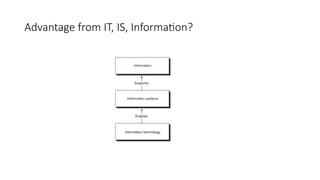
Advantage from IT, IS, Information?
The role of IT in Strategic Management
• Innovative applications - Create innovative applications that provide
direct strategic advantage to organizations
• Competitive weapons - IS(s) themselves are recognized as a
competitive weapon
• Changes in processes - IT supports changes in business processes that
translate to strategic advantage
• Links with business partners - IT links a company with its business
partners effectively and efficiently
• Cost reductions - IT enables companies to reduce costs
• Relationships with suppliers and customers -IT can be used to
lock in suppliers and customers, or to build in switching costs
• New products -A firm can leverage its investment in IT to create new
products that are in demand in the marketplace
• Competitive intelligence - by collecting and analyzing information
about products, markets, competitors, and environmental changes
IT Competitive advantages
• Derive from the way in which an organization uses the
technology, and cites claimed examples of competitive
advantage from IT.
• short-term competitive advantage from IT is possible, in the
longer term the impact of IT is on industry structure rather
than the competitive position of any particular organization
within that industry.
• Cost leadership
• Differentiation
• Speed and Agility
• Data-driven Decision Making
• Customer engagement and experience
• Global reach
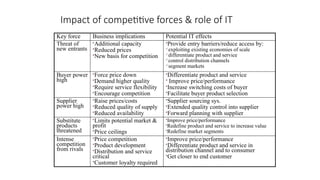
Impact of competitive forces & role of IT
Key force Business implications Potential IT effects
Threat of
new entrants
Additional capacity
Reduced prices
New basis for competition
Provide entry barriers/reduce access by:
exploiting existing economies of scale
differentiate product and service
control distribution channels
segment markets
Buyer power
high
Force price down
Demand higher quality
Require service flexibility
Encourage competition
Differentiate product and service
 Improve price/performance
Increase switching costs of buyer
Facilitate buyer product selection
Supplier
power high
Raise prices/costs
Reduced quality of supply
Reduced availability
Supplier sourcing sys.
Extended quality control into supplier
Forward planning with supplier
Substitute
products
threatened
Limits potential market &
profit
Price ceilings
Improve price/performance
Redefine product and service to increase value
Redefine market segments
Intense
competition
from rivals
Price competition
Product development
Distribution and service
critical
Customer loyalty required
Improve price/performance
Differentiate product and service in
distribution channel and to consumer
Get closer to end customer
IS Competitive advantages
• Hardware, Software, Data, People, Processes.
• differentiation
• Cost Advantage
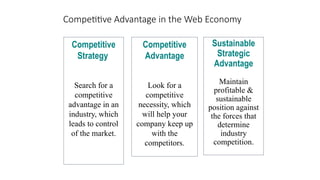
Competitive Advantage in the Web Economy
Competitive
Advantage
Look for a
competitive
necessity, which
will help your
company keep up
with the
competitors.
Competitive
Strategy
Search for a
competitive
advantage in an
industry, which
leads to control
of the market.
Sustainable
Strategic
Advantage
Maintain
profitable &
sustainable
position against
the forces that
determine
industry
competition.
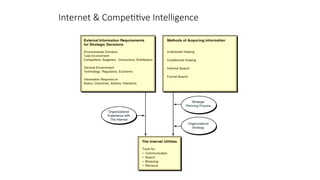
Internet & Competitive Intelligence
Information Competitive advantages
• Adcock et al. (1993) argue that competitive advantage does
not come from IT or IS, but from the ‘underlying management
processes’ which make use of them.
• Enhanced decision making
• Customer insights and personalization
• Operational efficiency
• Innovation and product development
• Competitive intelligence
• Risk Management
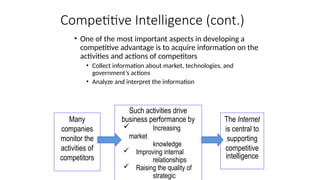
Competitive Intelligence (cont.)
The Internet
is central to
supporting
competitive
intelligence
Such activities drive
business performance by
 Increasing
market
knowledge
 Improving internal
relationships
 Raising the quality of
strategic
Many
companies
monitor the
activities of
competitors
• One of the most important aspects in developing a
competitive advantage is to acquire information on the
activities and actions of competitors
• Collect information about market, technologies, and
government’s actions
• Analyze and interpret the information
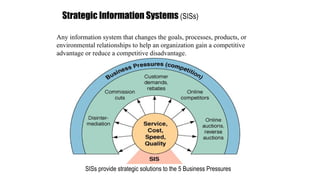
Strategic Information Systems (SISs)
SISs provide strategic solutions to the 5 Business Pressures
Any information system that changes the goals, processes, products, or
environmental relationships to help an organization gain a competitive
advantage or reduce a competitive disadvantage.
strategic management
• Strategic management
• the way an organization maps or crafts the strategy of
its future operations
• 3 Elements
• Long-range planning
• Response management
• Proactive innovation
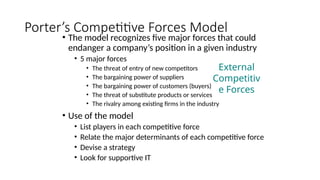
Porter’s Competitive Forces Model
• The model recognizes five major forces that could
endanger a company’s position in a given industry
• 5 major forces
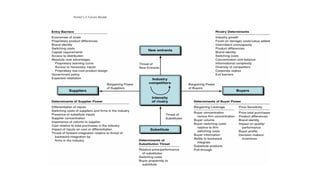
• The threat of entry of new competitors
• The bargaining power of suppliers
• The bargaining power of customers (buyers)
• The threat of substitute products or services
• The rivalry among existing firms in the industry
• Use of the model
• List players in each competitive force
• Relate the major determinants of each competitive force
• Devise a strategy
• Look for supportive IT
External
Competitiv
e Forces
Porter’s 5 Forces Model
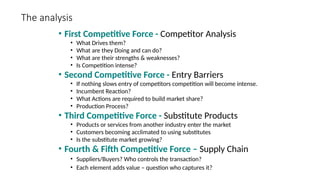
The analysis
• First Competitive Force - Competitor Analysis
• What Drives them?
• What are they Doing and can do?
• What are their strengths & weaknesses?
• Is Competition intense?
• Second Competitive Force - Entry Barriers
• If nothing slows entry of competitors competition will become intense.
• Incumbent Reaction?
• What Actions are required to build market share?
• Production Process?
• Third Competitive Force - Substitute Products
• Products or services from another industry enter the market
• Customers becoming acclimated to using substitutes
• Is the substitute market growing?
• Fourth & Fifth Competitive Force – Supply Chain
• Suppliers/Buyers? Who controls the transaction?
• Each element adds value – question who captures it?
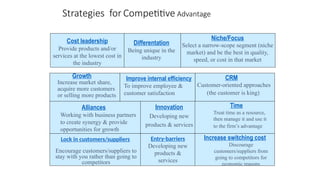
Strategies for Competitive Advantage
Niche/Focus
Select a narrow-scope segment (niche
market) and be the best in quality,
speed, or cost in that market
Differentation
Being unique in the
industry
Cost leadership
Provide products and/or
services at the lowest cost in
the industry
Growth
Increase market share,
acquire more customers
or selling more products
Improve internal efficiency
To improve employee &
customer satisfaction
CRM
Customer-oriented approaches
(the customer is king)
Alliances
Working with business partners
to create synergy & provide
opportunities for growth
Innovation
Developing new
products & services
Time
Treat time as a resource,
then manage it and use it
to the firm’s advantage
Lock in customers/suppliers
Encourage customers/suppliers to
stay with you rather than going to
competitors
Entry-barriers
Developing new
products &
services
Increase switching cost
Discourage
customers/suppliers from
going to competitors for
economic reasons
Global Competition
• Growth of Companies Operating in a Global Environment
• Fully Global or Multinational Corporations
• Companies that export or import
• Companies facing competitions of low labor cost and high natural
resources
• Companies with low cost production facilities abroad
• Small companies that can now use EC to buy/sell internationally
• Global dimensions along which management can globalize
• Product
• Markets & Placement
• Promotion
• Where value is added to the product
• Competitive strategy
• Use of non-home-country personnel - labor
• Multidomestic Strategy: Zero standardization along the global
dimensions. Global Strategy: Complete standardization along the
seven global dimensions.
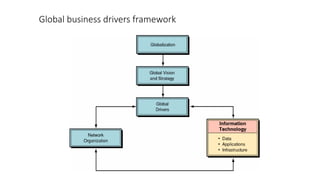
Global business drivers framework
SISs: Examples
• Cases
• Wiring the “customer supply chain” at 1-800-Flowers
• Increasing Tax Collection Efforts at the Wisconsin
Department of Revenue
• Time-based Competitive Advantage at Cannondale
• Southwest Airlines Flies high with SWIFT
• Using ERP to Meet Strategic Challenges at Turner Industries
• The Port of Singapore exports its intelligent systems over its
enterprise portal
• Problem - The Port of Singapore, the world’s largest international
port, faced increased global competition.
• Solution - Implementation of Intelligent Systems
• Results
• Reduction in Cycle Time: 4 hours versus 16 - 20 hours in neighboring ports
• Reduction in uploading/ loading time: 30 sec. versus 4-5 min./ truck in
neighboring ports.
Managerial Issues
• Implementing SIS Can Be Risky
• The investment involved in implementing SIS is high
• Strategic Information Systems Requires Planning
• Planning for an SIS is a major concern of organizations
• Sustaining Competitive Advantage Is Challenging.
• As companies become larger and more sophisticated, they
develop resources to duplicate the systems of their
competitors quickly.
• Ethical Issues
• Gaining competitive advantage through the use of IT may
involve unethical or even illegal actions
• Companies can use IT to monitor the activities of other
companies and may invade the privacy of individuals working
there.
Information System Strategic Management_Lecture #06.pptx

Information System Strategic Management_Lecture #06.pptx

  • 1.
    Competitive advantage fromIS Lecture #06 Sadiqullah “Sadiqi” 2024/10/26
  • 2.
  • 3.
    Introduction •Data Management: Informationsystems enable businesses to collect, store, and analyze vast amounts of data, providing insights into market trends and consumer behavior. •Decision Making: By utilizing data analytics, organizations can make informed decisions quickly, adapting to competitive pressures and market changes. •Operational Efficiency: Automation and streamlined processes through information systems reduce costs and improve productivity, allowing companies to compete more effectively. •Innovation and Agility: Companies can leverage information systems to innovate products and services rapidly, responding to market demands more swiftly than competitors.
  • 4.
    Con… •Customer Relationship Management(CRM): Information systems facilitate better communication with customers, enhancing relationships and fostering loyalty, which can be a competitive advantage. •Strategic Planning: Information systems provide tools for strategic analysis, helping organizations identify strengths, weaknesses, opportunities, and threats in the competitive landscape. •Market Positioning: Businesses can use information systems to track competitors’ activities, allowing them to position themselves strategically in the market
  • 5.
    Porter’s Three GenericStrategies • The foremost author in the field of competitive or ‘strategic’ advantage is Michael Porter. • Differentiation: making your product or service in some way different from that of your competitors. • Cost leadership: generates an advantage by producing at a lower cost, and thereby increasing profit margins • Focus: focus is the concentration on a particular area of the market where the organization aims to outperform competitors by its increased knowledge and skills.
  • 6.
  • 7.
    Advantage from IT,IS, Information?
  • 8.
    The role ofIT in Strategic Management • Innovative applications - Create innovative applications that provide direct strategic advantage to organizations • Competitive weapons - IS(s) themselves are recognized as a competitive weapon • Changes in processes - IT supports changes in business processes that translate to strategic advantage • Links with business partners - IT links a company with its business partners effectively and efficiently • Cost reductions - IT enables companies to reduce costs • Relationships with suppliers and customers -IT can be used to lock in suppliers and customers, or to build in switching costs • New products -A firm can leverage its investment in IT to create new products that are in demand in the marketplace • Competitive intelligence - by collecting and analyzing information about products, markets, competitors, and environmental changes
  • 9.
    IT Competitive advantages •Derive from the way in which an organization uses the technology, and cites claimed examples of competitive advantage from IT. • short-term competitive advantage from IT is possible, in the longer term the impact of IT is on industry structure rather than the competitive position of any particular organization within that industry. • Cost leadership • Differentiation • Speed and Agility • Data-driven Decision Making • Customer engagement and experience • Global reach
  • 10.
    Impact of competitiveforces & role of IT Key force Business implications Potential IT effects Threat of new entrants Additional capacity Reduced prices New basis for competition Provide entry barriers/reduce access by: exploiting existing economies of scale differentiate product and service control distribution channels segment markets Buyer power high Force price down Demand higher quality Require service flexibility Encourage competition Differentiate product and service  Improve price/performance Increase switching costs of buyer Facilitate buyer product selection Supplier power high Raise prices/costs Reduced quality of supply Reduced availability Supplier sourcing sys. Extended quality control into supplier Forward planning with supplier Substitute products threatened Limits potential market & profit Price ceilings Improve price/performance Redefine product and service to increase value Redefine market segments Intense competition from rivals Price competition Product development Distribution and service critical Customer loyalty required Improve price/performance Differentiate product and service in distribution channel and to consumer Get closer to end customer
  • 11.
    IS Competitive advantages •Hardware, Software, Data, People, Processes. • differentiation • Cost Advantage
  • 12.
    Competitive Advantage inthe Web Economy Competitive Advantage Look for a competitive necessity, which will help your company keep up with the competitors. Competitive Strategy Search for a competitive advantage in an industry, which leads to control of the market. Sustainable Strategic Advantage Maintain profitable & sustainable position against the forces that determine industry competition.
  • 13.
  • 14.
    Information Competitive advantages •Adcock et al. (1993) argue that competitive advantage does not come from IT or IS, but from the ‘underlying management processes’ which make use of them. • Enhanced decision making • Customer insights and personalization • Operational efficiency • Innovation and product development • Competitive intelligence • Risk Management
  • 15.
    Competitive Intelligence (cont.) TheInternet is central to supporting competitive intelligence Such activities drive business performance by  Increasing market knowledge  Improving internal relationships  Raising the quality of strategic Many companies monitor the activities of competitors • One of the most important aspects in developing a competitive advantage is to acquire information on the activities and actions of competitors • Collect information about market, technologies, and government’s actions • Analyze and interpret the information
  • 16.
    Strategic Information Systems(SISs) SISs provide strategic solutions to the 5 Business Pressures Any information system that changes the goals, processes, products, or environmental relationships to help an organization gain a competitive advantage or reduce a competitive disadvantage.
  • 17.
    strategic management • Strategicmanagement • the way an organization maps or crafts the strategy of its future operations • 3 Elements • Long-range planning • Response management • Proactive innovation
  • 18.
    Porter’s Competitive ForcesModel • The model recognizes five major forces that could endanger a company’s position in a given industry • 5 major forces • The threat of entry of new competitors • The bargaining power of suppliers • The bargaining power of customers (buyers) • The threat of substitute products or services • The rivalry among existing firms in the industry • Use of the model • List players in each competitive force • Relate the major determinants of each competitive force • Devise a strategy • Look for supportive IT External Competitiv e Forces
  • 19.
  • 20.
    The analysis • FirstCompetitive Force - Competitor Analysis • What Drives them? • What are they Doing and can do? • What are their strengths & weaknesses? • Is Competition intense? • Second Competitive Force - Entry Barriers • If nothing slows entry of competitors competition will become intense. • Incumbent Reaction? • What Actions are required to build market share? • Production Process? • Third Competitive Force - Substitute Products • Products or services from another industry enter the market • Customers becoming acclimated to using substitutes • Is the substitute market growing? • Fourth & Fifth Competitive Force – Supply Chain • Suppliers/Buyers? Who controls the transaction? • Each element adds value – question who captures it?
  • 21.
    Strategies for CompetitiveAdvantage Niche/Focus Select a narrow-scope segment (niche market) and be the best in quality, speed, or cost in that market Differentation Being unique in the industry Cost leadership Provide products and/or services at the lowest cost in the industry Growth Increase market share, acquire more customers or selling more products Improve internal efficiency To improve employee & customer satisfaction CRM Customer-oriented approaches (the customer is king) Alliances Working with business partners to create synergy & provide opportunities for growth Innovation Developing new products & services Time Treat time as a resource, then manage it and use it to the firm’s advantage Lock in customers/suppliers Encourage customers/suppliers to stay with you rather than going to competitors Entry-barriers Developing new products & services Increase switching cost Discourage customers/suppliers from going to competitors for economic reasons
  • 22.
    Global Competition • Growthof Companies Operating in a Global Environment • Fully Global or Multinational Corporations • Companies that export or import • Companies facing competitions of low labor cost and high natural resources • Companies with low cost production facilities abroad • Small companies that can now use EC to buy/sell internationally • Global dimensions along which management can globalize • Product • Markets & Placement • Promotion • Where value is added to the product • Competitive strategy • Use of non-home-country personnel - labor • Multidomestic Strategy: Zero standardization along the global dimensions. Global Strategy: Complete standardization along the seven global dimensions.
  • 23.
  • 24.
    SISs: Examples • Cases •Wiring the “customer supply chain” at 1-800-Flowers • Increasing Tax Collection Efforts at the Wisconsin Department of Revenue • Time-based Competitive Advantage at Cannondale • Southwest Airlines Flies high with SWIFT • Using ERP to Meet Strategic Challenges at Turner Industries • The Port of Singapore exports its intelligent systems over its enterprise portal • Problem - The Port of Singapore, the world’s largest international port, faced increased global competition. • Solution - Implementation of Intelligent Systems • Results • Reduction in Cycle Time: 4 hours versus 16 - 20 hours in neighboring ports • Reduction in uploading/ loading time: 30 sec. versus 4-5 min./ truck in neighboring ports.
  • 25.
    Managerial Issues • ImplementingSIS Can Be Risky • The investment involved in implementing SIS is high • Strategic Information Systems Requires Planning • Planning for an SIS is a major concern of organizations • Sustaining Competitive Advantage Is Challenging. • As companies become larger and more sophisticated, they develop resources to duplicate the systems of their competitors quickly. • Ethical Issues • Gaining competitive advantage through the use of IT may involve unethical or even illegal actions • Companies can use IT to monitor the activities of other companies and may invade the privacy of individuals working there.