Management  Information Systems -  Chapter 1   By:  Prof. Y. Peter Chiu  2 / 2009
Chapter 1 Managing the Digital Firm 1.1   Why Information Systems ? 1.2   Contemporary Approaches to Information System 1.3   Toward the Digital Firm:     The New Role of Information Systems in  Organizations 1.4   Learning to Use Information Systems:     New Opportunities with Technology
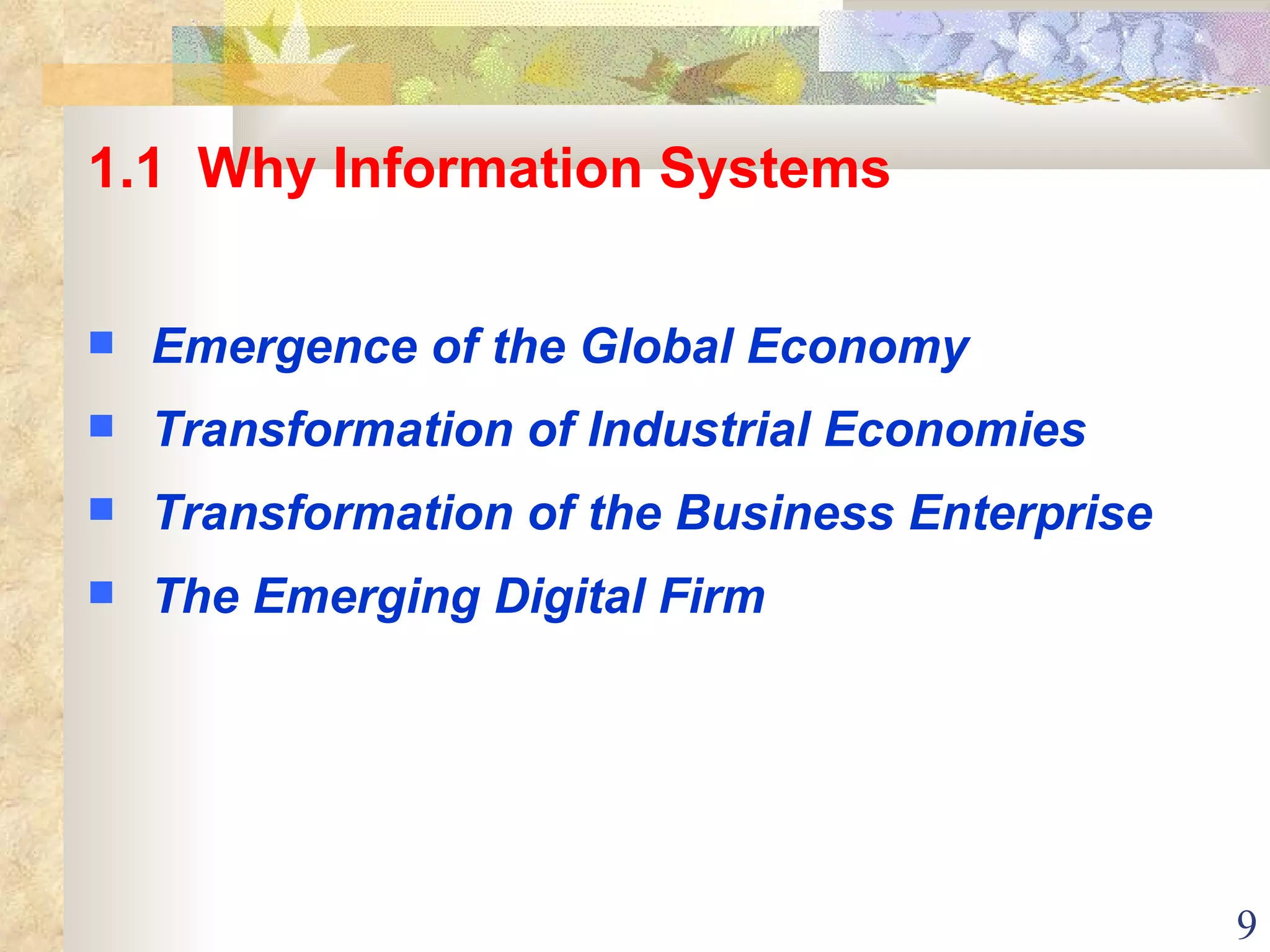
1.1  Why Information Systems Four powerful worldwide changes have altered the business environment : Emergence of the Global Economy Transformation of Industrial Economies Transformation of the Business Enterprise The Emerging Digital Firm
Management & control in a global marketplace Competition in world markets Global work groups Global delivery systems 1.1  Why Information Systems Globalization
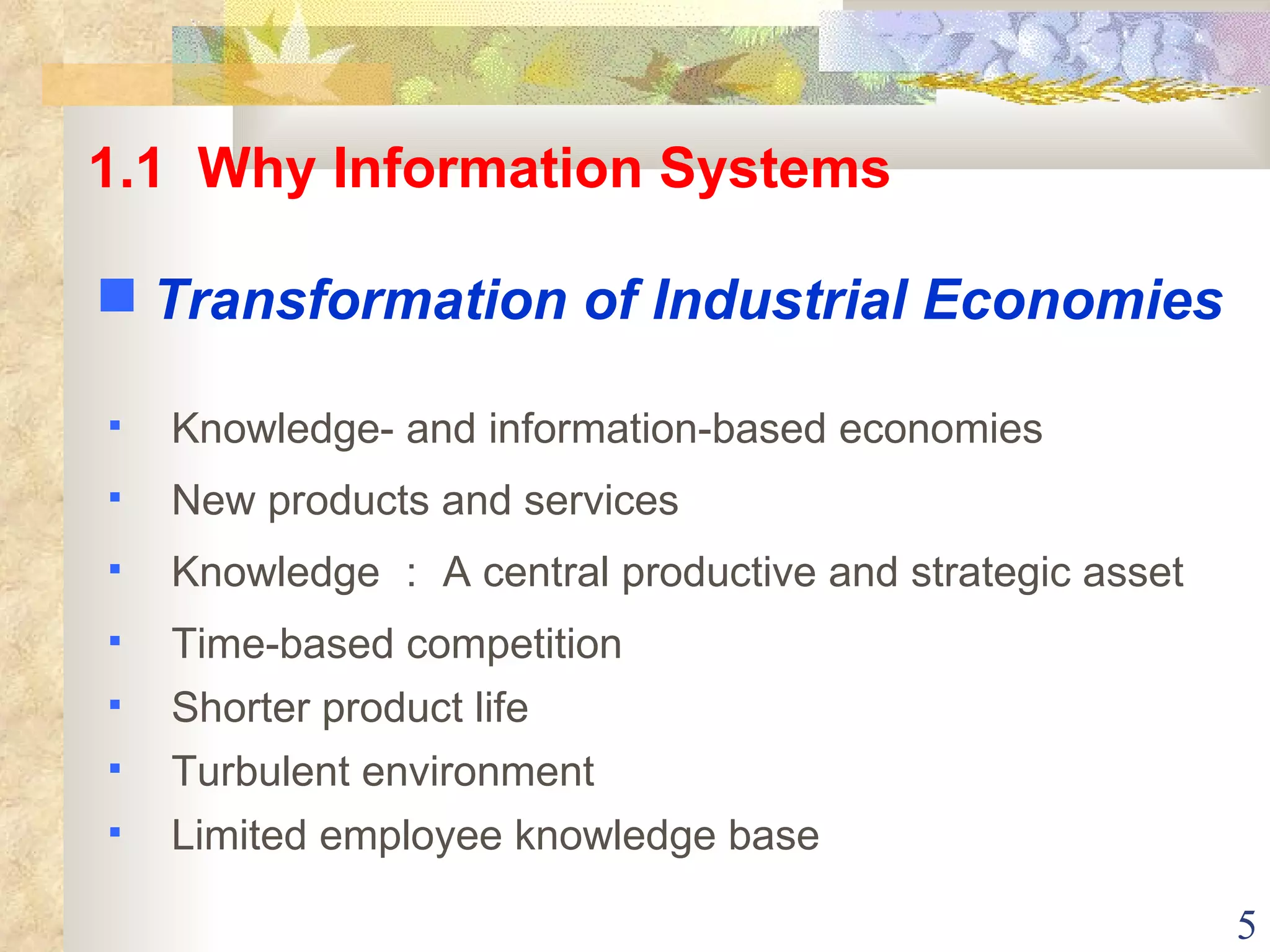
Knowledge- and information-based economies New products and services Knowledge : A central productive and strategic asset  Time-based competition  Shorter product life Turbulent environment Limited employee knowledge base 1.1  Why Information Systems Transformation of Industrial Economies
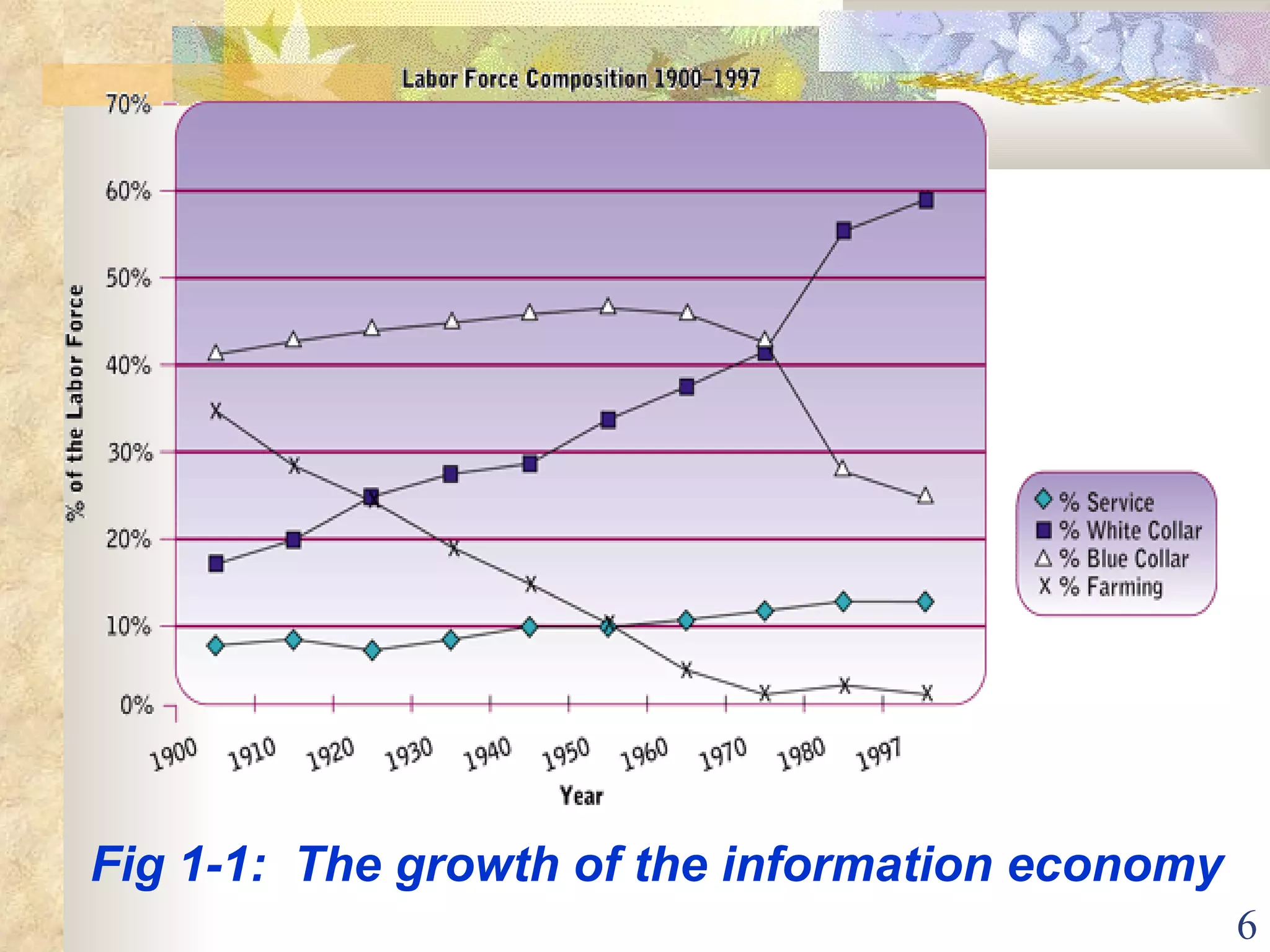
Fig 1-1:  The growth of the information economy
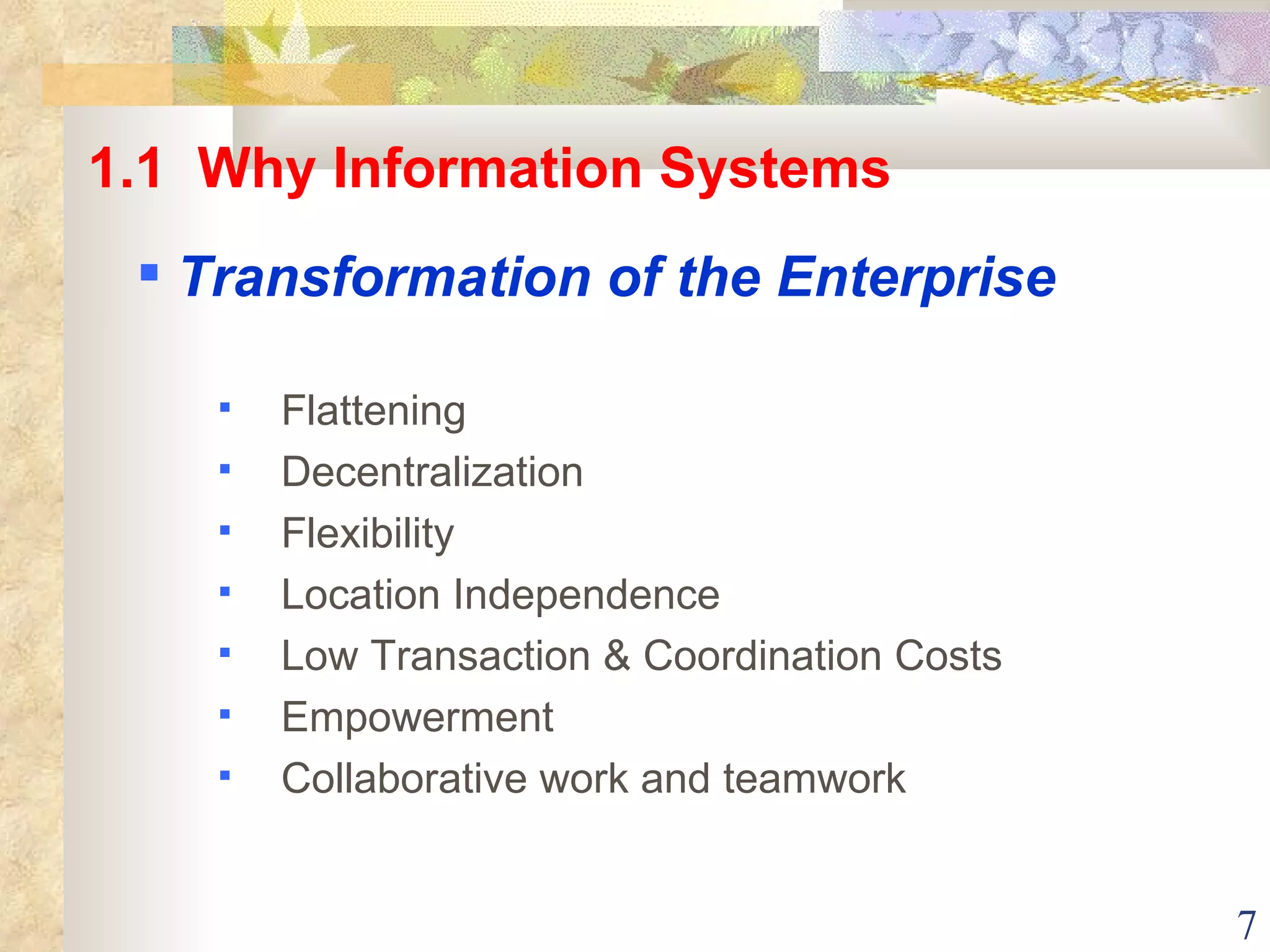
Flattening Decentralization Flexibility Location Independence Low Transaction & Coordination Costs Empowerment Collaborative work and teamwork 1.1  Why Information Systems Transformation of the Enterprise
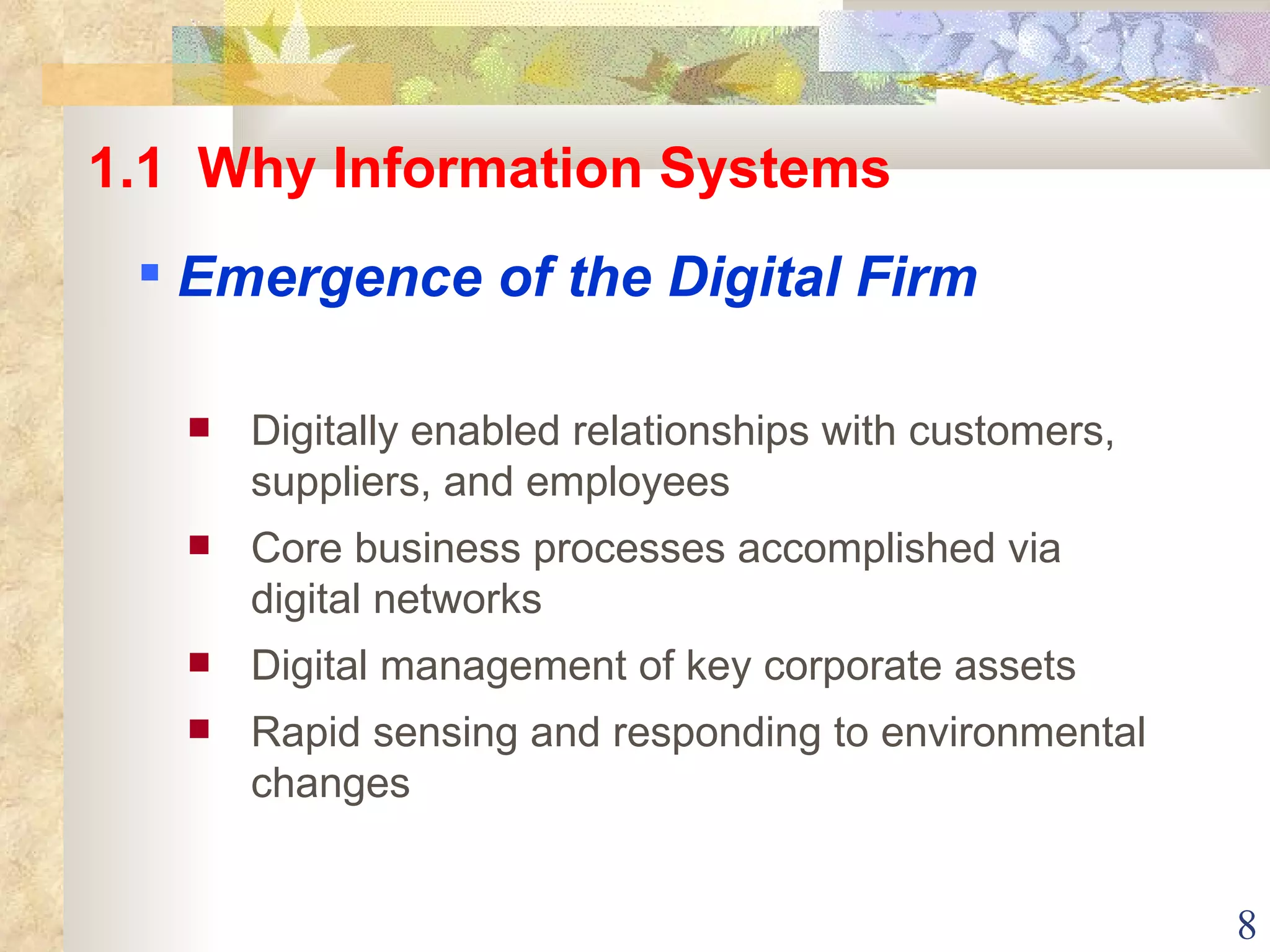
Digitally enabled relationships with customers, suppliers, and employees Core business processes accomplished via digital networks Digital management of key corporate assets Rapid sensing and responding to environmental changes 1.1  Why Information Systems Emergence of the Digital Firm
1.1  Why Information Systems Emergence of the Global Economy Transformation of Industrial Economies Transformation of the Business Enterprise The Emerging Digital Firm
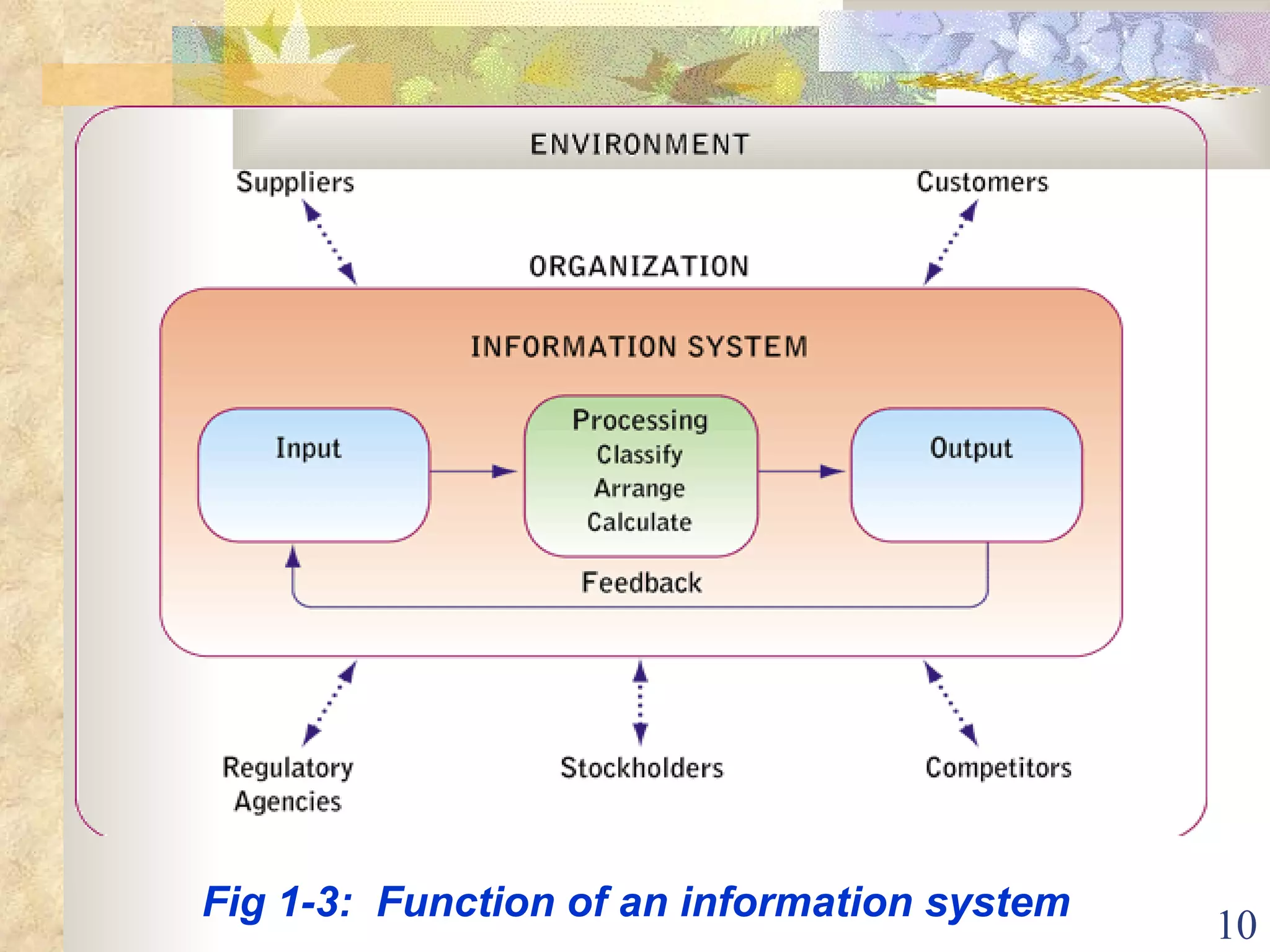
Fig 1-3:  Function of an information system
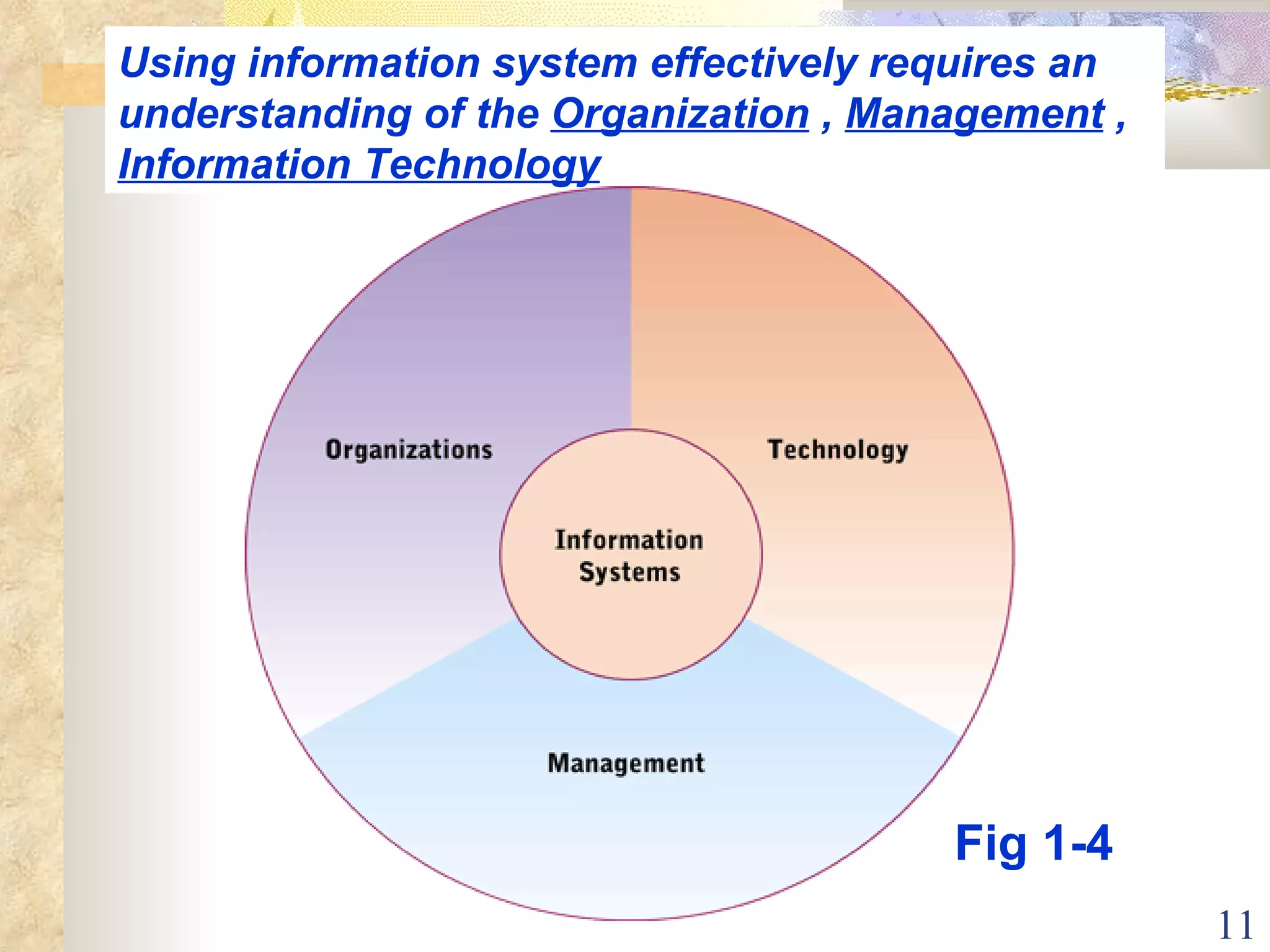
Using information system effectively requires an understanding of the  Organization  ,  Management  ,  Information Technology Fig 1-4
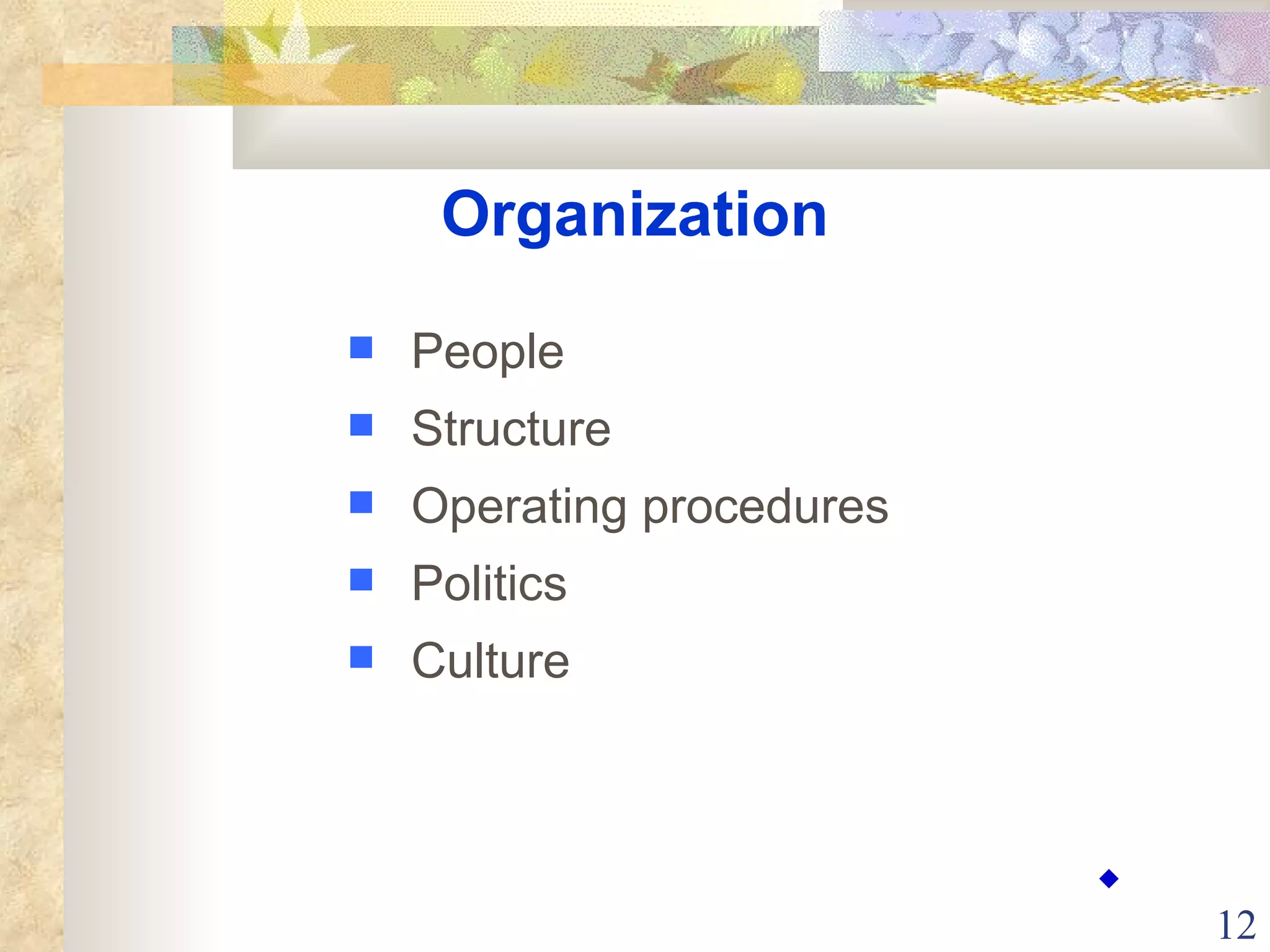
Organization People Structure Operating procedures Politics Culture ◆
Major Organizational Functions Sales & Marketing Manufacturing Finance Accounting Human Resources
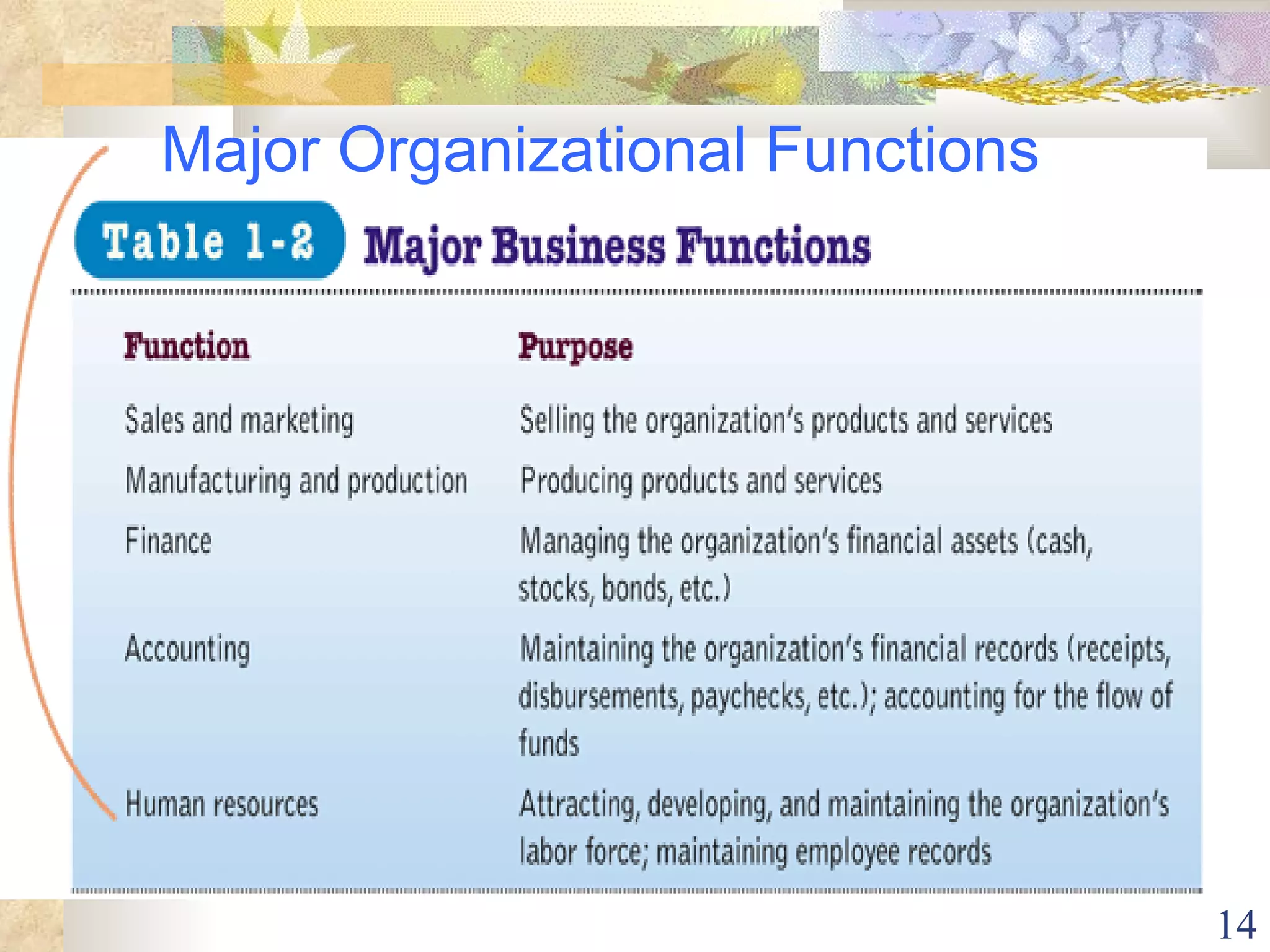
Major Organizational Functions
Management set the organizational strategy allocate the financial resources allocate the human resources coordinate the work leadership create new products or new services re-create organization from time to time
Technology tools to managers glue  that holds the organization together Computer hardware Computer software Storage technology Telecommunications technology Information technology Infrastructure
1.2  Contemporary Approaches to Information Systems Technical approach Behavioral approach
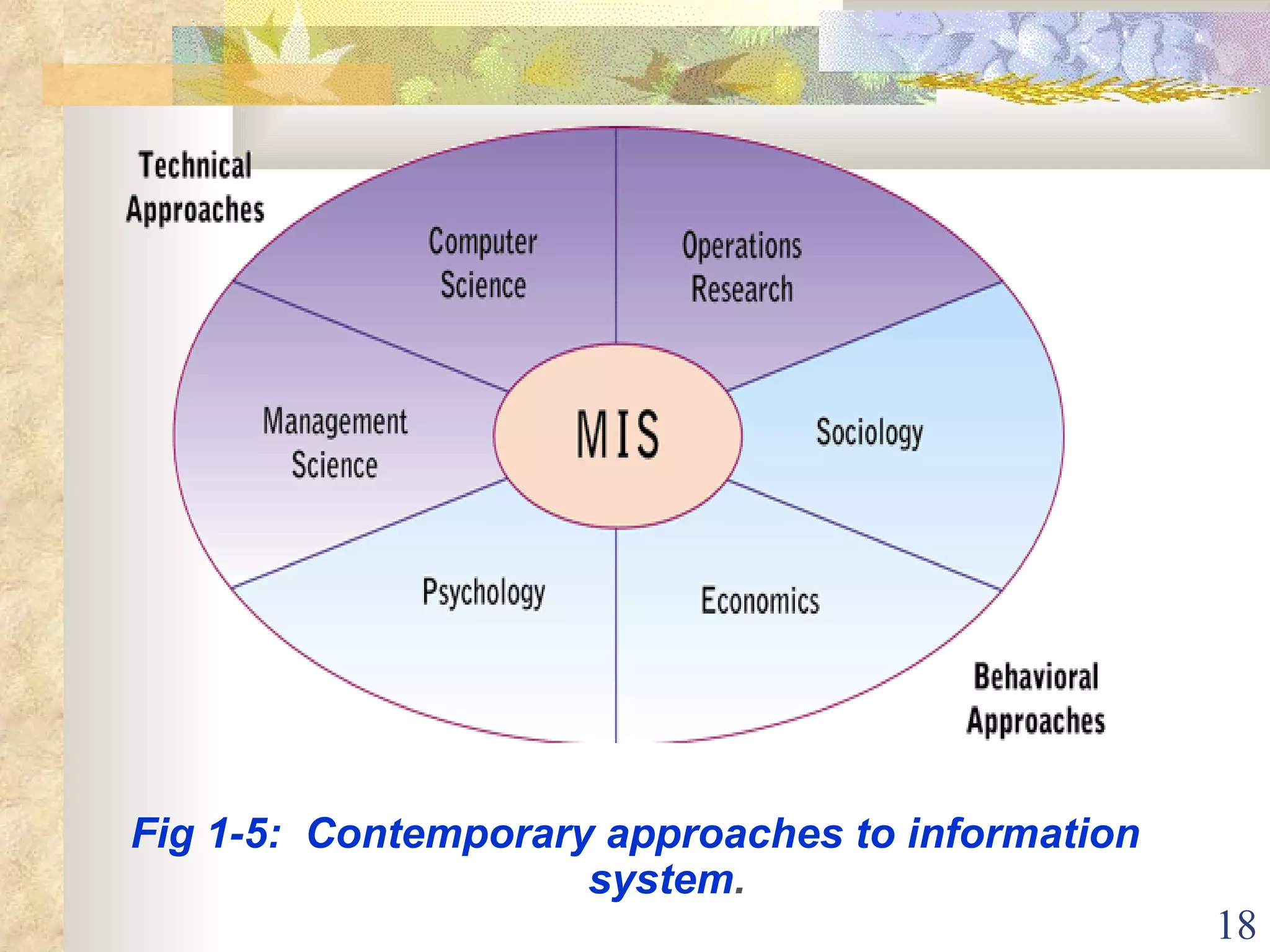
Fig 1-5:  Contemporary approaches to information system .
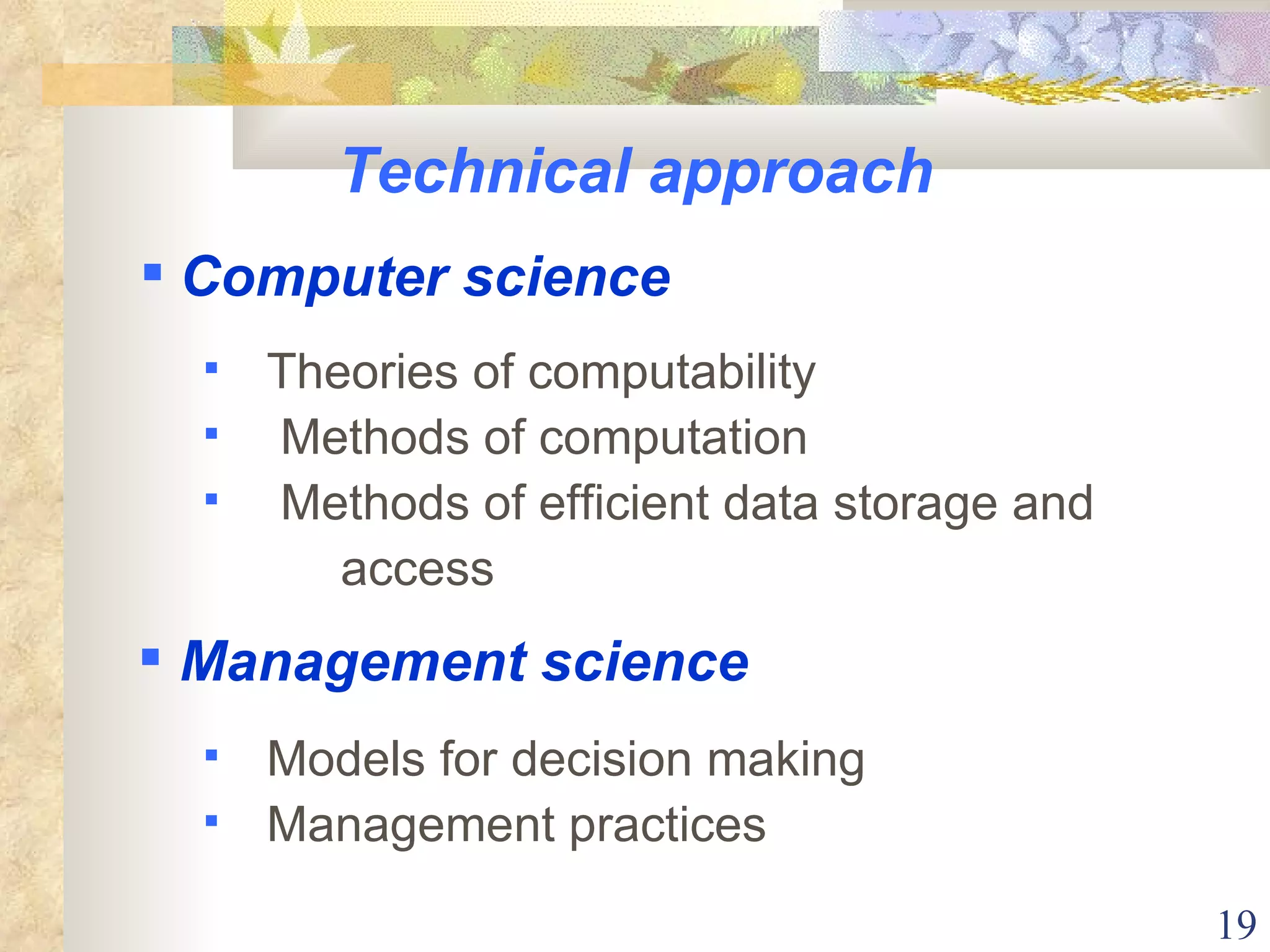
Technical approach Theories of computability Methods of computation Methods of efficient data storage and access Models for decision making Management practices Computer science Management science
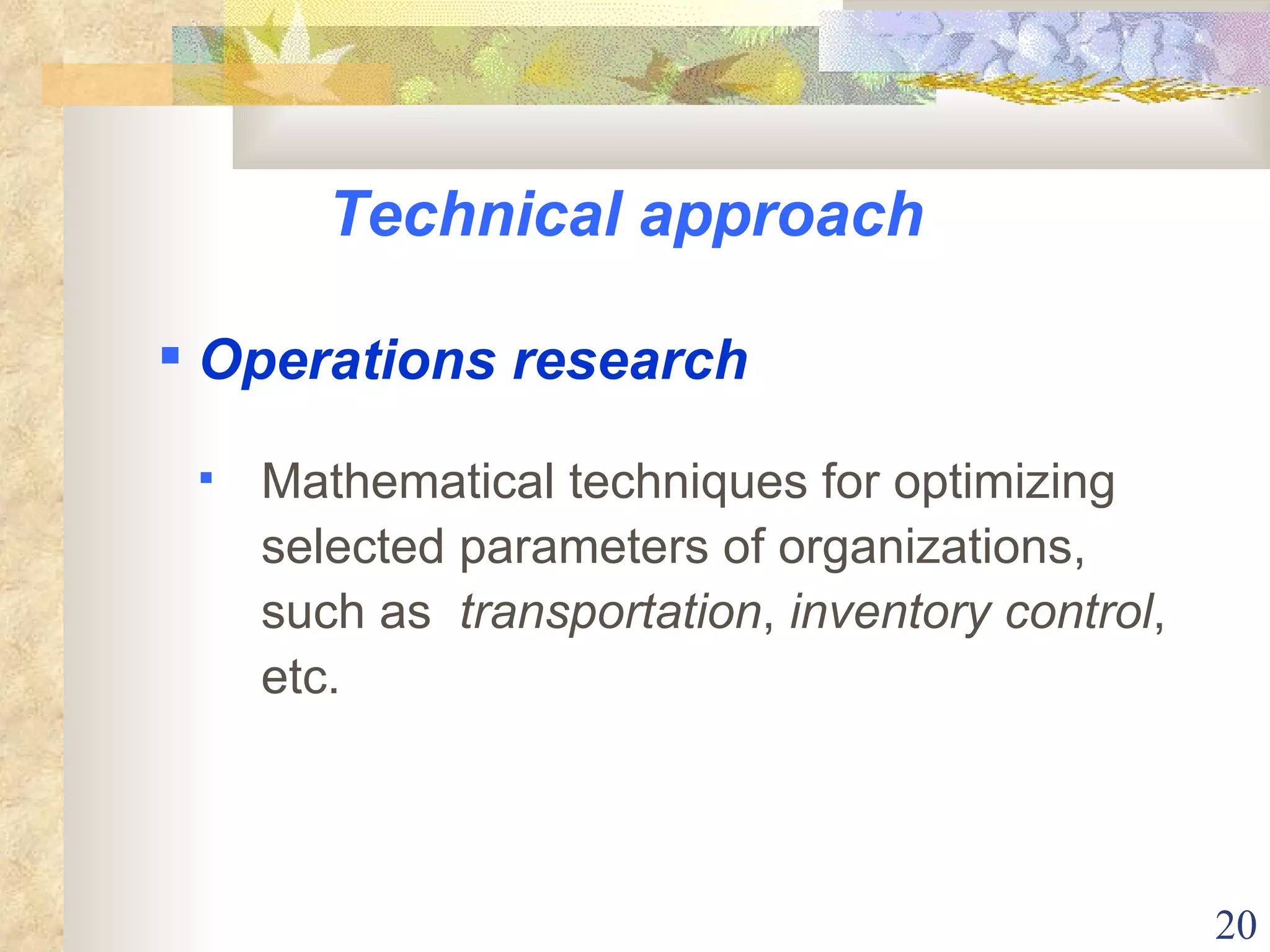
Technical approach Mathematical techniques for optimizing selected parameters of organizations, such as  transportation ,  inventory control , etc. Operations research
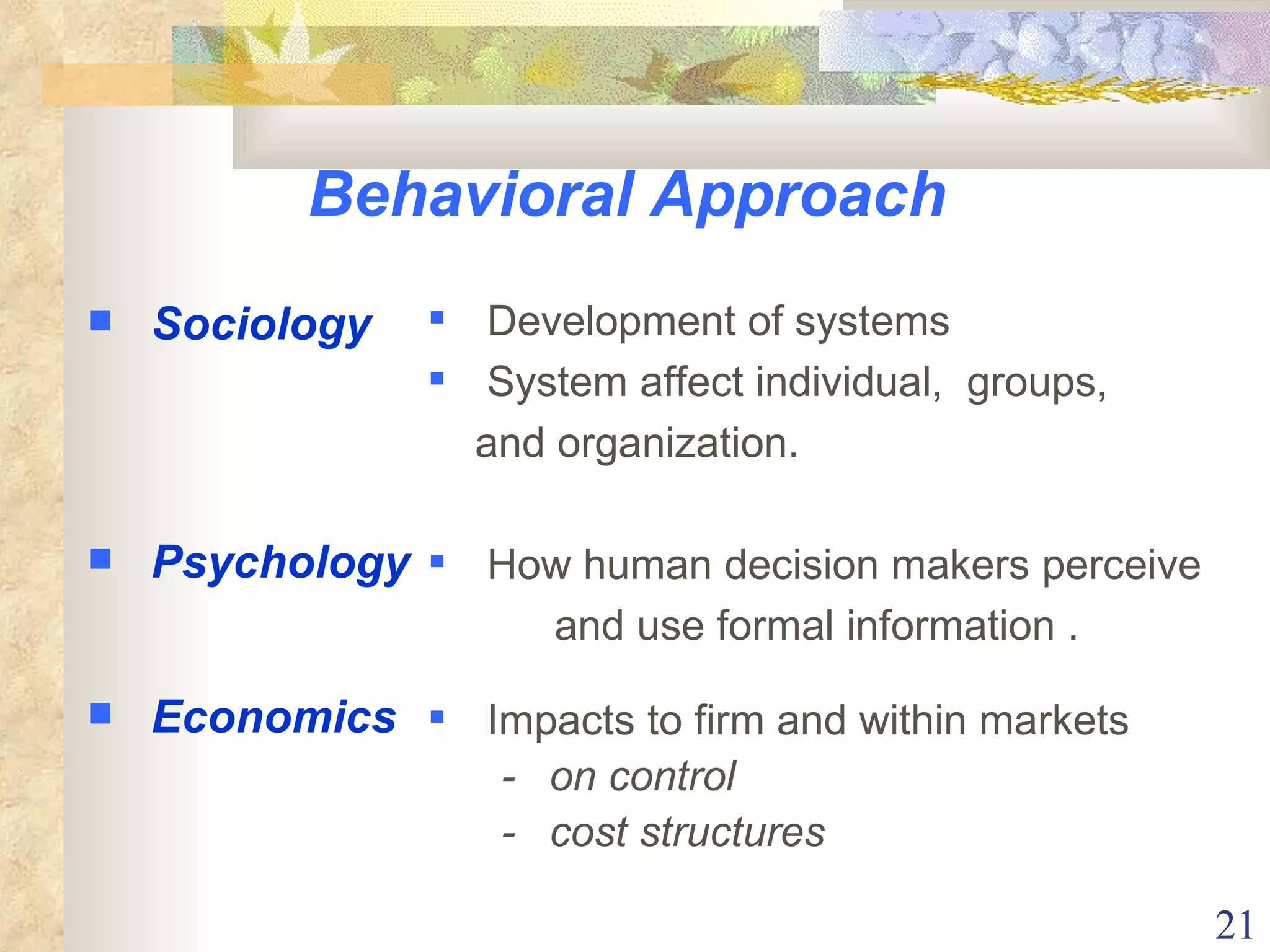
Behavioral Approach Sociology Psychology Economics Development of systems System affect individual,  groups,  and organization. How human decision makers perceive  and use formal information . Impacts to firm and within markets -  on control -  cost structures
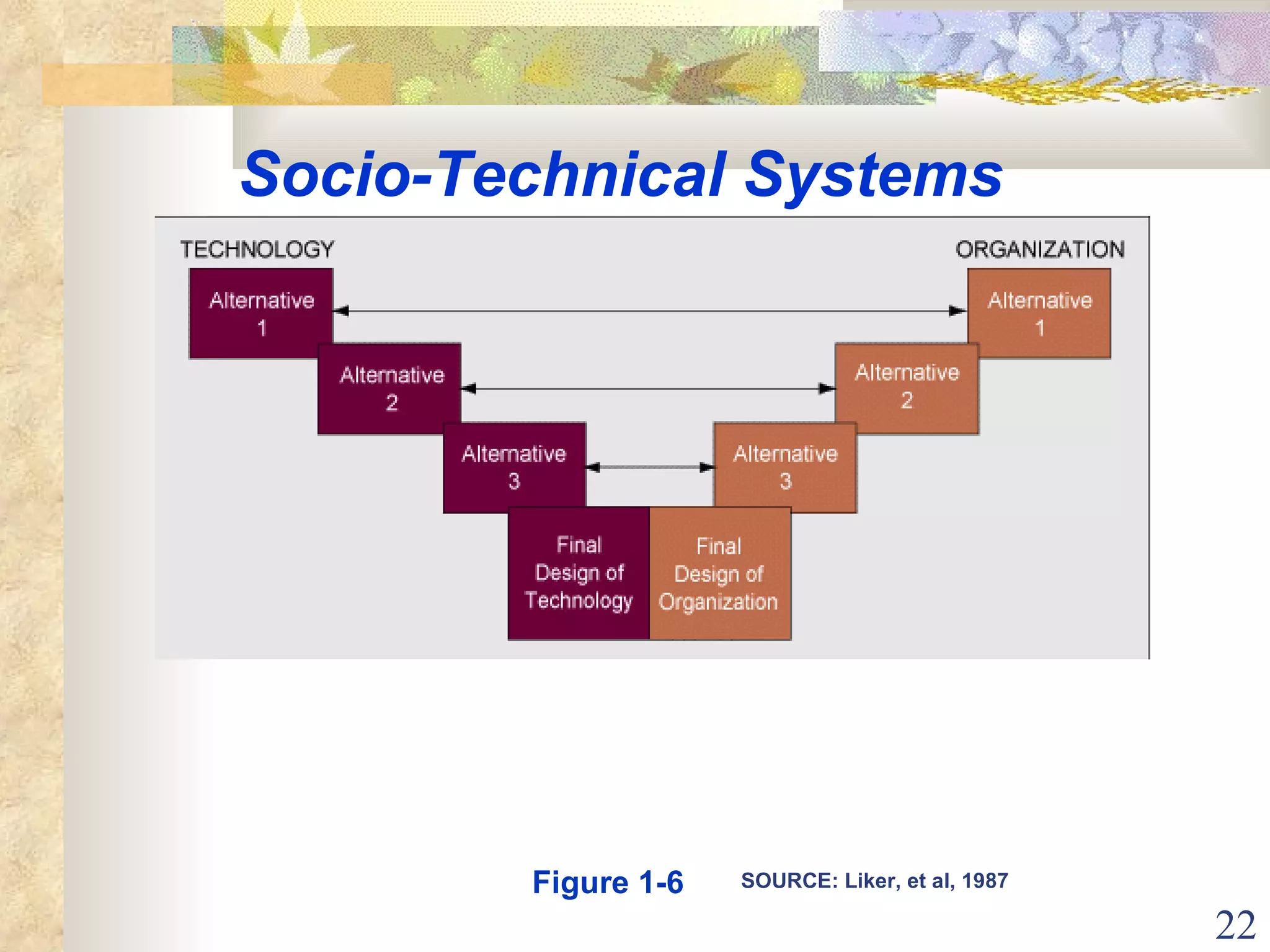
Socio-Technical Systems SOURCE: Liker, et al, 1987 Figure 1-6
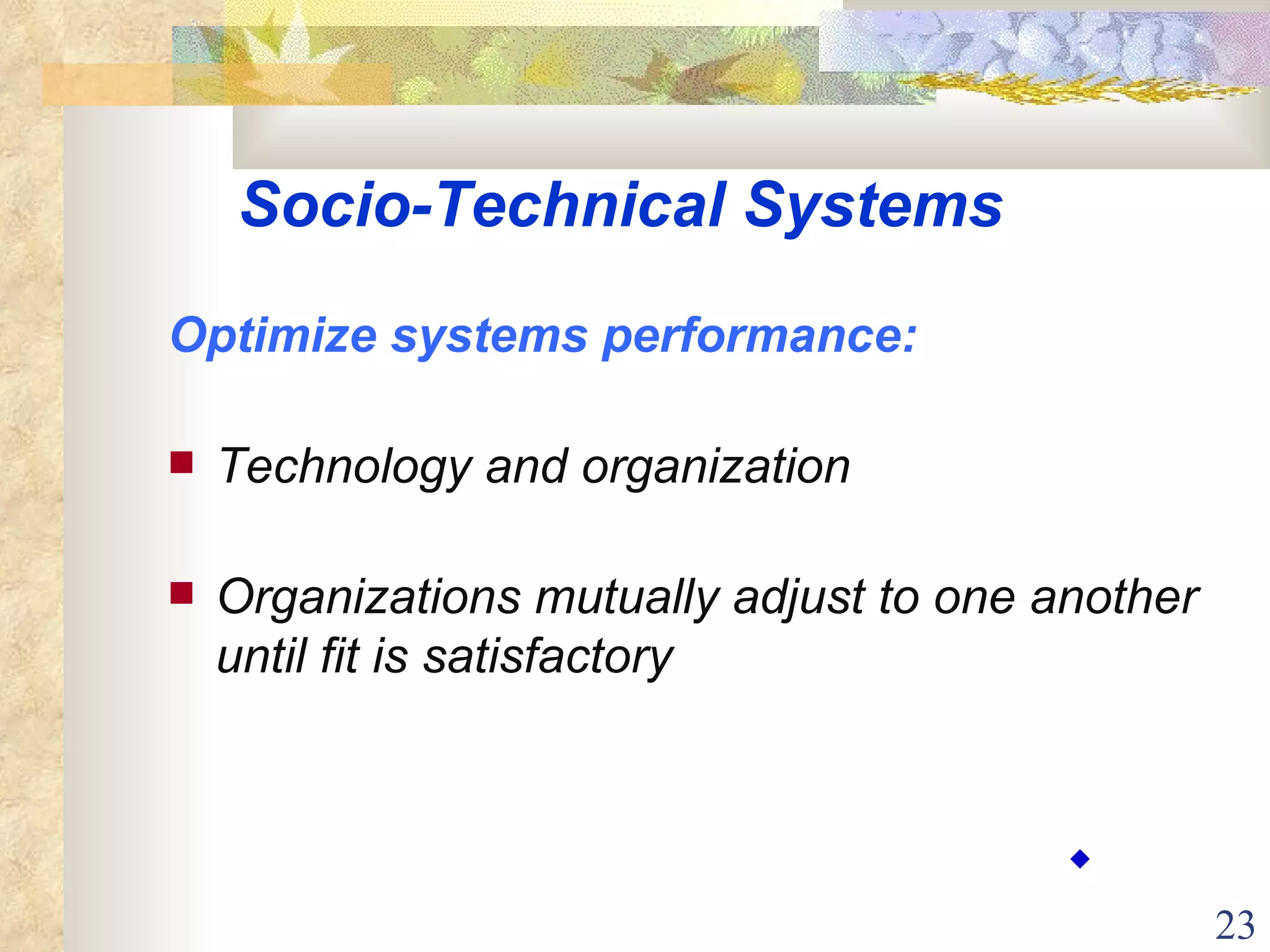
Optimize systems performance: Technology and organization  Organizations mutually adjust to one another until fit is satisfactory Socio-Technical Systems ◆
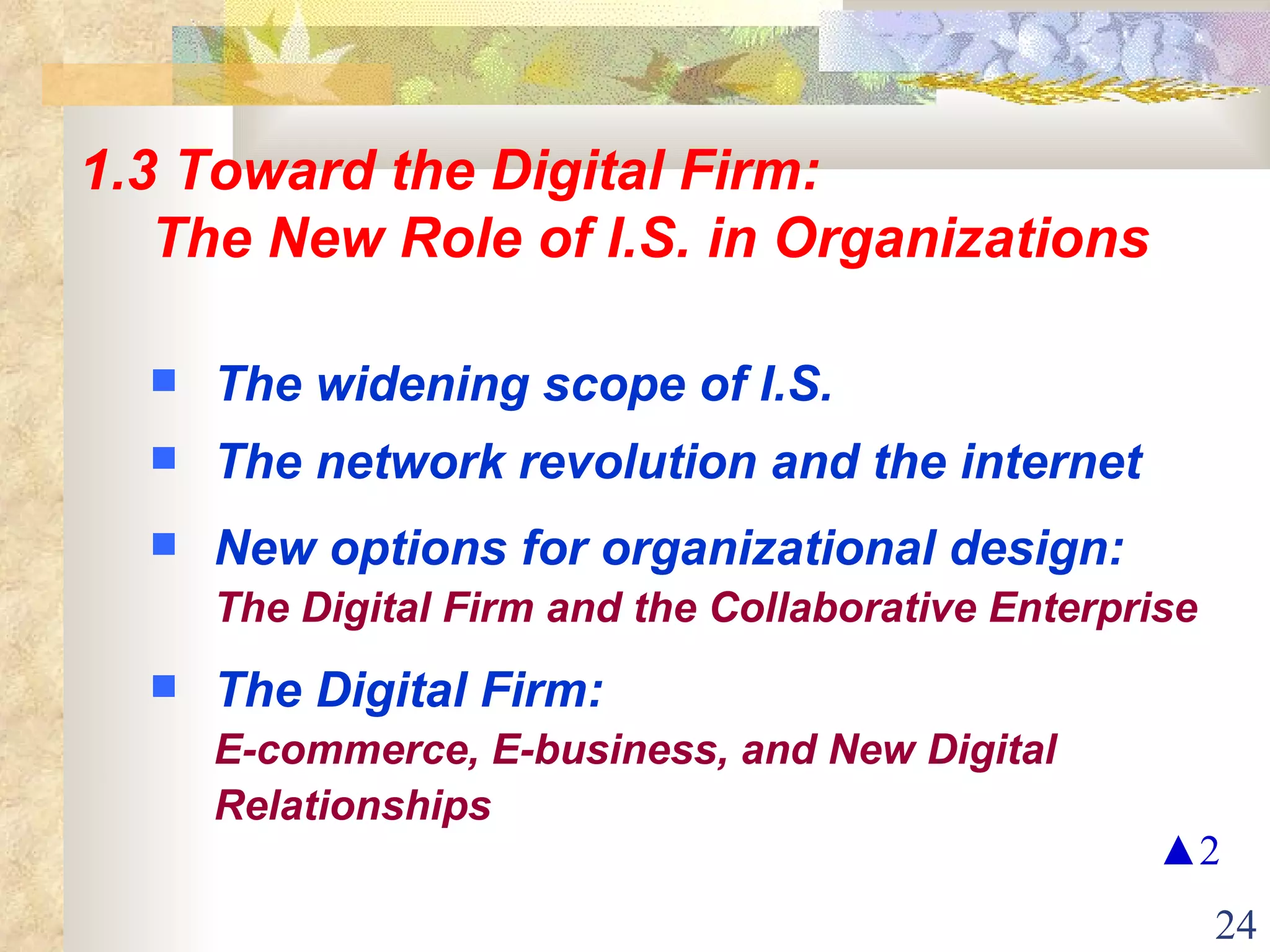
1.3 Toward the Digital Firm: The New Role of I.S. in Organizations The widening scope of I.S. The network revolution and the internet New options for organizational design:   The Digital Firm and the Collaborative Enterprise The Digital Firm:   E-commerce, E-business, and New Digital Relationships ▲ 2
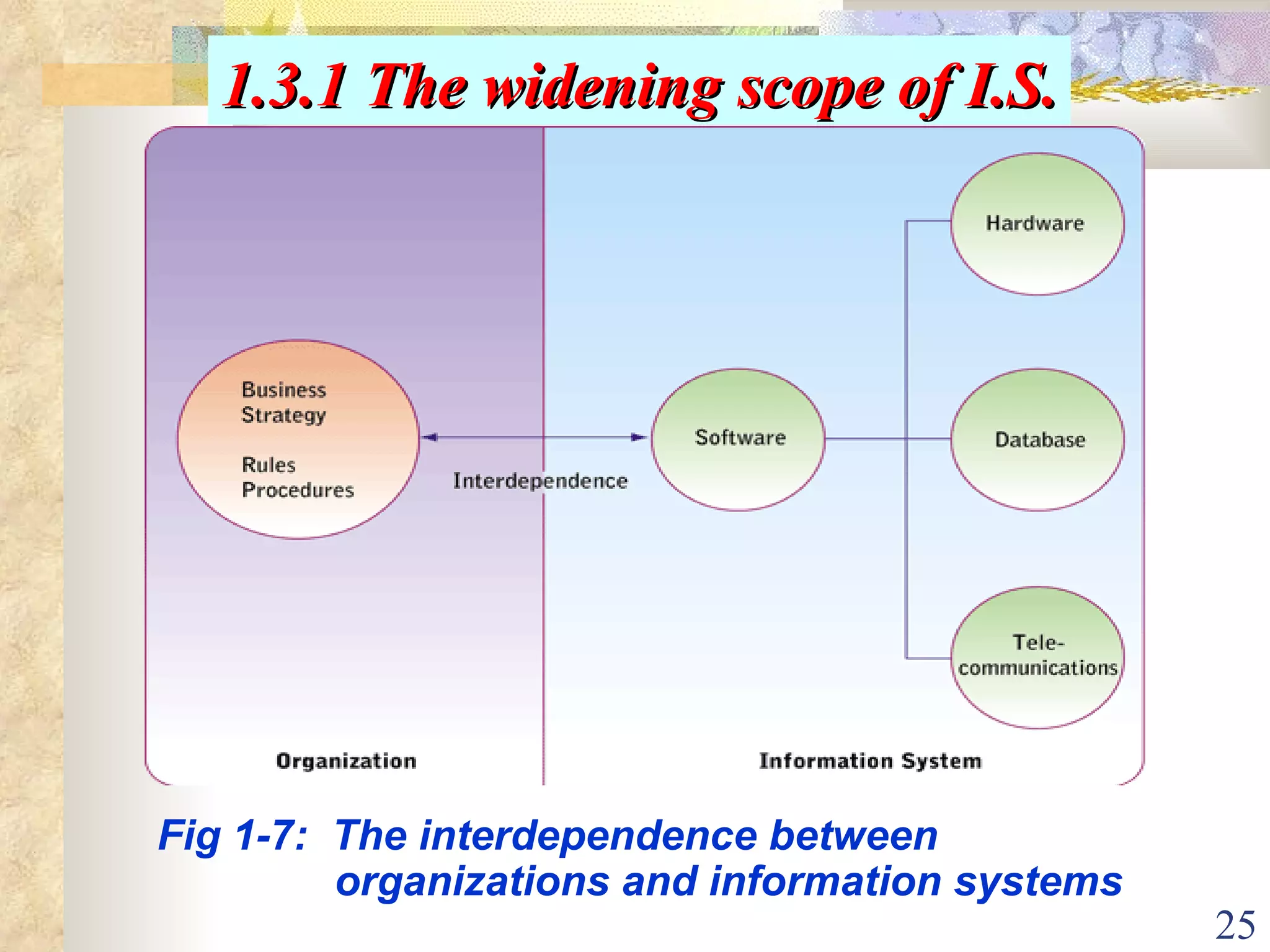
Fig 1-7:  The interdependence between  organizations and information systems 1.3.1 The widening scope of I.S.
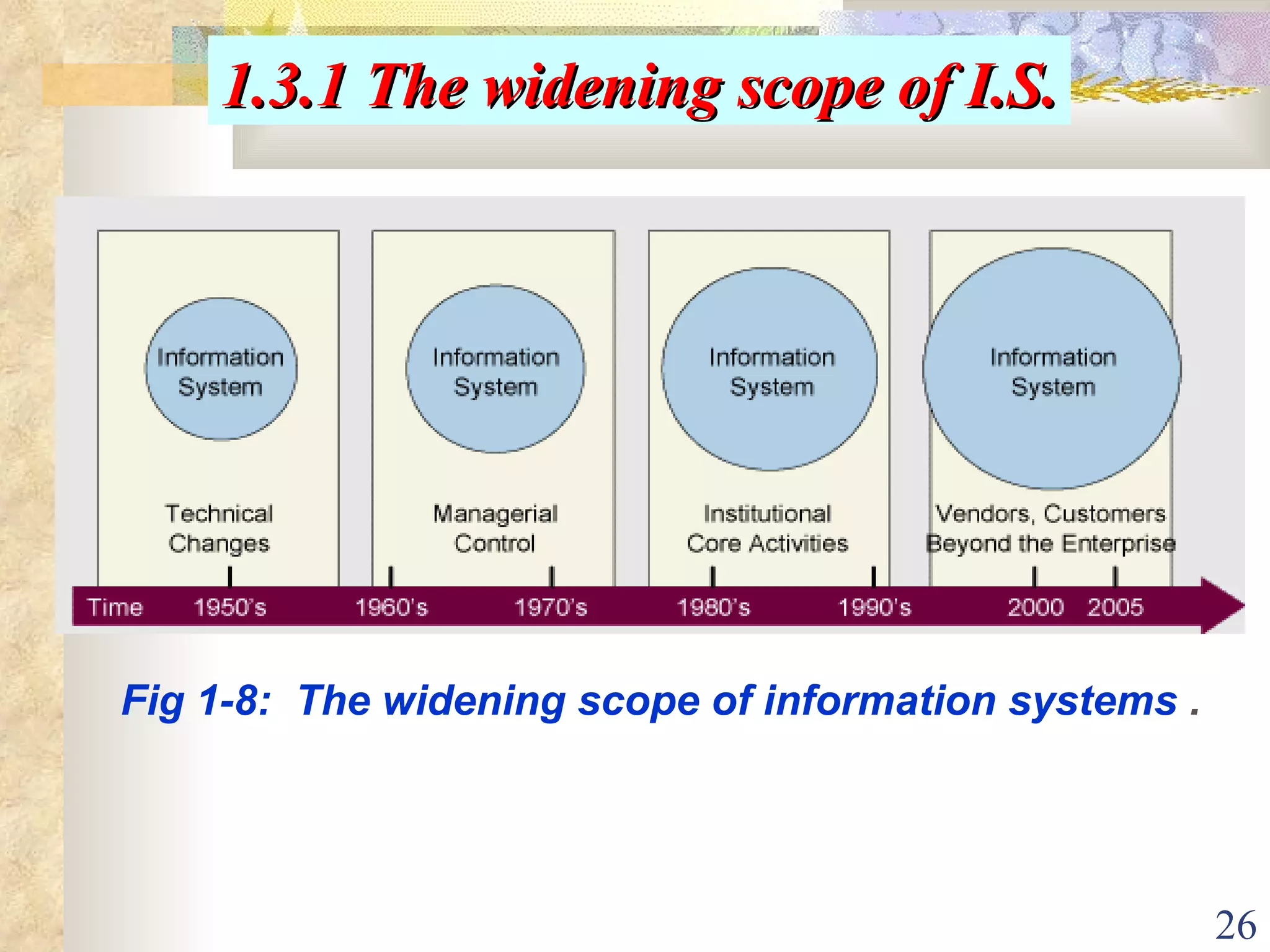
Fig 1-8:  The widening scope of information systems  . 1.3.1 The widening scope of I.S.
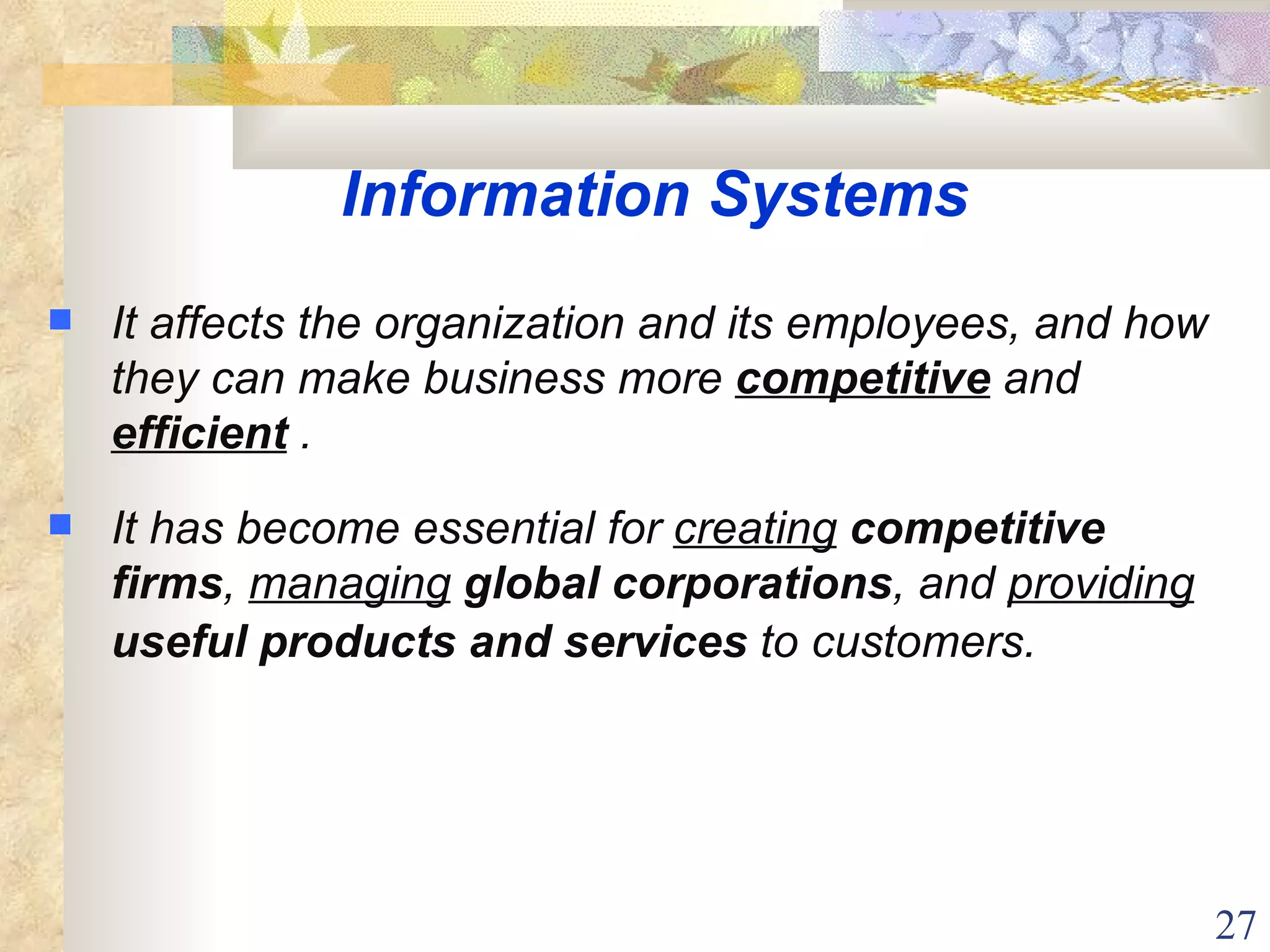
Information Systems It affects the organization and its employees, and how they can make business more  competitive  and  efficient  . It has become essential for  creating   competitive firms ,  managing   global corporations , and  providing   useful products and services  to customers.
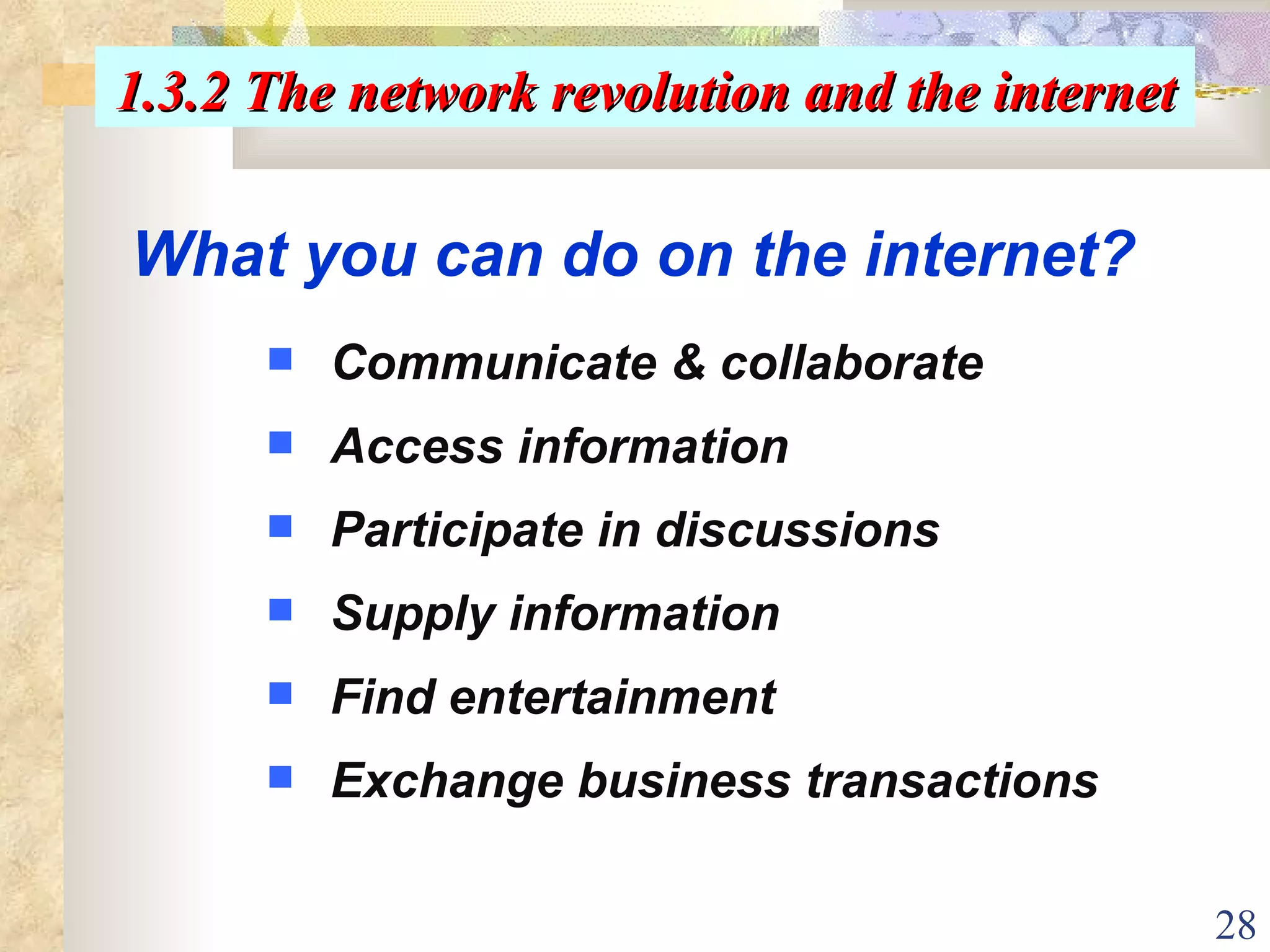
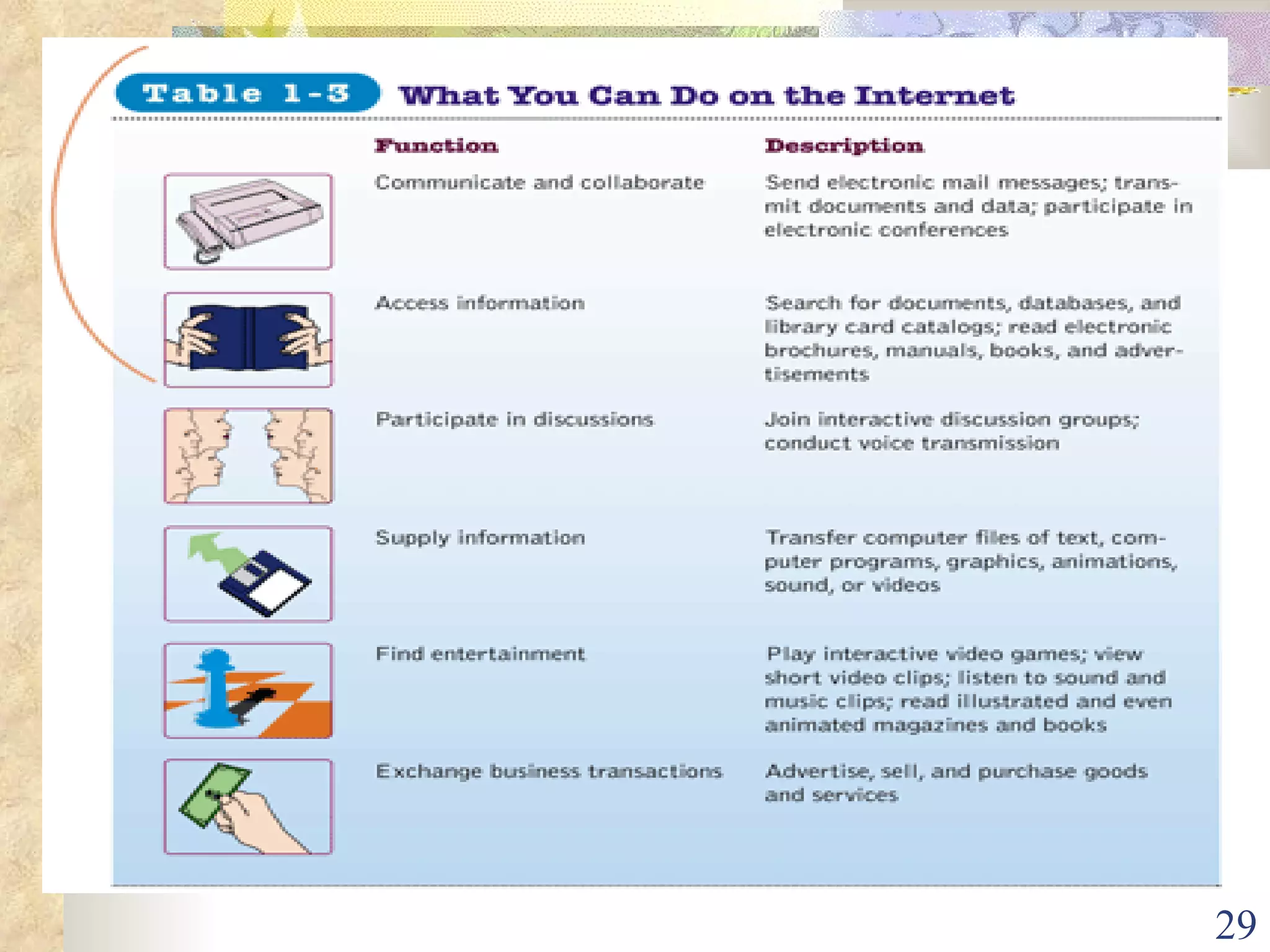
What you can do on the internet? Communicate & collaborate Access information  Participate in discussions Supply information Find entertainment Exchange business transactions   1.3.2 The network revolution and the internet
 
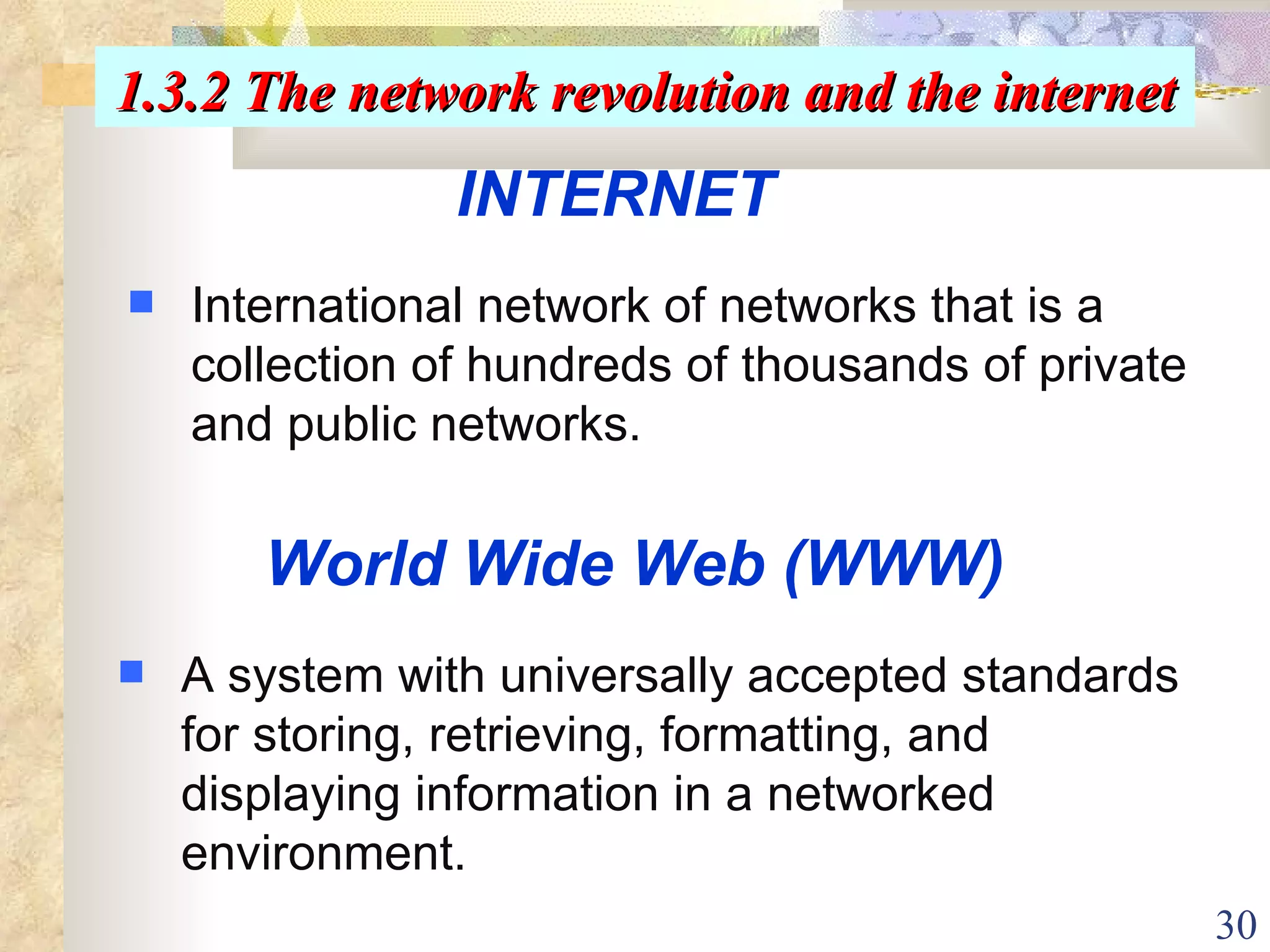
INTERNET International network of networks that is a collection of hundreds of thousands of private and public networks. World Wide Web (WWW) A system with universally accepted standards for storing, retrieving, formatting, and displaying information in a networked environment. 1.3.2 The network revolution and the internet
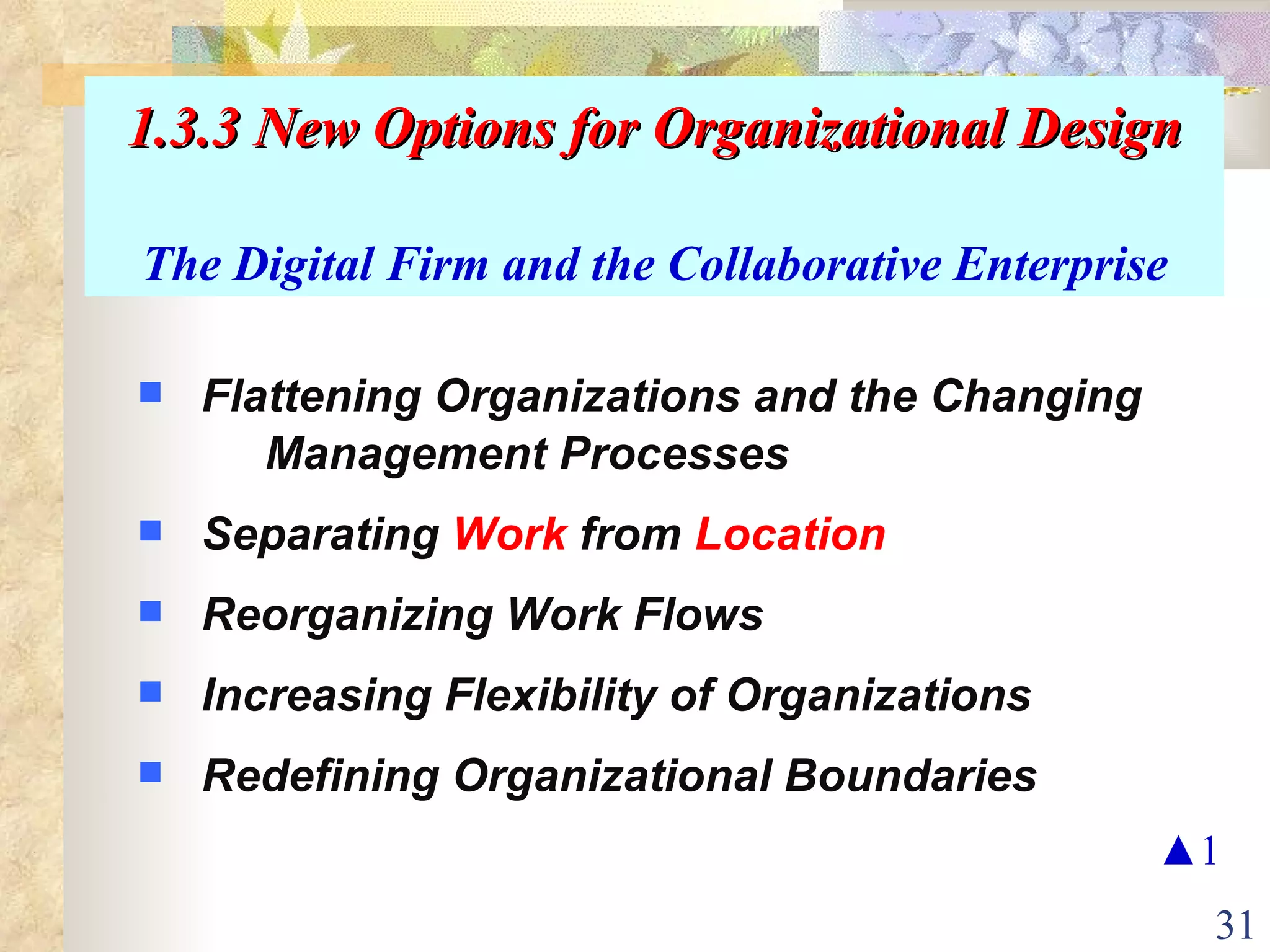
1.3.3 New Options for Organizational Design The Digital Firm and the Collaborative Enterprise Flattening Organizations and the Changing  Management Processes Separating  Work  from  Location Reorganizing Work Flows Increasing Flexibility of Organizations Redefining Organizational Boundaries ▲ 1
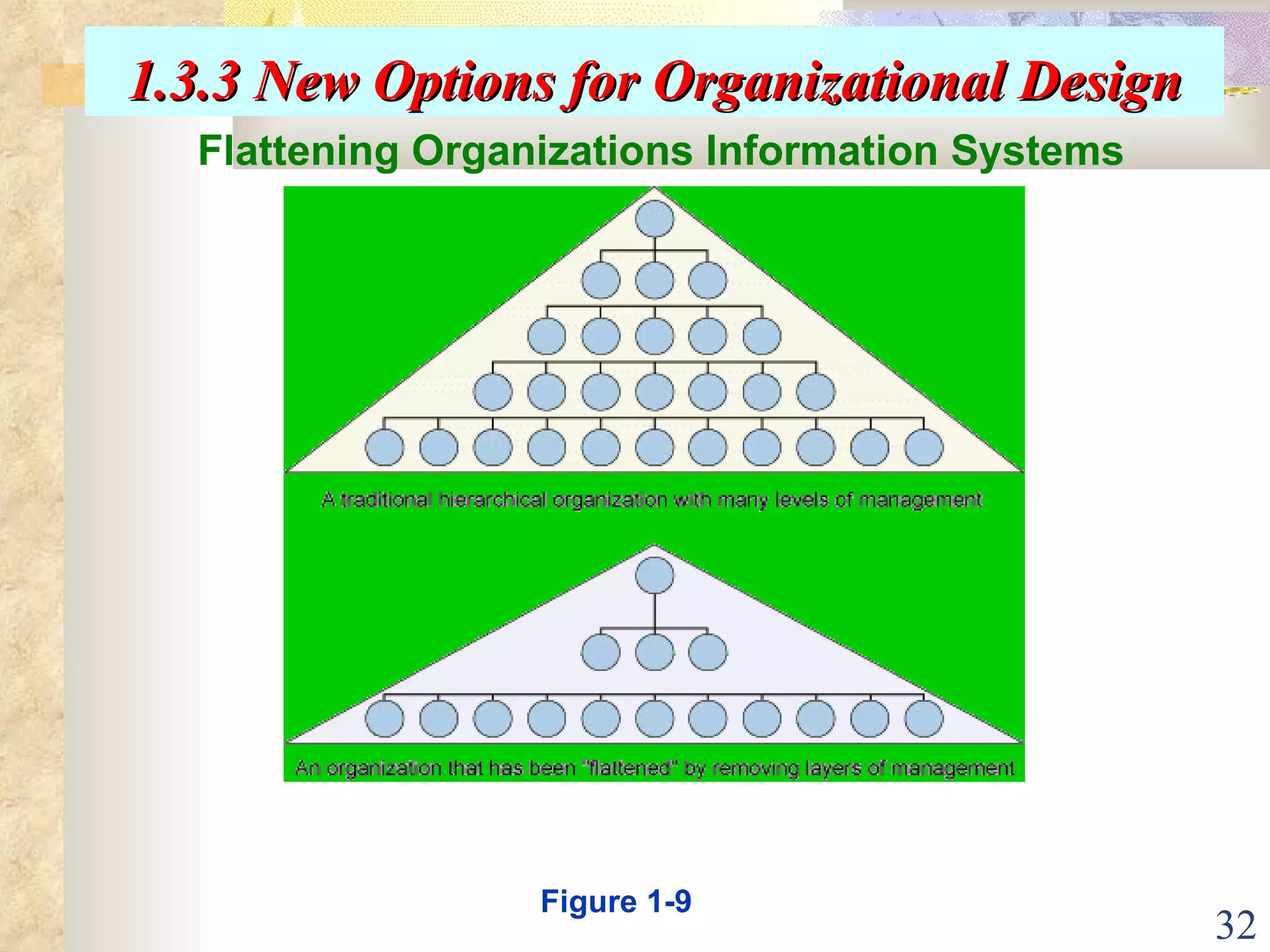
Flattening Organizations Information Systems 1.3.3 New Options for Organizational Design Figure 1-9
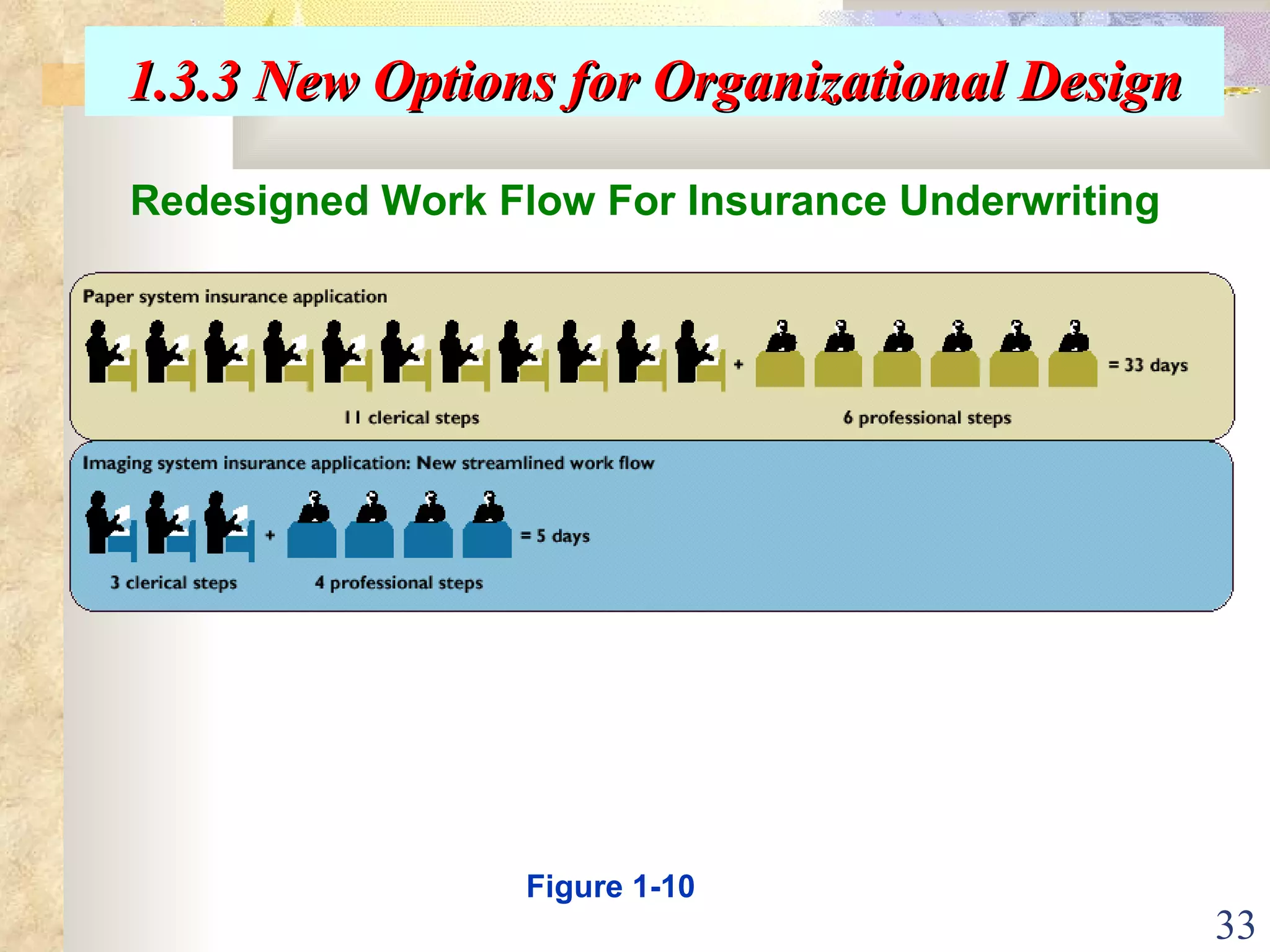
Redesigned Work Flow For Insurance Underwriting 1.3.3 New Options for Organizational Design Figure 1-10
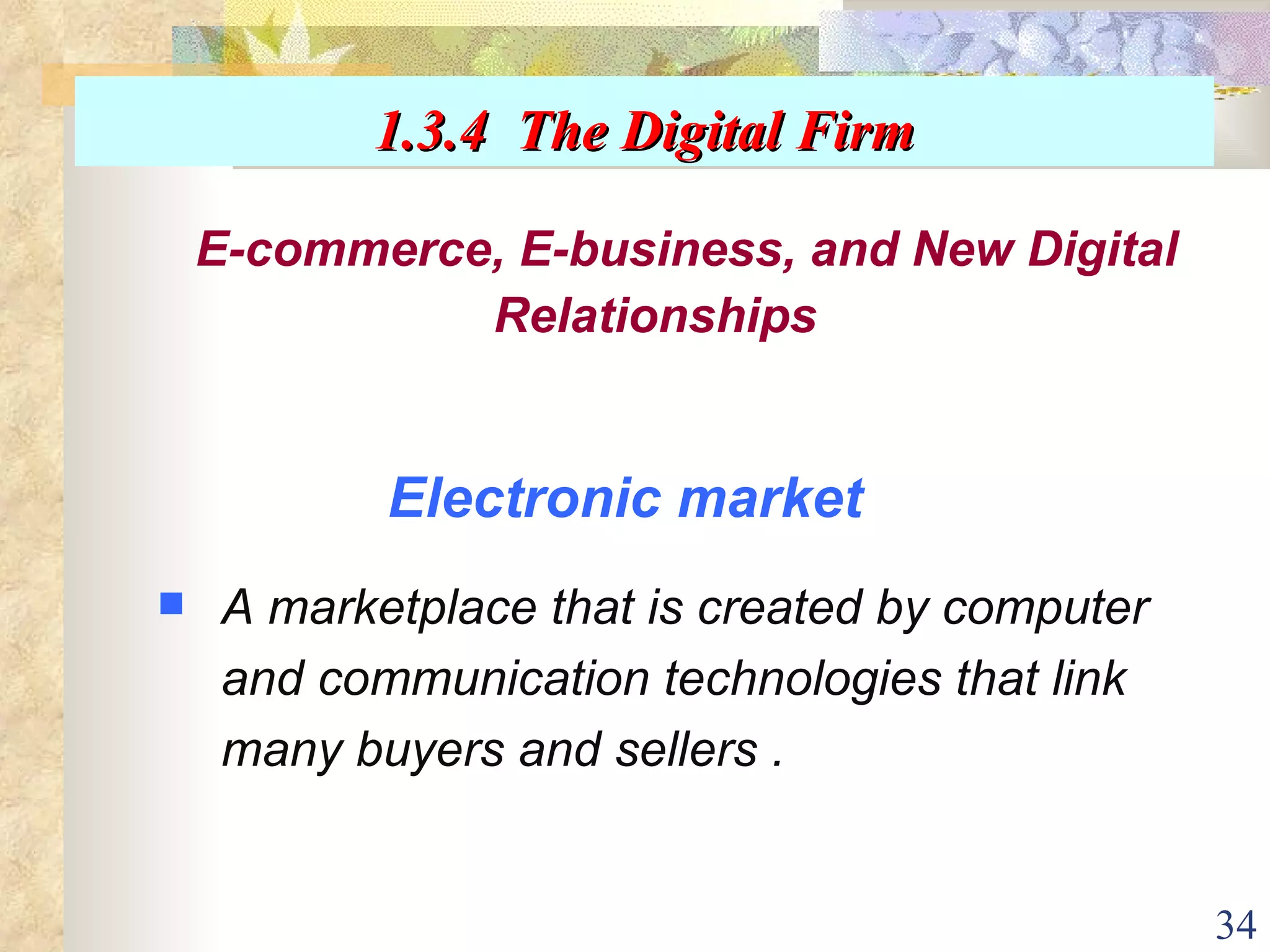
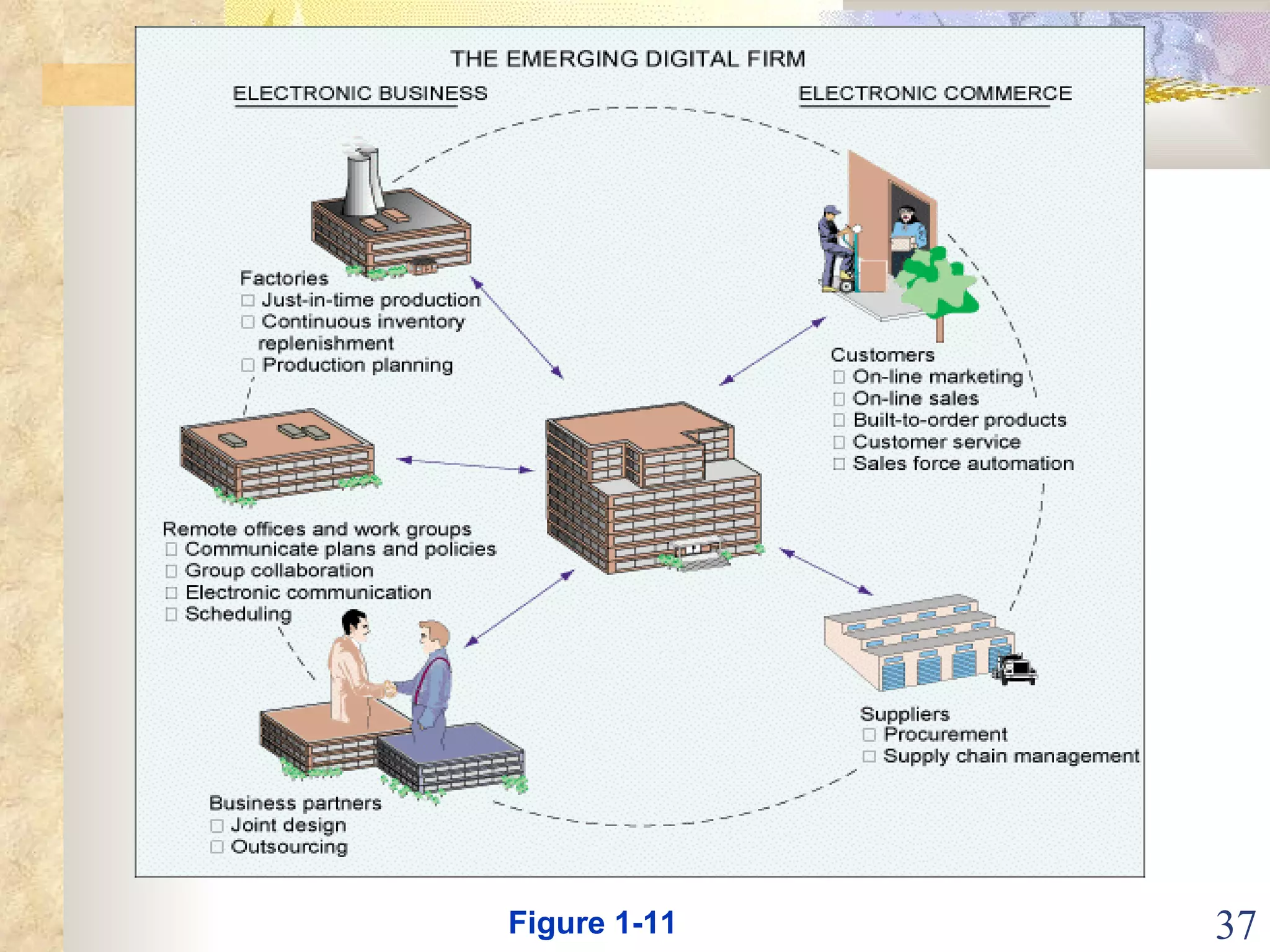
Electronic market A marketplace that is created by computer and communication technologies that link many buyers and sellers . E-commerce, E-business, and New Digital Relationships 1.3.4  The Digital Firm
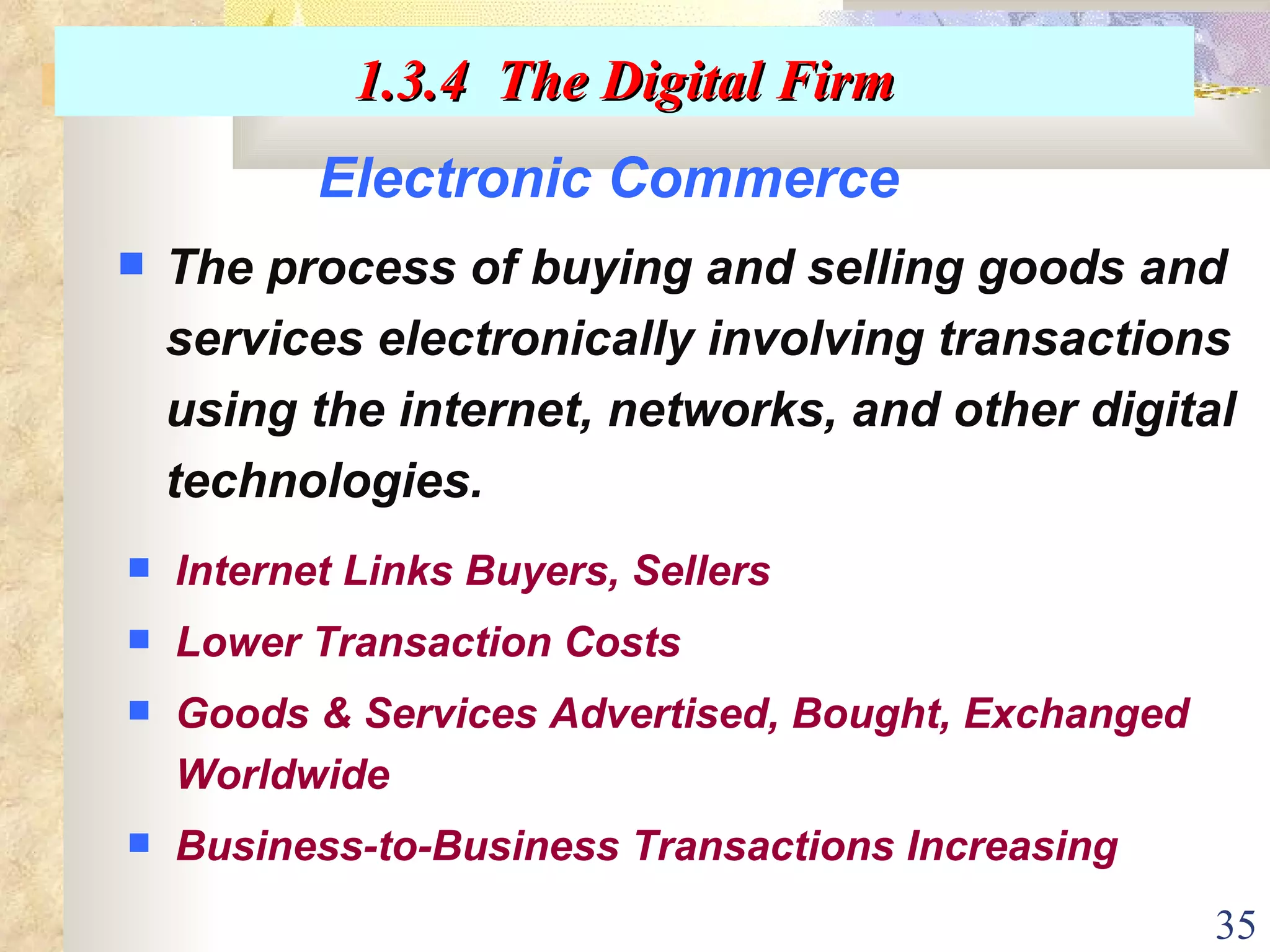
Electronic Commerce The process of buying and selling goods and services electronically involving transactions using the internet, networks, and other digital technologies. Internet Links Buyers, Sellers Lower Transaction Costs Goods & Services Advertised, Bought, Exchanged Worldwide Business-to-Business Transactions Increasing 1.3.4  The Digital Firm
Electronic Business The use of the  Internet  and other digital technology for organizational communication and coordination and the management of the firm. Intranet   An internal network based on   Internet   and   World Wide Web   technology and standards . 1.3.4  The Digital Firm
Figure 1-11
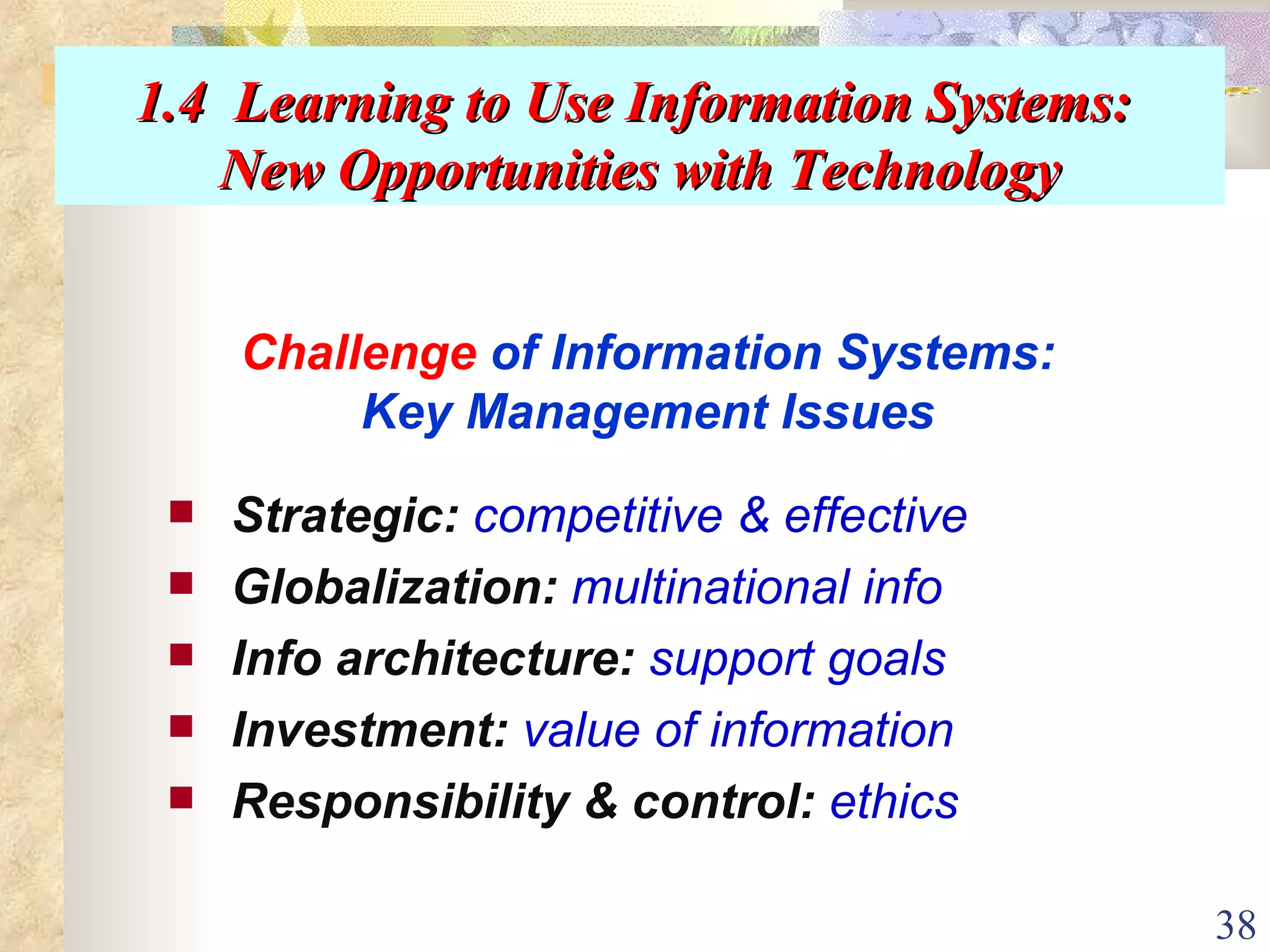
1.4  Learning to Use Information Systems:  New Opportunities with Technology Strategic:   competitive & effective Globalization:   multinational info Info architecture:   support goals Investment:   value of information Responsibility & control:   ethics Challenge  of Information Systems: Key Management Issues
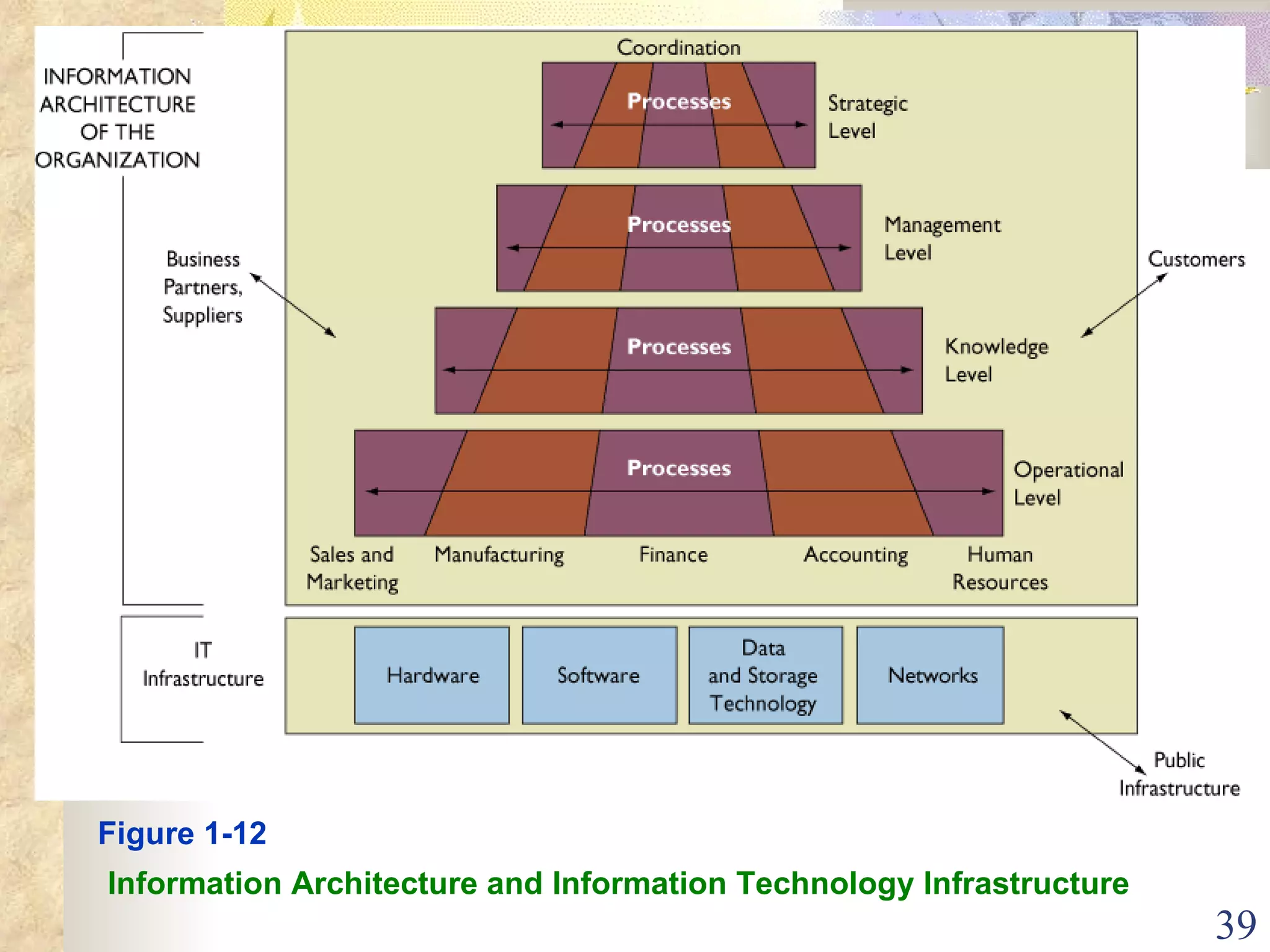
Figure 1-12 Information Architecture and Information Technology Infrastructure
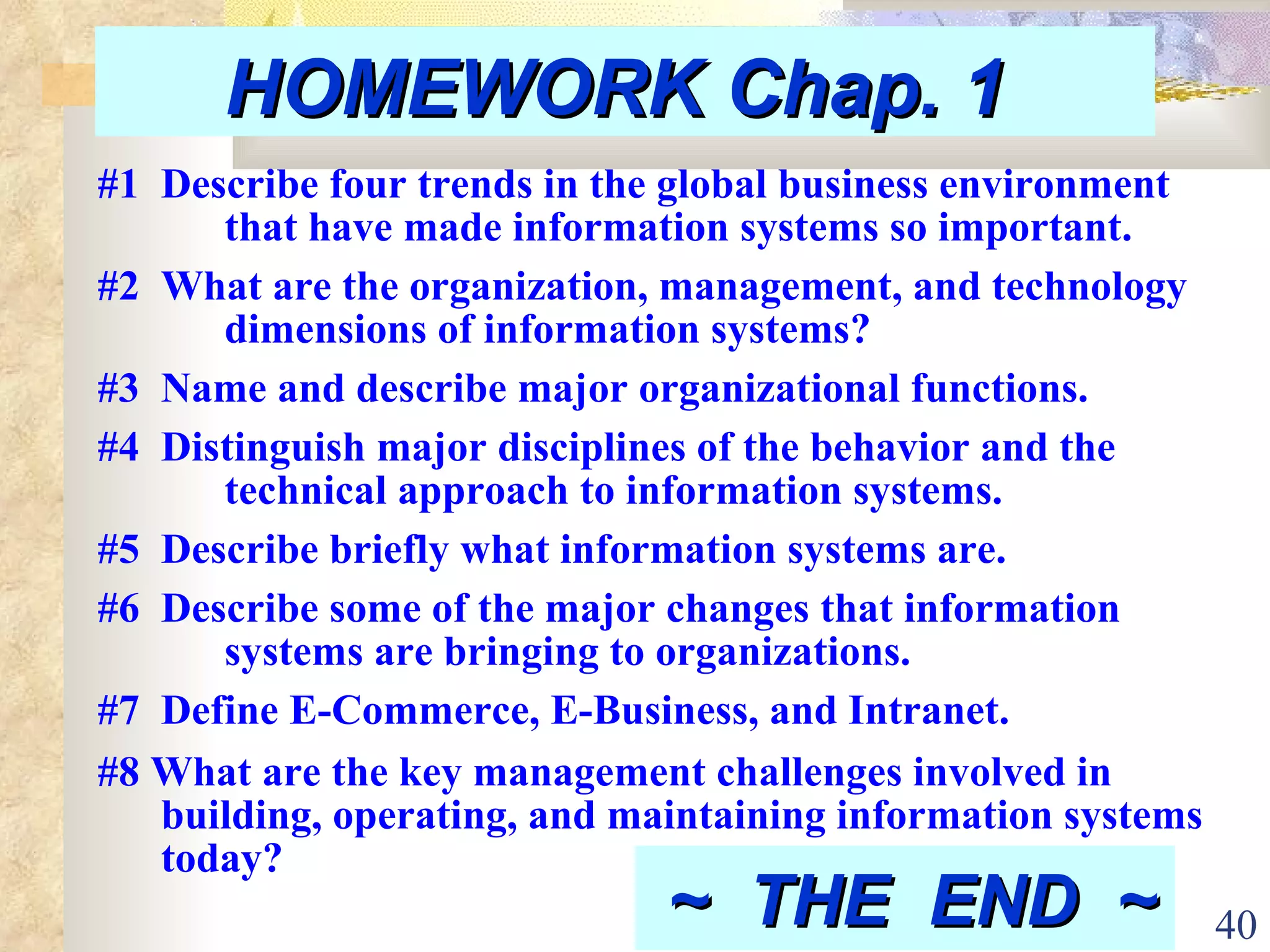
HOMEWORK Chap. 1  #1  Describe four trends in the global business environment  that have made information systems so important. #2  What are the organization, management, and technology  dimensions of information systems? #3  Name and describe major organizational functions. #4  Distinguish major disciplines of the behavior and the  technical approach to information systems.  #5  Describe briefly what information systems are. #6  Describe some of the major changes that information  systems are bringing to organizations. #7  Define E-Commerce, E-Business, and Intranet. #8 What are the key management challenges involved in building, operating, and maintaining information systems today? ~  THE  END  ~
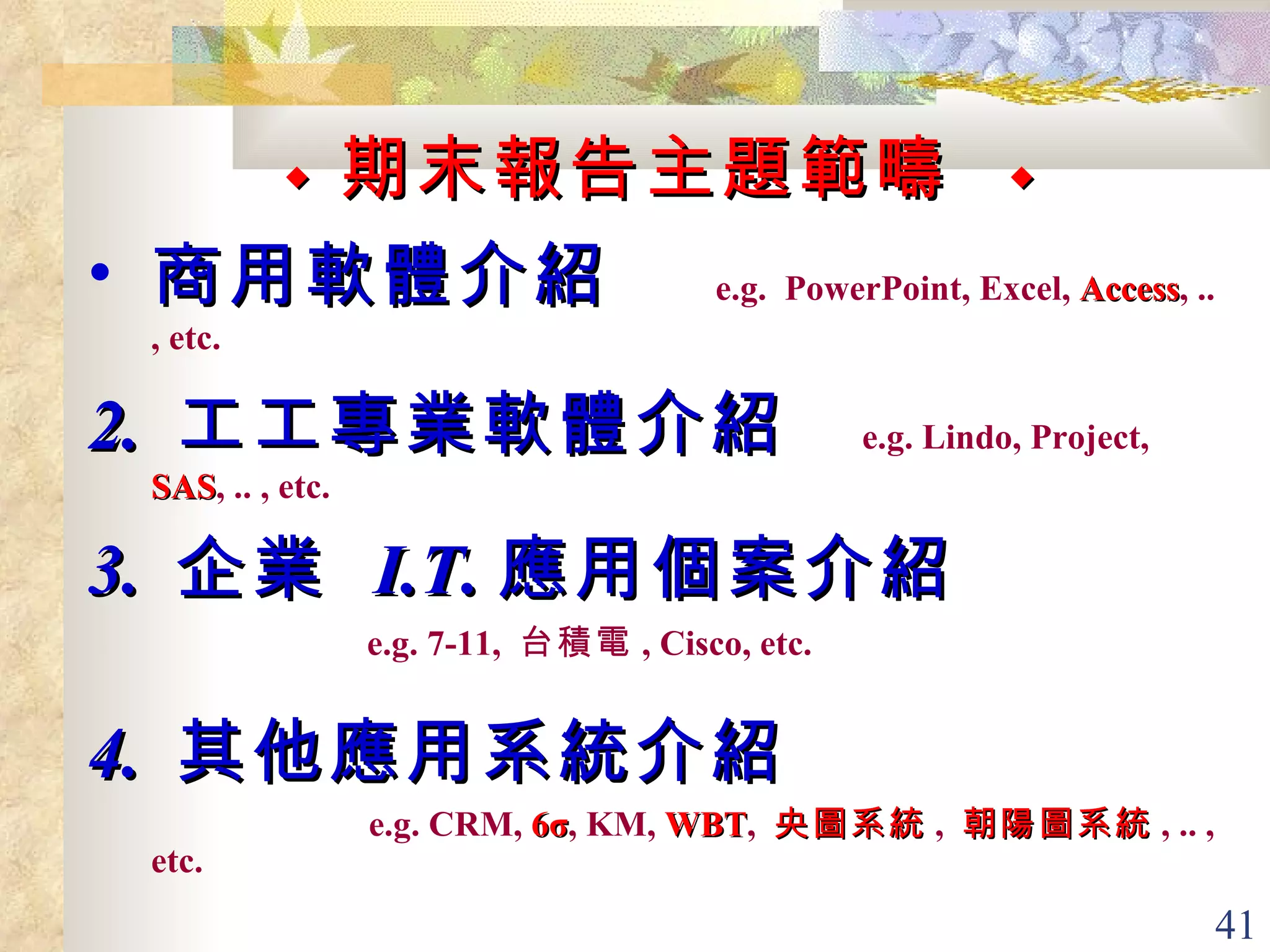
◆  期末報告主題範疇   ◆ 商用軟體介紹  e.g.  PowerPoint, Excel,  Access , .. , etc. 2.  工工專業軟體介紹  e.g. Lindo, Project,  SAS , .. , etc. 3.  企業  I.T. 應用個案介紹  e.g. 7-11,  台積電 , Cisco, etc.   4.  其他應用系統介紹  e.g. CRM,   6σ , KM,  WBT ,  央圖系統 ,  朝陽圖系統 , .. , etc.
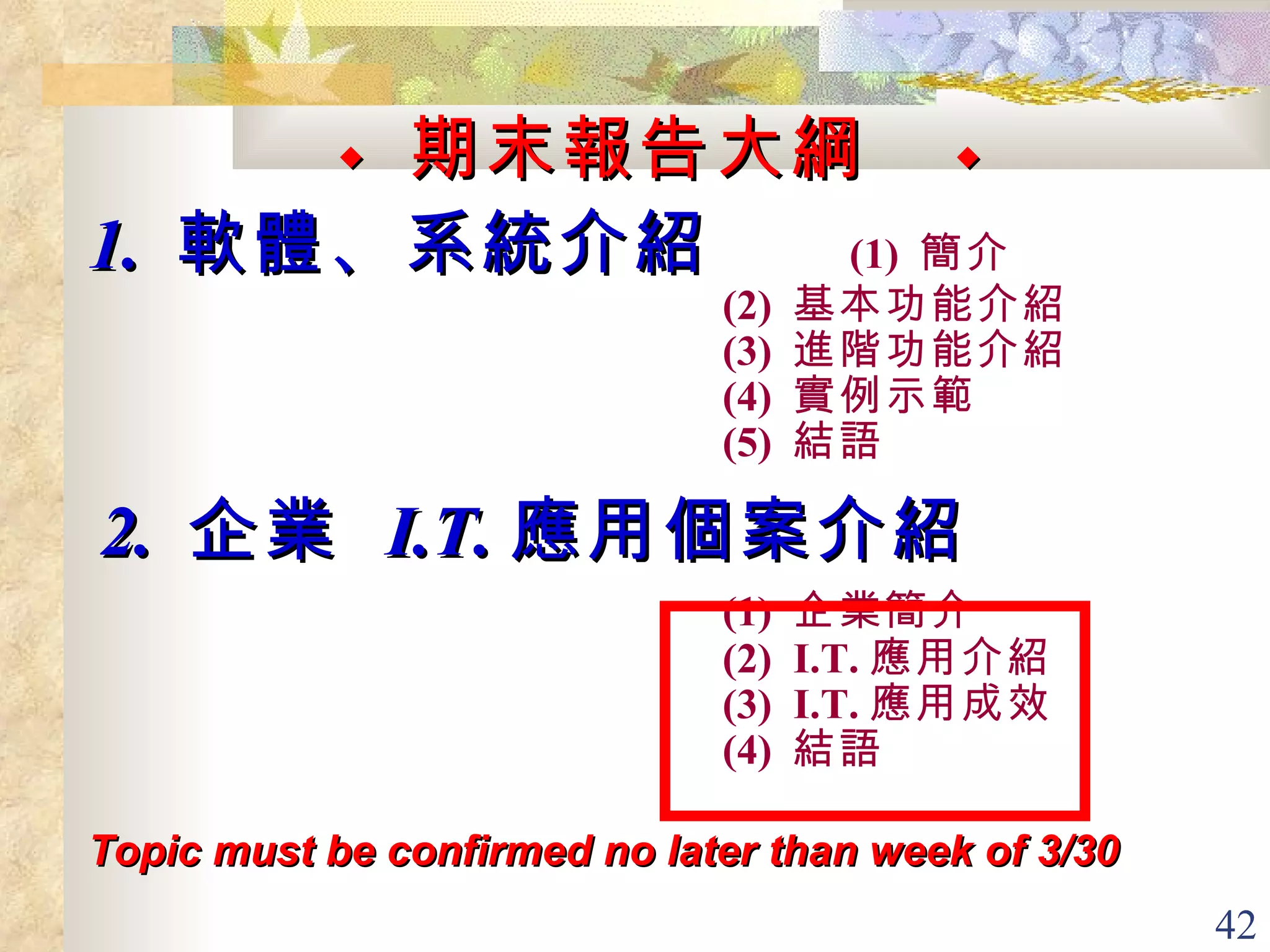
◆  期末報告大綱   ◆ 1.  軟體、系統介紹  (1)  簡介  (2)  基本功能介紹 (3)  進階功能介紹 (4)  實例示範 (5)  結語 2.  企業  I.T. 應用個案介紹  (1)  企業簡介 (2)  I.T. 應用介紹 (3)  I.T. 應用成效 (4)  結語   Topic must be confirmed no later than week of 3/30
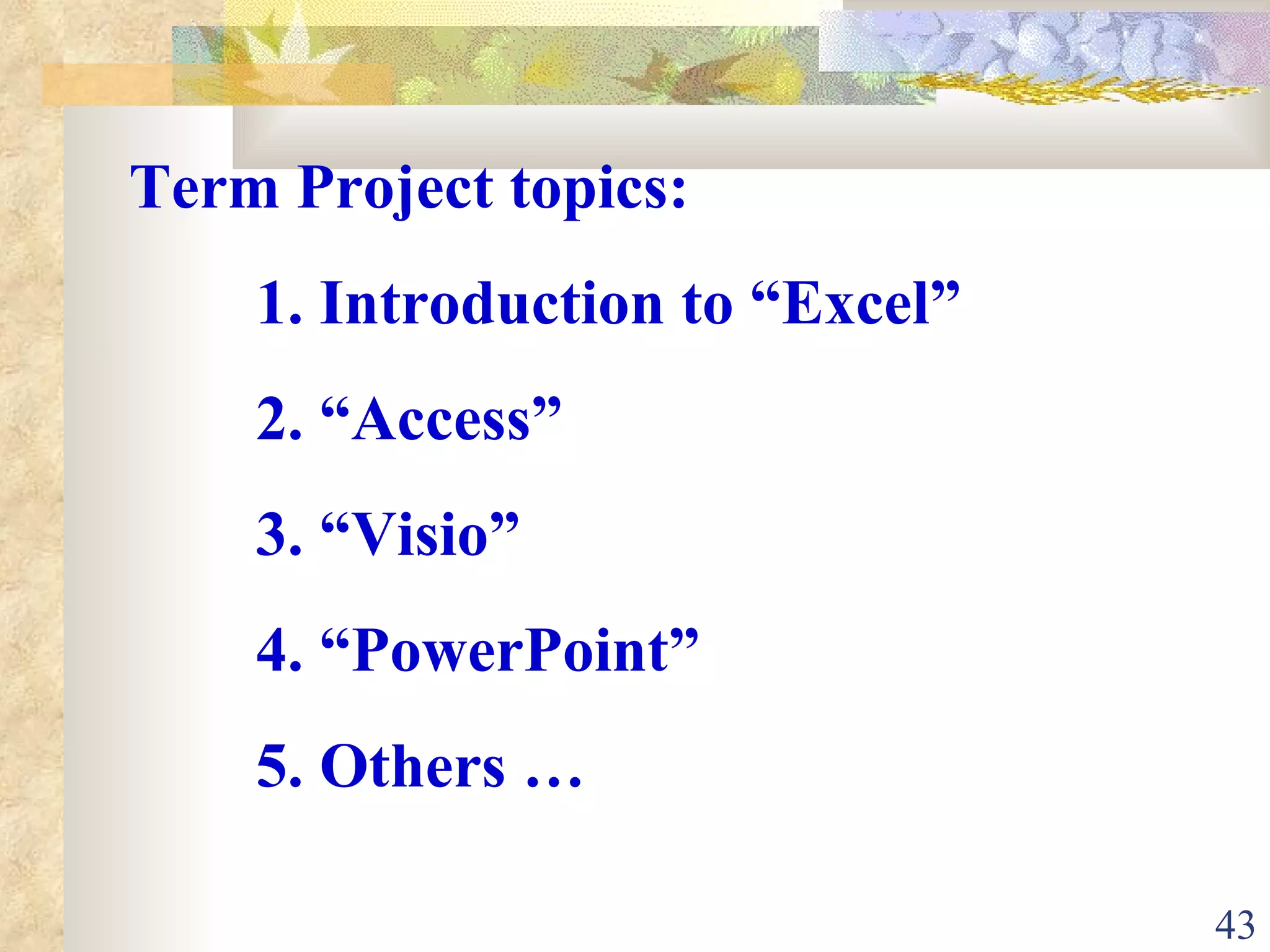
Term Project topics: 1. Introduction to “Excel” 2. “Access” 3. “Visio” 4. “PowerPoint” 5. Others …

Managing the digital firm

  • 1.
    Management InformationSystems - Chapter 1 By: Prof. Y. Peter Chiu 2 / 2009
  • 2.
    Chapter 1 Managingthe Digital Firm 1.1 Why Information Systems ? 1.2 Contemporary Approaches to Information System 1.3 Toward the Digital Firm: The New Role of Information Systems in Organizations 1.4 Learning to Use Information Systems: New Opportunities with Technology
  • 3.
    1.1 WhyInformation Systems Four powerful worldwide changes have altered the business environment : Emergence of the Global Economy Transformation of Industrial Economies Transformation of the Business Enterprise The Emerging Digital Firm
  • 4.
    Management & controlin a global marketplace Competition in world markets Global work groups Global delivery systems 1.1 Why Information Systems Globalization
  • 5.
    Knowledge- and information-basedeconomies New products and services Knowledge : A central productive and strategic asset Time-based competition Shorter product life Turbulent environment Limited employee knowledge base 1.1 Why Information Systems Transformation of Industrial Economies
  • 6.
    Fig 1-1: The growth of the information economy
  • 7.
    Flattening Decentralization FlexibilityLocation Independence Low Transaction & Coordination Costs Empowerment Collaborative work and teamwork 1.1 Why Information Systems Transformation of the Enterprise
  • 8.
    Digitally enabled relationshipswith customers, suppliers, and employees Core business processes accomplished via digital networks Digital management of key corporate assets Rapid sensing and responding to environmental changes 1.1 Why Information Systems Emergence of the Digital Firm
  • 9.
    1.1 WhyInformation Systems Emergence of the Global Economy Transformation of Industrial Economies Transformation of the Business Enterprise The Emerging Digital Firm
  • 10.
    Fig 1-3: Function of an information system
  • 11.
    Using information systemeffectively requires an understanding of the Organization , Management , Information Technology Fig 1-4
  • 12.
    Organization People StructureOperating procedures Politics Culture ◆
  • 13.
    Major Organizational FunctionsSales & Marketing Manufacturing Finance Accounting Human Resources
  • 14.
  • 15.
    Management set theorganizational strategy allocate the financial resources allocate the human resources coordinate the work leadership create new products or new services re-create organization from time to time
  • 16.
    Technology tools tomanagers glue that holds the organization together Computer hardware Computer software Storage technology Telecommunications technology Information technology Infrastructure
  • 17.
    1.2 ContemporaryApproaches to Information Systems Technical approach Behavioral approach
  • 18.
    Fig 1-5: Contemporary approaches to information system .
  • 19.
    Technical approach Theoriesof computability Methods of computation Methods of efficient data storage and access Models for decision making Management practices Computer science Management science
  • 20.
    Technical approach Mathematicaltechniques for optimizing selected parameters of organizations, such as transportation , inventory control , etc. Operations research
  • 21.
    Behavioral Approach SociologyPsychology Economics Development of systems System affect individual, groups, and organization. How human decision makers perceive and use formal information . Impacts to firm and within markets - on control - cost structures
  • 22.
    Socio-Technical Systems SOURCE:Liker, et al, 1987 Figure 1-6
  • 23.
    Optimize systems performance:Technology and organization Organizations mutually adjust to one another until fit is satisfactory Socio-Technical Systems ◆
  • 24.
    1.3 Toward theDigital Firm: The New Role of I.S. in Organizations The widening scope of I.S. The network revolution and the internet New options for organizational design: The Digital Firm and the Collaborative Enterprise The Digital Firm: E-commerce, E-business, and New Digital Relationships ▲ 2
  • 25.
    Fig 1-7: The interdependence between organizations and information systems 1.3.1 The widening scope of I.S.
  • 26.
    Fig 1-8: The widening scope of information systems . 1.3.1 The widening scope of I.S.
  • 27.
    Information Systems Itaffects the organization and its employees, and how they can make business more competitive and efficient . It has become essential for creating competitive firms , managing global corporations , and providing useful products and services to customers.
  • 28.
    What you cando on the internet? Communicate & collaborate Access information Participate in discussions Supply information Find entertainment Exchange business transactions 1.3.2 The network revolution and the internet
  • 29.
  • 30.
    INTERNET International networkof networks that is a collection of hundreds of thousands of private and public networks. World Wide Web (WWW) A system with universally accepted standards for storing, retrieving, formatting, and displaying information in a networked environment. 1.3.2 The network revolution and the internet
  • 31.
    1.3.3 New Optionsfor Organizational Design The Digital Firm and the Collaborative Enterprise Flattening Organizations and the Changing Management Processes Separating Work from Location Reorganizing Work Flows Increasing Flexibility of Organizations Redefining Organizational Boundaries ▲ 1
  • 32.
    Flattening Organizations InformationSystems 1.3.3 New Options for Organizational Design Figure 1-9
  • 33.
    Redesigned Work FlowFor Insurance Underwriting 1.3.3 New Options for Organizational Design Figure 1-10
  • 34.
    Electronic market Amarketplace that is created by computer and communication technologies that link many buyers and sellers . E-commerce, E-business, and New Digital Relationships 1.3.4 The Digital Firm
  • 35.
    Electronic Commerce Theprocess of buying and selling goods and services electronically involving transactions using the internet, networks, and other digital technologies. Internet Links Buyers, Sellers Lower Transaction Costs Goods & Services Advertised, Bought, Exchanged Worldwide Business-to-Business Transactions Increasing 1.3.4 The Digital Firm
  • 36.
    Electronic Business Theuse of the Internet and other digital technology for organizational communication and coordination and the management of the firm. Intranet An internal network based on Internet and World Wide Web technology and standards . 1.3.4 The Digital Firm
  • 37.
  • 38.
    1.4 Learningto Use Information Systems: New Opportunities with Technology Strategic: competitive & effective Globalization: multinational info Info architecture: support goals Investment: value of information Responsibility & control: ethics Challenge of Information Systems: Key Management Issues
  • 39.
    Figure 1-12 InformationArchitecture and Information Technology Infrastructure
  • 40.
    HOMEWORK Chap. 1 #1 Describe four trends in the global business environment that have made information systems so important. #2 What are the organization, management, and technology dimensions of information systems? #3 Name and describe major organizational functions. #4 Distinguish major disciplines of the behavior and the technical approach to information systems. #5 Describe briefly what information systems are. #6 Describe some of the major changes that information systems are bringing to organizations. #7 Define E-Commerce, E-Business, and Intranet. #8 What are the key management challenges involved in building, operating, and maintaining information systems today? ~ THE END ~
  • 41.
    ◆ 期末報告主題範疇 ◆ 商用軟體介紹 e.g. PowerPoint, Excel, Access , .. , etc. 2. 工工專業軟體介紹 e.g. Lindo, Project, SAS , .. , etc. 3. 企業 I.T. 應用個案介紹 e.g. 7-11, 台積電 , Cisco, etc. 4. 其他應用系統介紹 e.g. CRM, 6σ , KM, WBT , 央圖系統 , 朝陽圖系統 , .. , etc.
  • 42.
    ◆ 期末報告大綱 ◆ 1. 軟體、系統介紹 (1) 簡介 (2) 基本功能介紹 (3) 進階功能介紹 (4) 實例示範 (5) 結語 2. 企業 I.T. 應用個案介紹 (1) 企業簡介 (2) I.T. 應用介紹 (3) I.T. 應用成效 (4) 結語 Topic must be confirmed no later than week of 3/30
  • 43.
    Term Project topics:1. Introduction to “Excel” 2. “Access” 3. “Visio” 4. “PowerPoint” 5. Others …