McGraw-Hill/Irwin Copyright © 2008, The McGraw-Hill Companies, Inc. All rights reserved.
McGraw-Hill/Irwin Copyright © 2008 by The McGraw-Hill Companies, Inc. All rights reserved.
McGraw-Hill/Irwin Copyright © 2008, The McGraw-Hill Companies, Inc. All rights reserved.
Competing with
Information Technology
Chapter
2
2-3
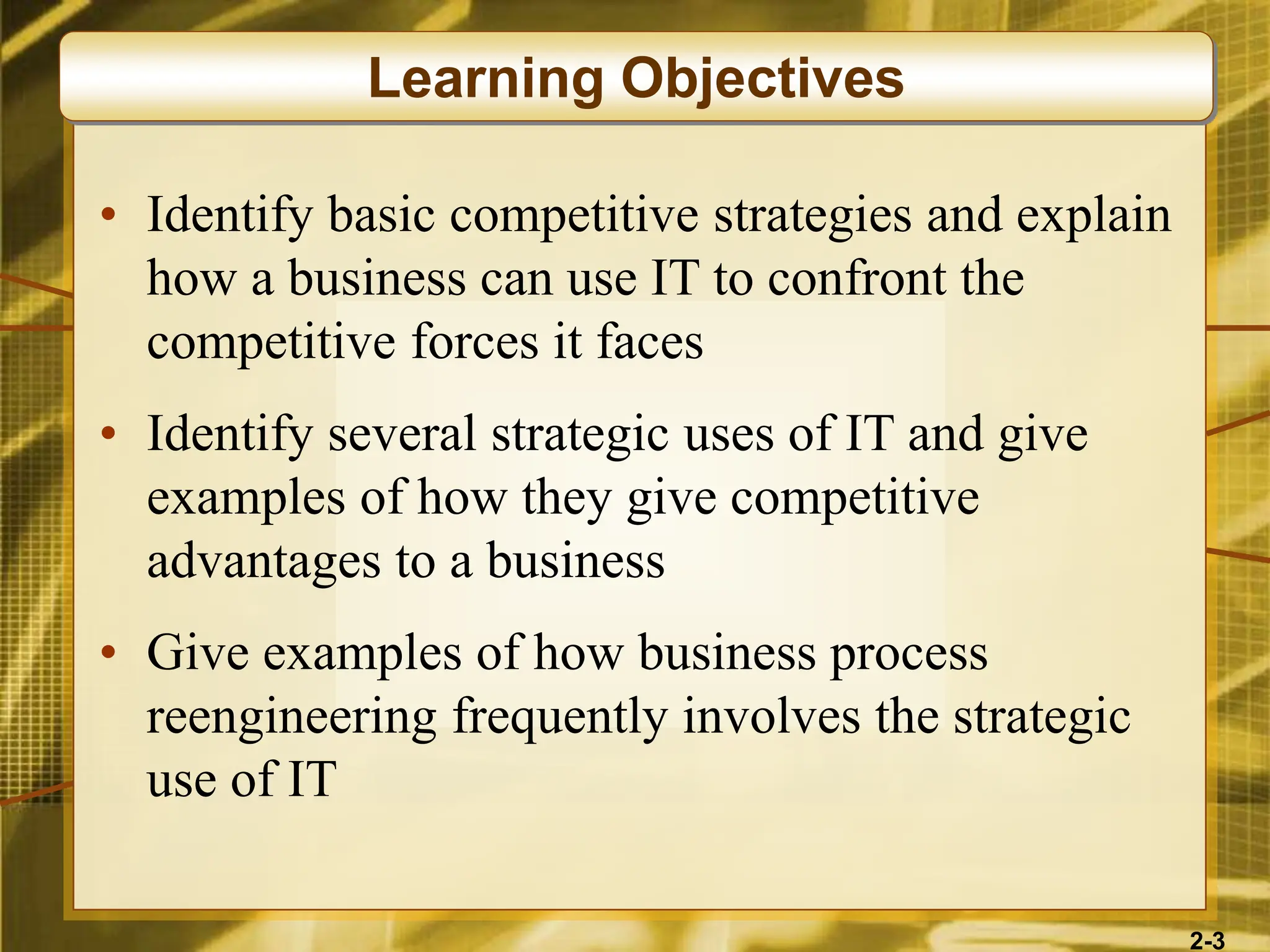
• Identify basic competitive strategies and explain
how a business can use IT to confront the
competitive forces it faces
• Identify several strategic uses of IT and give
examples of how they give competitive
advantages to a business
• Give examples of how business process
reengineering frequently involves the strategic
use of IT
Learning Objectives
2-4
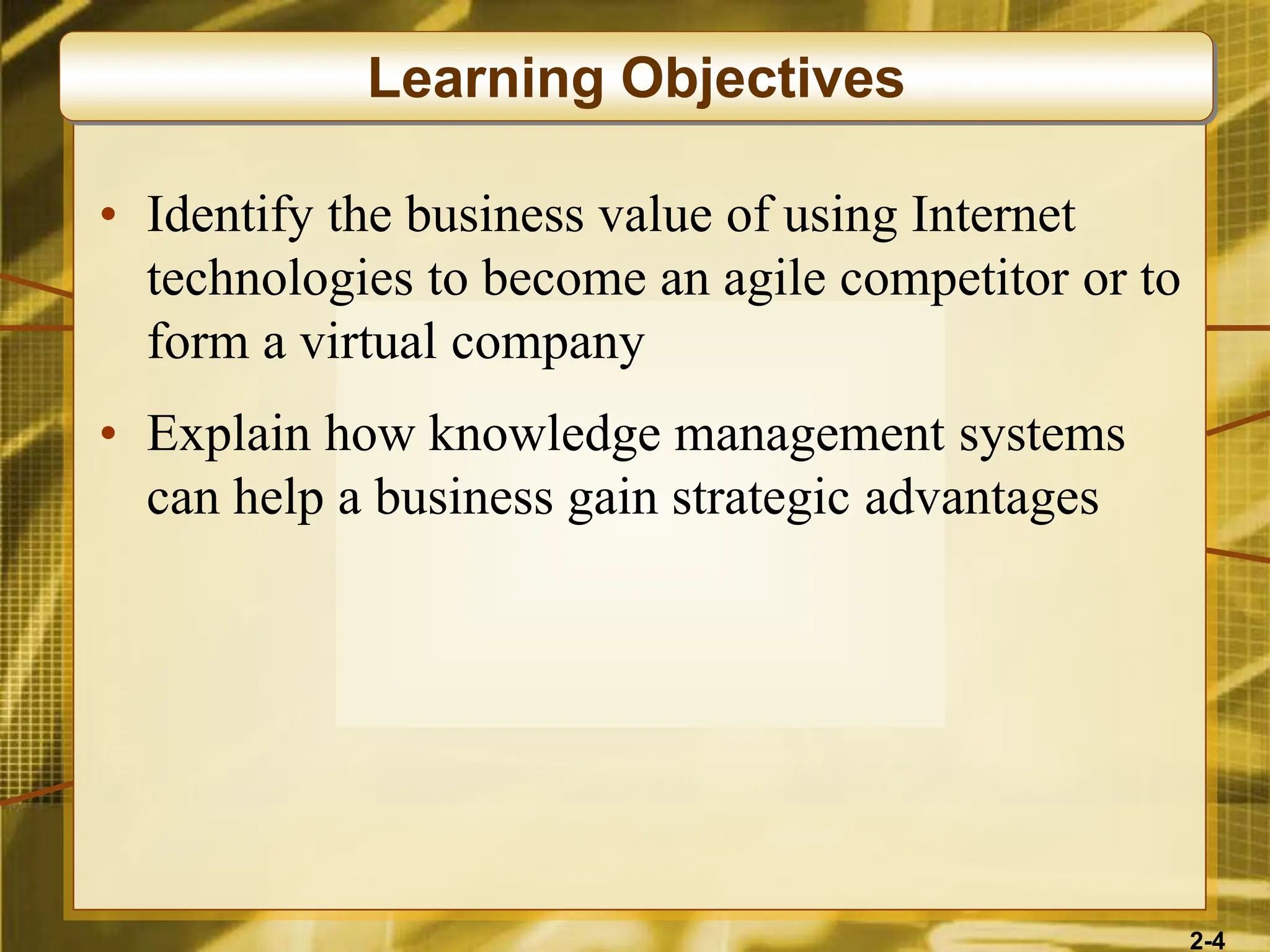
• Identify the business value of using Internet
technologies to become an agile competitor or to
form a virtual company
• Explain how knowledge management systems
can help a business gain strategic advantages
Learning Objectives
2-5
• Technology is no longer an afterthought in
business strategy, but the cause and driver
• IT can change the way businesses compete
• A strategic information system is any
information system that uses IT to help an
organization…
• Gain a competitive advantage
• Reduce a competitive disadvantage
• Or meet other strategic enterprise objectives
Strategic IT
2-6
• Does IT matter?
• No
• Nicholas Carr argues that IT is infrastructure, much
like electricity
• Too commonplace to offer a competitive advantage
• Yes
• It is not just networks and computers
• The important part is the software and information
and how IT is used
Case 1: GE, Dell, Intel, GM and Others
2-7
• Do you agree with the argument made by
Nicholas Carr to support his position that IT
no longer gives companies a competitive
advantage?
• Do you agree with the argument made in support
of the competitive advantage that IT can provide
to a business?
• What are several ways that IT could provide
competitive advantage to a business?
Case Study Questions
2-8
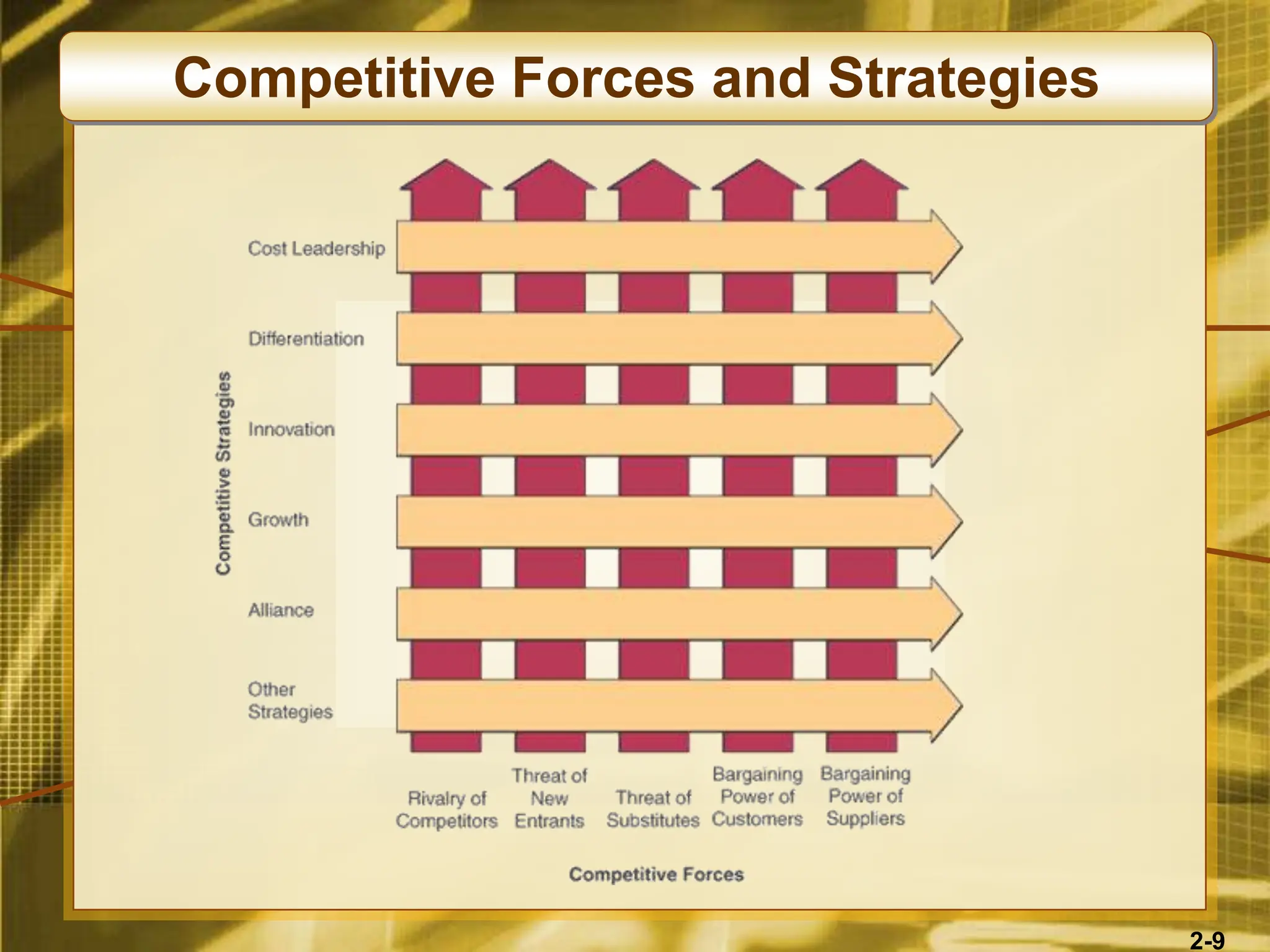
• To succeed, a business must develop strategies to
counter these forces…
• Rivalry of competitors within its industry
• New entrants into an industry and its markets
• Substitute products that may capture market share
• Bargaining power of customers
• Bargaining power of suppliers
Competitive Forces
2-9
Competitive Forces and Strategies
2-10
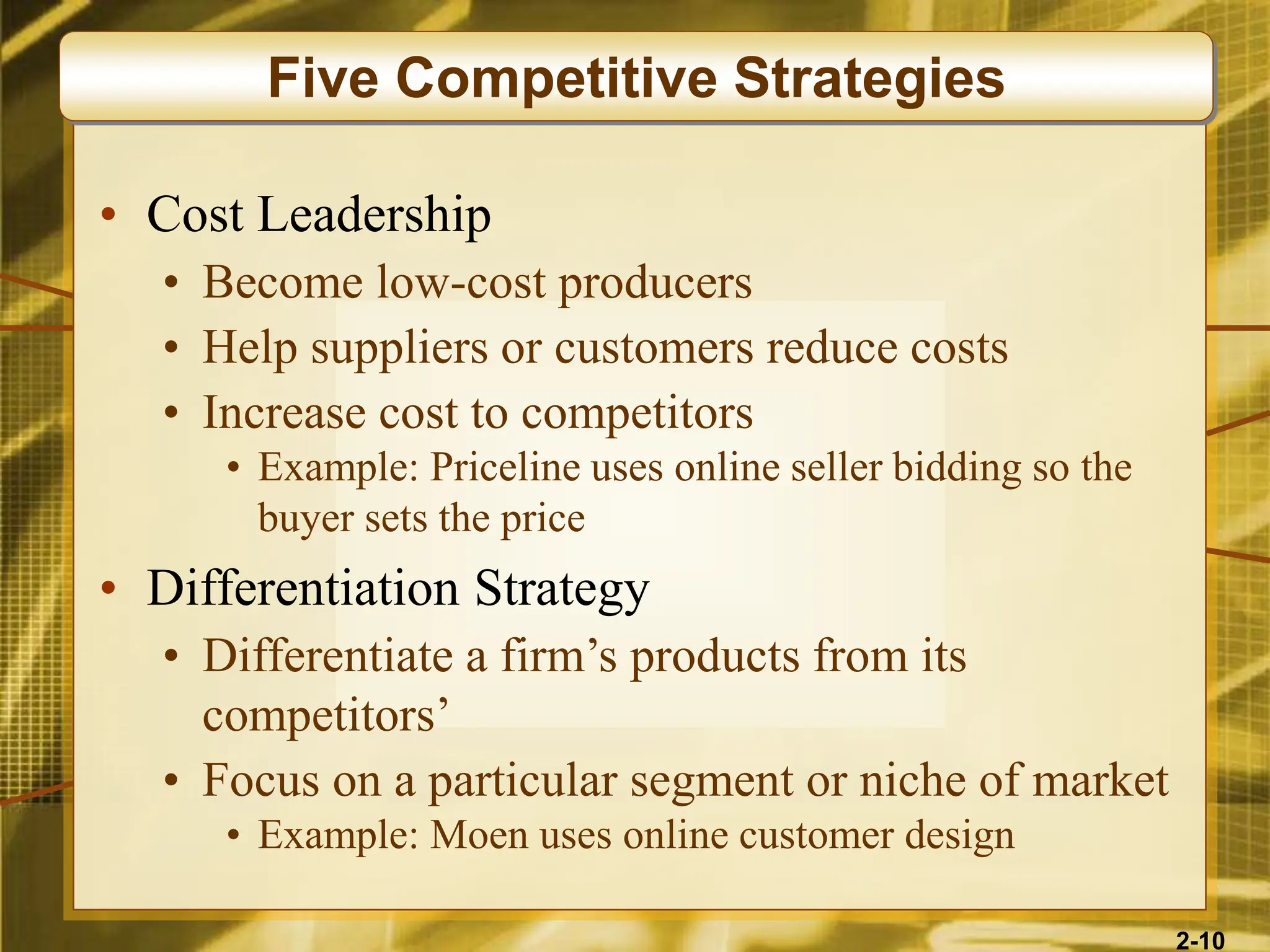
• Cost Leadership
• Become low-cost producers
• Help suppliers or customers reduce costs
• Increase cost to competitors
• Example: Priceline uses online seller bidding so the
buyer sets the price
• Differentiation Strategy
• Differentiate a firm’s products from its
competitors’
• Focus on a particular segment or niche of market
• Example: Moen uses online customer design
Five Competitive Strategies
2-11
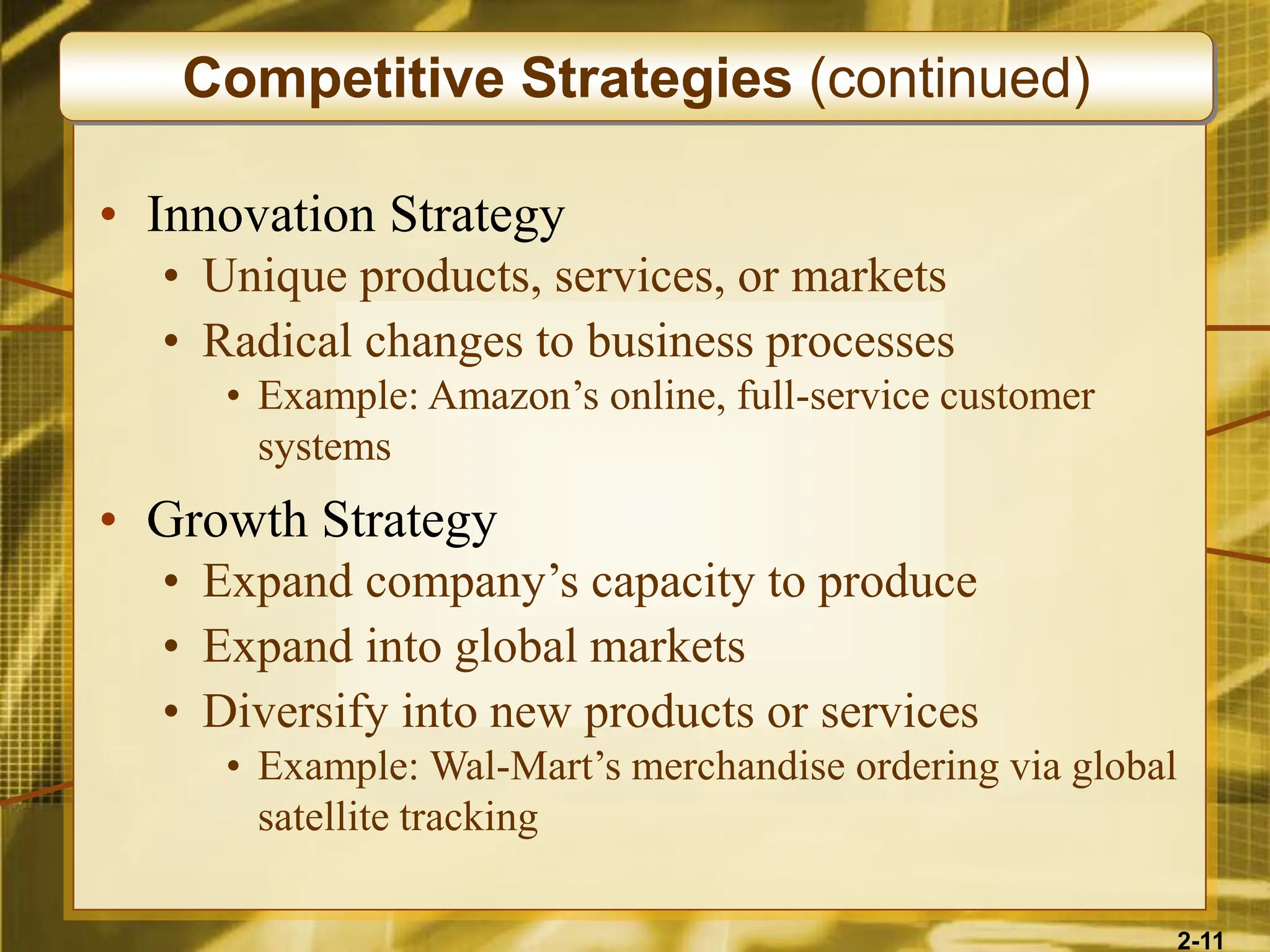
• Innovation Strategy
• Unique products, services, or markets
• Radical changes to business processes
• Example: Amazon’s online, full-service customer
systems
• Growth Strategy
• Expand company’s capacity to produce
• Expand into global markets
• Diversify into new products or services
• Example: Wal-Mart’s merchandise ordering via global
satellite tracking
Competitive Strategies (continued)
2-12
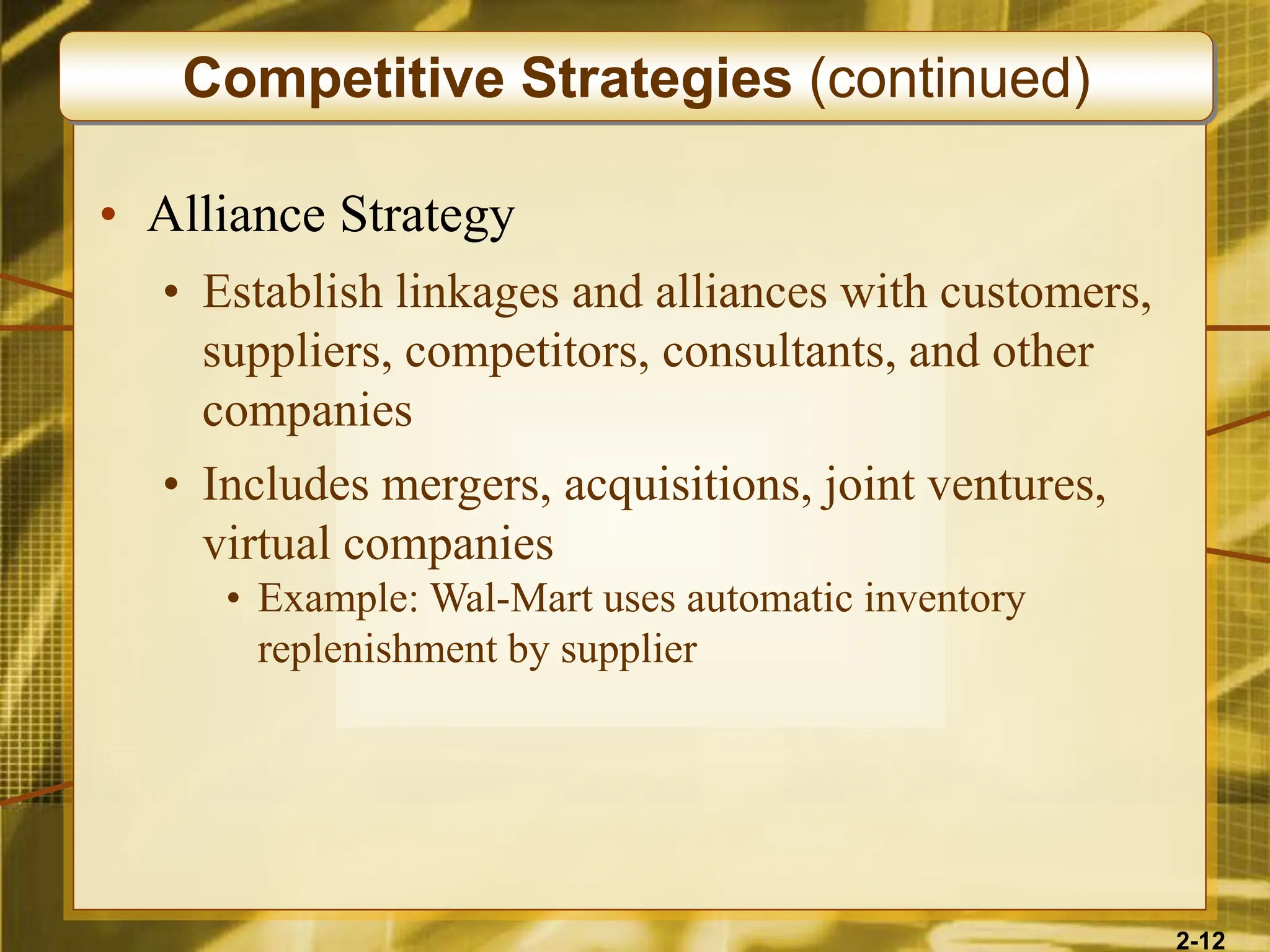
• Alliance Strategy
• Establish linkages and alliances with customers,
suppliers, competitors, consultants, and other
companies
• Includes mergers, acquisitions, joint ventures,
virtual companies
• Example: Wal-Mart uses automatic inventory
replenishment by supplier
Competitive Strategies (continued)
2-13
• These strategies are not mutually exclusive
• Organizations use one, some, or all
• A given activity could fall into one or more
categories of competitive strategy
• Not everything innovative serves to differentiate
one organization from another
• Likewise, not everything that differentiates
organizations is necessarily innovative
Using Competitive Strategies
2-14
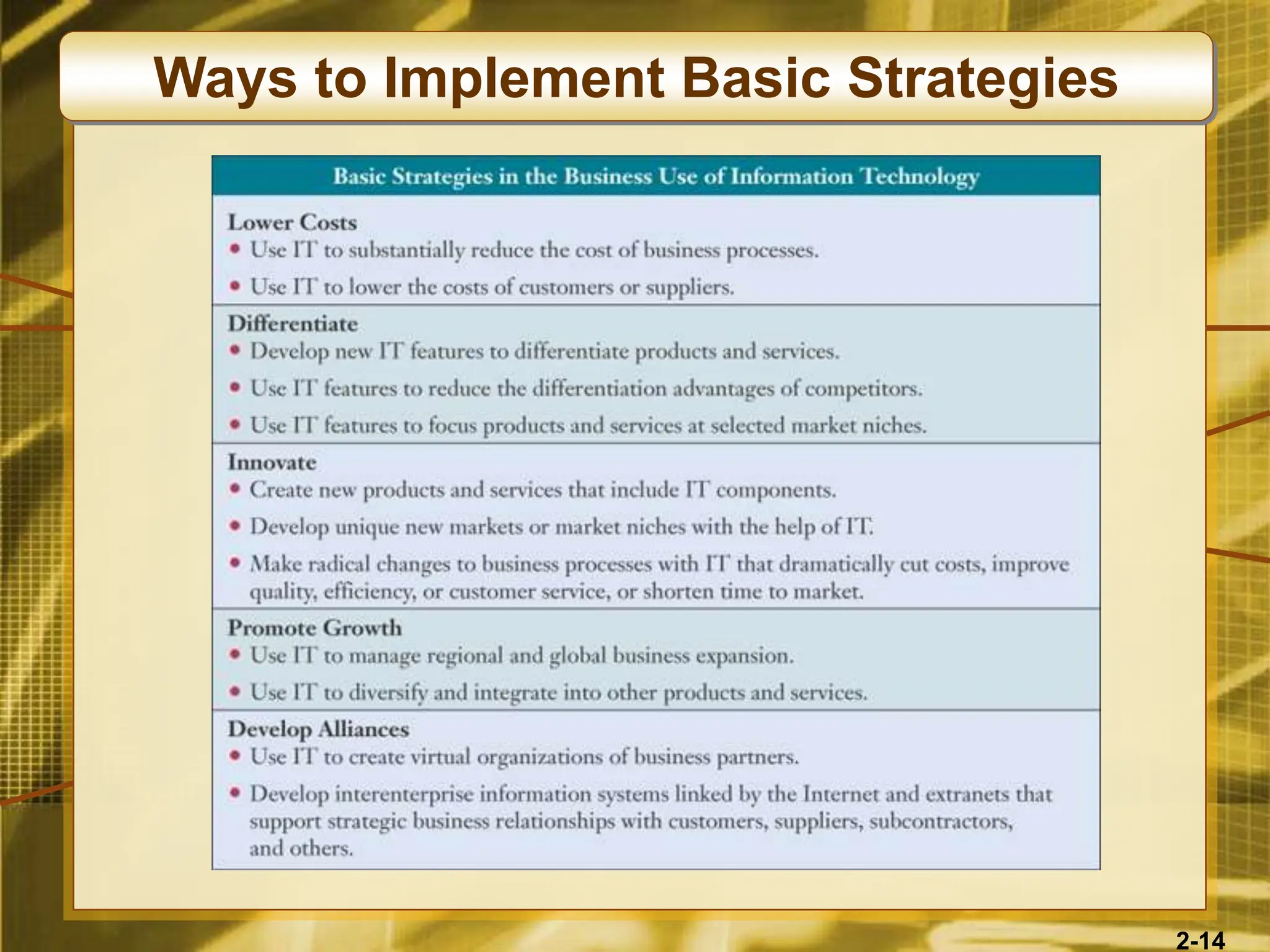
Ways to Implement Basic Strategies
2-15
• Lock in Customers and Suppliers
• Deter them from switching to competitors
• Build in Switching Costs
• Make customers and suppliers dependent on the
use of innovative IS
• Erect Barriers to Entry
• Discourage or delay other companies from
entering the market
• Increase the technology or investment needed to
enter
Other Competitive Strategies
2-16
• Build Strategic IT Capabilities
• Take advantage of strategic opportunities when
they arise
• Improve efficiency of business practices
• Leverage Investment in IT
• Develop products and service that would not be
possible without a strong IT capability
Other Competitive Strategies
2-17
• What is the business value in being customer-
focused?
• Keep customers loyal
• Anticipate their future needs
• Respond to customer concerns
• Provide top-quality customer service
• Focus on customer value
• Quality, not price, has become the primary
determinant of value
• Consistently
Customer-Focused Business
2-18
• Companies that consistently offer the best value
from the customer’s perspective…
• Track individual preferences
• Keep up with market trends
• Supply products, services, and information
anytime, anywhere
• Tailor customer services to the individual
• Use Customer Relationship Management (CRM)
systems to focus on the customer
Providing Customer Value
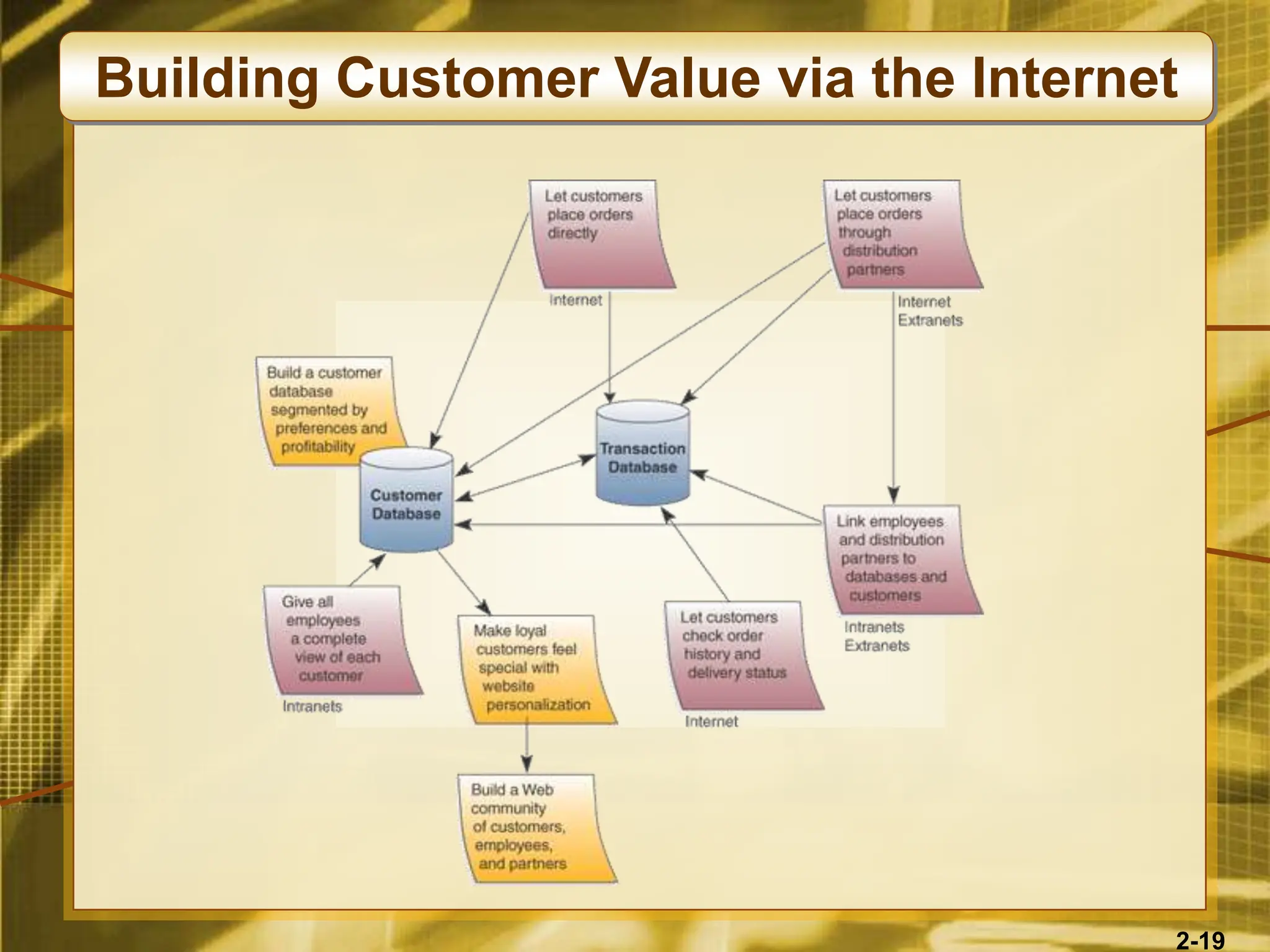
2-19
Building Customer Value via the Internet
2-20
• View the firm as a chain of basic activities that
add value to its products and services
• Primary processes directly relate to
manufacturing or delivering products
• Support processes help support the day-to-day
running of the firm and indirectly contribute to
products or services
• Use the value chain to highlight where
competitive strategies will add the most value
The Value Chain and Strategic IS
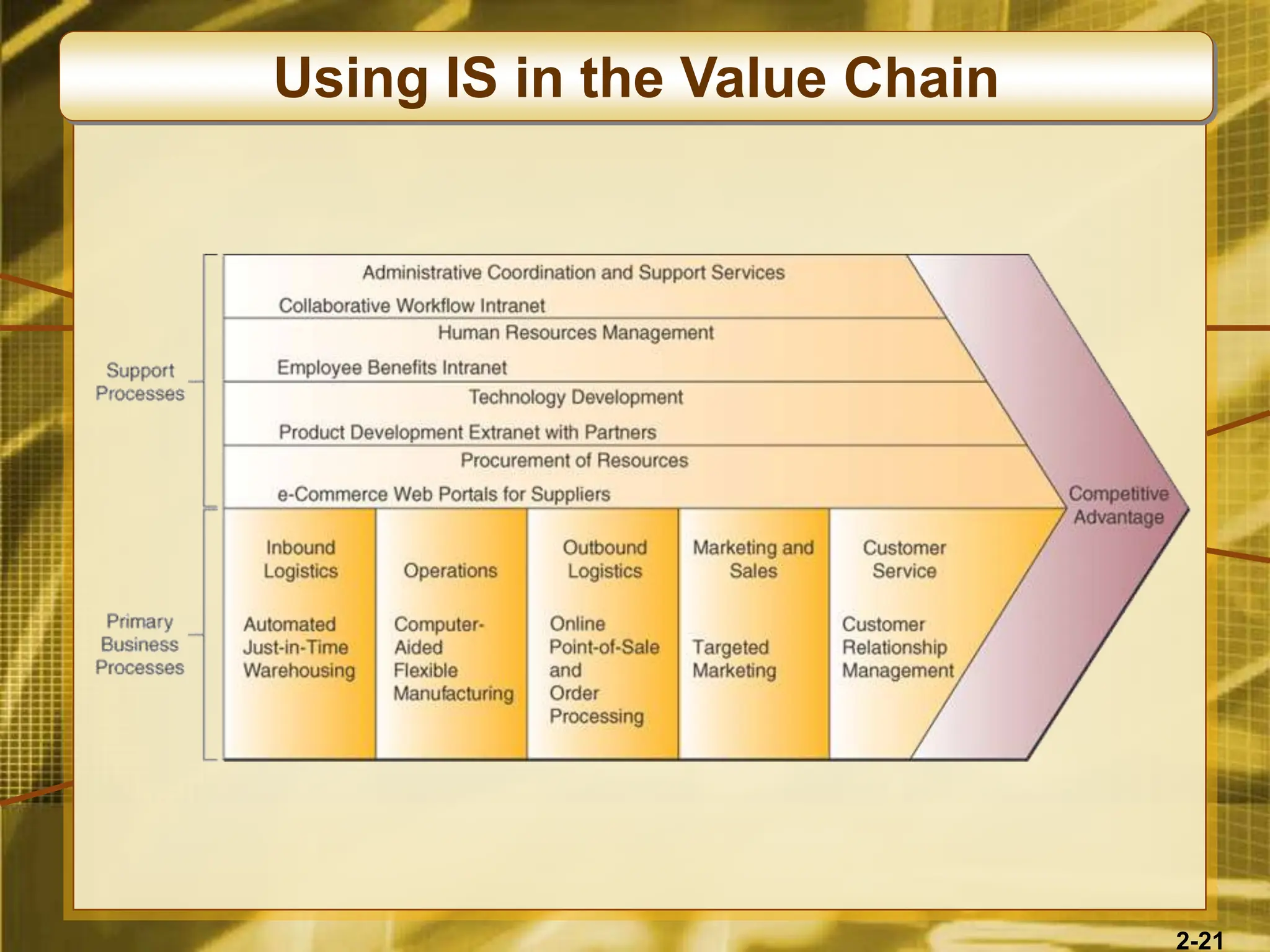
2-21
Using IS in the Value Chain
2-22
• A company that emphasizes strategic business
use of IT would use it to gain a competitive
differentiation
• Products
• Services
• Capabilities
Strategic Uses of IT
2-23
• The Internet rapidly advanced large-scale storage
and data analysis
• Products could be networked and accessed at
customer sites
• Connectivity was cheap
• Unprecedented opportunities for strategic
relationships and returns
Case 2: GE Energy and GE Healthcare
2-24
• GE saw unprecedented opportunities for
strategic relationships and returns
• Invested heavily in remote monitoring and
diagnostics
• Profitability went up
• Created customer dependency
• Has created longer-term customer relationships
Case 2: GE Energy and GE Healthcare
2-25
• What are the business benefits of using IT to
build strategic customer relationships for GE
Energy and GE Healthcare?
• What are the business benefits for their
customers?
• What strategic uses of information technology
do you see implemented in this case?
• How could other companies benefit from the use
of IT to build strategic customer relationships?
Case Study Questions
2-26
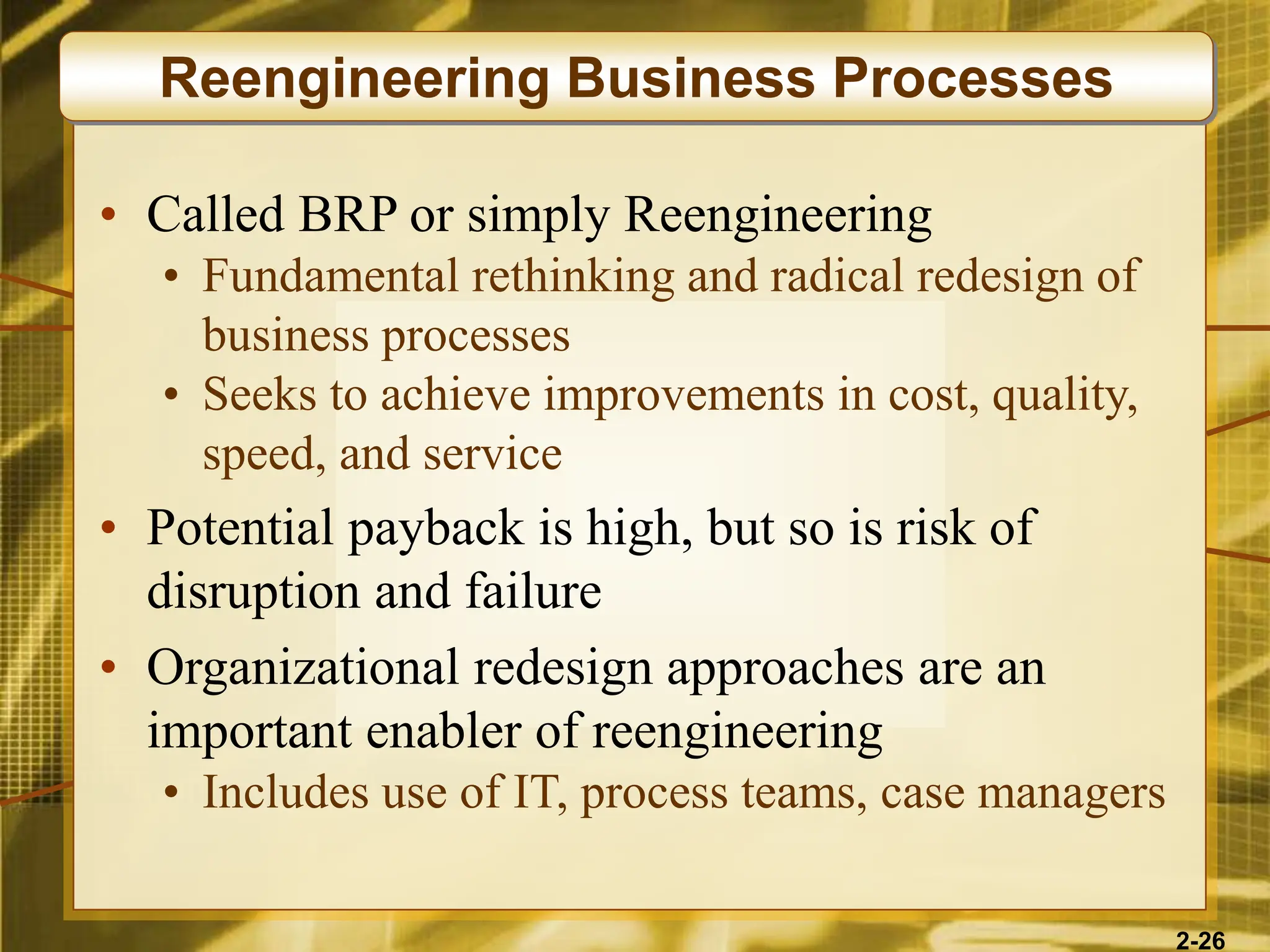
• Called BRP or simply Reengineering
• Fundamental rethinking and radical redesign of
business processes
• Seeks to achieve improvements in cost, quality,
speed, and service
• Potential payback is high, but so is risk of
disruption and failure
• Organizational redesign approaches are an
important enabler of reengineering
• Includes use of IT, process teams, case managers
Reengineering Business Processes
2-27
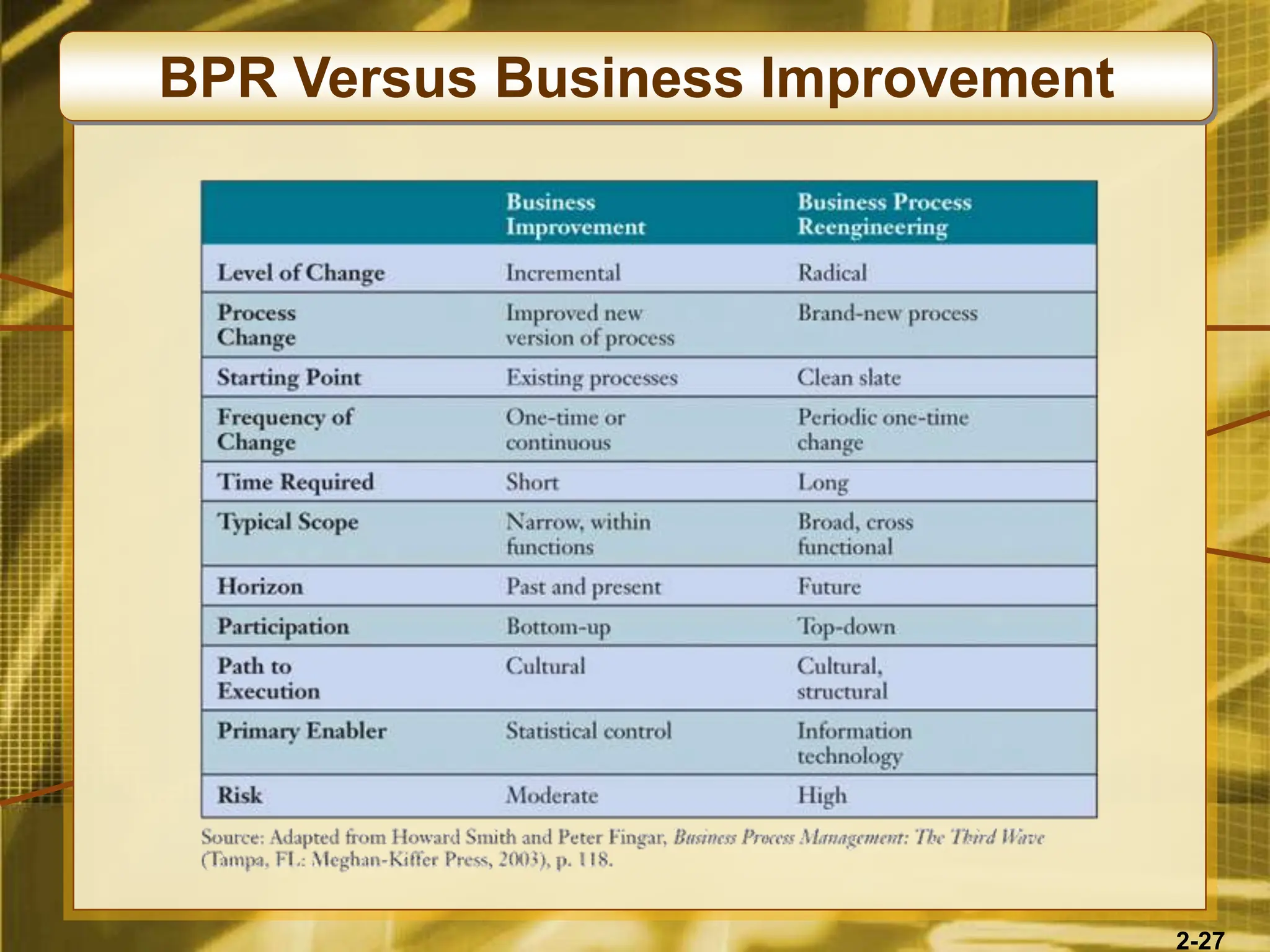
BPR Versus Business Improvement
2-28
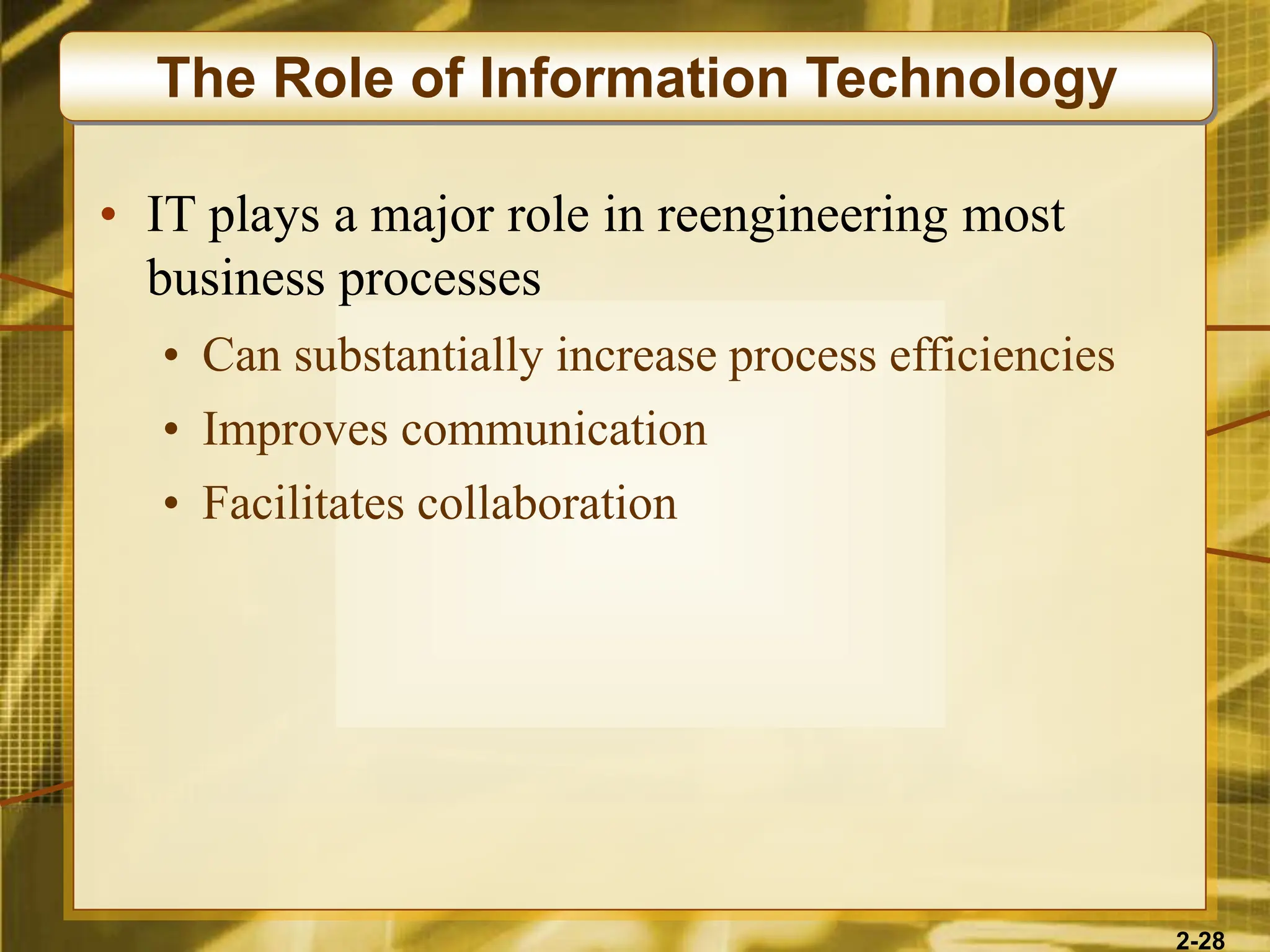
• IT plays a major role in reengineering most
business processes
• Can substantially increase process efficiencies
• Improves communication
• Facilitates collaboration
The Role of Information Technology
2-29
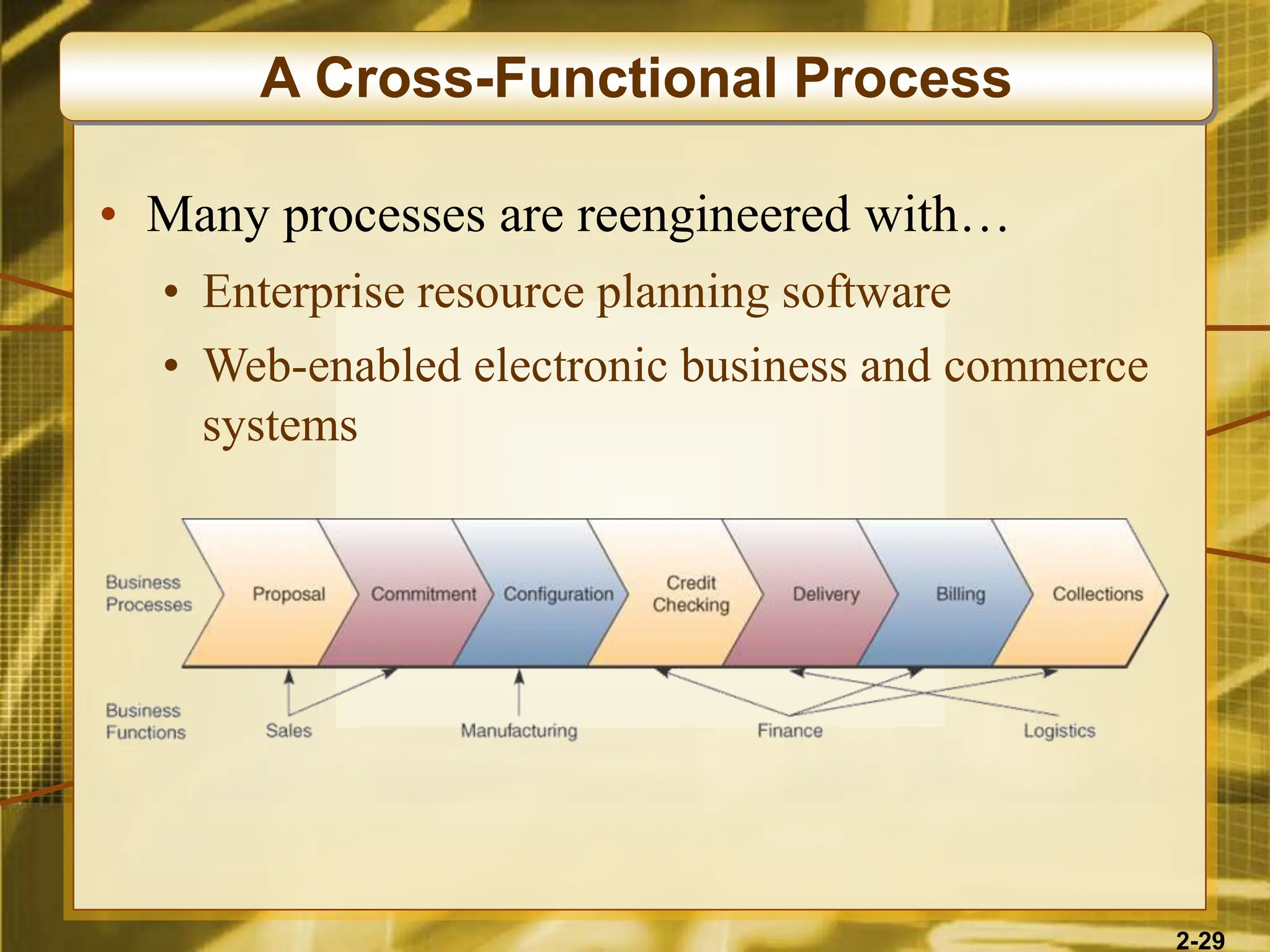
• Many processes are reengineered with…
• Enterprise resource planning software
• Web-enabled electronic business and commerce
systems
A Cross-Functional Process
2-30
• IT that supports this process…
• CRM systems using intranets and the Internet
• Supplier-managed inventory systems using the
Internet and extranets
• Cross-functional ERP software to integrate
manufacturing, distribution, finance, and human
resource processes
• Customer-accessible e-commerce websites for
order entry, status checking, payment, and service
• Customer, product, and order status databases
accessed via intranets and extranets
Reengineering Order Management
2-31
• Agility is the ability to prosper
• In rapidly changing, continually fragmenting
global markets
• By selling high-quality, high-performance,
customer-configured products and services
• By using Internet technologies
• An agile company profits in spite of
• Broad product ranges
• Short model lifetimes
• Individualized products
• Arbitrary lot sizes
Becoming an Agile Company
2-32
• An agile company…
• Presents products as solutions to customers’
problems
• Cooperates with customers, suppliers and
competitors
• Brings products to market as quickly and cost-
effectively as possible
• Organizes to thrive on change and uncertainty
• Leverages the impact of its people and the
knowledge they possess
Strategies for Agility
2-33
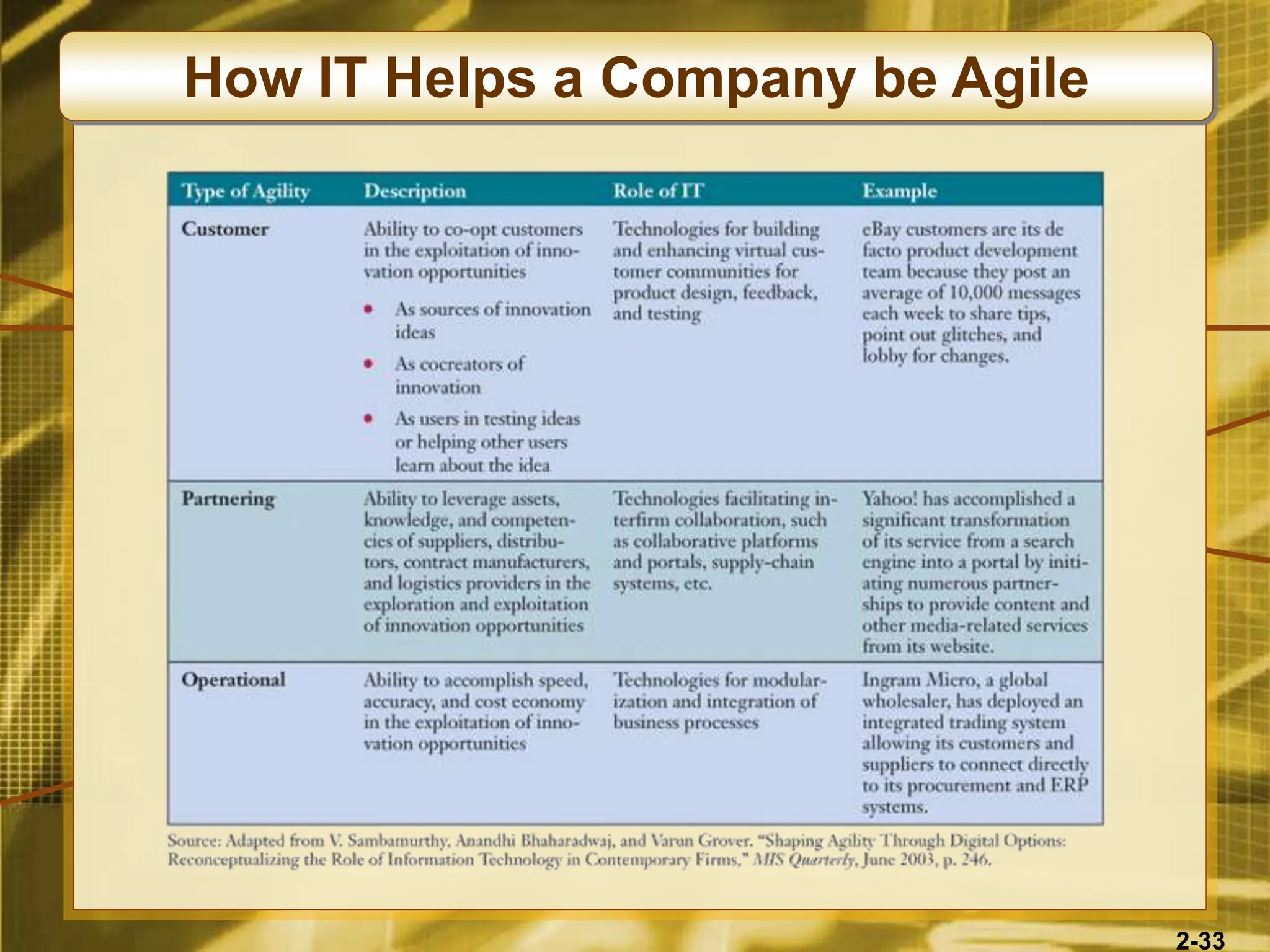
How IT Helps a Company be Agile
2-34
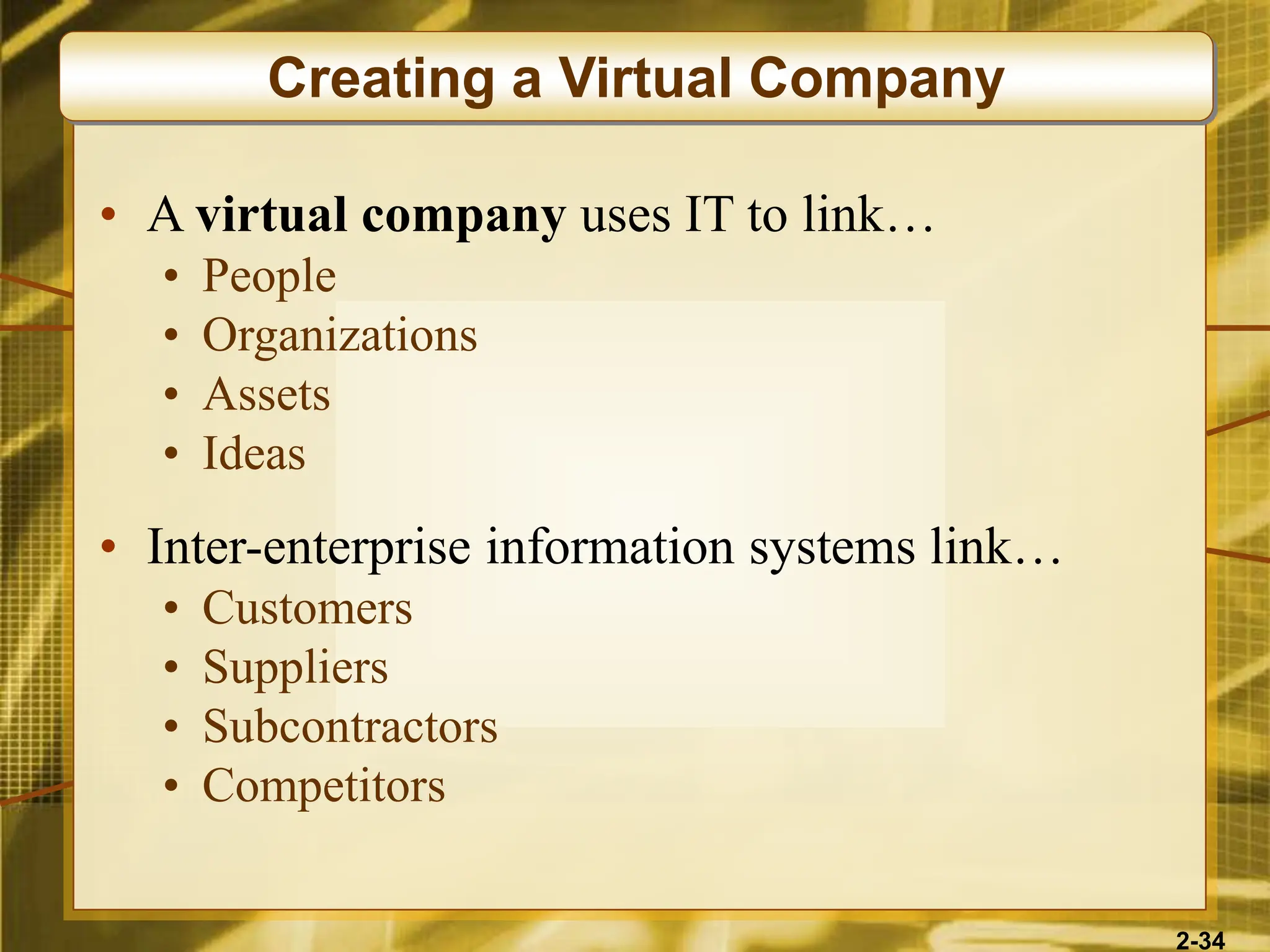
• A virtual company uses IT to link…
• People
• Organizations
• Assets
• Ideas
• Inter-enterprise information systems link…
• Customers
• Suppliers
• Subcontractors
• Competitors
Creating a Virtual Company
2-35
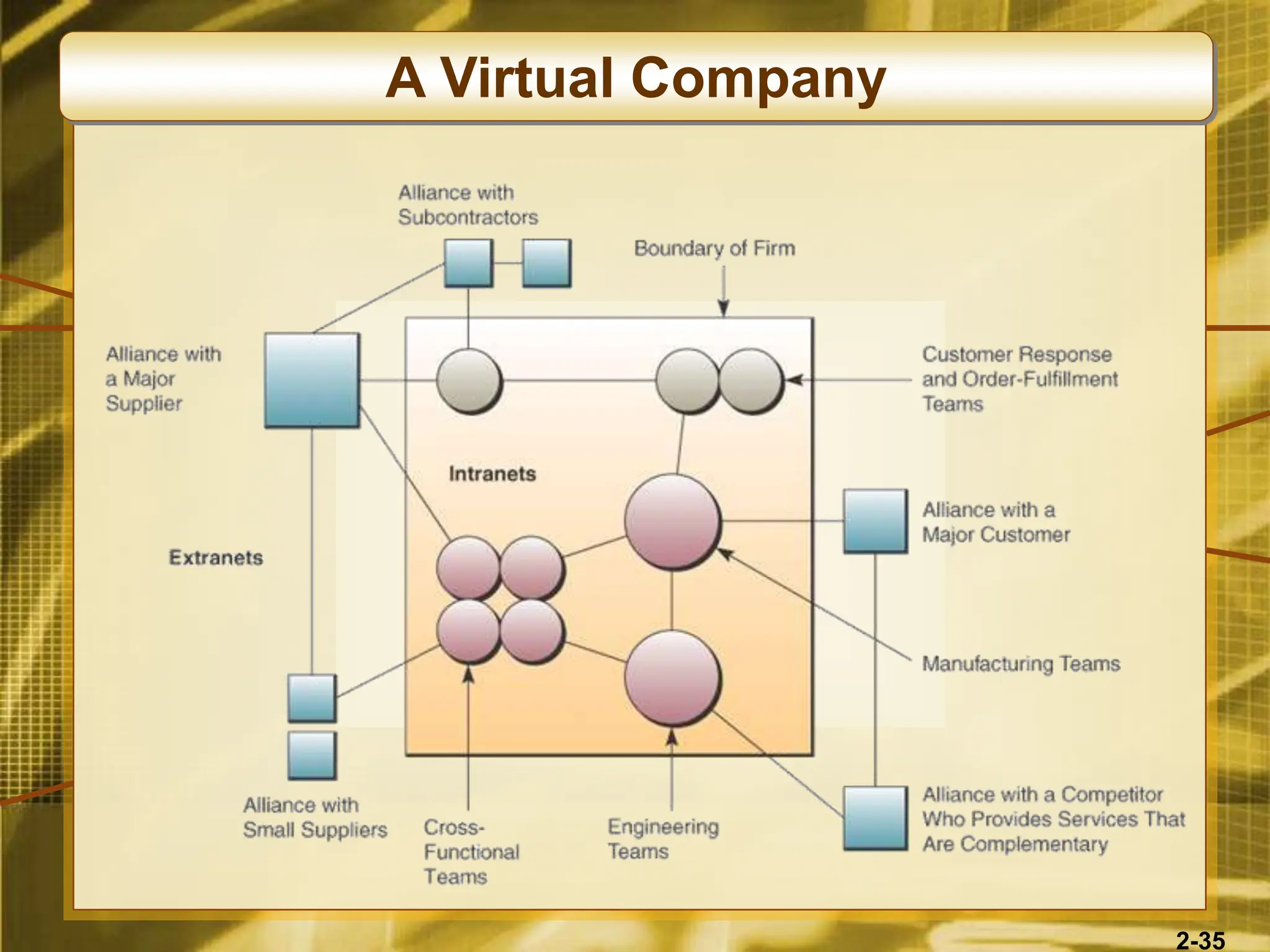
A Virtual Company
2-36
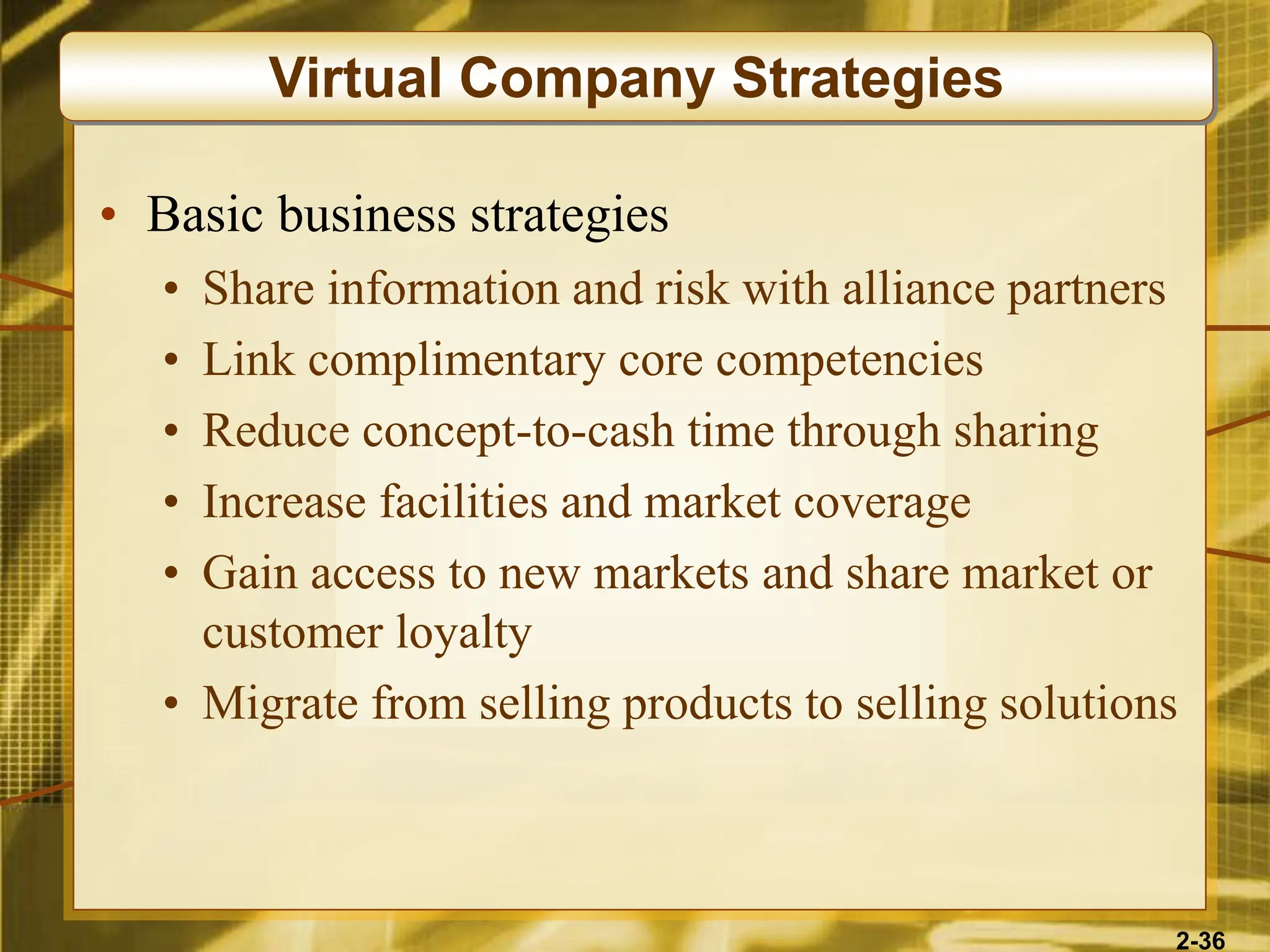
• Basic business strategies
• Share information and risk with alliance partners
• Link complimentary core competencies
• Reduce concept-to-cash time through sharing
• Increase facilities and market coverage
• Gain access to new markets and share market or
customer loyalty
• Migrate from selling products to selling solutions
Virtual Company Strategies
2-37
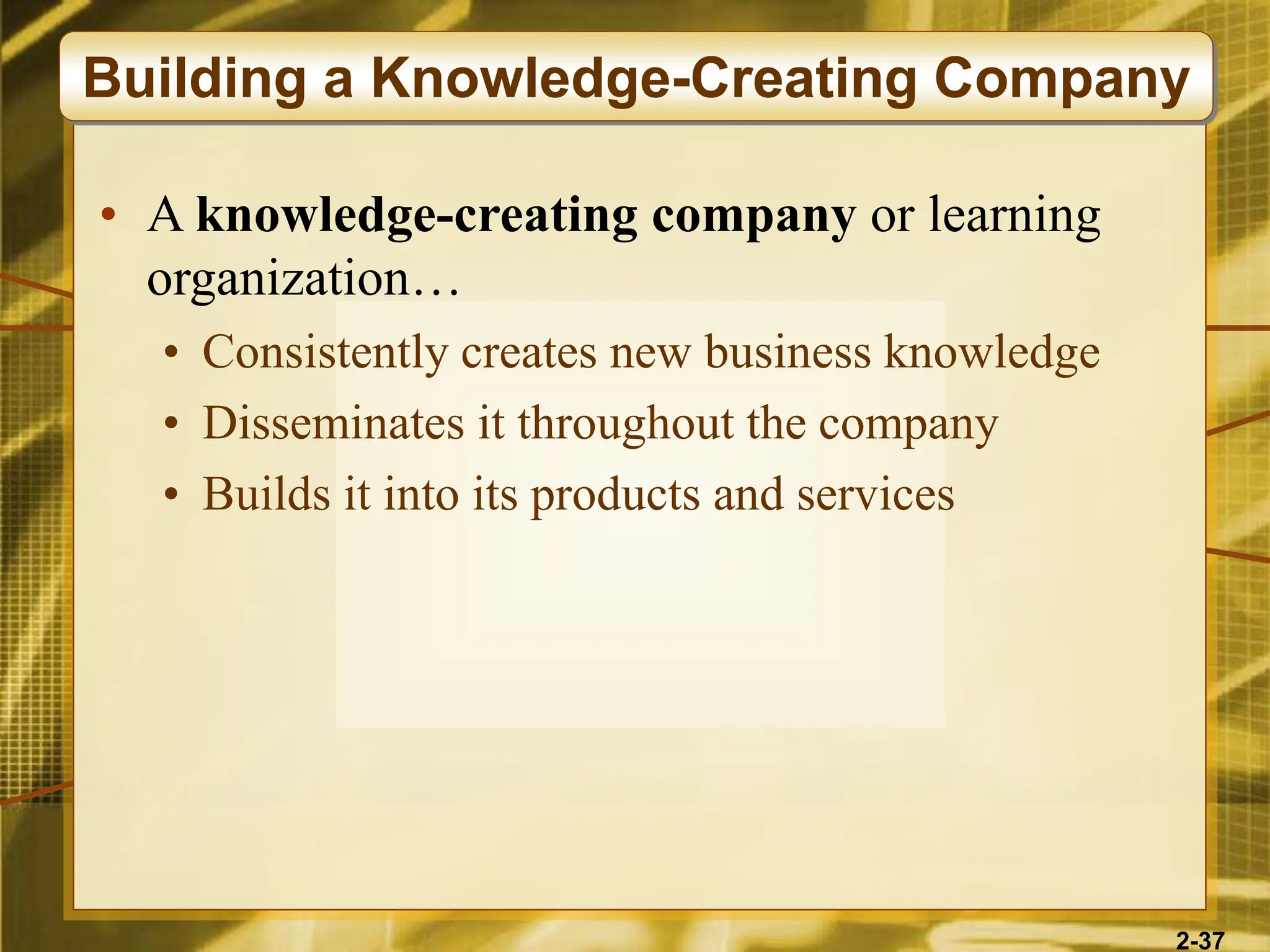
• A knowledge-creating company or learning
organization…
• Consistently creates new business knowledge
• Disseminates it throughout the company
• Builds it into its products and services
Building a Knowledge-Creating Company
2-38
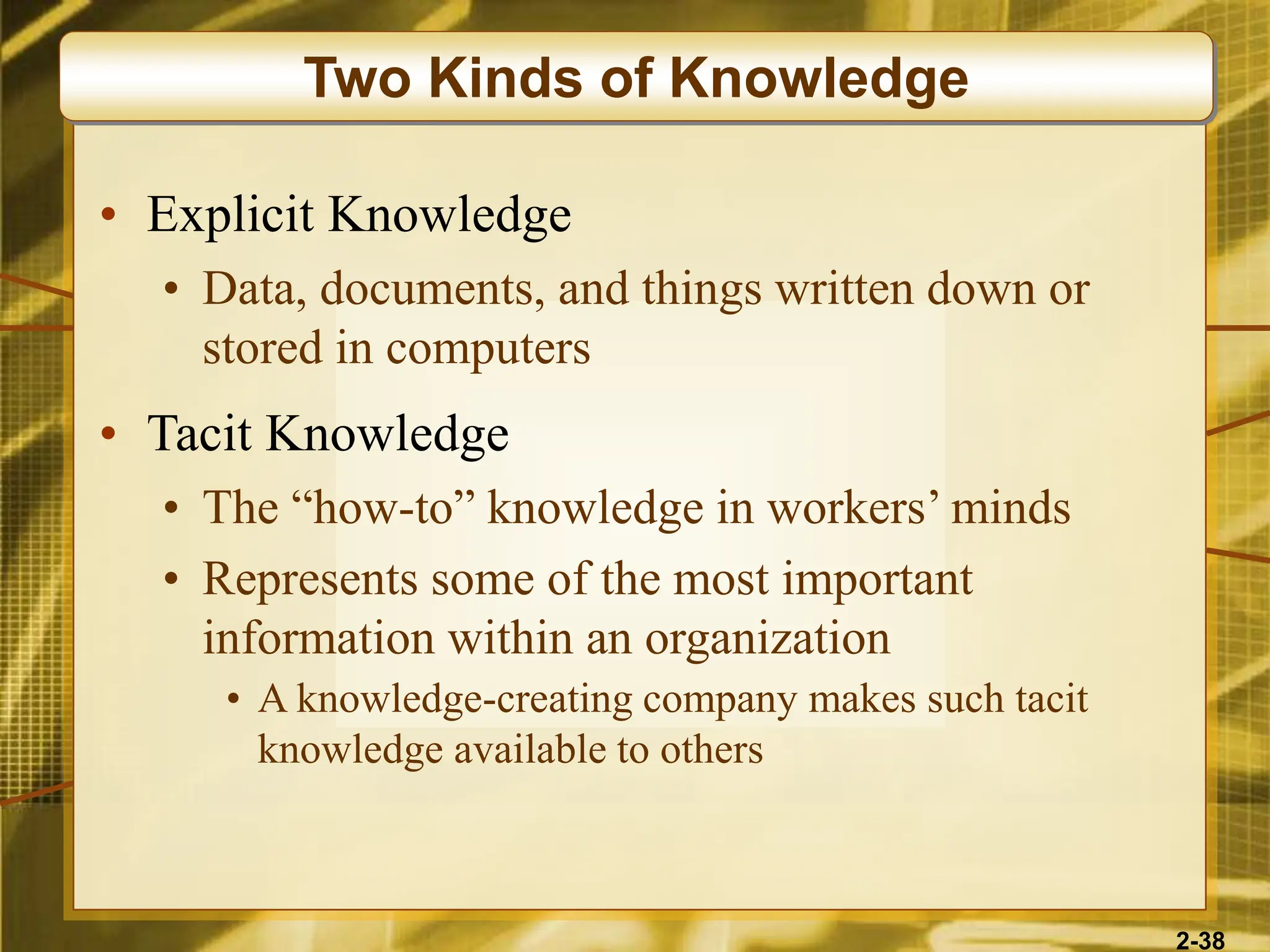
• Explicit Knowledge
• Data, documents, and things written down or
stored in computers
• Tacit Knowledge
• The “how-to” knowledge in workers’ minds
• Represents some of the most important
information within an organization
• A knowledge-creating company makes such tacit
knowledge available to others
Two Kinds of Knowledge
2-39
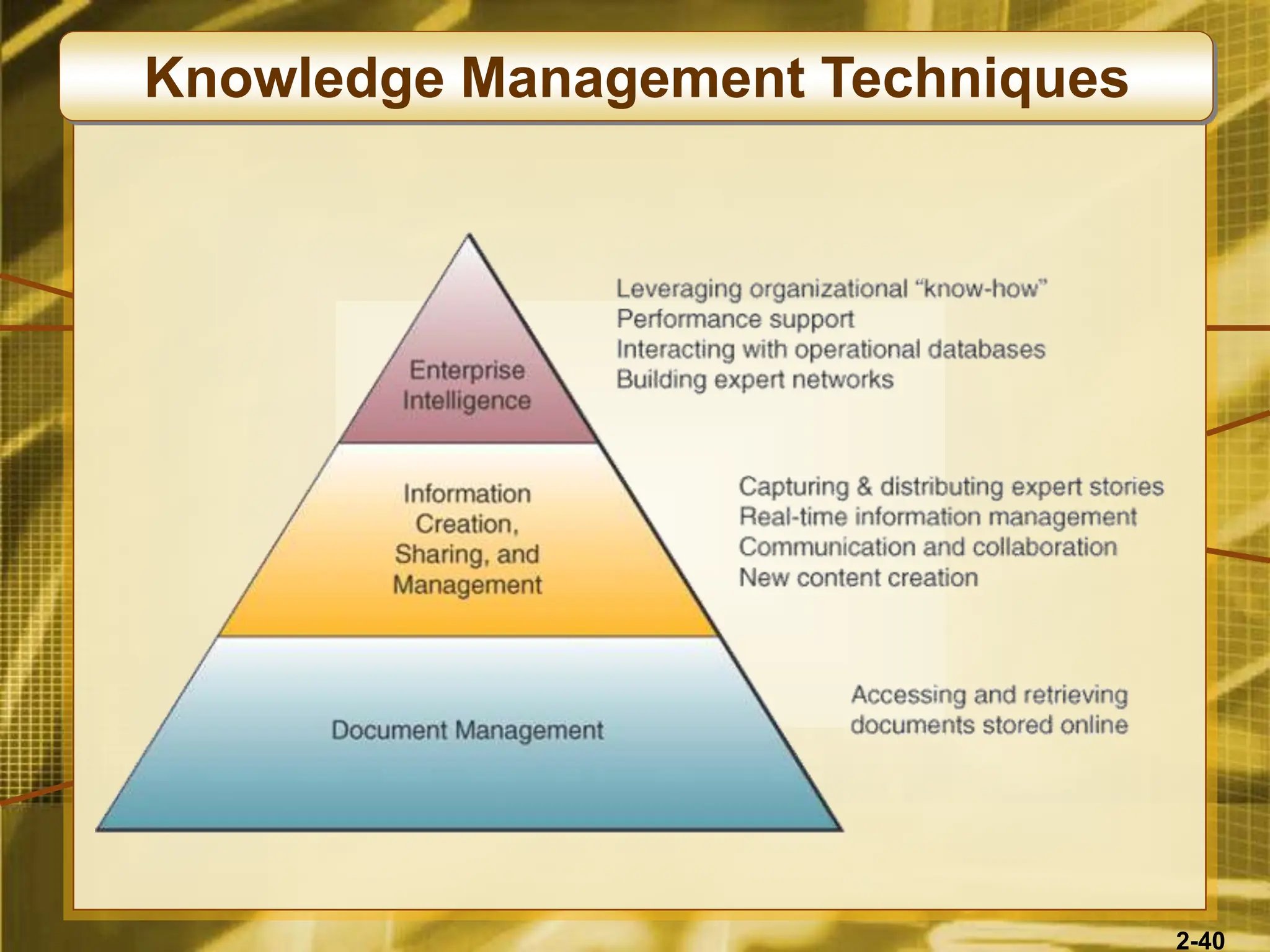
• Successful knowledge management
• Creates techniques, technologies, systems,
and rewards for getting employees to share
what they know
• Makes better use of accumulated workplace and
enterprise knowledge
Knowledge Management
2-40
Knowledge Management Techniques
2-41
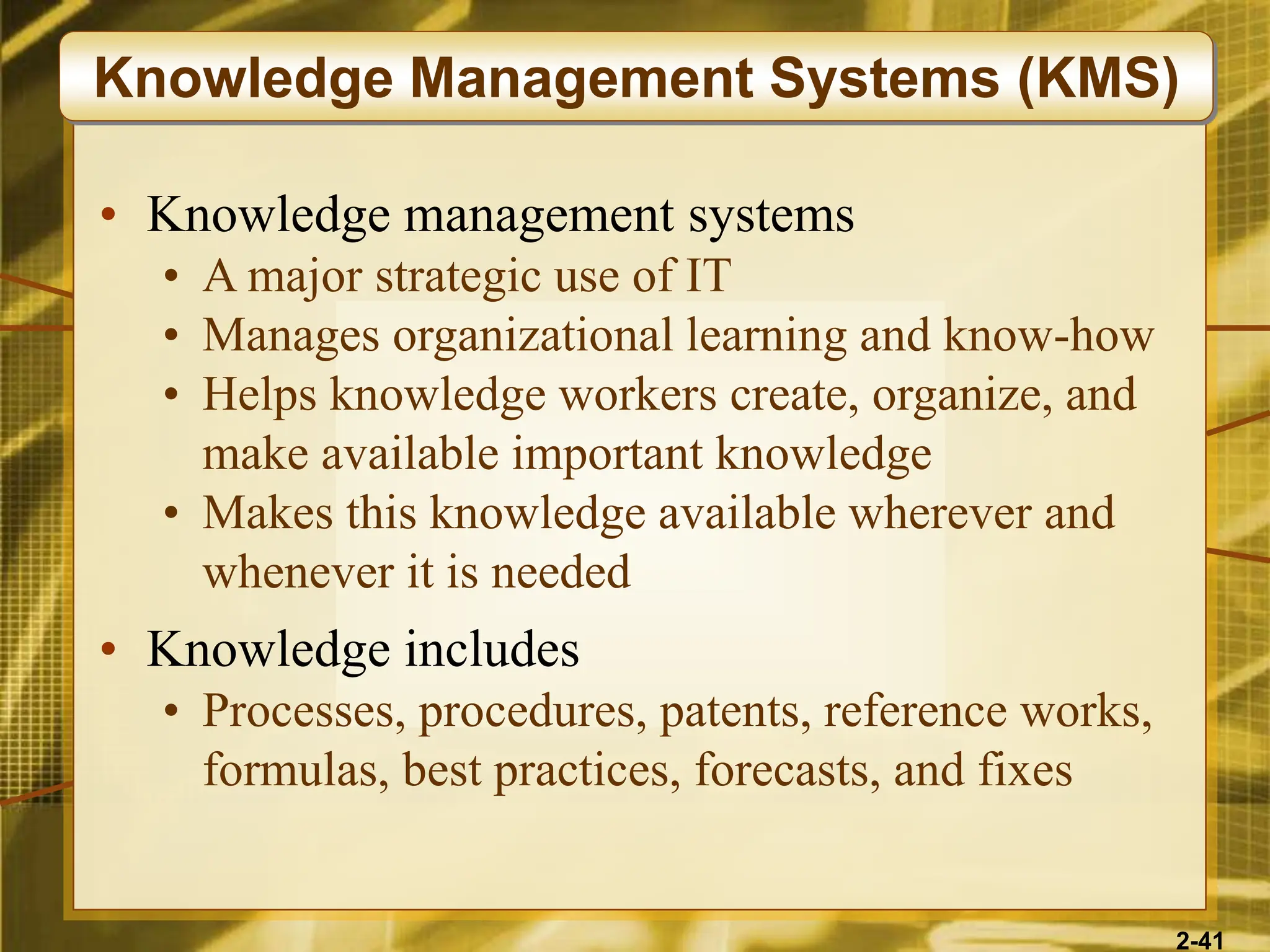
• Knowledge management systems
• A major strategic use of IT
• Manages organizational learning and know-how
• Helps knowledge workers create, organize, and
make available important knowledge
• Makes this knowledge available wherever and
whenever it is needed
• Knowledge includes
• Processes, procedures, patents, reference works,
formulas, best practices, forecasts, and fixes
Knowledge Management Systems (KMS)
2-42
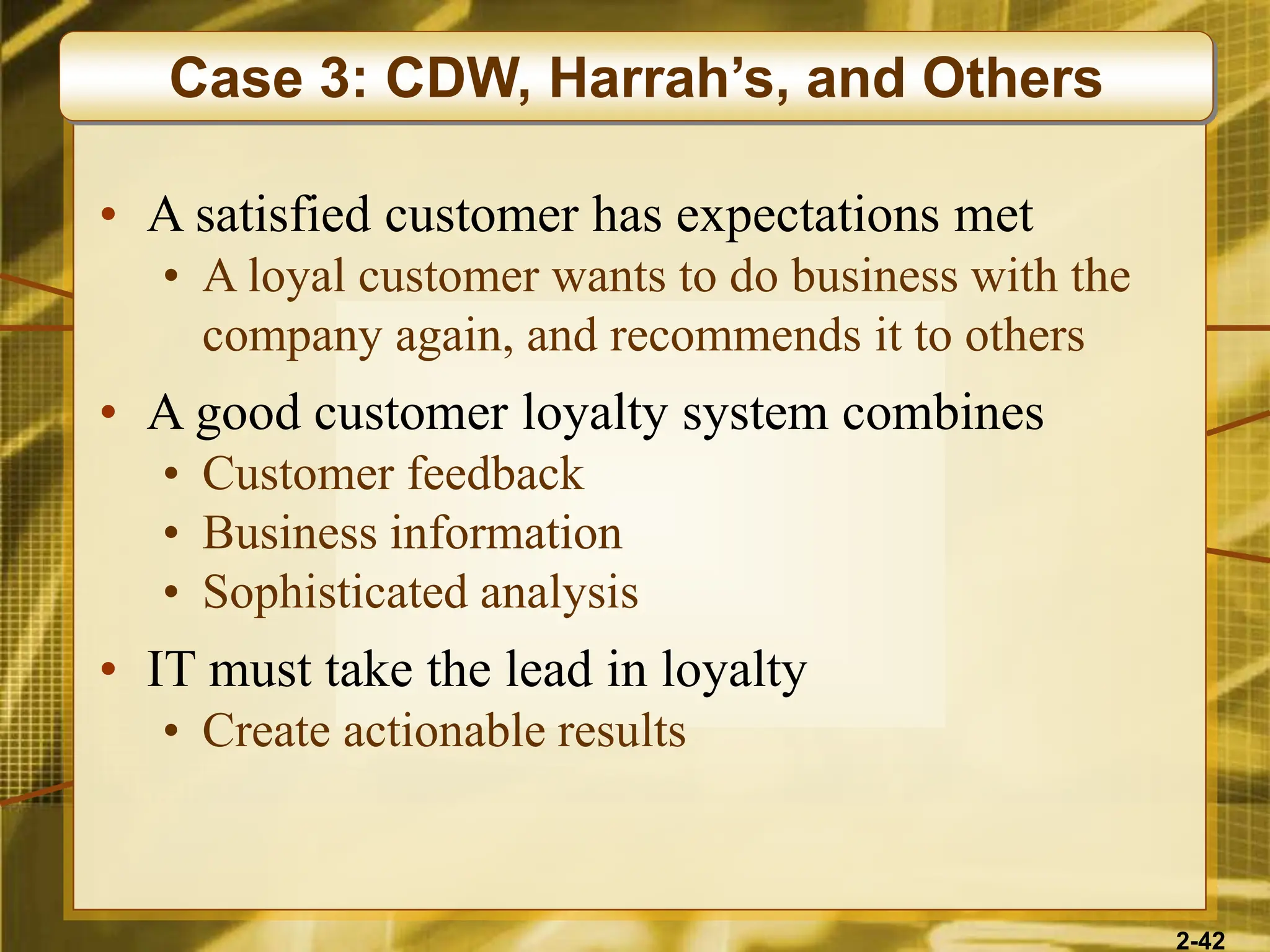
• A satisfied customer has expectations met
• A loyal customer wants to do business with the
company again, and recommends it to others
• A good customer loyalty system combines
• Customer feedback
• Business information
• Sophisticated analysis
• IT must take the lead in loyalty
• Create actionable results
Case 3: CDW, Harrah’s, and Others
2-43
• Does CDW’s customer loyalty program give
them a competitive advantage?
• What is the strategic value of Harrah’s approach
to determining and rewarding customer loyalty?
• What else could CDW and Harrah’s do to truly
become customer-focused businesses?
Case Study Questions
2-44
• The DOC uses DOC Insider to offer advice on
doing business abroad
• The AskMe system includes…
• Automated best practices
• Automatic experts’ profile creation
• Methods for accessing and delivering knowledge
• Real-time collaboration services
• Analytic capabilities
Case 4: The U.S. Dept. of Commerce
2-45
• What are the key business challenges facing
companies in supporting their global marketing
an expansion efforts?
• How is the AskMe knowledge management
system helping to meet this challenge?
• How can the AskMe system help identify
weaknesses in global business knowledge with
the DOC?
• What other global trade situations could the
AskMe system provide information about?
Case Study Questions

ch 2 Competing with Information Technology.ppt

  • 1.
    McGraw-Hill/Irwin Copyright ©2008, The McGraw-Hill Companies, Inc. All rights reserved. McGraw-Hill/Irwin Copyright © 2008 by The McGraw-Hill Companies, Inc. All rights reserved.
  • 2.
    McGraw-Hill/Irwin Copyright ©2008, The McGraw-Hill Companies, Inc. All rights reserved. Competing with Information Technology Chapter 2
  • 3.
    2-3 • Identify basiccompetitive strategies and explain how a business can use IT to confront the competitive forces it faces • Identify several strategic uses of IT and give examples of how they give competitive advantages to a business • Give examples of how business process reengineering frequently involves the strategic use of IT Learning Objectives
  • 4.
    2-4 • Identify thebusiness value of using Internet technologies to become an agile competitor or to form a virtual company • Explain how knowledge management systems can help a business gain strategic advantages Learning Objectives
  • 5.
    2-5 • Technology isno longer an afterthought in business strategy, but the cause and driver • IT can change the way businesses compete • A strategic information system is any information system that uses IT to help an organization… • Gain a competitive advantage • Reduce a competitive disadvantage • Or meet other strategic enterprise objectives Strategic IT
  • 6.
    2-6 • Does ITmatter? • No • Nicholas Carr argues that IT is infrastructure, much like electricity • Too commonplace to offer a competitive advantage • Yes • It is not just networks and computers • The important part is the software and information and how IT is used Case 1: GE, Dell, Intel, GM and Others
  • 7.
    2-7 • Do youagree with the argument made by Nicholas Carr to support his position that IT no longer gives companies a competitive advantage? • Do you agree with the argument made in support of the competitive advantage that IT can provide to a business? • What are several ways that IT could provide competitive advantage to a business? Case Study Questions
  • 8.
    2-8 • To succeed,a business must develop strategies to counter these forces… • Rivalry of competitors within its industry • New entrants into an industry and its markets • Substitute products that may capture market share • Bargaining power of customers • Bargaining power of suppliers Competitive Forces
  • 9.
  • 10.
    2-10 • Cost Leadership •Become low-cost producers • Help suppliers or customers reduce costs • Increase cost to competitors • Example: Priceline uses online seller bidding so the buyer sets the price • Differentiation Strategy • Differentiate a firm’s products from its competitors’ • Focus on a particular segment or niche of market • Example: Moen uses online customer design Five Competitive Strategies
  • 11.
    2-11 • Innovation Strategy •Unique products, services, or markets • Radical changes to business processes • Example: Amazon’s online, full-service customer systems • Growth Strategy • Expand company’s capacity to produce • Expand into global markets • Diversify into new products or services • Example: Wal-Mart’s merchandise ordering via global satellite tracking Competitive Strategies (continued)
  • 12.
    2-12 • Alliance Strategy •Establish linkages and alliances with customers, suppliers, competitors, consultants, and other companies • Includes mergers, acquisitions, joint ventures, virtual companies • Example: Wal-Mart uses automatic inventory replenishment by supplier Competitive Strategies (continued)
  • 13.
    2-13 • These strategiesare not mutually exclusive • Organizations use one, some, or all • A given activity could fall into one or more categories of competitive strategy • Not everything innovative serves to differentiate one organization from another • Likewise, not everything that differentiates organizations is necessarily innovative Using Competitive Strategies
  • 14.
    2-14 Ways to ImplementBasic Strategies
  • 15.
    2-15 • Lock inCustomers and Suppliers • Deter them from switching to competitors • Build in Switching Costs • Make customers and suppliers dependent on the use of innovative IS • Erect Barriers to Entry • Discourage or delay other companies from entering the market • Increase the technology or investment needed to enter Other Competitive Strategies
  • 16.
    2-16 • Build StrategicIT Capabilities • Take advantage of strategic opportunities when they arise • Improve efficiency of business practices • Leverage Investment in IT • Develop products and service that would not be possible without a strong IT capability Other Competitive Strategies
  • 17.
    2-17 • What isthe business value in being customer- focused? • Keep customers loyal • Anticipate their future needs • Respond to customer concerns • Provide top-quality customer service • Focus on customer value • Quality, not price, has become the primary determinant of value • Consistently Customer-Focused Business
  • 18.
    2-18 • Companies thatconsistently offer the best value from the customer’s perspective… • Track individual preferences • Keep up with market trends • Supply products, services, and information anytime, anywhere • Tailor customer services to the individual • Use Customer Relationship Management (CRM) systems to focus on the customer Providing Customer Value
  • 19.
  • 20.
    2-20 • View thefirm as a chain of basic activities that add value to its products and services • Primary processes directly relate to manufacturing or delivering products • Support processes help support the day-to-day running of the firm and indirectly contribute to products or services • Use the value chain to highlight where competitive strategies will add the most value The Value Chain and Strategic IS
  • 21.
    2-21 Using IS inthe Value Chain
  • 22.
    2-22 • A companythat emphasizes strategic business use of IT would use it to gain a competitive differentiation • Products • Services • Capabilities Strategic Uses of IT
  • 23.
    2-23 • The Internetrapidly advanced large-scale storage and data analysis • Products could be networked and accessed at customer sites • Connectivity was cheap • Unprecedented opportunities for strategic relationships and returns Case 2: GE Energy and GE Healthcare
  • 24.
    2-24 • GE sawunprecedented opportunities for strategic relationships and returns • Invested heavily in remote monitoring and diagnostics • Profitability went up • Created customer dependency • Has created longer-term customer relationships Case 2: GE Energy and GE Healthcare
  • 25.
    2-25 • What arethe business benefits of using IT to build strategic customer relationships for GE Energy and GE Healthcare? • What are the business benefits for their customers? • What strategic uses of information technology do you see implemented in this case? • How could other companies benefit from the use of IT to build strategic customer relationships? Case Study Questions
  • 26.
    2-26 • Called BRPor simply Reengineering • Fundamental rethinking and radical redesign of business processes • Seeks to achieve improvements in cost, quality, speed, and service • Potential payback is high, but so is risk of disruption and failure • Organizational redesign approaches are an important enabler of reengineering • Includes use of IT, process teams, case managers Reengineering Business Processes
  • 27.
  • 28.
    2-28 • IT playsa major role in reengineering most business processes • Can substantially increase process efficiencies • Improves communication • Facilitates collaboration The Role of Information Technology
  • 29.
    2-29 • Many processesare reengineered with… • Enterprise resource planning software • Web-enabled electronic business and commerce systems A Cross-Functional Process
  • 30.
    2-30 • IT thatsupports this process… • CRM systems using intranets and the Internet • Supplier-managed inventory systems using the Internet and extranets • Cross-functional ERP software to integrate manufacturing, distribution, finance, and human resource processes • Customer-accessible e-commerce websites for order entry, status checking, payment, and service • Customer, product, and order status databases accessed via intranets and extranets Reengineering Order Management
  • 31.
    2-31 • Agility isthe ability to prosper • In rapidly changing, continually fragmenting global markets • By selling high-quality, high-performance, customer-configured products and services • By using Internet technologies • An agile company profits in spite of • Broad product ranges • Short model lifetimes • Individualized products • Arbitrary lot sizes Becoming an Agile Company
  • 32.
    2-32 • An agilecompany… • Presents products as solutions to customers’ problems • Cooperates with customers, suppliers and competitors • Brings products to market as quickly and cost- effectively as possible • Organizes to thrive on change and uncertainty • Leverages the impact of its people and the knowledge they possess Strategies for Agility
  • 33.
    2-33 How IT Helpsa Company be Agile
  • 34.
    2-34 • A virtualcompany uses IT to link… • People • Organizations • Assets • Ideas • Inter-enterprise information systems link… • Customers • Suppliers • Subcontractors • Competitors Creating a Virtual Company
  • 35.
  • 36.
    2-36 • Basic businessstrategies • Share information and risk with alliance partners • Link complimentary core competencies • Reduce concept-to-cash time through sharing • Increase facilities and market coverage • Gain access to new markets and share market or customer loyalty • Migrate from selling products to selling solutions Virtual Company Strategies
  • 37.
    2-37 • A knowledge-creatingcompany or learning organization… • Consistently creates new business knowledge • Disseminates it throughout the company • Builds it into its products and services Building a Knowledge-Creating Company
  • 38.
    2-38 • Explicit Knowledge •Data, documents, and things written down or stored in computers • Tacit Knowledge • The “how-to” knowledge in workers’ minds • Represents some of the most important information within an organization • A knowledge-creating company makes such tacit knowledge available to others Two Kinds of Knowledge
  • 39.
    2-39 • Successful knowledgemanagement • Creates techniques, technologies, systems, and rewards for getting employees to share what they know • Makes better use of accumulated workplace and enterprise knowledge Knowledge Management
  • 40.
  • 41.
    2-41 • Knowledge managementsystems • A major strategic use of IT • Manages organizational learning and know-how • Helps knowledge workers create, organize, and make available important knowledge • Makes this knowledge available wherever and whenever it is needed • Knowledge includes • Processes, procedures, patents, reference works, formulas, best practices, forecasts, and fixes Knowledge Management Systems (KMS)
  • 42.
    2-42 • A satisfiedcustomer has expectations met • A loyal customer wants to do business with the company again, and recommends it to others • A good customer loyalty system combines • Customer feedback • Business information • Sophisticated analysis • IT must take the lead in loyalty • Create actionable results Case 3: CDW, Harrah’s, and Others
  • 43.
    2-43 • Does CDW’scustomer loyalty program give them a competitive advantage? • What is the strategic value of Harrah’s approach to determining and rewarding customer loyalty? • What else could CDW and Harrah’s do to truly become customer-focused businesses? Case Study Questions
  • 44.
    2-44 • The DOCuses DOC Insider to offer advice on doing business abroad • The AskMe system includes… • Automated best practices • Automatic experts’ profile creation • Methods for accessing and delivering knowledge • Real-time collaboration services • Analytic capabilities Case 4: The U.S. Dept. of Commerce
  • 45.
    2-45 • What arethe key business challenges facing companies in supporting their global marketing an expansion efforts? • How is the AskMe knowledge management system helping to meet this challenge? • How can the AskMe system help identify weaknesses in global business knowledge with the DOC? • What other global trade situations could the AskMe system provide information about? Case Study Questions