6.1 Copyright © 2014 Pearson Education, Inc. publishing as Prentice Hall
Managing Global SystemsManaging Global Systems
Chapter 15
VIDEO CASES
Video Case 1: Daum Runs Oracle Apps on Linux
Video Case 2: Lean Manufacturing and Global ERP: Humanetics and Global Shop
Video Case 3: Monsanto Uses Cisco and Microsoft to Manage Globally
15.2 Copyright © 2016 Pearson Education Ltd.
Management Information Systems
Chapter 15: Managing Global Systems
• What major factors are driving the internationalization of
business?
• What are the alternative strategies for developing global
businesses?
• What are the challenges posed by global information
systems and management solutions for these challenges?
• What are the issues and technical alternatives to be
considered when developing international information
systems?
Learning Objectives
15.3 Copyright © 2016 Pearson Education Ltd.
Management Information Systems
Chapter 15: Managing Global Systems
• Problem: Large number of brands, products,
locations; complex production process; multiple
systems
• Solution: SAP’s ERP system implemented globally,
integrated with Apriso’s FlexNet for operations
management
• Demonstrates the need for global firms to have
integrated systems for monitoring production
• Illustrates the use of enterprise software to enforce
global quality and production standards
L’Oréal’s Global Makeover
15.4 Copyright © 2016 Pearson Education Ltd.
Management Information Systems
Chapter 15: Managing Global Systems
• Global economic system and global world order
driven by advanced networks and information
systems
• Growth of international trade has radically altered
domestic economies around the globe
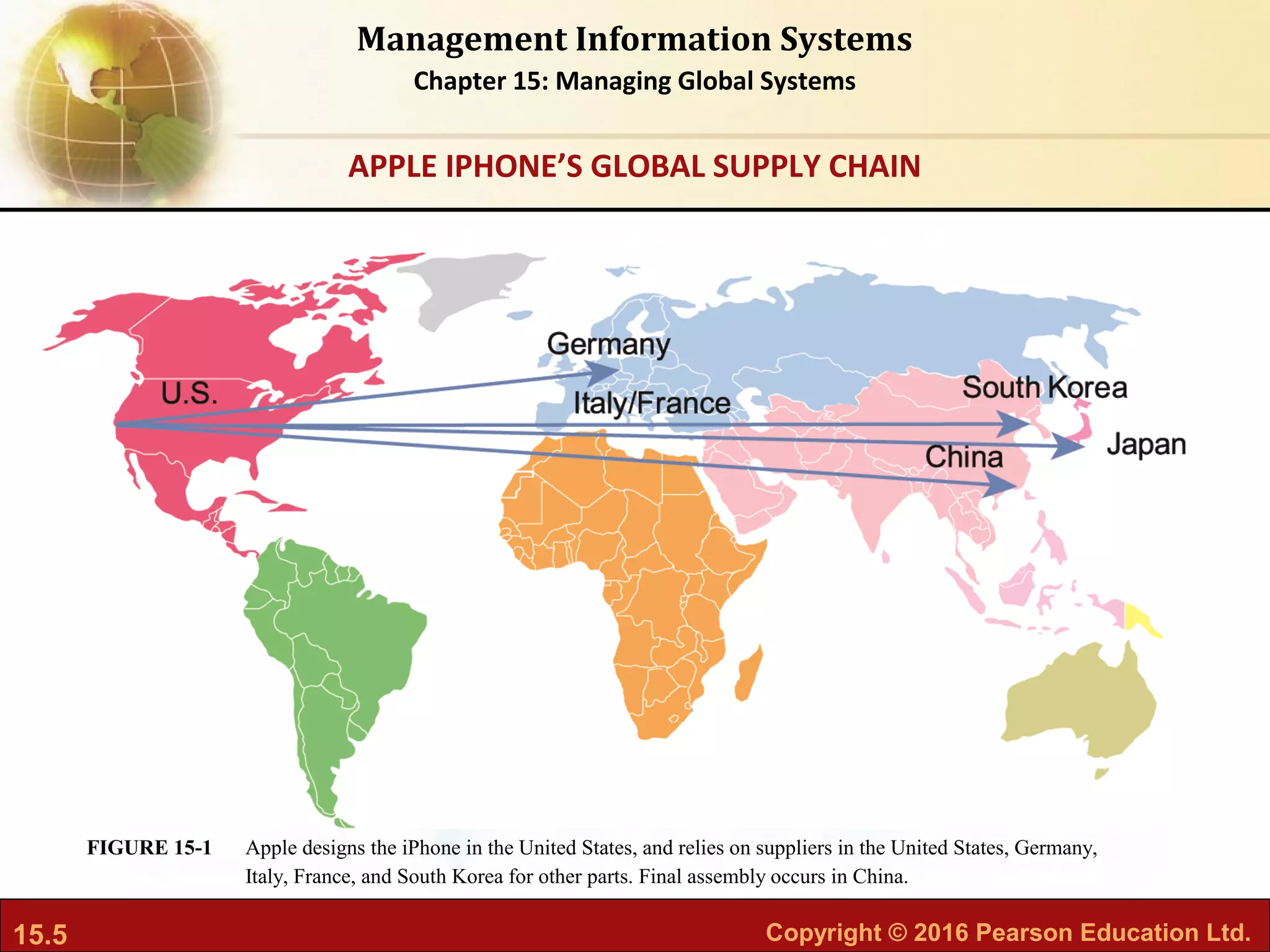
• For example, production of many high-end
electronic products parceled out to multiple
countries
– For example: Apple iPhone’s global supply chain
Factors Driving the Internationalization of Business
15.5 Copyright © 2016 Pearson Education Ltd.
Management Information Systems
Chapter 15: Managing Global Systems
Apple designs the iPhone in the United States, and relies on suppliers in the United States, Germany,
Italy, France, and South Korea for other parts. Final assembly occurs in China.
FIGURE 15-1
APPLE IPHONE’S GLOBAL SUPPLY CHAIN
15.6 Copyright © 2016 Pearson Education Ltd.
Management Information Systems
Chapter 15: Managing Global Systems
• Strategy when building international systems
– Understand global environment.
• Business drivers for global competition
• Inhibitors creating management challenges
– Develop corporate strategy for global competition.
– Develop organization structure and division of labor.
– Consider management issues.
• Design of business procedures, reengineering,
managing change
– Consider technology platform.
Factors Driving the Internationalization of Business
15.7 Copyright © 2016 Pearson Education Ltd.
Management Information Systems
Chapter 15: Managing Global Systems
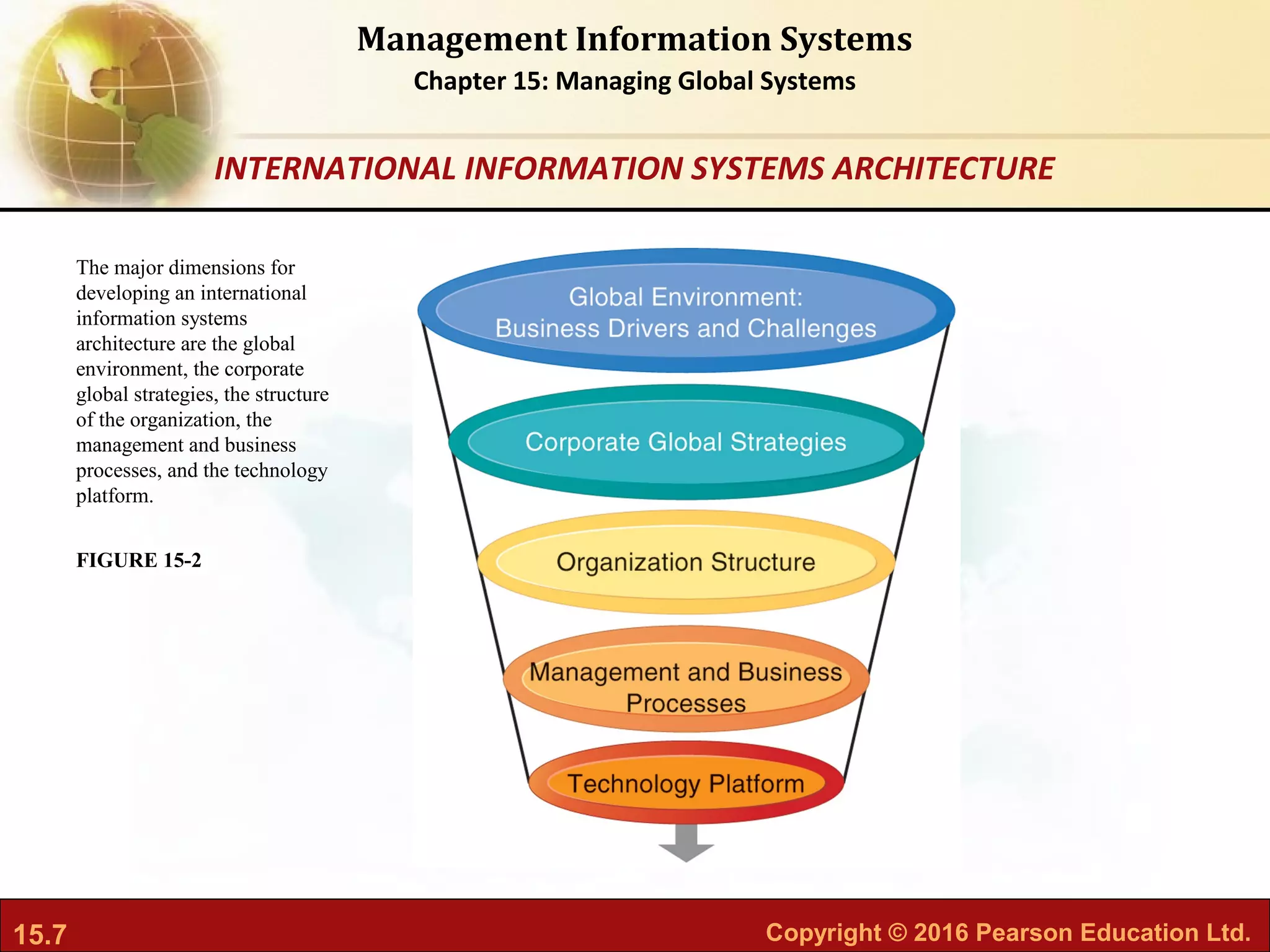
The major dimensions for
developing an international
information systems
architecture are the global
environment, the corporate
global strategies, the structure
of the organization, the
management and business
processes, and the technology
platform.
FIGURE 15-2
INTERNATIONAL INFORMATION SYSTEMS ARCHITECTURE
15.8 Copyright © 2016 Pearson Education Ltd.
Management Information Systems
Chapter 15: Managing Global Systems
• Global business drivers:
– General cultural factors lead toward internationalization
and result in specific business globalization factors
Factors Driving the Internationalization of Business
GENERAL CULTURAL FACTORS SPECIFIC BUSINESS FACTORS
Global communication and
transportation technologies
Development of global culture
Emergence of global social norms
Political stability
Global knowledge base
Global markets
Global production and operations
Global coordination
Global workforce
Global economies of scale
15.9 Copyright © 2016 Pearson Education Ltd.
Management Information Systems
Chapter 15: Managing Global Systems
• Challenges and obstacles to global business
systems
– General cultural challenges
•Cultural particularism
– Regionalism, nationalism, language differences
•Social expectations:
– Brand-name expectations, work hours
•Political laws
– Transborder data flow
– Transborder data and privacy laws, commercial
regulations
Factors Driving the Internationalization of Business
15.10 Copyright © 2016 Pearson Education Ltd.
Management Information Systems
Chapter 15: Managing Global Systems
• Challenges to global business systems (cont.)
– Specific challenges
• Standards
– Different EDI, e-mail, telecommunication standards
• Reliability
– Phone networks not uniformly reliable
• Speed
– Different data transfer speeds, many slower than United
States
• Personnel
– Shortages of skilled consultants
Factors Driving the Internationalization of Business
15.11 Copyright © 2016 Pearson Education Ltd.
Management Information Systems
Chapter 15: Managing Global Systems
• State of the art
– Most companies have inherited a patchwork
international system using traditional batch-oriented
reporting, manual entry of data from one legacy system
to another, and little online control and communication.
– Significant difficulties in building appropriate
international architectures:
• Planning a system appropriate to firm’s global strategy
• Structuring organization of systems and business units
• Solving implementation issues
• Choosing right technical platform
Factors Driving the Internationalization of Business
15.12 Copyright © 2016 Pearson Education Ltd.
Management Information Systems
Chapter 15: Managing Global Systems
• Global strategies and business organization
– Three main kinds of organizational structure
• Centralized: In the home country
• Decentralized/dispersed: To local foreign units
• Coordinated: All units participate as equals
– Four main global strategies
• Domestic exporter
• Multinational
• Franchisers
• Transnational
Strategies for Developing Global Businesses
15.13 Copyright © 2016 Pearson Education Ltd.
Management Information Systems
Chapter 15: Managing Global Systems
GLOBAL BUSINESS AND STRATEGY
Organizing International Information Systems
BUSINESS
FUNCTION
DOMESTIC
EXPORTER
MULTINATIONAL FRANCHISER TRANSNATIONAL
Production Centralized Dispersed Coordinated Coordinated
Finance/
Accounting
Centralized Centralized Centralized Coordinated
Sales/
Marketing
Mixed Dispersed Coordinated Coordinated
Human
Resources
Centralized Centralized Coordinated Coordinated
Strategic
Management
Centralized Centralized Centralized Coordinated
15.14 Copyright © 2016 Pearson Education Ltd.
Management Information Systems
Chapter 15: Managing Global Systems
• Global systems to fit the strategy
– Configuration, management, and development of
systems tend to follow global strategy chosen
– Four main types of systems configuration
1. Centralized: Systems development and operation occur
totally at domestic home base
2. Duplicated: Development occurs at home base but
operations are handed over to autonomous units in
foreign locations
3. Decentralized: Each foreign unit designs own solutions
and systems
4. Networked: Development and operations occur in
coordinated fashion across all units
Strategies for Developing Global Businesses
15.15 Copyright © 2016 Pearson Education Ltd.
Management Information Systems
Chapter 15: Managing Global Systems
The large Xs show the dominant patterns, and the small Xs show the emerging patterns. For instance, domestic
exporters rely predominantly on centralized systems, but there is continual pressure and some development of
decentralized systems in local marketing regions.
FIGURE 15-3
GLOBAL STRATEGY AND SYSTEMS CONFIGURATIONS
15.16 Copyright © 2016 Pearson Education Ltd.
Management Information Systems
Chapter 15: Managing Global Systems
• To develop a global company and
information systems support structure:
1. Organize value-adding activities along lines of comparative
advantage.
• For example: Locate functions where they can best be performed,
for least cost and maximum impact.
1. Develop and operate systems units at each level of corporate
activity—regional, national, and international.
2. Establish at world headquarters:
• Single office responsible for development of international systems
• Global CIO position
Strategies for Developing Global Businesses
15.17 Copyright © 2016 Pearson Education Ltd.
Management Information Systems
Chapter 15: Managing Global Systems
• Principle management challenges in
developing global systems
– Agreeing on common user requirements
– Introducing changes in business processes
– Coordinating application development
– Coordinating software releases
– Encouraging local users to support global
systems
Challenges of Global Information Systems
15.18 Copyright © 2016 Pearson Education Ltd.
Management Information Systems
Chapter 15: Managing Global Systems
• Typical scenario: Disorganization on a global scale
– Traditional multinational consumer-goods company based in
United States and operating in Europe would like to expand
into Asia
– World headquarters and strategic management in United
States
• Only centrally coordinated system is financial controls and reporting
– Separate regional, national production and marketing centers
– Foreign divisions have separate IT systems
– E-mail systems are incompatible
– Each production facility uses different ERP system, different
hardware and database platforms, and so on
Challenges of Global Information Systems
15.19 Copyright © 2016 Pearson Education Ltd.
Management Information Systems
Chapter 15: Managing Global Systems
• Global systems strategy
– Share only core systems
• Core systems support functionality critical to firm
– Partially coordinate systems that share some key
elements
• Do not have to be totally common across national
boundaries
• Local variation desirable
– Peripheral systems
• Need to suit local requirements only
Challenges of Global Information Systems
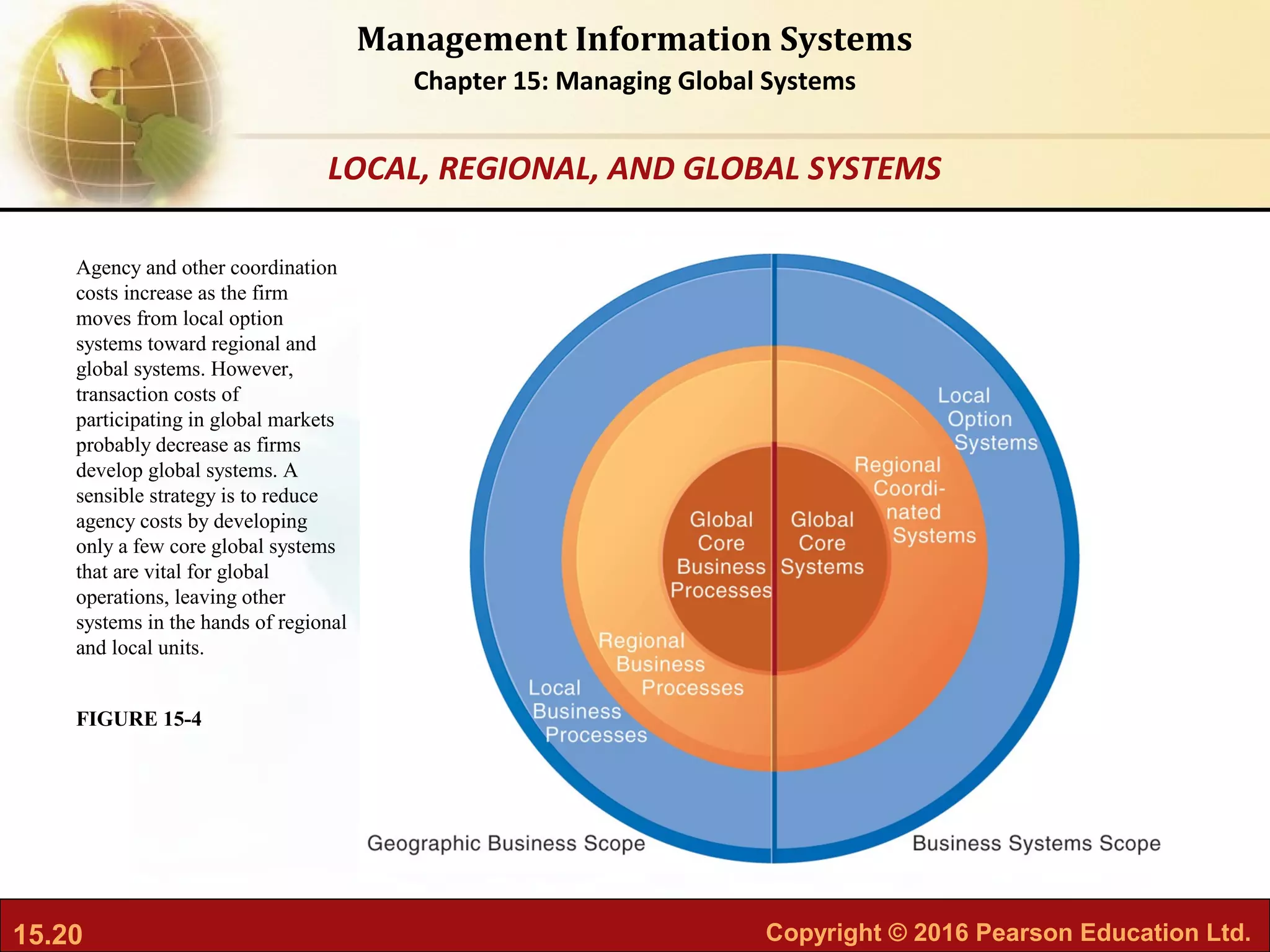
15.20 Copyright © 2016 Pearson Education Ltd.
Management Information Systems
Chapter 15: Managing Global Systems
Agency and other coordination
costs increase as the firm
moves from local option
systems toward regional and
global systems. However,
transaction costs of
participating in global markets
probably decrease as firms
develop global systems. A
sensible strategy is to reduce
agency costs by developing
only a few core global systems
that are vital for global
operations, leaving other
systems in the hands of regional
and local units.
FIGURE 15-4
LOCAL, REGIONAL, AND GLOBAL SYSTEMS
15.21 Copyright © 2016 Pearson Education Ltd.
Management Information Systems
Chapter 15: Managing Global Systems
1. Define core business processes.
2. Identify core systems to coordinate centrally.
3. Choose an approach:
– Piecemeal and grand design approaches tend to fail.
– Evolve transnational applications incrementally from existing
applications.
1. Make benefits clear:
– Global flexibility
– Gains in efficiency
– Global markets and larger customer base unleash new economies of
scale at production facilities
– Optimizing corporate funds over much larger capital base
Challenges of Global Information Systems
15.22 Copyright © 2016 Pearson Education Ltd.
Management Information Systems
Chapter 15: Managing Global Systems
• The management solution: Implementation
– Agreeing on common user requirements
• Short list of core business processes
• Develop common language, understanding of common
elements and unique local qualities
– Introducing changes in business processes
• Success depends on legitimacy, authority, ability to
involve users in change design process
– Coordinating applications development
• Coordinate change through incremental steps
• Reduce set of transnational systems to bare minimum
Challenges of Global Information Systems
15.23 Copyright © 2016 Pearson Education Ltd.
Management Information Systems
Chapter 15: Managing Global Systems
• The management solution (cont.)
– Coordinating software releases
• Institute procedures to ensure all operating units
update at same time
– Encouraging local users to support global systems
• Cooptation: Bringing the opposition into design and
implementation process without giving up control over
direction and nature of the change
– Permit each country unit to develop one transnational
application
– Develop new transnational centers of excellence
Challenges of Global Information Systems
15.24 Copyright © 2016 Pearson Education Ltd.
Management Information Systems
Chapter 15: Managing Global Systems
• Technology challenges of global systems
– Computing platforms and systems integration
• How new core systems will fit in with existing suite of
applications developed around globe by different divisions
• Standardization: Data standards, interfaces, software, and
so on
– Connectivity
• Internet does not guarantee any level of service
• Many firms use private networks and VPNs
• Low penetration of PCs, outdated infrastructures in
developing countries
Issues and Alternatives in Developing International Systems
15.25 Copyright © 2016 Pearson Education Ltd.
Management Information Systems
Chapter 15: Managing Global Systems
Read the Interactive Session and discuss the following questions
Interactive Session: Organizations
• Describe the technical and organizational obstacles
to e-commerce growth in Russia.
• How do these technical and organizational factors
hamper companies from doing business in Russia or
setting up Russian e-commerce sites?
• Will non-Russian companies such as Amazon.com
and eBay flourish in Russia? Explain.
E-commerce Russian-Style
15.26 Copyright © 2016 Pearson Education Ltd.
Management Information Systems
Chapter 15: Managing Global Systems
Read the Interactive Session and discuss the following questions
Interactive Session: Management
• Why is the Internet restricted in South Korea?
• What are the implications of South Korea’s Internet
restrictions for international companies doing
business in South Korea?
• What management, organization, and technology
factors should be taken into account when
developing an e-commerce presence for the South
Korean market?
South Korea’s Restricted Internet
15.27 Copyright © 2016 Pearson Education Ltd.
Management Information Systems
Chapter 15: Managing Global Systems
The percentage of the total population using the Internet in developing countries is much smaller than
in the United States and Europe, but it is growing rapidly.
FIGURE 15-5
INTERNET POPULATION IN SELECTED COUNTRIES
15.28 Copyright © 2016 Pearson Education Ltd.
Management Information Systems
Chapter 15: Managing Global Systems
• Technology challenges of global systems (cont.)
– Software
• Integrating new systems with old
• Human interface design issues, languages
• Software localization: converting software to operate
in second language
• Most important software applications:
– TPS and MIS
– SCM, EDI, and enterprise systems
– Collaboration tools, e-mail, videoconferencing
Issues and Alternatives in Developing International Systems

MIS-CH15: Managing Global Systems

  • 1.
    6.1 Copyright ©2014 Pearson Education, Inc. publishing as Prentice Hall Managing Global SystemsManaging Global Systems Chapter 15 VIDEO CASES Video Case 1: Daum Runs Oracle Apps on Linux Video Case 2: Lean Manufacturing and Global ERP: Humanetics and Global Shop Video Case 3: Monsanto Uses Cisco and Microsoft to Manage Globally
  • 2.
    15.2 Copyright ©2016 Pearson Education Ltd. Management Information Systems Chapter 15: Managing Global Systems • What major factors are driving the internationalization of business? • What are the alternative strategies for developing global businesses? • What are the challenges posed by global information systems and management solutions for these challenges? • What are the issues and technical alternatives to be considered when developing international information systems? Learning Objectives
  • 3.
    15.3 Copyright ©2016 Pearson Education Ltd. Management Information Systems Chapter 15: Managing Global Systems • Problem: Large number of brands, products, locations; complex production process; multiple systems • Solution: SAP’s ERP system implemented globally, integrated with Apriso’s FlexNet for operations management • Demonstrates the need for global firms to have integrated systems for monitoring production • Illustrates the use of enterprise software to enforce global quality and production standards L’Oréal’s Global Makeover
  • 4.
    15.4 Copyright ©2016 Pearson Education Ltd. Management Information Systems Chapter 15: Managing Global Systems • Global economic system and global world order driven by advanced networks and information systems • Growth of international trade has radically altered domestic economies around the globe • For example, production of many high-end electronic products parceled out to multiple countries – For example: Apple iPhone’s global supply chain Factors Driving the Internationalization of Business
  • 5.
    15.5 Copyright ©2016 Pearson Education Ltd. Management Information Systems Chapter 15: Managing Global Systems Apple designs the iPhone in the United States, and relies on suppliers in the United States, Germany, Italy, France, and South Korea for other parts. Final assembly occurs in China. FIGURE 15-1 APPLE IPHONE’S GLOBAL SUPPLY CHAIN
  • 6.
    15.6 Copyright ©2016 Pearson Education Ltd. Management Information Systems Chapter 15: Managing Global Systems • Strategy when building international systems – Understand global environment. • Business drivers for global competition • Inhibitors creating management challenges – Develop corporate strategy for global competition. – Develop organization structure and division of labor. – Consider management issues. • Design of business procedures, reengineering, managing change – Consider technology platform. Factors Driving the Internationalization of Business
  • 7.
    15.7 Copyright ©2016 Pearson Education Ltd. Management Information Systems Chapter 15: Managing Global Systems The major dimensions for developing an international information systems architecture are the global environment, the corporate global strategies, the structure of the organization, the management and business processes, and the technology platform. FIGURE 15-2 INTERNATIONAL INFORMATION SYSTEMS ARCHITECTURE
  • 8.
    15.8 Copyright ©2016 Pearson Education Ltd. Management Information Systems Chapter 15: Managing Global Systems • Global business drivers: – General cultural factors lead toward internationalization and result in specific business globalization factors Factors Driving the Internationalization of Business GENERAL CULTURAL FACTORS SPECIFIC BUSINESS FACTORS Global communication and transportation technologies Development of global culture Emergence of global social norms Political stability Global knowledge base Global markets Global production and operations Global coordination Global workforce Global economies of scale
  • 9.
    15.9 Copyright ©2016 Pearson Education Ltd. Management Information Systems Chapter 15: Managing Global Systems • Challenges and obstacles to global business systems – General cultural challenges •Cultural particularism – Regionalism, nationalism, language differences •Social expectations: – Brand-name expectations, work hours •Political laws – Transborder data flow – Transborder data and privacy laws, commercial regulations Factors Driving the Internationalization of Business
  • 10.
    15.10 Copyright ©2016 Pearson Education Ltd. Management Information Systems Chapter 15: Managing Global Systems • Challenges to global business systems (cont.) – Specific challenges • Standards – Different EDI, e-mail, telecommunication standards • Reliability – Phone networks not uniformly reliable • Speed – Different data transfer speeds, many slower than United States • Personnel – Shortages of skilled consultants Factors Driving the Internationalization of Business
  • 11.
    15.11 Copyright ©2016 Pearson Education Ltd. Management Information Systems Chapter 15: Managing Global Systems • State of the art – Most companies have inherited a patchwork international system using traditional batch-oriented reporting, manual entry of data from one legacy system to another, and little online control and communication. – Significant difficulties in building appropriate international architectures: • Planning a system appropriate to firm’s global strategy • Structuring organization of systems and business units • Solving implementation issues • Choosing right technical platform Factors Driving the Internationalization of Business
  • 12.
    15.12 Copyright ©2016 Pearson Education Ltd. Management Information Systems Chapter 15: Managing Global Systems • Global strategies and business organization – Three main kinds of organizational structure • Centralized: In the home country • Decentralized/dispersed: To local foreign units • Coordinated: All units participate as equals – Four main global strategies • Domestic exporter • Multinational • Franchisers • Transnational Strategies for Developing Global Businesses
  • 13.
    15.13 Copyright ©2016 Pearson Education Ltd. Management Information Systems Chapter 15: Managing Global Systems GLOBAL BUSINESS AND STRATEGY Organizing International Information Systems BUSINESS FUNCTION DOMESTIC EXPORTER MULTINATIONAL FRANCHISER TRANSNATIONAL Production Centralized Dispersed Coordinated Coordinated Finance/ Accounting Centralized Centralized Centralized Coordinated Sales/ Marketing Mixed Dispersed Coordinated Coordinated Human Resources Centralized Centralized Coordinated Coordinated Strategic Management Centralized Centralized Centralized Coordinated
  • 14.
    15.14 Copyright ©2016 Pearson Education Ltd. Management Information Systems Chapter 15: Managing Global Systems • Global systems to fit the strategy – Configuration, management, and development of systems tend to follow global strategy chosen – Four main types of systems configuration 1. Centralized: Systems development and operation occur totally at domestic home base 2. Duplicated: Development occurs at home base but operations are handed over to autonomous units in foreign locations 3. Decentralized: Each foreign unit designs own solutions and systems 4. Networked: Development and operations occur in coordinated fashion across all units Strategies for Developing Global Businesses
  • 15.
    15.15 Copyright ©2016 Pearson Education Ltd. Management Information Systems Chapter 15: Managing Global Systems The large Xs show the dominant patterns, and the small Xs show the emerging patterns. For instance, domestic exporters rely predominantly on centralized systems, but there is continual pressure and some development of decentralized systems in local marketing regions. FIGURE 15-3 GLOBAL STRATEGY AND SYSTEMS CONFIGURATIONS
  • 16.
    15.16 Copyright ©2016 Pearson Education Ltd. Management Information Systems Chapter 15: Managing Global Systems • To develop a global company and information systems support structure: 1. Organize value-adding activities along lines of comparative advantage. • For example: Locate functions where they can best be performed, for least cost and maximum impact. 1. Develop and operate systems units at each level of corporate activity—regional, national, and international. 2. Establish at world headquarters: • Single office responsible for development of international systems • Global CIO position Strategies for Developing Global Businesses
  • 17.
    15.17 Copyright ©2016 Pearson Education Ltd. Management Information Systems Chapter 15: Managing Global Systems • Principle management challenges in developing global systems – Agreeing on common user requirements – Introducing changes in business processes – Coordinating application development – Coordinating software releases – Encouraging local users to support global systems Challenges of Global Information Systems
  • 18.
    15.18 Copyright ©2016 Pearson Education Ltd. Management Information Systems Chapter 15: Managing Global Systems • Typical scenario: Disorganization on a global scale – Traditional multinational consumer-goods company based in United States and operating in Europe would like to expand into Asia – World headquarters and strategic management in United States • Only centrally coordinated system is financial controls and reporting – Separate regional, national production and marketing centers – Foreign divisions have separate IT systems – E-mail systems are incompatible – Each production facility uses different ERP system, different hardware and database platforms, and so on Challenges of Global Information Systems
  • 19.
    15.19 Copyright ©2016 Pearson Education Ltd. Management Information Systems Chapter 15: Managing Global Systems • Global systems strategy – Share only core systems • Core systems support functionality critical to firm – Partially coordinate systems that share some key elements • Do not have to be totally common across national boundaries • Local variation desirable – Peripheral systems • Need to suit local requirements only Challenges of Global Information Systems
  • 20.
    15.20 Copyright ©2016 Pearson Education Ltd. Management Information Systems Chapter 15: Managing Global Systems Agency and other coordination costs increase as the firm moves from local option systems toward regional and global systems. However, transaction costs of participating in global markets probably decrease as firms develop global systems. A sensible strategy is to reduce agency costs by developing only a few core global systems that are vital for global operations, leaving other systems in the hands of regional and local units. FIGURE 15-4 LOCAL, REGIONAL, AND GLOBAL SYSTEMS
  • 21.
    15.21 Copyright ©2016 Pearson Education Ltd. Management Information Systems Chapter 15: Managing Global Systems 1. Define core business processes. 2. Identify core systems to coordinate centrally. 3. Choose an approach: – Piecemeal and grand design approaches tend to fail. – Evolve transnational applications incrementally from existing applications. 1. Make benefits clear: – Global flexibility – Gains in efficiency – Global markets and larger customer base unleash new economies of scale at production facilities – Optimizing corporate funds over much larger capital base Challenges of Global Information Systems
  • 22.
    15.22 Copyright ©2016 Pearson Education Ltd. Management Information Systems Chapter 15: Managing Global Systems • The management solution: Implementation – Agreeing on common user requirements • Short list of core business processes • Develop common language, understanding of common elements and unique local qualities – Introducing changes in business processes • Success depends on legitimacy, authority, ability to involve users in change design process – Coordinating applications development • Coordinate change through incremental steps • Reduce set of transnational systems to bare minimum Challenges of Global Information Systems
  • 23.
    15.23 Copyright ©2016 Pearson Education Ltd. Management Information Systems Chapter 15: Managing Global Systems • The management solution (cont.) – Coordinating software releases • Institute procedures to ensure all operating units update at same time – Encouraging local users to support global systems • Cooptation: Bringing the opposition into design and implementation process without giving up control over direction and nature of the change – Permit each country unit to develop one transnational application – Develop new transnational centers of excellence Challenges of Global Information Systems
  • 24.
    15.24 Copyright ©2016 Pearson Education Ltd. Management Information Systems Chapter 15: Managing Global Systems • Technology challenges of global systems – Computing platforms and systems integration • How new core systems will fit in with existing suite of applications developed around globe by different divisions • Standardization: Data standards, interfaces, software, and so on – Connectivity • Internet does not guarantee any level of service • Many firms use private networks and VPNs • Low penetration of PCs, outdated infrastructures in developing countries Issues and Alternatives in Developing International Systems
  • 25.
    15.25 Copyright ©2016 Pearson Education Ltd. Management Information Systems Chapter 15: Managing Global Systems Read the Interactive Session and discuss the following questions Interactive Session: Organizations • Describe the technical and organizational obstacles to e-commerce growth in Russia. • How do these technical and organizational factors hamper companies from doing business in Russia or setting up Russian e-commerce sites? • Will non-Russian companies such as Amazon.com and eBay flourish in Russia? Explain. E-commerce Russian-Style
  • 26.
    15.26 Copyright ©2016 Pearson Education Ltd. Management Information Systems Chapter 15: Managing Global Systems Read the Interactive Session and discuss the following questions Interactive Session: Management • Why is the Internet restricted in South Korea? • What are the implications of South Korea’s Internet restrictions for international companies doing business in South Korea? • What management, organization, and technology factors should be taken into account when developing an e-commerce presence for the South Korean market? South Korea’s Restricted Internet
  • 27.
    15.27 Copyright ©2016 Pearson Education Ltd. Management Information Systems Chapter 15: Managing Global Systems The percentage of the total population using the Internet in developing countries is much smaller than in the United States and Europe, but it is growing rapidly. FIGURE 15-5 INTERNET POPULATION IN SELECTED COUNTRIES
  • 28.
    15.28 Copyright ©2016 Pearson Education Ltd. Management Information Systems Chapter 15: Managing Global Systems • Technology challenges of global systems (cont.) – Software • Integrating new systems with old • Human interface design issues, languages • Software localization: converting software to operate in second language • Most important software applications: – TPS and MIS – SCM, EDI, and enterprise systems – Collaboration tools, e-mail, videoconferencing Issues and Alternatives in Developing International Systems

Editor's Notes

  • #3 This chapter discusses the use and influence of information technology in developing a global business strategy. You could ask students to give an example of a global company and describe what it is that makes that company global. What are the advantages that a global firm has over an equivalent national firm?
  • #5 This slide emphasizes the role of advanced networks and information systems in enabling the growth of global economic systems and global world order. Ask students why networks and IT advances make globalization more feasible. The text uses the example of HP’s path to market to illustrate what globalization means for an international firm, illustrated in the next slide.
  • #7 This slide discusses the strategy a firm should take in order to make a successful move toward globalization. Why would understanding the business drivers be the top consideration? Why is considering the technology platform the last consideration?
  • #8 This graphic illustrates the strategy for developing an international system. There are a variety of choices when determining a corporate global strategy. For example, you could sell to the globe from a domestic base, or organize production and distribution around the world. Determining a global strategy means deciding what portions of the business are located globally. What would be the biggest factors in making this decision?
  • #9 The first strategic consideration in building an international system is to examine the global environment in terms of business drivers and challenges. This slide and the next two examine business drivers and challenges that lead industries toward global markets and competition. Ask students what global culture is and how this influences internationalization. Ask students to explain what the global knowledge base is, and how this has changed over the past half-century. Can all industries benefit equally from globalization? Why or why not?
  • #10 This slide continues the discussion of the environmental factors driving a business or industry to globalization. There are both general, cultural challenges in internationalization as well as specific challenges; this slide looks at the general challenges. Ask students to define particularism and to provide an example of it. How would particularism, regionalism, nationalism, affect the success of a business trying to globalize? What is transborder data flow? With the use of the Internet, how is transborder data flow an issue?
  • #11 This slide continues the discussion of the challenges to internationalization and looks at specific challenges that firms face. One challenge discussed in the text is different accounting standards. How can accounting standards be different from country to country? Ask students how an accounting standard can pose difficulties to developing a global information system. Ask students to define EDI (discussed in an earlier chapter).
  • #12 This slide describes the reality of global information systems in use in typical businesses today. Few businesses that have begun to internationalize have top-of-the-line systems and face powerful competition from those companies that do have truly international systems.
  • #13 This slide discusses the general ways business activities can be organized and the four main business strategies used by global companies. Ask students to describe each of the strategies (domestic exporter, multinational, franchiser, transnational) and to provide an example.
  • #14 This table shows how each of the four main global business strategies handles the organization of business functions (production, finance, sales, human resources, management). Of these four strategies, the transnational is the truly international form, taking the globe, not the home country, as a frame of reference. However, it is important to note that few companies have attained a truly transnational organization. Ask students what the social effects, if any, might be if more and more companies become transnational, without reference to an origin country.
  • #16 This table shows which system configurations are typically used when a firm employs one of the four global strategies. The large Xs show the dominant patterns whereas the small Xs show the emerging pattern. The transnational has the most ambitious form of systems development, using a singular global environment. This structure is most visible in financial services companies, where the homogeneity of the product (money, money instruments) seems to overcome cultural barriers.
  • #17 This slide discusses how a firm should organize itself for doing business on an international scale and offers three main principles to follow when developing a global company and information systems support structure. Ask students to explain the second principal. (For local needs, there should be host country systems units; regional systems units should handle systems development across national boundaries but within major geographic regions; transnational systems should create linkages across and between regional systems.) What types of systems would serve local over regional needs?
  • #18 Even if the right strategy is developed for a global systems, there are still many management problems that are encountered when developing and building a global information system. Note that these are the same types of challenges faced when building local systems—on an international scale, the challenges become increasingly complex. Ask students to describe how a user–designer communications gap might become more complex or heightened when building an international system. What other types of factors are at play when building an international system that make this a more complicated process than building a local system?
  • #19 This slide describes a common scenario of a multinational company and the challenges it faces in trying to develop a transnational information system as it expands into Asian markets. What types of implementation problems can the company expect when it begins development? Can resistance be expected even from the IT departments in different countries? The text describes some likely reactions (the foreign divisions will resist efforts to agree on common user requirements, U.S. systems groups will not easily accept guidance from anyone recommending a transnational strategy, etc.).
  • #20 This slide looks at the basic framework of a solution to implementing a transnational information system. Ask students what types of systems might be considered “core systems.” What types of systems might fall into the partially coordinated category? The peripheral systems category?
  • #21 This graphic illustrates the scope of the three different categories of system (global, regional, local). Give the student an example industry, say, sports apparel manufacturing, and ask students to describe what local, regional, and global business processes might be. Use Nike as an example—a U.S. firm for design, marketing, sales and distribution where all the products are made in offshore factories.
  • #22 This slide outlines the steps in creating a successful global systems solution appropriate to the firm’s goals and strategies. Ask students how a firm would determine its core business processes? (Conduct business process analysis.) Emphasize that the second step is to define the core systems identified as the transnational systems, and these should be kept to a minimum. Emphasize that it is crucial for senior managers at headquarters and in foreign divisions to understand the benefits. Ask students how a larger customer base unleashes economies of scale. What does optimizing funds over a larger capital base mean?
  • #23 This slide reconsiders the management challenges introduced on Slide 17 (Table 15-4 in the text). What is meant by “developing a common language to discuss the business” and why is this important? Ask students to define legitimacy. Emphasize that, at the global level, there is far too much complexity to implement full-scale, worldwide application changes.
  • #24 This slide continues the discussion of solutions to the management challenges. What types of difficulties might there be in having all units update software at the same time? Why does the text suggest that, as much as possible, raw power—commanding people—should be avoided, when dealing with user resistance?
  • #25 This slide and the next emphasize the types of technological, rather than organizational, challenges faced when building a global system. It is important to note that all units having the same hardware and operating software does not guarantee integration, data standardization must also be enforced. For example, technical accounting terms such as the beginning and end of the fiscal year must be standardized.
  • #28 This graph shows the percentage of population using the Internet, by region. It illustrates the lower penetration of Internet usage in developing countries.
  • #29 This slide continues the discussion of technology challenges in building global systems. Ask students why MIS and TPS are typically the most important applications.