Management  Information  Systems  -  Chap. 3   By:  Prof. Y. Peter Chiu  2 / 2009
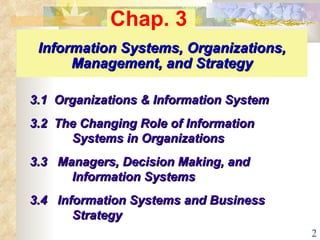
Information Systems, Organizations, Management, and Strategy   3.1  Organizations & Information System 3.2  The Changing Role of Information    Systems in Organizations 3.3  Managers, Decision Making, and    Information Systems  3.4  Information Systems and Business    Strategy Chap. 3
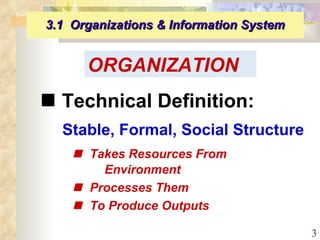
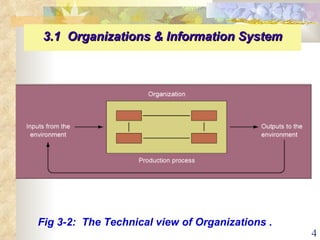
3.1  Organizations & Information System      Technical Definition:   Stable, Formal, Social Structure    Takes Resources From  Environment    Processes Them    To Produce Outputs ORGANIZATION
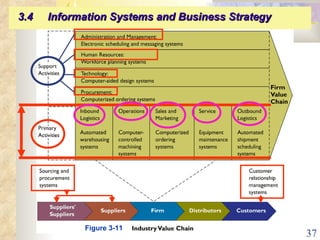
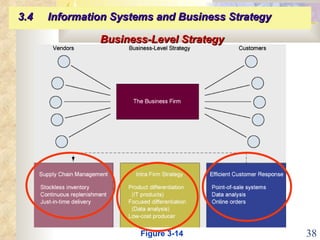
Fig 3-2:  The Technical view of Organizations . 3.1  Organizations & Information System
   Behavioral Definition :   Collection Of    Rights, Privileges,  Obligations, Responsibilities    Delicately Balanced    Conflict Resolution 3.1  Organizations & Information System   ORGANIZATION
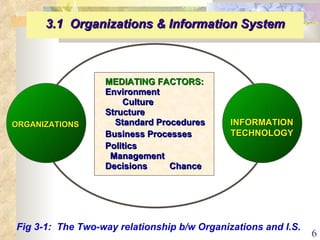
Fig 3-1:  The Two-way relationship b/w Organizations and I.S. 3.1  Organizations & Information System   MEDIATING FACTORS:   Environment  Culture Structure  Standard Procedures Business Processes Politics  Management Decisions  Chance ORGANIZATIONS INFORMATION TECHNOLOGY
Structural Characteristics of All Organizations Clear Division Of Labor Hierarchy Explicit Rules & Procedures Impartial Judgments Technical Qualifications Maximum Organizational Efficiency 3.1  Organizations & Information System
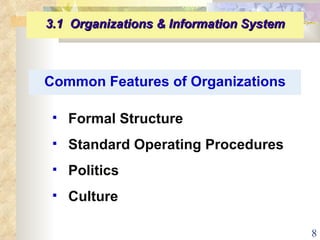
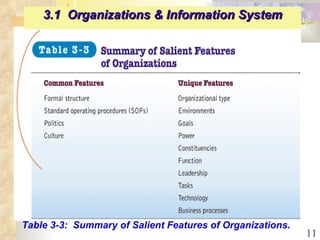
Common Features of Organizations   Formal Structure Standard Operating Procedures Politics Culture 3.1  Organizations & Information System
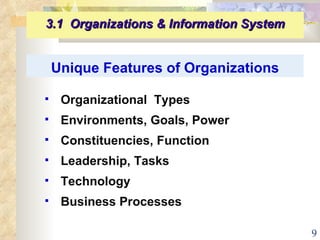
Unique Features of Organizations Organizational  Types  Environments, Goals, Power Constituencies, Function Leadership, Tasks Technology Business Processes 3.1  Organizations & Information System
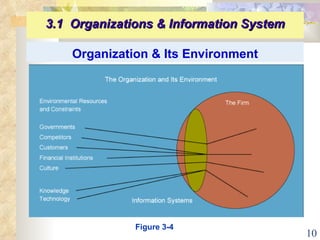
Organization & Its Environment 3.1  Organizations & Information System   Figure 3-4
Table 3-3:  Summary of Salient Features of Organizations . 3.1  Organizations & Information System
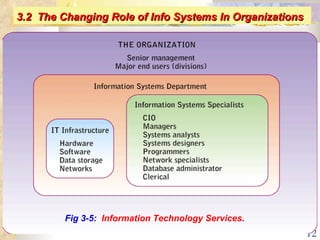
Fig 3-5:  Information Technology Services . 3.2  The Changing Role of Info Systems In Organizations
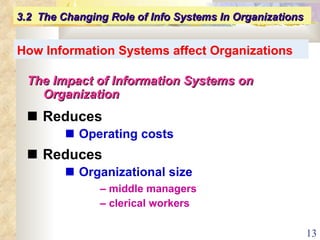
How Information Systems affect Organizations The Impact of Information Systems on Organization    Reduces    Operating costs    Reduces    Organizational size   –  middle managers   –  clerical workers 3.2  The Changing Role of Info Systems In Organizations
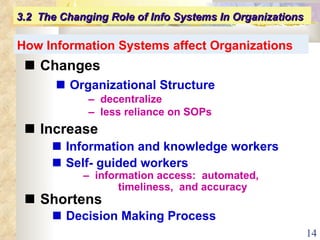
   Changes    Organizational Structure   –  decentralize –  less reliance on SOPs    Increase    Information and knowledge workers    Self- guided workers How Information Systems affect Organizations –  information access:  automated,   timeliness,  and accuracy    Shortens    Decision Making Process 3.2  The Changing Role of Info Systems In Organizations
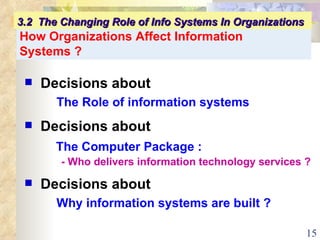
How Organizations Affect Information Systems ? Decisions about   The Role of information systems Decisions about The Computer Package :   - Who delivers information technology services ? Decisions about Why information systems are built ? 3.2  The Changing Role of Info Systems In Organizations
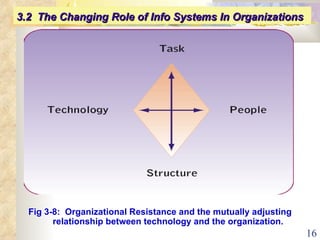
Fig 3-8:  Organizational Resistance and the mutually adjusting relationship between technology and the organization. 3.2  The Changing Role of Info Systems In Organizations
Internet & Organizations    The internet increase the     ■   Accessibility   ■   Storage   ■   Distribution of Info & Knowledge    For organizations ■   Lowering the transaction and agency costs 3.2  The Changing Role of Info Systems In Organizations ◆
Role Of Managers    Classical Descriptions of Management   Describe functions-   plan, organize, coordinate, decide,  control    Behavioral Models Based on observations of managers  on the job 3.3  Managers, Decision Making, and Information Systems
Behavioral model   of management  activities :    High-volume, High-speed work    Variety, Fragmentation, Brevity    Issue preference  current, ad hoc,  specific    Contacts, complex web of interactions    Strong preference for  verbal media    Control of the agenda What Managers Do ?   3.3  Managers, Decision Making, and Information Systems
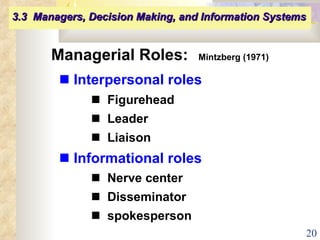
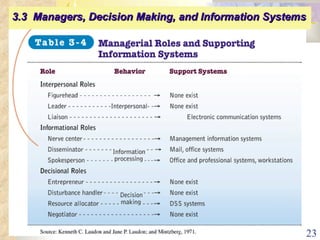
Managerial Roles:   Mintzberg (1971)    Interpersonal roles      Figurehead    Leader    Liaison    Informational roles    Nerve center    Disseminator    spokesperson 3.3  Managers, Decision Making, and Information Systems
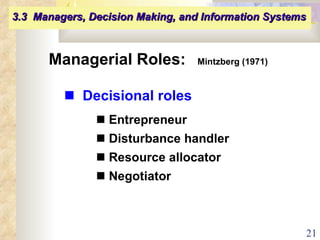
Managerial Roles:   Mintzberg (1971)    Decisional roles      Entrepreneur     Disturbance handler    Resource allocator    Negotiator 3.3  Managers, Decision Making, and Information Systems
How information systems can benefit managers ?    What managers do ?    What information managers need for  decision making ?      How decisions are made ?      What kinds of decisions can be  supported by formal information  systems ? 3.3  Managers, Decision Making, and Information Systems   ◇
3.3  Managers, Decision Making, and Information Systems
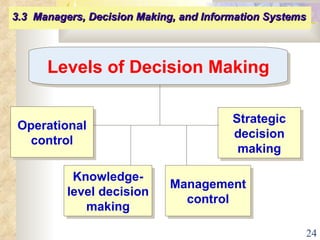
3.3  Managers, Decision Making, and Information Systems   Levels of Decision Making Operational control Knowledge- level decision making Management control Strategic decision making
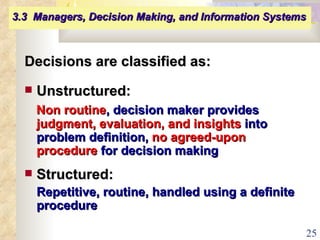
Decisions are classified as: Unstructured:   Non routine , decision maker provides  judgment, evaluation, and insights  into problem definition,  no agreed-upon procedure  for decision making Structured:   Repetitive, routine, handled using a definite procedure 3.3  Managers, Decision Making, and Information Systems
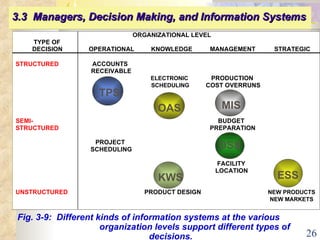
Fig. 3-9:  Different kinds of information systems at the various    organization levels support different types of decisions. 3.3  Managers, Decision Making, and Information Systems   TPS OAS MIS KWS DSS ESS ORGANIZATIONAL LEVEL TYPE OF DECISION OPERATIONAL KNOWLEDGE MANAGEMENT STRATEGIC STRUCTURED ACCOUNTS  RECEIVABLE ELECTRONIC  PRODUCTION SCHEDULING COST OVERRUNS SEMI- BUDGET STRUCTURED PREPARATION PROJECT SCHEDULING FACILITY LOCATION UNSTRUCTURED PRODUCT DESIGN NEW PRODUCTS NEW MARKETS
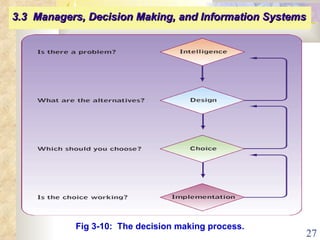
Fig 3-10:  The decision making process. 3.3  Managers, Decision Making, and Information Systems
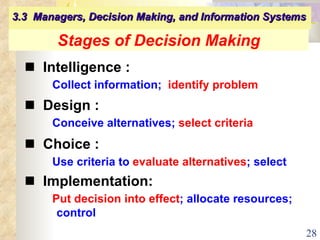
Stages of Decision Making    Intelligence :   Collect information;  identify problem    Design :   Conceive alternatives;  select criteria    Choice : Use criteria to  evaluate alternatives ; select      Implementation: Put decision into effect ; allocate resources; control 3.3  Managers, Decision Making, and Information Systems
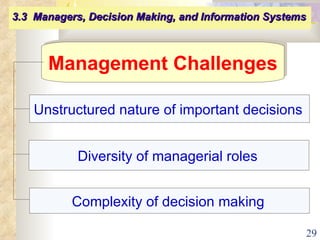
Management Challenges Unstructured nature of important decisions   Diversity of managerial roles   Complexity of decision making   3.3  Managers, Decision Making, and Information Systems
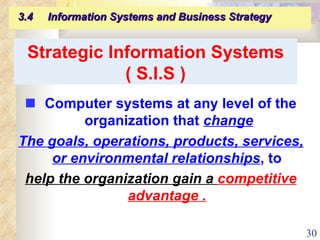
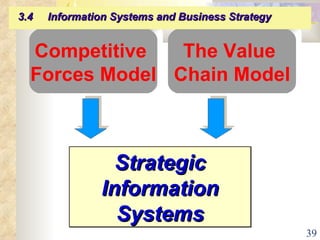
Strategic Information Systems ( S.I.S )    Computer systems at any level of the organization that  change The goals, operations, products, services, or environmental relationships , to  help the organization gain a  competitive advantage .   3.4  Information Systems and Business Strategy
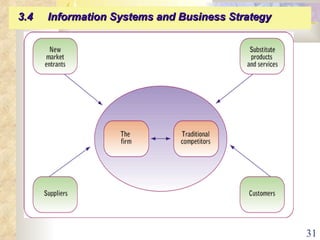
Fig. 3-15:  Porter’s competitive forces model 3.4  Information Systems and Business Strategy
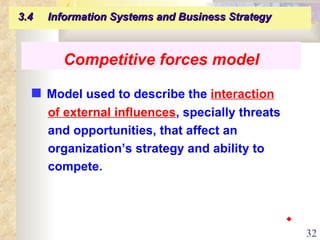
Competitive forces model    Model used to describe the  interaction of external influences , specially threats  and opportunities, that affect an  organization’s strategy and ability to  compete.  3.4  Information Systems and Business Strategy   ◆
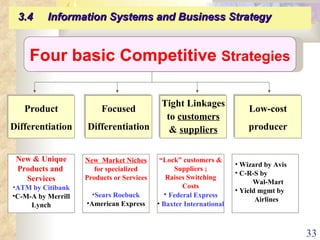
Four basic Competitive  Strategies Product Differentiation Focused Differentiation Tight Linkages to  customers &  suppliers Low-cost producer New & Unique Products and  Services ATM by Citibank C-M-A by Merrill Lynch New  Market Niches for specialized Products or Services Sears Roebuck American Express “ Lock” customers & Suppliers ; Raises Switching Costs Federal Express Baxter International Wizard by Avis C-R-S by Wal-Mart Yield mgmt by Airlines 3.4  Information Systems and Business Strategy
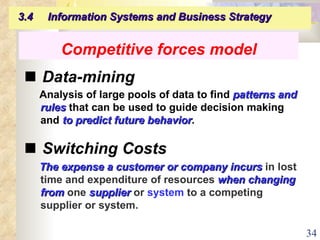
   Data-mining Analysis of large pools of data to find  patterns and rules  that can be used to guide decision making and  to predict future behavior .    Switching Costs The expense a customer or company incurs  in lost time and expenditure of resources  when changing from  one  supplier  or  system  to a competing supplier or system. Competitive forces model 3.4  Information Systems and Business Strategy
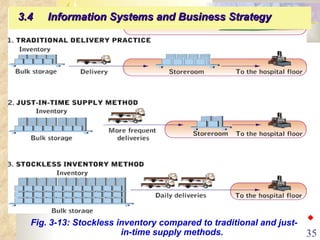
Fig. 3-13: Stockless inventory compared to traditional and just-in-time supply methods. 3.4  Information Systems and Business Strategy   ◆
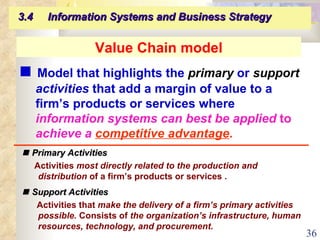
Value Chain model    Model that highlights the   primary  or  support  activities  that add a margin of value to a firm’s products or services where  information systems can best be applied  to  achieve a   competitive advantage . 3.4  Information Systems and Business Strategy      Primary Activities Activities  most directly related to the production and distribution  of a firm’s products or services .      Support Activities Activities that  make the delivery of a firm’s primary activities possible.  Consists of  the organization’s infrastructure, human resources, technology, and procurement.
3.4  Information Systems and Business Strategy   Figure 3-11
Business-Level Strategy   3.4  Information Systems and Business Strategy   Figure 3-14
Strategic Information Systems Competitive  Forces Model The Value  Chain Model 3.4  Information Systems and Business Strategy
What managers should do ?    How is the  industry  currently  using information systems  ?    Can  significant strategic opportunities be gained  by  introducing new   information system technology  ? 3.4  Information Systems and Business Strategy
   What is the  current business strategic plan , and how does that plan  mesh   with  the  current strategy for information services  ?    Does the firm have  the technology and capital required  to  develop a strategic information systems initiative  ? What managers should do ? 3.4  Information Systems and Business Strategy
HOMEWORK  CHAP.3 # 1  What are the Mediating Factors between organizations and  Information Technology ? # 2  Describe briefly what common features and unique features of  organizations are?  # 3  Describe how information systems affect organizations; and  how organizations affect information systems.  # 8  What specific managerial roles can information systems  support ? Where are information systems particularly  strong in supporting managers, and where are they weak?  # 9   What are the four stages of decision making described by  Simon?  # 12  What is a strategic information system?  # 13  Describe what competitive forces model and value chain  model are? Name four basic competitive strategies. # 14  What managers should do after understanding the impact of  strategic information system? ~ THE  END ~

Information systems, organizations, management, and strategy

  • 1.
    Management Information Systems - Chap. 3 By: Prof. Y. Peter Chiu 2 / 2009
  • 2.
    Information Systems, Organizations,Management, and Strategy 3.1 Organizations & Information System 3.2 The Changing Role of Information Systems in Organizations 3.3 Managers, Decision Making, and Information Systems 3.4 Information Systems and Business Strategy Chap. 3
  • 3.
    3.1 Organizations& Information System  Technical Definition: Stable, Formal, Social Structure  Takes Resources From Environment  Processes Them  To Produce Outputs ORGANIZATION
  • 4.
    Fig 3-2: The Technical view of Organizations . 3.1 Organizations & Information System
  • 5.
    Behavioral Definition : Collection Of  Rights, Privileges, Obligations, Responsibilities  Delicately Balanced  Conflict Resolution 3.1 Organizations & Information System ORGANIZATION
  • 6.
    Fig 3-1: The Two-way relationship b/w Organizations and I.S. 3.1 Organizations & Information System MEDIATING FACTORS: Environment Culture Structure Standard Procedures Business Processes Politics Management Decisions Chance ORGANIZATIONS INFORMATION TECHNOLOGY
  • 7.
    Structural Characteristics ofAll Organizations Clear Division Of Labor Hierarchy Explicit Rules & Procedures Impartial Judgments Technical Qualifications Maximum Organizational Efficiency 3.1 Organizations & Information System
  • 8.
    Common Features ofOrganizations Formal Structure Standard Operating Procedures Politics Culture 3.1 Organizations & Information System
  • 9.
    Unique Features ofOrganizations Organizational Types Environments, Goals, Power Constituencies, Function Leadership, Tasks Technology Business Processes 3.1 Organizations & Information System
  • 10.
    Organization & ItsEnvironment 3.1 Organizations & Information System Figure 3-4
  • 11.
    Table 3-3: Summary of Salient Features of Organizations . 3.1 Organizations & Information System
  • 12.
    Fig 3-5: Information Technology Services . 3.2 The Changing Role of Info Systems In Organizations
  • 13.
    How Information Systemsaffect Organizations The Impact of Information Systems on Organization  Reduces  Operating costs  Reduces  Organizational size – middle managers – clerical workers 3.2 The Changing Role of Info Systems In Organizations
  • 14.
    Changes  Organizational Structure – decentralize – less reliance on SOPs  Increase  Information and knowledge workers  Self- guided workers How Information Systems affect Organizations – information access: automated, timeliness, and accuracy  Shortens  Decision Making Process 3.2 The Changing Role of Info Systems In Organizations
  • 15.
    How Organizations AffectInformation Systems ? Decisions about The Role of information systems Decisions about The Computer Package : - Who delivers information technology services ? Decisions about Why information systems are built ? 3.2 The Changing Role of Info Systems In Organizations
  • 16.
    Fig 3-8: Organizational Resistance and the mutually adjusting relationship between technology and the organization. 3.2 The Changing Role of Info Systems In Organizations
  • 17.
    Internet & Organizations The internet increase the ■ Accessibility ■ Storage ■ Distribution of Info & Knowledge  For organizations ■ Lowering the transaction and agency costs 3.2 The Changing Role of Info Systems In Organizations ◆
  • 18.
    Role Of Managers Classical Descriptions of Management Describe functions- plan, organize, coordinate, decide, control  Behavioral Models Based on observations of managers on the job 3.3 Managers, Decision Making, and Information Systems
  • 19.
    Behavioral model of management activities :  High-volume, High-speed work  Variety, Fragmentation, Brevity  Issue preference current, ad hoc, specific  Contacts, complex web of interactions  Strong preference for verbal media  Control of the agenda What Managers Do ? 3.3 Managers, Decision Making, and Information Systems
  • 20.
    Managerial Roles: Mintzberg (1971)  Interpersonal roles  Figurehead  Leader  Liaison  Informational roles  Nerve center  Disseminator  spokesperson 3.3 Managers, Decision Making, and Information Systems
  • 21.
    Managerial Roles: Mintzberg (1971)  Decisional roles  Entrepreneur  Disturbance handler  Resource allocator  Negotiator 3.3 Managers, Decision Making, and Information Systems
  • 22.
    How information systemscan benefit managers ?  What managers do ?  What information managers need for decision making ?  How decisions are made ?  What kinds of decisions can be supported by formal information systems ? 3.3 Managers, Decision Making, and Information Systems ◇
  • 23.
    3.3 Managers,Decision Making, and Information Systems
  • 24.
    3.3 Managers,Decision Making, and Information Systems Levels of Decision Making Operational control Knowledge- level decision making Management control Strategic decision making
  • 25.
    Decisions are classifiedas: Unstructured: Non routine , decision maker provides judgment, evaluation, and insights into problem definition, no agreed-upon procedure for decision making Structured: Repetitive, routine, handled using a definite procedure 3.3 Managers, Decision Making, and Information Systems
  • 26.
    Fig. 3-9: Different kinds of information systems at the various organization levels support different types of decisions. 3.3 Managers, Decision Making, and Information Systems TPS OAS MIS KWS DSS ESS ORGANIZATIONAL LEVEL TYPE OF DECISION OPERATIONAL KNOWLEDGE MANAGEMENT STRATEGIC STRUCTURED ACCOUNTS RECEIVABLE ELECTRONIC PRODUCTION SCHEDULING COST OVERRUNS SEMI- BUDGET STRUCTURED PREPARATION PROJECT SCHEDULING FACILITY LOCATION UNSTRUCTURED PRODUCT DESIGN NEW PRODUCTS NEW MARKETS
  • 27.
    Fig 3-10: The decision making process. 3.3 Managers, Decision Making, and Information Systems
  • 28.
    Stages of DecisionMaking  Intelligence : Collect information; identify problem  Design : Conceive alternatives; select criteria  Choice : Use criteria to evaluate alternatives ; select  Implementation: Put decision into effect ; allocate resources; control 3.3 Managers, Decision Making, and Information Systems
  • 29.
    Management Challenges Unstructurednature of important decisions Diversity of managerial roles Complexity of decision making 3.3 Managers, Decision Making, and Information Systems
  • 30.
    Strategic Information Systems( S.I.S )  Computer systems at any level of the organization that change The goals, operations, products, services, or environmental relationships , to help the organization gain a competitive advantage . 3.4 Information Systems and Business Strategy
  • 31.
    Fig. 3-15: Porter’s competitive forces model 3.4 Information Systems and Business Strategy
  • 32.
    Competitive forces model Model used to describe the interaction of external influences , specially threats and opportunities, that affect an organization’s strategy and ability to compete. 3.4 Information Systems and Business Strategy ◆
  • 33.
    Four basic Competitive Strategies Product Differentiation Focused Differentiation Tight Linkages to customers & suppliers Low-cost producer New & Unique Products and Services ATM by Citibank C-M-A by Merrill Lynch New Market Niches for specialized Products or Services Sears Roebuck American Express “ Lock” customers & Suppliers ; Raises Switching Costs Federal Express Baxter International Wizard by Avis C-R-S by Wal-Mart Yield mgmt by Airlines 3.4 Information Systems and Business Strategy
  • 34.
    Data-mining Analysis of large pools of data to find patterns and rules that can be used to guide decision making and to predict future behavior .  Switching Costs The expense a customer or company incurs in lost time and expenditure of resources when changing from one supplier or system to a competing supplier or system. Competitive forces model 3.4 Information Systems and Business Strategy
  • 35.
    Fig. 3-13: Stocklessinventory compared to traditional and just-in-time supply methods. 3.4 Information Systems and Business Strategy ◆
  • 36.
    Value Chain model Model that highlights the primary or support activities that add a margin of value to a firm’s products or services where information systems can best be applied to achieve a competitive advantage . 3.4 Information Systems and Business Strategy  Primary Activities Activities most directly related to the production and distribution of a firm’s products or services .  Support Activities Activities that make the delivery of a firm’s primary activities possible. Consists of the organization’s infrastructure, human resources, technology, and procurement.
  • 37.
    3.4 InformationSystems and Business Strategy Figure 3-11
  • 38.
    Business-Level Strategy 3.4 Information Systems and Business Strategy Figure 3-14
  • 39.
    Strategic Information SystemsCompetitive Forces Model The Value Chain Model 3.4 Information Systems and Business Strategy
  • 40.
    What managers shoulddo ?  How is the industry currently using information systems ?  Can significant strategic opportunities be gained by introducing new information system technology ? 3.4 Information Systems and Business Strategy
  • 41.
    What is the current business strategic plan , and how does that plan mesh with the current strategy for information services ?  Does the firm have the technology and capital required to develop a strategic information systems initiative ? What managers should do ? 3.4 Information Systems and Business Strategy
  • 42.
    HOMEWORK CHAP.3# 1 What are the Mediating Factors between organizations and Information Technology ? # 2 Describe briefly what common features and unique features of organizations are? # 3 Describe how information systems affect organizations; and how organizations affect information systems. # 8 What specific managerial roles can information systems support ? Where are information systems particularly strong in supporting managers, and where are they weak? # 9 What are the four stages of decision making described by Simon? # 12 What is a strategic information system? # 13 Describe what competitive forces model and value chain model are? Name four basic competitive strategies. # 14 What managers should do after understanding the impact of strategic information system? ~ THE END ~