Accident and Incident
Investigation

1/210
Objectives of this Section
●

●

●

To define the reasons for investigating
accident and incidents.
To outline the process for effectively
investigating accidents and incidents.
To facilitate an effective investigation.

2/210
Accident Investigation
●

●

Important part of any safety management system.
Highlights the reasons why accidents occur and how
to prevent them.
The primary purpose of accident investigations is to
improve health and safety performance by:
 Exploring the reasons for the event and identifying both the
immediate and underlying causes;
 Identifying remedies to improve the health and safety
management system by improving risk control, preventing a
recurrence and reducing financial losses.

3/210
What to Investigate?
●

●

●

All accidents whether major or minor are caused.
Serious accidents have the same root causes as
minor accidents as do incidents with a potential for
serious loss. It is these root causes that bring about
the accident, the severity is often a matter of chance.
Accident studies have shown that there is a
consistently greater number of less serious
accidents than serious accidents and in the same
way a greater number of incidents then accidents.
4/210
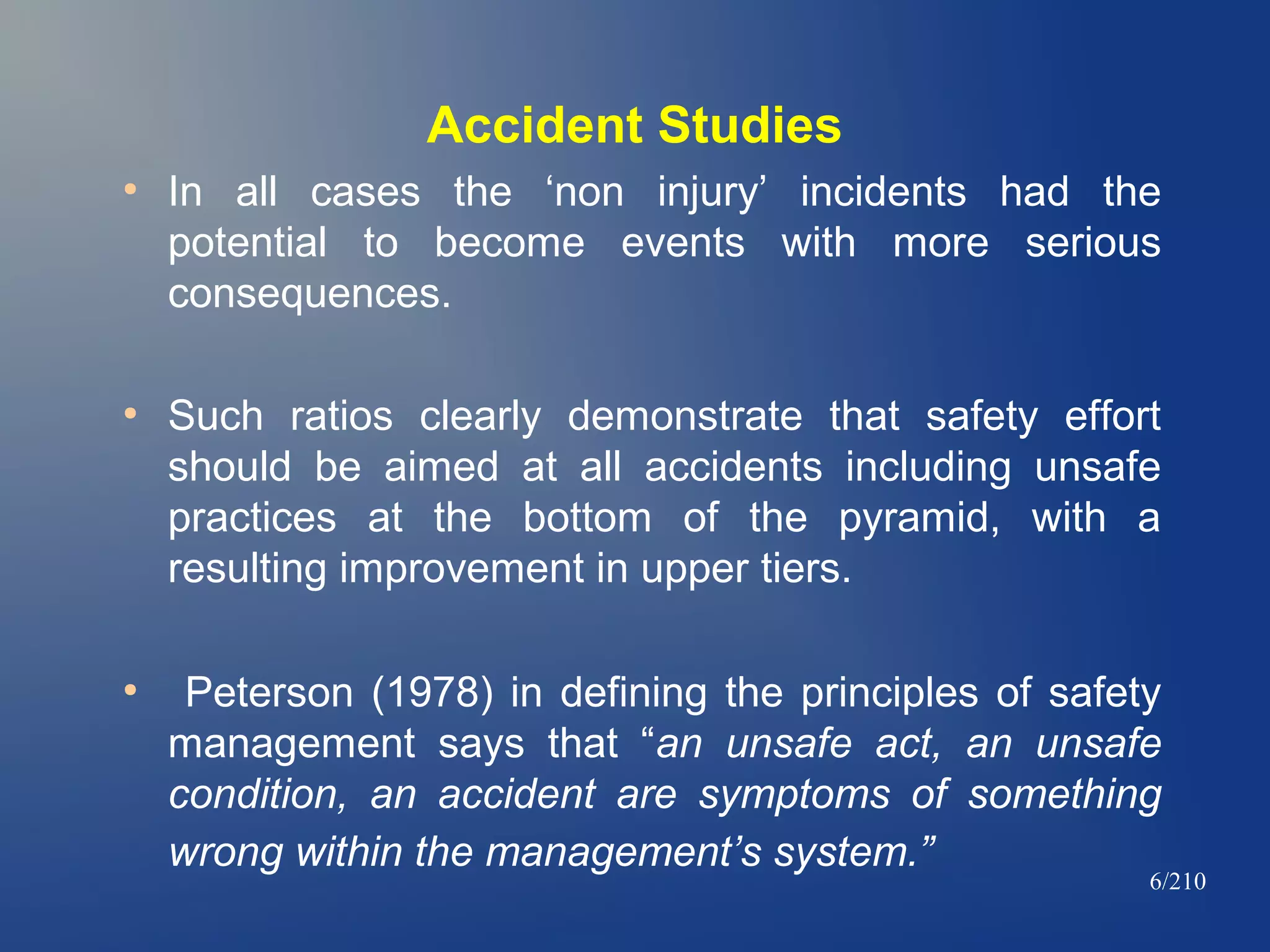
Many accident ratio studies have been undertaken and
the one shown below is based on studies carried out by
the Health & Safety Executive.

1

Major injury
Or illness

7
Minor injuries or illnesses

189
Non Injury Accidents/Illnesses

5/210
Accident Studies
●

●

●

In all cases the ‘non injury’ incidents had the
potential to become events with more serious
consequences.
Such ratios clearly demonstrate that safety effort
should be aimed at all accidents including unsafe
practices at the bottom of the pyramid, with a
resulting improvement in upper tiers.
Peterson (1978) in defining the principles of safety
management says that “an unsafe act, an unsafe
condition, an accident are symptoms of something
wrong within the management’s system.”

6/210
Accident Studies
●

●

All events represent a degree of failure in control and
are potential learning experiences. It therefore
follows that all accidents should be investigated to
some extent.
This extent should be determined by the loss
potential, rather then just the immediate effect.

7/210
Stages in an Accident/Incident
Investigation
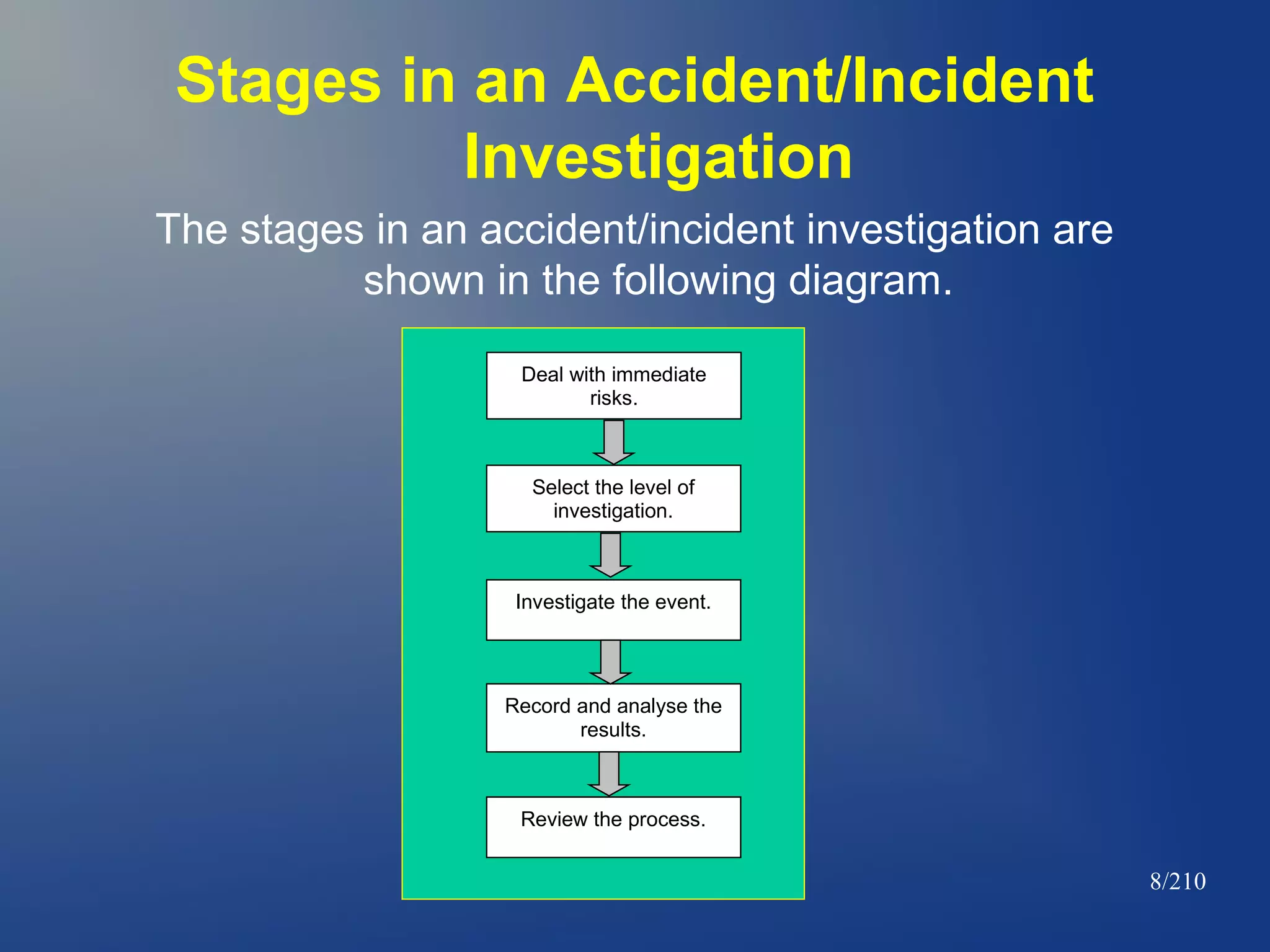
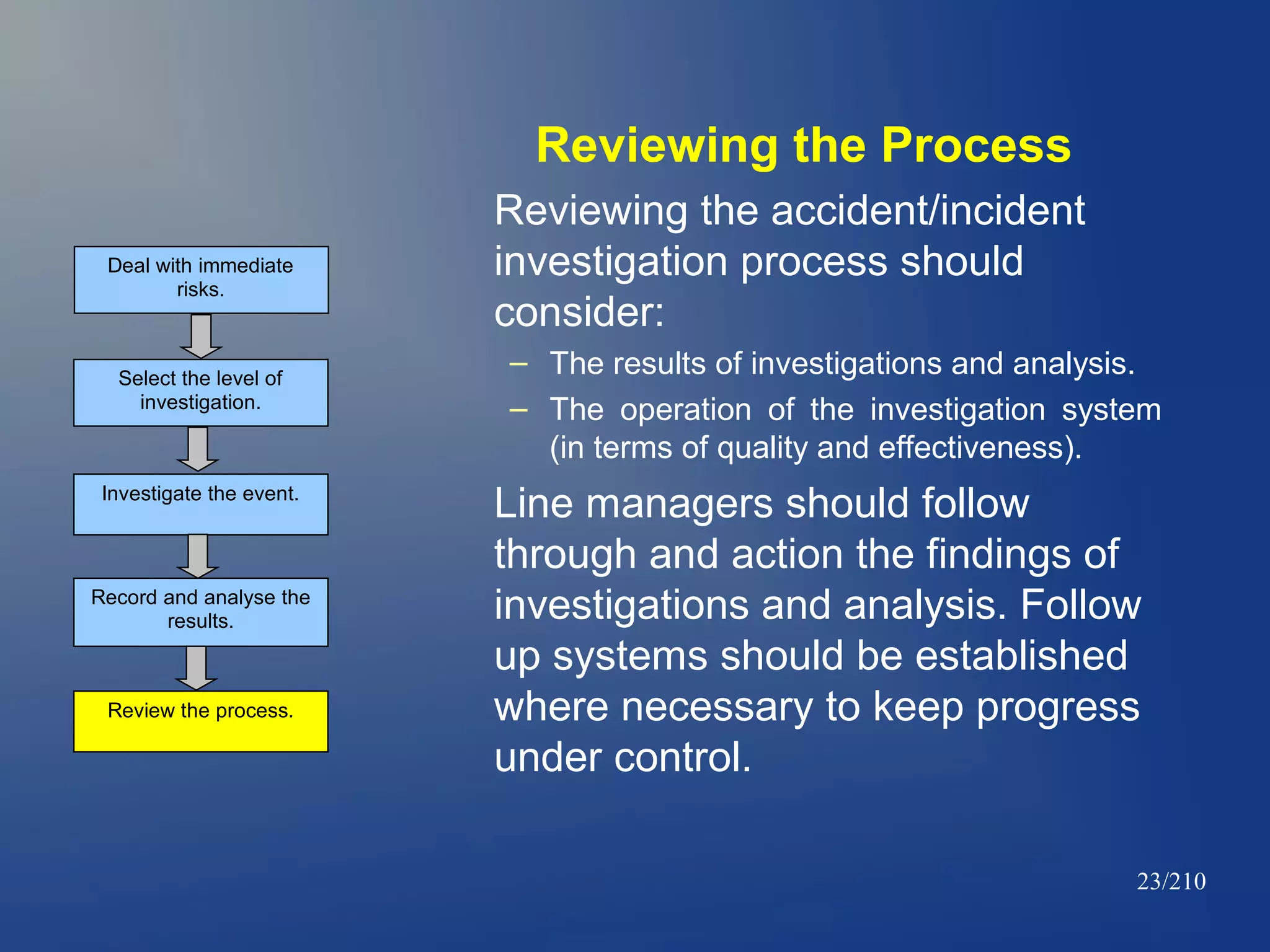
The stages in an accident/incident investigation are
shown in the following diagram.
Deal with immediate
risks.

Select the level of
investigation.

Investigate the event.

Record and analyse the
results.

Review the process.

8/210
Dealing with Immediate
Risks
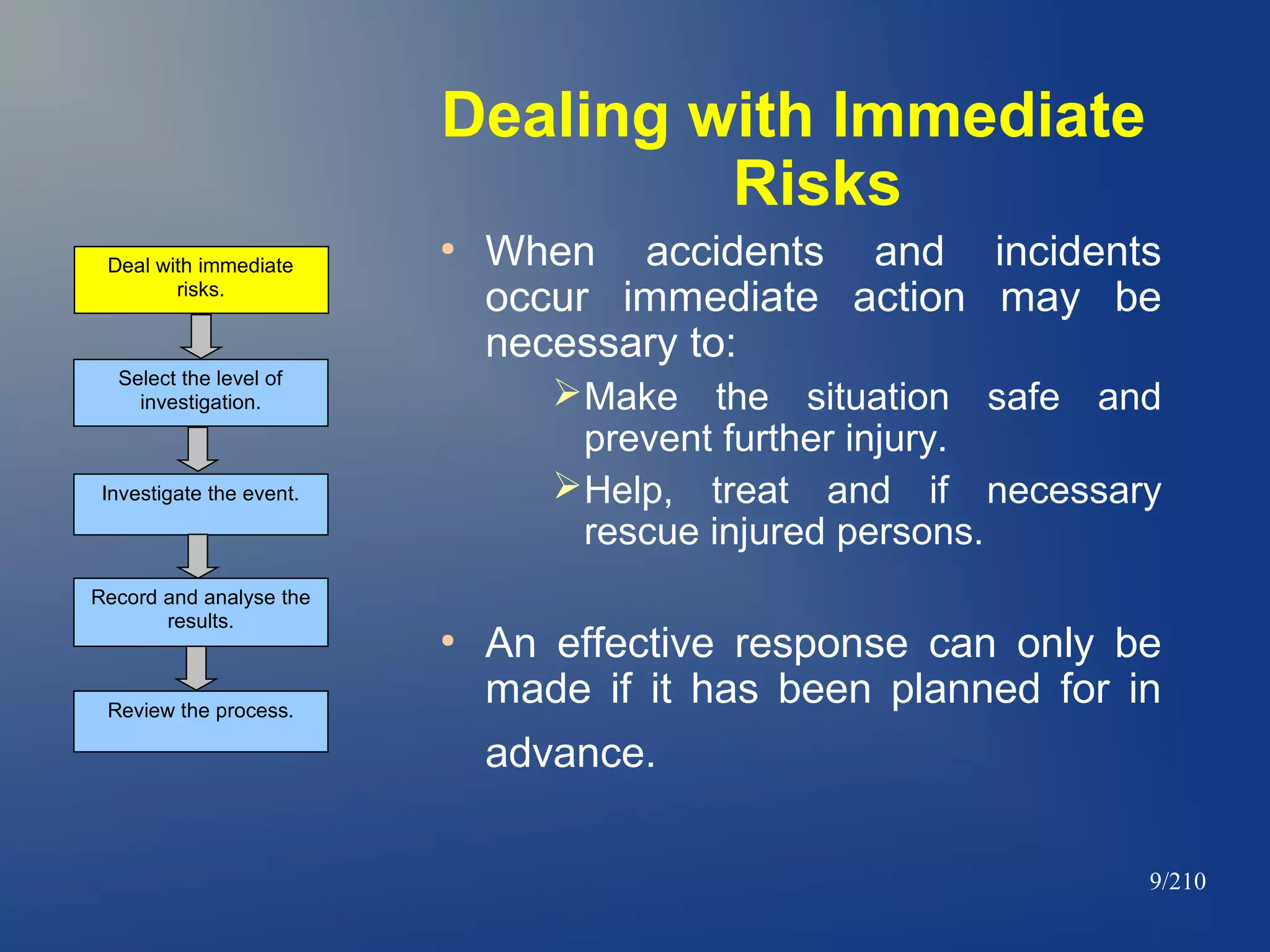
Deal with immediate
risks.

●

Select the level of
investigation.

Make the situation safe and
prevent further injury.
Help, treat and if necessary
rescue injured persons.

Investigate the event.

Record and analyse the
results.

Review the process.

When accidents and incidents
occur immediate action may be
necessary to:

●

An effective response can only be
made if it has been planned for in
advance.
9/210
Day 2 start

10/210
Selecting the level of
investigation
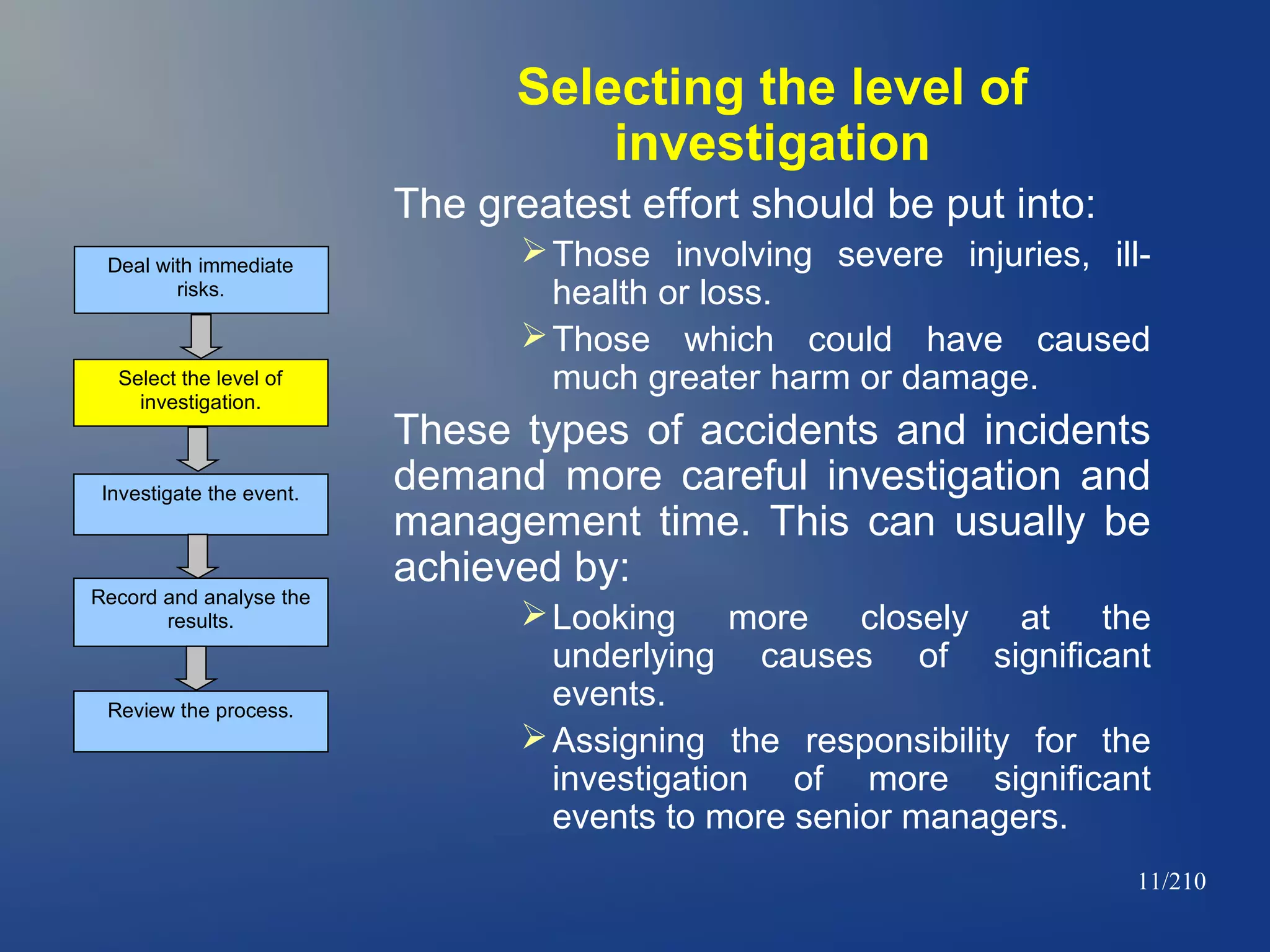
The greatest effort should be put into:
Deal with immediate
risks.

Select the level of
investigation.

Investigate the event.

Record and analyse the
results.

Review the process.

 Those involving severe injuries, illhealth or loss.
 Those which could have caused
much greater harm or damage.

These types of accidents and incidents
demand more careful investigation and
management time. This can usually be
achieved by:
 Looking more closely at the
underlying causes of significant
events.
 Assigning the responsibility for the
investigation of more significant
events to more senior managers.
11/210
Investigating the Event
Deal with immediate
risks.

Select the level of
investigation.

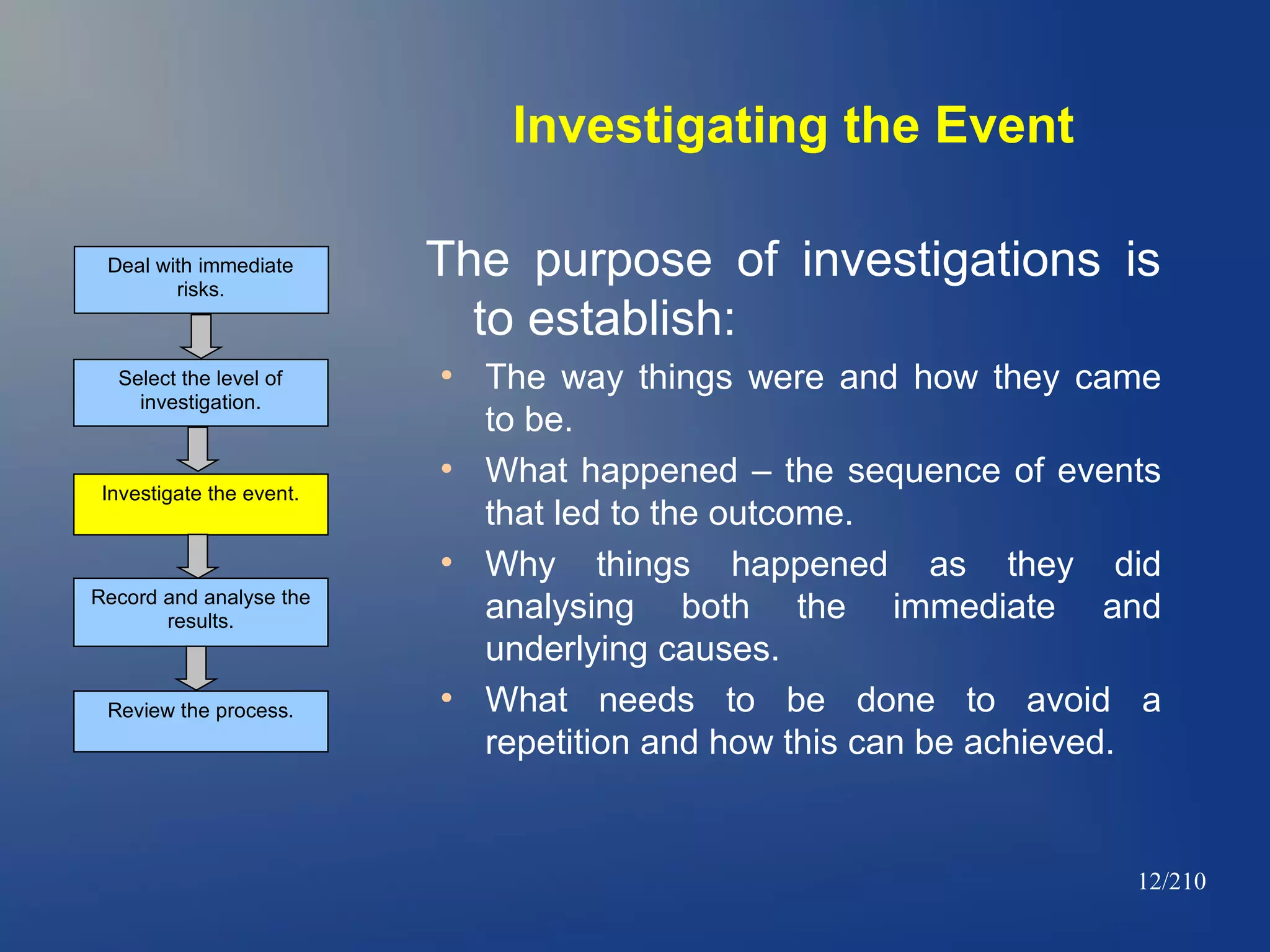
The purpose of investigations is
to establish:
●

●

Investigate the event.
●

Record and analyse the
results.

Review the process.

●

The way things were and how they came
to be.
What happened – the sequence of events
that led to the outcome.
Why things happened as they did
analysing both the immediate and
underlying causes.
What needs to be done to avoid a
repetition and how this can be achieved.

12/210
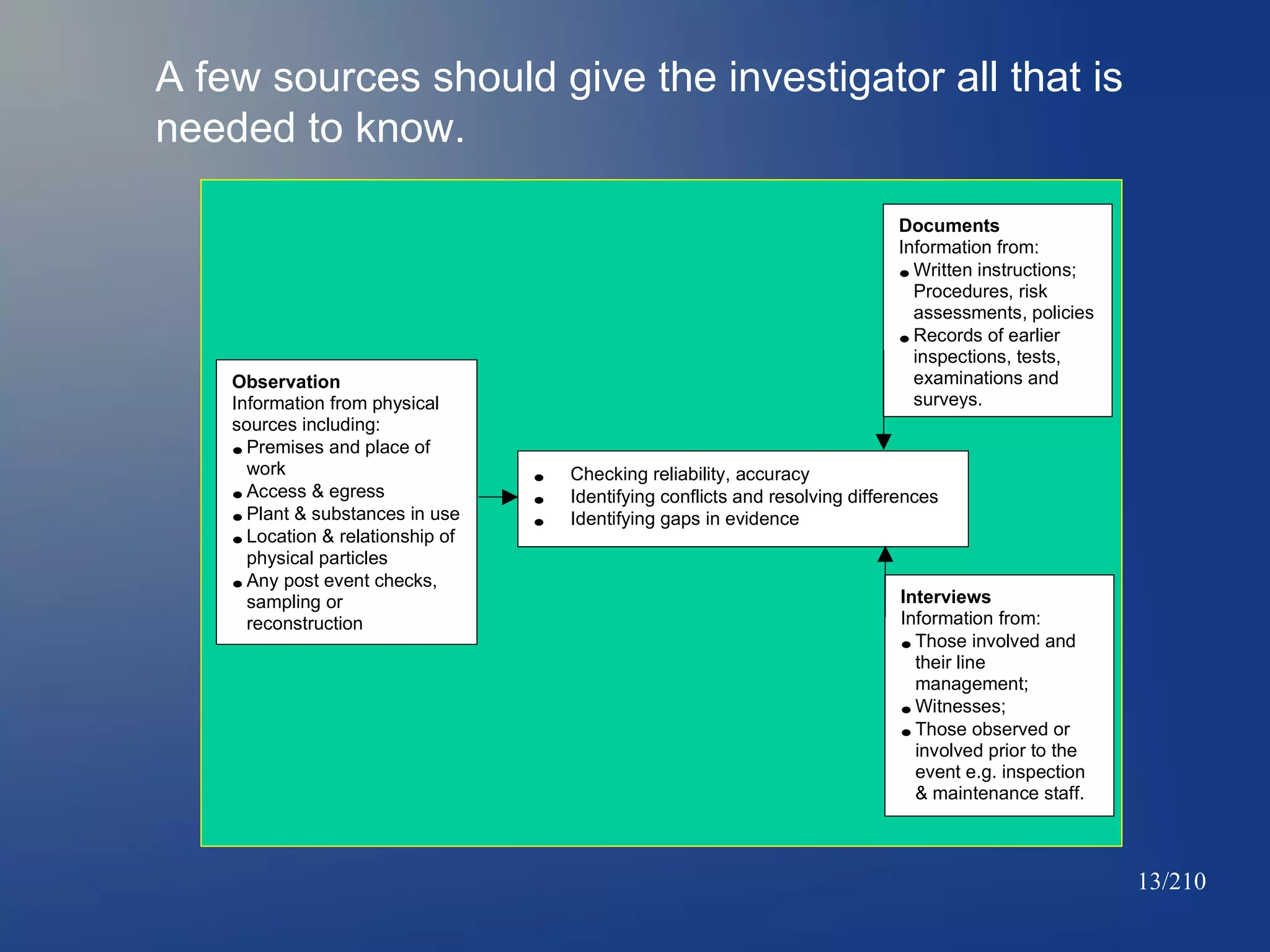
A few sources should give the investigator all that is
needed to know.

Observation
Information from physical
sources including:
• Premises and place of
work
• Access & egress
• Plant & substances in use
• Location & relationship of
physical particles
• Any post event checks,
sampling or
reconstruction

Documents
Information from:
• Written instructions;
Procedures, risk
assessments, policies
• Records of earlier
inspections, tests,
examinations and
surveys.

•
•
•

Checking reliability, accuracy
Identifying conflicts and resolving differences
Identifying gaps in evidence

Interviews
Information from:
• Those involved and
their line
management;
• Witnesses;
• Those observed or
involved prior to the
event e.g. inspection
& maintenance staff.

13/210
Interviews
●

●

●

Interviewing the person(s) involved and
witnesses to the accident is of prime
importance, ideally in familiar surroundings
so as not to make the person uncomfortable.
The interview style is important with
emphasis on prevention rather than blame.
The person(s) should give an account of
what happened in their terms rather than the
investigators.
14/210
Interviews
●

●

Interviews should be separate to stop people
from influencing each other.
Questions when asked should not be
intimidating as the investigator will be seen
as aggressive and reflecting a blame culture.

15/210
Observation
The accident site should be inspected as
soon as possible after the accident. Particular
attention should/must be given to:
• Positions of people.
• Personnel protective equipment (PPE).
• Tools and equipment, plant or substances in
use.
• Orderliness/Tidiness.
16/210
Documents
Documentation to be looked at includes:
●

Written instructions, procedures and risk
assessments which should have been in operation
and followed. The validity of these documents may
need to be checked by interview. The main points to
look for are:
 Are they adequate/satisfactory?
 Were they followed on this occasion?
 Were people trained/competent to follow it?

●

Records of inspections, tests, examination and
surveys undertaken before the event. These provide
information on how and why the circumstances
leading to the event arose.
17/210
Determining Causes
●

●

●

Collect all information and facts which surround the
accident.
Immediate causes are obvious and easy to find.
They are brought about by unsafe acts and
conditions and are the ACTIVE FAILURES. Unsafe
acts show poor safety attitudes and indicate a lack of
proper training.
These unsafe acts and conditions are brought about
by the so called ‘root causes’. These are the
LATENT FAILURES and are brought about by
failures in organisation and the management’s safety
system.
18/210
Determine what changes are needed
The investigation should determine what control
measures were absent, inadequate or not implemented
and so generate remedial action for implementation to
correct this.

19/210
Generally, remedial actions should follow the
hierarchy of risk control:
●

●

●

●

Eliminate Risks by substituting the dangerous by the
inherently less dangerous.
Combat risks at source by engineering controls and
giving collective protective measures priority.
Minimise risk by designing suitable systems of
working.
Use PPE as a last resort.

20/210
Day 3 start

21/210
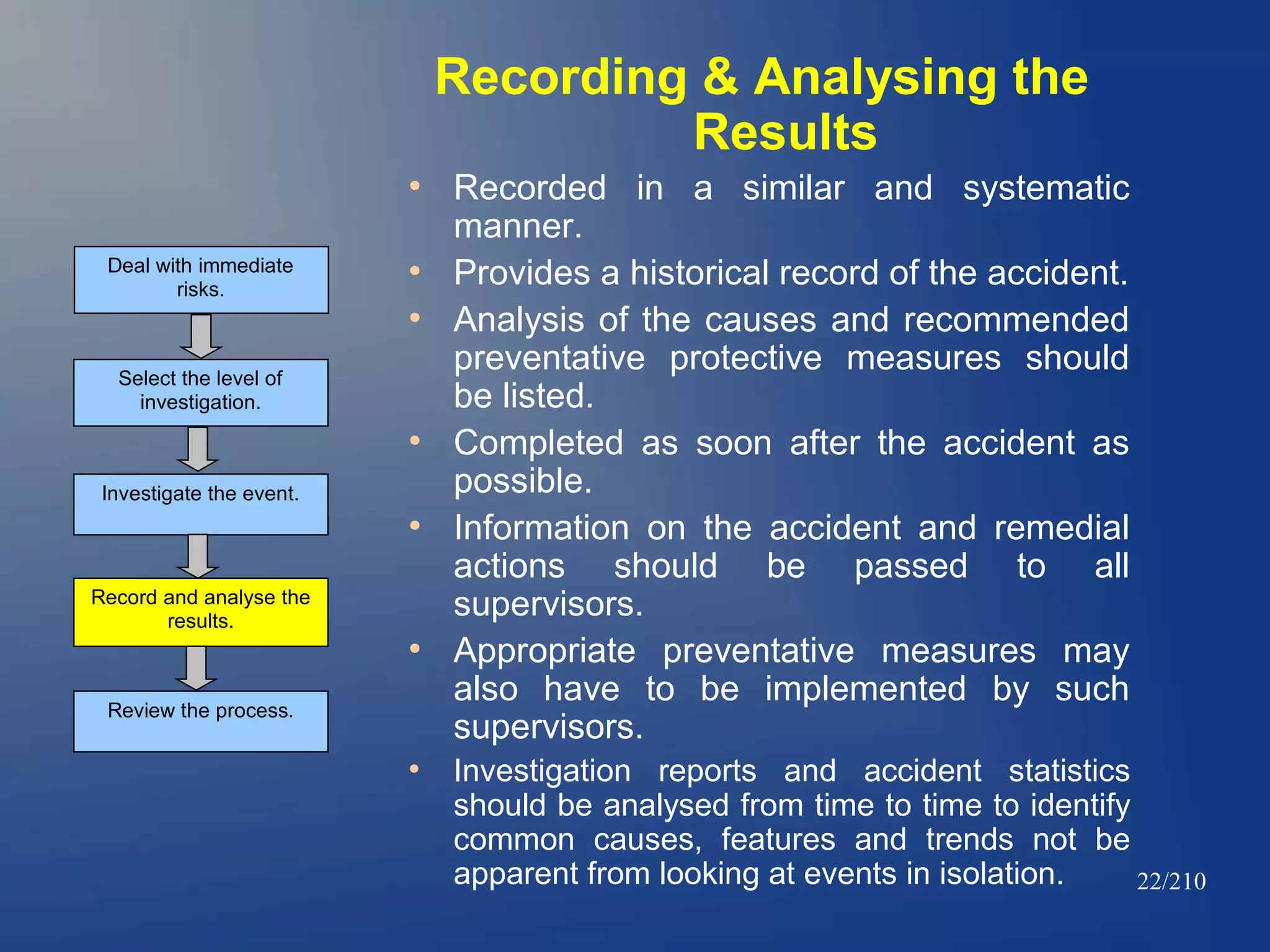
Recording & Analysing the
Results
●

Deal with immediate
risks.

●
●

Select the level of
investigation.
●

Investigate the event.
●

Record and analyse the
results.
●

Review the process.
●

Recorded in a similar and systematic
manner.
Provides a historical record of the accident.
Analysis of the causes and recommended
preventative protective measures should
be listed.
Completed as soon after the accident as
possible.
Information on the accident and remedial
actions should be passed to all
supervisors.
Appropriate preventative measures may
also have to be implemented by such
supervisors.
Investigation reports and accident statistics
should be analysed from time to time to identify
common causes, features and trends not be
apparent from looking at events in isolation.
22/210
Reviewing the Process
Deal with immediate
risks.

Select the level of
investigation.

Investigate the event.

Record and analyse the
results.

Review the process.

Reviewing the accident/incident
investigation process should
consider:
– The results of investigations and analysis.
– The operation of the investigation system
(in terms of quality and effectiveness).

Line managers should follow
through and action the findings of
investigations and analysis. Follow
up systems should be established
where necessary to keep progress
under control.
23/210
The investigation system should be examined
from time to time to check that it consistently
delivers information in accordance with the
stated objectives and standards. This usually
requires:
●

●

●

Checking samples of investigation forms to verify the
standard of investigation and the judgements made
about causation and prioritisation of remedial
actions.
Checking the numbers of incidents, near misses,
injury and ill-health events;
Checking that all events are being reported.
24/210
What is your definition
of an “Accident”?

25/210
What is an Accident
- an unplanned event
- an unplanned incident involving
injury or fatality
- a series of events culminating in
an unplanned and unforeseen
event
26/210
How do Accidents occur?
- Accidents

(with or without injuries) occur
when a series of unrelated events coincide at
a certain time and space.
-This can be from a few events to a series of
a dozen or more
(Because the coincidence of the series of
events is a matter of luck, actual accidents
only happen infrequently)
27/210
Unsafe Acts
- An unsafe act occurs in approx 85%- 95% of
all analyzed accidents with injuries
- An unsafe act is usually the last of a series of
events before the accident occurs (it could
occur at any step of the event)
- By stopping or eliminating the unsafe act, we
can stop the accident from occurring

28/210
What is an Accident Investigation?
●

A systematic approach to the identification of
causal factors and implementation of
corrective actions without placing blame on
or finding personal fault. The information
collected during an investigation is essential
to determine trends and taking appropriate
steps to prevent future accidents.

29/210
Which Accidents should be
Recorded or Reported?
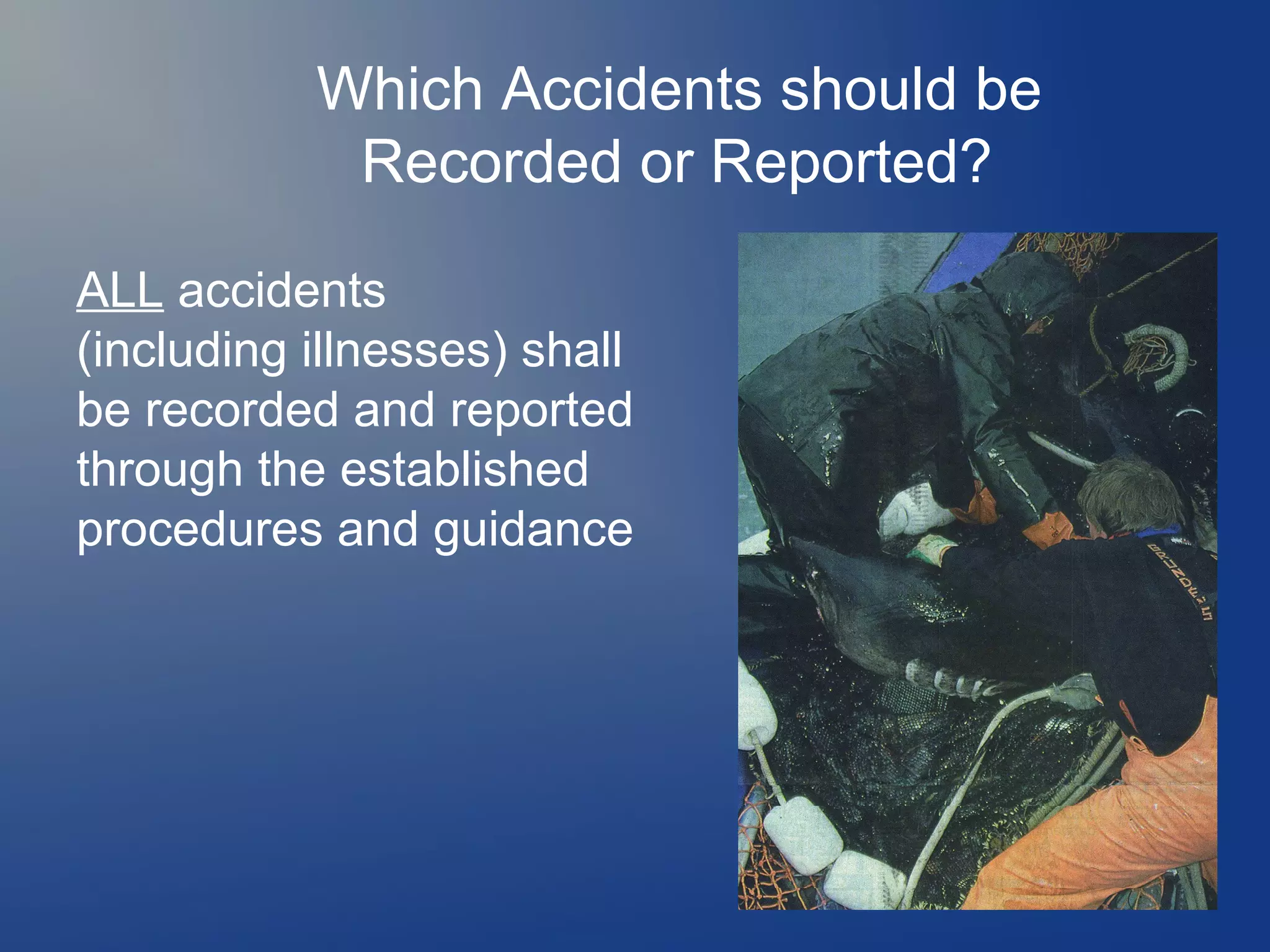
ALL accidents
(including illnesses) shall
be recorded and reported
through the established
procedures and guidance

30/210
Why Investigate Accidents?
●
●
●
●

Determine the cause
Develop and implement corrective actions
Document the events
Meet legal requirements

Primary Focus:
PREVENT REOCCURENCE!!!
31/210
Accident vs. Near-Miss
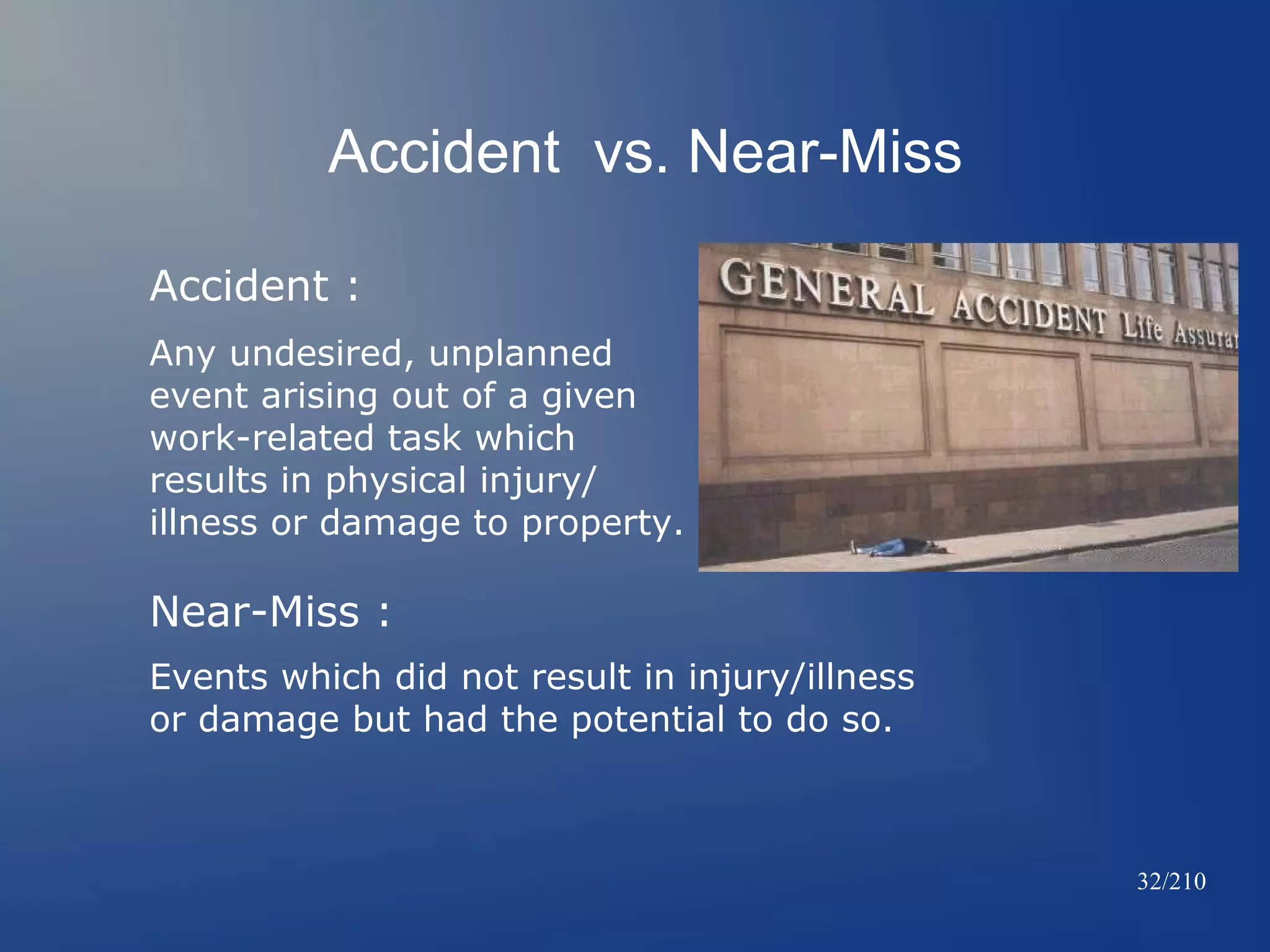
Accident :
Any undesired, unplanned
event arising out of a given
work-related task which
results in physical injury/
illness or damage to property.

Near-Miss :
Events which did not result in injury/illness
or damage but had the potential to do so.

32/210
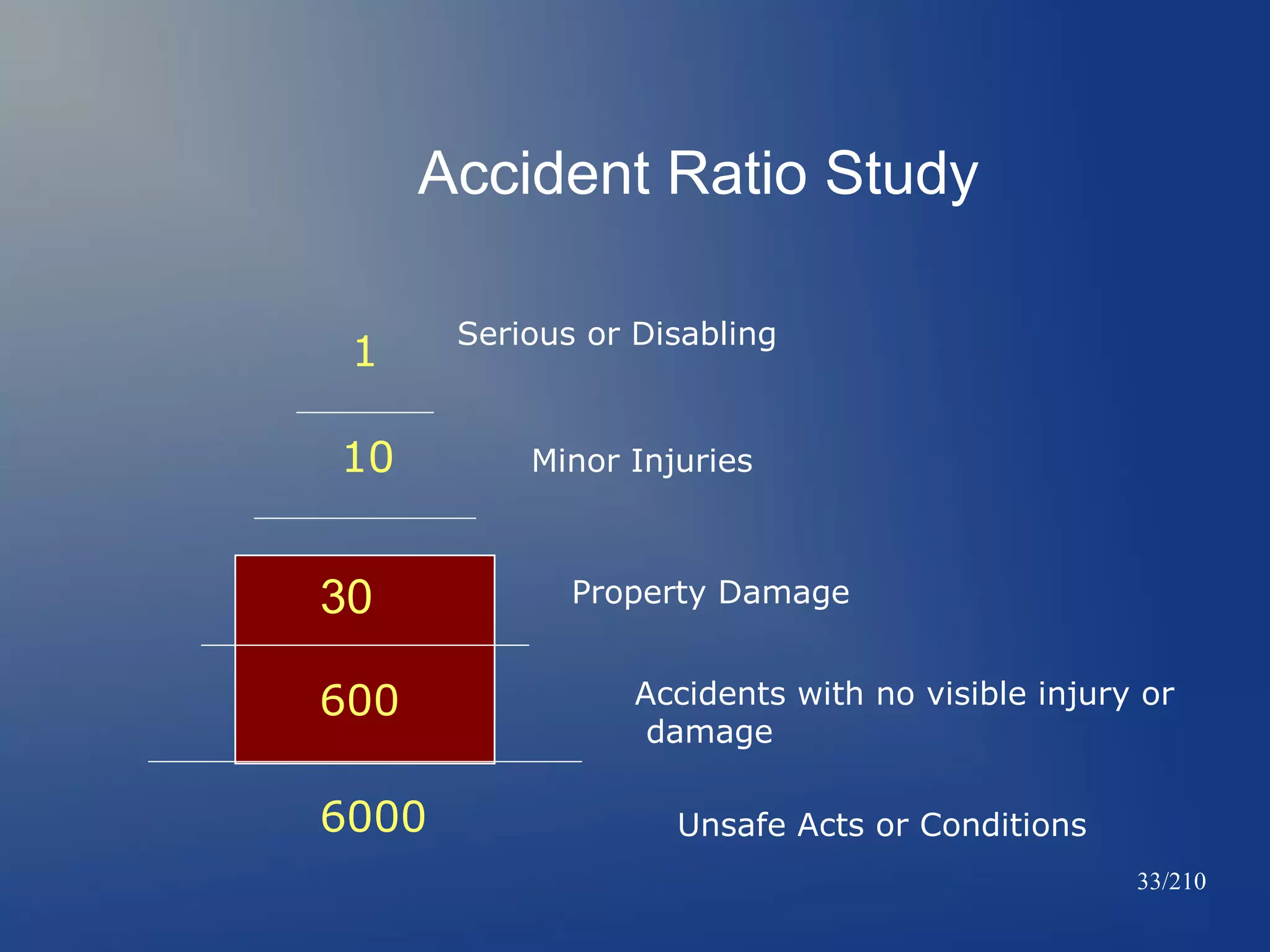
Accident Ratio Study
1
10

30
600
6000

Serious or Disabling

Minor Injuries

Property Damage
Accidents with no visible injury or
damage
Unsafe Acts or Conditions
33/210
Accident Causes
Unsafe Act
- an act by the injured person or another
person (or both) which caused the accident,
and/or
●
Unsafe Condition
- some environmental or hazardous
situation which caused the accident
independent of the employee
●

34/210
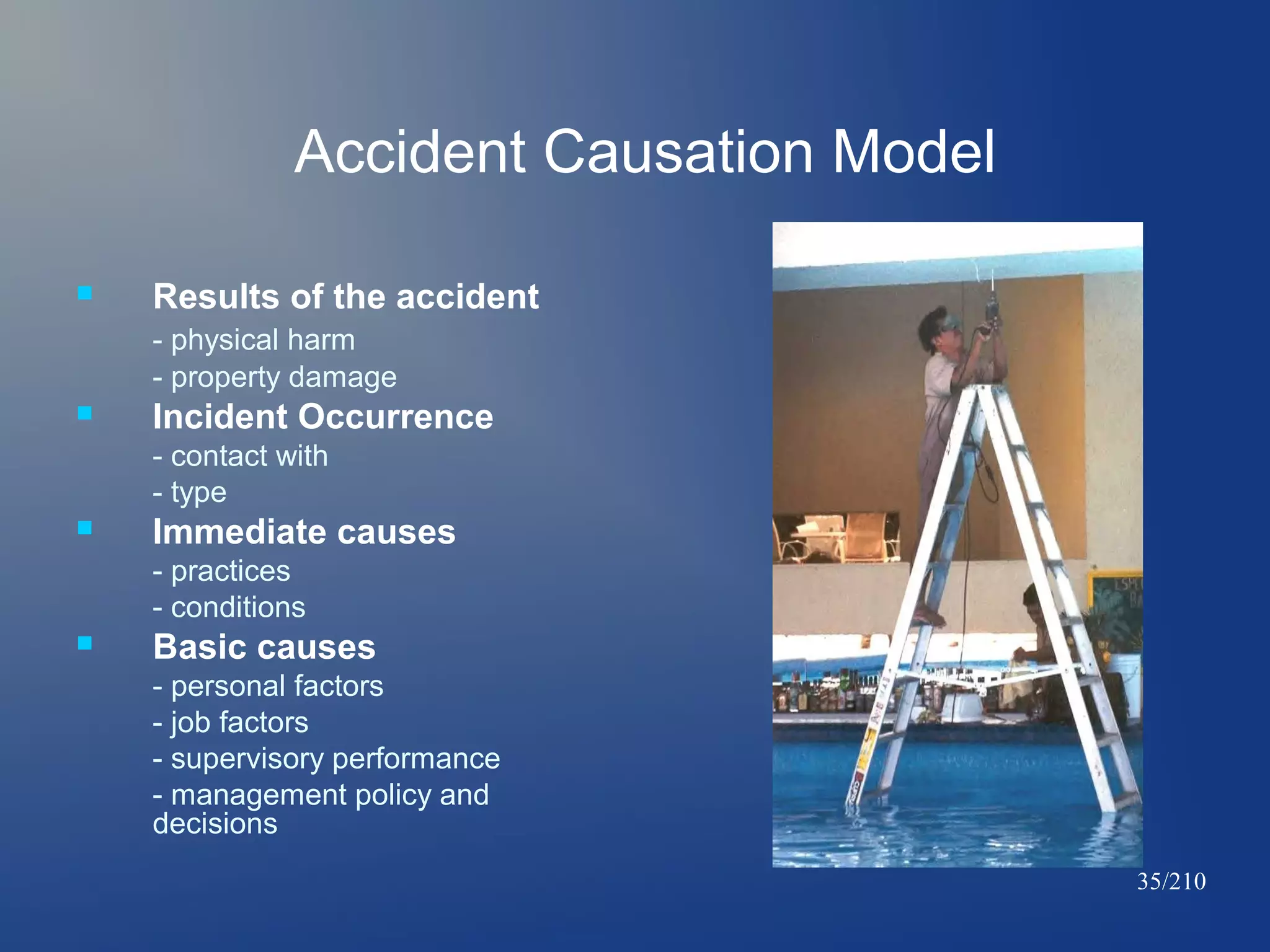
Accident Causation Model


Results of the accident
- physical harm
- property damage



Incident Occurrence
- contact with
- type



Immediate causes
- practices
- conditions



Basic causes
- personal factors
- job factors
- supervisory performance
- management policy and
decisions
35/210
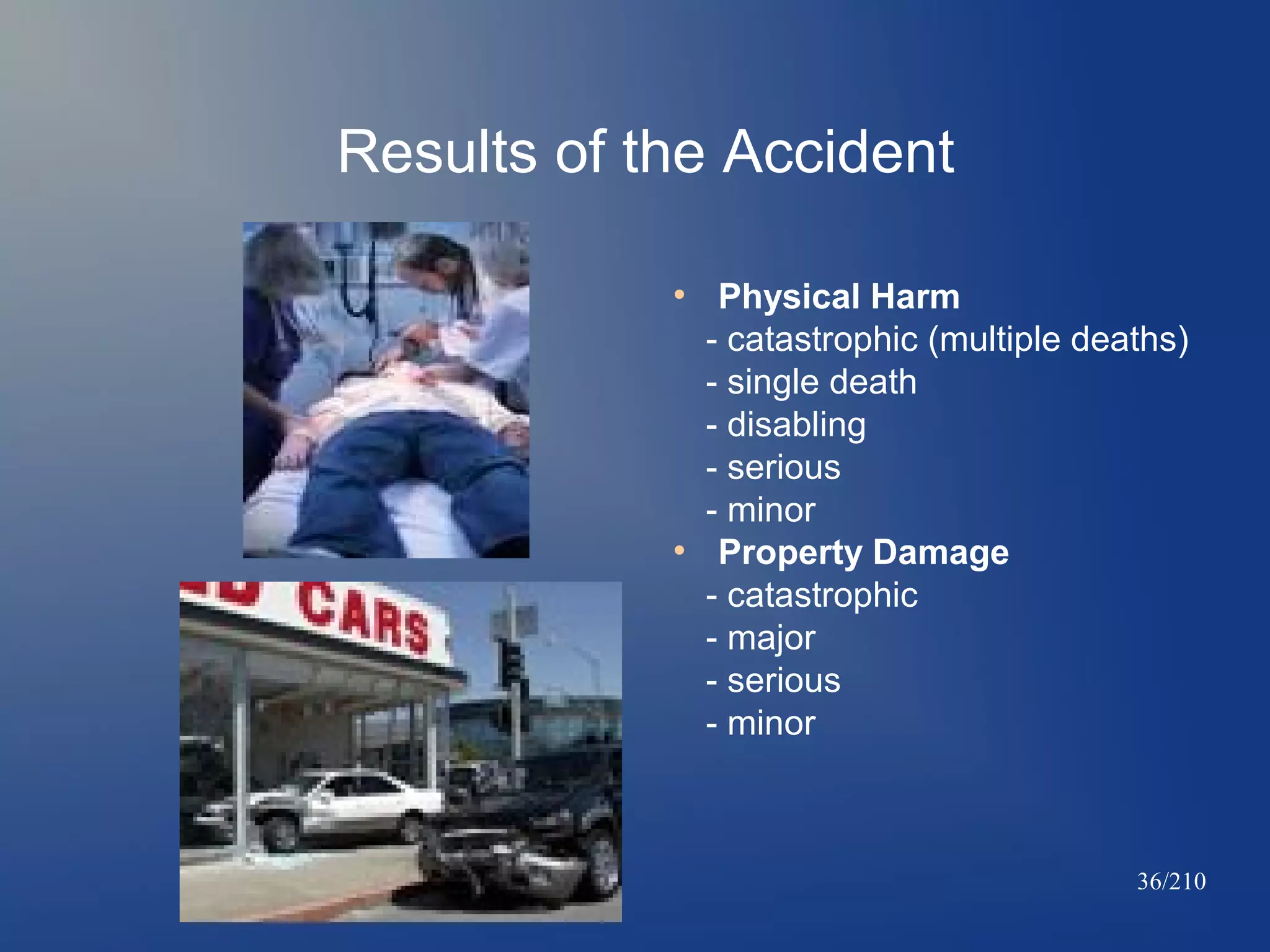
Results of the Accident
●

●

Physical Harm
- catastrophic (multiple deaths)
- single death
- disabling
- serious
- minor
Property Damage
- catastrophic
- major
- serious
- minor

36/210
Incident Occurrence
●

●

Type
- struck by
- struck against
- slip, trip
- fell from
- caught on - fell on same level
- caught in
- overexertion
Contact with
- electricity
- noise
- hazmat
- radiation

- equipment
- vibration
- heat/cold
- animals/insects
37/210
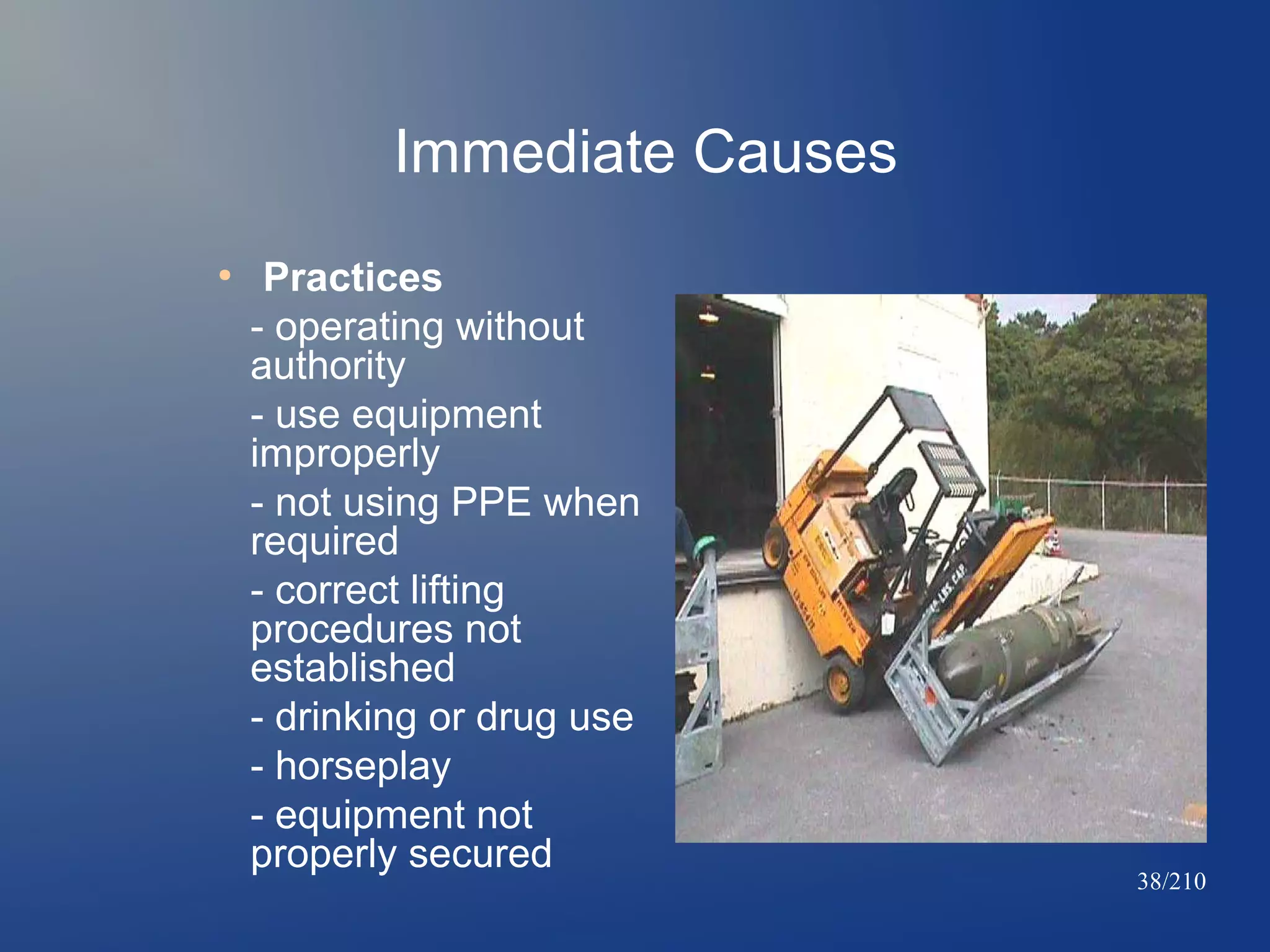
Immediate Causes
●

Practices
- operating without
authority
- use equipment
improperly
- not using PPE when
required
- correct lifting
procedures not
established
- drinking or drug use
- horseplay
- equipment not
properly secured

38/210
Immediate Causes (cont’d)
●

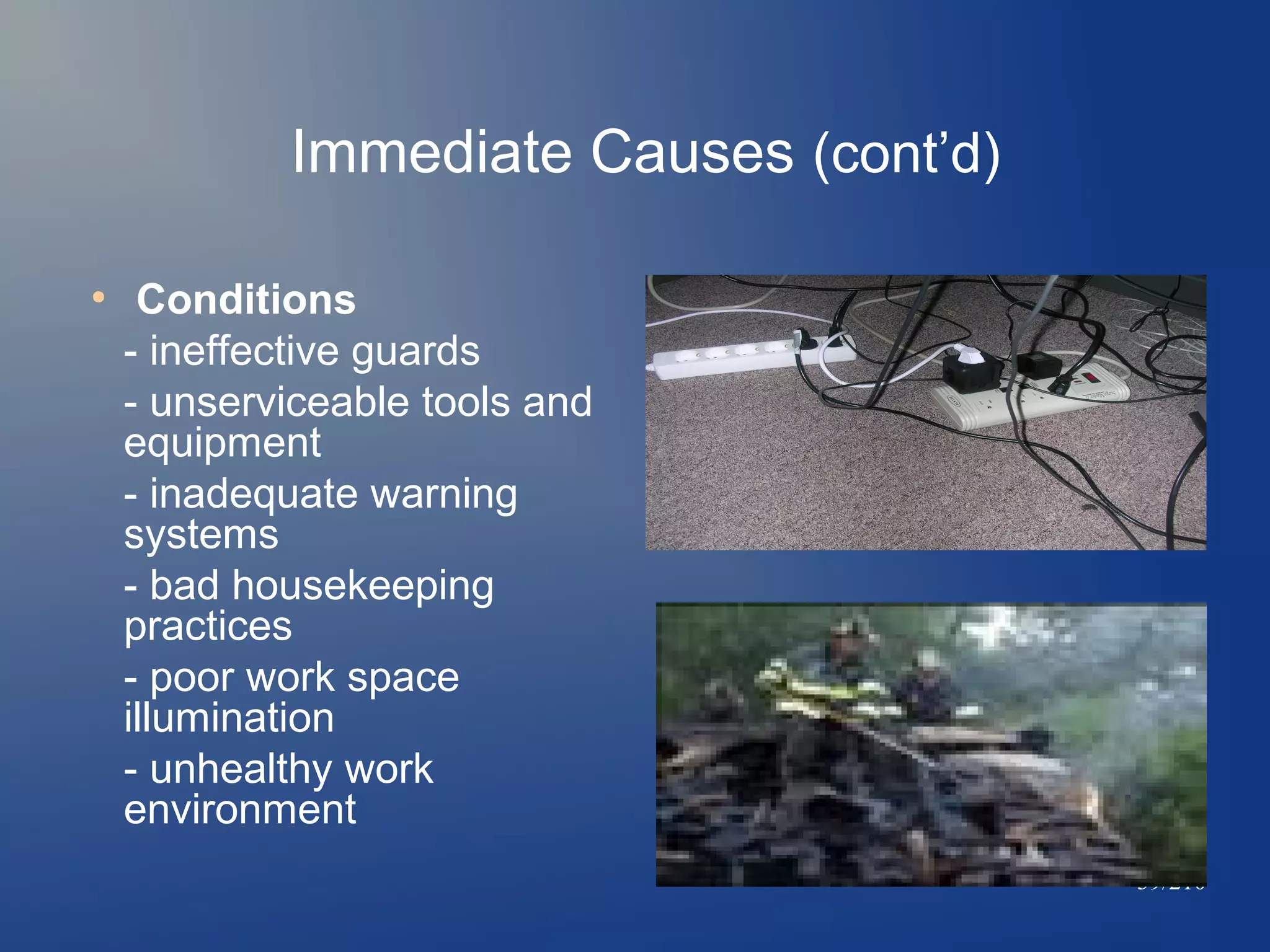
Conditions
- ineffective guards
- unserviceable tools and
equipment
- inadequate warning
systems
- bad housekeeping
practices
- poor work space
illumination
- unhealthy work
environment
39/210
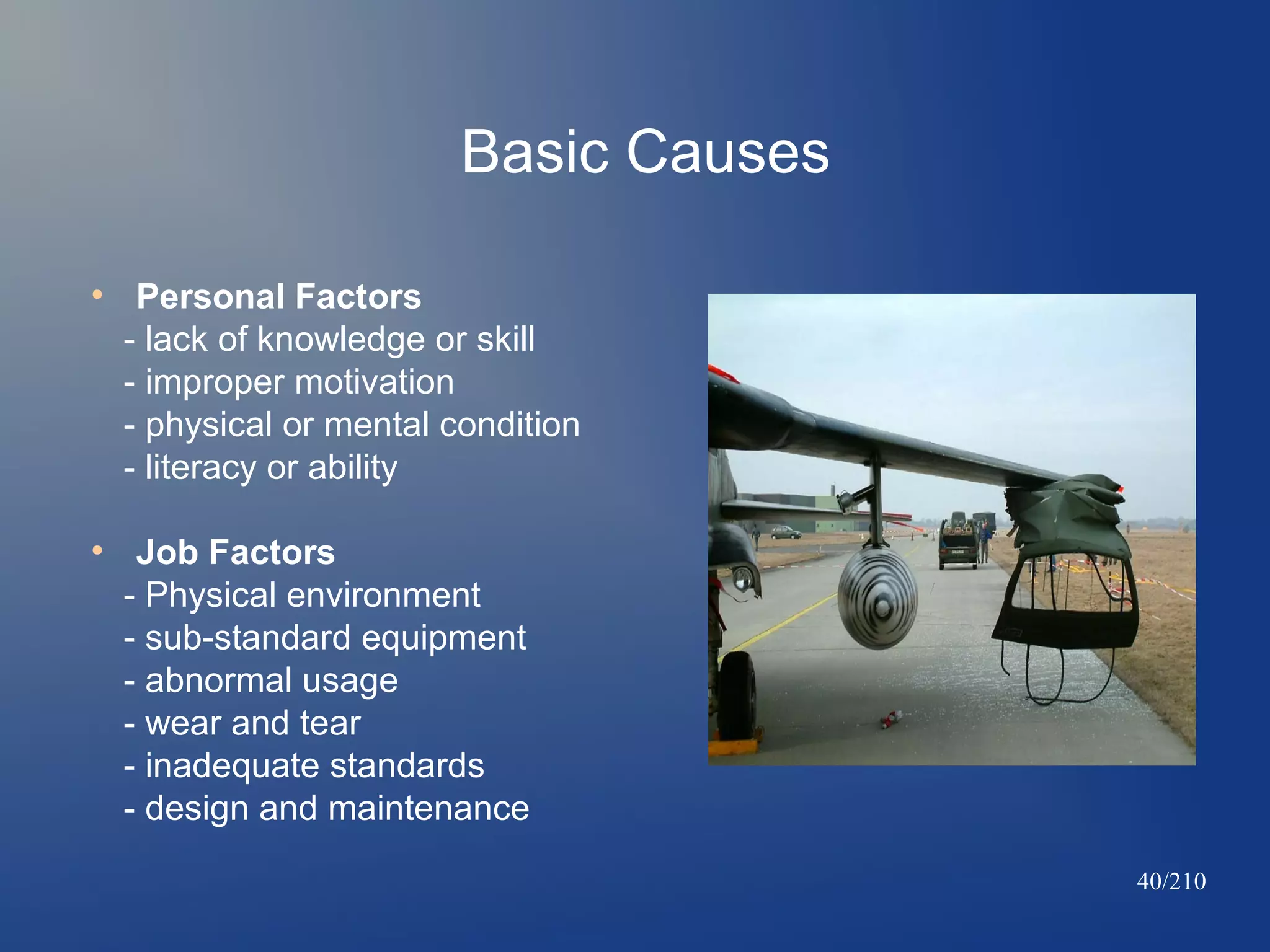
Basic Causes
●

●

Personal Factors
- lack of knowledge or skill
- improper motivation
- physical or mental condition
- literacy or ability
Job Factors
- Physical environment
- sub-standard equipment
- abnormal usage
- wear and tear
- inadequate standards
- design and maintenance
40/210
Basic Causes (cont’d)
●

●

Supervisory Performance
- inadequate instructions
- failure of SOPs
- rules not enforced
- hazards not corrected
- devices not provided
Management Policy and
Decisions
- set measurable standards
- measure work in progress
- evaluate work vs. standards
- correct performance

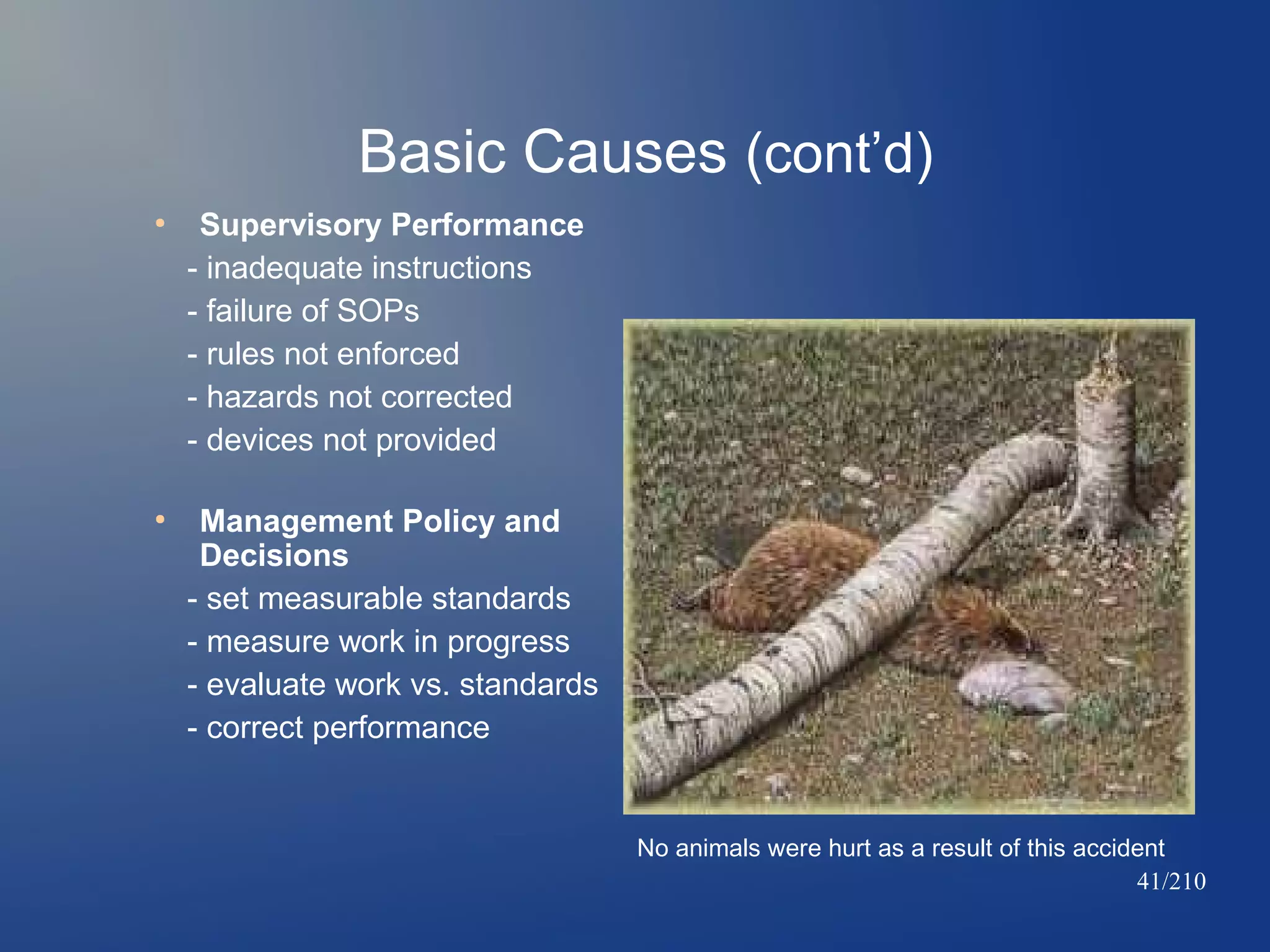
No animals were hurt as a result of this accident
41/210
Severity of Incident
●

●

Major
- Employee fatality,
- Hospitalization of 3 or more employees,
- Permanent employee disability,
- Five or more lost workdays,
- Conditions that could pose an imminent and
threat of serious injury/illness to other employees
- Property losses in excess of $1 Million
Minor
- All other (less serious) incidents and unsafe
conditions reported by employees
42/210
Who Investigates?
●

●

Major Accidents
- NOAA “GO TEAM” Investigation Team
- LO Representative
- Other agencies such as NTSB, USCG, OSHA
Minor Accidents
- First-Line Supervisor
- Site Director or Manager
- Site Safety Representative
- NOAA SECO (if needed)
43/210
Investigator’s Qualifications
●
●
●
●
●
●
●

Technical knowledge
Objectivity
Analytical approach
Familiarity with the job, process or operation
Tact in communicating
Intellectual honesty
Inquisitiveness and curiosity
44/210
When to Investigate?
●

Immediately after incident



●

Witness memories fade
Equipment and clues
are moved

Finish investigation quickly

45/210
What to Investigate?
●

All accidents and near-misses
- Conduct investigation upon first
notification
- Keeping the scene in-tact and
recording witnesses statements
early is key to a successful
investigation
46/210
Accident Investigation Kit
May Include:
●
Digital Camera
●
Report forms, clipboard, pens
●
Barricade tape
●
Flashlight
●
Tape measure
●
Tape recorder
●
Personal Protective Equipment (as appropriate)
47/210
The Accident Occurs
●

●

●

●
●

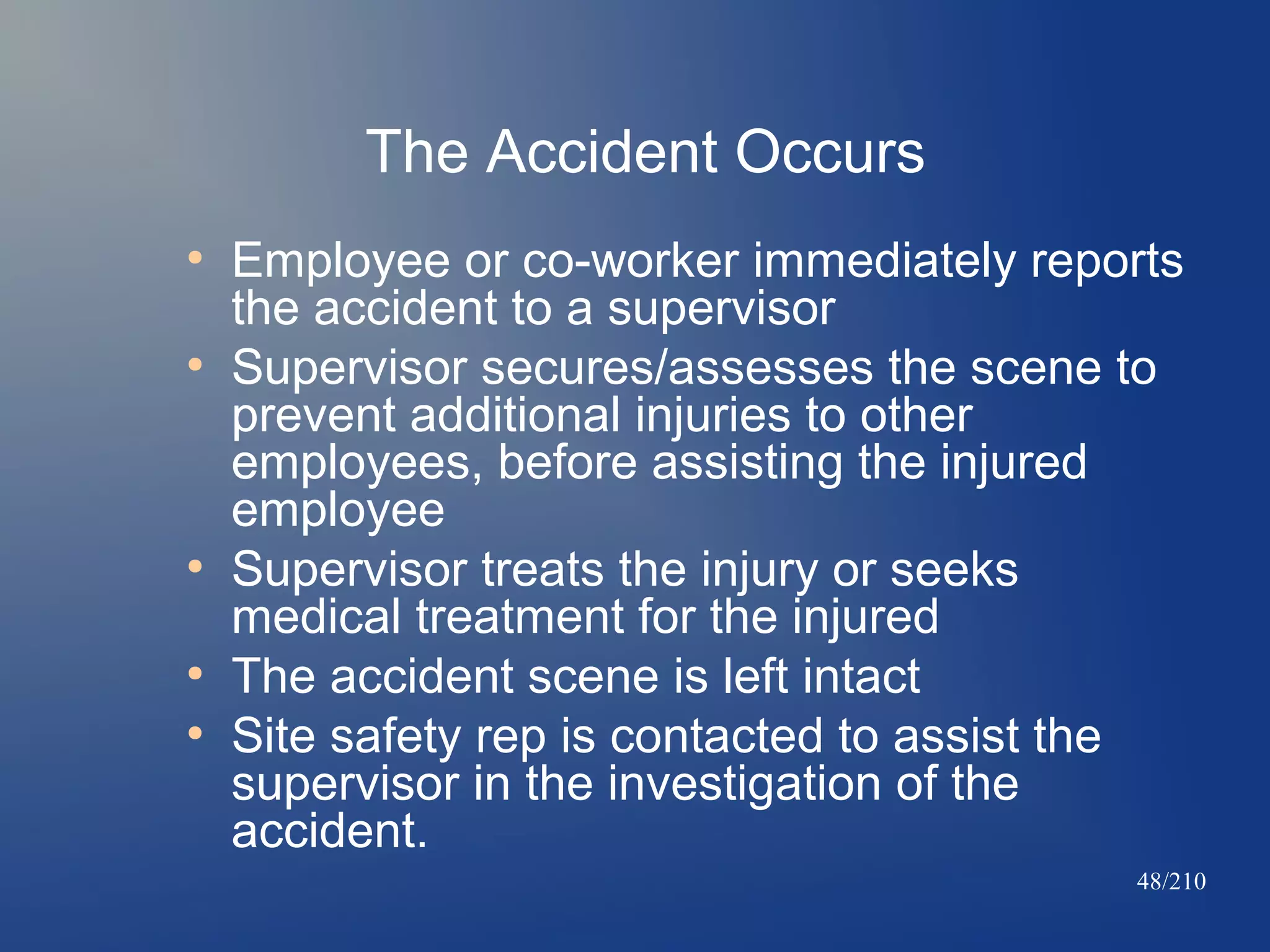
Employee or co-worker immediately reports
the accident to a supervisor
Supervisor secures/assesses the scene to
prevent additional injuries to other
employees, before assisting the injured
employee
Supervisor treats the injury or seeks
medical treatment for the injured
The accident scene is left intact
Site safety rep is contacted to assist the
supervisor in the investigation of the
accident.
48/210
Beginning the Investigation
●

●
●

●

●

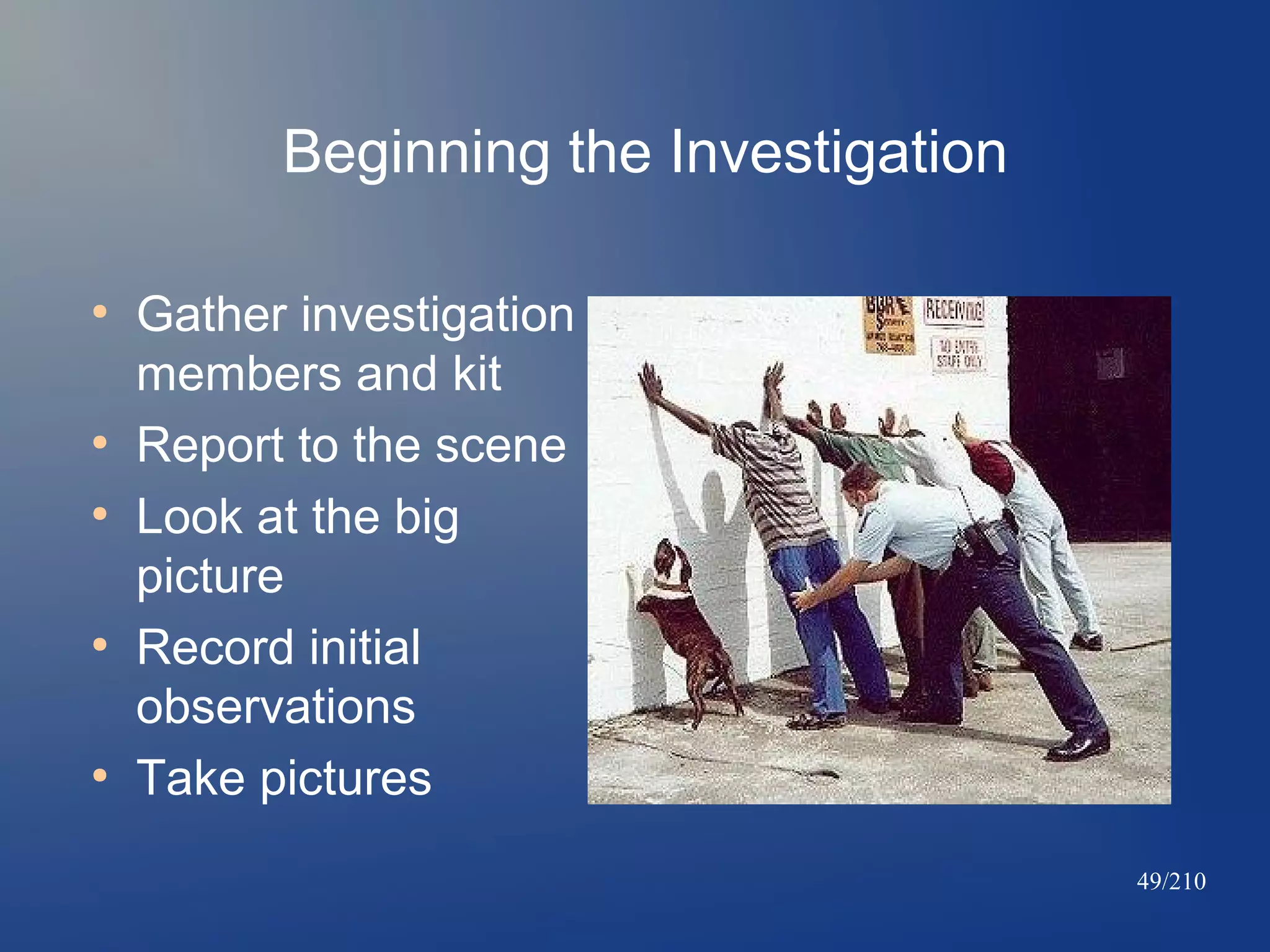
Gather investigation
members and kit
Report to the scene
Look at the big
picture
Record initial
observations
Take pictures
49/210
What’s Involved?
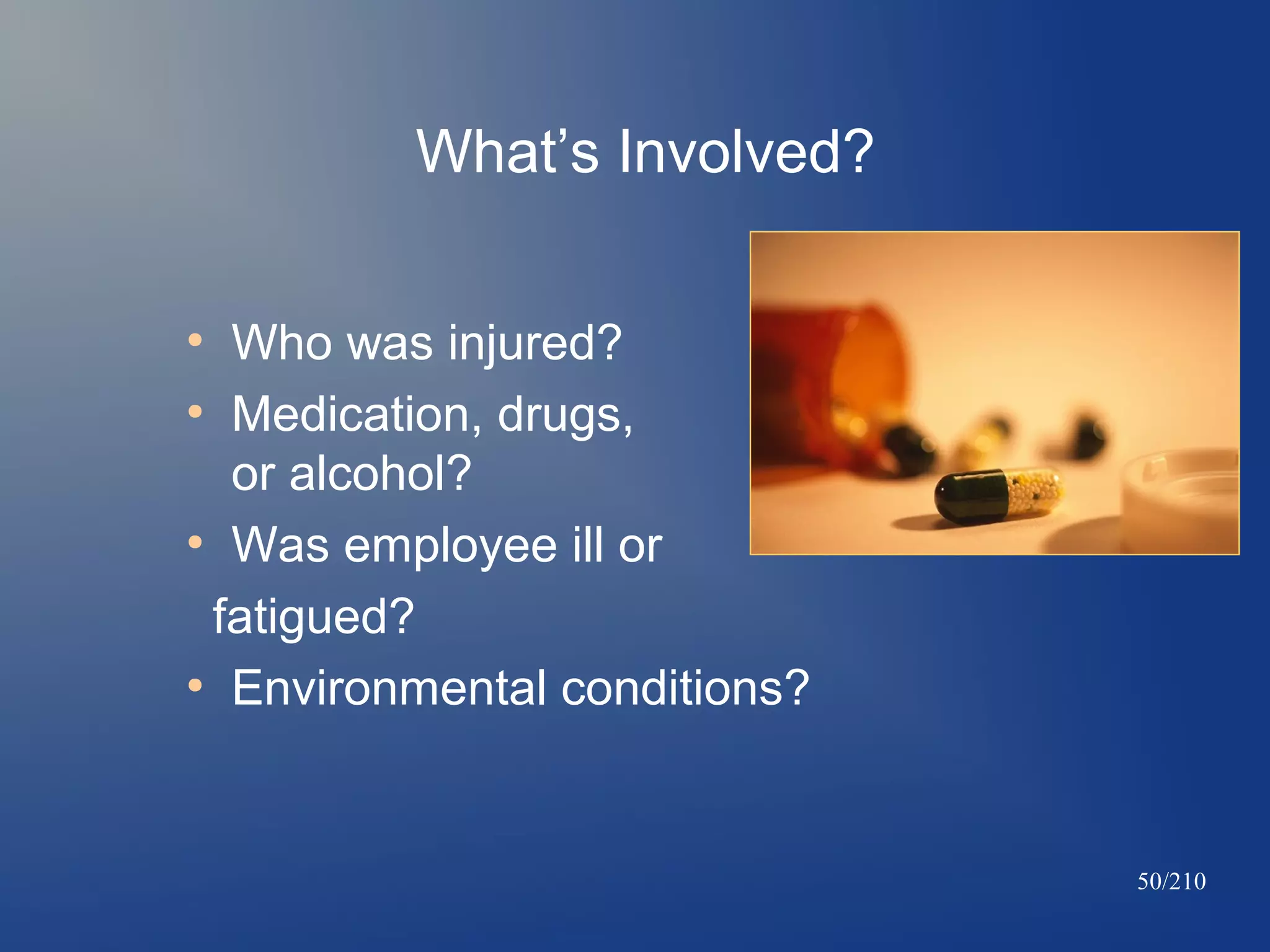
Who was injured?
●
Medication, drugs,
or alcohol?
●
Was employee ill or
fatigued?
●
Environmental conditions?
●

50/210
Witnesses
Who witnessed the
accident?
●
Was a supervisor or
Team Lead nearby?
●
Where were other
employees?
●
Why didn’t anyone
witness the accident
(working alone, remote areas)?
●

51/210
Interviewing Tips
●

●

●
●
●

Discuss what happened leading
up to and after the accident
Encourage witnesses to describe
the accident in their own words
Don’t be defensive or judgmental
Use open-ended questions
Do not interrupt the witness
52/210
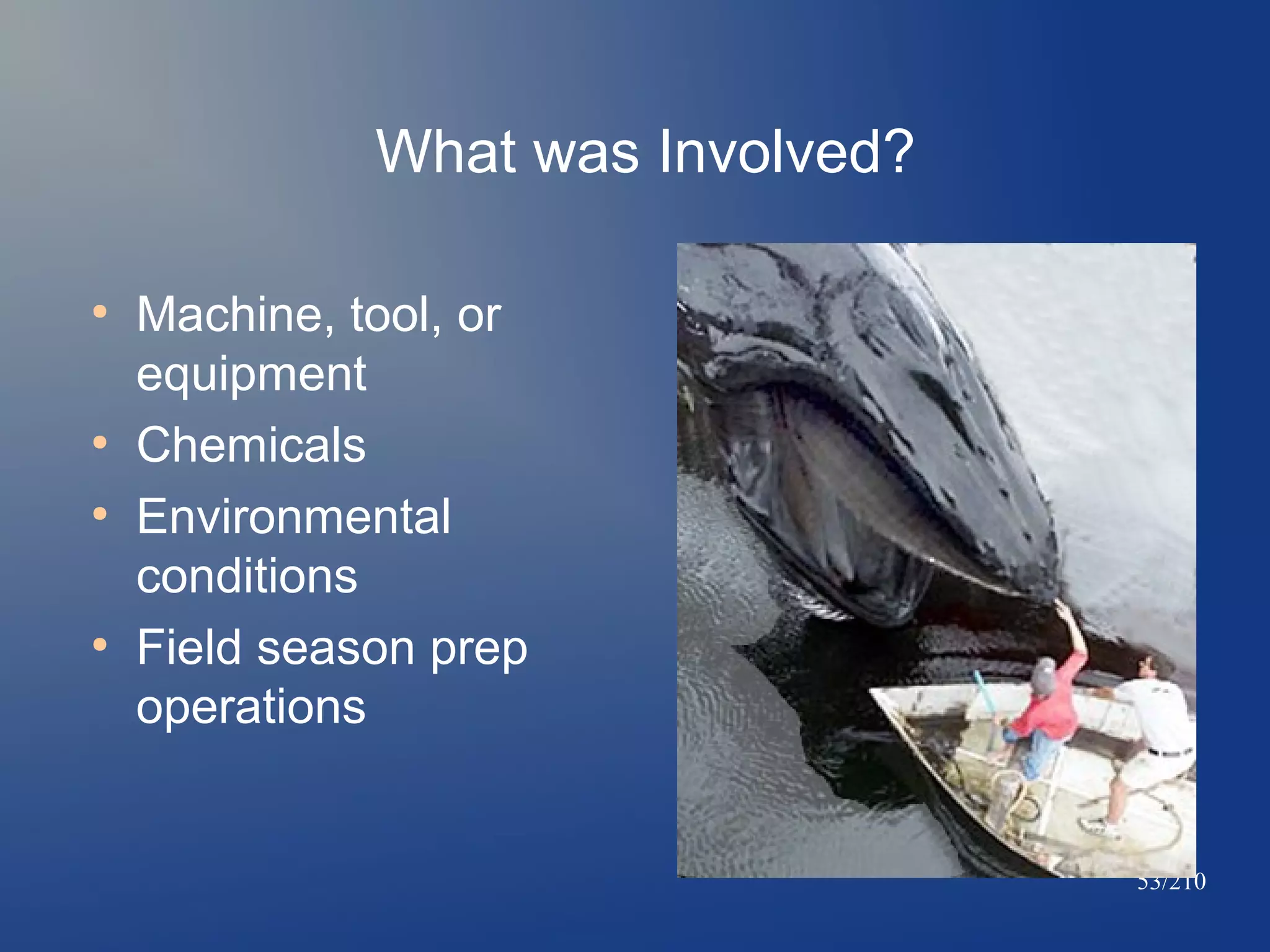
What was Involved?
●

●
●

●

Machine, tool, or
equipment
Chemicals
Environmental
conditions
Field season prep
operations

53/210
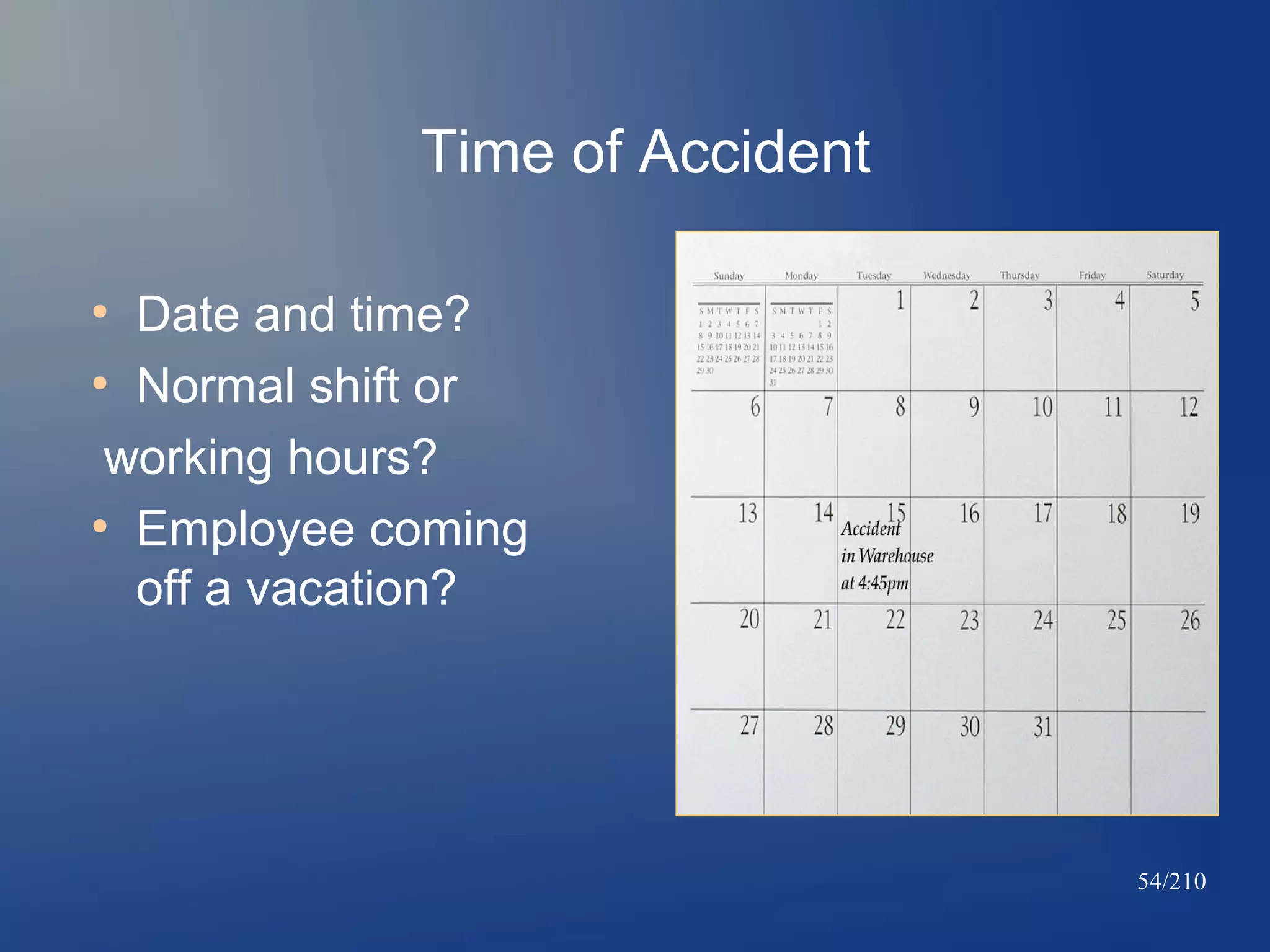
Time of Accident
Date and time?
●
Normal shift or
working hours?
●
Employee coming
off a vacation?
●

54/210
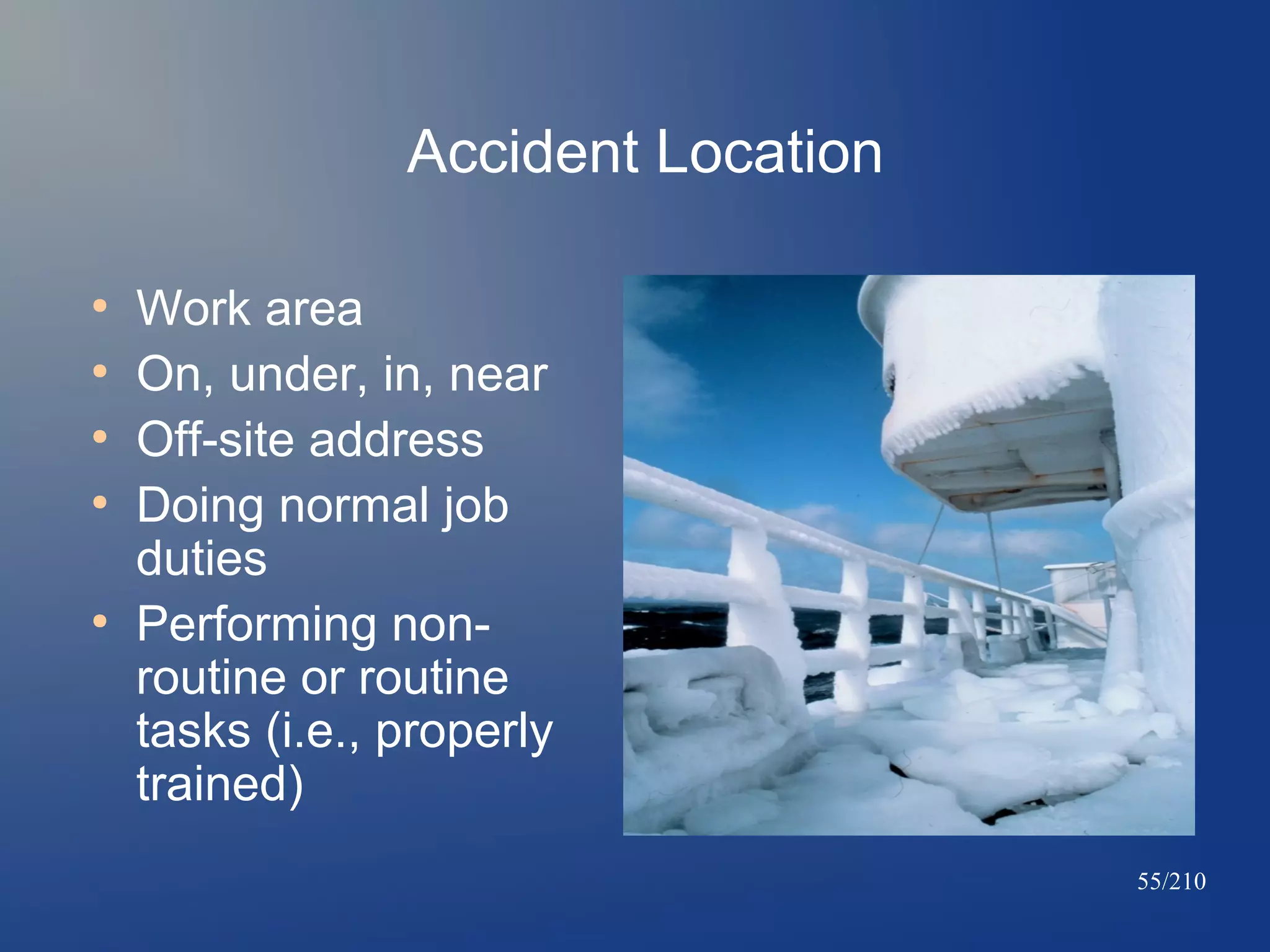
Accident Location
●
●
●
●

●

Work area
On, under, in, near
Off-site address
Doing normal job
duties
Performing nonroutine or routine
tasks (i.e., properly
trained)
55/210
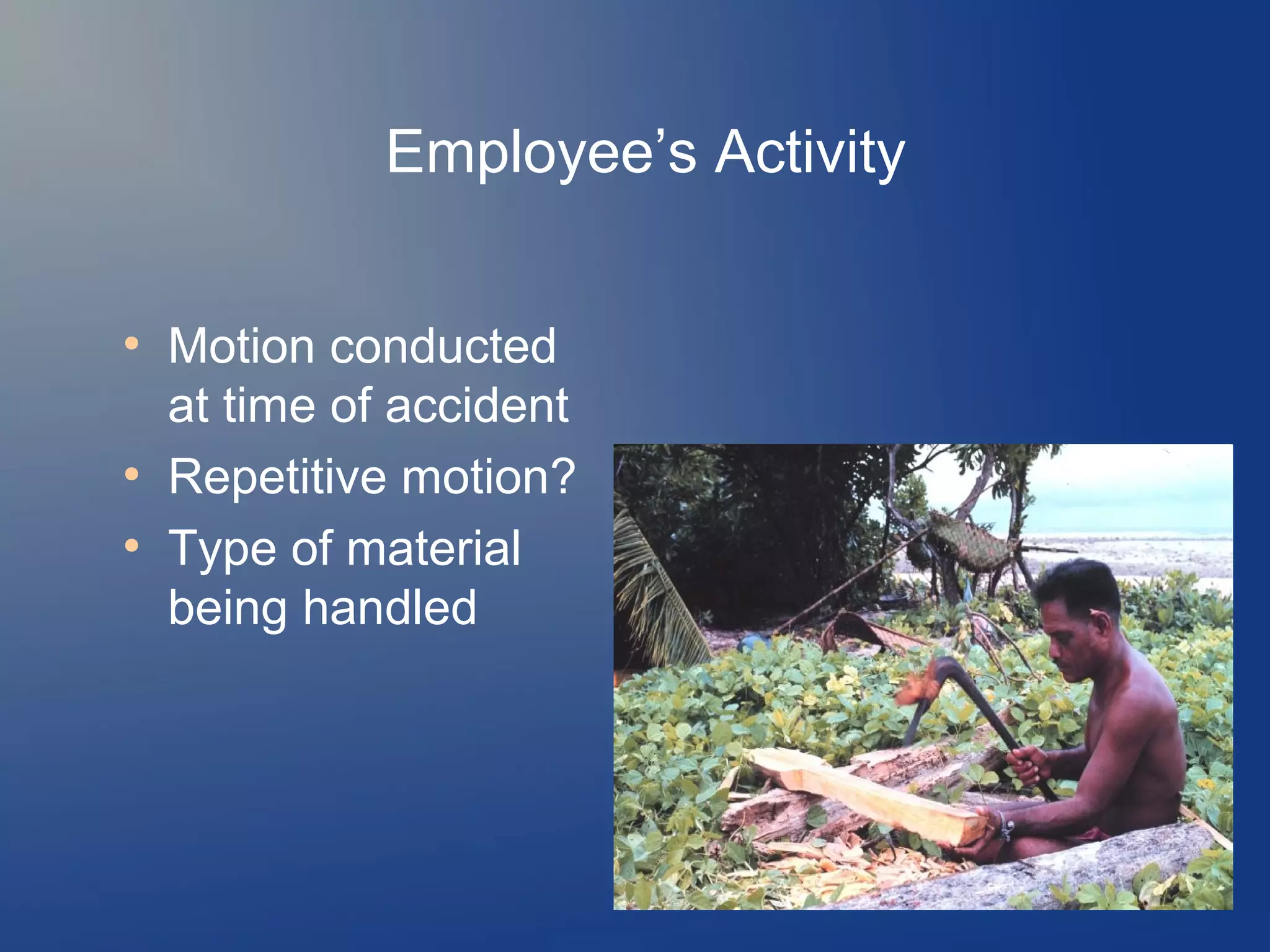
Employee’s Activity
●

●
●

Motion conducted
at time of accident
Repetitive motion?
Type of material
being handled

56/210
Accident Narrative
Describe the details so the reader
can clearly picture the accident
●
Specific body parts affected
●
Specific motions
of injured employee
just before,
during, and
after accident
●

57/210
Causal Factors
●
●
●
●

Try not to accept single cause theory
Identify underlying causes (root)
Primary cause
Secondary causes



Contributing causes
Effects

58/210
Corrective Actions Taken
●

●

Include immediate interim controls
implemented at the time of accident
Recommended corrective actions






Employee training
Preventive maintenance activities
Better operating procedures
Hazard recognition (ORM)
Management awareness of risks involved

59/210
Immediate Notification
●

Supervisor shall complete the NOAA Web Based
Accident/ Illness Report Form and submit within
24 hours of incident occurrence (8 hours for major
incidents).

60/210
Accident Analysis Summary
●
●

●

●
●
●

Investigate accident immediately
Determine who was involved and
who witnessed it
Ascertain what items or equipment
were involved
Record detailed description
Determine causal factors
Implement corrective actions
61/210
62/210
63/210
1.

What is an Accident Investigation?
a.

b.
c.
d.

A systematic approach to the identification of causal
factors and implementation of corrective actions.
Finding personal fault and placing blame.
The appropriate steps to prevent future actions.
The essential step to determine trends and taking
action against person or persons at fault.

64/210
2.

Which Accidents should be Recorded or
Reported?
a.
b.

c.

d.

Only on the job accidents.
ALL accidents (including illnesses) shall be
recorded and reported.
Only on the job accidents on illnesses that occur on
the job and reported within 8 hours.
All accidents shall be recorded and reported.
65/210
3.

Why Investigate Accidents?
a.
b.
c.

d.

To develop and implement corrective actions.
To document the events.
The Primary Focus is to PREVENT
REOCCURENCE!!!
To determine the cause.

66/210
4.

Accident vs. Near-Miss?
a.

b.

c.

Any unplanned event arising out of work that
resulted in injury vs. Any event which did not result
in injury but had potential to do so.
Any unsafe work habit vs. Any Hazardous working
conditions.
Any event which warns us of a problem vs. Any
circumstances that result in injury or property
damage.
67/210
5.

Which of the following are the basic areas
that are looked at in an Accident
Investigation.
a.
b.
c.
d.

Policies.
Equipment.
Training.
All of the above.

68/210
Accident Investigation

Accident analysis is carried out in order to
determine the cause or causes of an accident
or series of accidents so as to prevent further
incidents of a similar kind. It is also known as
accident investigation.

69/210
Accident Investigation

It may be performed by a range of experts,
including forensic scientists, forensic
engineers or health and safety advisers.
Accident investigators, particularly those in
the aircraft industry, are colloquially known as
"tin-kickers".

70/210
Sequence

Accident analysis is performed in four steps:
Fact gathering: After an accident happened
a forensic process starts to gather all possibly
relevant facts that may contribute to
understanding the accident.

71/210
Sequence
Fact Analysis:

After the forensic process has been
completed or at least delivered some results,
the facts are put together to give a "big
picture." The history of the accident is
reconstructed and checked for consistency
and plausibility.

72/210
Sequence
Conclusion Drawing:

If the accident history is sufficiently
informative, conclusions can be drawn about
causation and contributing factors.

73/210
Sequence
Counter-measures:

In some cases the development of countermeasures is desired or recommendations
have to be issued to prevent further accidents
of the same kind.

74/210
Methods

There exist numerous forms of Accident
Analysis methods. These can be divided into
three categories:

75/210
Methods
Causal Analysis
Causal Analysis uses the principle of
causality to determine the course of events.
Though people casually speak of a "chain of
events", results from Causal Analysis usually
have the form of directed a-cyclic graphs-the
nodes being events and the edges the causeeffect relations. Methods of Causal Analysis
differ in their respective notion of causation.
76/210
Methods
Expert Analysis
Expert Analysis relies on the knowledge and
experience of field experts. This form of
analysis usually lacks a rigorous
(formal/semiformal) methodological
approach.
This usually affects falsify-ability and
objectivity of analyses. This is of importance
when conclusions are heavily disputed
among experts.
77/210
Methods
Organizational Analysis

Organizational Analysis relies on systemic
theories of organization. Most theories imply
that if a system's behaviour stayed within the
bounds of the ideal organization then no
accidents can occur.

78/210
Methods
Organizational Analysis

Organizational Analysis can be falsified and
results from analyses can be checked for
objectivity. Choosing an organizational theory
for accident analysis comes from the
assumption that the system to be analysed
conforms to that theory.

79/210
Using Digital Photographs to Extract
Evidence
Once all available data has been collected by
accident scene investigators and law
enforcement officers, camera matching,
photogrammetry or rectification can be used
to determine the exact location of physical
evidence shown in the accident scene
photos.

80/210
Camera matching:

Camera matching uses accident scene
photos that show various points of evidence.
The technique uses CAD software to create a
3-dimensional model of the accident site and
roadway surface.

81/210
Camera matching:
All survey data and photos are then imported
into a three dimensional software package
like 3D Studio Max.
A virtual camera can be then be positioned
relative to the 3D roadway surface.
Physical evidence is then mapped from the
photos onto the 3D roadway to create a three
dimensional accident scene drawing.
82/210
Photogrammetry

Photogrammetry is used to determine the
three-dimensional geometry of an object on
the accident scene from the original two
dimensional photos.

83/210
Photogrammetry

The photographs can be used to extract
evidence that may be lost after the accident
is cleared. Photographs from several
viewpoints are imported into software like
PhotoModeler.

84/210
Photogrammetry

The forensic engineer can then choose points
common to each photo. The software will
calculate the location of each point in a three
dimensional coordinate system.

85/210
Rectification

Photographic rectification is also used to
analyze evidence that may not have been
measured at the accident scene. Two
dimensional rectification transforms a single
photograph into a top-down view. Software
like PC-Rect can be used to rectify a digital
photograph.

86/210
Failure mode and effects analysis

87/210
Failure mode and effects analysis

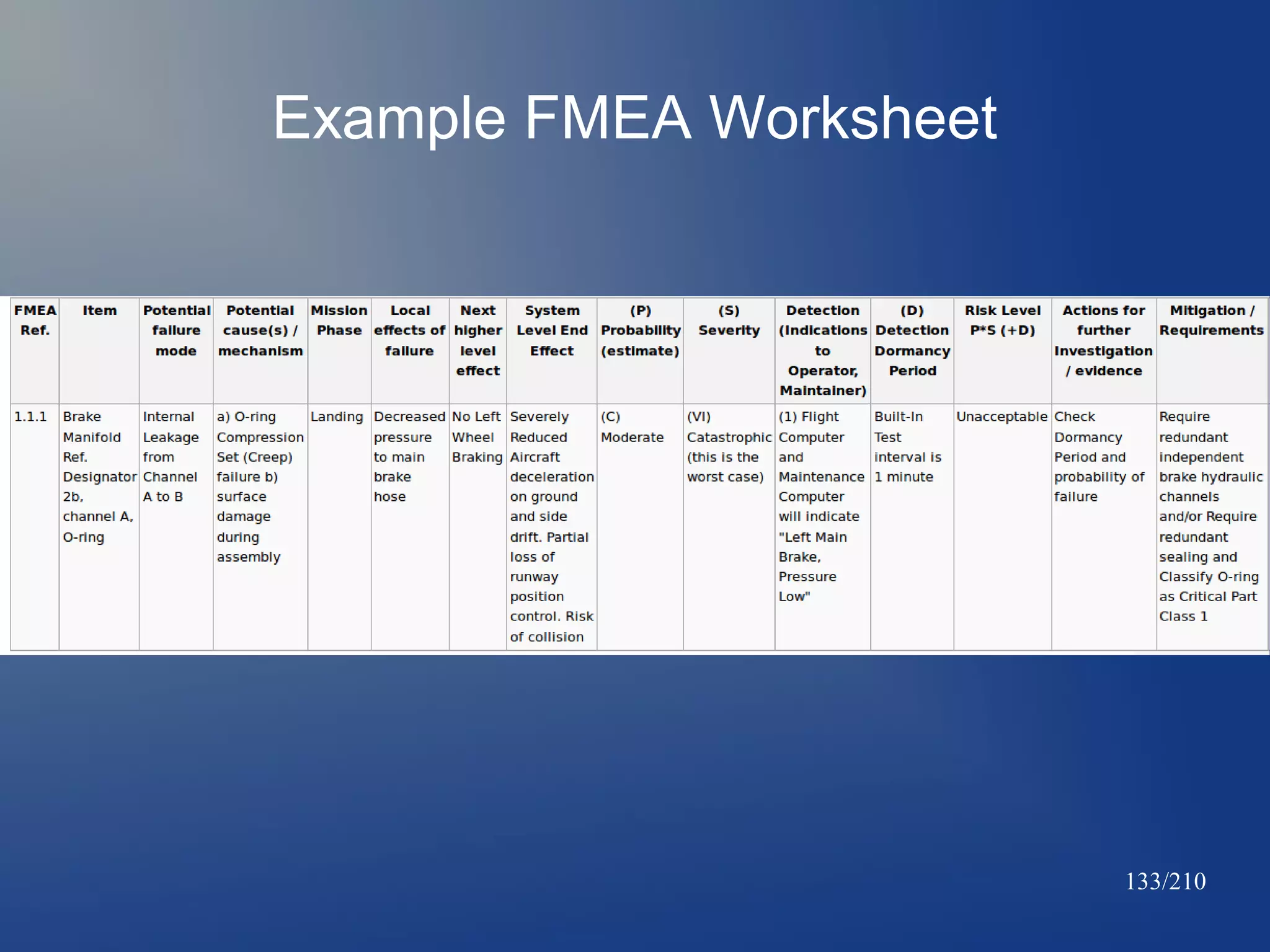
Failure Mode and Effects Analysis (FMEA) was
one of the first systematic techniques for failure
analysis.
It was developed by reliability engineers in the
1950s to study problems that might arise from
malfunctions of military systems.
88/210
Failure mode and effects analysis

A FMEA is often the first step of a system
reliability study. It involves reviewing as many
components, assemblies, and subsystems as
possible to identify failure modes, and their
causes and effects.

89/210
Failure mode and effects analysis

For each component, the failure modes and their
resulting effects on the rest of the system are
recorded in a specific FMEA worksheet.
There are numerous variations of such
worksheets.
A FMEA is mainly a qualitative analysis.
90/210
Failure mode and effects analysis

A few different types of FMEA analysis exist, like
Functional,
Design, and
Process FMEA.

91/210
Failure mode and effects analysis

Sometimes the FMEA is called FMECA to
indicate that Criticality analysis is performed also.

92/210
Failure mode and effects analysis

An FMEA is an inductive reasoning (forward
logic) single point of failure analysis and is a core
task in reliability engineering, safety engineering
and quality engineering.
Quality engineering is specially concerned with
the "Process" (Manufacturing and Assembly) type
of FMEA.
93/210
Failure mode and effects analysis

A successful FMEA activity helps to identify
potential failure modes based on experience with
similar products and processes - or based on
common physics of failure logic.

94/210
Failure mode and effects analysis

It is widely used in development and
manufacturing industries in various phases of the
product life cycle.
Effects analysis refers to studying the
consequences of those failures on different
system levels.
95/210
Failure mode and effects analysis

Functional analyses are needed as an input to
determine correct failure modes, at all system
levels, both for functional FMEA or Piece-Part
(hardware) FMEA.

96/210
Failure mode and effects analysis

A FMEA is used to structure Mitigation for Risk
reduction based on either failure (mode) effect
severity reduction or based on lowering the
probability of failure or both.

97/210
Failure mode and effects analysis

The FMEA is in principle a full inductive (forward
logic) analysis, however the failure probability can
only be estimated or reduced by understanding
the failure mechanism.

98/210
Failure mode and effects analysis

Ideally this probability shall be lowered to
"impossible to occur" by eliminating the (root)
causes. It is therefore important to include in the
FMEA an appropriate depth of information on the
causes of failure (deductive analysis).

99/210
Failure mode and effects analysis

The FME(C)A is a design tool used to
systematically analyze postulated component
failures and identify the resultant effects on
system operations. The analysis is sometimes
characterized as consisting of two sub-analyses,
the first being the failure modes and effects
analysis (FMEA), and the second, the criticality
analysis (CA).
100/210
Failure mode and effects analysis

Successful development of an FMEA requires
that the analyst include all significant failure
modes for each contributing element or part in the
system. FMEAs can be performed at the system,
subsystem, assembly, subassembly or part level.

101/210
Failure mode and effects analysis

The FMECA should be a living document during
development of a hardware design. It should be
scheduled and completed concurrently with the
design. If completed in a timely manner, the
FMECA can help guide design decisions. The
usefulness of the FMECA as a design tool and in
the decision making process is dependent on the
effectiveness and timeliness with which design
problems are identified.
102/210
Failure mode and effects analysis

Timeliness is probably the most important
consideration. In the extreme case, the FMECA
would be of little value to the design decision
process if the analysis is performed after the
hardware is built.

103/210
Failure mode and effects analysis

While the FMECA identifies all part failure modes,
its primary benefit is the early identification of all
critical and catastrophic subsystem or system
failure modes so they can be eliminated or
minimized through design modification at the
earliest point in the development effort.
104/210
Failure mode and effects analysis

Therefore, the FMECA should be performed
at the system level as soon as preliminary
design information is available and extended
to the lower levels as the detail design
progresses.
105/210
Failure mode and effects analysis
Remark: For more complete scenario modelling
other type of Reliability analysis may be considered,
for example fault tree analysis(FTA); a deductive
(backward logic) failure analysis that may handle
multiple failures within the item and/or external to
the item including maintenance and logistics. It
starts at higher functional / system level. A FTA
may use the basic failure mode FMEA records or
an effect summary as one of its inputs (the basic
events). Interface hazard analysis, Human error
analysis and others may be added for completion in
106/210
scenario modelling.
Functional analysis

The analysis may be performed at the functional
level until the design has matured sufficiently to
identify specific hardware that will perform the
functions; then the analysis should be extended to
the hardware level. When performing the hardware
level FMECA, interfacing hardware is considered to
be operating within specification. In addition, each
part failure postulated is considered to be the only
failure in the system (i.e., it is a single failure
analysis).

107/210
Functional analysis

In addition to the FMEAs done on systems to
evaluate the impact lower level failures have on
system operation, several other FMEAs are done.
Special attention is paid to interfaces between
systems and in fact at all functional interfaces. The
purpose of these FMEAs is to assure that
irreversible physical and/or functional damage is
not propagated across the interface as a result of
failures in one of the interfacing units.
108/210
Functional analysis

These analyses are done to the piece part level for
the circuits that directly interface with the other
units. The FMEA can be accomplished without a
CA, but a CA requires that the FMEA has
previously identified system level critical failures.
When both steps are done, the total process is
called a FMECA.
109/210
Ground rules

The ground rules of each FMEA include a set of
project selected procedures; the assumptions on
which the analysis is based; the hardware that has
been included and excluded from the analysis and
the rationale for the exclusions. The ground rules
also describe the indenture level of the analysis, the
basic hardware status, and the criteria for system
and mission success.
110/210
Ground rules

Every effort should be made to define all ground
rules before the FMEA begins; however, the ground
rules may be expanded and clarified as the analysis
proceeds. A typical set of ground rules
(assumptions) follows:

111/210
Ground rules

Only one failure mode exists at a time.
●
All inputs (including software commands) to the
item being analyzed are present and at nominal
values.
●
All consumables are present in sufficient
quantities.
●
Nominal power is available
●

112/210
Benefits

Major benefits derived from a properly implemented
FMECA effort are as follows:

113/210
Benefits

It provides a documented method for selecting a
design with a high probability of successful
operation and safety.

114/210
Benefits

A documented uniform method of assessing
potential failure mechanisms, failure modes and
their impact on system operation, resulting in a list
of failure modes ranked according to the
seriousness of their system impact and likelihood of
occurrence.
115/210
Benefits

Early identification of single failure points (SFPS)
and system interface problems, which may be
critical to mission success and/or safety. They also
provide a method of verifying that switching
between redundant elements is not jeopardized by
postulated single failures.
116/210
Benefits

An effective method for evaluating the effect of
proposed changes to the design and/or operational
procedures on mission success and safety.

117/210
Benefits

A basis for in-flight troubleshooting procedures and
for locating performance monitoring and faultdetection devices.

118/210
Benefits

Criteria for early planning of tests.

119/210
Basic terms

The following covers some basic FMEA
terminology.
Failure
The loss under stated conditions.

120/210
Basic terms
Failure mode
The specific manner or way by which a failure
occurs in terms of failure of the item (being a part or
(sub) system) function under investigation; it may
generally describe the way the failure occurs. It
shall at least clearly describe a (end) failure state of
the item (or function in case of a Functional FMEA)
under consideration. It is the result of the failure
mechanism (cause of the failure mode). For
example; a fully fractured axle, a deformed axle or a
fully open or fully closed electrical contact are each
a separate failure mode.
121/210
Basic terms
Failure cause and/or mechanism

Defects in requirements, design, process, quality
control, handling or part application, which are the
underlying cause or sequence of causes that
initiate a process (mechanism) that leads to a
failure mode over a certain time. A failure mode
may have more causes.
122/210
Basic terms
Failure cause and/or mechanism

For example; "fatigue or corrosion of a structural
beam" or "fretting corrosion in a electrical contact"
is a failure mechanism and in itself (likely) not a
failure mode. The related failure mode (end state) is
a "full fracture of structural beam" or "an open
electrical contact". The initial Cause might have
been "Improper application of corrosion protection
layer (paint)" and /or "(abnormal) vibration input
from another (possible failed) system".
123/210
Basic terms / Failure effect

Immediate consequences of a failure on operation,
function or functionality, or status of some item.

124/210
Indenture levels (bill of material or
functional breakdown)

An identifier for system level and thereby item
complexity. Complexity increases as levels are
closer to one.

125/210
Local effect

The failure effect as it applies to the item under
analysis.

126/210
Next higher level effect

The failure effect as it applies at the next higher
indenture level.

127/210
End effect

The failure effect at the highest indenture level or
total system.

128/210
Detection

The means of detection of the failure mode by
maintainer, operator or built in detection system,
including estimated dormancy period (if applicable)

129/210
Risk Priority Number (RPN)

Cost (of the event) * Probability (of the event
occurring) * Detection (Probability that the event
would not be detected before the user was aware of
it)

130/210
Severity

The consequences of a failure mode. Severity
considers the worst potential consequence of a
failure, determined by the degree of injury, property
damage, system damage and/or time lost to repair
the failure.

131/210
Remarks / mitigation / actions

Additional info, including the proposed mitigation or
actions used to lower a risk or justify a risk level or
scenario.

132/210
Example FMEA Worksheet

133/210
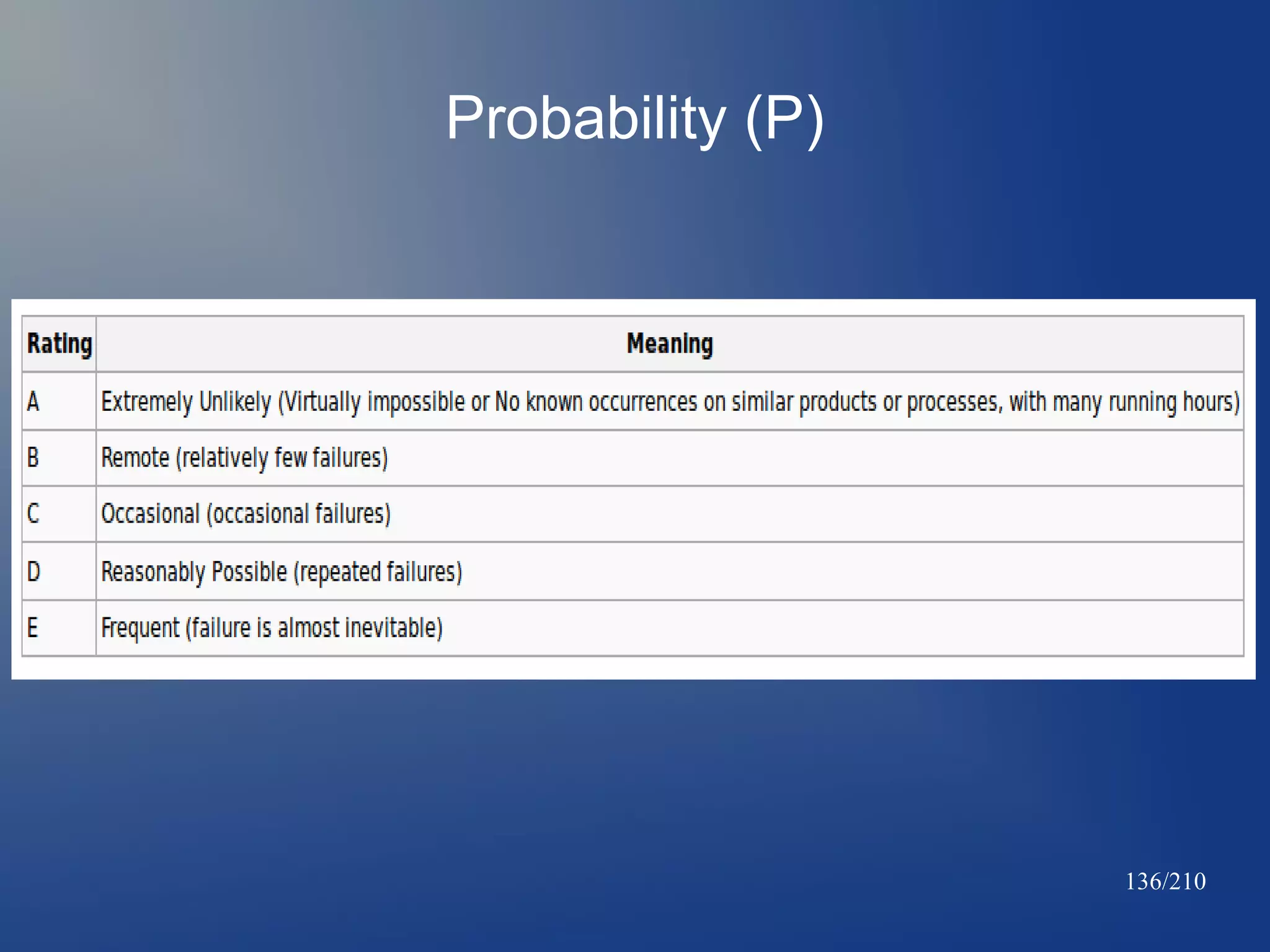
Probability (P)

In this step it is necessary to look at the cause of
a failure mode and the likelihood of occurrence.
This can be done by analysis, calculations / FEM,
looking at similar items or processes and the
failure modes that have been documented for
them in the past. A failure cause is looked upon
as a design weakness. All the potential causes
for a failure mode should be identified and
documented.
134/210
Probability (P)

This should be in technical terms. Examples of
causes are: Human errors in handling,
Manufacturing induced faults, Fatigue, Creep,
Abrasive wear, erroneous algorithms, excessive
voltage or improper operating conditions or use
(depending on the used ground rules). A failure
mode is given an Probability Ranking.
135/210
Probability (P)

136/210
Severity (S)

Determine the Severity for the worst case
scenario adverse end effect (state). It is
convenient to write these effects down in terms of
what the user might see or experience in terms of
functional failures. Examples of these end effects
are: full loss of function x, degraded performance,
functions in reversed mode, too late functioning,
erratic functioning, etc.
137/210
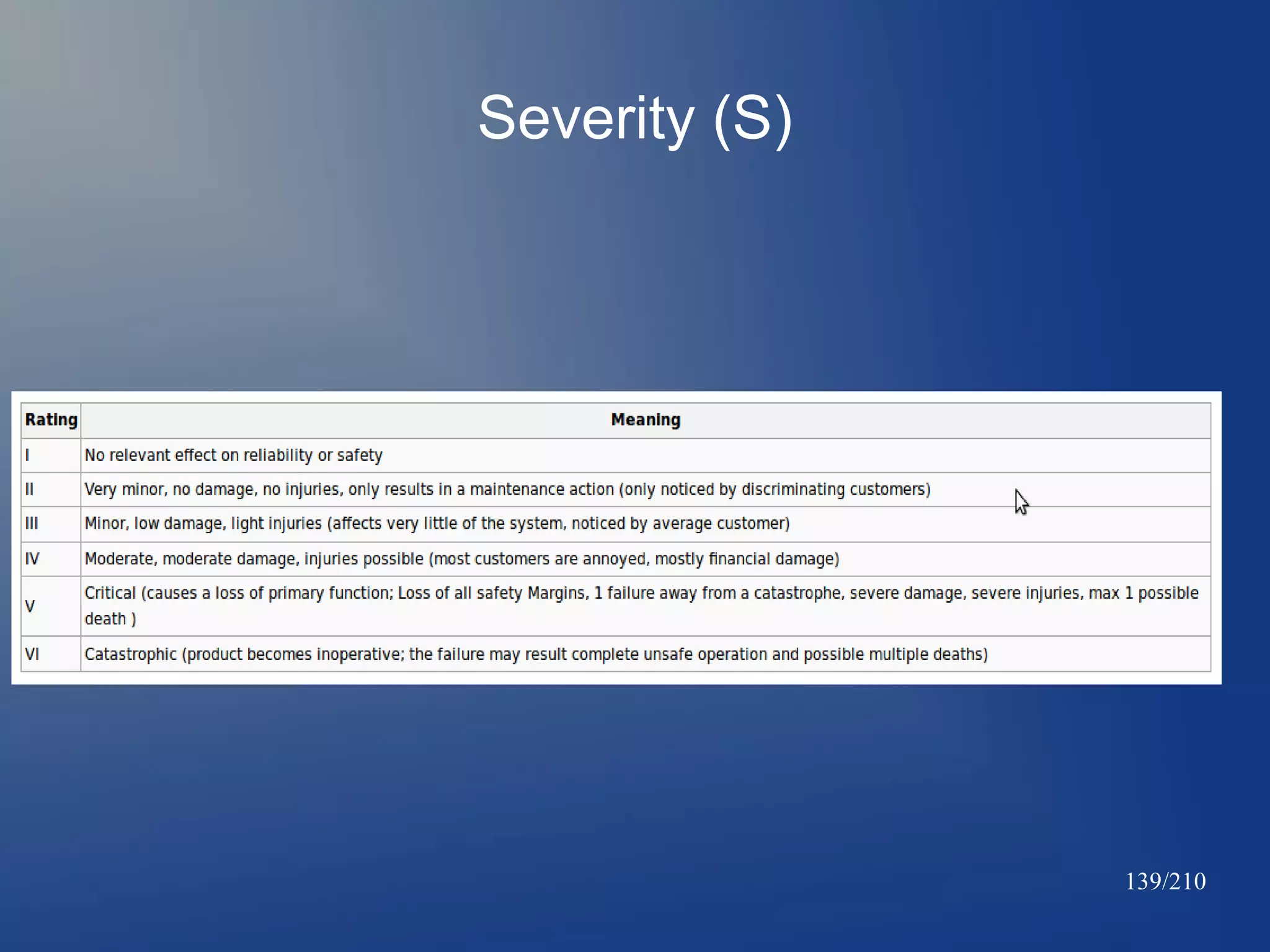
Severity (S)

Each end effect is given a Severity number (S)
from, say, I (no effect) to VI (catastrophic), based
on cost and/or loss of life or quality of life. These
numbers prioritize the failure modes (together
with probability and detectability). Below a typical
classification is given. Other classifications are
possible. See also hazard analysis.
138/210
Severity (S)

139/210
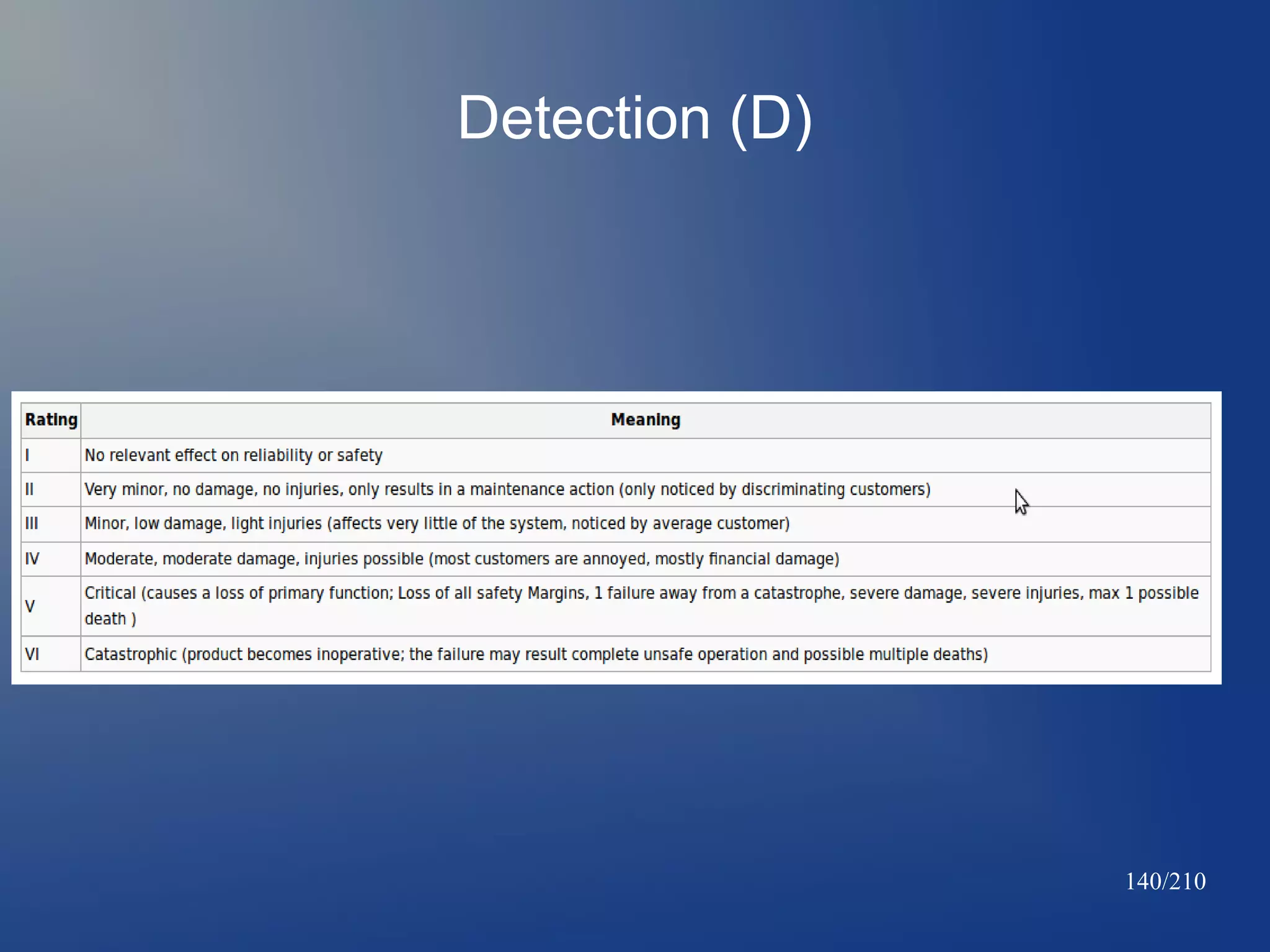
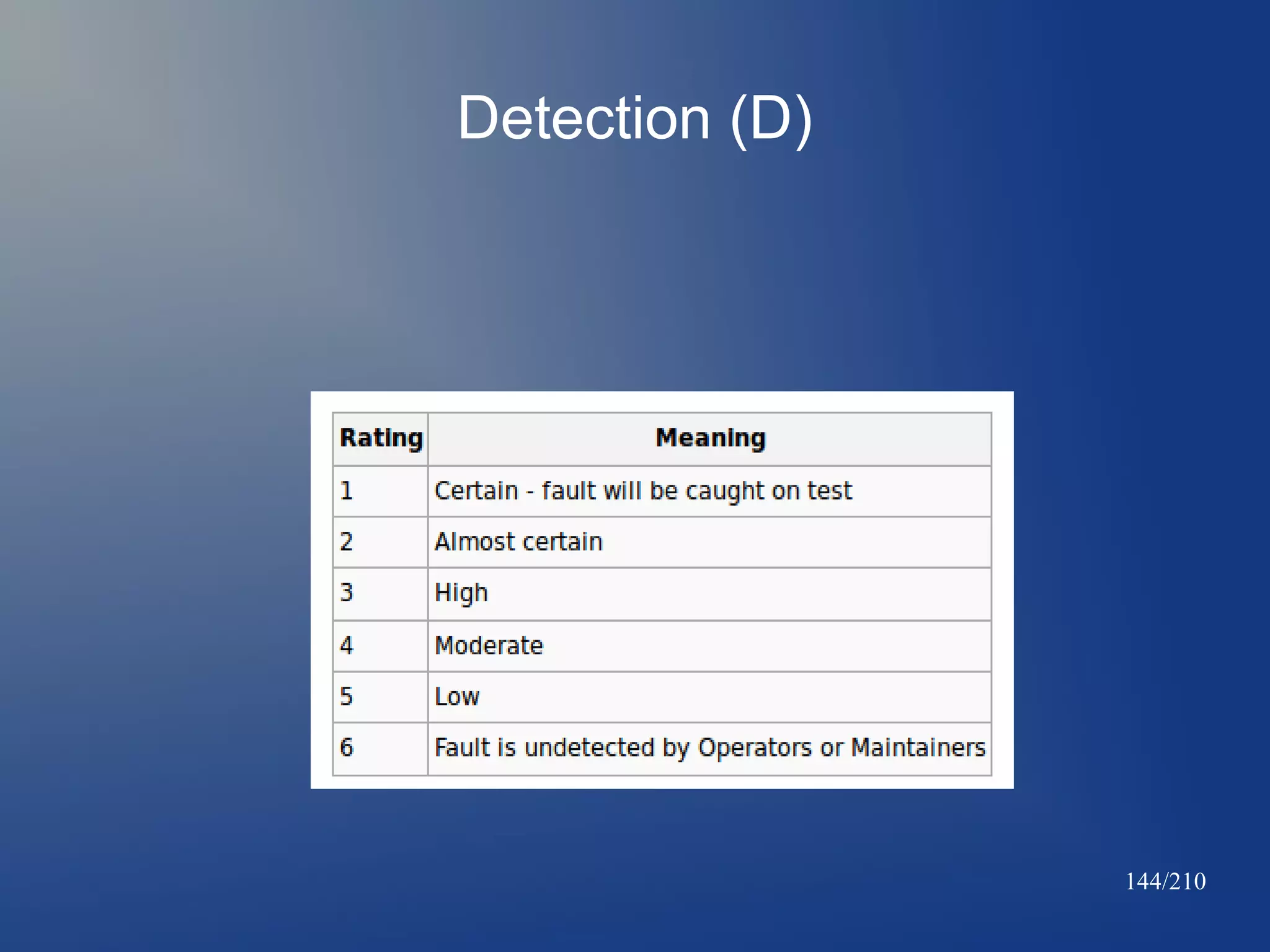
Detection (D)

140/210
Detection (D)

The means or method by which a failure is
detected, isolated by operator and/or maintainer
and the time it may take. This is important for
maintainability control (Availability of the system)
and it is specially important for multiple failure
scenarios.
141/210
Detection (D)

This may involve dormant failure modes (e.g. No
direct system effect, while a redundant system /
item automatic takes over or when the failure only
is problematic during specific mission or system
states) or latent failures (e.g. deterioration failure
mechanisms, like a metal growing crack, but not
a critical length).
142/210
Detection (D)

It should be made clear how the failure mode or
cause can be discovered by an operator under
normal system operation or if it can be discovered
by the maintenance crew by some diagnostic
action or automatic built in system test. A
dormancy and/or latency period may be entered.
143/210
Detection (D)

144/210
Detection (D)
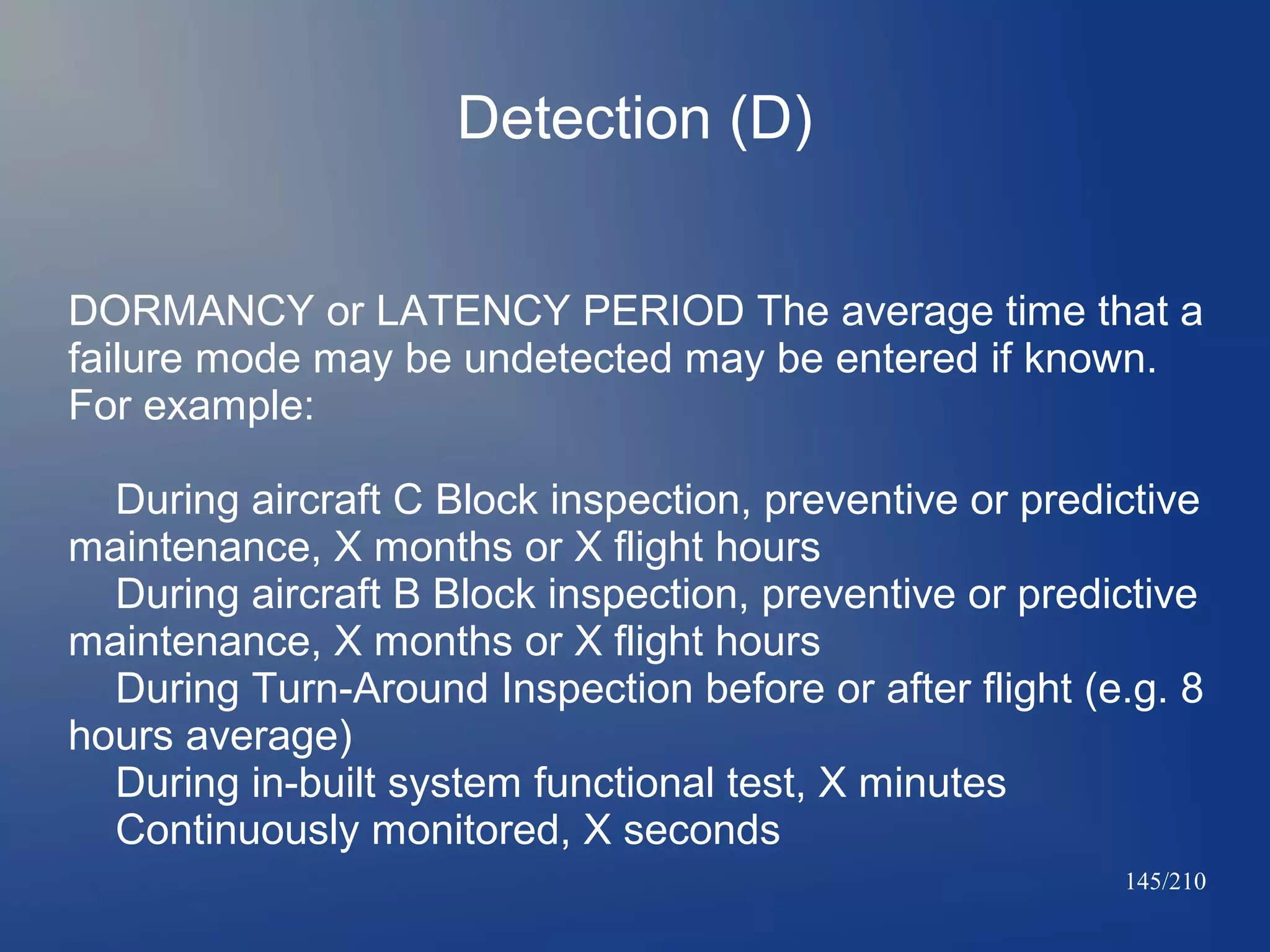
DORMANCY or LATENCY PERIOD The average time that a
failure mode may be undetected may be entered if known.
For example:
During aircraft C Block inspection, preventive or predictive
maintenance, X months or X flight hours
During aircraft B Block inspection, preventive or predictive
maintenance, X months or X flight hours
During Turn-Around Inspection before or after flight (e.g. 8
hours average)
During in-built system functional test, X minutes
Continuously monitored, X seconds
145/210
Detection (D)

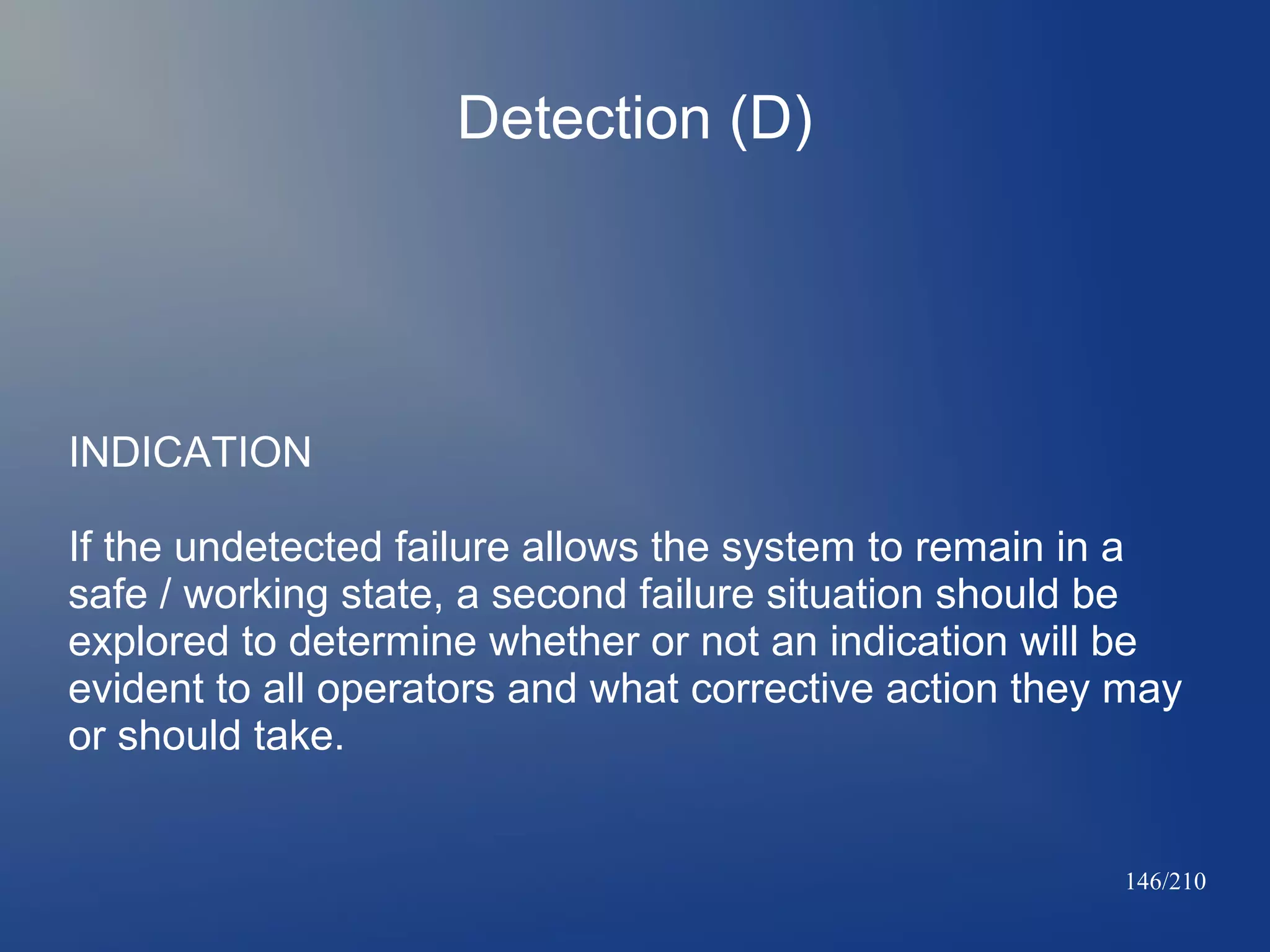
INDICATION
If the undetected failure allows the system to remain in a
safe / working state, a second failure situation should be
explored to determine whether or not an indication will be
evident to all operators and what corrective action they may
or should take.

146/210
Detection (D)

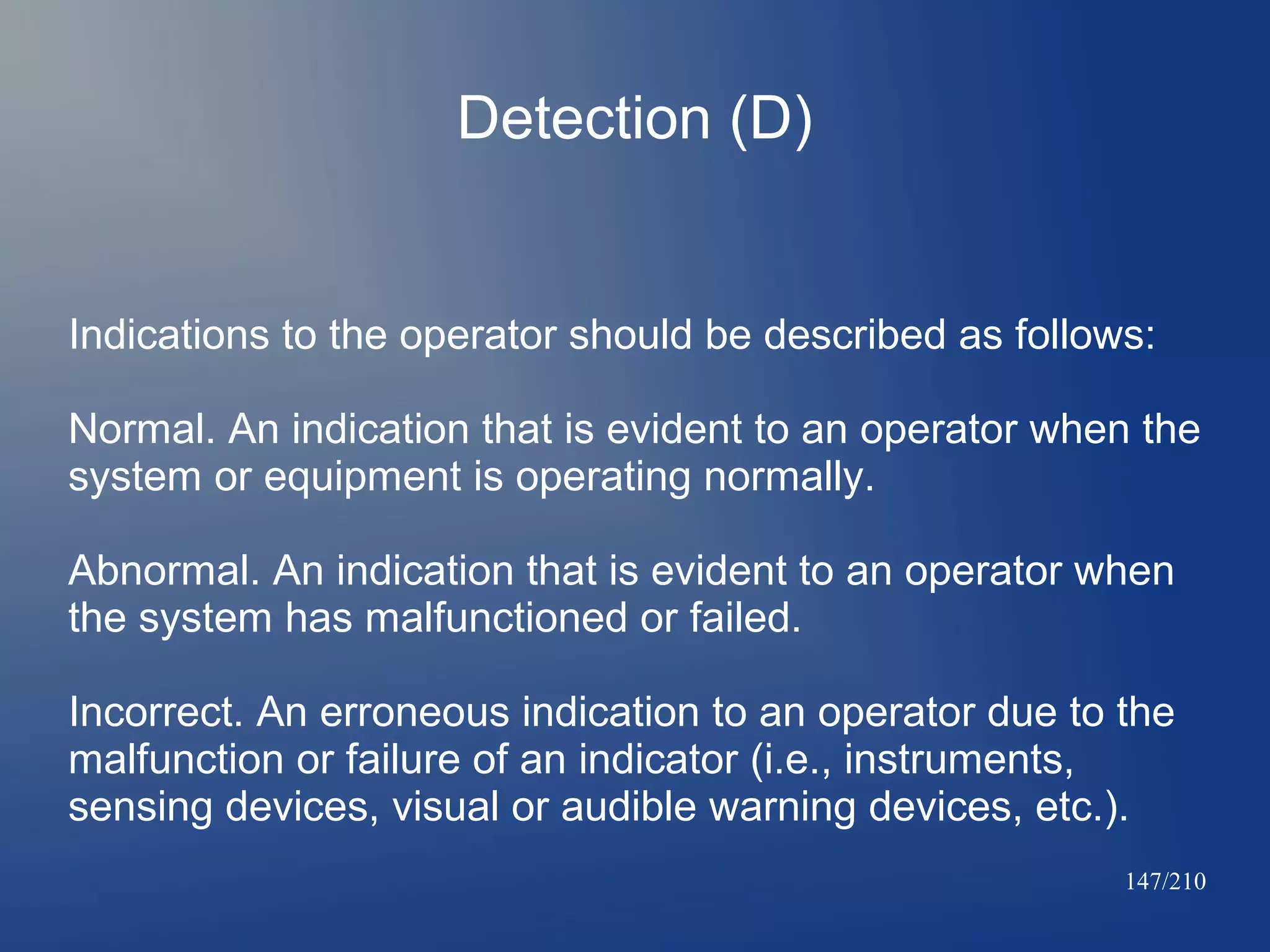
Indications to the operator should be described as follows:
Normal. An indication that is evident to an operator when the
system or equipment is operating normally.
Abnormal. An indication that is evident to an operator when
the system has malfunctioned or failed.
Incorrect. An erroneous indication to an operator due to the
malfunction or failure of an indicator (i.e., instruments,
sensing devices, visual or audible warning devices, etc.).
147/210
Detection (D)

PERFORM DETECTION COVERAGE ANALYSIS FOR
TEST PROCESSES AND MONITORING (From ARP4761
Standard):

148/210
Detection (D)

This type of analysis is useful to determine how effective
various test processes are at the detection of latent and
dormant faults. The method used to accomplish this involves
an examination of the applicable failure modes to determine
whether or not their effects are detected, and to determine
the percentage of failure rate applicable to the failure modes
which are detected. The possibility that the detection means
may itself fail latent should be accounted for in the coverage
analysis as a limiting factor (i.e., coverage cannot be more
reliable than the detection means availability).
149/210
Detection (D)

Inclusion of the detection coverage in the FMEA can lead to
each individual failure that would have been one effect
category now being a separate effect category due to the
detection coverage possibilities. Another way to include
detection coverage is for the FTA to conservatively assume
that no holes in coverage due to latent failure in the
detection method affect detection of all failures assigned to
the failure effect category of concern. The FMEA can be
revised is necessary for those cases where this conservative
assumption does not allow the top event probability
requirements to be met.
150/210
Detection (D)

After these three basic steps the Risk level may be provided.

151/210
Risk level (P*S) and (D)

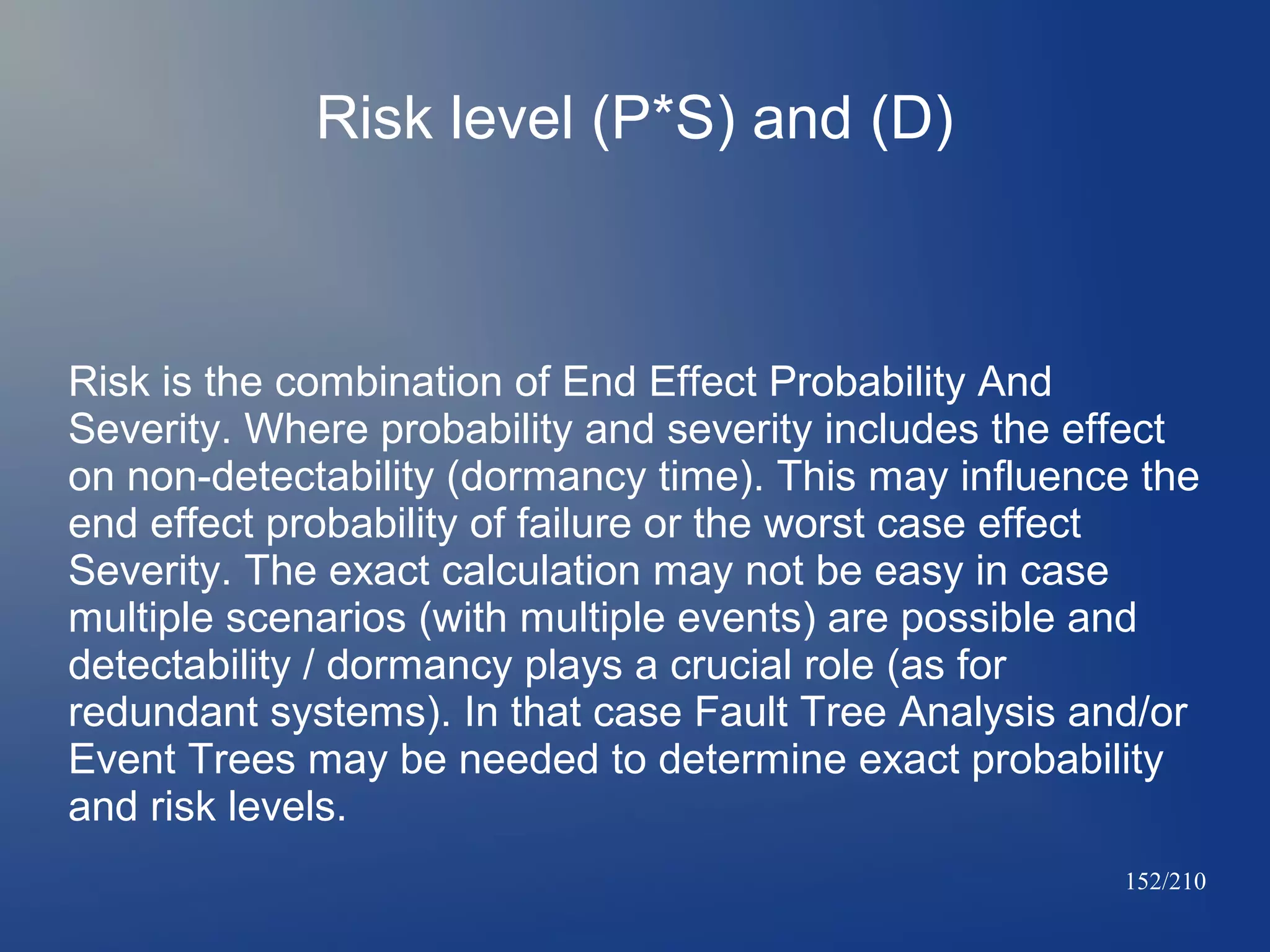
Risk is the combination of End Effect Probability And
Severity. Where probability and severity includes the effect
on non-detectability (dormancy time). This may influence the
end effect probability of failure or the worst case effect
Severity. The exact calculation may not be easy in case
multiple scenarios (with multiple events) are possible and
detectability / dormancy plays a crucial role (as for
redundant systems). In that case Fault Tree Analysis and/or
Event Trees may be needed to determine exact probability
and risk levels.
152/210
Risk level (P*S) and (D)

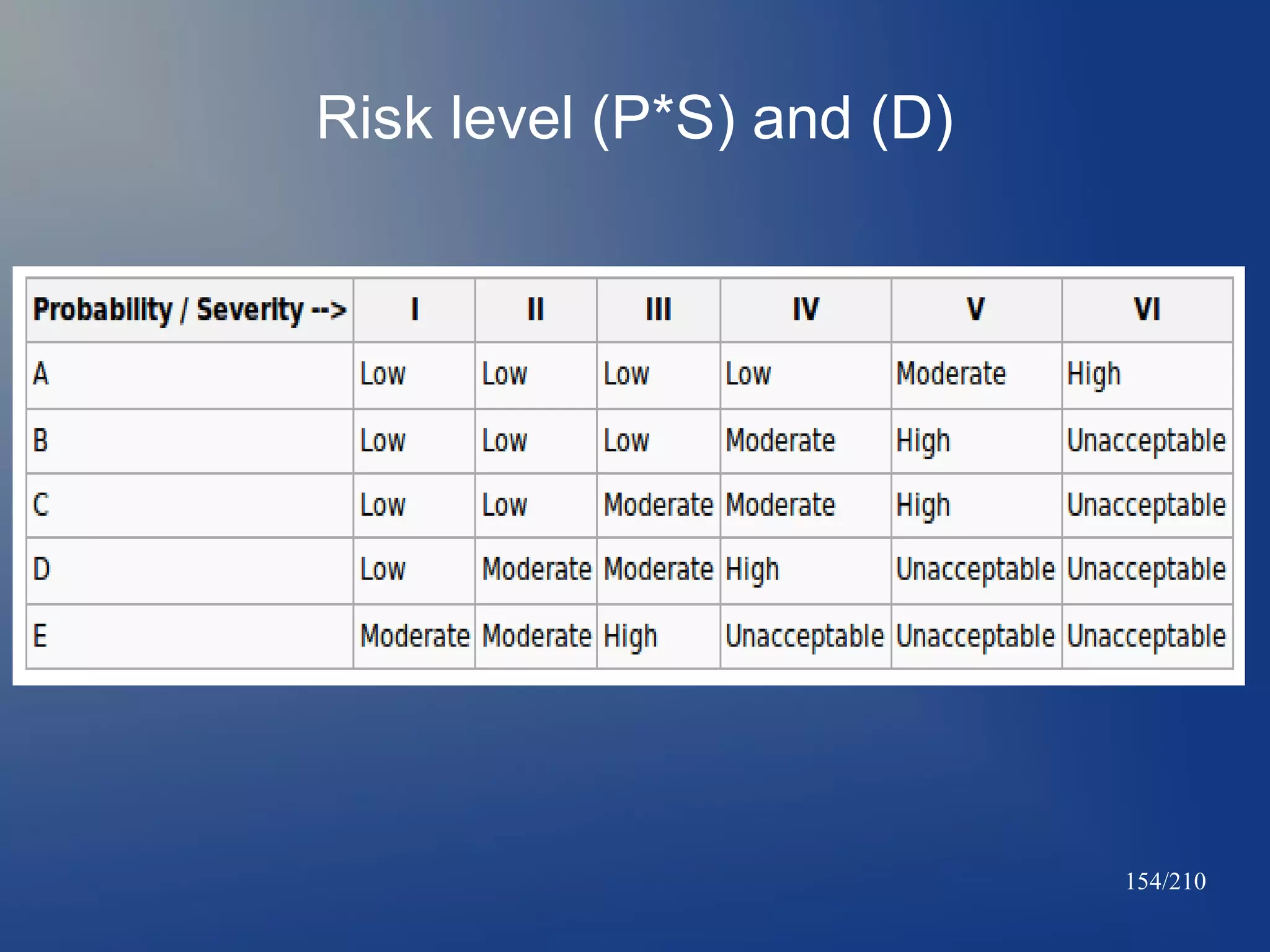
Preliminary Risk levels can be selected based on a Risk
Matrix like shown below, based on Mil. Std. 882.[24] The
higher the Risk level, the more justification and mitigation is
needed to provide evidence and lower the risk to an
acceptable level. High risk should be indicated to higher
level management, who are responsible for final decision
making.

153/210
Risk level (P*S) and (D)

154/210
Risk level (P*S) and (D)

After this step the FMEA has become like a FMECA.

155/210
Timing

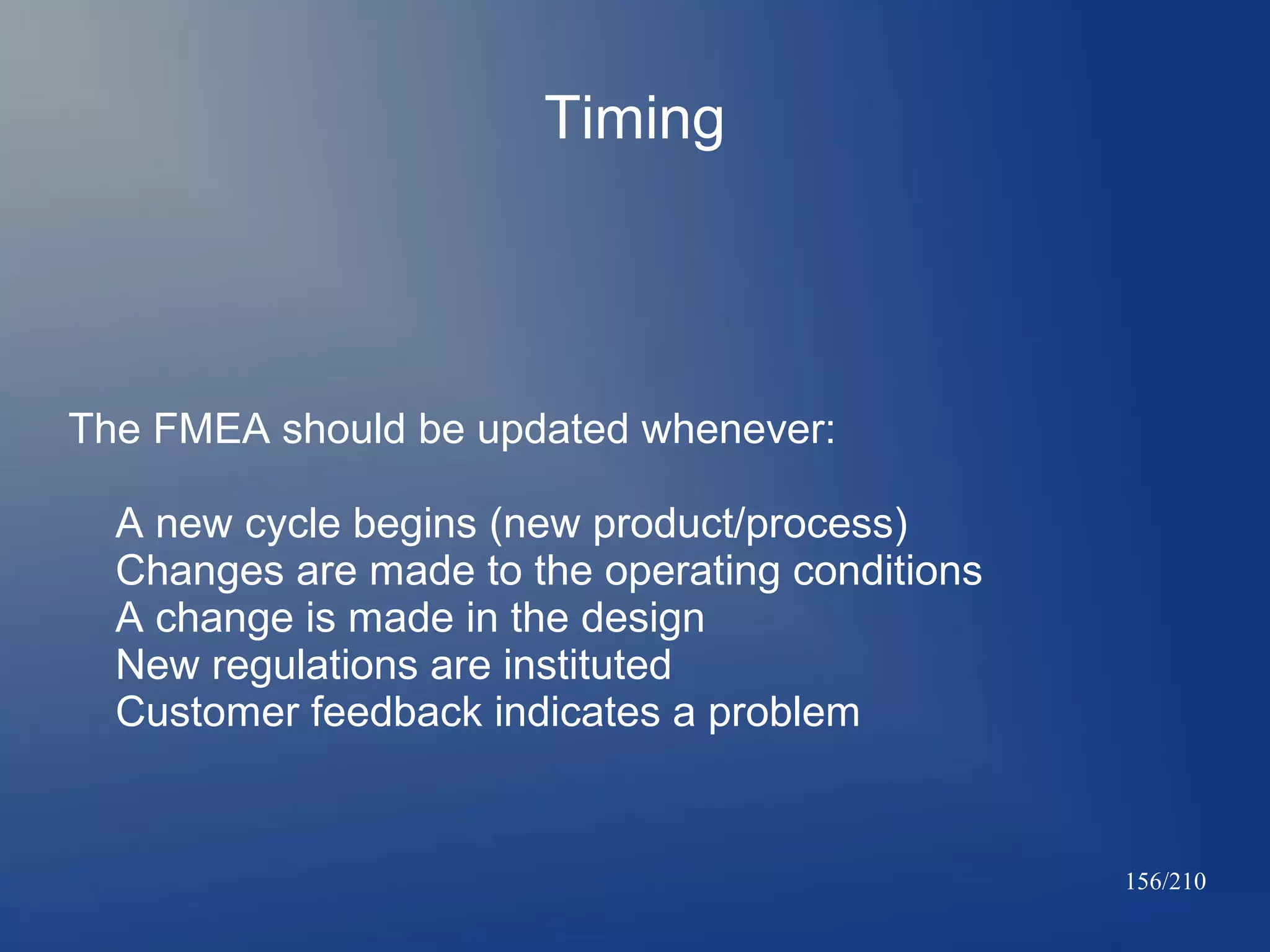
The FMEA should be updated whenever:
A new cycle begins (new product/process)
Changes are made to the operating conditions
A change is made in the design
New regulations are instituted
Customer feedback indicates a problem

156/210
Uses

Development of system requirements that minimize the
likelihood of failures.
Development of designs and test systems to ensure that
the failures have been eliminated or the risk is reduced to
acceptable level.
Development and evaluation of diagnostic systems
To help with design choices (trade-off analysis).

157/210
Advantages

Improve the quality, reliability and safety of a
product/process
Improve company image and competitiveness
Increase user satisfaction
Reduce system development time and cost
Collect information to reduce future failures, capture
engineering knowledge

158/210
Advantages

Reduce the potential for warranty concerns
Early identification and elimination of potential failure
modes
Emphasize problem prevention
Minimize late changes and associated cost
Catalyst for teamwork and idea exchange between
functions
Reduce the possibility of same kind of failure in future
Reduce impact on company profit margin
Improve production yield
159/210
Limitations

If used as a top-down tool, FMEA may only identify major
failure modes in a system. Fault tree analysis (FTA) is better
suited for "top-down" analysis. When used as a "bottom-up"
tool FMEA can augment or complement FTA and identify
many more causes and failure modes resulting in top-level
symptoms. It is not able to discover complex failure modes
involving multiple failures within a subsystem, or to report
expected failure intervals of particular failure modes up to
the upper level subsystem or system.
160/210
Limitations

Additionally, the multiplication of the severity, occurrence
and detection rankings may result in rank reversals, where a
less serious failure mode receives a higher RPN than a
more serious failure mode.
The reason for this is that the rankings are ordinal scale
numbers, and multiplication is not defined for ordinal
numbers. The ordinal rankings only say that one ranking is
better or worse than another, but not by how much. For
instance, a ranking of "2" may not be twice as severe as a
ranking of "1," or an "8" may not be twice as severe as a "4,"
but multiplication treats them as though they are. See Level
of measurement for further discussion.

161/210
Types

Functional: before design solutions are provided (or only on
high level) functions can be evaluated on potential functional
failure effects. General Mitigations ("design to"
requirements) can be proposed to limit consequence of
functional failures or limit the probability of occurrence in this
early development. It is based on a functional breakdown of
a system. This type may also be used for Software
evaluation.
162/210
Types

Concept Design / Hardware: analysis of systems or
subsystems in the early design concept stages to analyse
the failure mechanisms and lower level functional failures,
specially to different concept solutions in more detail. It may
be used in trade-off studies.

163/210
Types

Detailed Design / Hardware: analysis of products prior to
production. These are the most detailed (in mil 1629 called
Piece-Part or Hardware FMEA) FMEAs and used to identify
any possible hardware (or other) failure mode up to the
lowest part level. It should be based on hardware
breakdown (e.g. the BoM = Bill of Material). Any Failure
effect Severity, failure Prevention (Mitigation), Failure
Detection and Diagnostics may be fully analysed in this
FMEA.
164/210
Types

Process: analysis of manufacturing and assembly
processes. Both quality and reliability may be affected from
process faults. The input for this FMEA is amongst others a
work process / task Breakdown.

165/210
166/210
HOW TO CONDUCT AN
EFFECTIVE SAFETY
ASSESSMENT
OFFICE SPACES
Why should you be conducting
assessments?
●
●

●
●

To spot unsafe conditions and equipment
To focus on unsafe work practices or
behavior trends before they lead to injuries
Reveal the need for new safeguards
To provide a safe working environment for
all workers
What should I look for during an office
assessment?
●
●
●
●
●
●
●

Emergency Egress
Work Environment
Ergonomics
Emergency Information
Fire Prevention
Electrical Systems
Employee Behavior
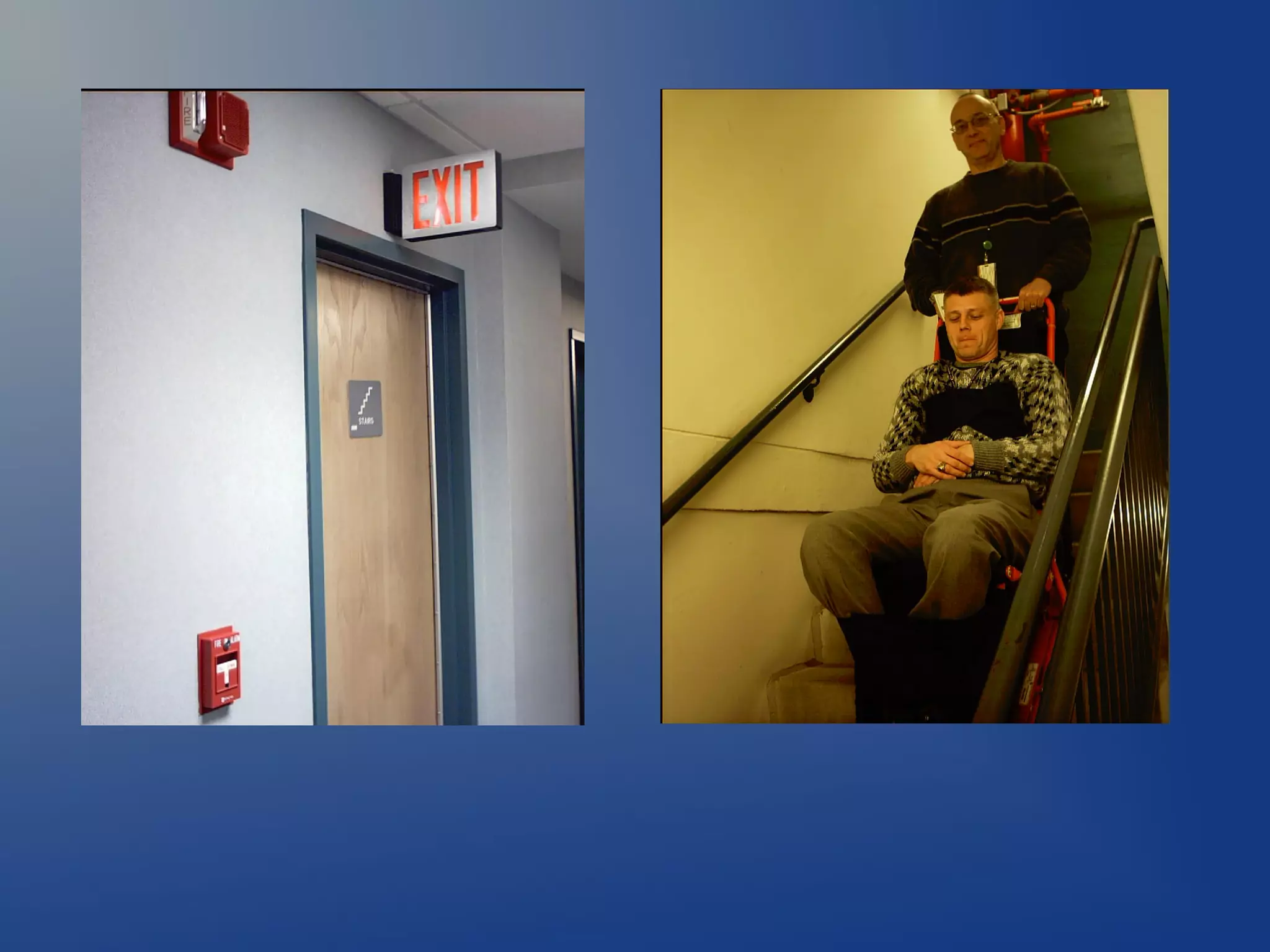
Emergency Egress
●
●

●
●
●

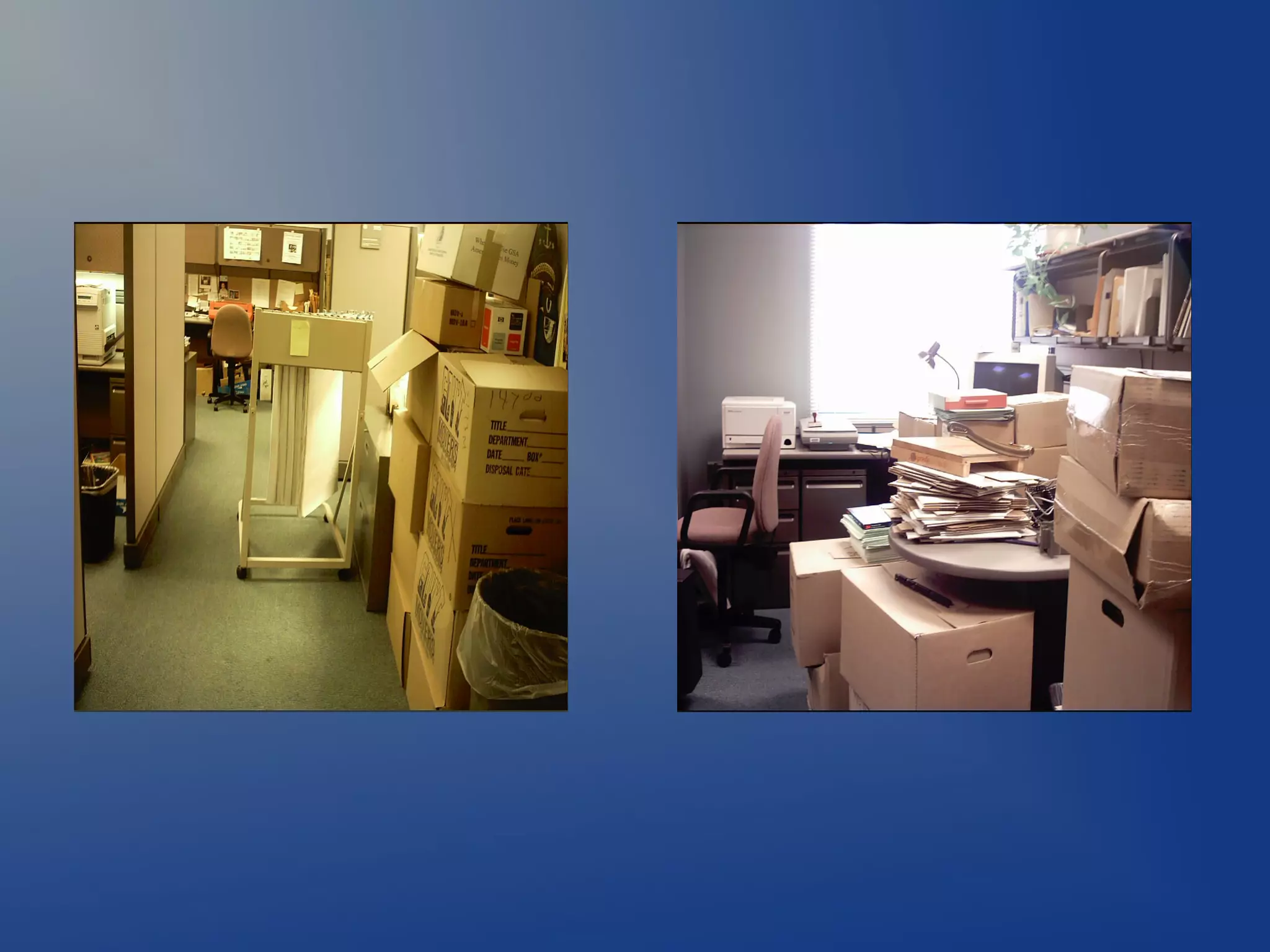
Blocked or locked doorways
Locking devices that can impede
emergency egress
Properly marked exits
Properly illuminated exits
Clear aisles and pathways
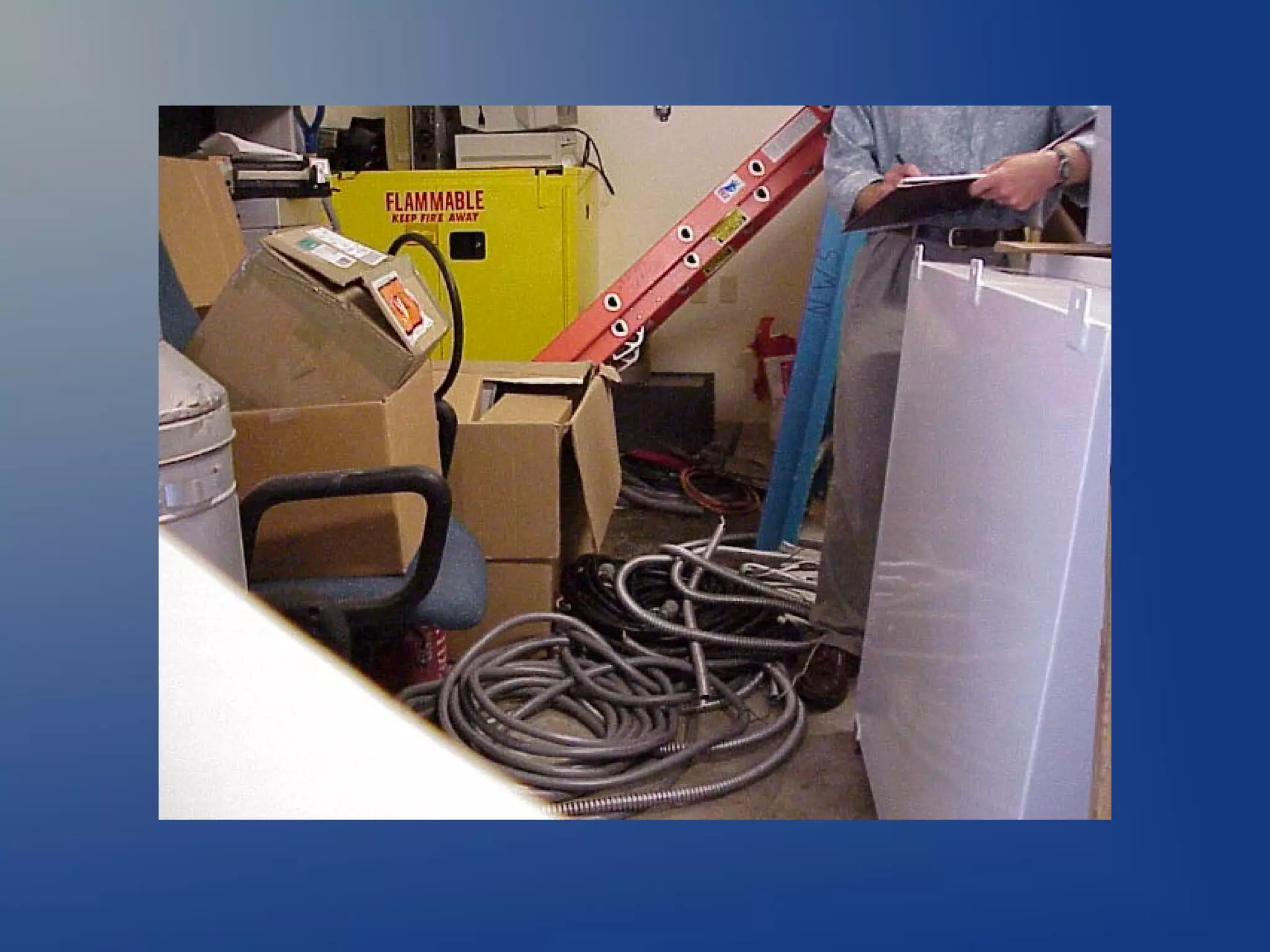
Work Environment
●
●

●
●

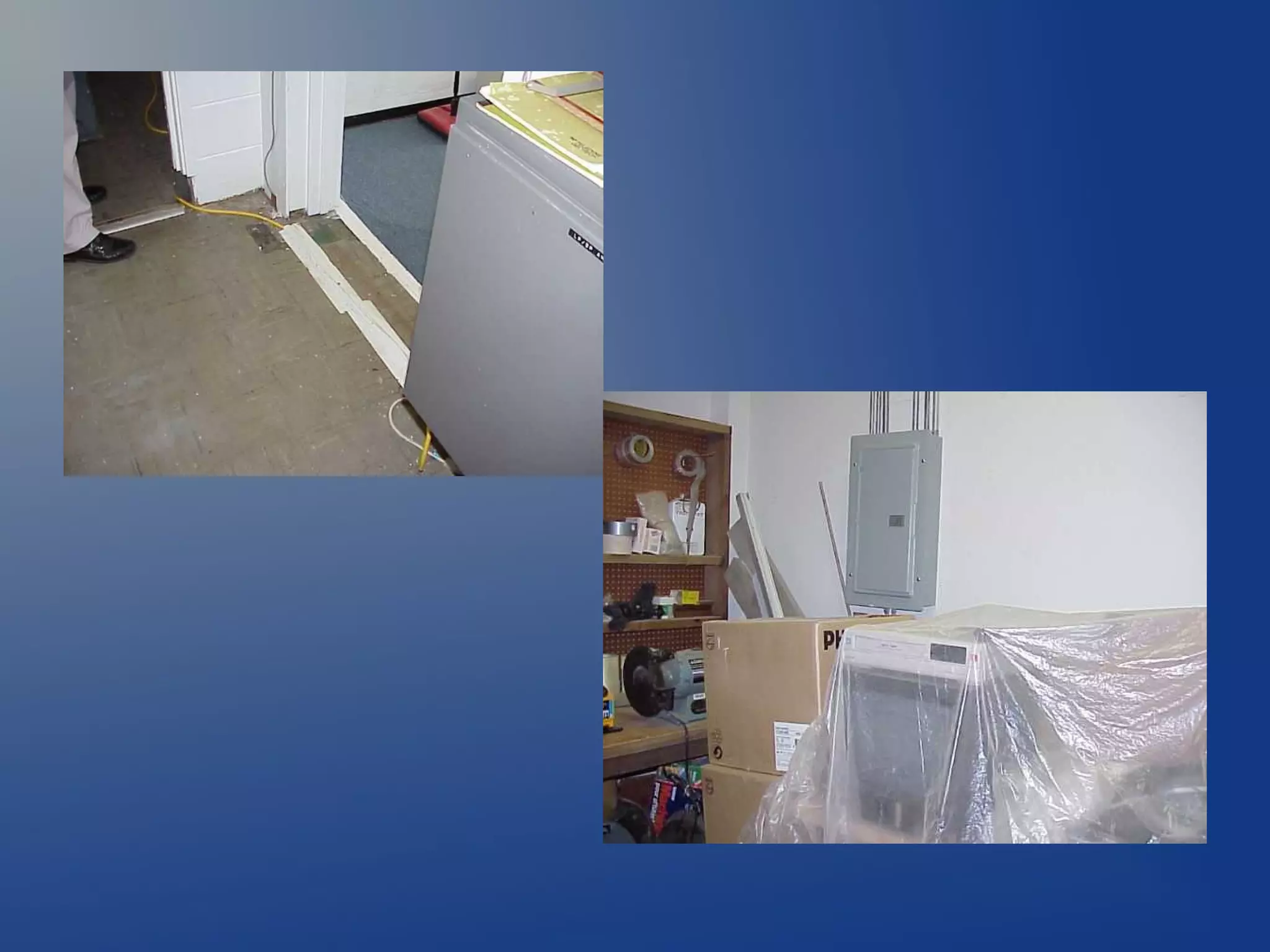
Clean, sanitary and orderly work spaces
Tripping hazards such as loose tiles,
carpeting, flooring
Are drawers kept open when not in use
Are items stored above shoulder level and
unsecured
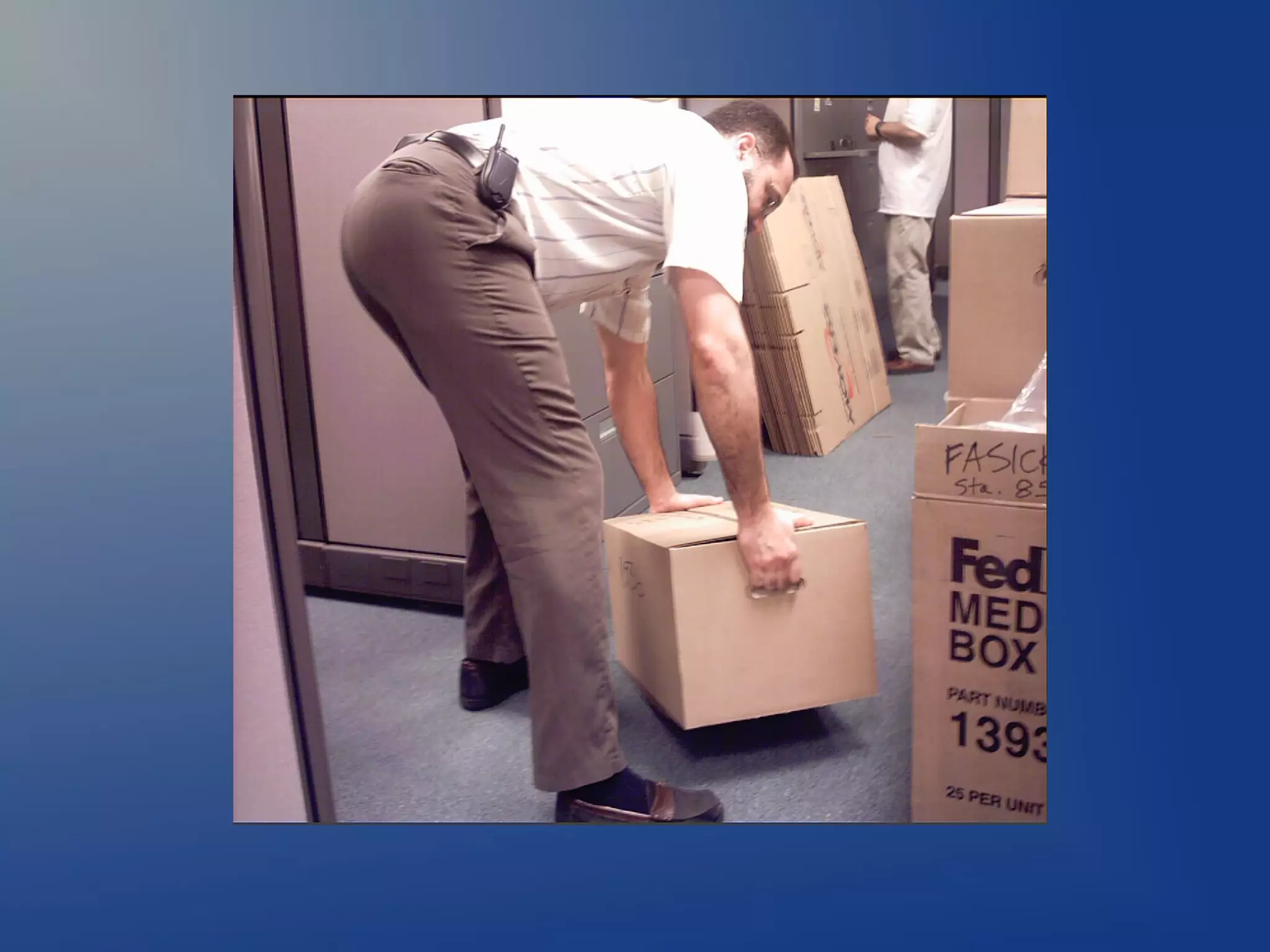
Ergonomics
●

●

●

Are workstations configured to prevent
employee discomfort and injury
Are employees aware of ergonomic risk
factors
Have employees received ergonomic
training
Emergency Information
●

●

●

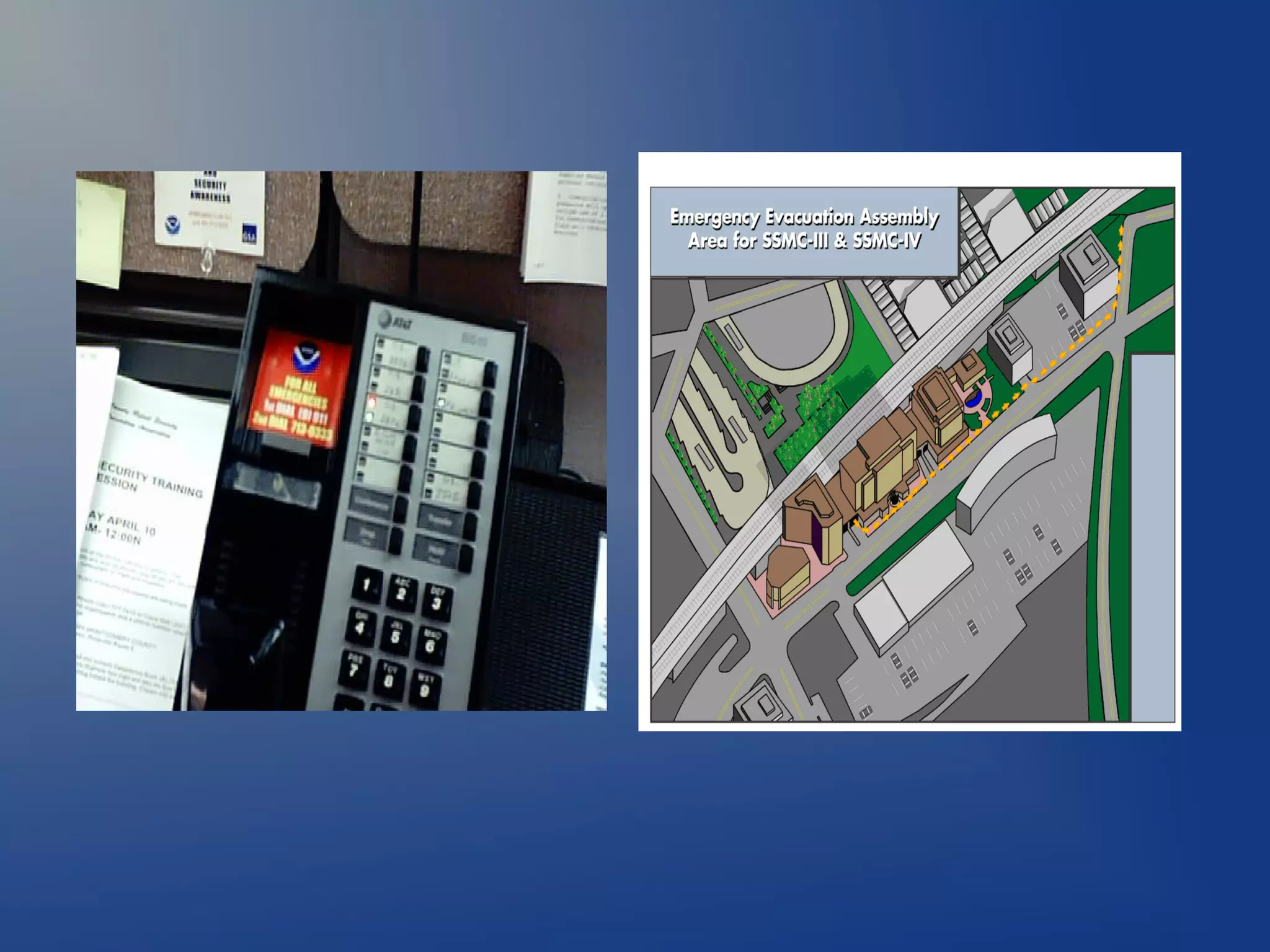
Are emergency phone numbers posted
where they can be readily found
Are employees trained in emergency
procedures
Are evacuation procedures and diagrams
posted
Fire Prevention
●

●

●

●

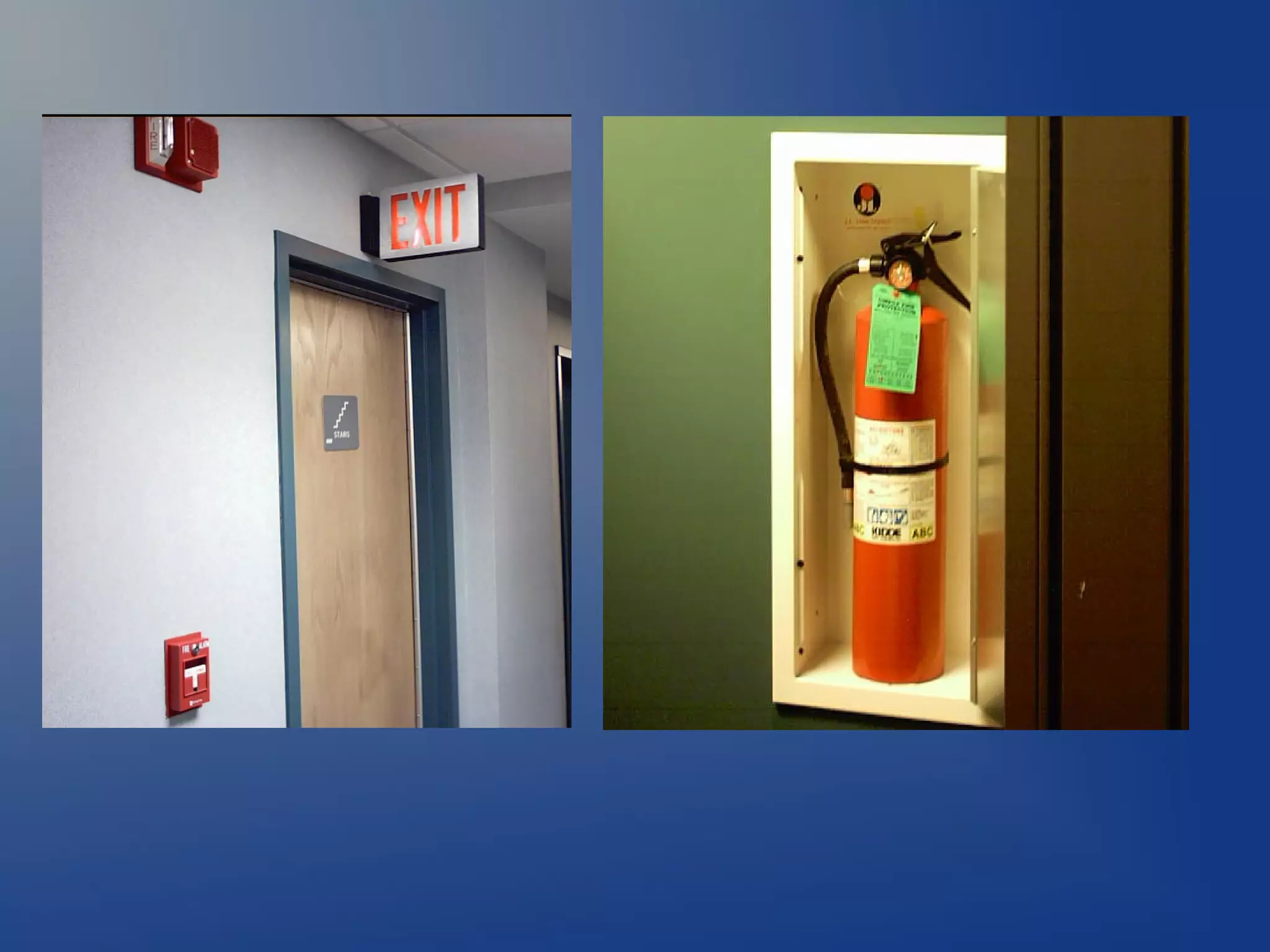
Are portable fire extinguishers readily
available and unobstructed
Are fire pull stations clearly marked and
unobstructed
Are all fire sprinkler heads kept clear and
unobstructed (at least 18 inches)
Are space heaters used and authorized
Electrical Systems
●

●

●

●
●

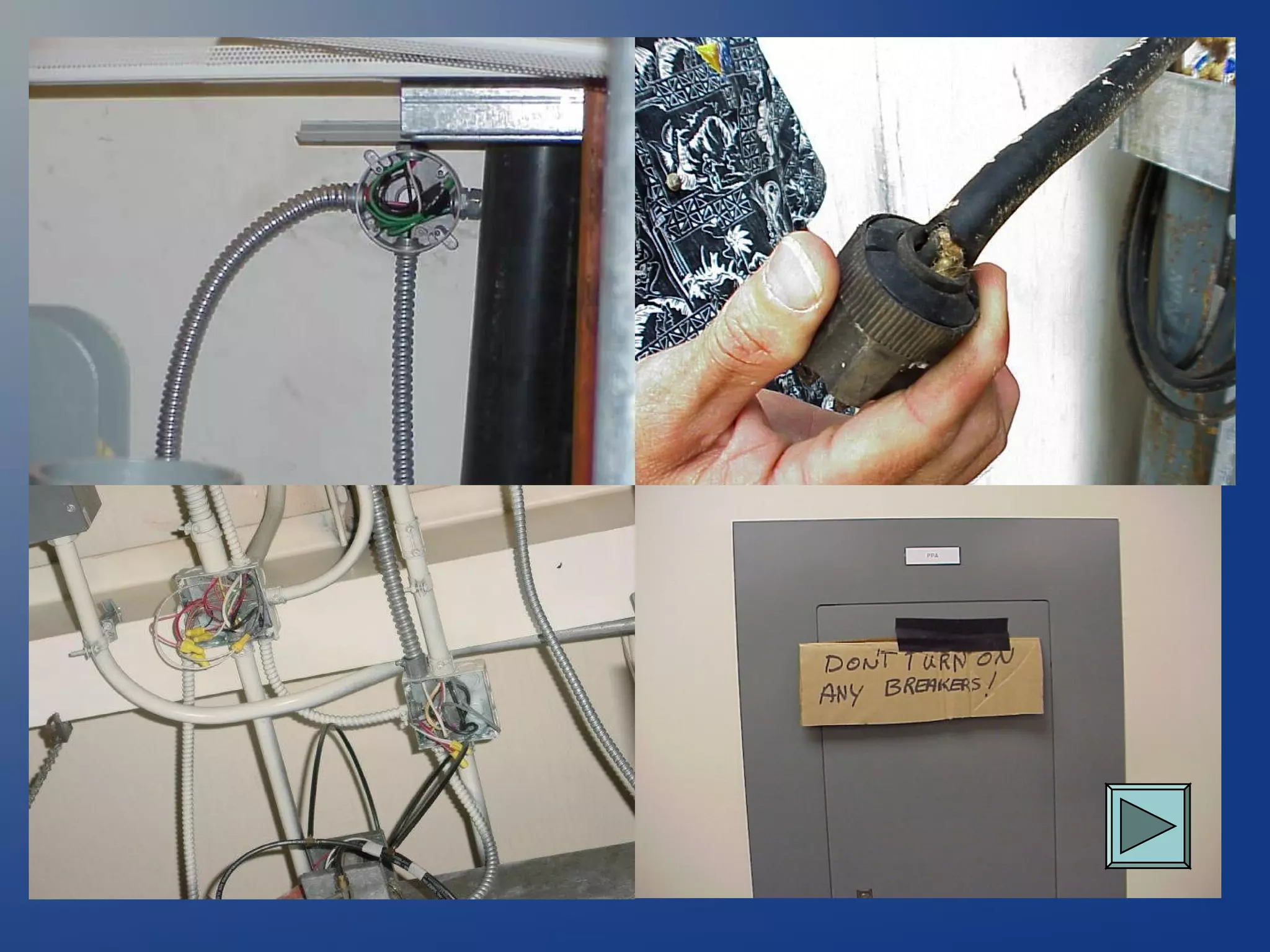
Are extension cords/power strips kept
uncoupled (piggy-backed)
Are all extension cords/power strips
provided by the agency
Are electrical outlets clear of combustible
materials
Do electrical cords create trip hazards
Are extension cords used as permanent
wiring
Employee Behavior
●

●

●

Are employees observing established
safety rules
Do employees minimize hazards by
applying Operational Risk Management
principles
Are employee allowed to report unsafe
conditions or acts without restraint
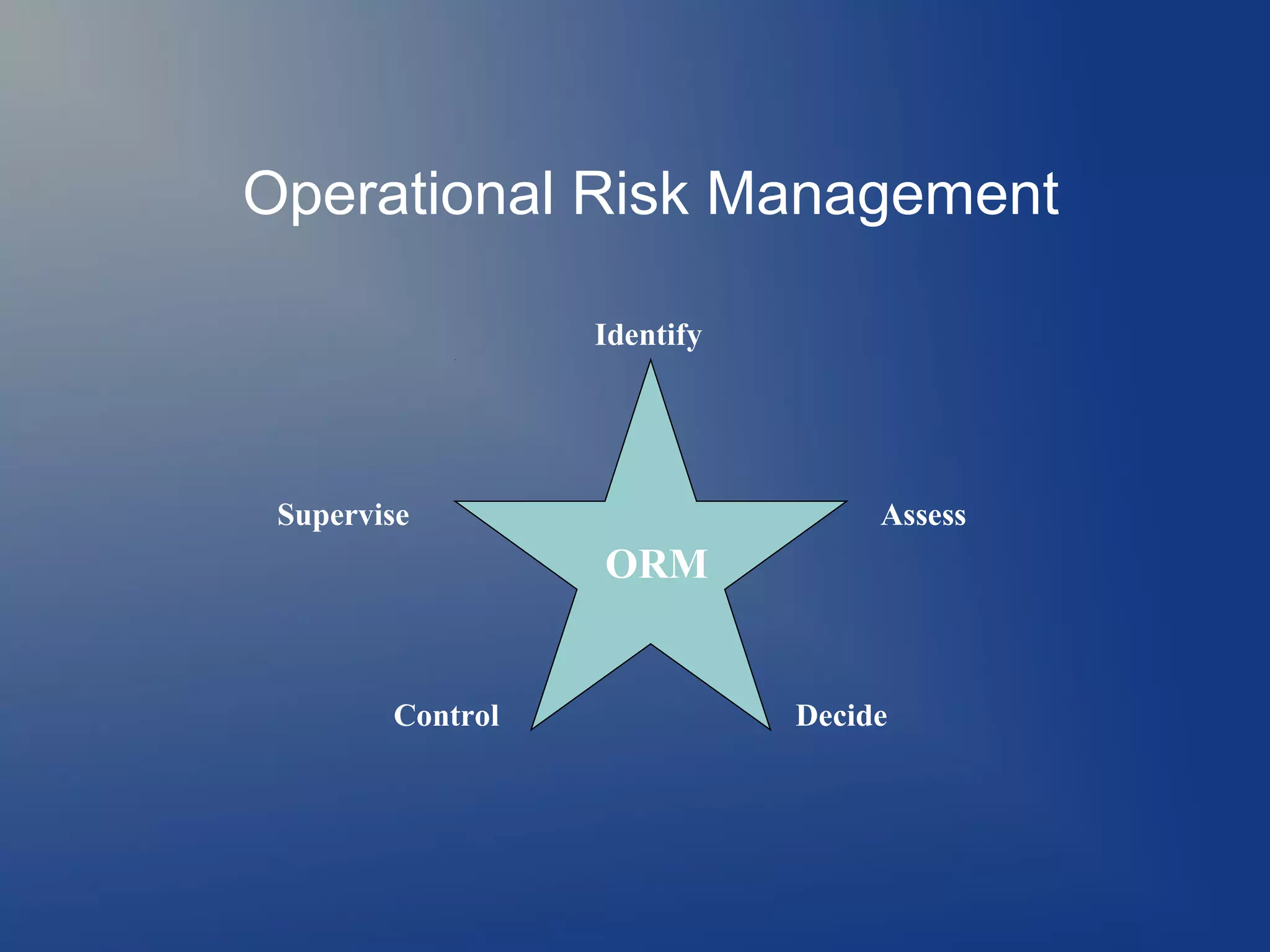
Operational Risk Management
Identify

Supervise

Assess

ORM

Control

Decide
How to assess safety
SUMMARY
●
●
●

●

Promoting Safety
Monthly Assessment Program
Positive Findings (above & beyond
minimum requirements)
Assessments – emergency info, egress,
environment, ergonomics, fire prevention,
electrical, unsafe behavior
Risk Assessment and Management
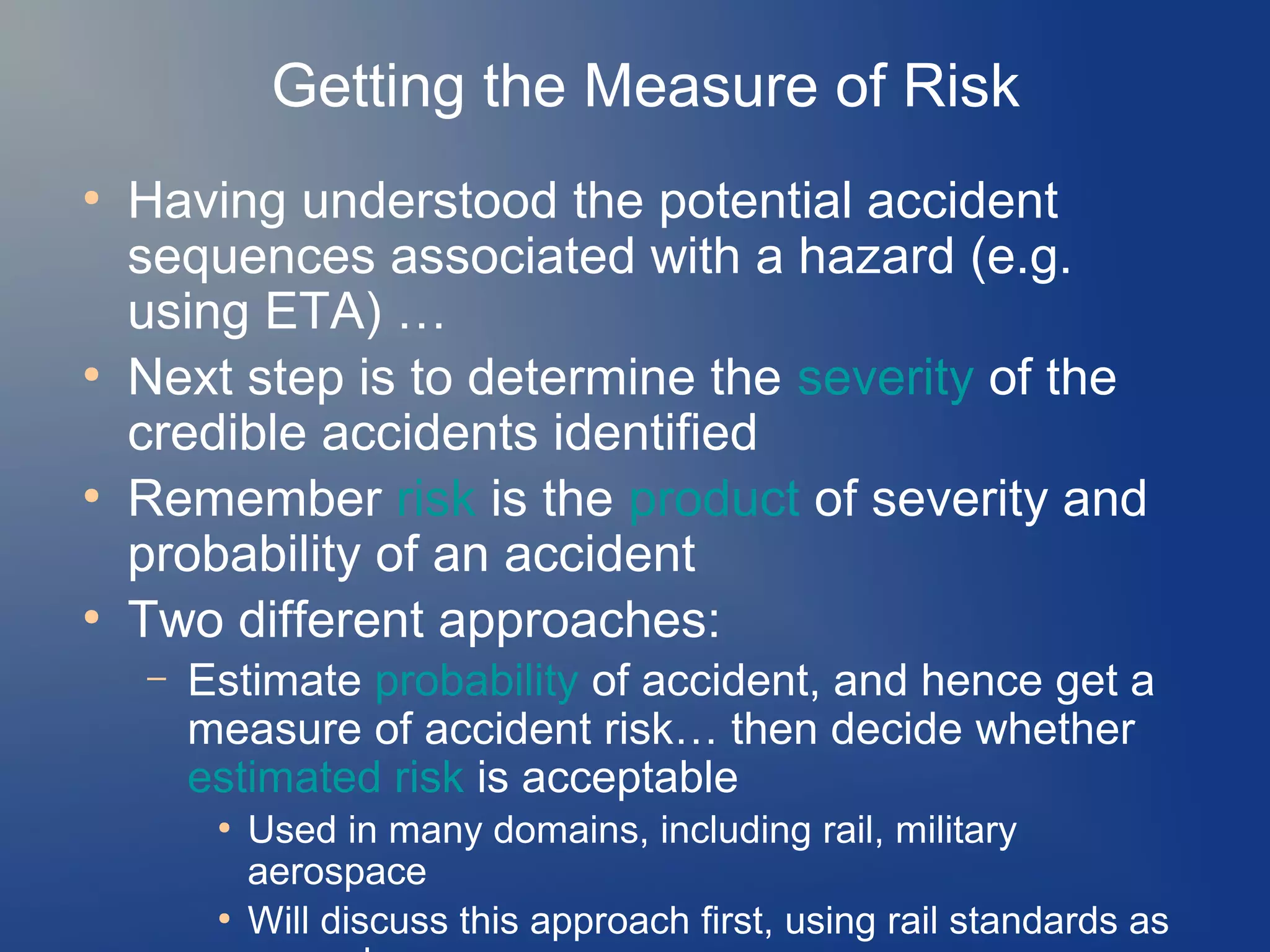
Getting the Measure of Risk
●

●

●

●

Having understood the potential accident
sequences associated with a hazard (e.g.
using ETA) …
Next step is to determine the severity of the
credible accidents identified
Remember risk is the product of severity and
probability of an accident
Two different approaches:
–

Estimate probability of accident, and hence get a
measure of accident risk… then decide whether
estimated risk is acceptable
●

●

Used in many domains, including rail, military
aerospace
Will discuss this approach first, using rail standards as
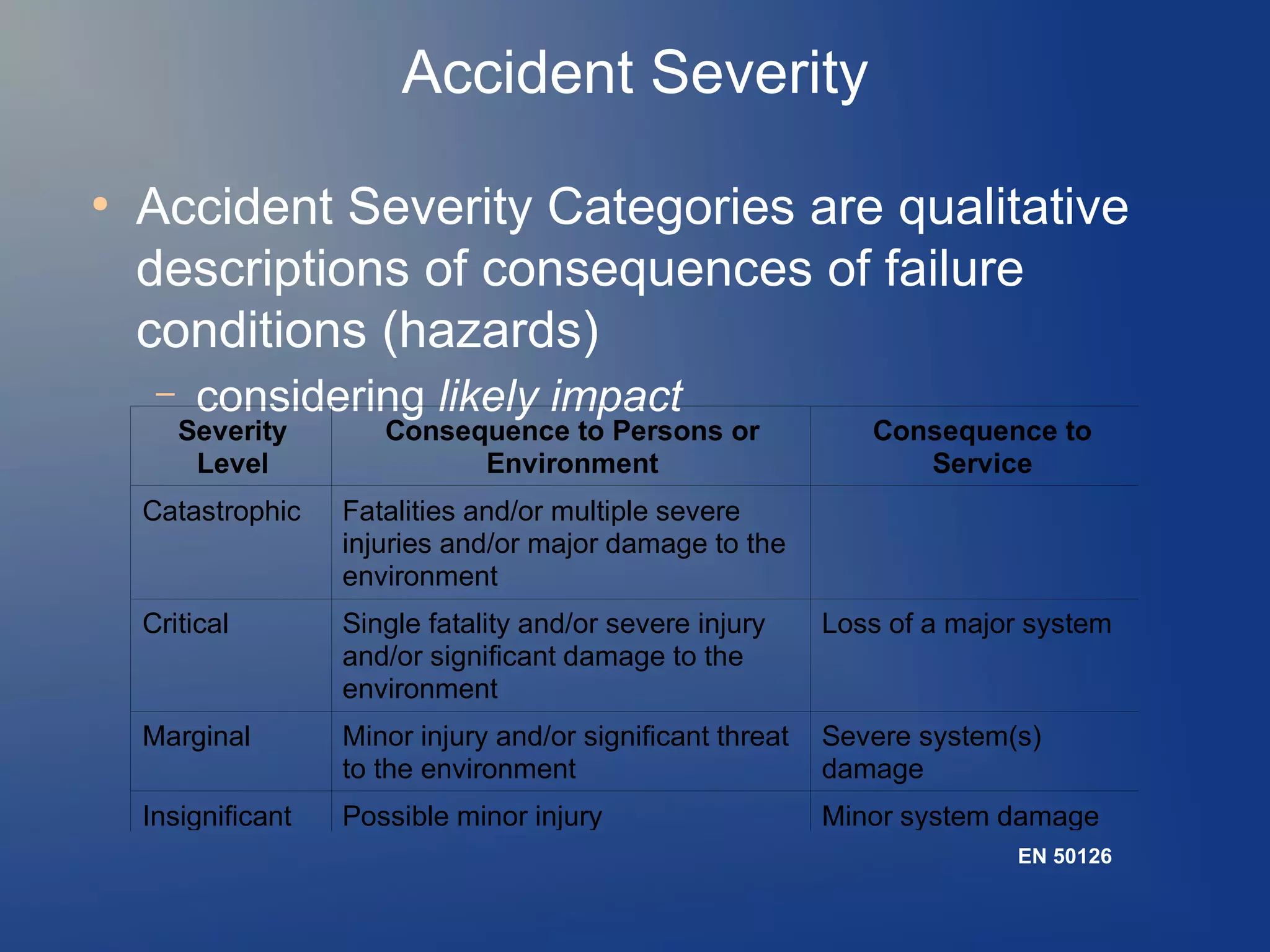
Accident Severity
●

Accident Severity Categories are qualitative
descriptions of consequences of failure
conditions (hazards)
–

considering likely impact

Severity
Level

Consequence to Persons or
Environment

Consequence to
Service

Catastrophic

Fatalities and/or multiple severe
injuries and/or major damage to the
environment

Critical

Single fatality and/or severe injury
and/or significant damage to the
environment

Loss of a major system

Marginal

Minor injury and/or significant threat
to the environment

Severe system(s)
damage

Insignificant

Possible minor injury

Minor system damage
EN 50126
Accident Probability
Next, estimate (predict) accident probability
●

●

Use historical results, analysis, and engineering judgment to
determine appropriate qualitative probability category
Note we may have to consider both
–
–

how likely hazard is to arise
how likely hazard is to develop into accident

Category

Description

Frequent

Likely to occur frequently. The hazard will be continually experienced.

Probable

Will occur several times. The hazard can be expected to occur often.

Occasional

Likely to occur several times. The hazard can be expected to occur several
times

Remote

Likely to occur sometime in the system lifecycle. The hazard can
reasonably be expected to occur

Improbable

Unlikely to occur, but possible. It can be assumed that the hazard will
exceptionally occur.

Incredible

Extremely unlikely to occur. It can be assumed that the hazard may not
occur.

EN 50126
Classifying Risk
●

●

Having assigned severity and probability
associated with hazard consequences …
Next step is to use a Hazard Risk Matrix to
classify the the risk
Frequency of
occurrence of a
hazardous event

Risk Levels

Frequent

Undesirable

Intolerable

Intolerable

Intolerable

Probable

Tolerable

Undesirable

Intolerable

Intolerable

Occasional

Negligible

Undesirable

Undesirable

Intolerable

Remote

Negligible

Tolerable

Undesirable

Undesirable

Improbable

Negligible

Negligible

Tolerable

Tolerable

Incredible

Negligible

Negligible

Negligible

Negligible

Insignificant

Marginal

Critical

Catastrophic

Severity Level of Hazard Consequence
EN 50126
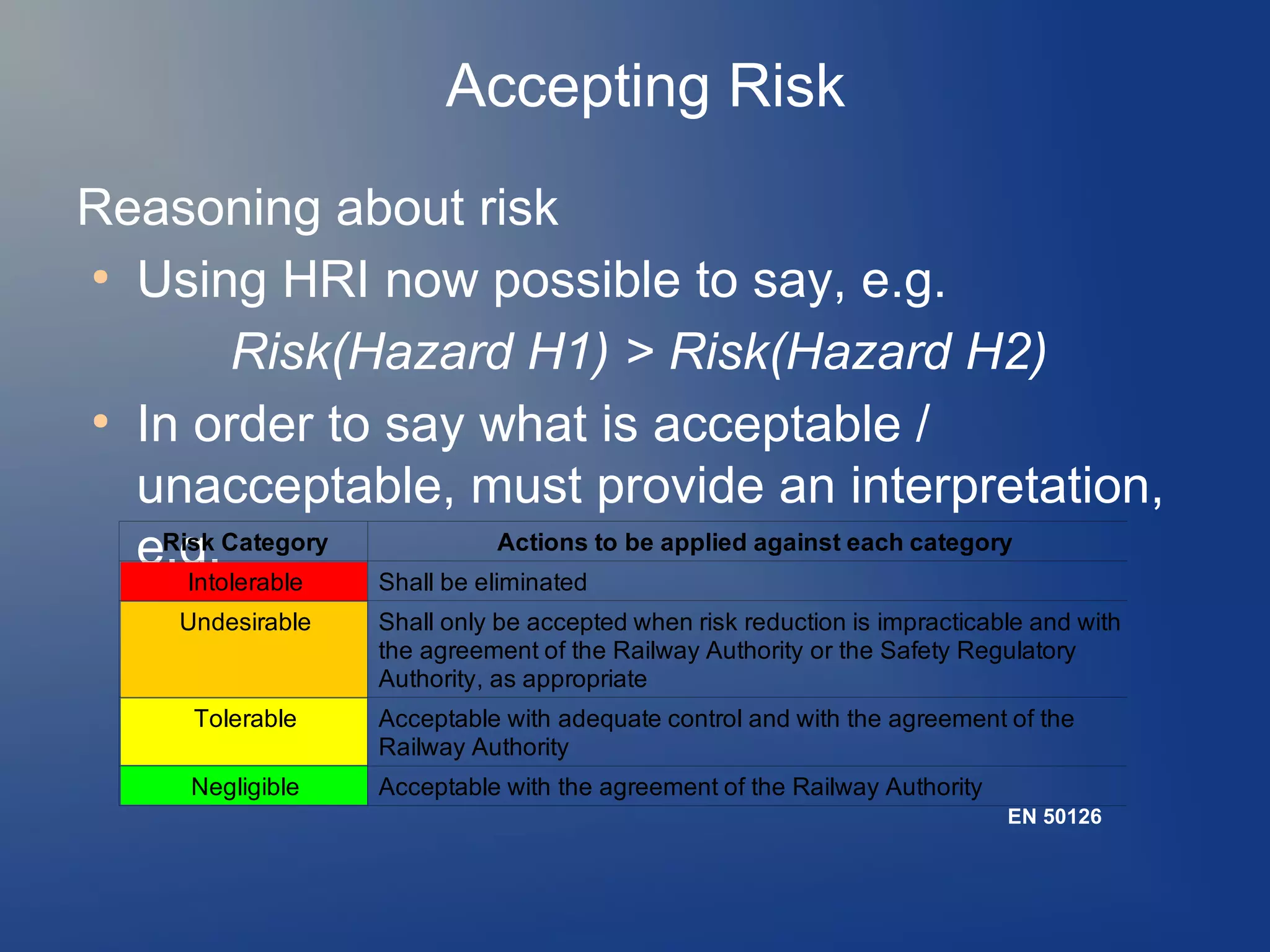
Accepting Risk
Reasoning about risk
●
Using HRI now possible to say, e.g.
Risk(Hazard H1) > Risk(Hazard H2)
●
In order to say what is acceptable /
unacceptable, must provide an interpretation,
Risk
Actions to be applied against each category
e.g.Category
Intolerable

Undesirable

Shall be eliminated

Shall only be accepted when risk reduction is impracticable and with
the agreement of the Railway Authority or the Safety Regulatory
Authority, as appropriate

Tolerable

Acceptable with adequate control and with the agreement of the
Railway Authority

Negligible

Acceptable with the agreement of the Railway Authority
EN 50126
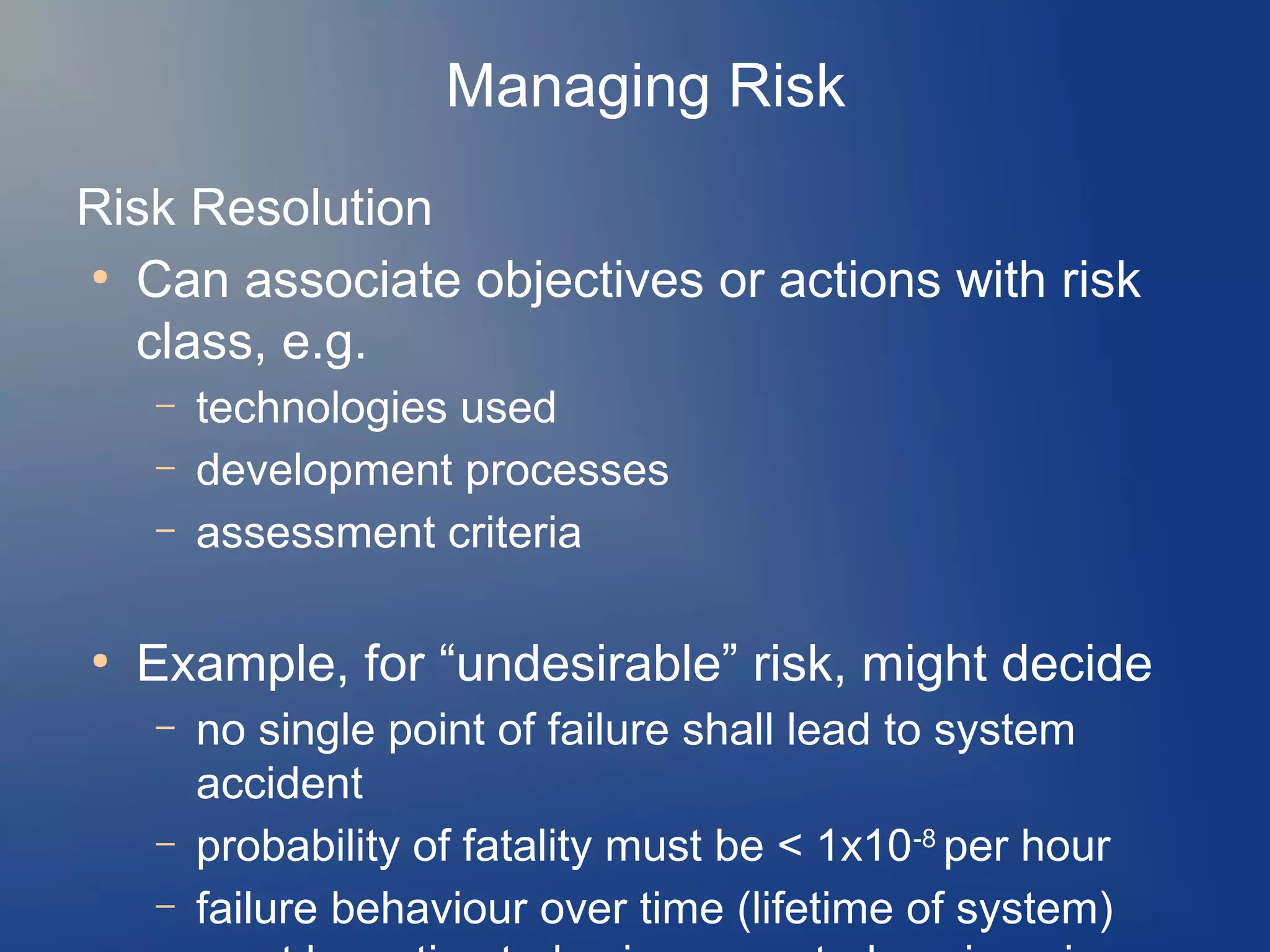
Managing Risk
Risk Resolution
●
Can associate objectives or actions with risk
class, e.g.
–
–
–

●

technologies used
development processes
assessment criteria

Example, for “undesirable” risk, might decide
–
–
–

no single point of failure shall lead to system
accident
probability of fatality must be < 1x10⁻⁸ per hour
failure behaviour over time (lifetime of system)
Determining Risk - Civil Aerospace Style 1
Start with determination of severity
●
very similar to rail categories

ARP 4761
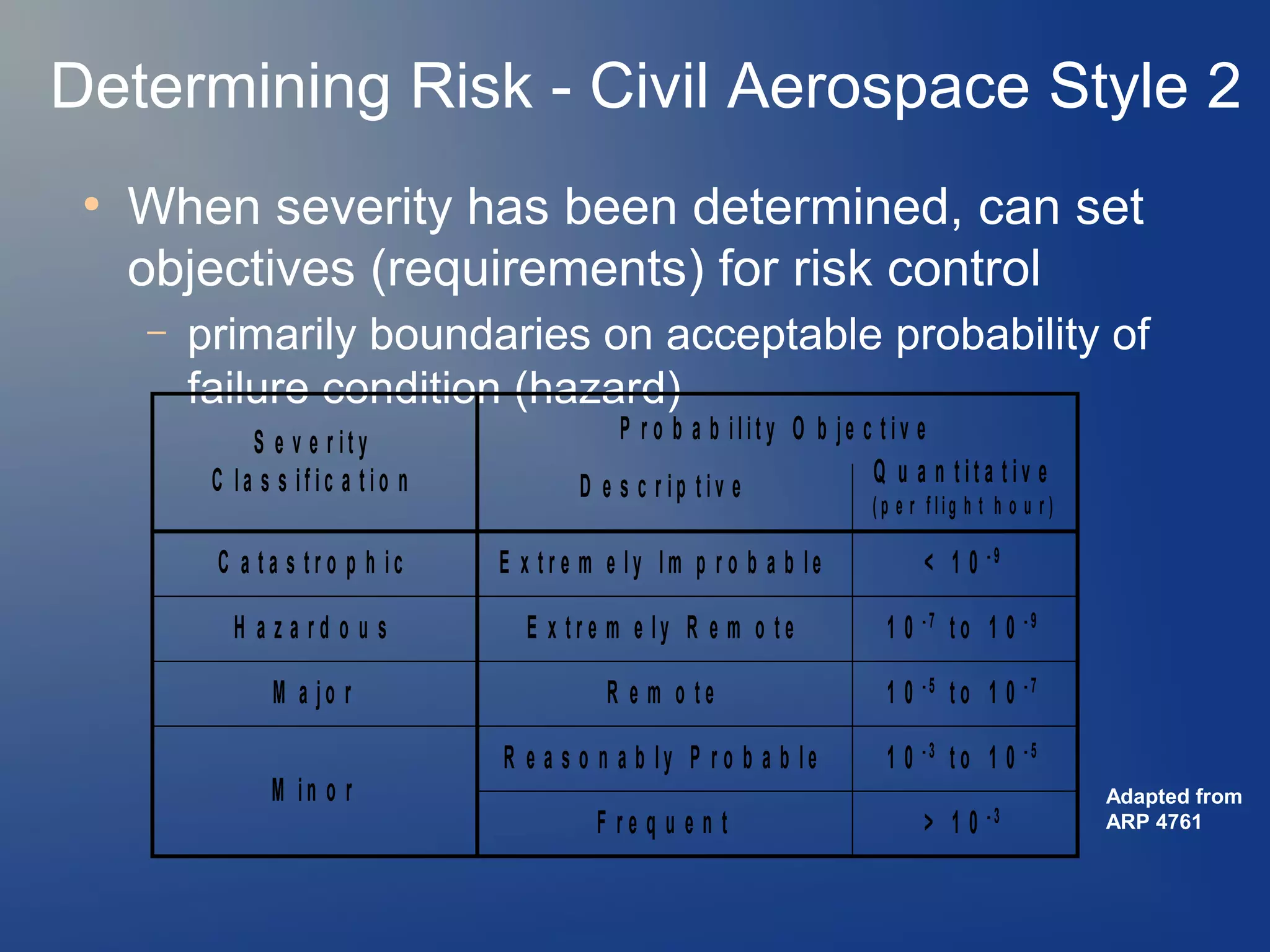
Determining Risk - Civil Aerospace Style 2
●

When severity has been determined, can set
objectives (requirements) for risk control
–

primarily boundaries on acceptable probability of
failure condition (hazard)
S e v e r ity
C la s s ific a tio n

P r o b a b ility O b je c tiv e
Q u a n tita tiv e
D e s c r ip tiv e

(p e r flig h t h o u r )

C a ta s tro p h ic

E x tr e m e ly Im p r o b a b le

< 1 0 -9

H a z a rd o u s

E x tr e m e ly R e m o te

1 0 -7 t o 1 0 -9

M a jo r

R e m o te

1 0 -5 t o 1 0 -7

R e a s o n a b ly P r o b a b le

1 0 -3 t o 1 0 -5

M in o r

F re q u e n t

> 10

-3

Adapted from
ARP 4761
Determining Risk - Civil Aerospace Style 3
For civil aerospace, severity-related objectives are
set in
standards
●
easy to work with
●
unambiguous
–

provided you can agree on standardised and
objective measures of severity!

BUT
●
Need to understand that direct mapping from
severity to probability objectives is based on
important assumption:
Determining Risk - Civil Aerospace Style 4
Where does acceptable risk come from?
●

in principle, requirements reflect “what risk the
public is willing to accept”
–
–

●

risk (A) = probability (A) * severity (A)
level of acceptable risk hard to determine, and
subjective

in practice, certification bodies (airworthiness
authorities) act as surrogates for the public
–
–

“bottom line” is hull loss rate
civil aviation hull loss rate target is currently 10 -7
per flying hour
●

for comparison, military aviation (UK) hull loss rate
Determining Risk - Civil Aerospace Style 5
●

Has further implications:
–
–

●

implicit assumption about number of catastrophic
failure conditions on an aircraft
also implicit assumption about how probable
failure condition is to actually develop into an
accident

Example:
–
–
–

probability objective (target) for catastrophic failure
condition is < 10-9 per flight hour
target hull loss rate is < 10-7 per flight hour
implies either a maximum of 100 catastrophic
failure conditions on an aircraft, assuming all
occurrences of catastrophic failure conditions will
Determining Risk - Civil Aerospace Style 6
●
●

Note that objective of probability per flying hour has its problems…
Consider:

–
–

histogram shows accidents / time
1.8% of accidents occur in load / taxi / unload
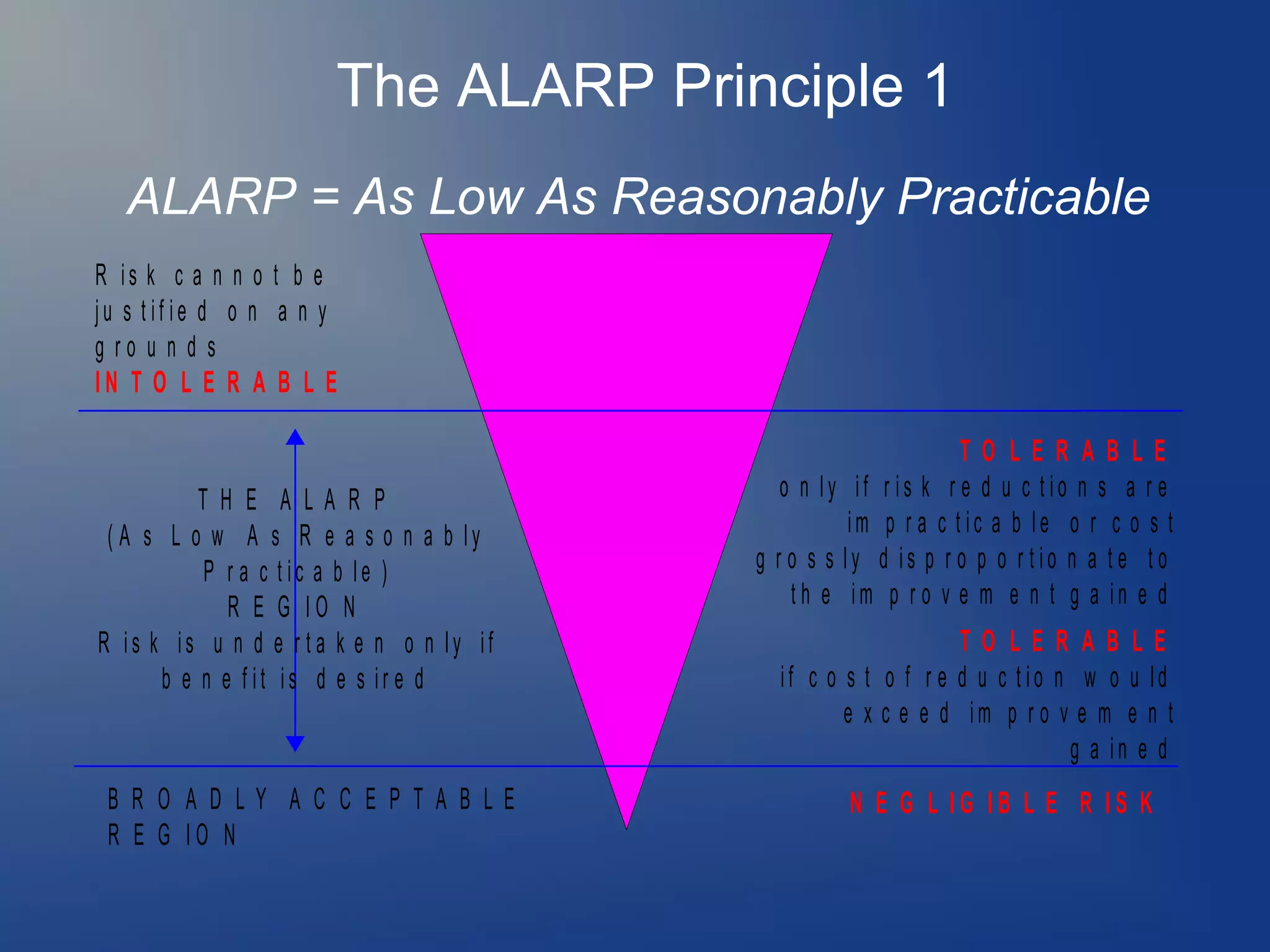
The ALARP Principle 1
ALARP = As Low As Reasonably Practicable
R is k c a n n o t b e
ju s tif ie d o n a n y
g ro u n d s
IN T O L E R A B L E

T H E A LA R P
( A s L o w A s R e a s o n a b ly
P r a c t ic a b le )
R E G IO N
R is k is u n d e r t a k e n o n ly if
b e n e f it is d e s ir e d

B R O A D LY A C C E P T A B LE
R E G IO N

TO LE R A B LE
o n ly if r is k r e d u c tio n s a r e
im p r a c t ic a b le o r c o s t
g r o s s ly d is p r o p o r tio n a te to
th e im p r o v e m e n t g a in e d
TO LE R A B LE
if c o s t o f r e d u c t io n w o u ld
e x c e e d im p r o v e m e n t
g a in e d
N E G L IG IB L E R IS K
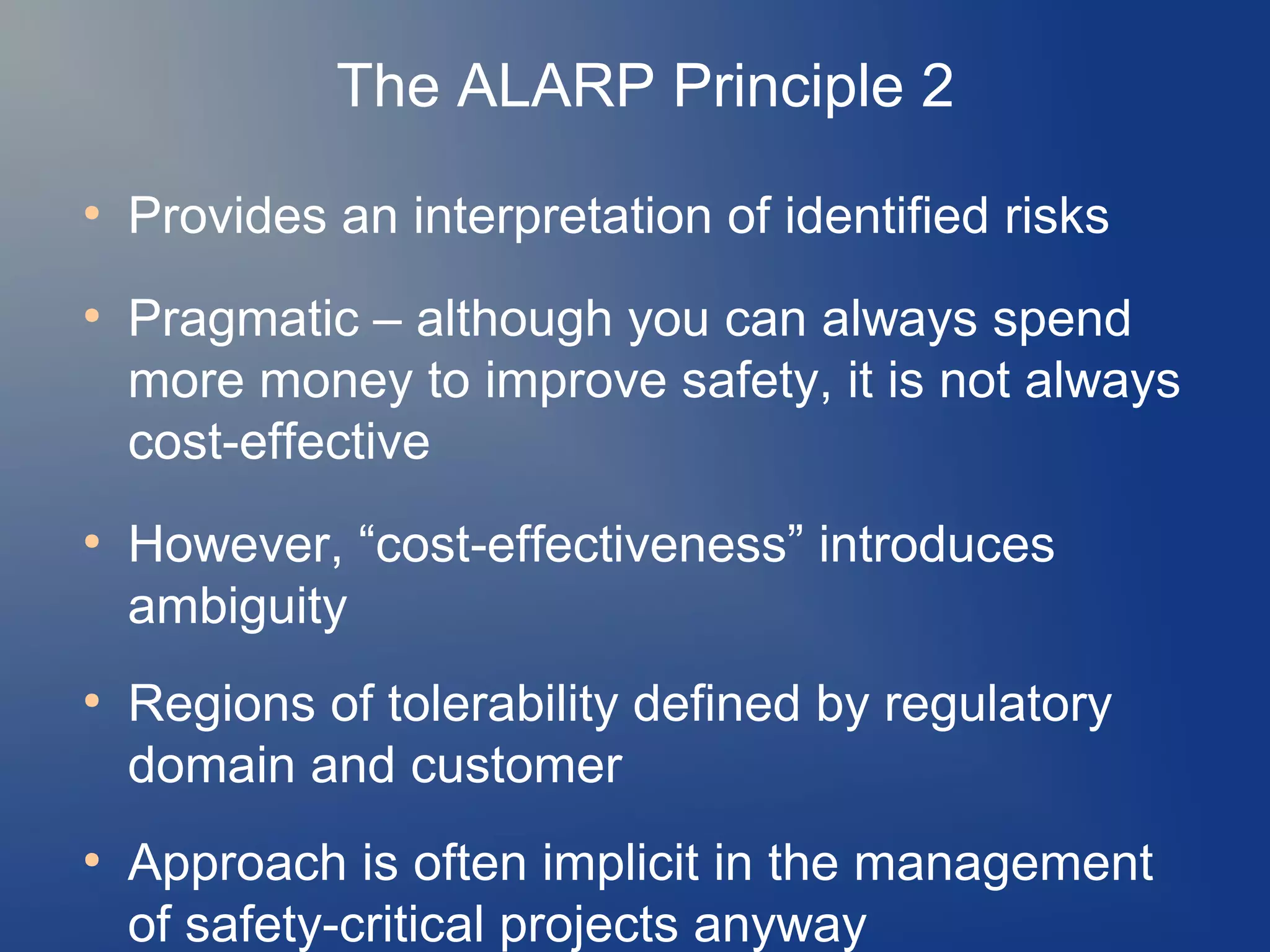
The ALARP Principle 2
●

●

●

●

●

Provides an interpretation of identified risks
Pragmatic – although you can always spend
more money to improve safety, it is not always
cost-effective
However, “cost-effectiveness” introduces
ambiguity
Regions of tolerability defined by regulatory
domain and customer
Approach is often implicit in the management
of safety-critical projects anyway
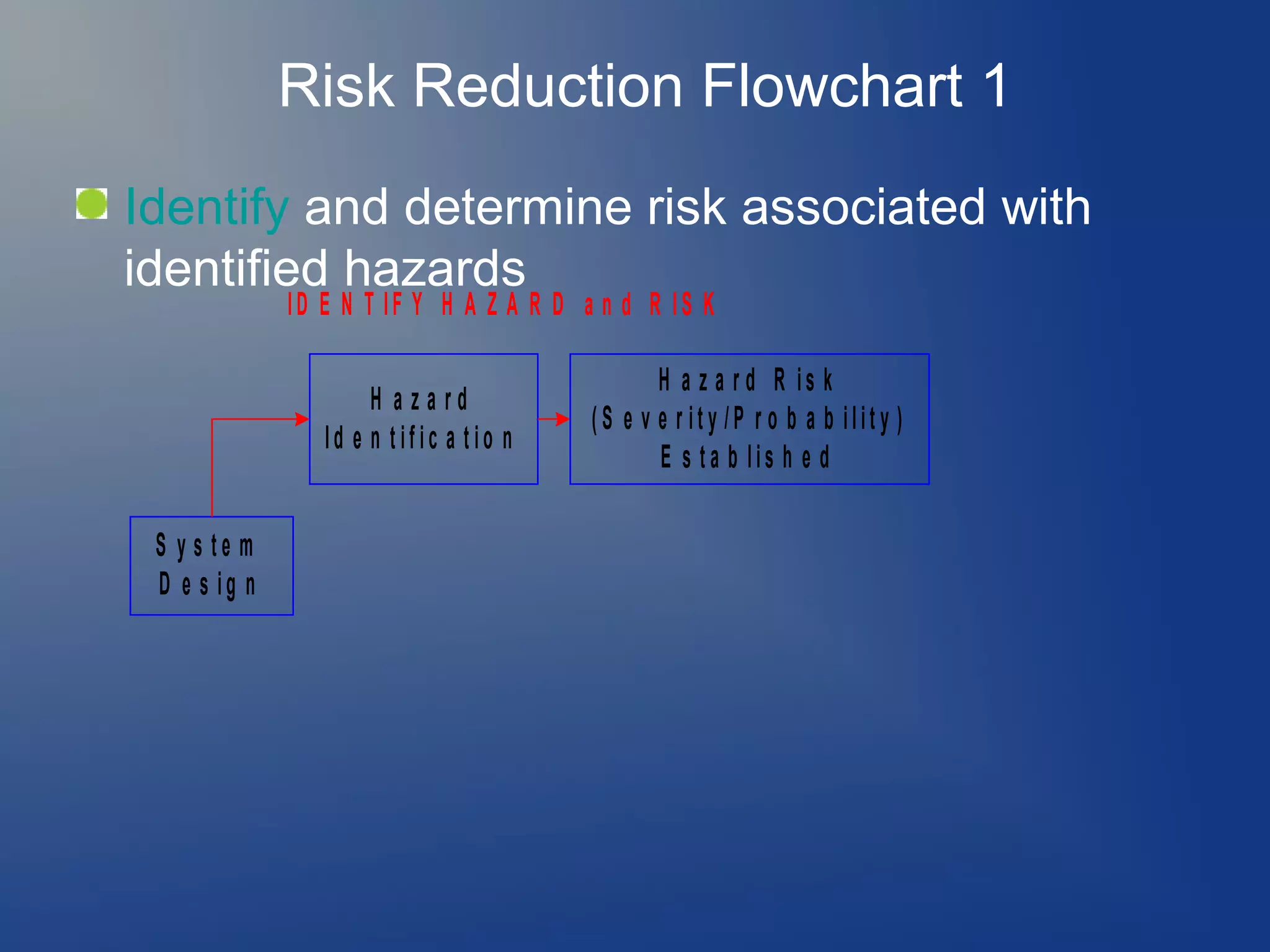
Risk Reduction Flowchart 1
Identify and determine risk associated with
identified hazards
ID E N T IF Y H A Z A R D a n d R IS K
H a za rd
Id e n tific a tio n
S y s te m
D e s ig n

H a z a r d R is k
(S e v e r ity /P r o b a b ility )
E s ta b lis h e d
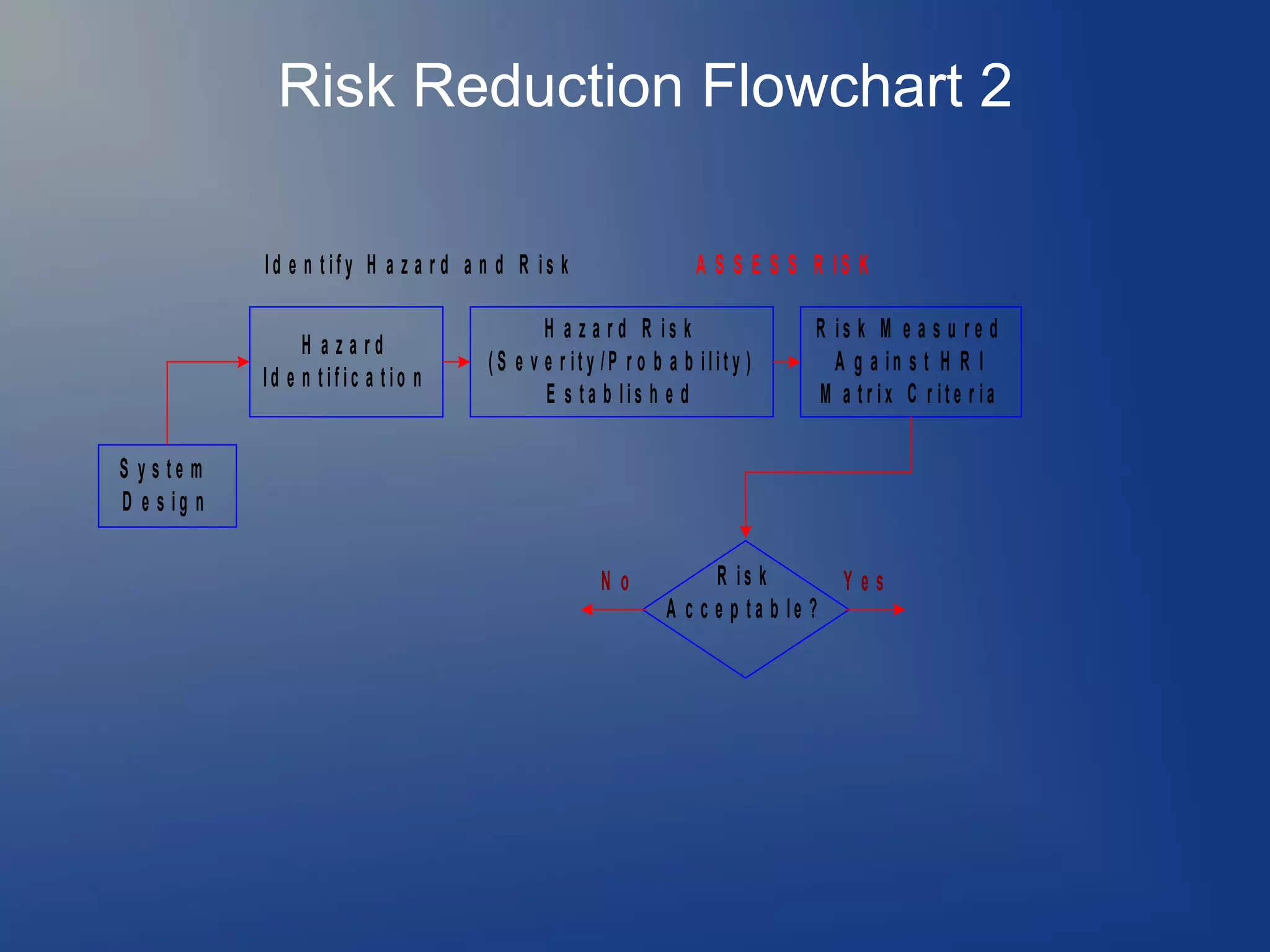
Risk Reduction Flowchart 2
Id e n tify H a z a r d a n d R is k
H a za rd
Id e n tific a tio n

A S S E S S R IS K

H a z a r d R is k
(S e v e r ity /P r o b a b ility )
E s ta b lis h e d

R is k M e a s u r e d
A g a in s t H R I
M a tr ix C r ite r ia

S y s te m
D e s ig n
No

R is k
Yes
A c c e p ta b le ?
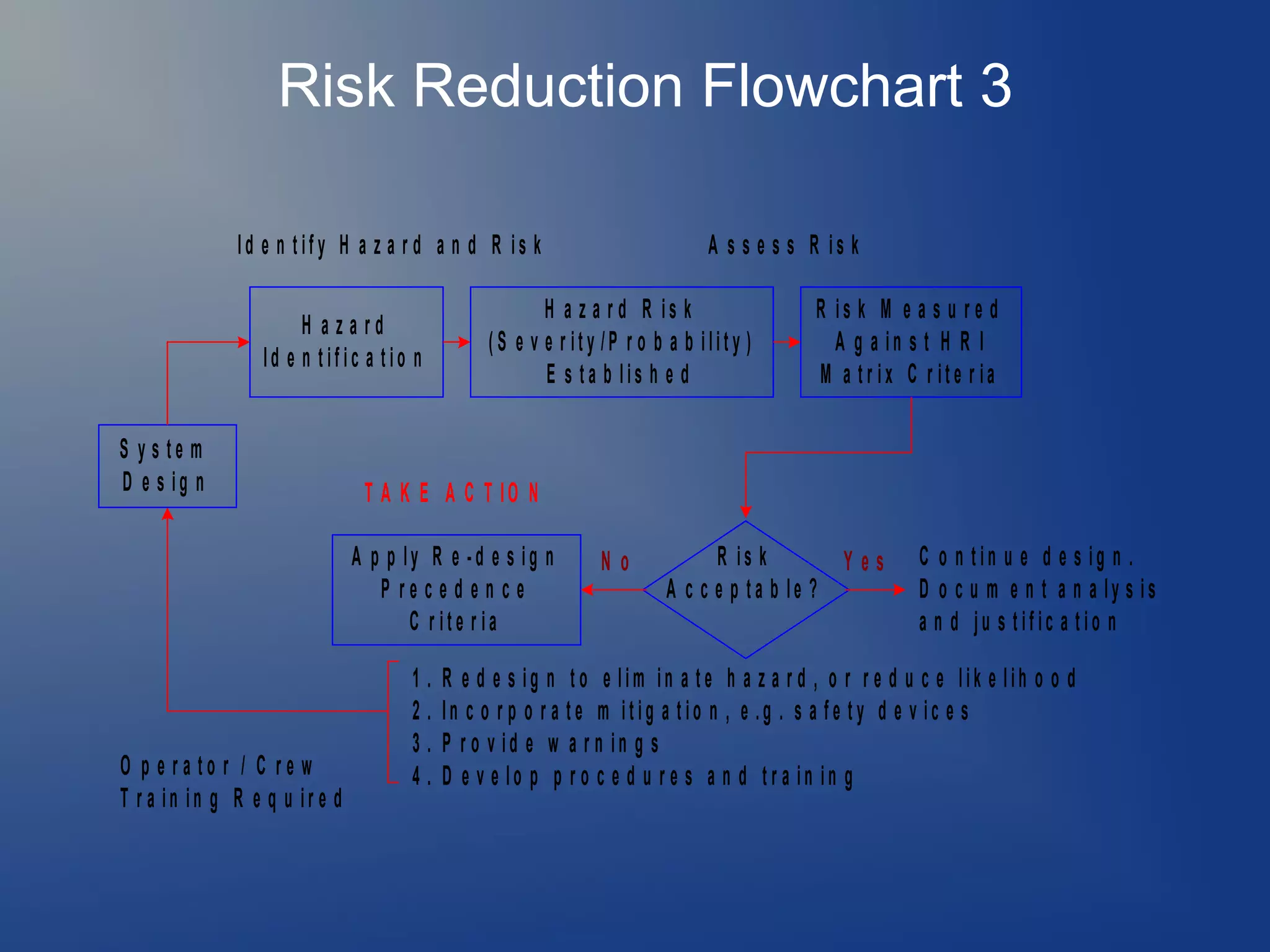
Risk Reduction Flowchart 3
Id e n tify H a z a r d a n d R is k
H a za rd
Id e n tific a tio n
S y s te m
D e s ig n

H a z a r d R is k
(S e v e r ity /P r o b a b ility )
E s ta b lis h e d

R is k M e a s u r e d
A g a in s t H R I
M a tr ix C r ite r ia

T A K E A C T IO N
A p p ly R e -d e s ig n
P re c e d e n c e
C r ite r ia

O p e ra to r / C re w
T r a in in g R e q u ir e d

A s s e s s R is k

1.
2.
3.
4.

No

R is k
Yes
A c c e p ta b le ?

C o n tin u e d e s ig n .
D o c u m e n t a n a ly s is
a n d ju s tific a tio n

R e d e s ig n to e lim in a te h a z a r d , o r r e d u c e lik e lih o o d
In c o r p o r a te m itig a tio n , e .g . s a fe ty d e v ic e s
P r o v id e w a r n in g s
D e v e lo p p r o c e d u r e s a n d tr a in in g
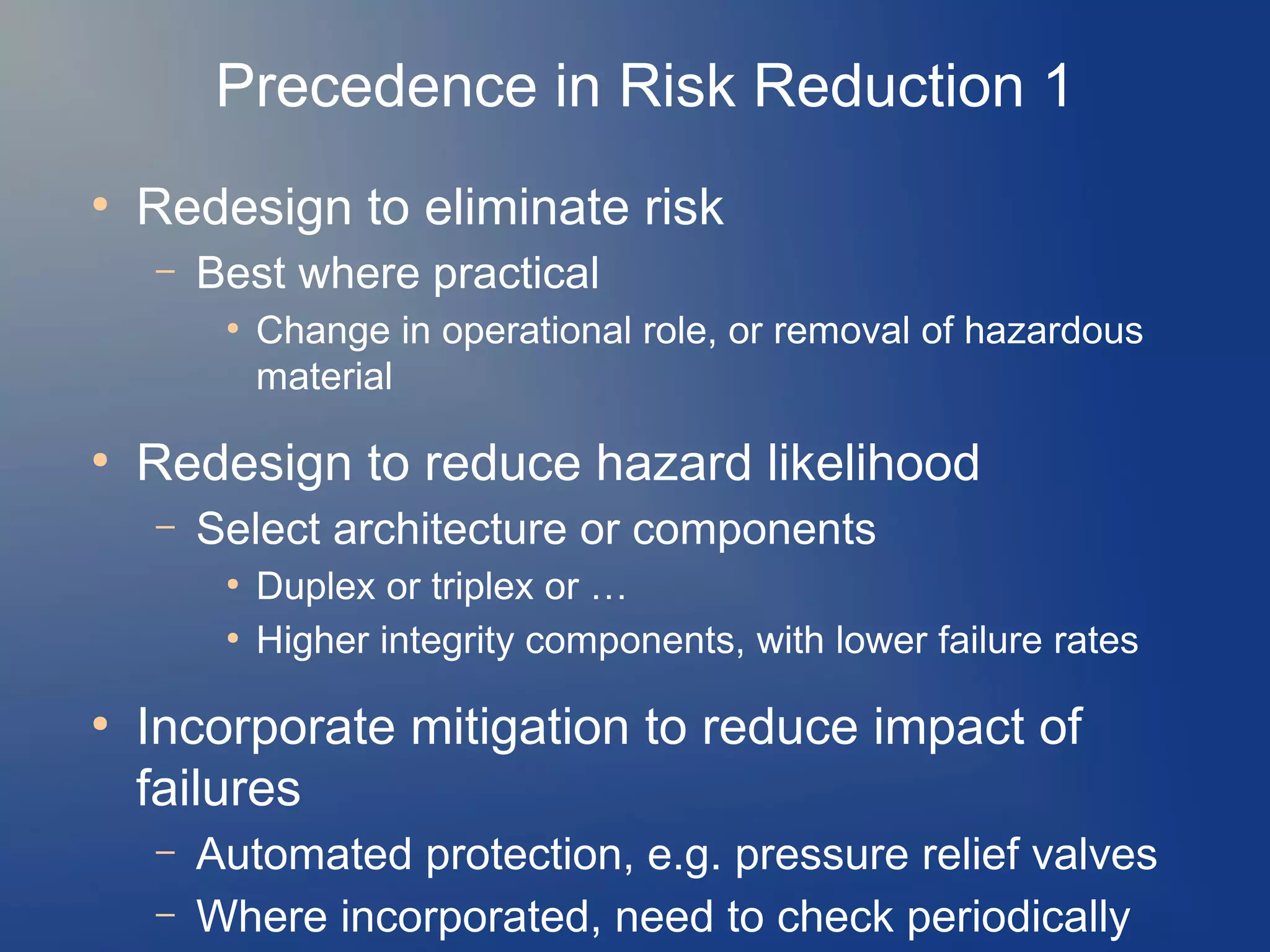
Precedence in Risk Reduction 1
●

Redesign to eliminate risk
–

Best where practical
●

●

Redesign to reduce hazard likelihood
–

Select architecture or components
●
●

●

Change in operational role, or removal of hazardous
material

Duplex or triplex or …
Higher integrity components, with lower failure rates

Incorporate mitigation to reduce impact of
failures
–
–

Automated protection, e.g. pressure relief valves
Where incorporated, need to check periodically
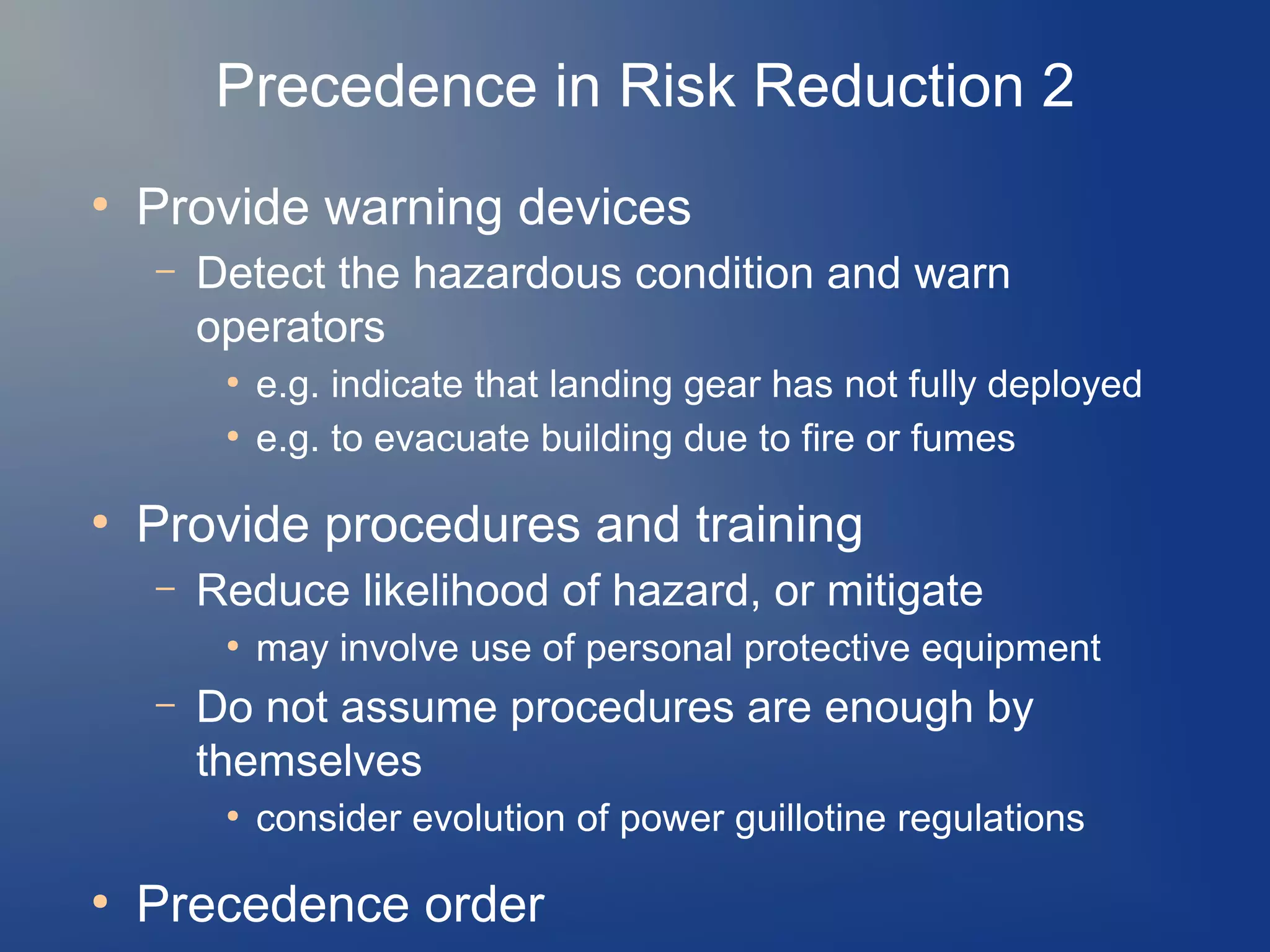
Precedence in Risk Reduction 2
●

Provide warning devices
–

Detect the hazardous condition and warn
operators
●
●

●

Provide procedures and training
–

Reduce likelihood of hazard, or mitigate
●

–

may involve use of personal protective equipment

Do not assume procedures are enough by
themselves
●

●

e.g. indicate that landing gear has not fully deployed
e.g. to evacuate building due to fire or fumes

consider evolution of power guillotine regulations

Precedence order
Residual Risk - 1
●

Residual Risks are those that cannot be
‘designed out’
–

●

●

risks inherent to design, where benefit is desirable

Significant residual risks must be formally
accepted by the appropriate authority (typically
customer / operator)
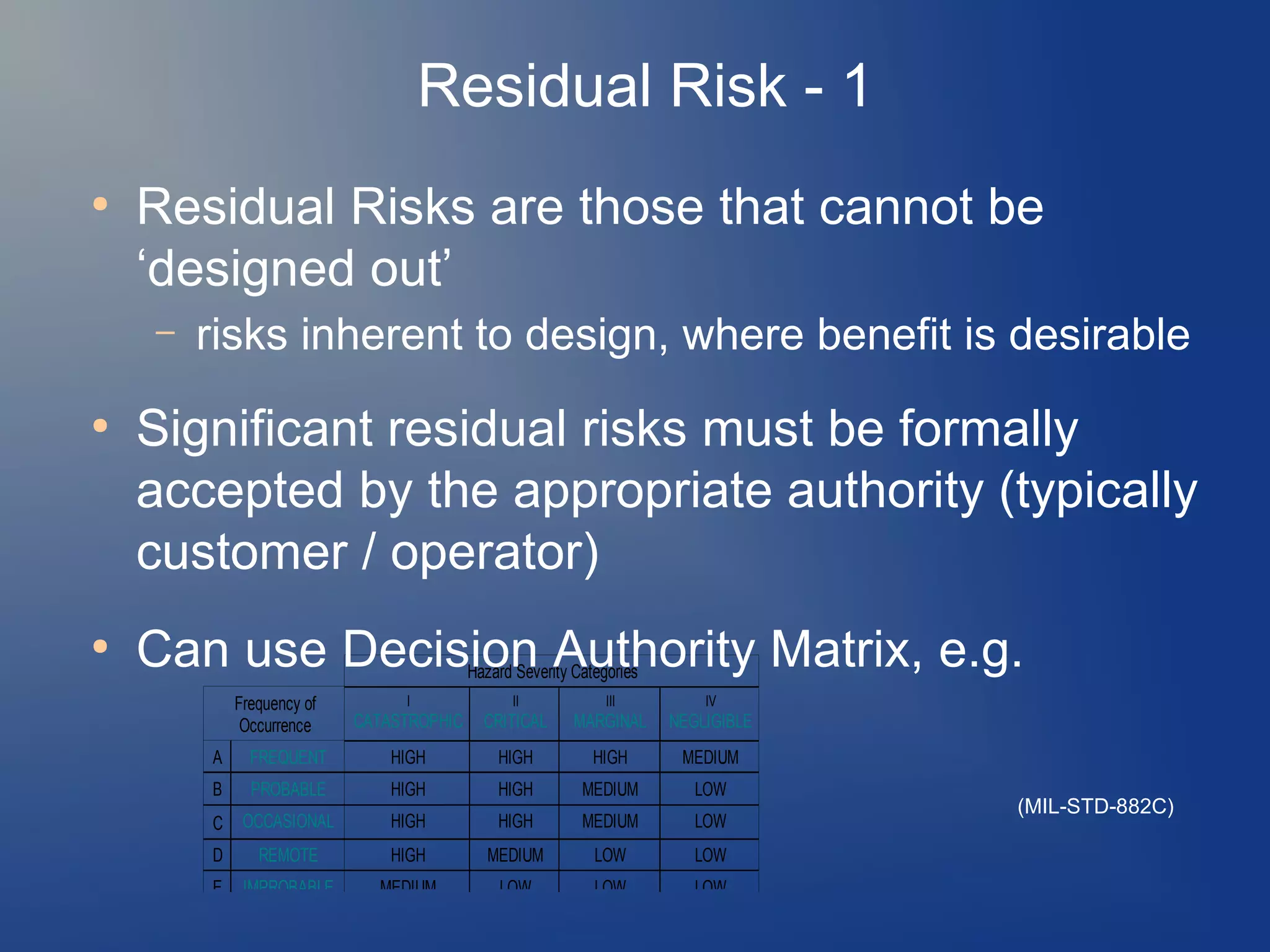
Can use Decision Authority Matrix, e.g.
Hazard Severity Categories

Frequency of
Occurrence

I

II

III

IV

CATASTROPHIC

CRITICAL

MARGINAL

NEGLIGIBLE

A

FREQUENT

HIGH

HIGH

HIGH

MEDIUM

B

PROBABLE

HIGH

HIGH

MEDIUM

LOW

C

OCCASIONAL

HIGH

HIGH

MEDIUM

LOW

D

REMOTE

HIGH

MEDIUM

LOW

LOW

E

IMPROBABLE

MEDIUM

LOW

LOW

LOW

(MIL-STD-882C)
Residual Risk 2
Appropriate Decision Authority (From MIL-STD882C)
HIGH – Service Acquisition Executive
–

e.g. no ground collision avoidance on F22 –
signed off by
4-star Air Force General

MEDIUM – Program Executive Officer
LOW – Program Manager
●

●

Usually a requirement to document all actions
taken to resolve risk within terms of contract
Customer authority can then decide whether
Risk Management Summary
●

●

Risk Assessment is the process of identifying
the risk associated with system hazards
Approach in many sectors (military, rail…) is to
use Hazard Risk Matrix to determine the risk
associated with a hazard from severity and
probability estimates
–

●

then decide on acceptability of risk

Alternative approach (Civil Aerospace) is
based around severity
–
–

assumption of fixed level of acceptable risk...
… so can derive objectives, including probability,
from severity

Accident investigation course

  • 1.
  • 2.
    Objectives of thisSection ● ● ● To define the reasons for investigating accident and incidents. To outline the process for effectively investigating accidents and incidents. To facilitate an effective investigation. 2/210
  • 3.
    Accident Investigation ● ● Important partof any safety management system. Highlights the reasons why accidents occur and how to prevent them. The primary purpose of accident investigations is to improve health and safety performance by:  Exploring the reasons for the event and identifying both the immediate and underlying causes;  Identifying remedies to improve the health and safety management system by improving risk control, preventing a recurrence and reducing financial losses. 3/210
  • 4.
    What to Investigate? ● ● ● Allaccidents whether major or minor are caused. Serious accidents have the same root causes as minor accidents as do incidents with a potential for serious loss. It is these root causes that bring about the accident, the severity is often a matter of chance. Accident studies have shown that there is a consistently greater number of less serious accidents than serious accidents and in the same way a greater number of incidents then accidents. 4/210
  • 5.
    Many accident ratiostudies have been undertaken and the one shown below is based on studies carried out by the Health & Safety Executive. 1 Major injury Or illness 7 Minor injuries or illnesses 189 Non Injury Accidents/Illnesses 5/210
  • 6.
    Accident Studies ● ● ● In allcases the ‘non injury’ incidents had the potential to become events with more serious consequences. Such ratios clearly demonstrate that safety effort should be aimed at all accidents including unsafe practices at the bottom of the pyramid, with a resulting improvement in upper tiers. Peterson (1978) in defining the principles of safety management says that “an unsafe act, an unsafe condition, an accident are symptoms of something wrong within the management’s system.” 6/210
  • 7.
    Accident Studies ● ● All eventsrepresent a degree of failure in control and are potential learning experiences. It therefore follows that all accidents should be investigated to some extent. This extent should be determined by the loss potential, rather then just the immediate effect. 7/210
  • 8.
    Stages in anAccident/Incident Investigation The stages in an accident/incident investigation are shown in the following diagram. Deal with immediate risks. Select the level of investigation. Investigate the event. Record and analyse the results. Review the process. 8/210
  • 9.
    Dealing with Immediate Risks Dealwith immediate risks. ● Select the level of investigation. Make the situation safe and prevent further injury. Help, treat and if necessary rescue injured persons. Investigate the event. Record and analyse the results. Review the process. When accidents and incidents occur immediate action may be necessary to: ● An effective response can only be made if it has been planned for in advance. 9/210
  • 10.
  • 11.
    Selecting the levelof investigation The greatest effort should be put into: Deal with immediate risks. Select the level of investigation. Investigate the event. Record and analyse the results. Review the process.  Those involving severe injuries, illhealth or loss.  Those which could have caused much greater harm or damage. These types of accidents and incidents demand more careful investigation and management time. This can usually be achieved by:  Looking more closely at the underlying causes of significant events.  Assigning the responsibility for the investigation of more significant events to more senior managers. 11/210
  • 12.
    Investigating the Event Dealwith immediate risks. Select the level of investigation. The purpose of investigations is to establish: ● ● Investigate the event. ● Record and analyse the results. Review the process. ● The way things were and how they came to be. What happened – the sequence of events that led to the outcome. Why things happened as they did analysing both the immediate and underlying causes. What needs to be done to avoid a repetition and how this can be achieved. 12/210
  • 13.
    A few sourcesshould give the investigator all that is needed to know. Observation Information from physical sources including: • Premises and place of work • Access & egress • Plant & substances in use • Location & relationship of physical particles • Any post event checks, sampling or reconstruction Documents Information from: • Written instructions; Procedures, risk assessments, policies • Records of earlier inspections, tests, examinations and surveys. • • • Checking reliability, accuracy Identifying conflicts and resolving differences Identifying gaps in evidence Interviews Information from: • Those involved and their line management; • Witnesses; • Those observed or involved prior to the event e.g. inspection & maintenance staff. 13/210
  • 14.
    Interviews ● ● ● Interviewing the person(s)involved and witnesses to the accident is of prime importance, ideally in familiar surroundings so as not to make the person uncomfortable. The interview style is important with emphasis on prevention rather than blame. The person(s) should give an account of what happened in their terms rather than the investigators. 14/210
  • 15.
    Interviews ● ● Interviews should beseparate to stop people from influencing each other. Questions when asked should not be intimidating as the investigator will be seen as aggressive and reflecting a blame culture. 15/210
  • 16.
    Observation The accident siteshould be inspected as soon as possible after the accident. Particular attention should/must be given to: • Positions of people. • Personnel protective equipment (PPE). • Tools and equipment, plant or substances in use. • Orderliness/Tidiness. 16/210
  • 17.
    Documents Documentation to belooked at includes: ● Written instructions, procedures and risk assessments which should have been in operation and followed. The validity of these documents may need to be checked by interview. The main points to look for are:  Are they adequate/satisfactory?  Were they followed on this occasion?  Were people trained/competent to follow it? ● Records of inspections, tests, examination and surveys undertaken before the event. These provide information on how and why the circumstances leading to the event arose. 17/210
  • 18.
    Determining Causes ● ● ● Collect allinformation and facts which surround the accident. Immediate causes are obvious and easy to find. They are brought about by unsafe acts and conditions and are the ACTIVE FAILURES. Unsafe acts show poor safety attitudes and indicate a lack of proper training. These unsafe acts and conditions are brought about by the so called ‘root causes’. These are the LATENT FAILURES and are brought about by failures in organisation and the management’s safety system. 18/210
  • 19.
    Determine what changesare needed The investigation should determine what control measures were absent, inadequate or not implemented and so generate remedial action for implementation to correct this. 19/210
  • 20.
    Generally, remedial actionsshould follow the hierarchy of risk control: ● ● ● ● Eliminate Risks by substituting the dangerous by the inherently less dangerous. Combat risks at source by engineering controls and giving collective protective measures priority. Minimise risk by designing suitable systems of working. Use PPE as a last resort. 20/210
  • 21.
  • 22.
    Recording & Analysingthe Results ● Deal with immediate risks. ● ● Select the level of investigation. ● Investigate the event. ● Record and analyse the results. ● Review the process. ● Recorded in a similar and systematic manner. Provides a historical record of the accident. Analysis of the causes and recommended preventative protective measures should be listed. Completed as soon after the accident as possible. Information on the accident and remedial actions should be passed to all supervisors. Appropriate preventative measures may also have to be implemented by such supervisors. Investigation reports and accident statistics should be analysed from time to time to identify common causes, features and trends not be apparent from looking at events in isolation. 22/210
  • 23.
    Reviewing the Process Dealwith immediate risks. Select the level of investigation. Investigate the event. Record and analyse the results. Review the process. Reviewing the accident/incident investigation process should consider: – The results of investigations and analysis. – The operation of the investigation system (in terms of quality and effectiveness). Line managers should follow through and action the findings of investigations and analysis. Follow up systems should be established where necessary to keep progress under control. 23/210
  • 24.
    The investigation systemshould be examined from time to time to check that it consistently delivers information in accordance with the stated objectives and standards. This usually requires: ● ● ● Checking samples of investigation forms to verify the standard of investigation and the judgements made about causation and prioritisation of remedial actions. Checking the numbers of incidents, near misses, injury and ill-health events; Checking that all events are being reported. 24/210
  • 25.
    What is yourdefinition of an “Accident”? 25/210
  • 26.
    What is anAccident - an unplanned event - an unplanned incident involving injury or fatality - a series of events culminating in an unplanned and unforeseen event 26/210
  • 27.
    How do Accidentsoccur? - Accidents (with or without injuries) occur when a series of unrelated events coincide at a certain time and space. -This can be from a few events to a series of a dozen or more (Because the coincidence of the series of events is a matter of luck, actual accidents only happen infrequently) 27/210
  • 28.
    Unsafe Acts - Anunsafe act occurs in approx 85%- 95% of all analyzed accidents with injuries - An unsafe act is usually the last of a series of events before the accident occurs (it could occur at any step of the event) - By stopping or eliminating the unsafe act, we can stop the accident from occurring 28/210
  • 29.
    What is anAccident Investigation? ● A systematic approach to the identification of causal factors and implementation of corrective actions without placing blame on or finding personal fault. The information collected during an investigation is essential to determine trends and taking appropriate steps to prevent future accidents. 29/210
  • 30.
    Which Accidents shouldbe Recorded or Reported? ALL accidents (including illnesses) shall be recorded and reported through the established procedures and guidance 30/210
  • 31.
    Why Investigate Accidents? ● ● ● ● Determinethe cause Develop and implement corrective actions Document the events Meet legal requirements Primary Focus: PREVENT REOCCURENCE!!! PREVENT REOCCURENCE!!! PREVENT REOCCURENCE!!! 31/210
  • 32.
    Accident vs. Near-Miss Accident: Any undesired, unplanned event arising out of a given work-related task which results in physical injury/ illness or damage to property. Near-Miss : Events which did not result in injury/illness or damage but had the potential to do so. 32/210
  • 33.
    Accident Ratio Study 1 10 30 600 6000 Seriousor Disabling Minor Injuries Property Damage Accidents with no visible injury or damage Unsafe Acts or Conditions 33/210
  • 34.
    Accident Causes Unsafe Act -an act by the injured person or another person (or both) which caused the accident, and/or ● Unsafe Condition - some environmental or hazardous situation which caused the accident independent of the employee ● 34/210
  • 35.
    Accident Causation Model  Resultsof the accident - physical harm - property damage  Incident Occurrence - contact with - type  Immediate causes - practices - conditions  Basic causes - personal factors - job factors - supervisory performance - management policy and decisions 35/210
  • 36.
    Results of theAccident ● ● Physical Harm - catastrophic (multiple deaths) - single death - disabling - serious - minor Property Damage - catastrophic - major - serious - minor 36/210
  • 37.
    Incident Occurrence ● ● Type - struckby - struck against - slip, trip - fell from - caught on - fell on same level - caught in - overexertion Contact with - electricity - noise - hazmat - radiation - equipment - vibration - heat/cold - animals/insects 37/210
  • 38.
    Immediate Causes ● Practices - operatingwithout authority - use equipment improperly - not using PPE when required - correct lifting procedures not established - drinking or drug use - horseplay - equipment not properly secured 38/210
  • 39.
    Immediate Causes (cont’d) ● Conditions -ineffective guards - unserviceable tools and equipment - inadequate warning systems - bad housekeeping practices - poor work space illumination - unhealthy work environment 39/210
  • 40.
    Basic Causes ● ● Personal Factors -lack of knowledge or skill - improper motivation - physical or mental condition - literacy or ability Job Factors - Physical environment - sub-standard equipment - abnormal usage - wear and tear - inadequate standards - design and maintenance 40/210
  • 41.
    Basic Causes (cont’d) ● ● SupervisoryPerformance - inadequate instructions - failure of SOPs - rules not enforced - hazards not corrected - devices not provided Management Policy and Decisions - set measurable standards - measure work in progress - evaluate work vs. standards - correct performance No animals were hurt as a result of this accident 41/210
  • 42.
    Severity of Incident ● ● Major -Employee fatality, - Hospitalization of 3 or more employees, - Permanent employee disability, - Five or more lost workdays, - Conditions that could pose an imminent and threat of serious injury/illness to other employees - Property losses in excess of $1 Million Minor - All other (less serious) incidents and unsafe conditions reported by employees 42/210
  • 43.
    Who Investigates? ● ● Major Accidents -NOAA “GO TEAM” Investigation Team - LO Representative - Other agencies such as NTSB, USCG, OSHA Minor Accidents - First-Line Supervisor - Site Director or Manager - Site Safety Representative - NOAA SECO (if needed) 43/210
  • 44.
    Investigator’s Qualifications ● ● ● ● ● ● ● Technical knowledge Objectivity Analyticalapproach Familiarity with the job, process or operation Tact in communicating Intellectual honesty Inquisitiveness and curiosity 44/210
  • 45.
    When to Investigate? ● Immediatelyafter incident   ● Witness memories fade Equipment and clues are moved Finish investigation quickly 45/210
  • 46.
    What to Investigate? ● Allaccidents and near-misses - Conduct investigation upon first notification - Keeping the scene in-tact and recording witnesses statements early is key to a successful investigation 46/210
  • 47.
    Accident Investigation Kit MayInclude: ● Digital Camera ● Report forms, clipboard, pens ● Barricade tape ● Flashlight ● Tape measure ● Tape recorder ● Personal Protective Equipment (as appropriate) 47/210
  • 48.
    The Accident Occurs ● ● ● ● ● Employeeor co-worker immediately reports the accident to a supervisor Supervisor secures/assesses the scene to prevent additional injuries to other employees, before assisting the injured employee Supervisor treats the injury or seeks medical treatment for the injured The accident scene is left intact Site safety rep is contacted to assist the supervisor in the investigation of the accident. 48/210
  • 49.
    Beginning the Investigation ● ● ● ● ● Gatherinvestigation members and kit Report to the scene Look at the big picture Record initial observations Take pictures 49/210
  • 50.
    What’s Involved? Who wasinjured? ● Medication, drugs, or alcohol? ● Was employee ill or fatigued? ● Environmental conditions? ● 50/210
  • 51.
    Witnesses Who witnessed the accident? ● Wasa supervisor or Team Lead nearby? ● Where were other employees? ● Why didn’t anyone witness the accident (working alone, remote areas)? ● 51/210
  • 52.
    Interviewing Tips ● ● ● ● ● Discuss whathappened leading up to and after the accident Encourage witnesses to describe the accident in their own words Don’t be defensive or judgmental Use open-ended questions Do not interrupt the witness 52/210
  • 53.
    What was Involved? ● ● ● ● Machine,tool, or equipment Chemicals Environmental conditions Field season prep operations 53/210
  • 54.
    Time of Accident Dateand time? ● Normal shift or working hours? ● Employee coming off a vacation? ● 54/210
  • 55.
    Accident Location ● ● ● ● ● Work area On,under, in, near Off-site address Doing normal job duties Performing nonroutine or routine tasks (i.e., properly trained) 55/210
  • 56.
    Employee’s Activity ● ● ● Motion conducted attime of accident Repetitive motion? Type of material being handled 56/210
  • 57.
    Accident Narrative Describe thedetails so the reader can clearly picture the accident ● Specific body parts affected ● Specific motions of injured employee just before, during, and after accident ● 57/210
  • 58.
    Causal Factors ● ● ● ● Try notto accept single cause theory Identify underlying causes (root) Primary cause Secondary causes   Contributing causes Effects 58/210
  • 59.
    Corrective Actions Taken ● ● Includeimmediate interim controls implemented at the time of accident Recommended corrective actions      Employee training Preventive maintenance activities Better operating procedures Hazard recognition (ORM) Management awareness of risks involved 59/210
  • 60.
    Immediate Notification ● Supervisor shallcomplete the NOAA Web Based Accident/ Illness Report Form and submit within 24 hours of incident occurrence (8 hours for major incidents). 60/210
  • 61.
    Accident Analysis Summary ● ● ● ● ● ● Investigateaccident immediately Determine who was involved and who witnessed it Ascertain what items or equipment were involved Record detailed description Determine causal factors Implement corrective actions 61/210
  • 62.
  • 63.
  • 64.
    1. What is anAccident Investigation? a. b. c. d. A systematic approach to the identification of causal factors and implementation of corrective actions. Finding personal fault and placing blame. The appropriate steps to prevent future actions. The essential step to determine trends and taking action against person or persons at fault. 64/210
  • 65.
    2. Which Accidents shouldbe Recorded or Reported? a. b. c. d. Only on the job accidents. ALL accidents (including illnesses) shall be recorded and reported. Only on the job accidents on illnesses that occur on the job and reported within 8 hours. All accidents shall be recorded and reported. 65/210
  • 66.
    3. Why Investigate Accidents? a. b. c. d. Todevelop and implement corrective actions. To document the events. The Primary Focus is to PREVENT REOCCURENCE!!! To determine the cause. 66/210
  • 67.
    4. Accident vs. Near-Miss? a. b. c. Anyunplanned event arising out of work that resulted in injury vs. Any event which did not result in injury but had potential to do so. Any unsafe work habit vs. Any Hazardous working conditions. Any event which warns us of a problem vs. Any circumstances that result in injury or property damage. 67/210
  • 68.
    5. Which of thefollowing are the basic areas that are looked at in an Accident Investigation. a. b. c. d. Policies. Equipment. Training. All of the above. 68/210
  • 69.
    Accident Investigation Accident analysisis carried out in order to determine the cause or causes of an accident or series of accidents so as to prevent further incidents of a similar kind. It is also known as accident investigation. 69/210
  • 70.
    Accident Investigation It maybe performed by a range of experts, including forensic scientists, forensic engineers or health and safety advisers. Accident investigators, particularly those in the aircraft industry, are colloquially known as "tin-kickers". 70/210
  • 71.
    Sequence Accident analysis isperformed in four steps: Fact gathering: After an accident happened a forensic process starts to gather all possibly relevant facts that may contribute to understanding the accident. 71/210
  • 72.
    Sequence Fact Analysis: After theforensic process has been completed or at least delivered some results, the facts are put together to give a "big picture." The history of the accident is reconstructed and checked for consistency and plausibility. 72/210
  • 73.
    Sequence Conclusion Drawing: If theaccident history is sufficiently informative, conclusions can be drawn about causation and contributing factors. 73/210
  • 74.
    Sequence Counter-measures: In some casesthe development of countermeasures is desired or recommendations have to be issued to prevent further accidents of the same kind. 74/210
  • 75.
    Methods There exist numerousforms of Accident Analysis methods. These can be divided into three categories: 75/210
  • 76.
    Methods Causal Analysis Causal Analysisuses the principle of causality to determine the course of events. Though people casually speak of a "chain of events", results from Causal Analysis usually have the form of directed a-cyclic graphs-the nodes being events and the edges the causeeffect relations. Methods of Causal Analysis differ in their respective notion of causation. 76/210
  • 77.
    Methods Expert Analysis Expert Analysisrelies on the knowledge and experience of field experts. This form of analysis usually lacks a rigorous (formal/semiformal) methodological approach. This usually affects falsify-ability and objectivity of analyses. This is of importance when conclusions are heavily disputed among experts. 77/210
  • 78.
    Methods Organizational Analysis Organizational Analysisrelies on systemic theories of organization. Most theories imply that if a system's behaviour stayed within the bounds of the ideal organization then no accidents can occur. 78/210
  • 79.
    Methods Organizational Analysis Organizational Analysiscan be falsified and results from analyses can be checked for objectivity. Choosing an organizational theory for accident analysis comes from the assumption that the system to be analysed conforms to that theory. 79/210
  • 80.
    Using Digital Photographsto Extract Evidence Once all available data has been collected by accident scene investigators and law enforcement officers, camera matching, photogrammetry or rectification can be used to determine the exact location of physical evidence shown in the accident scene photos. 80/210
  • 81.
    Camera matching: Camera matchinguses accident scene photos that show various points of evidence. The technique uses CAD software to create a 3-dimensional model of the accident site and roadway surface. 81/210
  • 82.
    Camera matching: All surveydata and photos are then imported into a three dimensional software package like 3D Studio Max. A virtual camera can be then be positioned relative to the 3D roadway surface. Physical evidence is then mapped from the photos onto the 3D roadway to create a three dimensional accident scene drawing. 82/210
  • 83.
    Photogrammetry Photogrammetry is usedto determine the three-dimensional geometry of an object on the accident scene from the original two dimensional photos. 83/210
  • 84.
    Photogrammetry The photographs canbe used to extract evidence that may be lost after the accident is cleared. Photographs from several viewpoints are imported into software like PhotoModeler. 84/210
  • 85.
    Photogrammetry The forensic engineercan then choose points common to each photo. The software will calculate the location of each point in a three dimensional coordinate system. 85/210
  • 86.
    Rectification Photographic rectification isalso used to analyze evidence that may not have been measured at the accident scene. Two dimensional rectification transforms a single photograph into a top-down view. Software like PC-Rect can be used to rectify a digital photograph. 86/210
  • 87.
    Failure mode andeffects analysis 87/210
  • 88.
    Failure mode andeffects analysis Failure Mode and Effects Analysis (FMEA) was one of the first systematic techniques for failure analysis. It was developed by reliability engineers in the 1950s to study problems that might arise from malfunctions of military systems. 88/210
  • 89.
    Failure mode andeffects analysis A FMEA is often the first step of a system reliability study. It involves reviewing as many components, assemblies, and subsystems as possible to identify failure modes, and their causes and effects. 89/210
  • 90.
    Failure mode andeffects analysis For each component, the failure modes and their resulting effects on the rest of the system are recorded in a specific FMEA worksheet. There are numerous variations of such worksheets. A FMEA is mainly a qualitative analysis. 90/210
  • 91.
    Failure mode andeffects analysis A few different types of FMEA analysis exist, like Functional, Design, and Process FMEA. 91/210
  • 92.
    Failure mode andeffects analysis Sometimes the FMEA is called FMECA to indicate that Criticality analysis is performed also. 92/210
  • 93.
    Failure mode andeffects analysis An FMEA is an inductive reasoning (forward logic) single point of failure analysis and is a core task in reliability engineering, safety engineering and quality engineering. Quality engineering is specially concerned with the "Process" (Manufacturing and Assembly) type of FMEA. 93/210
  • 94.
    Failure mode andeffects analysis A successful FMEA activity helps to identify potential failure modes based on experience with similar products and processes - or based on common physics of failure logic. 94/210
  • 95.
    Failure mode andeffects analysis It is widely used in development and manufacturing industries in various phases of the product life cycle. Effects analysis refers to studying the consequences of those failures on different system levels. 95/210
  • 96.
    Failure mode andeffects analysis Functional analyses are needed as an input to determine correct failure modes, at all system levels, both for functional FMEA or Piece-Part (hardware) FMEA. 96/210
  • 97.
    Failure mode andeffects analysis A FMEA is used to structure Mitigation for Risk reduction based on either failure (mode) effect severity reduction or based on lowering the probability of failure or both. 97/210
  • 98.
    Failure mode andeffects analysis The FMEA is in principle a full inductive (forward logic) analysis, however the failure probability can only be estimated or reduced by understanding the failure mechanism. 98/210
  • 99.
    Failure mode andeffects analysis Ideally this probability shall be lowered to "impossible to occur" by eliminating the (root) causes. It is therefore important to include in the FMEA an appropriate depth of information on the causes of failure (deductive analysis). 99/210
  • 100.
    Failure mode andeffects analysis The FME(C)A is a design tool used to systematically analyze postulated component failures and identify the resultant effects on system operations. The analysis is sometimes characterized as consisting of two sub-analyses, the first being the failure modes and effects analysis (FMEA), and the second, the criticality analysis (CA). 100/210
  • 101.
    Failure mode andeffects analysis Successful development of an FMEA requires that the analyst include all significant failure modes for each contributing element or part in the system. FMEAs can be performed at the system, subsystem, assembly, subassembly or part level. 101/210
  • 102.
    Failure mode andeffects analysis The FMECA should be a living document during development of a hardware design. It should be scheduled and completed concurrently with the design. If completed in a timely manner, the FMECA can help guide design decisions. The usefulness of the FMECA as a design tool and in the decision making process is dependent on the effectiveness and timeliness with which design problems are identified. 102/210
  • 103.
    Failure mode andeffects analysis Timeliness is probably the most important consideration. In the extreme case, the FMECA would be of little value to the design decision process if the analysis is performed after the hardware is built. 103/210
  • 104.
    Failure mode andeffects analysis While the FMECA identifies all part failure modes, its primary benefit is the early identification of all critical and catastrophic subsystem or system failure modes so they can be eliminated or minimized through design modification at the earliest point in the development effort. 104/210
  • 105.
    Failure mode andeffects analysis Therefore, the FMECA should be performed at the system level as soon as preliminary design information is available and extended to the lower levels as the detail design progresses. 105/210
  • 106.
    Failure mode andeffects analysis Remark: For more complete scenario modelling other type of Reliability analysis may be considered, for example fault tree analysis(FTA); a deductive (backward logic) failure analysis that may handle multiple failures within the item and/or external to the item including maintenance and logistics. It starts at higher functional / system level. A FTA may use the basic failure mode FMEA records or an effect summary as one of its inputs (the basic events). Interface hazard analysis, Human error analysis and others may be added for completion in 106/210 scenario modelling.
  • 107.
    Functional analysis The analysismay be performed at the functional level until the design has matured sufficiently to identify specific hardware that will perform the functions; then the analysis should be extended to the hardware level. When performing the hardware level FMECA, interfacing hardware is considered to be operating within specification. In addition, each part failure postulated is considered to be the only failure in the system (i.e., it is a single failure analysis). 107/210
  • 108.
    Functional analysis In additionto the FMEAs done on systems to evaluate the impact lower level failures have on system operation, several other FMEAs are done. Special attention is paid to interfaces between systems and in fact at all functional interfaces. The purpose of these FMEAs is to assure that irreversible physical and/or functional damage is not propagated across the interface as a result of failures in one of the interfacing units. 108/210
  • 109.
    Functional analysis These analysesare done to the piece part level for the circuits that directly interface with the other units. The FMEA can be accomplished without a CA, but a CA requires that the FMEA has previously identified system level critical failures. When both steps are done, the total process is called a FMECA. 109/210
  • 110.
    Ground rules The groundrules of each FMEA include a set of project selected procedures; the assumptions on which the analysis is based; the hardware that has been included and excluded from the analysis and the rationale for the exclusions. The ground rules also describe the indenture level of the analysis, the basic hardware status, and the criteria for system and mission success. 110/210
  • 111.
    Ground rules Every effortshould be made to define all ground rules before the FMEA begins; however, the ground rules may be expanded and clarified as the analysis proceeds. A typical set of ground rules (assumptions) follows: 111/210
  • 112.
    Ground rules Only onefailure mode exists at a time. ● All inputs (including software commands) to the item being analyzed are present and at nominal values. ● All consumables are present in sufficient quantities. ● Nominal power is available ● 112/210
  • 113.
    Benefits Major benefits derivedfrom a properly implemented FMECA effort are as follows: 113/210
  • 114.
    Benefits It provides adocumented method for selecting a design with a high probability of successful operation and safety. 114/210
  • 115.
    Benefits A documented uniformmethod of assessing potential failure mechanisms, failure modes and their impact on system operation, resulting in a list of failure modes ranked according to the seriousness of their system impact and likelihood of occurrence. 115/210
  • 116.
    Benefits Early identification ofsingle failure points (SFPS) and system interface problems, which may be critical to mission success and/or safety. They also provide a method of verifying that switching between redundant elements is not jeopardized by postulated single failures. 116/210
  • 117.
    Benefits An effective methodfor evaluating the effect of proposed changes to the design and/or operational procedures on mission success and safety. 117/210
  • 118.
    Benefits A basis forin-flight troubleshooting procedures and for locating performance monitoring and faultdetection devices. 118/210
  • 119.
    Benefits Criteria for earlyplanning of tests. 119/210
  • 120.
    Basic terms The followingcovers some basic FMEA terminology. Failure The loss under stated conditions. 120/210
  • 121.
    Basic terms Failure mode Thespecific manner or way by which a failure occurs in terms of failure of the item (being a part or (sub) system) function under investigation; it may generally describe the way the failure occurs. It shall at least clearly describe a (end) failure state of the item (or function in case of a Functional FMEA) under consideration. It is the result of the failure mechanism (cause of the failure mode). For example; a fully fractured axle, a deformed axle or a fully open or fully closed electrical contact are each a separate failure mode. 121/210
  • 122.
    Basic terms Failure causeand/or mechanism Defects in requirements, design, process, quality control, handling or part application, which are the underlying cause or sequence of causes that initiate a process (mechanism) that leads to a failure mode over a certain time. A failure mode may have more causes. 122/210
  • 123.
    Basic terms Failure causeand/or mechanism For example; "fatigue or corrosion of a structural beam" or "fretting corrosion in a electrical contact" is a failure mechanism and in itself (likely) not a failure mode. The related failure mode (end state) is a "full fracture of structural beam" or "an open electrical contact". The initial Cause might have been "Improper application of corrosion protection layer (paint)" and /or "(abnormal) vibration input from another (possible failed) system". 123/210
  • 124.
    Basic terms /Failure effect Immediate consequences of a failure on operation, function or functionality, or status of some item. 124/210
  • 125.
    Indenture levels (billof material or functional breakdown) An identifier for system level and thereby item complexity. Complexity increases as levels are closer to one. 125/210
  • 126.
    Local effect The failureeffect as it applies to the item under analysis. 126/210
  • 127.
    Next higher leveleffect The failure effect as it applies at the next higher indenture level. 127/210
  • 128.
    End effect The failureeffect at the highest indenture level or total system. 128/210
  • 129.
    Detection The means ofdetection of the failure mode by maintainer, operator or built in detection system, including estimated dormancy period (if applicable) 129/210
  • 130.
    Risk Priority Number(RPN) Cost (of the event) * Probability (of the event occurring) * Detection (Probability that the event would not be detected before the user was aware of it) 130/210
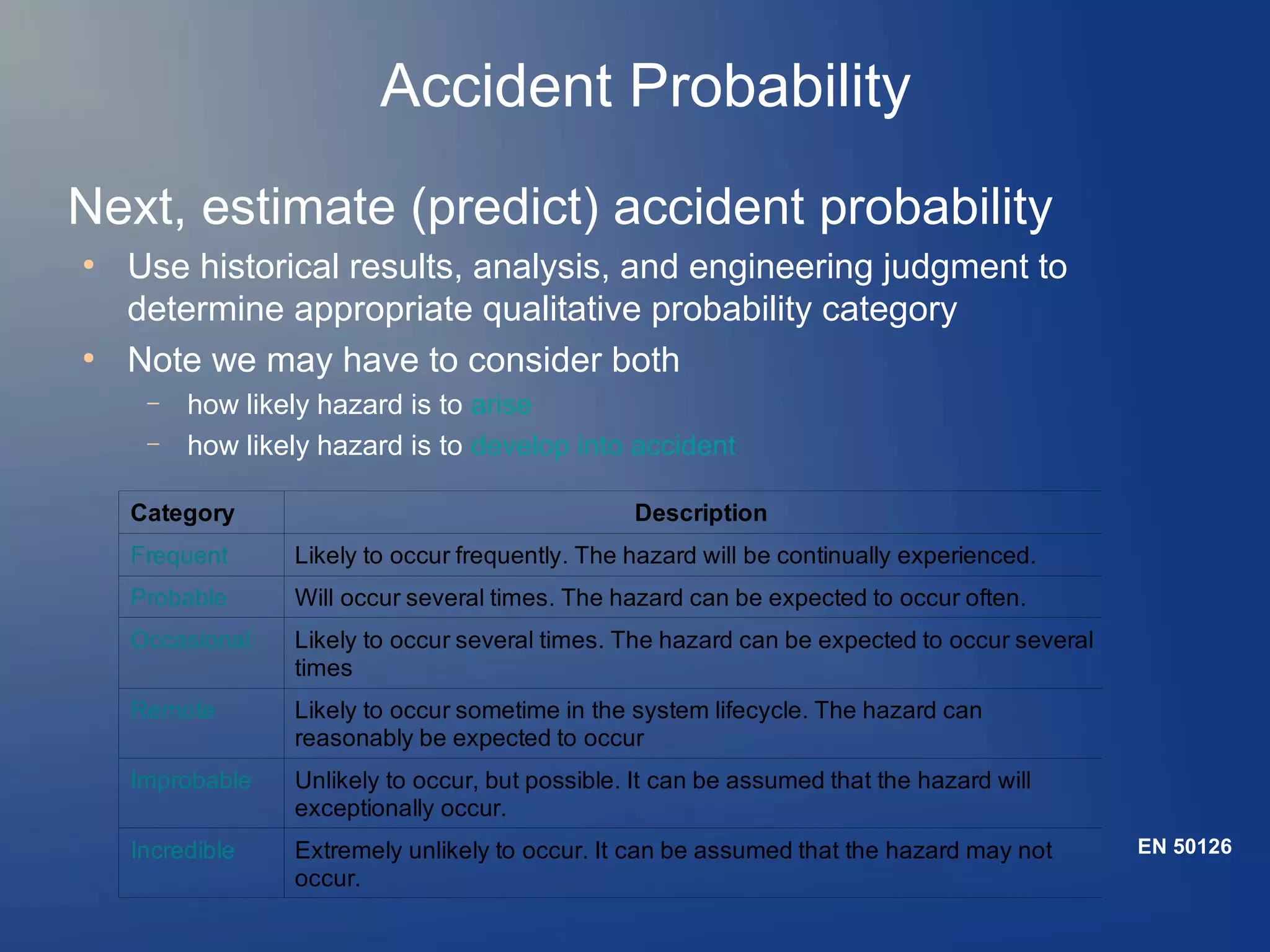
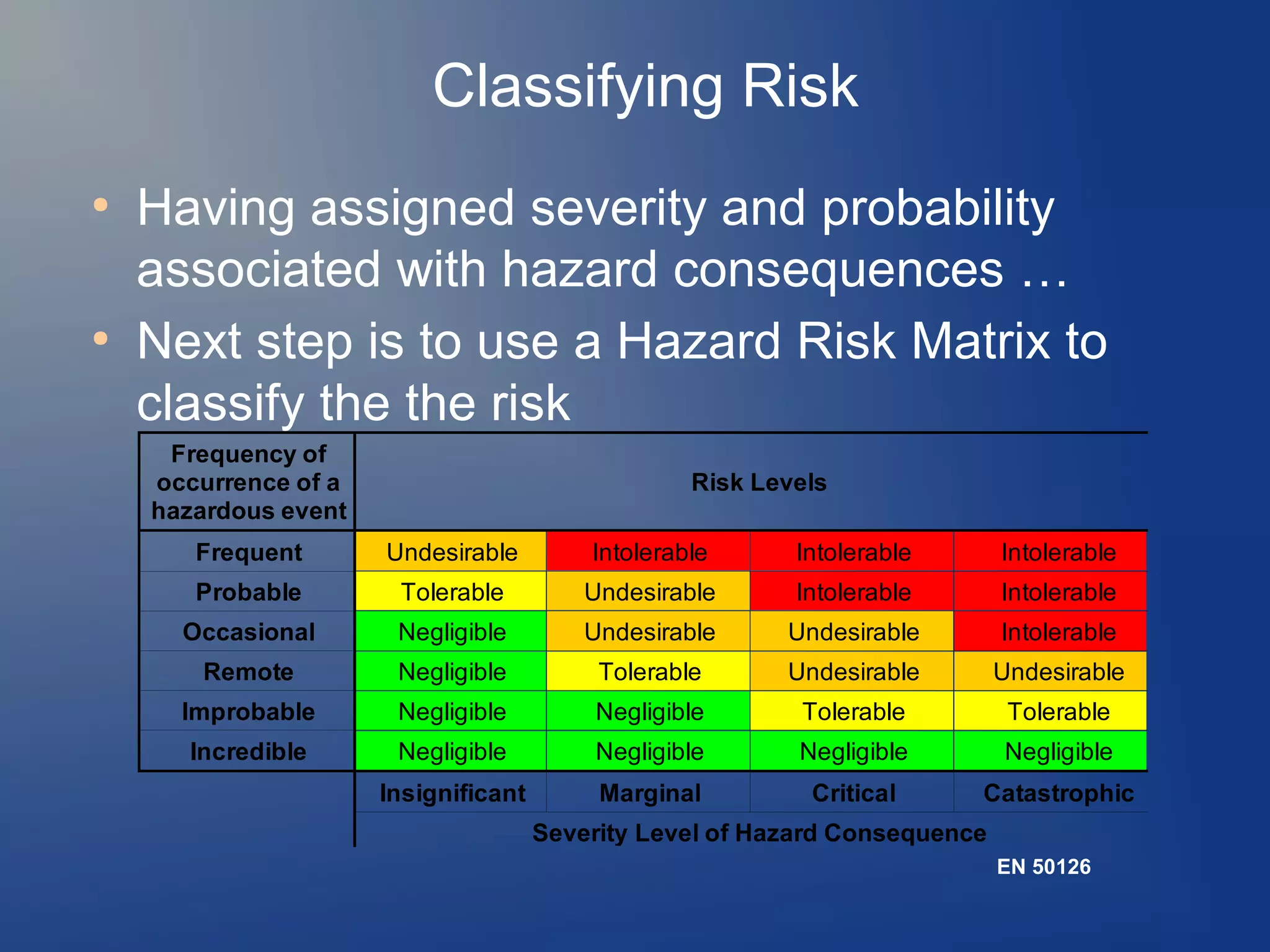
  • 131.
    Severity The consequences ofa failure mode. Severity considers the worst potential consequence of a failure, determined by the degree of injury, property damage, system damage and/or time lost to repair the failure. 131/210
  • 132.
    Remarks / mitigation/ actions Additional info, including the proposed mitigation or actions used to lower a risk or justify a risk level or scenario. 132/210
  • 133.
  • 134.
    Probability (P) In thisstep it is necessary to look at the cause of a failure mode and the likelihood of occurrence. This can be done by analysis, calculations / FEM, looking at similar items or processes and the failure modes that have been documented for them in the past. A failure cause is looked upon as a design weakness. All the potential causes for a failure mode should be identified and documented. 134/210
  • 135.
    Probability (P) This shouldbe in technical terms. Examples of causes are: Human errors in handling, Manufacturing induced faults, Fatigue, Creep, Abrasive wear, erroneous algorithms, excessive voltage or improper operating conditions or use (depending on the used ground rules). A failure mode is given an Probability Ranking. 135/210
  • 136.
  • 137.
    Severity (S) Determine theSeverity for the worst case scenario adverse end effect (state). It is convenient to write these effects down in terms of what the user might see or experience in terms of functional failures. Examples of these end effects are: full loss of function x, degraded performance, functions in reversed mode, too late functioning, erratic functioning, etc. 137/210
  • 138.
    Severity (S) Each endeffect is given a Severity number (S) from, say, I (no effect) to VI (catastrophic), based on cost and/or loss of life or quality of life. These numbers prioritize the failure modes (together with probability and detectability). Below a typical classification is given. Other classifications are possible. See also hazard analysis. 138/210
  • 139.
  • 140.
  • 141.
    Detection (D) The meansor method by which a failure is detected, isolated by operator and/or maintainer and the time it may take. This is important for maintainability control (Availability of the system) and it is specially important for multiple failure scenarios. 141/210
  • 142.
    Detection (D) This mayinvolve dormant failure modes (e.g. No direct system effect, while a redundant system / item automatic takes over or when the failure only is problematic during specific mission or system states) or latent failures (e.g. deterioration failure mechanisms, like a metal growing crack, but not a critical length). 142/210
  • 143.
    Detection (D) It shouldbe made clear how the failure mode or cause can be discovered by an operator under normal system operation or if it can be discovered by the maintenance crew by some diagnostic action or automatic built in system test. A dormancy and/or latency period may be entered. 143/210
  • 144.
  • 145.
    Detection (D) DORMANCY orLATENCY PERIOD The average time that a failure mode may be undetected may be entered if known. For example: During aircraft C Block inspection, preventive or predictive maintenance, X months or X flight hours During aircraft B Block inspection, preventive or predictive maintenance, X months or X flight hours During Turn-Around Inspection before or after flight (e.g. 8 hours average) During in-built system functional test, X minutes Continuously monitored, X seconds 145/210
  • 146.
    Detection (D) INDICATION If theundetected failure allows the system to remain in a safe / working state, a second failure situation should be explored to determine whether or not an indication will be evident to all operators and what corrective action they may or should take. 146/210
  • 147.
    Detection (D) Indications tothe operator should be described as follows: Normal. An indication that is evident to an operator when the system or equipment is operating normally. Abnormal. An indication that is evident to an operator when the system has malfunctioned or failed. Incorrect. An erroneous indication to an operator due to the malfunction or failure of an indicator (i.e., instruments, sensing devices, visual or audible warning devices, etc.). 147/210
  • 148.
    Detection (D) PERFORM DETECTIONCOVERAGE ANALYSIS FOR TEST PROCESSES AND MONITORING (From ARP4761 Standard): 148/210
  • 149.
    Detection (D) This typeof analysis is useful to determine how effective various test processes are at the detection of latent and dormant faults. The method used to accomplish this involves an examination of the applicable failure modes to determine whether or not their effects are detected, and to determine the percentage of failure rate applicable to the failure modes which are detected. The possibility that the detection means may itself fail latent should be accounted for in the coverage analysis as a limiting factor (i.e., coverage cannot be more reliable than the detection means availability). 149/210
  • 150.
    Detection (D) Inclusion ofthe detection coverage in the FMEA can lead to each individual failure that would have been one effect category now being a separate effect category due to the detection coverage possibilities. Another way to include detection coverage is for the FTA to conservatively assume that no holes in coverage due to latent failure in the detection method affect detection of all failures assigned to the failure effect category of concern. The FMEA can be revised is necessary for those cases where this conservative assumption does not allow the top event probability requirements to be met. 150/210
  • 151.
    Detection (D) After thesethree basic steps the Risk level may be provided. 151/210
  • 152.
    Risk level (P*S)and (D) Risk is the combination of End Effect Probability And Severity. Where probability and severity includes the effect on non-detectability (dormancy time). This may influence the end effect probability of failure or the worst case effect Severity. The exact calculation may not be easy in case multiple scenarios (with multiple events) are possible and detectability / dormancy plays a crucial role (as for redundant systems). In that case Fault Tree Analysis and/or Event Trees may be needed to determine exact probability and risk levels. 152/210
  • 153.
    Risk level (P*S)and (D) Preliminary Risk levels can be selected based on a Risk Matrix like shown below, based on Mil. Std. 882.[24] The higher the Risk level, the more justification and mitigation is needed to provide evidence and lower the risk to an acceptable level. High risk should be indicated to higher level management, who are responsible for final decision making. 153/210
  • 154.
    Risk level (P*S)and (D) 154/210
  • 155.
    Risk level (P*S)and (D) After this step the FMEA has become like a FMECA. 155/210
  • 156.
    Timing The FMEA shouldbe updated whenever: A new cycle begins (new product/process) Changes are made to the operating conditions A change is made in the design New regulations are instituted Customer feedback indicates a problem 156/210
  • 157.
    Uses Development of systemrequirements that minimize the likelihood of failures. Development of designs and test systems to ensure that the failures have been eliminated or the risk is reduced to acceptable level. Development and evaluation of diagnostic systems To help with design choices (trade-off analysis). 157/210
  • 158.
    Advantages Improve the quality,reliability and safety of a product/process Improve company image and competitiveness Increase user satisfaction Reduce system development time and cost Collect information to reduce future failures, capture engineering knowledge 158/210
  • 159.
    Advantages Reduce the potentialfor warranty concerns Early identification and elimination of potential failure modes Emphasize problem prevention Minimize late changes and associated cost Catalyst for teamwork and idea exchange between functions Reduce the possibility of same kind of failure in future Reduce impact on company profit margin Improve production yield 159/210
  • 160.
    Limitations If used asa top-down tool, FMEA may only identify major failure modes in a system. Fault tree analysis (FTA) is better suited for "top-down" analysis. When used as a "bottom-up" tool FMEA can augment or complement FTA and identify many more causes and failure modes resulting in top-level symptoms. It is not able to discover complex failure modes involving multiple failures within a subsystem, or to report expected failure intervals of particular failure modes up to the upper level subsystem or system. 160/210
  • 161.
    Limitations Additionally, the multiplicationof the severity, occurrence and detection rankings may result in rank reversals, where a less serious failure mode receives a higher RPN than a more serious failure mode. The reason for this is that the rankings are ordinal scale numbers, and multiplication is not defined for ordinal numbers. The ordinal rankings only say that one ranking is better or worse than another, but not by how much. For instance, a ranking of "2" may not be twice as severe as a ranking of "1," or an "8" may not be twice as severe as a "4," but multiplication treats them as though they are. See Level of measurement for further discussion. 161/210
  • 162.
    Types Functional: before designsolutions are provided (or only on high level) functions can be evaluated on potential functional failure effects. General Mitigations ("design to" requirements) can be proposed to limit consequence of functional failures or limit the probability of occurrence in this early development. It is based on a functional breakdown of a system. This type may also be used for Software evaluation. 162/210
  • 163.
    Types Concept Design /Hardware: analysis of systems or subsystems in the early design concept stages to analyse the failure mechanisms and lower level functional failures, specially to different concept solutions in more detail. It may be used in trade-off studies. 163/210
  • 164.
    Types Detailed Design /Hardware: analysis of products prior to production. These are the most detailed (in mil 1629 called Piece-Part or Hardware FMEA) FMEAs and used to identify any possible hardware (or other) failure mode up to the lowest part level. It should be based on hardware breakdown (e.g. the BoM = Bill of Material). Any Failure effect Severity, failure Prevention (Mitigation), Failure Detection and Diagnostics may be fully analysed in this FMEA. 164/210
  • 165.
    Types Process: analysis ofmanufacturing and assembly processes. Both quality and reliability may be affected from process faults. The input for this FMEA is amongst others a work process / task Breakdown. 165/210
  • 166.
  • 167.
    HOW TO CONDUCTAN EFFECTIVE SAFETY ASSESSMENT OFFICE SPACES
  • 168.
    Why should yoube conducting assessments? ● ● ● ● To spot unsafe conditions and equipment To focus on unsafe work practices or behavior trends before they lead to injuries Reveal the need for new safeguards To provide a safe working environment for all workers
  • 169.
    What should Ilook for during an office assessment? ● ● ● ● ● ● ● Emergency Egress Work Environment Ergonomics Emergency Information Fire Prevention Electrical Systems Employee Behavior
  • 170.
    Emergency Egress ● ● ● ● ● Blocked orlocked doorways Locking devices that can impede emergency egress Properly marked exits Properly illuminated exits Clear aisles and pathways
  • 172.
    Work Environment ● ● ● ● Clean, sanitaryand orderly work spaces Tripping hazards such as loose tiles, carpeting, flooring Are drawers kept open when not in use Are items stored above shoulder level and unsecured
  • 175.
    Ergonomics ● ● ● Are workstations configuredto prevent employee discomfort and injury Are employees aware of ergonomic risk factors Have employees received ergonomic training
  • 176.
    Emergency Information ● ● ● Are emergencyphone numbers posted where they can be readily found Are employees trained in emergency procedures Are evacuation procedures and diagrams posted
  • 178.
    Fire Prevention ● ● ● ● Are portablefire extinguishers readily available and unobstructed Are fire pull stations clearly marked and unobstructed Are all fire sprinkler heads kept clear and unobstructed (at least 18 inches) Are space heaters used and authorized
  • 180.
    Electrical Systems ● ● ● ● ● Are extensioncords/power strips kept uncoupled (piggy-backed) Are all extension cords/power strips provided by the agency Are electrical outlets clear of combustible materials Do electrical cords create trip hazards Are extension cords used as permanent wiring
  • 183.
    Employee Behavior ● ● ● Are employeesobserving established safety rules Do employees minimize hazards by applying Operational Risk Management principles Are employee allowed to report unsafe conditions or acts without restraint
  • 184.
  • 186.
    How to assesssafety SUMMARY ● ● ● ● Promoting Safety Monthly Assessment Program Positive Findings (above & beyond minimum requirements) Assessments – emergency info, egress, environment, ergonomics, fire prevention, electrical, unsafe behavior
  • 188.
  • 189.
    Getting the Measureof Risk ● ● ● ● Having understood the potential accident sequences associated with a hazard (e.g. using ETA) … Next step is to determine the severity of the credible accidents identified Remember risk is the product of severity and probability of an accident Two different approaches: – Estimate probability of accident, and hence get a measure of accident risk… then decide whether estimated risk is acceptable ● ● Used in many domains, including rail, military aerospace Will discuss this approach first, using rail standards as
  • 190.
    Accident Severity ● Accident SeverityCategories are qualitative descriptions of consequences of failure conditions (hazards) – considering likely impact Severity Level Consequence to Persons or Environment Consequence to Service Catastrophic Fatalities and/or multiple severe injuries and/or major damage to the environment Critical Single fatality and/or severe injury and/or significant damage to the environment Loss of a major system Marginal Minor injury and/or significant threat to the environment Severe system(s) damage Insignificant Possible minor injury Minor system damage EN 50126
  • 191.
    Accident Probability Next, estimate(predict) accident probability ● ● Use historical results, analysis, and engineering judgment to determine appropriate qualitative probability category Note we may have to consider both – – how likely hazard is to arise how likely hazard is to develop into accident Category Description Frequent Likely to occur frequently. The hazard will be continually experienced. Probable Will occur several times. The hazard can be expected to occur often. Occasional Likely to occur several times. The hazard can be expected to occur several times Remote Likely to occur sometime in the system lifecycle. The hazard can reasonably be expected to occur Improbable Unlikely to occur, but possible. It can be assumed that the hazard will exceptionally occur. Incredible Extremely unlikely to occur. It can be assumed that the hazard may not occur. EN 50126
  • 192.
    Classifying Risk ● ● Having assignedseverity and probability associated with hazard consequences … Next step is to use a Hazard Risk Matrix to classify the the risk Frequency of occurrence of a hazardous event Risk Levels Frequent Undesirable Intolerable Intolerable Intolerable Probable Tolerable Undesirable Intolerable Intolerable Occasional Negligible Undesirable Undesirable Intolerable Remote Negligible Tolerable Undesirable Undesirable Improbable Negligible Negligible Tolerable Tolerable Incredible Negligible Negligible Negligible Negligible Insignificant Marginal Critical Catastrophic Severity Level of Hazard Consequence EN 50126
  • 193.
    Accepting Risk Reasoning aboutrisk ● Using HRI now possible to say, e.g. Risk(Hazard H1) > Risk(Hazard H2) ● In order to say what is acceptable / unacceptable, must provide an interpretation, Risk Actions to be applied against each category e.g.Category Intolerable Undesirable Shall be eliminated Shall only be accepted when risk reduction is impracticable and with the agreement of the Railway Authority or the Safety Regulatory Authority, as appropriate Tolerable Acceptable with adequate control and with the agreement of the Railway Authority Negligible Acceptable with the agreement of the Railway Authority EN 50126
  • 194.
    Managing Risk Risk Resolution ● Canassociate objectives or actions with risk class, e.g. – – – ● technologies used development processes assessment criteria Example, for “undesirable” risk, might decide – – – no single point of failure shall lead to system accident probability of fatality must be < 1x10⁻⁸ per hour failure behaviour over time (lifetime of system)
  • 195.
    Determining Risk -Civil Aerospace Style 1 Start with determination of severity ● very similar to rail categories ARP 4761
  • 196.
    Determining Risk -Civil Aerospace Style 2 ● When severity has been determined, can set objectives (requirements) for risk control – primarily boundaries on acceptable probability of failure condition (hazard) S e v e r ity C la s s ific a tio n P r o b a b ility O b je c tiv e Q u a n tita tiv e D e s c r ip tiv e (p e r flig h t h o u r ) C a ta s tro p h ic E x tr e m e ly Im p r o b a b le < 1 0 -9 H a z a rd o u s E x tr e m e ly R e m o te 1 0 -7 t o 1 0 -9 M a jo r R e m o te 1 0 -5 t o 1 0 -7 R e a s o n a b ly P r o b a b le 1 0 -3 t o 1 0 -5 M in o r F re q u e n t > 10 -3 Adapted from ARP 4761
  • 197.
    Determining Risk -Civil Aerospace Style 3 For civil aerospace, severity-related objectives are set in standards ● easy to work with ● unambiguous – provided you can agree on standardised and objective measures of severity! BUT ● Need to understand that direct mapping from severity to probability objectives is based on important assumption:
  • 198.
    Determining Risk -Civil Aerospace Style 4 Where does acceptable risk come from? ● in principle, requirements reflect “what risk the public is willing to accept” – – ● risk (A) = probability (A) * severity (A) level of acceptable risk hard to determine, and subjective in practice, certification bodies (airworthiness authorities) act as surrogates for the public – – “bottom line” is hull loss rate civil aviation hull loss rate target is currently 10 -7 per flying hour ● for comparison, military aviation (UK) hull loss rate
  • 199.
    Determining Risk -Civil Aerospace Style 5 ● Has further implications: – – ● implicit assumption about number of catastrophic failure conditions on an aircraft also implicit assumption about how probable failure condition is to actually develop into an accident Example: – – – probability objective (target) for catastrophic failure condition is < 10-9 per flight hour target hull loss rate is < 10-7 per flight hour implies either a maximum of 100 catastrophic failure conditions on an aircraft, assuming all occurrences of catastrophic failure conditions will
  • 200.
    Determining Risk -Civil Aerospace Style 6 ● ● Note that objective of probability per flying hour has its problems… Consider: – – histogram shows accidents / time 1.8% of accidents occur in load / taxi / unload
  • 201.
    The ALARP Principle1 ALARP = As Low As Reasonably Practicable R is k c a n n o t b e ju s tif ie d o n a n y g ro u n d s IN T O L E R A B L E T H E A LA R P ( A s L o w A s R e a s o n a b ly P r a c t ic a b le ) R E G IO N R is k is u n d e r t a k e n o n ly if b e n e f it is d e s ir e d B R O A D LY A C C E P T A B LE R E G IO N TO LE R A B LE o n ly if r is k r e d u c tio n s a r e im p r a c t ic a b le o r c o s t g r o s s ly d is p r o p o r tio n a te to th e im p r o v e m e n t g a in e d TO LE R A B LE if c o s t o f r e d u c t io n w o u ld e x c e e d im p r o v e m e n t g a in e d N E G L IG IB L E R IS K
  • 202.
    The ALARP Principle2 ● ● ● ● ● Provides an interpretation of identified risks Pragmatic – although you can always spend more money to improve safety, it is not always cost-effective However, “cost-effectiveness” introduces ambiguity Regions of tolerability defined by regulatory domain and customer Approach is often implicit in the management of safety-critical projects anyway
  • 203.
    Risk Reduction Flowchart1 Identify and determine risk associated with identified hazards ID E N T IF Y H A Z A R D a n d R IS K H a za rd Id e n tific a tio n S y s te m D e s ig n H a z a r d R is k (S e v e r ity /P r o b a b ility ) E s ta b lis h e d
  • 204.
    Risk Reduction Flowchart2 Id e n tify H a z a r d a n d R is k H a za rd Id e n tific a tio n A S S E S S R IS K H a z a r d R is k (S e v e r ity /P r o b a b ility ) E s ta b lis h e d R is k M e a s u r e d A g a in s t H R I M a tr ix C r ite r ia S y s te m D e s ig n No R is k Yes A c c e p ta b le ?
  • 205.
    Risk Reduction Flowchart3 Id e n tify H a z a r d a n d R is k H a za rd Id e n tific a tio n S y s te m D e s ig n H a z a r d R is k (S e v e r ity /P r o b a b ility ) E s ta b lis h e d R is k M e a s u r e d A g a in s t H R I M a tr ix C r ite r ia T A K E A C T IO N A p p ly R e -d e s ig n P re c e d e n c e C r ite r ia O p e ra to r / C re w T r a in in g R e q u ir e d A s s e s s R is k 1. 2. 3. 4. No R is k Yes A c c e p ta b le ? C o n tin u e d e s ig n . D o c u m e n t a n a ly s is a n d ju s tific a tio n R e d e s ig n to e lim in a te h a z a r d , o r r e d u c e lik e lih o o d In c o r p o r a te m itig a tio n , e .g . s a fe ty d e v ic e s P r o v id e w a r n in g s D e v e lo p p r o c e d u r e s a n d tr a in in g
  • 206.
    Precedence in RiskReduction 1 ● Redesign to eliminate risk – Best where practical ● ● Redesign to reduce hazard likelihood – Select architecture or components ● ● ● Change in operational role, or removal of hazardous material Duplex or triplex or … Higher integrity components, with lower failure rates Incorporate mitigation to reduce impact of failures – – Automated protection, e.g. pressure relief valves Where incorporated, need to check periodically
  • 207.
    Precedence in RiskReduction 2 ● Provide warning devices – Detect the hazardous condition and warn operators ● ● ● Provide procedures and training – Reduce likelihood of hazard, or mitigate ● – may involve use of personal protective equipment Do not assume procedures are enough by themselves ● ● e.g. indicate that landing gear has not fully deployed e.g. to evacuate building due to fire or fumes consider evolution of power guillotine regulations Precedence order
  • 208.
    Residual Risk -1 ● Residual Risks are those that cannot be ‘designed out’ – ● ● risks inherent to design, where benefit is desirable Significant residual risks must be formally accepted by the appropriate authority (typically customer / operator) Can use Decision Authority Matrix, e.g. Hazard Severity Categories Frequency of Occurrence I II III IV CATASTROPHIC CRITICAL MARGINAL NEGLIGIBLE A FREQUENT HIGH HIGH HIGH MEDIUM B PROBABLE HIGH HIGH MEDIUM LOW C OCCASIONAL HIGH HIGH MEDIUM LOW D REMOTE HIGH MEDIUM LOW LOW E IMPROBABLE MEDIUM LOW LOW LOW (MIL-STD-882C)
  • 209.
    Residual Risk 2 AppropriateDecision Authority (From MIL-STD882C) HIGH – Service Acquisition Executive – e.g. no ground collision avoidance on F22 – signed off by 4-star Air Force General MEDIUM – Program Executive Officer LOW – Program Manager ● ● Usually a requirement to document all actions taken to resolve risk within terms of contract Customer authority can then decide whether
  • 210.
    Risk Management Summary ● ● RiskAssessment is the process of identifying the risk associated with system hazards Approach in many sectors (military, rail…) is to use Hazard Risk Matrix to determine the risk associated with a hazard from severity and probability estimates – ● then decide on acceptability of risk Alternative approach (Civil Aerospace) is based around severity – – assumption of fixed level of acceptable risk... … so can derive objectives, including probability, from severity

Editor's Notes

  • #32 I.Background Information: Stress the importance of investigating incidents. Your investigation team must understand that their job can save the organization a lot of money and help prevent a similar accident from occurring in the future. The input of every member of the investigation team is vital to a thorough and successful investigation report. II.Speaker’s Notes: Why should we investigate accidents? To prevent future accidents from occurring is the number one reason. Also, accident investigations will usually bring out “hidden” safety issues that can be addressed in other work areas to prevent accidents in those areas. Determining the cause is not a reason to place blame. Usually there are multiple causes or contributing factors. Digging into the root or main cause may take time, because it may be hidden under a number of easy or apparent causes. We also need to document the NMFS version of the incident for reporting to the Occupational Safety and Health Administration (OSHA) and so the workers’ compensation claim can be managed correctly.
  • #44 I.Background Information: Your accident investigation and reporting procedures should explain who is responsible for investigating the different types of accidents. This is just an example of which employees might be on the investigation team. Please make the appropriate changes so the information coincides with your company’s accident investigation and reporting procedures. How NOAA’s accident investigation and reporting procedures define “minor” and “major” accidents? Make sure the definitions in the Speaker’s Notes: match the description in your company’s plan. II.Speaker’s Notes: A “minor” accident is one in which no injury occurs or the most severe injury only requires first-aid, not a visit to the doctor. This type of accident or near miss can easily be handled by the injured employee’s supervisor and a member of the safety committee. The chosen safety committee member should work in a different department so he or she can look at the situation from a fresh perspective. A “major” accident is one in which the injury is severe enough that a doctor’s visit is required. Again the supervisor will be involved, along with at least one member (possibly more) of the safety committee. The safety manager and production manager will also be involved. The assembled investigation team decides who leads the investigation and who will be responsible for writing the report.
  • #45 I.Background Information: The employees in this class will have the basis to become qualified trainers just by their participation in this class. Once they understand the importance of the investigation and learn how to find and communicate details, they will be effective members of an investigation team. II.Speaker’s Notes: Not everyone is permitted to investigate accidents. Obviously, you are on yourway due to your participation in this class. By the end of this session you will understand the proper way to investigate accidents. You should also understand the importance of conducting an investigation. If you don’t take the investigation process seriously, or just go through the motions, the investigation will not be valid. A thorough investigation requires the ability to seek out hidden details and to communicate those details successfully so that others reading the investigation report will be able to picture exactly what happened.
  • #46 I.Background Information: How do you notify or assemble the investigation team? Is the SECO or safety focal point contacted, and then they contact members of the investigation team? II.Speaker’s Notes: Ideally, the investigation should begin immediately. The investigation team should be assembled and the process should begin even while the injured employee is still being treated. The memories of the injured employee and witnesses are affected by time. They may elaborate on the story or forget important details if they are not questioned immediately. Potential causal factors might be removed. For example, the equipment involved may be moved, the slippery floor cleaned up, the broken ladder repaired. Investigators want to arrive at the scene before anything is changed. If the investigation team cannot arrive at the scene immediately, they should make it a priority to arrive as soon as possible. Waiting a day or two is just not acceptable. By then you have lost important information, and the investigation will not be complete. Recommendations from the investigation may not be valid because they are based on inaccurate information.
  • #48 I.Background Information: Do you have an accident investigation kit made up? If so, where is it located? Who has access to the kit? Who is responsible for obtaining the kit when the investigation team is called? All of this information should be explained in your accident investigation and reporting procedures. II.Speaker’s Notes: This slide lists the essential elements of an investigation kit. Pictures can be taken and used as evidence or to help supplement the report. Having the report forms will help make sure details are not overlooked while conducting the investigation. Barricade tape is used to block off the accident scene until the investigation is complete. A flashlight may be needed to look for those hidden details A tape measure records the height of fall, etc. A tape recorder can be used by all team members to record witnesses’ statements or investigator’s observations. Work gloves are needed because equipment or debris may need to be moved.
  • #49 I.Background Information: Your employees should already understand the importance of immediately reporting all incidents, including near misses. This is stressed in the “New Employee Safety Orientation” training session. Do your supervisors understand how to handle an injured employee? Have they been trained in first-aid/CPR? Do they take the injured worker to the doctor if necessary? Does the supervisor know how to initiate an incident investigation? Do they understand the importance of leaving the incident scene intact for the investigators? Make sure the supervisor understands that the employee should complete the employee account of incident form as soon as possible. II.Speaker’s Notes: Employees are responsible for immediately reporting all injuries, near miss incidents, and facility-damaging accidents. Remember, as a supervisor, you are responsible for ensuring all injured personnel receive proper treatment. Do not touch the incident scene until the investigation team arrives, unless something presents an immediate danger to other personnel, until the investigation team arrives. Contact the incident investigation team and have the injured employee complete the employee account of the incident form.
  • #50 I.Background Information: How does NMFS call for an investigation team to gather? Who determines the members of a particular investigation team? Who retrieves the investigation kit? Pass out Accident Investigation forms. II.Speaker’s Notes: Once the team has gathered at the scene, decide who will be the team leader. Step back from the scene to look at the big picture. Do you observe anything that is unusual or out of place? Record your initial observations. Try not to record what you think may have happened; just record what you see. Take pictures or a video.
  • #51 I.Background Information: Does NMFS have any kind of post-accident drug screen requirement? If so, you will find out later if the injured employee was on alcohol or illegal drugs. Most of the information contained in this slide will have to be taken from the employee’s statement. The employee may not think to include all of this information, so make sure the employee is thoroughly interviewed. II.Speaker’s Notes: Write down the complete name of the injured employee(s). What department do they work in? Who is the supervisor? Have the injured employee complete his or her account of the incident. Was the injured employee taking any medication, either prescription or non-prescription, such as pain medicine, allergy medicine, aspirin, etc.? Is the employee diabetic or subject to seizures? Is there any evidence of use of alcohol or illegal drugs? Was the employee feeling ill lately (if so, the employee may have been taking medication)? Did the employee have symptoms of drowsiness, upset stomach, headaches, etc.? Was the injured employee working a double shift or rotating shifts? Fatigue or the adjustment in work hours may have contributed to the incident. When interviewing the injured employee, do not come across as trying to find the employee at fault for the accident. Just tell the employee that these are standard questions on the form that have to be answered.
  • #52 I.Speaker’s Notes: Write down the name(s) of the witness(es), the departments in which they work, and the names of their supervisors. Interview witnesses separately and write down or record their statements. Some questions to ask witnesses include: Were there any unsafe acts on the part of the person involved that precipitated the incident (i.e., horseplay or not following proper safety procedures). Do you know of any personal factor on the part of the individual involved that may have induced an unsafe condition (i.e., inexperience, alcohol use or fatigue). If supervisors were nearby, was the employee being directly supervised? Where was the supervisor at the time of the accident? Use a facility map or draw a picture of where other employees, including witnesses, were located when the accident occurred. What were they doing? If there were no witnesses, why not? Was the injured employee working alone? If not, why had the other employees left the injured employee alone? Was the fact that the employee was alone a contributing factor?
  • #53 I.Background Information: If time allows, have the employees conduct some mock interviews to get them comfortable with the process. II.Speaker’s Notes: When interviewing, avoid using domineering or patronizing mannerisms or speech. The interviewee will probably not respond well to this attitude. Convey your sincere concern for the safety of employees at your facility and let them know that you are trying to find ways to fix the cause of this accident. Do not interrupt the interviewee; take detailed notes. Review your notes at the end of the interview to avoid any misunderstanding.
  • #54 I.Speaker’s Notes: Was the injured employee operating a machine, tool, or piece of equipment that may have contributed to the incident? Was there a malfunction? Was the employee trained to use the equipment? How much experience did the employee have with the equipment? Was the employee being directly supervised while using the equipment? Was the employee wearing proper PPE, if required? Was the employee using a chemical at the time of the incident? If so, was the employee properly trained, experienced, or supervised? Was the employee wearing appropriate PPE? Environmental factors include: slippery floor, inadequate lighting, crowded work space, noise, stress, etc. The work schedule can be a factor if the work level was increased well above normal levels. Did this increase cause the injured employee to bypass safety procedures in order to speed up production? Were safety hazards ignored because “production had to be finished”?
  • #55 I.Speaker’s Notes: Note the date and exact time of the incident. Was this just before or after a break? Did the injury occur early Monday morning, when the employee may have been tired from a busy weekend? Was the employee working his or her normal shift and performing a normal job function? If not, why was the employee doing work that was outside of the normal work functions? Was the employee coming off of a vacation or sick leave? Is it possible that the employee was daydreaming about the vacation he or she planned to start the next day?
  • #56 I.Speaker’s Notes: The incident location needs to be specific. Start with the main work area such as: the northwest corner of the maintenance shop, lobby of the main office, main deck of the vessel. Now get specific: Was the employee on something such as a ladder, a machine, a platform, a chair, a staircase, etc.? Was the injured employee under a overhead load, workbench, a machine, etc.? Was the employee in a forklift, manlift, confined space, etc.? If the accident occurred off-site, make sure the address of the accident site is noted along with these details. Was the injured employee doing work that is part of his or her normal job functions? If not, was the employee properly trained to do the work?
  • #57 I.Speaker’s Notes: What type of motion was the injured employee conducting at the time of the accident? Examples include: walking, running, bending over, squatting, climbing, operating a lever, pushing a broom, using a scalpel, turning a valve, turning a wrench, pounding a hammer, etc. Were the motions repetitive? Were they handling heavy or light material? Was it big and bulky? Did they have help, or were they using appropriate material handling equipment, such as a pallet jack or truck dollies?
  • #58 I.Background Information: Detailed description is important for claims management. Should the employee later claim that he also injured his knee in the accident, you have a detailed account in which no one witnessed his holding a knee or limping after the accident to indicate that the knee was also injured. II.Speaker’s Notes: The incident should be described on the report in such detail that any reader can clearly picture what happened. For example: The injured employee was walking east down the main aisle, staying to the north side of the aisle, in building #4. He was carrying two boxes of samples with a combined weight of 35 pounds; however, the boxes did come up to his chin and limited his field of vision. The employee did not see the 6-foot, 1/2-inch-diameter extension cord that was laying on the floor and protruding 18 inches into the aisle right next to the newly installed U-Make-It machine. The injured employee stepped on the cord with his left foot, which then rolled forward. Body parts: The employee fell onto his left side and did not have time to break his fall, so his left elbow squarely struck the ground. The boxes were released upon impact. Three of the sample containers broke, spilling approximately 1.5 liters of 10% formalin. Motions after the incident. The employee rolled to his back, sat up and held his left elbow in his right hand. He sat in this position for about a minute before being helped to his feet.
  • #59 I.Speaker’s Notes: There are almost always multiple causes that contribute to an accident. Try not to settle on a single cause theory, because there are usually contributing factors. What are all the possible underlying causes or contributing factors. In the example described on the last slide: The employee was carrying a load that partially blocked his vision, the cord should not have protruded out to the aisle. Other considerations: Was the aisle properly lighted? Was there a noise or something that distracted the injured worker from looking down, etc.? Once the list of potential causes or contributing factors has been compiled, try to determine the primary cause, or the cause that appears to have contributed the most to the accident. This is the cause that, if removed, the accident probably would have been prevented. Other causes will be considered as secondary potential causes. All causes should be investigated for corrective actions; however, the primary cause should be the focus of corrective actions.
  • #60 I.Background Information: Does NMFS accident investigation and reporting procedures have a form for documenting and recommending corrective actions to management? II.Speaker’s Notes: Immediate corrective actions are those that are done right after the investigation is complete. These will remove a danger and prevent a repeat of the accident until formal, or long-term, corrective actions can be completed. These do not need a recommendation form, because they are implemented immediately by the supervisor or the investigation team. For example, put the extension cord back in its proper storage location before someone else slips on it. Once the investigation team has compiled the investigation report, they can make a number of recommendations to management. Recommendations might include retraining employees on lifting and carrying techniques and material handling equipment, retraining maintenance on putting material away when the job is finished, or maybe improving the lighting in that area of the facility.
  • #62 I. Speaker’s Notes: To summarize, these are the steps you should follow when an accident occurs.