Service Oriented Architecture
Agenda
●
Motivation for Service Oriented Architecture (SOA)
●
SOA Defined
●
SOA Principles
●
Applying SOA
Current Environment
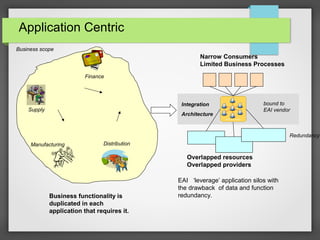
Application Centric
Application Centric
Finance
DistributionManufacturing
Supply
Narrow Consumers
Limited Business Processes
Overlapped resources
Overlapped providers
Business scope
Integration
Architecture
Business functionality is
duplicated in each
application that requires it.
EAI ‘leverage’ application silos with
the drawback of data and function
redundancy.
bound to
EAI vendor
Redundancy
Goal - Service Centric
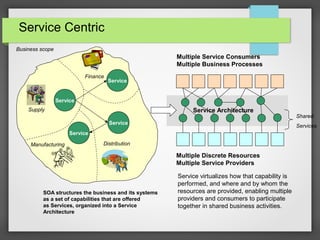
Service Architecture
Service
Service
Service
Service
Finance
DistributionManufacturing
Supply
Service virtualizes how that capability is
performed, and where and by whom the
resources are provided, enabling multiple
providers and consumers to participate
together in shared business activities.
Multiple Service Consumers
Multiple Business Processes
Multiple Discrete Resources
Multiple Service Providers
Business scope
SOA structures the business and its systems
as a set of capabilities that are offered
as Services, organized into a Service
Architecture
Shared
Services
Service Centric
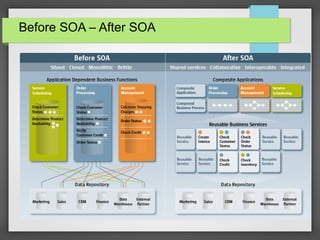
Before SOA – After SOA
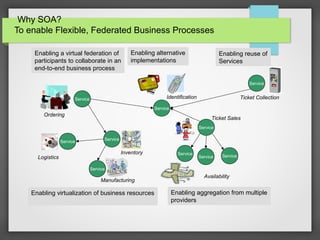
Why SOA?
To enable Flexible, Federated Business Processes
Enabling a virtual federation of
participants to collaborate in an
end-to-end business process
Enabling alternative
implementations
Enabling reuse of
Services
Enabling virtualization of business resources Enabling aggregation from multiple
providers
Identification
Ticket Sales
Ticket Collection
Inventory
Logistics
Manufacturing
Availability
Service
Service
Service
Service
Service
Service
Service
Service Service
Service
Ordering
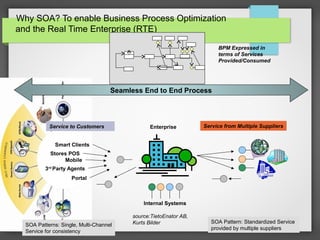
Why SOA? To enable Business Process Optimization
and the Real Time Enterprise (RTE)
Seamless End to End Process
Internal Systems
SOA Pattern: Standardized Service
provided by multiple suppliers
Service from Multiple Suppliers
SOA Patterns: Single, Multi-Channel
Service for consistency
BPM Expressed in
terms of Services
Provided/Consumed
Enterprise
source:TietoEnator AB,
Kurts Bilder
Smart Clients
Stores POS
Mobile
3rd
Party Agents
Portal
Service to Customers
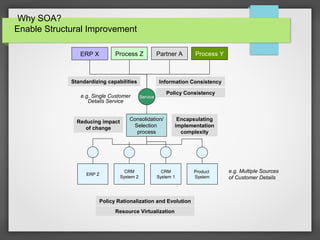
Why SOA?
Enable Structural Improvement
ERP X Process Z Partner A Process Y
Service
Standardizing capabilities Information Consistency
Policy Consistency
e.g. Single Customer
Details Service
Consolidation/
Selection
process
Reducing impact
of change
Encapsulating
implementation
complexity
ERP Z
CRM
System 2
CRM
System 1
Product
System
Policy Rationalization and Evolution
Resource Virtualization
e.g. Multiple Sources
of Customer Details
SOA Defined
●
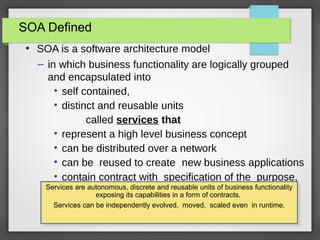
SOA is a software architecture model
– in which business functionality are logically grouped
and encapsulated into
• self contained,
• distinct and reusable units
called services that
• represent a high level business concept
• can be distributed over a network
• can be reused to create new business applications
• contain contract with specification of the purpose,
functionality, interfaces (coarse grained),
constraints, usage
... of the business functionality
Services are autonomous, discrete and reusable units of business functionality
exposing its capabilities in a form of contracts.
Services can be independently evolved, moved, scaled even in runtime.
Services are autonomous, discrete and reusable units of business functionality
exposing its capabilities in a form of contracts.
Services can be independently evolved, moved, scaled even in runtime.
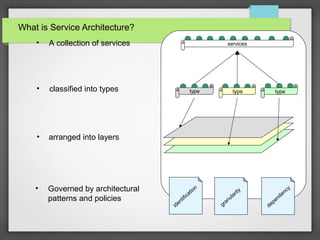
What is Service Architecture?
• A collection of services
• classified into types
• arranged into layers
• Governed by architectural
patterns and policies
services
identification
granularity
dependency
type typetype
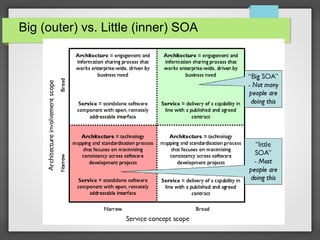
Big (outer) vs. Little (inner) SOA
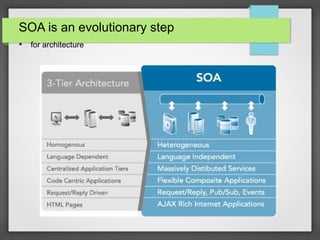
SOA is an evolutionary step
 for architecture
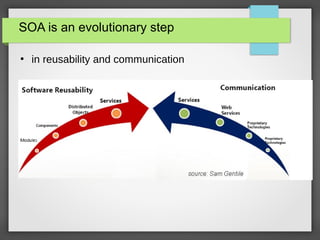
SOA is an evolutionary step
●
in reusability and communication
SOA is an evolutionary step
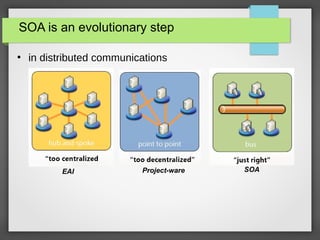
Project-ware SOAEAI
●
in distributed communications
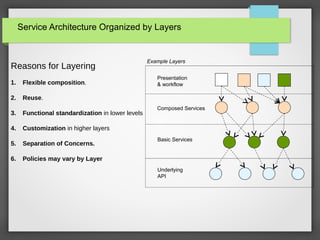
Service Architecture Organized by Layers
Reasons for Layering
1. Flexible composition.
2. Reuse.
3. Functional standardization in lower levels
4. Customization in higher layers
5. Separation of Concerns.
6. Policies may vary by Layer
Example Layers
Presentation
& workflow
Composed Services
Basic Services
Underlying
API
Major service types
●
Basic Services:
– Data-centric and logic-centric services
– Encapsulate data behavior and data model and ensures data
consistency (only on one backend).
– Basic services are stateless services with high degree of reusability.
– Represent fundamental SOA maturity level and usually are build on top
existing legacy API (underlying services)
●
Composed Services :
– expose harmonized access to inconsistent basic services technology
(gateways, adapters, façades, and functionality-adding services).
– Encapsulate business specific workflows or orchestrated services.
Service Types
SOA Principles
●
Standardized Service Contracts
●
Loose Coupling
●
Abstraction
●
Reusability
●
Autonomy
●
Statelessness
●
Discoverability
●
Composability
Standardized Service Contracts
●
“Services within the same service inventory are in
compliance with the same contract design standards."
●
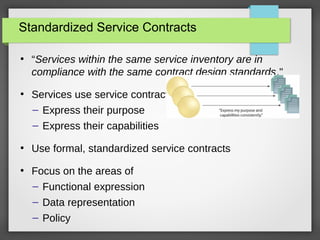
Services use service contract to
– Express their purpose
– Express their capabilities
●
Use formal, standardized service contracts
●
Focus on the areas of
– Functional expression
– Data representation
– Policy
Loose Coupling
●
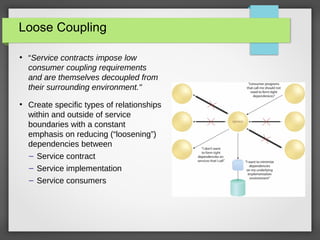
“Service contracts impose low
consumer coupling requirements
and are themselves decoupled from
their surrounding environment."
●
Create specific types of relationships
within and outside of service
boundaries with a constant
emphasis on reducing (“loosening”)
dependencies between
– Service contract
– Service implementation
– Service consumers
Abstraction
●
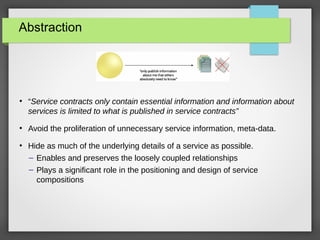
“Service contracts only contain essential information and information about
services is limited to what is published in service contracts”
●
Avoid the proliferation of unnecessary service information, meta-data.
●
Hide as much of the underlying details of a service as possible.
– Enables and preserves the loosely coupled relationships
– Plays a significant role in the positioning and design of service
compositions
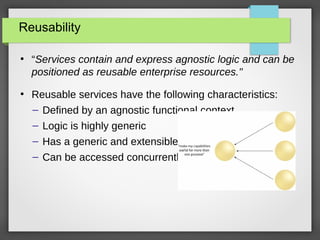
Reusability
●
“Services contain and express agnostic logic and can be
positioned as reusable enterprise resources."
●
Reusable services have the following characteristics:
– Defined by an agnostic functional context
– Logic is highly generic
– Has a generic and extensible contract
– Can be accessed concurrently
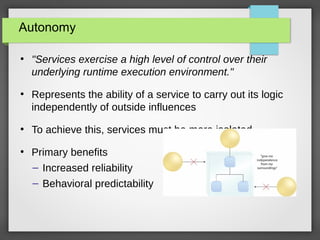
Autonomy
●
"Services exercise a high level of control over their
underlying runtime execution environment."
●
Represents the ability of a service to carry out its logic
independently of outside influences
●
To achieve this, services must be more isolated
●
Primary benefits
– Increased reliability
– Behavioral predictability
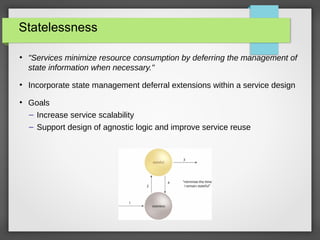
Statelessness
●
"Services minimize resource consumption by deferring the management of
state information when necessary."
●
Incorporate state management deferral extensions within a service design
●
Goals
– Increase service scalability
– Support design of agnostic logic and improve service reuse
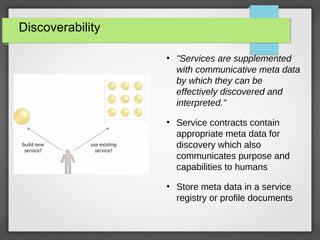
Discoverability
●
"Services are supplemented
with communicative meta data
by which they can be
effectively discovered and
interpreted."
●
Service contracts contain
appropriate meta data for
discovery which also
communicates purpose and
capabilities to humans
●
Store meta data in a service
registry or profile documents
Composability
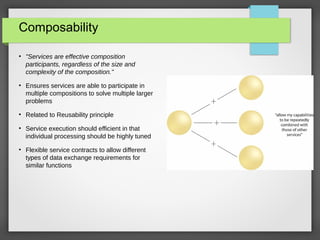
●
"Services are effective composition
participants, regardless of the size and
complexity of the composition."
●
Ensures services are able to participate in
multiple compositions to solve multiple larger
problems
●
Related to Reusability principle
●
Service execution should efficient in that
individual processing should be highly tuned
●
Flexible service contracts to allow different
types of data exchange requirements for
similar functions
Applying SOA - Governance
Goal: Establish SOA organization governance (SOA Board) that governs SOA efforts
and breaks down capabilities into non-overlapping services
 Governance is a program that makes sure people do what is ‘right’
 In conjunction with software, governance controls the development and operation of
software
Applying SOA - Governance
●
Policies
– Codification of laws, regulations, corporate guidelines and best practices
– Must address all stages of the service lifecycle (technology selection, design,
development practices, configuration management, release management,
runtime management, etc.)
●
Processes
– Enforce policies
– System-driven processes (code check-in, code builds, unit tests)
– Human-driven process (requests, design reviews, code reviews, threat
assessment, test case review, release engineering, service registration, etc.)
●
Metrics
– Measurements of service reuse, compliancy with policy, etc.
– Organization
– Governance program should be run by SOA Board, which should have cross-
functional representatives
Applying SOA –
Governance
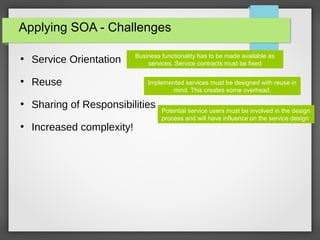
Business functionality has to be made available as
services. Service contracts must be fixed
Implemented services must be designed with reuse in
mind. This creates some overhead.
Potential service users must be involved in the design
process and will have influence on the service design
Applying SOA - Challenges
●
Service Orientation
●
Reuse
●
Sharing of Responsibilities
●
Increased complexity!
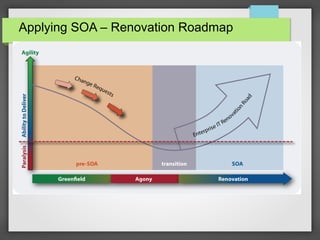
Applying SOA – Renovation Roadmap
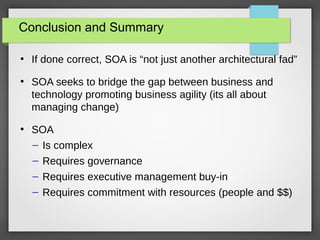
Conclusion and Summary
●
If done correct, SOA is “not just another architectural fad”
●
SOA seeks to bridge the gap between business and
technology promoting business agility (its all about
managing change)
●
SOA
– Is complex
– Requires governance
– Requires executive management buy-in
– Requires commitment with resources (people and $$)

Service oriented architecture 27 May 2014

  • 1.
  • 2.
    Agenda ● Motivation for ServiceOriented Architecture (SOA) ● SOA Defined ● SOA Principles ● Applying SOA
  • 3.
  • 4.
  • 5.
    Application Centric Finance DistributionManufacturing Supply Narrow Consumers LimitedBusiness Processes Overlapped resources Overlapped providers Business scope Integration Architecture Business functionality is duplicated in each application that requires it. EAI ‘leverage’ application silos with the drawback of data and function redundancy. bound to EAI vendor Redundancy
  • 6.
  • 7.
    Service Architecture Service Service Service Service Finance DistributionManufacturing Supply Service virtualizeshow that capability is performed, and where and by whom the resources are provided, enabling multiple providers and consumers to participate together in shared business activities. Multiple Service Consumers Multiple Business Processes Multiple Discrete Resources Multiple Service Providers Business scope SOA structures the business and its systems as a set of capabilities that are offered as Services, organized into a Service Architecture Shared Services Service Centric
  • 8.
    Before SOA –After SOA
  • 9.
    Why SOA? To enableFlexible, Federated Business Processes Enabling a virtual federation of participants to collaborate in an end-to-end business process Enabling alternative implementations Enabling reuse of Services Enabling virtualization of business resources Enabling aggregation from multiple providers Identification Ticket Sales Ticket Collection Inventory Logistics Manufacturing Availability Service Service Service Service Service Service Service Service Service Service Ordering
  • 10.
    Why SOA? Toenable Business Process Optimization and the Real Time Enterprise (RTE) Seamless End to End Process Internal Systems SOA Pattern: Standardized Service provided by multiple suppliers Service from Multiple Suppliers SOA Patterns: Single, Multi-Channel Service for consistency BPM Expressed in terms of Services Provided/Consumed Enterprise source:TietoEnator AB, Kurts Bilder Smart Clients Stores POS Mobile 3rd Party Agents Portal Service to Customers
  • 11.
    Why SOA? Enable StructuralImprovement ERP X Process Z Partner A Process Y Service Standardizing capabilities Information Consistency Policy Consistency e.g. Single Customer Details Service Consolidation/ Selection process Reducing impact of change Encapsulating implementation complexity ERP Z CRM System 2 CRM System 1 Product System Policy Rationalization and Evolution Resource Virtualization e.g. Multiple Sources of Customer Details
  • 12.
    SOA Defined ● SOA isa software architecture model – in which business functionality are logically grouped and encapsulated into • self contained, • distinct and reusable units called services that • represent a high level business concept • can be distributed over a network • can be reused to create new business applications • contain contract with specification of the purpose, functionality, interfaces (coarse grained), constraints, usage ... of the business functionality Services are autonomous, discrete and reusable units of business functionality exposing its capabilities in a form of contracts. Services can be independently evolved, moved, scaled even in runtime. Services are autonomous, discrete and reusable units of business functionality exposing its capabilities in a form of contracts. Services can be independently evolved, moved, scaled even in runtime.
  • 13.
    What is ServiceArchitecture? • A collection of services • classified into types • arranged into layers • Governed by architectural patterns and policies services identification granularity dependency type typetype
  • 14.
    Big (outer) vs.Little (inner) SOA
  • 15.
    SOA is anevolutionary step  for architecture
  • 16.
    SOA is anevolutionary step ● in reusability and communication
  • 17.
    SOA is anevolutionary step Project-ware SOAEAI ● in distributed communications
  • 18.
    Service Architecture Organizedby Layers Reasons for Layering 1. Flexible composition. 2. Reuse. 3. Functional standardization in lower levels 4. Customization in higher layers 5. Separation of Concerns. 6. Policies may vary by Layer Example Layers Presentation & workflow Composed Services Basic Services Underlying API
  • 19.
    Major service types ● BasicServices: – Data-centric and logic-centric services – Encapsulate data behavior and data model and ensures data consistency (only on one backend). – Basic services are stateless services with high degree of reusability. – Represent fundamental SOA maturity level and usually are build on top existing legacy API (underlying services) ● Composed Services : – expose harmonized access to inconsistent basic services technology (gateways, adapters, façades, and functionality-adding services). – Encapsulate business specific workflows or orchestrated services.
  • 20.
  • 21.
    SOA Principles ● Standardized ServiceContracts ● Loose Coupling ● Abstraction ● Reusability ● Autonomy ● Statelessness ● Discoverability ● Composability
  • 22.
    Standardized Service Contracts ● “Serviceswithin the same service inventory are in compliance with the same contract design standards." ● Services use service contract to – Express their purpose – Express their capabilities ● Use formal, standardized service contracts ● Focus on the areas of – Functional expression – Data representation – Policy
  • 23.
    Loose Coupling ● “Service contractsimpose low consumer coupling requirements and are themselves decoupled from their surrounding environment." ● Create specific types of relationships within and outside of service boundaries with a constant emphasis on reducing (“loosening”) dependencies between – Service contract – Service implementation – Service consumers
  • 24.
    Abstraction ● “Service contracts onlycontain essential information and information about services is limited to what is published in service contracts” ● Avoid the proliferation of unnecessary service information, meta-data. ● Hide as much of the underlying details of a service as possible. – Enables and preserves the loosely coupled relationships – Plays a significant role in the positioning and design of service compositions
  • 25.
    Reusability ● “Services contain andexpress agnostic logic and can be positioned as reusable enterprise resources." ● Reusable services have the following characteristics: – Defined by an agnostic functional context – Logic is highly generic – Has a generic and extensible contract – Can be accessed concurrently
  • 26.
    Autonomy ● "Services exercise ahigh level of control over their underlying runtime execution environment." ● Represents the ability of a service to carry out its logic independently of outside influences ● To achieve this, services must be more isolated ● Primary benefits – Increased reliability – Behavioral predictability
  • 27.
    Statelessness ● "Services minimize resourceconsumption by deferring the management of state information when necessary." ● Incorporate state management deferral extensions within a service design ● Goals – Increase service scalability – Support design of agnostic logic and improve service reuse
  • 28.
    Discoverability ● "Services are supplemented withcommunicative meta data by which they can be effectively discovered and interpreted." ● Service contracts contain appropriate meta data for discovery which also communicates purpose and capabilities to humans ● Store meta data in a service registry or profile documents
  • 29.
    Composability ● "Services are effectivecomposition participants, regardless of the size and complexity of the composition." ● Ensures services are able to participate in multiple compositions to solve multiple larger problems ● Related to Reusability principle ● Service execution should efficient in that individual processing should be highly tuned ● Flexible service contracts to allow different types of data exchange requirements for similar functions
  • 30.
    Applying SOA -Governance Goal: Establish SOA organization governance (SOA Board) that governs SOA efforts and breaks down capabilities into non-overlapping services  Governance is a program that makes sure people do what is ‘right’  In conjunction with software, governance controls the development and operation of software
  • 31.
    Applying SOA -Governance ● Policies – Codification of laws, regulations, corporate guidelines and best practices – Must address all stages of the service lifecycle (technology selection, design, development practices, configuration management, release management, runtime management, etc.) ● Processes – Enforce policies – System-driven processes (code check-in, code builds, unit tests) – Human-driven process (requests, design reviews, code reviews, threat assessment, test case review, release engineering, service registration, etc.) ● Metrics – Measurements of service reuse, compliancy with policy, etc. – Organization – Governance program should be run by SOA Board, which should have cross- functional representatives
  • 32.
  • 33.
    Business functionality hasto be made available as services. Service contracts must be fixed Implemented services must be designed with reuse in mind. This creates some overhead. Potential service users must be involved in the design process and will have influence on the service design Applying SOA - Challenges ● Service Orientation ● Reuse ● Sharing of Responsibilities ● Increased complexity!
  • 34.
    Applying SOA –Renovation Roadmap
  • 35.
    Conclusion and Summary ● Ifdone correct, SOA is “not just another architectural fad” ● SOA seeks to bridge the gap between business and technology promoting business agility (its all about managing change) ● SOA – Is complex – Requires governance – Requires executive management buy-in – Requires commitment with resources (people and $$)

Editor's Notes

  • #8 structures the business and its systems as a set of capabilities that are <CLICK> offered as Services organized into a service architecture and where the Service virtualizes how that capability is performed, and where and by whom the resources are provided, enabling <CLICK> multiple providers and consumers to participate together in shared business activities.
  • #10 En federation är en sammanslutning av olika självständiga enheter, länder eller organisationer, som tillsammans bildar en enda stor samorganisation eller stat
  • #15 Inner SOA : is Software Architect activity and describes on how applications are designed as segments of business functionality that are isolated behind explicit service boundaries. This is a software development centric view of what “service” is - a standalone software component with some kind of remotely addressable invocation interface (e.g.REST, WS-* interface). Architecture is viewed as software design. SOA tenets are more relaxed, for example explicit service boundaries are often not effective for performance reasons. Outer SOA:is about business alignment and represent Enterprise Architect activity how to connect disparate systems across application, department, corporate and industry boundaries. Big SOA cares about connecting heterogeneous systems that may originate from different vendors or silo applications. Big SOA services expose usually publicly services that are accessible for chaining, orchestration and enables situational (composite) applications to be build. In "big SOA", organizations have a much broader view of what a "service" is. In this broader view a service isn't something you build; it's something that is experienced by a consumer. This view, therefore, is really about realizing that delivering a service requires all sorts of IT competencies (design, development, integration, testing, deployment, admin, operations and change management) to be integrated together across the lifecycle of an investment that is packaged up as a service.
  • #17 Services have become the dominant consideration in architecture and are going to be with us for a very long time
  • #19 Flexible composition. Services arecomposed from many Services inlower layers Reuse. Services are used bymany Services in higher layers Functional standardization andcommoditization in lower levels Customization in higher layers Separation of Concerns. Each layermay reflect different Purpose and role of Service Provider of services in that layer Appropriate Technology or implementation approach for the layer Policies may vary by Layer. E.g. Different Sourcing permitted Degree of Standardization/Differentiation allowed
  • #34 Independence from Technology - Dependency on the underlying IT infrastructure is reduced so that business departments can focus on functional requirements. Shorter Time to Market- Business departments can achieve a shorter time to market for new functionality. Reduction of Development Costs- The costs for developing new functionality are significantly reduced. Service Orientation- Business functionality has to be made available as services. Service contracts must be fixed and adhered to. Reuse- Implemented services must be designed with reuse in mind. This creates some overhead. Sharing of Responsibilities- Potential service users must be involved in the design process and will have influence on the service design.