Presented by
ABHISHEK DIXIT
Assistant Professor
• The expressways are the highest class of roads in the Indian
Road Network.
• These four to six lanes expressways makes faster transport
networks between many major cities and ports of India.
• Two-wheeler vehicles are forbidden on the road due to safety
concerns.
• Expressways are a more efficient way to move heavy amounts
of traffic.
• They have multiple lanes of traffic traveling in the same
direction.
• Expressways have controlled access for entering and exiting.
• Directions of travel are divided by a barrier of some type.
• Driving on Expressways are safer than highways, However
accidents occurred on expressways are usually more severe.
• Heavy traffic can cause congestion and decreased speed.
• Expressway signs
involve information,
warnings, regulatory,
and local restrictions.
• It is very important to
stay alert and read all
signs when driving.
• Pedestrians, non-motorized vehicles, and slow vehicles are
not permitted on expressways
• Expressways have generally wider shoulders than most
highways
• Guard rail ends are angled away from road
• Many expressways have protected turning lanes.
The following additional suggestions may be considered
particularly for development of Expressways Network in the
country: -
• Due emphasis for preserving ecology and environment.
• Traffic segregation and discouraging 2 / 3 wheelers
expressways including tractors, etc.
• Development / construction of “Urban Links” to National
Expressways Network.
• The programme would need to be implemented jointly by
Central and State Governments with participation of the private
sector.
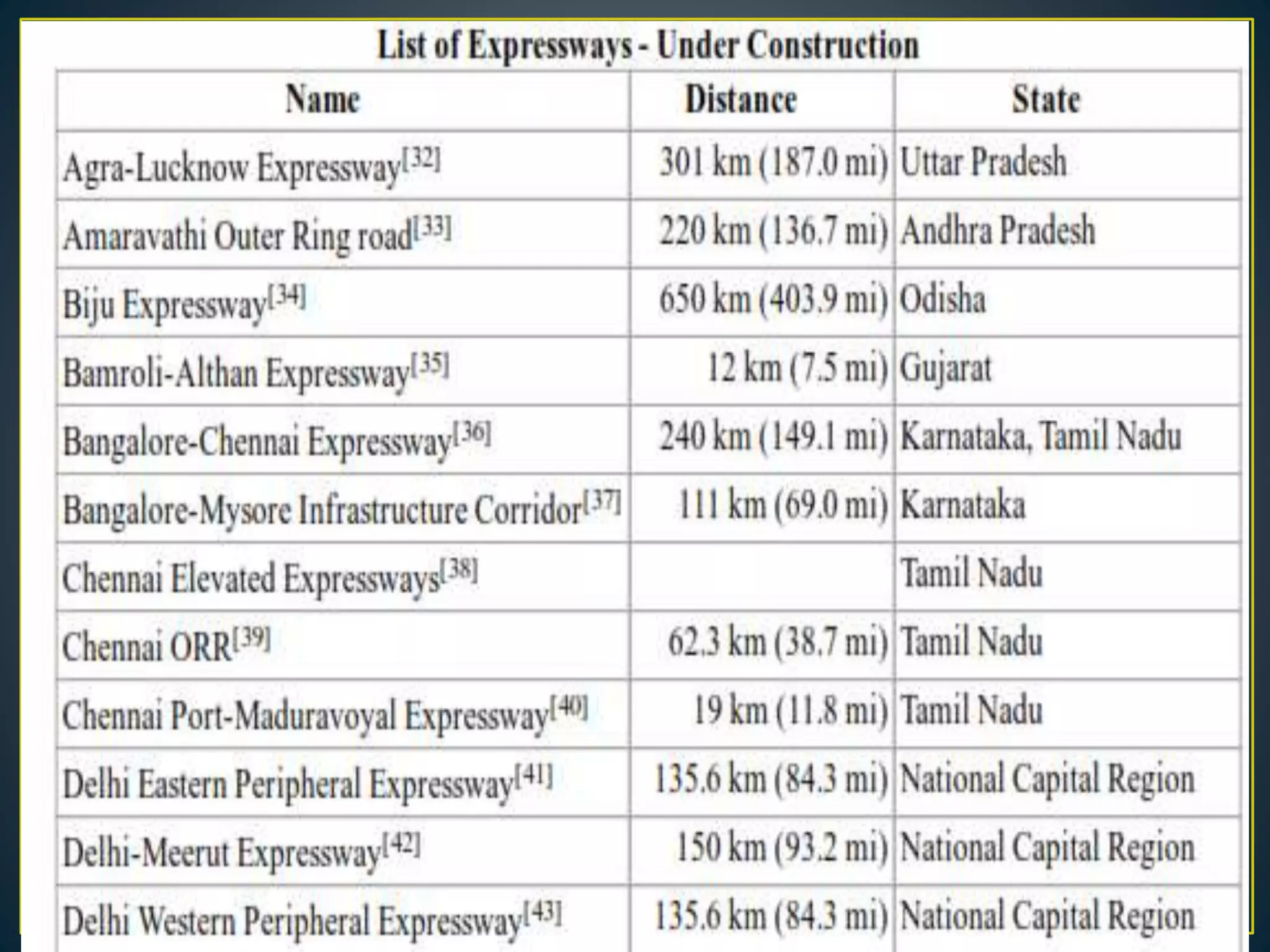
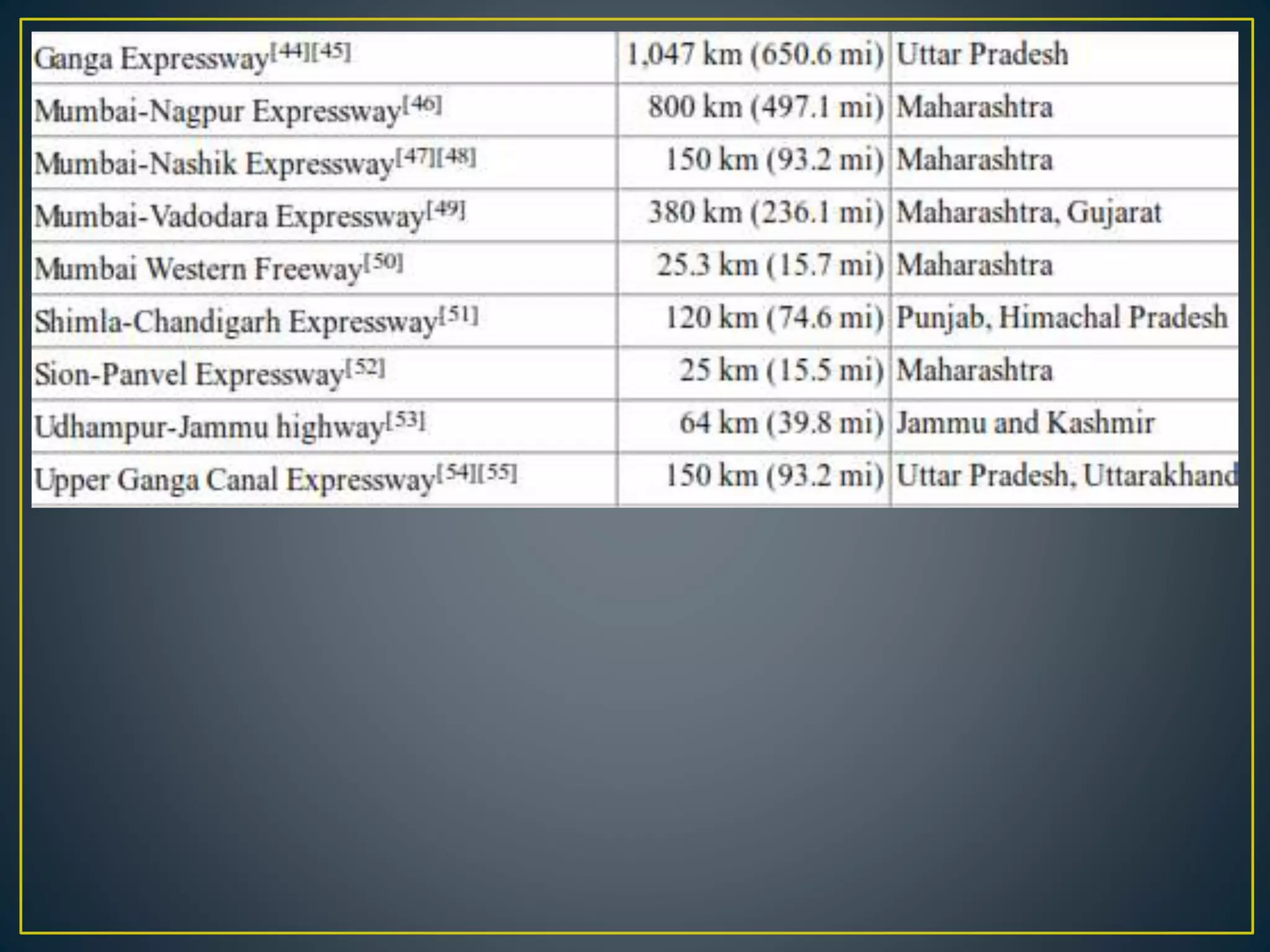
• Currently, expressways in India measure 6000 kms
approximately and work is on to add more to the number. If all
goes according to the plans, around 18,637 kms more
expressways will be added to the Indian Road Network by the
year 2022.
• The length of the expressway will be 302 Kilometer and it will
be the longest access controlled 6 lane expressway in the
country.
• The width of 6 lane expressway is 110 meters which can be
expanded to 8 lanes in future based on requirements.
• About 8,500 acres of land will be required for the entire
expressway out of which more than 7,000 acres or 85% has
been acquired.
• The project will cost about Rs 15,000 Crore and all the cost
will be borne by the state government.
• The speed limit of Agra-Lucknow expressway would be 120
km per hour.
• The construction work at five places Lucknow, Unnao,
Firozabad, Kannauj and Agra had begun and will be done
simultaneously.
• The project will be completed within a time span of merely 22
months
• The project will also provide easy connectivity to the National
Capital Region through Greater Noida-Agra Yamuna
Expressway.
• The project will be developed by and under intense care of
UPEIDA (UP Expressway Industrial Development Authority).
• The expressway will provide faster transport to agricultural
producers, handicrafts and small industries etc.
• The project has been named “Green Field” project.
Ahmedabad Vadodara Expressway (National
Expressway 1)
Length: 96 Kilometers, Connecting Ahmedabad to Vadodara
Cost: 475 Crores
The Expressway is being expanded from 4 to 6 service lanes.
The expressway is proposed to be extended up to Mumbai once
the 6 lane work is completed.
As of 2013, it remains India’s only National Expressway.
• Mumbai-Pune Expressway (official name is the Yashwantrao
Chavan Expressway) is 93 km long and is considered as one of
the best expressways in India.
• It is India’s first six lane high speed expressway and was made
by Maharashtra State Road Development Corporation
(MSRDC)
• Cost of project: Rs 1,630 crore.
• It was opened to public in April 2002.
Mumbai-Pune Expressway
• Mumbai-Pune Expressway (official name is the Yashwantrao
Chavan Expressway) is 93 km long and is considered as one of
the best expressways in India.
• It is India’s first six lane high speed expressway and was made
by Maharashtra State Road Development Corporation
(MSRDC)
• Cost of project: Rs 1,630 crore.
• It was opened to public in April 2002.
• Mumbai-Pune Expressway (official name is the Yashwantrao
Chavan Expressway) is 93 km long and is considered as one of
the best expressways in India.
• It is India’s first six lane high speed expressway and was made
by Maharashtra State Road Development Corporation
(MSRDC)
• Cost of project: Rs 1,630 crore.
• It was opened to public in April 2002.
• Jaipur-Kishangarh Expressway is 90km long and it connects
Jaipur with Kishangarh.
• It was constructed under the Golden Quadrilateral National
Highways Development Project.
• Cost of project: Rs 121 crore.
• It was opened to public in April 2002.
• More than 20,000 vehicles pass from this highway everyday.
• Ambala Chandigarh Expressway covers a distance of 35 km
and has reduced the traffic congestion to a much greater extent.
• It was opened in 2009 and was built at a cost of Rs 298 crore
• Chennai Bypass covers a distance of 32 km and connects four
national highways (NH45, NH4, NH205 and NH5) around
Chennai.
• The cost of this project was Rs 405 crore
• Delhi-Gurgaon Expressway covers a distance of 28 km.
• It was opened for public use in January 2008.
Allahabad Bypass Expressway
Length: 84.708 km completed in 2009
The Allahabad bypass expressway is a part of the National
Highway 2 and passes through the state of Uttar Pradesh.
The projects is also the part of Golden Quadrilateral, India’s
longest bypass section joining the four main Indian metropolitan
cities – Delhi, Kolkata, Mumbai and Chennai.
Constructed by Larsen & Toubro, Hindustan Construction
Company and OSE-KMC (Joint Venture)
Expressway plan
Expressway plan
Expressway plan
Expressway plan

Expressway plan

  • 1.
  • 2.
    • The expresswaysare the highest class of roads in the Indian Road Network. • These four to six lanes expressways makes faster transport networks between many major cities and ports of India. • Two-wheeler vehicles are forbidden on the road due to safety concerns.
  • 4.
    • Expressways area more efficient way to move heavy amounts of traffic. • They have multiple lanes of traffic traveling in the same direction. • Expressways have controlled access for entering and exiting.
  • 5.
    • Directions oftravel are divided by a barrier of some type. • Driving on Expressways are safer than highways, However accidents occurred on expressways are usually more severe. • Heavy traffic can cause congestion and decreased speed.
  • 6.
    • Expressway signs involveinformation, warnings, regulatory, and local restrictions. • It is very important to stay alert and read all signs when driving.
  • 7.
    • Pedestrians, non-motorizedvehicles, and slow vehicles are not permitted on expressways • Expressways have generally wider shoulders than most highways • Guard rail ends are angled away from road • Many expressways have protected turning lanes.
  • 8.
    The following additionalsuggestions may be considered particularly for development of Expressways Network in the country: - • Due emphasis for preserving ecology and environment. • Traffic segregation and discouraging 2 / 3 wheelers expressways including tractors, etc. • Development / construction of “Urban Links” to National Expressways Network. • The programme would need to be implemented jointly by Central and State Governments with participation of the private sector.
  • 9.
    • Currently, expresswaysin India measure 6000 kms approximately and work is on to add more to the number. If all goes according to the plans, around 18,637 kms more expressways will be added to the Indian Road Network by the year 2022.
  • 10.
    • The lengthof the expressway will be 302 Kilometer and it will be the longest access controlled 6 lane expressway in the country. • The width of 6 lane expressway is 110 meters which can be expanded to 8 lanes in future based on requirements. • About 8,500 acres of land will be required for the entire expressway out of which more than 7,000 acres or 85% has been acquired.
  • 11.
    • The projectwill cost about Rs 15,000 Crore and all the cost will be borne by the state government. • The speed limit of Agra-Lucknow expressway would be 120 km per hour. • The construction work at five places Lucknow, Unnao, Firozabad, Kannauj and Agra had begun and will be done simultaneously. • The project will be completed within a time span of merely 22 months
  • 12.
    • The projectwill also provide easy connectivity to the National Capital Region through Greater Noida-Agra Yamuna Expressway. • The project will be developed by and under intense care of UPEIDA (UP Expressway Industrial Development Authority). • The expressway will provide faster transport to agricultural producers, handicrafts and small industries etc. • The project has been named “Green Field” project.
  • 13.
    Ahmedabad Vadodara Expressway(National Expressway 1) Length: 96 Kilometers, Connecting Ahmedabad to Vadodara Cost: 475 Crores The Expressway is being expanded from 4 to 6 service lanes. The expressway is proposed to be extended up to Mumbai once the 6 lane work is completed. As of 2013, it remains India’s only National Expressway.
  • 14.
    • Mumbai-Pune Expressway(official name is the Yashwantrao Chavan Expressway) is 93 km long and is considered as one of the best expressways in India. • It is India’s first six lane high speed expressway and was made by Maharashtra State Road Development Corporation (MSRDC) • Cost of project: Rs 1,630 crore. • It was opened to public in April 2002.
  • 15.
  • 16.
    • Mumbai-Pune Expressway(official name is the Yashwantrao Chavan Expressway) is 93 km long and is considered as one of the best expressways in India. • It is India’s first six lane high speed expressway and was made by Maharashtra State Road Development Corporation (MSRDC) • Cost of project: Rs 1,630 crore. • It was opened to public in April 2002.
  • 17.
    • Mumbai-Pune Expressway(official name is the Yashwantrao Chavan Expressway) is 93 km long and is considered as one of the best expressways in India. • It is India’s first six lane high speed expressway and was made by Maharashtra State Road Development Corporation (MSRDC) • Cost of project: Rs 1,630 crore. • It was opened to public in April 2002.
  • 18.
    • Jaipur-Kishangarh Expresswayis 90km long and it connects Jaipur with Kishangarh. • It was constructed under the Golden Quadrilateral National Highways Development Project. • Cost of project: Rs 121 crore. • It was opened to public in April 2002. • More than 20,000 vehicles pass from this highway everyday.
  • 19.
    • Ambala ChandigarhExpressway covers a distance of 35 km and has reduced the traffic congestion to a much greater extent. • It was opened in 2009 and was built at a cost of Rs 298 crore
  • 20.
    • Chennai Bypasscovers a distance of 32 km and connects four national highways (NH45, NH4, NH205 and NH5) around Chennai. • The cost of this project was Rs 405 crore
  • 21.
    • Delhi-Gurgaon Expresswaycovers a distance of 28 km. • It was opened for public use in January 2008.
  • 22.
    Allahabad Bypass Expressway Length:84.708 km completed in 2009 The Allahabad bypass expressway is a part of the National Highway 2 and passes through the state of Uttar Pradesh. The projects is also the part of Golden Quadrilateral, India’s longest bypass section joining the four main Indian metropolitan cities – Delhi, Kolkata, Mumbai and Chennai. Constructed by Larsen & Toubro, Hindustan Construction Company and OSE-KMC (Joint Venture)