0
Hazard and Operability (HAZOP)
Study
Gaurav Singh Rajput
school of engineering, CUSAT
@gauravkrsrajput
1
HAZOP Fundamental
2
A scenario…
• You and your family are on a road trip by using a
car in the middle of the night. You were replying
a text message while driving at 100 km/h and it w
as raining heavily. The car hits a deep hole and o
ne of your tire blows. You hit the brake, but due t
o slippery road and your car tire thread was thin, t
he car skidded and was thrown off the road.
3
Points to ponder
What is the cause of the accident?
What is the consequence of the event?
What can we do to prevent all those things to happen in the firs
t place?
(5 minutes for brainstorming ideas)
4
What other possible accidents might ha
ppen on the road trip?
Can we be prepared before the accident
occurs?
5
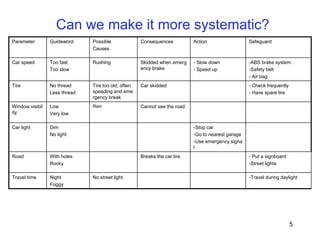
Can we make it more systematic?
Parameter Guideword Possible
Causes
Consequences Action Safeguard
Car speed Too fast
Too slow
Rushing Skidded when emerg
ency brake
- Slow down
- Speed up
-ABS brake system
-Safety belt
- Air bag
Tire No thread
Less thread
Tire too old, often
speeding and eme
rgency break
Car skidded - Check frequently
- Have spare tire
Window visibil
ity
Low
Very low
Rain Cannot see the road
Car light Dim
No light
-Stop car
-Go to nearest garage
-Use emergency signa
l
Road With holes
Rocky
Breaks the car tire - Put a signboard
-Street lights
Travel time Night
Foggy
No street light -Travel during daylight
6
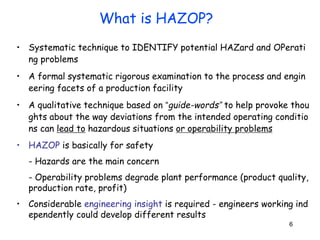
• Systematic technique to IDENTIFY potential HAZard and OPerati
ng problems
• A formal systematic rigorous examination to the process and engin
eering facets of a production facility
• A qualitative technique based on “guide-words” to help provoke thou
ghts about the way deviations from the intended operating conditio
ns can lead to hazardous situations or operability problems
• HAZOP is basically for safety
- Hazards are the main concern
- Operability problems degrade plant performance (product quality,
production rate, profit)
• Considerable engineering insight is required - engineers working ind
ependently could develop different results
What is HAZOP?
7
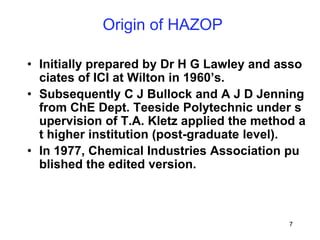
Origin of HAZOP
• Initially prepared by Dr H G Lawley and asso
ciates of ICI at Wilton in 1960’s.
• Subsequently C J Bullock and A J D Jenning
from ChE Dept. Teeside Polytechnic under s
upervision of T.A. Kletz applied the method a
t higher institution (post-graduate level).
• In 1977, Chemical Industries Association pu
blished the edited version.
8
Later Development - HAZOP
• ICI expanded the procedure called HAZARD STUD
Y steps 1 to 6.
• The ICI six steps :
 Project exploration / preliminary project assessment – to i
dentify inherent hazards of process chemicals, site suitab
ility and probable environmental impact.
 Project definition – to identify and reduce significant haza
rds associated with items and areas, check conformity wi
th relevant standards and codes of practices.
USE CHECK LISTS
9
 Design and procurement – to examine the PID in detail for
identification of deviations from design intent capable of
causing operability problems or hazards.
 During final stages of construction – to check that all rec
ommended and accepted actions recorded in steps i, ii a
nd iii implemented.
 During plant commissioning – to check that all relevant st
atutory requirements have been acknowledges and all ins
talled safety systems are reliably operable.
Later Development - HAZOP
10
 During normal operation, some time after start-u
p – especially if any modification been made. To
check if changes in operation has not invalidate
d the HAZOP report of step iii by introducing ne
w hazards.
This procedures are adopted fully or partly by m
any companies around the world.
Later Development - HAZOP
11
Objective of HAZOP
• For identifying cause and the consequences of perceived
mal operations of equipment and associated operator int
erfaces in the context of the complete system.
• It accommodates the status of recognized design stand
ards and codes of practice but rightly questions the rel
evance of these in specific circumstances where hazards may
remain undetected.
12
• HAZOP identifies potential hazards , failures and operability prob
lems.
• Its use is recommended as a principal method by professional insti
tutions and legislators on the basis of proven capabilities for over
40 years.
• It is most effective as a team effort consists of plant and prices
designers, operating personnel, control and instrumentation engine
er etc.
• It encourages creativity in design concept evaluation.
• Its use results in fewer commissioning and operational problems an
d better informed personnel, thus confirming overall cost effectiv
eness improvement.
How and Why HAZOP is Used
13
• Necessary changes to a system for eliminating or reducing the pro
bability of operating deviations are suggested by the analytical pr
ocedure.
• HAZOP provides a necessary management tool and bonus in so far
that it demonstrates to insurers and inspectors evidence of compr
ehensive thoroughness.
• HAZOP reports are an integral part of plant and safety records a
nd are also applicable to design changes and plant modifications, t
hereby containing accountability for equipment and its associated
human interface throughout the operating lifetime.
How and Why HAZOP is Used
14
• HAZOP technique is now used by most major companies handling a
nd processing hazardous material, especially those where engineer
ing practice involves elevated operating parameters :
- oil and gas production
- flammable and toxic chemicals
- pharmaceuticals etc
• Progressive legislation in encouraging smaller and specialty manufa
cturing sites to adopt the method also as standard practice.
How and Why HAZOP is Used
15
• It emphasizes upon the operating integrity of a system, thereby
leading methodically to most potential and detectable deviations
which could conceivably arise in the course of normal operating r
outine
- including "start-up " and "shut-down" procedures
- as well as steady-state operations.
• It is important to remember at all times that HAZOP is an ident
ifying technique and not intended as a means of solving problems
nor is the method intended to be used solely as an undisciplined
means of searching for hazardous scenarios.
Purpose of HAZOP
16
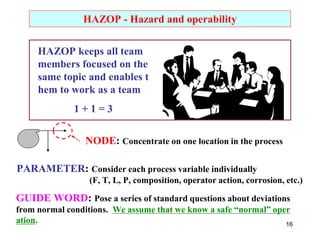
HAZOP - Hazard and operability
HAZOP keeps all team
members focused on the
same topic and enables t
hem to work as a team
1 + 1 = 3
NODE: Concentrate on one location in the process
PARAMETER: Consider each process variable individually
(F, T, L, P, composition, operator action, corrosion, etc.)
GUIDE WORD: Pose a series of standard questions about deviations
from normal conditions. We assume that we know a safe “normal” oper
ation.
17
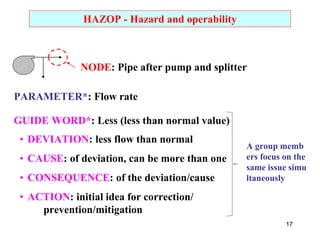
HAZOP - Hazard and operability
NODE: Pipe after pump and splitter
PARAMETER*: Flow rate
GUIDE WORD*: Less (less than normal value)
• DEVIATION: less flow than normal
• CAUSE: of deviation, can be more than one
• CONSEQUENCE: of the deviation/cause
• ACTION: initial idea for correction/
prevention/mitigation
A group memb
ers focus on the
same issue simu
ltaneously
18
Question : How can one be certain to identify all possible deviations ?
Answer : No absolute certainty as the study is subjective and 100 % ac
hievement in this context can have no significance. Any individual or cor
porate effort will yield results directly proportional to the appropriate
background experience of those taking part.
However, with the appropriate levels of individual project-related expe
rtise , such a procedure is fully capable of identifying at least 80 % of
potential deviations which could rise during normal operation.
Relevant Question About HAZOP
19
Separate consideration is demanded for other operating modes, suc
h as commissioning, emergency shut-down procedures and isolation o
f equipment for maintenance or modification.
Once an installation is endorsed by a properly-conducted HAZOP st
udy, it is these non-steady state circumstances which benefit partic
ularly from the technique throughout the life time of the installatio
n.
' Operability' must also consider the human factors involved as well
as the prediction of equipment behavior.
Relevant Question About HAZOP
20
Apart from the uniformity of day-to-day activities , hazards which
could cause major production interruptions and loss, possibly leadin
g to costly incidents, need to be identified :
• Are there chemicals used in the plant which have not been c
lassified as hazard because they are handled in small quantities, ar
e assumed harmless, or are not considered to have long-term toxic
effect upon employees?
• What hazardous materials are transported to or from the s
ite ?
• What routes are taken ?
• What would be the consequences of accidental release?
Relevant Question About HAZOP
21
• What effluents are generated by the operation being carried out or
contemplated ? What regulations require to be honored for their dis
posal?
• Are chemicals properly packaged & labeled?
• Are the consequences of product misuse made absolutely clear?
• Have all potential God-made events and man-made incidents (e. g bre
aches of security, sabotage, electric power failure ) been considered
?
• Are the codes and standards applicable to each facility and relating t
o its design , sitting and construction complied with? For example, in
pressure vessel design.
Relevant Question About HAZOP
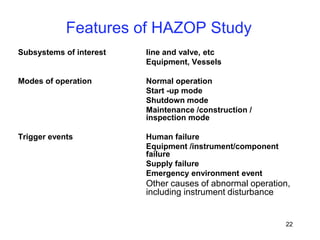
22
Features of HAZOP Study
Subsystems of interest line and valve, etc
Equipment, Vessels
Modes of operation Normal operation
Start -up mode
Shutdown mode
Maintenance /construction /
inspection mode
Trigger events Human failure
Equipment /instrument/component
failure
Supply failure
Emergency environment event
Other causes of abnormal operation,
including instrument disturbance
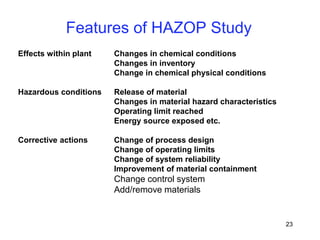
23
Effects within plant Changes in chemical conditions
Changes in inventory
Change in chemical physical conditions
Hazardous conditions Release of material
Changes in material hazard characteristics
Operating limit reached
Energy source exposed etc.
Corrective actions Change of process design
Change of operating limits
Change of system reliability
Improvement of material containment
Change control system
Add/remove materials
Features of HAZOP Study
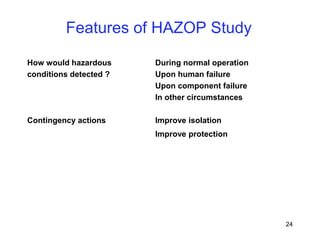
24
How would hazardous During normal operation
conditions detected ? Upon human failure
Upon component failure
In other circumstances
Contingency actions Improve isolation
Improve protection
Features of HAZOP Study
25
Documents Needed for HAZOP Stud
y
• For Preliminary HAZOP
– Process Flow Sheet ( PFS or PFD )
– Description of the Process
• For Detailed HAZOP
– Piping and Instrumentation Diagram ( P & ID )
– Process Calculations
– Process Data Sheets
– Instrument Data Sheets
– Interlock Schedules
– Layout Requirements
– Hazardous Area Classification
– Description of the Process
26
Before Detailed HAZOP
• The development of the detailed P&I Diagram is the l
ast stage of the process design.
• The development will follow a normal standard proc
edure and include the following considerations :
– Basic process control system - this is a closed loop control
to maintain process within an acceptable operating region.
– Alarm system - this is to bring unusual situation to attentio
n of a person monitoring the process in the plant
– Safety interlock system - this is to stop operation or part of
the process during emergencies.
– Relief system - this is to divert material safely during emerg
encies.
27
P&ID
• A Piping and Instrumentation Diagram - P&ID, is a schematic illustratio
n of functional relationship of piping, instrumentation and system equi
pment components.
• P&ID represents the last step in process design.
• P&ID shows all of piping including the physical sequence of branches,
reducers, valves, equipment, instrumentation and control interlocks.
• P&ID is normally developed from process flow diagram (PFD).
• The P&ID are used to operate the process system.
• A process cannot be adequately designed without proper P&ID.
28
A P&ID should include: (Basically every mechanical aspect of the plant with some exceptions)
• Instrumentation and designations
• Mechanical equipment with names and numbers
• All valves and their identifications
• Process piping, sizes and identification
• Miscellaneous - vents, drains, special fittings, sampling lines, reducers, increasers and swager
s
• Permanent start-up and flush lines
• Flow directions
• Interconnections references
• Control inputs and outputs, interlocks
• Interfaces for class changes
• Seismic category
• Quality level
• Annunciation inputs
• Computer control system input
• Vendor and contractor interfaces
• Identification of components and subsystems delivered by others
• Intended physical sequence of the equipment
P&I D
29
A P&ID should not include:
• Instrument root valves
• control relays
• manual switches
• equipment rating or capacity
• primary instrument tubing and valves
• pressure temperature and flow data
• elbow, tees and similar standard fittings
• extensive explanatory notes
P&I D
30
P&ID and Safety
• P&I Diagram
– ISA Standard
– DIN Standard
• Layers of protection
31
• Procedure in HAZOP study consist of examining the process an
d instrumentation (P&I) line diagram , process line by process li
ne .
• A list of guide words is used to generate deviations from norma
l operation corresponding to all conceivable possibilities.
• Guide words covering every parameter relevant to the system u
nder review :i.e. flow rate and quality, pressure, temperature, vi
scosity, components etc.
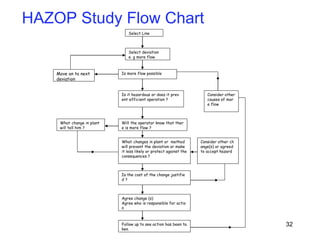
• Flowchart for application of HAZOP is shown in figure.
HAZOP Study Procedure
32
Select Line
Select deviation
e. g more flow
Is more flow possibleMove on to next
deviation
Is it hazardous or does it prev
ent efficient operation ?
Will the operator know that ther
e is more flow ?
What changes in plant or method
will prevent the deviation or make
it less likely or protect against the
consequences ?
Is the cost of the change justifie
d ?
Agree change (s)
Agree who is responsible for actio
n
Consider other
causes of mor
e flow
What change in plant
will tell him ?
Consider other ch
ange(s) or agreed
to accept hazard
Follow up to see action has been ta
ken
HAZOP Study Flow Chart
33
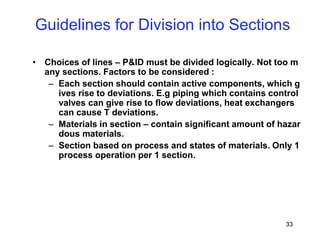
Guidelines for Division into Sections
• Choices of lines – P&ID must be divided logically. Not too m
any sections. Factors to be considered :
– Each section should contain active components, which g
ives rise to deviations. E.g piping which contains control
valves can give rise to flow deviations, heat exchangers
can cause T deviations.
– Materials in section – contain significant amount of hazar
dous materials.
– Section based on process and states of materials. Only 1
process operation per 1 section.
34
• General guidelines :
– Define each major process component as a section. Usu
ally anything assigned equipment number should be con
sidered a major process component.
– Define one line section between each major process com
ponent.
– Define additional line sections for each branches off the
main process flow.
– Define a process section at each connection to existing e
quipment.
Guidelines for Division into Sections
35
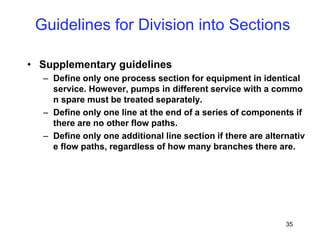
• Supplementary guidelines
– Define only one process section for equipment in identical
service. However, pumps in different service with a commo
n spare must be treated separately.
– Define only one line at the end of a series of components if
there are no other flow paths.
– Define only one additional line section if there are alternativ
e flow paths, regardless of how many branches there are.
Guidelines for Division into Sections
36
• Do not define line between major equipment items
if there are no single active components that coul
d cause deviations.
• Do not define sections for existing equipment that
is upstream of new or modified equipment. Addre
ss malfunctions of such upstream equipment as d
eviations in the new or modified equipment.
Guidelines for Division into Sections
37
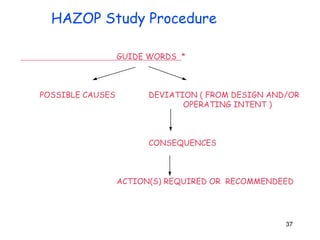
GUIDE WORDS *
POSSIBLE CAUSES DEVIATION ( FROM DESIGN AND/OR
OPERATING INTENT )
CONSEQUENCES
ACTION(S) REQUIRED OR RECOMMENDEED
HAZOP Study Procedure
38
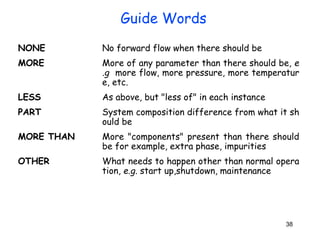
NONE No forward flow when there should be
MORE More of any parameter than there should be, e
.g more flow, more pressure, more temperatur
e, etc.
LESS As above, but "less of" in each instance
PART System composition difference from what it sh
ould be
MORE THAN More "components" present than there should
be for example, extra phase, impurities
OTHER What needs to happen other than normal opera
tion, e.g. start up,shutdown, maintenance
Guide Words
39
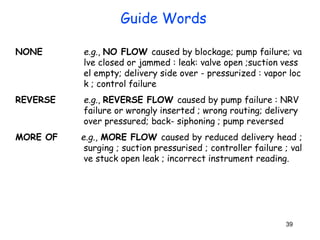
NONE e.g., NO FLOW caused by blockage; pump failure; va
lve closed or jammed : leak: valve open ;suction vess
el empty; delivery side over - pressurized : vapor loc
k ; control failure
REVERSE e.g., REVERSE FLOW caused by pump failure : NRV
failure or wrongly inserted ; wrong routing; delivery
over pressured; back- siphoning ; pump reversed
MORE OF e.g., MORE FLOW caused by reduced delivery head ;
surging ; suction pressurised ; controller failure ; val
ve stuck open leak ; incorrect instrument reading.
Guide Words
40
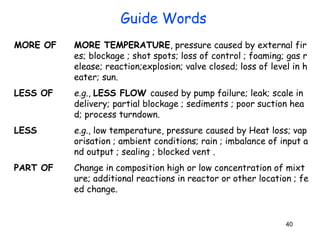
MORE OF MORE TEMPERATURE, pressure caused by external fir
es; blockage ; shot spots; loss of control ; foaming; gas r
elease; reaction;explosion; valve closed; loss of level in h
eater; sun.
LESS OF e.g., LESS FLOW caused by pump failure; leak; scale in
delivery; partial blockage ; sediments ; poor suction hea
d; process turndown.
LESS e.g., low temperature, pressure caused by Heat loss; vap
orisation ; ambient conditions; rain ; imbalance of input a
nd output ; sealing ; blocked vent .
PART OF Change in composition high or low concentration of mixt
ure; additional reactions in reactor or other location ; fe
ed change.
Guide Words
41
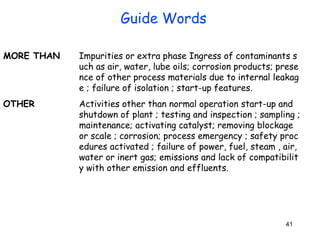
MORE THAN Impurities or extra phase Ingress of contaminants s
uch as air, water, lube oils; corrosion products; prese
nce of other process materials due to internal leakag
e ; failure of isolation ; start-up features.
OTHER Activities other than normal operation start-up and
shutdown of plant ; testing and inspection ; sampling ;
maintenance; activating catalyst; removing blockage
or scale ; corrosion; process emergency ; safety proc
edures activated ; failure of power, fuel, steam , air,
water or inert gas; emissions and lack of compatibilit
y with other emission and effluents.
Guide Words
42
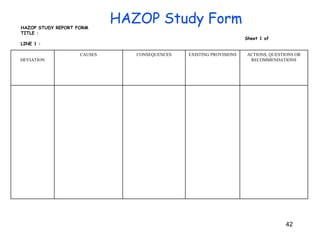
HAZOP STUDY REPORT FORM
TITLE :
Sheet 1 of
LINE 1 :
DEVIATION
CAUSES CONSEQUENCES EXISTING PROVISIONS ACTIONS, QUESTIONS OR
RECOMMENDATIONS
HAZOP Study Form
43
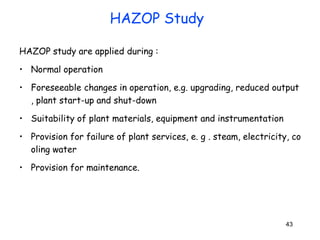
HAZOP study are applied during :
• Normal operation
• Foreseeable changes in operation, e.g. upgrading, reduced output
, plant start-up and shut-down
• Suitability of plant materials, equipment and instrumentation
• Provision for failure of plant services, e. g . steam, electricity, co
oling water
• Provision for maintenance.
HAZOP Study
44
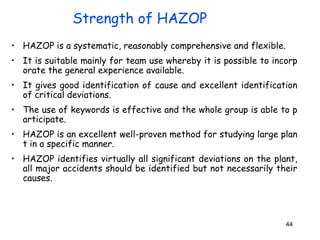
• HAZOP is a systematic, reasonably comprehensive and flexible.
• It is suitable mainly for team use whereby it is possible to incorp
orate the general experience available.
• It gives good identification of cause and excellent identification
of critical deviations.
• The use of keywords is effective and the whole group is able to p
articipate.
• HAZOP is an excellent well-proven method for studying large plan
t in a specific manner.
• HAZOP identifies virtually all significant deviations on the plant,
all major accidents should be identified but not necessarily their
causes.
Strength of HAZOP
45
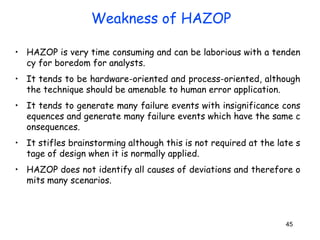
• HAZOP is very time consuming and can be laborious with a tenden
cy for boredom for analysts.
• It tends to be hardware-oriented and process-oriented, although
the technique should be amenable to human error application.
• It tends to generate many failure events with insignificance cons
equences and generate many failure events which have the same c
onsequences.
• It stifles brainstorming although this is not required at the late s
tage of design when it is normally applied.
• HAZOP does not identify all causes of deviations and therefore o
mits many scenarios.
Weakness of HAZOP
46
• It takes little account of the probabilities of events or consequen
ces, although quantitative assessment are sometime added. The g
roup generally let their collective experiences decide whether dev
iations are meaningful.
• HAZOP is poor where multiple-combination events can have sever
e effects.
• It tends to assume defects or deterioration of materials of const
ruction will not arise.
• When identifying consequences, HAZOP tends to encourage listin
g these as resulting in action by emergency control measures with
out considering that such action might fail. It tends to ignore the
contribution which can be made by operator interventions
Weakness of HAZOP
47
Managing HAZOP
How to manage HAZOP
48
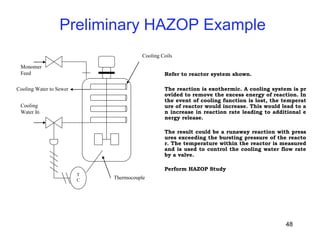
Preliminary HAZOP Example
T
C
Cooling Coils
Monomer
Feed
Cooling Water to Sewer
Cooling
Water In
Thermocouple
Refer to reactor system shown.
The reaction is exothermic. A cooling system is pr
ovided to remove the excess energy of reaction. In
the event of cooling function is lost, the temperat
ure of reactor would increase. This would lead to a
n increase in reaction rate leading to additional e
nergy release.
The result could be a runaway reaction with press
ures exceeding the bursting pressure of the reacto
r. The temperature within the reactor is measured
and is used to control the cooling water flow rate
by a valve.
Perform HAZOP Study
49
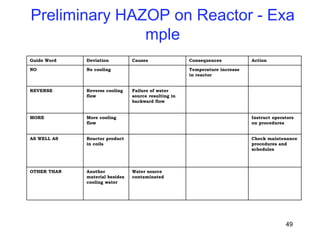
Preliminary HAZOP on Reactor - Exa
mple
Guide Word Deviation Causes Consequences Action
NO No cooling Temperature increase
in reactor
REVERSE Reverse cooling
flow
Failure of water
source resulting in
backward flow
MORE More cooling
flow
Instruct operators
on procedures
AS WELL AS Reactor product
in coils
Check maintenance
procedures and
schedules
OTHER THAN Another
material besides
cooling water
Water source
contaminated
50
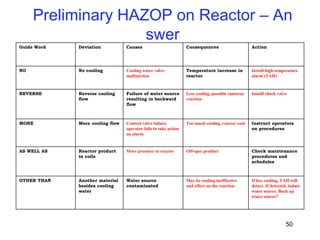
Preliminary HAZOP on Reactor – An
swer
Guide Word Deviation Causes Consequences Action
NO No cooling Cooling water valve
malfunction
Temperature increase in
reactor
Install high temperature
alarm (TAH)
REVERSE Reverse cooling
flow
Failure of water source
resulting in backward
flow
Less cooling, possible runaway
reaction
Install check valve
MORE More cooling flow Control valve failure,
operator fails to take action
on alarm
Too much cooling, reactor cool Instruct operators
on procedures
AS WELL AS Reactor product
in coils
More pressure in reactor Off-spec product Check maintenance
procedures and
schedules
OTHER THAN Another material
besides cooling
water
Water source
contaminated
May be cooling inefffective
and effect on the reaction
If less cooling, TAH will
detect. If detected, isolate
water source. Back up
water source?
51
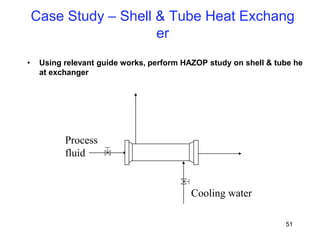
Case Study – Shell & Tube Heat Exchang
er
• Using relevant guide works, perform HAZOP study on shell & tube he
at exchanger
Process
fluid
Cooling water
52
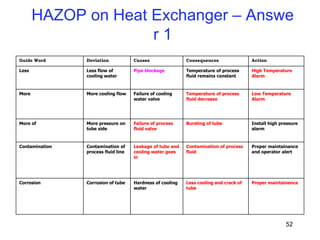
HAZOP on Heat Exchanger – Answe
r 1
Guide Word Deviation Causes Consequences Action
Less Less flow of
cooling water
Pipe blockage Temperature of process
fluid remains constant
High Temperature
Alarm
More More cooling flow Failure of cooling
water valve
Temperature of process
fluid decrease
Low Temperature
Alarm
More of More pressure on
tube side
Failure of process
fluid valve
Bursting of tube Install high pressure
alarm
Contamination Contamination of
process fluid line
Leakage of tube and
cooling water goes
in
Contamination of process
fluid
Proper maintainance
and operator alert
Corrosion Corrosion of tube Hardness of cooling
water
Less cooling and crack of
tube
Proper maintainence
53
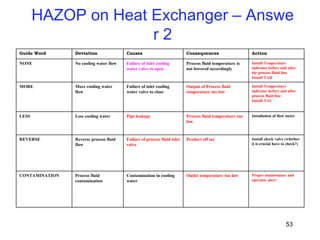
HAZOP on Heat Exchanger – Answe
r 2
Guide Word Deviation Causes Consequences Action
NONE No cooling water flow Failure of inlet cooling
water valve to open
Process fluid temperature is
not lowered accordingly
Install Temperature
indicator before and after
the process fluid line
Install TAH
MORE More cooling water
flow
Failure of inlet cooling
water valve to close
Output of Process fluid
temperature too low
Install Temperature
indicator before and after
process fluid line
Install TAL
LESS Less cooling water Pipe leakage Process fluid temperature too
low
Installation of flow meter
REVERSE Reverse process fluid
flow
Failure of process fluid inlet
valve
Product off set Install check valve (whether
it is crucial have to check?)
CONTAMINATION Process fluid
contamination
Contamination in cooling
water
Outlet temperature too low Proper maintenance and
operator alert
54
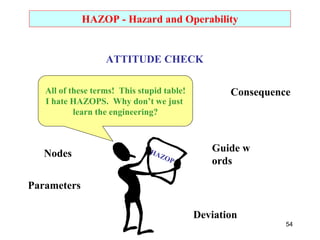
HAZOP - Hazard and Operability
Nodes
Parameters
Guide w
ords
Consequence
Deviation
All of these terms! This stupid table!
I hate HAZOPS. Why don’t we just
learn the engineering?
ATTITUDE CHECK
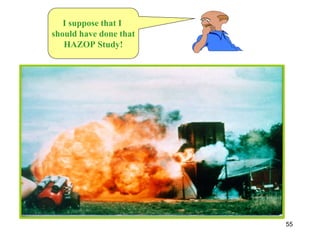
55
I suppose that I
should have done that
HAZOP Study!
56
HAZOP - Hazard and Operability
Without HAZOP
How will you focus all mem
bers of a team on the key is
sues in a systematic manner
?
You are responsibl
e for the safety tea
m.
57
Case Study
Case study hydrogen plant
58
Sample Answers
result HAZOP reactor.doc
59
HAZOP Management
60
What is required?
• Define objectives and scope – define TOR and scope of work.
•To new design – applied to a detailed design.
•To existing design – identify hazards not previously identifi
ed probably because not being HAZOPED.
•To plant modification
• Select team members. Two types of person needed :
•Detailed technical knowledge of the process.
•Those with knowledge and experience of applying highly stru
ctured, systematic HAZOP approach.
Planning for HAZOP Study
61
• Prepare for the study. Need sufficient information :
• Process Flow Sheet ( PFS or PFD )
• Piping and Instrumentation Diagram ( P & ID )
• Process Calculations
• Process Data Sheets
• Instrument Data Sheets
• Interlock Schedules
• Layout Requirements
• Hazardous Area Classification
• Operating instructions
Planning for HAZOP
62
• Prepare for the study. Need sufficient information :
• Safety procedures documents
• Relief/venting philosophy
• Chemical involved
• Piping specifications
• Previous HAZOP report
Planning for HAZOP
63
Planning for HAZOP
• Carry out the study
• Record the results (may need a secretary)
• Follow-up of actions noted
– final report contain resolution of all recommende
d actions
– must appoint someone as leader to check progre
ss of action
– team may meet again if answers to questions do
not simply lead to an action
– team may meet again if significant design change
s in interim report
64
Team Characteristics
– Members share common objectives.
– Everybody contributes and knows his/her roles, not lead
er dependent too much.
– Each members values and respects contribution of other
s.
– Members learn while they work.
– Over a period of time, individual contribution level are m
ore or less equal.
– Disagreement are worked through by discussion.
– The use of voting procedures is sparing and normally on
ly last resort if highly necessary.
– Members enjoy team meetings.
65
Questioning Techniques
• Open questions
– Help person being asked to think – use words ho
w, what and why.
• Closed questions
– To focus on an issue or problem. Start with word
s who, when, where.
– Required answer yes or no only.
• Question mix
– Mix between open and closed questions.
66
• Things to avoid
– Ambiguous or vague questions.
– Double barelled/multiple questions.
– Long complicated questions.
– Interrogation type of questions.
– A loaded questions – implied judgement.
Questioning Techniques
67
HAZOP leader
• Plan sessions and timetable
• Control discussion
• Limit discussion
• Encourage team to draw conclusion
• Ensure secretary has time for taking note
• Keep team in focus
• Encourage imagination of team members
• Motivate members
• Discourage recriminations
• Judge importance issues
Responsibility of HAZOP Team Membe
rs
68
Checklist for HAZOP Leader
• Always prepare study program in advance.
• Agree on the format or form to be used.
• Prepare follow up procedures.
• Brief members about HAZOP during first me
eting.
• Stop the team trying to redesign the process
.
• HAZOP is a team exercise. Do not let anybod
y (including the leader himself to dominate).
69
Checklist for HAZOP Leader
• If conflict arises, handle with care.
• Avoid long discussions by recording areas
which need to be resolved outside meeting.
• Leader must be strong, yet diplomatic.
• Speak clearly. Make you point.
• Better have experience working as team me
mber previously.
• Do not skip anything….some time small thing
s may cause big accident.
70
HAZOP Secretary
• Take adequate notes
• Record documentations
• Inform leader if more time required in taking notes
• If unclear, check wording before writing
• Produce interim lists of recommendations
• Produce draft report of study
• Check progress of chase action
• Produce final report
Responsibility of HAZOP Team Membe
rs
71
Process Engineer
• Provide a simple description
• Provide design intention for each process unit
• Provide information on process conditions and design conditions
• Provide a simple description
• Provide design intention for each process unit
• Provide information on process conditions and design conditions
Responsibility of HAZOP Team Membe
rs
72
Mechanical Design Engineer
• Provide specification details
• Provide vendor package details
• Provide equipment and piping layout information
Instrument Engineer
• Provide details of control philosophy
• Provide interlock and alarm details
• Provide info on shutdown, safety features
Responsibility of HAZOP Team Membe
rs
73
Plant Engineer or Manager
• Provide information on compatibility with any existing adjacent pl
ant
• Provide details of site utilities and services
• Provide (for study on existing plant) any update on maintenance ac
cess and modifications
Shift Operating Engineer or Supervisor
• Provide guidance on control instrumentation integrity from an ope
rating experience view point
• Provide (for study on existing plant) information on plant stability
at the specified control parameters
• Provide information on experienced operability deviations of haza
rd potential
Responsibility of HAZOP Team Membe
rs
74
Chemist
• Provide details of process chemistry
• Provide details of process hazards (polymerisations, byproducts,
corrosion etc)
Project Engineer
• Provide details of cost and time estimation and also budget cons
traints.
• Ensure rapid approval if required
Responsibility of HAZOP Team Membe
rs

Hazard and Operability Study (HAZOP) | Gaurav Singh Rajput

  • 1.
    0 Hazard and Operability(HAZOP) Study Gaurav Singh Rajput school of engineering, CUSAT @gauravkrsrajput
  • 2.
  • 3.
    2 A scenario… • Youand your family are on a road trip by using a car in the middle of the night. You were replying a text message while driving at 100 km/h and it w as raining heavily. The car hits a deep hole and o ne of your tire blows. You hit the brake, but due t o slippery road and your car tire thread was thin, t he car skidded and was thrown off the road.
  • 4.
    3 Points to ponder Whatis the cause of the accident? What is the consequence of the event? What can we do to prevent all those things to happen in the firs t place? (5 minutes for brainstorming ideas)
  • 5.
    4 What other possibleaccidents might ha ppen on the road trip? Can we be prepared before the accident occurs?
  • 6.
    5 Can we makeit more systematic? Parameter Guideword Possible Causes Consequences Action Safeguard Car speed Too fast Too slow Rushing Skidded when emerg ency brake - Slow down - Speed up -ABS brake system -Safety belt - Air bag Tire No thread Less thread Tire too old, often speeding and eme rgency break Car skidded - Check frequently - Have spare tire Window visibil ity Low Very low Rain Cannot see the road Car light Dim No light -Stop car -Go to nearest garage -Use emergency signa l Road With holes Rocky Breaks the car tire - Put a signboard -Street lights Travel time Night Foggy No street light -Travel during daylight
  • 7.
    6 • Systematic techniqueto IDENTIFY potential HAZard and OPerati ng problems • A formal systematic rigorous examination to the process and engin eering facets of a production facility • A qualitative technique based on “guide-words” to help provoke thou ghts about the way deviations from the intended operating conditio ns can lead to hazardous situations or operability problems • HAZOP is basically for safety - Hazards are the main concern - Operability problems degrade plant performance (product quality, production rate, profit) • Considerable engineering insight is required - engineers working ind ependently could develop different results What is HAZOP?
  • 8.
    7 Origin of HAZOP •Initially prepared by Dr H G Lawley and asso ciates of ICI at Wilton in 1960’s. • Subsequently C J Bullock and A J D Jenning from ChE Dept. Teeside Polytechnic under s upervision of T.A. Kletz applied the method a t higher institution (post-graduate level). • In 1977, Chemical Industries Association pu blished the edited version.
  • 9.
    8 Later Development -HAZOP • ICI expanded the procedure called HAZARD STUD Y steps 1 to 6. • The ICI six steps :  Project exploration / preliminary project assessment – to i dentify inherent hazards of process chemicals, site suitab ility and probable environmental impact.  Project definition – to identify and reduce significant haza rds associated with items and areas, check conformity wi th relevant standards and codes of practices. USE CHECK LISTS
  • 10.
    9  Design andprocurement – to examine the PID in detail for identification of deviations from design intent capable of causing operability problems or hazards.  During final stages of construction – to check that all rec ommended and accepted actions recorded in steps i, ii a nd iii implemented.  During plant commissioning – to check that all relevant st atutory requirements have been acknowledges and all ins talled safety systems are reliably operable. Later Development - HAZOP
  • 11.
    10  During normaloperation, some time after start-u p – especially if any modification been made. To check if changes in operation has not invalidate d the HAZOP report of step iii by introducing ne w hazards. This procedures are adopted fully or partly by m any companies around the world. Later Development - HAZOP
  • 12.
    11 Objective of HAZOP •For identifying cause and the consequences of perceived mal operations of equipment and associated operator int erfaces in the context of the complete system. • It accommodates the status of recognized design stand ards and codes of practice but rightly questions the rel evance of these in specific circumstances where hazards may remain undetected.
  • 13.
    12 • HAZOP identifiespotential hazards , failures and operability prob lems. • Its use is recommended as a principal method by professional insti tutions and legislators on the basis of proven capabilities for over 40 years. • It is most effective as a team effort consists of plant and prices designers, operating personnel, control and instrumentation engine er etc. • It encourages creativity in design concept evaluation. • Its use results in fewer commissioning and operational problems an d better informed personnel, thus confirming overall cost effectiv eness improvement. How and Why HAZOP is Used
  • 14.
    13 • Necessary changesto a system for eliminating or reducing the pro bability of operating deviations are suggested by the analytical pr ocedure. • HAZOP provides a necessary management tool and bonus in so far that it demonstrates to insurers and inspectors evidence of compr ehensive thoroughness. • HAZOP reports are an integral part of plant and safety records a nd are also applicable to design changes and plant modifications, t hereby containing accountability for equipment and its associated human interface throughout the operating lifetime. How and Why HAZOP is Used
  • 15.
    14 • HAZOP techniqueis now used by most major companies handling a nd processing hazardous material, especially those where engineer ing practice involves elevated operating parameters : - oil and gas production - flammable and toxic chemicals - pharmaceuticals etc • Progressive legislation in encouraging smaller and specialty manufa cturing sites to adopt the method also as standard practice. How and Why HAZOP is Used
  • 16.
    15 • It emphasizesupon the operating integrity of a system, thereby leading methodically to most potential and detectable deviations which could conceivably arise in the course of normal operating r outine - including "start-up " and "shut-down" procedures - as well as steady-state operations. • It is important to remember at all times that HAZOP is an ident ifying technique and not intended as a means of solving problems nor is the method intended to be used solely as an undisciplined means of searching for hazardous scenarios. Purpose of HAZOP
  • 17.
    16 HAZOP - Hazardand operability HAZOP keeps all team members focused on the same topic and enables t hem to work as a team 1 + 1 = 3 NODE: Concentrate on one location in the process PARAMETER: Consider each process variable individually (F, T, L, P, composition, operator action, corrosion, etc.) GUIDE WORD: Pose a series of standard questions about deviations from normal conditions. We assume that we know a safe “normal” oper ation.
  • 18.
    17 HAZOP - Hazardand operability NODE: Pipe after pump and splitter PARAMETER*: Flow rate GUIDE WORD*: Less (less than normal value) • DEVIATION: less flow than normal • CAUSE: of deviation, can be more than one • CONSEQUENCE: of the deviation/cause • ACTION: initial idea for correction/ prevention/mitigation A group memb ers focus on the same issue simu ltaneously
  • 19.
    18 Question : Howcan one be certain to identify all possible deviations ? Answer : No absolute certainty as the study is subjective and 100 % ac hievement in this context can have no significance. Any individual or cor porate effort will yield results directly proportional to the appropriate background experience of those taking part. However, with the appropriate levels of individual project-related expe rtise , such a procedure is fully capable of identifying at least 80 % of potential deviations which could rise during normal operation. Relevant Question About HAZOP
  • 20.
    19 Separate consideration isdemanded for other operating modes, suc h as commissioning, emergency shut-down procedures and isolation o f equipment for maintenance or modification. Once an installation is endorsed by a properly-conducted HAZOP st udy, it is these non-steady state circumstances which benefit partic ularly from the technique throughout the life time of the installatio n. ' Operability' must also consider the human factors involved as well as the prediction of equipment behavior. Relevant Question About HAZOP
  • 21.
    20 Apart from theuniformity of day-to-day activities , hazards which could cause major production interruptions and loss, possibly leadin g to costly incidents, need to be identified : • Are there chemicals used in the plant which have not been c lassified as hazard because they are handled in small quantities, ar e assumed harmless, or are not considered to have long-term toxic effect upon employees? • What hazardous materials are transported to or from the s ite ? • What routes are taken ? • What would be the consequences of accidental release? Relevant Question About HAZOP
  • 22.
    21 • What effluentsare generated by the operation being carried out or contemplated ? What regulations require to be honored for their dis posal? • Are chemicals properly packaged & labeled? • Are the consequences of product misuse made absolutely clear? • Have all potential God-made events and man-made incidents (e. g bre aches of security, sabotage, electric power failure ) been considered ? • Are the codes and standards applicable to each facility and relating t o its design , sitting and construction complied with? For example, in pressure vessel design. Relevant Question About HAZOP
  • 23.
    22 Features of HAZOPStudy Subsystems of interest line and valve, etc Equipment, Vessels Modes of operation Normal operation Start -up mode Shutdown mode Maintenance /construction / inspection mode Trigger events Human failure Equipment /instrument/component failure Supply failure Emergency environment event Other causes of abnormal operation, including instrument disturbance
  • 24.
    23 Effects within plantChanges in chemical conditions Changes in inventory Change in chemical physical conditions Hazardous conditions Release of material Changes in material hazard characteristics Operating limit reached Energy source exposed etc. Corrective actions Change of process design Change of operating limits Change of system reliability Improvement of material containment Change control system Add/remove materials Features of HAZOP Study
  • 25.
    24 How would hazardousDuring normal operation conditions detected ? Upon human failure Upon component failure In other circumstances Contingency actions Improve isolation Improve protection Features of HAZOP Study
  • 26.
    25 Documents Needed forHAZOP Stud y • For Preliminary HAZOP – Process Flow Sheet ( PFS or PFD ) – Description of the Process • For Detailed HAZOP – Piping and Instrumentation Diagram ( P & ID ) – Process Calculations – Process Data Sheets – Instrument Data Sheets – Interlock Schedules – Layout Requirements – Hazardous Area Classification – Description of the Process
  • 27.
    26 Before Detailed HAZOP •The development of the detailed P&I Diagram is the l ast stage of the process design. • The development will follow a normal standard proc edure and include the following considerations : – Basic process control system - this is a closed loop control to maintain process within an acceptable operating region. – Alarm system - this is to bring unusual situation to attentio n of a person monitoring the process in the plant – Safety interlock system - this is to stop operation or part of the process during emergencies. – Relief system - this is to divert material safely during emerg encies.
  • 28.
    27 P&ID • A Pipingand Instrumentation Diagram - P&ID, is a schematic illustratio n of functional relationship of piping, instrumentation and system equi pment components. • P&ID represents the last step in process design. • P&ID shows all of piping including the physical sequence of branches, reducers, valves, equipment, instrumentation and control interlocks. • P&ID is normally developed from process flow diagram (PFD). • The P&ID are used to operate the process system. • A process cannot be adequately designed without proper P&ID.
  • 29.
    28 A P&ID shouldinclude: (Basically every mechanical aspect of the plant with some exceptions) • Instrumentation and designations • Mechanical equipment with names and numbers • All valves and their identifications • Process piping, sizes and identification • Miscellaneous - vents, drains, special fittings, sampling lines, reducers, increasers and swager s • Permanent start-up and flush lines • Flow directions • Interconnections references • Control inputs and outputs, interlocks • Interfaces for class changes • Seismic category • Quality level • Annunciation inputs • Computer control system input • Vendor and contractor interfaces • Identification of components and subsystems delivered by others • Intended physical sequence of the equipment P&I D
  • 30.
    29 A P&ID shouldnot include: • Instrument root valves • control relays • manual switches • equipment rating or capacity • primary instrument tubing and valves • pressure temperature and flow data • elbow, tees and similar standard fittings • extensive explanatory notes P&I D
  • 31.
    30 P&ID and Safety •P&I Diagram – ISA Standard – DIN Standard • Layers of protection
  • 32.
    31 • Procedure inHAZOP study consist of examining the process an d instrumentation (P&I) line diagram , process line by process li ne . • A list of guide words is used to generate deviations from norma l operation corresponding to all conceivable possibilities. • Guide words covering every parameter relevant to the system u nder review :i.e. flow rate and quality, pressure, temperature, vi scosity, components etc. • Flowchart for application of HAZOP is shown in figure. HAZOP Study Procedure
  • 33.
    32 Select Line Select deviation e.g more flow Is more flow possibleMove on to next deviation Is it hazardous or does it prev ent efficient operation ? Will the operator know that ther e is more flow ? What changes in plant or method will prevent the deviation or make it less likely or protect against the consequences ? Is the cost of the change justifie d ? Agree change (s) Agree who is responsible for actio n Consider other causes of mor e flow What change in plant will tell him ? Consider other ch ange(s) or agreed to accept hazard Follow up to see action has been ta ken HAZOP Study Flow Chart
  • 34.
    33 Guidelines for Divisioninto Sections • Choices of lines – P&ID must be divided logically. Not too m any sections. Factors to be considered : – Each section should contain active components, which g ives rise to deviations. E.g piping which contains control valves can give rise to flow deviations, heat exchangers can cause T deviations. – Materials in section – contain significant amount of hazar dous materials. – Section based on process and states of materials. Only 1 process operation per 1 section.
  • 35.
    34 • General guidelines: – Define each major process component as a section. Usu ally anything assigned equipment number should be con sidered a major process component. – Define one line section between each major process com ponent. – Define additional line sections for each branches off the main process flow. – Define a process section at each connection to existing e quipment. Guidelines for Division into Sections
  • 36.
    35 • Supplementary guidelines –Define only one process section for equipment in identical service. However, pumps in different service with a commo n spare must be treated separately. – Define only one line at the end of a series of components if there are no other flow paths. – Define only one additional line section if there are alternativ e flow paths, regardless of how many branches there are. Guidelines for Division into Sections
  • 37.
    36 • Do notdefine line between major equipment items if there are no single active components that coul d cause deviations. • Do not define sections for existing equipment that is upstream of new or modified equipment. Addre ss malfunctions of such upstream equipment as d eviations in the new or modified equipment. Guidelines for Division into Sections
  • 38.
    37 GUIDE WORDS * POSSIBLECAUSES DEVIATION ( FROM DESIGN AND/OR OPERATING INTENT ) CONSEQUENCES ACTION(S) REQUIRED OR RECOMMENDEED HAZOP Study Procedure
  • 39.
    38 NONE No forwardflow when there should be MORE More of any parameter than there should be, e .g more flow, more pressure, more temperatur e, etc. LESS As above, but "less of" in each instance PART System composition difference from what it sh ould be MORE THAN More "components" present than there should be for example, extra phase, impurities OTHER What needs to happen other than normal opera tion, e.g. start up,shutdown, maintenance Guide Words
  • 40.
    39 NONE e.g., NOFLOW caused by blockage; pump failure; va lve closed or jammed : leak: valve open ;suction vess el empty; delivery side over - pressurized : vapor loc k ; control failure REVERSE e.g., REVERSE FLOW caused by pump failure : NRV failure or wrongly inserted ; wrong routing; delivery over pressured; back- siphoning ; pump reversed MORE OF e.g., MORE FLOW caused by reduced delivery head ; surging ; suction pressurised ; controller failure ; val ve stuck open leak ; incorrect instrument reading. Guide Words
  • 41.
    40 MORE OF MORETEMPERATURE, pressure caused by external fir es; blockage ; shot spots; loss of control ; foaming; gas r elease; reaction;explosion; valve closed; loss of level in h eater; sun. LESS OF e.g., LESS FLOW caused by pump failure; leak; scale in delivery; partial blockage ; sediments ; poor suction hea d; process turndown. LESS e.g., low temperature, pressure caused by Heat loss; vap orisation ; ambient conditions; rain ; imbalance of input a nd output ; sealing ; blocked vent . PART OF Change in composition high or low concentration of mixt ure; additional reactions in reactor or other location ; fe ed change. Guide Words
  • 42.
    41 MORE THAN Impuritiesor extra phase Ingress of contaminants s uch as air, water, lube oils; corrosion products; prese nce of other process materials due to internal leakag e ; failure of isolation ; start-up features. OTHER Activities other than normal operation start-up and shutdown of plant ; testing and inspection ; sampling ; maintenance; activating catalyst; removing blockage or scale ; corrosion; process emergency ; safety proc edures activated ; failure of power, fuel, steam , air, water or inert gas; emissions and lack of compatibilit y with other emission and effluents. Guide Words
  • 43.
    42 HAZOP STUDY REPORTFORM TITLE : Sheet 1 of LINE 1 : DEVIATION CAUSES CONSEQUENCES EXISTING PROVISIONS ACTIONS, QUESTIONS OR RECOMMENDATIONS HAZOP Study Form
  • 44.
    43 HAZOP study areapplied during : • Normal operation • Foreseeable changes in operation, e.g. upgrading, reduced output , plant start-up and shut-down • Suitability of plant materials, equipment and instrumentation • Provision for failure of plant services, e. g . steam, electricity, co oling water • Provision for maintenance. HAZOP Study
  • 45.
    44 • HAZOP isa systematic, reasonably comprehensive and flexible. • It is suitable mainly for team use whereby it is possible to incorp orate the general experience available. • It gives good identification of cause and excellent identification of critical deviations. • The use of keywords is effective and the whole group is able to p articipate. • HAZOP is an excellent well-proven method for studying large plan t in a specific manner. • HAZOP identifies virtually all significant deviations on the plant, all major accidents should be identified but not necessarily their causes. Strength of HAZOP
  • 46.
    45 • HAZOP isvery time consuming and can be laborious with a tenden cy for boredom for analysts. • It tends to be hardware-oriented and process-oriented, although the technique should be amenable to human error application. • It tends to generate many failure events with insignificance cons equences and generate many failure events which have the same c onsequences. • It stifles brainstorming although this is not required at the late s tage of design when it is normally applied. • HAZOP does not identify all causes of deviations and therefore o mits many scenarios. Weakness of HAZOP
  • 47.
    46 • It takeslittle account of the probabilities of events or consequen ces, although quantitative assessment are sometime added. The g roup generally let their collective experiences decide whether dev iations are meaningful. • HAZOP is poor where multiple-combination events can have sever e effects. • It tends to assume defects or deterioration of materials of const ruction will not arise. • When identifying consequences, HAZOP tends to encourage listin g these as resulting in action by emergency control measures with out considering that such action might fail. It tends to ignore the contribution which can be made by operator interventions Weakness of HAZOP
  • 48.
  • 49.
    48 Preliminary HAZOP Example T C CoolingCoils Monomer Feed Cooling Water to Sewer Cooling Water In Thermocouple Refer to reactor system shown. The reaction is exothermic. A cooling system is pr ovided to remove the excess energy of reaction. In the event of cooling function is lost, the temperat ure of reactor would increase. This would lead to a n increase in reaction rate leading to additional e nergy release. The result could be a runaway reaction with press ures exceeding the bursting pressure of the reacto r. The temperature within the reactor is measured and is used to control the cooling water flow rate by a valve. Perform HAZOP Study
  • 50.
    49 Preliminary HAZOP onReactor - Exa mple Guide Word Deviation Causes Consequences Action NO No cooling Temperature increase in reactor REVERSE Reverse cooling flow Failure of water source resulting in backward flow MORE More cooling flow Instruct operators on procedures AS WELL AS Reactor product in coils Check maintenance procedures and schedules OTHER THAN Another material besides cooling water Water source contaminated
  • 51.
    50 Preliminary HAZOP onReactor – An swer Guide Word Deviation Causes Consequences Action NO No cooling Cooling water valve malfunction Temperature increase in reactor Install high temperature alarm (TAH) REVERSE Reverse cooling flow Failure of water source resulting in backward flow Less cooling, possible runaway reaction Install check valve MORE More cooling flow Control valve failure, operator fails to take action on alarm Too much cooling, reactor cool Instruct operators on procedures AS WELL AS Reactor product in coils More pressure in reactor Off-spec product Check maintenance procedures and schedules OTHER THAN Another material besides cooling water Water source contaminated May be cooling inefffective and effect on the reaction If less cooling, TAH will detect. If detected, isolate water source. Back up water source?
  • 52.
    51 Case Study –Shell & Tube Heat Exchang er • Using relevant guide works, perform HAZOP study on shell & tube he at exchanger Process fluid Cooling water
  • 53.
    52 HAZOP on HeatExchanger – Answe r 1 Guide Word Deviation Causes Consequences Action Less Less flow of cooling water Pipe blockage Temperature of process fluid remains constant High Temperature Alarm More More cooling flow Failure of cooling water valve Temperature of process fluid decrease Low Temperature Alarm More of More pressure on tube side Failure of process fluid valve Bursting of tube Install high pressure alarm Contamination Contamination of process fluid line Leakage of tube and cooling water goes in Contamination of process fluid Proper maintainance and operator alert Corrosion Corrosion of tube Hardness of cooling water Less cooling and crack of tube Proper maintainence
  • 54.
    53 HAZOP on HeatExchanger – Answe r 2 Guide Word Deviation Causes Consequences Action NONE No cooling water flow Failure of inlet cooling water valve to open Process fluid temperature is not lowered accordingly Install Temperature indicator before and after the process fluid line Install TAH MORE More cooling water flow Failure of inlet cooling water valve to close Output of Process fluid temperature too low Install Temperature indicator before and after process fluid line Install TAL LESS Less cooling water Pipe leakage Process fluid temperature too low Installation of flow meter REVERSE Reverse process fluid flow Failure of process fluid inlet valve Product off set Install check valve (whether it is crucial have to check?) CONTAMINATION Process fluid contamination Contamination in cooling water Outlet temperature too low Proper maintenance and operator alert
  • 55.
    54 HAZOP - Hazardand Operability Nodes Parameters Guide w ords Consequence Deviation All of these terms! This stupid table! I hate HAZOPS. Why don’t we just learn the engineering? ATTITUDE CHECK
  • 56.
    55 I suppose thatI should have done that HAZOP Study!
  • 57.
    56 HAZOP - Hazardand Operability Without HAZOP How will you focus all mem bers of a team on the key is sues in a systematic manner ? You are responsibl e for the safety tea m.
  • 58.
  • 59.
  • 60.
  • 61.
    60 What is required? •Define objectives and scope – define TOR and scope of work. •To new design – applied to a detailed design. •To existing design – identify hazards not previously identifi ed probably because not being HAZOPED. •To plant modification • Select team members. Two types of person needed : •Detailed technical knowledge of the process. •Those with knowledge and experience of applying highly stru ctured, systematic HAZOP approach. Planning for HAZOP Study
  • 62.
    61 • Prepare forthe study. Need sufficient information : • Process Flow Sheet ( PFS or PFD ) • Piping and Instrumentation Diagram ( P & ID ) • Process Calculations • Process Data Sheets • Instrument Data Sheets • Interlock Schedules • Layout Requirements • Hazardous Area Classification • Operating instructions Planning for HAZOP
  • 63.
    62 • Prepare forthe study. Need sufficient information : • Safety procedures documents • Relief/venting philosophy • Chemical involved • Piping specifications • Previous HAZOP report Planning for HAZOP
  • 64.
    63 Planning for HAZOP •Carry out the study • Record the results (may need a secretary) • Follow-up of actions noted – final report contain resolution of all recommende d actions – must appoint someone as leader to check progre ss of action – team may meet again if answers to questions do not simply lead to an action – team may meet again if significant design change s in interim report
  • 65.
    64 Team Characteristics – Membersshare common objectives. – Everybody contributes and knows his/her roles, not lead er dependent too much. – Each members values and respects contribution of other s. – Members learn while they work. – Over a period of time, individual contribution level are m ore or less equal. – Disagreement are worked through by discussion. – The use of voting procedures is sparing and normally on ly last resort if highly necessary. – Members enjoy team meetings.
  • 66.
    65 Questioning Techniques • Openquestions – Help person being asked to think – use words ho w, what and why. • Closed questions – To focus on an issue or problem. Start with word s who, when, where. – Required answer yes or no only. • Question mix – Mix between open and closed questions.
  • 67.
    66 • Things toavoid – Ambiguous or vague questions. – Double barelled/multiple questions. – Long complicated questions. – Interrogation type of questions. – A loaded questions – implied judgement. Questioning Techniques
  • 68.
    67 HAZOP leader • Plansessions and timetable • Control discussion • Limit discussion • Encourage team to draw conclusion • Ensure secretary has time for taking note • Keep team in focus • Encourage imagination of team members • Motivate members • Discourage recriminations • Judge importance issues Responsibility of HAZOP Team Membe rs
  • 69.
    68 Checklist for HAZOPLeader • Always prepare study program in advance. • Agree on the format or form to be used. • Prepare follow up procedures. • Brief members about HAZOP during first me eting. • Stop the team trying to redesign the process . • HAZOP is a team exercise. Do not let anybod y (including the leader himself to dominate).
  • 70.
    69 Checklist for HAZOPLeader • If conflict arises, handle with care. • Avoid long discussions by recording areas which need to be resolved outside meeting. • Leader must be strong, yet diplomatic. • Speak clearly. Make you point. • Better have experience working as team me mber previously. • Do not skip anything….some time small thing s may cause big accident.
  • 71.
    70 HAZOP Secretary • Takeadequate notes • Record documentations • Inform leader if more time required in taking notes • If unclear, check wording before writing • Produce interim lists of recommendations • Produce draft report of study • Check progress of chase action • Produce final report Responsibility of HAZOP Team Membe rs
  • 72.
    71 Process Engineer • Providea simple description • Provide design intention for each process unit • Provide information on process conditions and design conditions • Provide a simple description • Provide design intention for each process unit • Provide information on process conditions and design conditions Responsibility of HAZOP Team Membe rs
  • 73.
    72 Mechanical Design Engineer •Provide specification details • Provide vendor package details • Provide equipment and piping layout information Instrument Engineer • Provide details of control philosophy • Provide interlock and alarm details • Provide info on shutdown, safety features Responsibility of HAZOP Team Membe rs
  • 74.
    73 Plant Engineer orManager • Provide information on compatibility with any existing adjacent pl ant • Provide details of site utilities and services • Provide (for study on existing plant) any update on maintenance ac cess and modifications Shift Operating Engineer or Supervisor • Provide guidance on control instrumentation integrity from an ope rating experience view point • Provide (for study on existing plant) information on plant stability at the specified control parameters • Provide information on experienced operability deviations of haza rd potential Responsibility of HAZOP Team Membe rs
  • 75.
    74 Chemist • Provide detailsof process chemistry • Provide details of process hazards (polymerisations, byproducts, corrosion etc) Project Engineer • Provide details of cost and time estimation and also budget cons traints. • Ensure rapid approval if required Responsibility of HAZOP Team Membe rs