Emergency Response Programme
Index
 Understanding Terminology
 Emergency Introduction
 Causes of Emergency
 Emergency Response Programme
 Emergency Management System
 Emergency Response Team
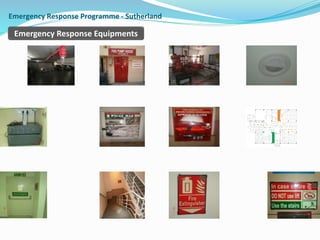
 Emergency Response Equipments
 Procedures in the event of emergency
 Emergency Responder Responsibility
 Emergency Responder Tool Kit
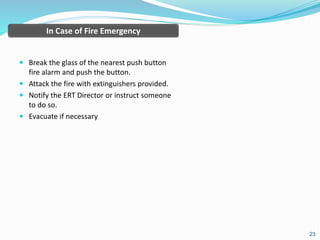
 In Case of Fire Emergency
 In Case of Earth Quake Emergency
 In Case of Bomb Threat Emergency
 Emergency Handling and Transportation
 Disaster is a situation in which the organization is incapable of coping.
 Emergency is a situation in which the organization is capable of coping.
 Risk is the probability that loss will occur as the result of an adverse
event.
 Hazard is the potential for a natural or human-caused event to occur
with negative consequences.
 A hazard can become an emergency; when the emergency moves
beyond the control, it becomes a disaster.
Understanding of Terminology
 An emergency is a situation that poses an immediate
loss to health, life, property or environment.
 Type of Emergency:
 Emergency to life
 Emergency to health
 Emergency to property
 Emergency to environment
Emergency Introduction
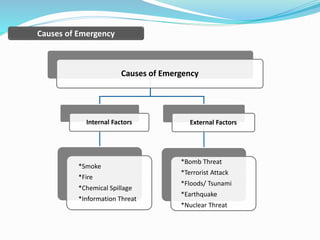
Causes of Emergency
Internal Factors
*Smoke
*Fire
*Chemical Spillage
*Information Threat
External Factors
*Bomb Threat
*Terrorist Attack
*Floods/ Tsunami
*Earthquake
*Nuclear Threat
Causes of Emergency
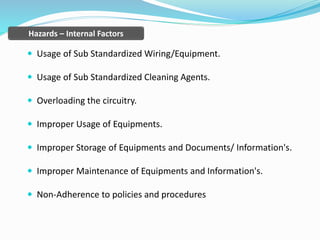
 Usage of Sub Standardized Wiring/Equipment.
 Usage of Sub Standardized Cleaning Agents.
 Overloading the circuitry.
 Improper Usage of Equipments.
 Improper Storage of Equipments and Documents/ Information's.
 Improper Maintenance of Equipments and Information's.
 Non-Adherence to policies and procedures
Hazards – Internal Factors
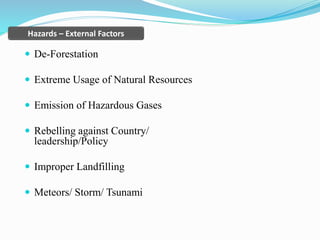
 De-Forestation
 Extreme Usage of Natural Resources
 Emission of Hazardous Gases
 Rebelling against Country/
leadership/Policy
 Improper Landfilling
 Meteors/ Storm/ Tsunami
Hazards – External Factors
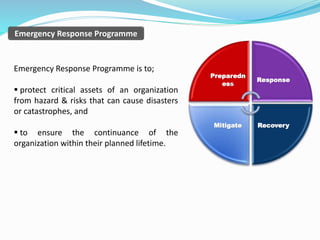
Preparedn
ess
Response
RecoveryMitigate
Emergency Response Programme is to;
 protect critical assets of an organization
from hazard & risks that can cause disasters
or catastrophes, and
 to ensure the continuance of the
organization within their planned lifetime.
Emergency Response Programme
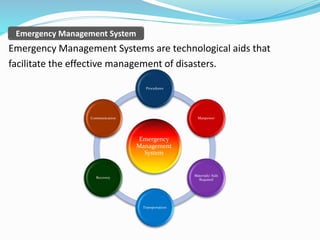
Emergency Management Systems are technological aids that
facilitate the effective management of disasters.
Emergency
Management
System
Procedures
Manpower
Materials/ Aids
Required
Transportation
Recovery
Communication
Emergency Management System
An Emergency Response Team (ERT) is a group of people
who are prepared for and respond to any emergency
incident, such as an interruption of business operations.
Emergency Response Team
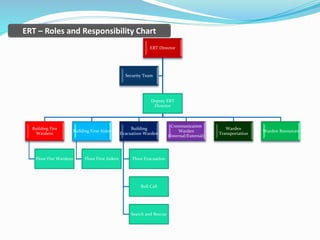
ERT Director
Deputy ERT
Director
Building Fire
Wardens
Floor Fire Wardens
Building First Aider
Floor First Aiders
Building
Evacuation Warden
Floor Evacuation
Roll Call
Search and Rescue
Communication
Warden
(Internal/External)
Warden
Transportation
Warden Resources
Security Team
ERT – Roles and Responsibility Chart
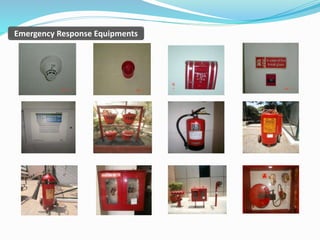
Emergency Response Equipments
Emergency Response Programme - Sutherland
Emergency Response Equipments
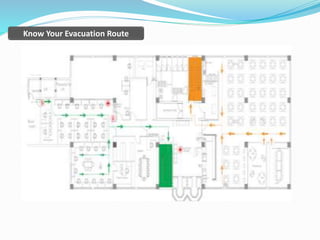
Know Your Evacuation Route
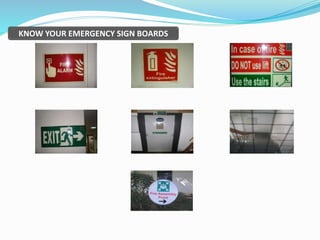
KNOW YOUR EMERGENCY SIGN BOARDS
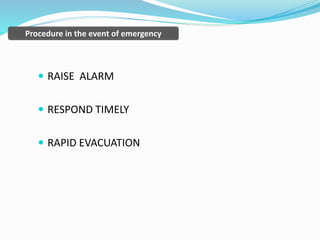
 RAISE ALARM
 RESPOND TIMELY
 RAPID EVACUATION
Procedure in the event of emergency
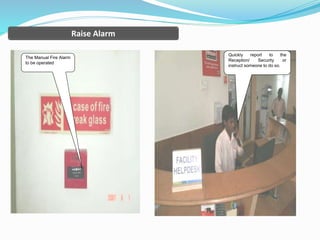
Quickly report to the
Reception/ Security or
instruct someone to do so.
The Manual Fire Alarm
to be operated
Raise Alarm
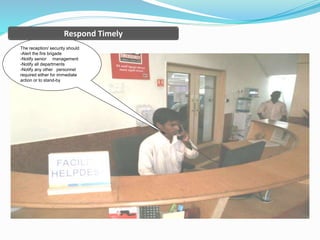
The reception/ security should
-Alert the fire brigade
-Notify senior management
-Notify all departments
-Notify any other personnel
required either for immediate
action or to stand-by
Respond Timely
Every employee should evacuate calmly and orderly
through the nearest exit (escape) route.
Do not wait to collect your belongings during
evacuation process.
(Picture: Employees evacuating through main
entrance.)
Every employee should know the alternative route
incase the main escape route is not approachable
due to fire. (Picture: Employees evacuating
through main gate.)
Should assemble at Assembly Point for roll call.
After Roll Call to wait for the clearance from Security/ Fire
Warden/ Incident Commander
(Picture: Assembling at the Assembly Point)
(Picture: Employees walking
towards the assembly point)
2
Rapid Evacuation
 Evacuate the wing/floor/building in a calm, complete and orderly manner through the nearest
exit.
 Search/sweep the respective floors(rest room, meeting room etc) and ensure that everyone have
left. (Subject to the situation, existing in the floor)
 Ensure Visitors and Vendors are also directed to the assembly point.
 Take the head counts at the assembly point of the respective wing/floor/building.
 Complete the roll call list and report to the Incident Commander.
 Assist the differently abled and pregnant employees during evacuation.
 ALL CLEAR will be declared by the INCIDENT COMMANDER
ER Responsibility
 Ensure all employees to re-enter the building through normal entrance not through the
emergency exits
 Develop a backup, to support in case of absence or increase in head count.
 Ensure passage or the area near the exit/emergency exit should free from obstacles.
 Ensure evacuation layout boards are available in their respective floors.
 Ensure fire extinguisher/ exit/ emergency exit/ First Aid/ In case of fire break glass
signage's are available in their respective floors.
 Ensure fire extinguishers are with in the maintenance period and are at prescribed
location.
ER Responsibility
The Emergency Responder tool kits are the responsibility of the respective ER member and are to be
associated with them at home or at office.
Took Kit Details:
 Identification Card
 Identification Jacket
 stick Pad
 Pen/ Pencil
 Torchlight
 Whistle
 Blanket
If the ER is been relocated
- within the same/different company/building/floor/wing they need to inform the respective HR
department, Functional Co ordinator
ER Tool Kit
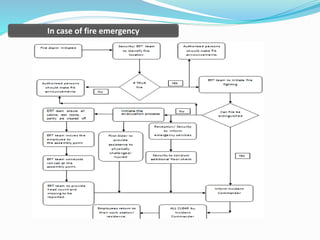
 Break the glass of the nearest push button
fire alarm and push the button.
 Attack the fire with extinguishers provided.
 Notify the ERT Director or instruct someone
to do so.
 Evacuate if necessary
23
In Case of Fire Emergency
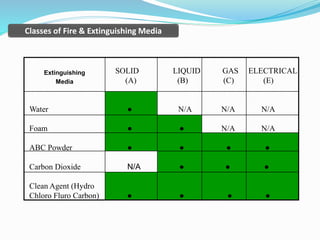
Extinguishing
Media
SOLID LIQUID GAS ELECTRICAL
(A) (B) (C) (E)
Water ● N/A N/A N/A
Foam ● ● N/A N/A
ABC Powder ● ● ● ●
Carbon Dioxide N/A ● ● ●
Clean Agent (Hydro
Chloro Fluro Carbon) ● ● ● ●
Classes of Fire & Extinguishing Media
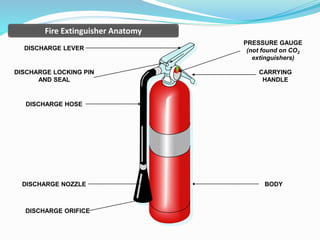
DISCHARGE HOSE
DISCHARGE NOZZLE
DISCHARGE ORIFICE
BODY
CARRYING
HANDLE
PRESSURE GAUGE
(not found on CO2
extinguishers)
DISCHARGE LEVER
DISCHARGE LOCKING PIN
AND SEAL
Fire Extinguisher Anatomy
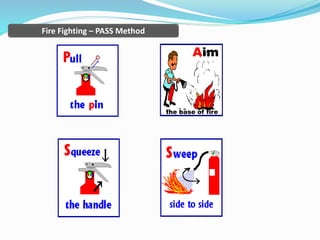
Aim
the base of fire
Fire Fighting – PASS Method
In case of fire emergency
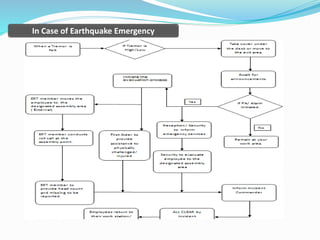
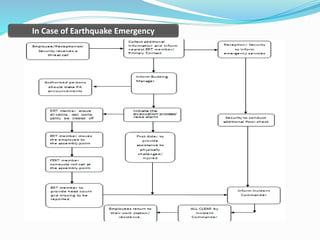
In Case of Earthquake Emergency
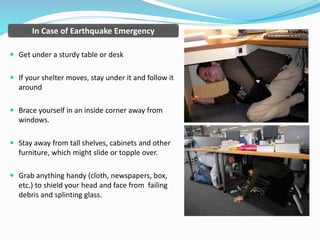
 Get under a sturdy table or desk
 If your shelter moves, stay under it and follow it
around
 Brace yourself in an inside corner away from
windows.
 Stay away from tall shelves, cabinets and other
furniture, which might slide or topple over.
 Grab anything handy (cloth, newspapers, box,
etc.) to shield your head and face from failing
debris and splinting glass.
In Case of Earthquake Emergency
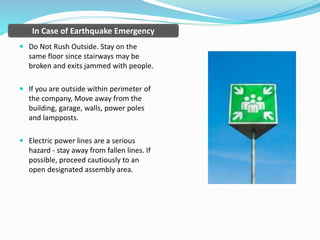
 Do Not Rush Outside. Stay on the
same floor since stairways may be
broken and exits jammed with people.
 If you are outside within perimeter of
the company, Move away from the
building, garage, walls, power poles
and lampposts.
 Electric power lines are a serious
hazard - stay away from fallen lines. If
possible, proceed cautiously to an
open designated assembly area.
After an Immediate Earthquake
 Remain Calm. Don't Panic.
 Wait until all motion has stopped.
 Do not run down stairs or outdoors. Be prepared for additional shockwaves.
 Do not light matches or try turn on electrical switches. Flashlights are one of the best
light sources after a damaging earthquake.
 Make a quick check for injuries or trapped people near you.
 Do not try to move seriously injured persons unless they are in immediate danger from
further injury.
 Kindly notify the situation to your nearest ERT member, if possible.
 Await for further instructions.
In Case of Earthquake Emergency
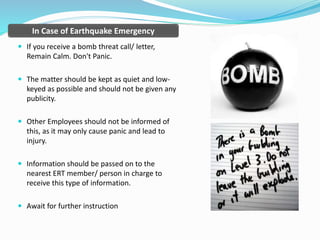
 If you receive a bomb threat call/ letter,
Remain Calm. Don't Panic.
 The matter should be kept as quiet and low-
keyed as possible and should not be given any
publicity.
 Other Employees should not be informed of
this, as it may only cause panic and lead to
injury.
 Information should be passed on to the
nearest ERT member/ person in charge to
receive this type of information.
 Await for further instruction
In Case of Earthquake Emergency
 Try to remain as CALM as possible;
 Concentrate on listening;
 Engage the caller in as much conversation as possible;
 Try to find out the exact location of the device;
 Try to find out the type of device;
 Try to find out the time the device is expected to detonate;
 Do not upset or panic the caller.
 Take notes of the exact words of the caller and his/her accent
 Try to determine the sex of the caller; and
 Listen for any background music or noises.
Bomb Threat Call Observation
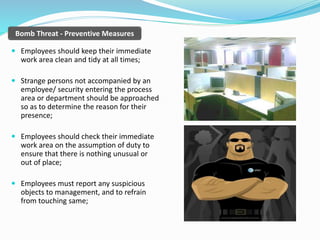
Bomb Threat - Preventive Measures
 Employees should keep their immediate
work area clean and tidy at all times;
 Strange persons not accompanied by an
employee/ security entering the process
area or department should be approached
so as to determine the reason for their
presence;
 Employees should check their immediate
work area on the assumption of duty to
ensure that there is nothing unusual or
out of place;
 Employees must report any suspicious
objects to management, and to refrain
from touching same;
In Case of Earthquake Emergency
Thank You

Emergency Response Training

  • 1.
  • 2.
    Index  Understanding Terminology Emergency Introduction  Causes of Emergency  Emergency Response Programme  Emergency Management System  Emergency Response Team  Emergency Response Equipments  Procedures in the event of emergency  Emergency Responder Responsibility  Emergency Responder Tool Kit  In Case of Fire Emergency  In Case of Earth Quake Emergency  In Case of Bomb Threat Emergency  Emergency Handling and Transportation
  • 3.
     Disaster isa situation in which the organization is incapable of coping.  Emergency is a situation in which the organization is capable of coping.  Risk is the probability that loss will occur as the result of an adverse event.  Hazard is the potential for a natural or human-caused event to occur with negative consequences.  A hazard can become an emergency; when the emergency moves beyond the control, it becomes a disaster. Understanding of Terminology
  • 4.
     An emergencyis a situation that poses an immediate loss to health, life, property or environment.  Type of Emergency:  Emergency to life  Emergency to health  Emergency to property  Emergency to environment Emergency Introduction
  • 5.
    Causes of Emergency InternalFactors *Smoke *Fire *Chemical Spillage *Information Threat External Factors *Bomb Threat *Terrorist Attack *Floods/ Tsunami *Earthquake *Nuclear Threat Causes of Emergency
  • 6.
     Usage ofSub Standardized Wiring/Equipment.  Usage of Sub Standardized Cleaning Agents.  Overloading the circuitry.  Improper Usage of Equipments.  Improper Storage of Equipments and Documents/ Information's.  Improper Maintenance of Equipments and Information's.  Non-Adherence to policies and procedures Hazards – Internal Factors
  • 7.
     De-Forestation  ExtremeUsage of Natural Resources  Emission of Hazardous Gases  Rebelling against Country/ leadership/Policy  Improper Landfilling  Meteors/ Storm/ Tsunami Hazards – External Factors
  • 8.
    Preparedn ess Response RecoveryMitigate Emergency Response Programmeis to;  protect critical assets of an organization from hazard & risks that can cause disasters or catastrophes, and  to ensure the continuance of the organization within their planned lifetime. Emergency Response Programme
  • 9.
    Emergency Management Systemsare technological aids that facilitate the effective management of disasters. Emergency Management System Procedures Manpower Materials/ Aids Required Transportation Recovery Communication Emergency Management System
  • 10.
    An Emergency ResponseTeam (ERT) is a group of people who are prepared for and respond to any emergency incident, such as an interruption of business operations. Emergency Response Team
  • 11.
    ERT Director Deputy ERT Director BuildingFire Wardens Floor Fire Wardens Building First Aider Floor First Aiders Building Evacuation Warden Floor Evacuation Roll Call Search and Rescue Communication Warden (Internal/External) Warden Transportation Warden Resources Security Team ERT – Roles and Responsibility Chart
  • 12.
  • 13.
    Emergency Response Programme- Sutherland Emergency Response Equipments
  • 14.
  • 15.
  • 16.
     RAISE ALARM RESPOND TIMELY  RAPID EVACUATION Procedure in the event of emergency
  • 17.
    Quickly report tothe Reception/ Security or instruct someone to do so. The Manual Fire Alarm to be operated Raise Alarm
  • 18.
    The reception/ securityshould -Alert the fire brigade -Notify senior management -Notify all departments -Notify any other personnel required either for immediate action or to stand-by Respond Timely
  • 19.
    Every employee shouldevacuate calmly and orderly through the nearest exit (escape) route. Do not wait to collect your belongings during evacuation process. (Picture: Employees evacuating through main entrance.) Every employee should know the alternative route incase the main escape route is not approachable due to fire. (Picture: Employees evacuating through main gate.) Should assemble at Assembly Point for roll call. After Roll Call to wait for the clearance from Security/ Fire Warden/ Incident Commander (Picture: Assembling at the Assembly Point) (Picture: Employees walking towards the assembly point) 2 Rapid Evacuation
  • 20.
     Evacuate thewing/floor/building in a calm, complete and orderly manner through the nearest exit.  Search/sweep the respective floors(rest room, meeting room etc) and ensure that everyone have left. (Subject to the situation, existing in the floor)  Ensure Visitors and Vendors are also directed to the assembly point.  Take the head counts at the assembly point of the respective wing/floor/building.  Complete the roll call list and report to the Incident Commander.  Assist the differently abled and pregnant employees during evacuation.  ALL CLEAR will be declared by the INCIDENT COMMANDER ER Responsibility
  • 21.
     Ensure allemployees to re-enter the building through normal entrance not through the emergency exits  Develop a backup, to support in case of absence or increase in head count.  Ensure passage or the area near the exit/emergency exit should free from obstacles.  Ensure evacuation layout boards are available in their respective floors.  Ensure fire extinguisher/ exit/ emergency exit/ First Aid/ In case of fire break glass signage's are available in their respective floors.  Ensure fire extinguishers are with in the maintenance period and are at prescribed location. ER Responsibility
  • 22.
    The Emergency Respondertool kits are the responsibility of the respective ER member and are to be associated with them at home or at office. Took Kit Details:  Identification Card  Identification Jacket  stick Pad  Pen/ Pencil  Torchlight  Whistle  Blanket If the ER is been relocated - within the same/different company/building/floor/wing they need to inform the respective HR department, Functional Co ordinator ER Tool Kit
  • 23.
     Break theglass of the nearest push button fire alarm and push the button.  Attack the fire with extinguishers provided.  Notify the ERT Director or instruct someone to do so.  Evacuate if necessary 23 In Case of Fire Emergency
  • 24.
    Extinguishing Media SOLID LIQUID GASELECTRICAL (A) (B) (C) (E) Water ● N/A N/A N/A Foam ● ● N/A N/A ABC Powder ● ● ● ● Carbon Dioxide N/A ● ● ● Clean Agent (Hydro Chloro Fluro Carbon) ● ● ● ● Classes of Fire & Extinguishing Media
  • 25.
    DISCHARGE HOSE DISCHARGE NOZZLE DISCHARGEORIFICE BODY CARRYING HANDLE PRESSURE GAUGE (not found on CO2 extinguishers) DISCHARGE LEVER DISCHARGE LOCKING PIN AND SEAL Fire Extinguisher Anatomy
  • 26.
    Aim the base offire Fire Fighting – PASS Method
  • 27.
    In case offire emergency
  • 28.
    In Case ofEarthquake Emergency  Get under a sturdy table or desk  If your shelter moves, stay under it and follow it around  Brace yourself in an inside corner away from windows.  Stay away from tall shelves, cabinets and other furniture, which might slide or topple over.  Grab anything handy (cloth, newspapers, box, etc.) to shield your head and face from failing debris and splinting glass.
  • 29.
    In Case ofEarthquake Emergency  Do Not Rush Outside. Stay on the same floor since stairways may be broken and exits jammed with people.  If you are outside within perimeter of the company, Move away from the building, garage, walls, power poles and lampposts.  Electric power lines are a serious hazard - stay away from fallen lines. If possible, proceed cautiously to an open designated assembly area.
  • 30.
    After an ImmediateEarthquake  Remain Calm. Don't Panic.  Wait until all motion has stopped.  Do not run down stairs or outdoors. Be prepared for additional shockwaves.  Do not light matches or try turn on electrical switches. Flashlights are one of the best light sources after a damaging earthquake.  Make a quick check for injuries or trapped people near you.  Do not try to move seriously injured persons unless they are in immediate danger from further injury.  Kindly notify the situation to your nearest ERT member, if possible.  Await for further instructions.
  • 31.
    In Case ofEarthquake Emergency
  • 32.
     If youreceive a bomb threat call/ letter, Remain Calm. Don't Panic.  The matter should be kept as quiet and low- keyed as possible and should not be given any publicity.  Other Employees should not be informed of this, as it may only cause panic and lead to injury.  Information should be passed on to the nearest ERT member/ person in charge to receive this type of information.  Await for further instruction In Case of Earthquake Emergency
  • 33.
     Try toremain as CALM as possible;  Concentrate on listening;  Engage the caller in as much conversation as possible;  Try to find out the exact location of the device;  Try to find out the type of device;  Try to find out the time the device is expected to detonate;  Do not upset or panic the caller.  Take notes of the exact words of the caller and his/her accent  Try to determine the sex of the caller; and  Listen for any background music or noises. Bomb Threat Call Observation
  • 34.
    Bomb Threat -Preventive Measures  Employees should keep their immediate work area clean and tidy at all times;  Strange persons not accompanied by an employee/ security entering the process area or department should be approached so as to determine the reason for their presence;  Employees should check their immediate work area on the assumption of duty to ensure that there is nothing unusual or out of place;  Employees must report any suspicious objects to management, and to refrain from touching same;
  • 35.
    In Case ofEarthquake Emergency
  • 36.