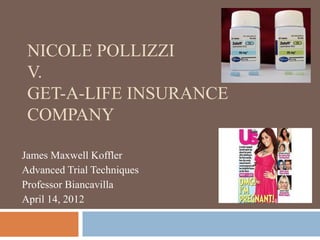
NICOLE POLLIZZI
 V.
 GET-A-LIFE INSURANCE
 COMPANY

James Maxwell Koffler
Advanced Trial Techniques
Professor Biancavilla
April 14, 2012
The Issue: Pollizzi v. Get-a-Life Ins. Co.
                (N.Y. Sup. Ct. 2012)
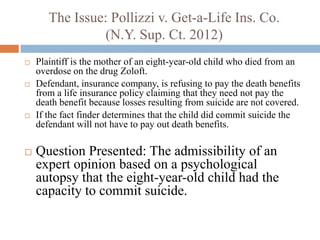
   Plaintiff is the mother of an eight-year-old child who died from an
    overdose on the drug Zoloft.
   Defendant, insurance company, is refusing to pay the death benefits
    from a life insurance policy claiming that they need not pay the
    death benefit because losses resulting from suicide are not covered.
   If the fact finder determines that the child did commit suicide the
    defendant will not have to pay out death benefits.

   Question Presented: The admissibility of an
    expert opinion based on a psychological
    autopsy that the eight-year-old child had the
    capacity to commit suicide.
Child Suicide:
      Why We Need An Expert Witness
   “[An expert] opinion is proper when it would help to clarify an issue calling for
    professional or technical knowledge, possessed by the expert and beyond the ken
    of the typical juror.” People v. Taylor, 75 N.Y.2d 277, 288 (1990).
   Suicide- Death caused by self-directed injurious behavior with any intent to die as
    a result of the behavior. CENTERS FOR DISEASE CONTROL AND PREVENTION, SELF-
    DIRECTED VIOLENCE SURVEILLANCE: UNIFORM DEFINITION AND RECOMMENDED
    DATA ELEMENTS 23 (2011).
    “A [strong] presumption against suicide is applicable in litigation under insurance
    contracts” Green v. William Penn Life Ins. Co. of N.Y., 12 N.Y.3d 342, 342, 346-47
    (2009).
   Plaintiff argues “A general consensus is that most children understand the
    irrevocable result of suicide by the age of 10” and not before. Freuchen, infra, at 2.
   Defense argues that children under ten do have the capacity to commit suicide if
    they are “physically and cognitively precocious” and that a psychological autopsy
    is relevant to that determination. Pelkonen, & Marttunen, infra, at 245.
Studies and Articles Define What A
        Psychological Autopsy Is.
   Developed by Edwin S. Schneidman & Norman L. Farberow in 1963.
   “[A] [p]sychological autopsy is a relatively unstructured clinical technique in which a mental
    health professional attempts to discern the mental state of a deceased person at some previous
    point in time.” James R. P. Ogloff & Randy K. Otto, Psychological Autopsy: Clinical and
    Legal Perspectives, 37 ST. LOUIS L.J. 607, 608 (1993).
   “[T]he psychological autopsy seeks to make a reasonable determination of what was in the
    mind of the decedent vis-à-vis his or her own death.” Schneidman, The Psychological
    Autopsy, AM. PSYCHOLOGIST, Jan. 1994, at 75.
   Psychological autopsies are normally conducted by interviewing persons who knew the
    deceased, as well as reviewing hospital records, police reports, coroner reports, doctor
    notes, and laboratory reports concerning the decedent along with their personal writings and
    effects.
   Select Studies: Anne Freuchen et al., Differences Between Children and Adolescents who
    Commit Suicide and Their Peers: A Psychological Autopsy of Suicide Victims Compared to
    Accident Victims and a Community Sample, CHILD & ADOLESCENT PSYCHIATRY &MENTAL
    HEALTH, Vol. 6 (2012); Mirijami Pelkonen & Mauri Marittunen, Child and Adolescent
    Suicide: Epidemiology, Risk Factors, and Approaches to Prevention, 5 PEDIATRIC DRUGS 243
    (2003); Bruce W. Ebert, Guide to Conducting a Psychological Autopsy, 18 PROF. PSYCHOL.:
    RES. & PRAC. 52 (1987).
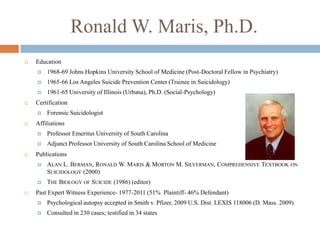
Ronald W. Maris, Ph.D.
   Education
       1968-69 Johns Hopkins University School of Medicine (Post-Doctoral Fellow in Psychiatry)
       1965-66 Los Angeles Suicide Prevention Center (Trainee in Suicidology)
       1961-65 University of Illinois (Urbana), Ph.D. (Social-Psychology)
   Certification
       Forensic Suicidologist
   Affiliations
       Professor Emeritus University of South Carolina
       Adjunct Professor University of South Carolina School of Medicine
   Publications
       ALAN L. BERMAN, RONALD W. MARIS & MORTON M. SILVERMAN, COMPREHENSIVE TEXTBOOK ON
        SUICIDOLOGY (2000)
       THE BIOLOGY OF SUICIDE (1986) (editor)
   Past Expert Witness Experience- 1977-2011 (51% Plaintiff- 46% Defendant)
       Psychological autopsy accepted in Smith v. Pfizer, 2009 U.S. Dist. LEXIS 118006 (D. Mass. 2009)
       Consulted in 230 cases; testified in 34 states
The Frye/Wesley Standard
   A method “must be sufficiently established to have
    gained general acceptance in the particular field in
    which it belongs.” Frye v. United States, 293 F.
    1013, 1014 (D.C. Cir. 1923) (emphasis added).
   “[T]he particular procedure … must be generally
    accepted as reliable.” People v. Wesley, 83 N.Y.2d
    417, 423 (1994) (emphasis added).
   Counting the scientists standard. See id. at 439
    (Kaye, C.J., concurring).
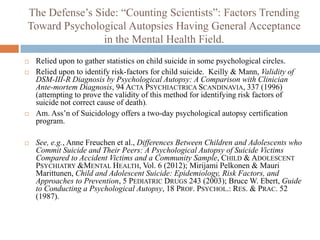
The Defense’s Side: “Counting Scientists”: Factors Trending
Toward Psychological Autopsies Having General Acceptance
                in the Mental Health Field.
   Relied upon to gather statistics on child suicide in some psychological circles.
   Relied upon to identify risk-factors for child suicide. Keilly & Mann, Validity of
    DSM-III-R Diagnosis by Psychological Autopsy: A Comparison with Clinician
    Ante-mortem Diagnosis, 94 ACTA PSYCHIACTRICA SCANDINAVIA, 337 (1996)
    (attempting to prove the validity of this method for identifying risk factors of
    suicide not correct cause of death).
   Am. Ass’n of Suicidology offers a two-day psychological autopsy certification
    program.

   See, e.g., Anne Freuchen et al., Differences Between Children and Adolescents who
    Commit Suicide and Their Peers: A Psychological Autopsy of Suicide Victims
    Compared to Accident Victims and a Community Sample, CHILD & ADOLESCENT
    PSYCHIATRY &MENTAL HEALTH, Vol. 6 (2012); Mirijami Pelkonen & Mauri
    Marittunen, Child and Adolescent Suicide: Epidemiology, Risk Factors, and
    Approaches to Prevention, 5 PEDIATRIC DRUGS 243 (2003); Bruce W. Ebert, Guide
    to Conducting a Psychological Autopsy, 18 PROF. PSYCHOL.: RES. & PRAC. 52
    (1987).
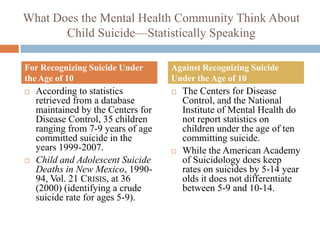
What Does the Mental Health Community Think About
       Child Suicide—Statistically Speaking

For Recognizing Suicide Under       Against Recognizing Suicide
the Age of 10                       Under the Age of 10
   According to statistics            The Centers for Disease
    retrieved from a database           Control, and the National
    maintained by the Centers for       Institute of Mental Health do
    Disease Control, 35 children        not report statistics on
    ranging from 7-9 years of age       children under the age of ten
    committed suicide in the            committing suicide.
    years 1999-2007.                   While the American Academy
   Child and Adolescent Suicide        of Suicidology does keep
    Deaths in New Mexico, 1990-         rates on suicides by 5-14 year
    94, Vol. 21 CRISIS, at 36           olds it does not differentiate
    (2000) (identifying a crude         between 5-9 and 10-14.
    suicide rate for ages 5-9).
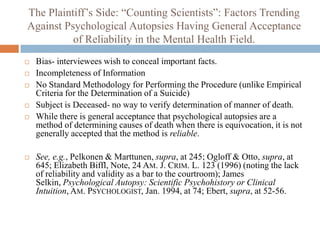
The Plaintiff’s Side: “Counting Scientists”: Factors Trending
Against Psychological Autopsies Having General Acceptance
          of Reliability in the Mental Health Field.
   Bias- interviewees wish to conceal important facts.
   Incompleteness of Information
   No Standard Methodology for Performing the Procedure (unlike Empirical
    Criteria for the Determination of a Suicide)
   Subject is Deceased- no way to verify determination of manner of death.
   While there is general acceptance that psychological autopsies are a
    method of determining causes of death when there is equivocation, it is not
    generally accepted that the method is reliable.

   See, e.g., Pelkonen & Marttunen, supra, at 245; Ogloff & Otto, supra, at
    645; Elizabeth Biffl, Note, 24 AM. J. CRIM. L. 123 (1996) (noting the lack
    of reliability and validity as a bar to the courtroom); James
    Selkin, Psychological Autopsy: Scientific Psychohistory or Clinical
    Intuition, AM. PSYCHOLOGIST, Jan. 1994, at 74; Ebert, supra, at 52-56.
Selected Judicial Rulings on
               Psychological Autopsies
   “Although federal courts use the Daubert test instead of the Frye standard … it is instructive to
    examine [those authorities]for purposes of discussion of accepted scientific methodology.” Parker v.
    Mobil Oil, Corp., 793 N.Y.S.2d 434, 437 (N.Y. App. Div. 2005).
   “[T]here is substantial reason to doubt the reliability of suicidal profiles if they are to be used to
    declare unequivocally that a subject's death was self-inflicted.” State v. Guthrie, 627 N.W.2d
    401, 417-18 (S.D. 2001) (deeming the admission of an expert opinion of a doctor who performed a
    psychological autopsy as an abuse of discretion due to reliability concerns).
   “Some courts have apparently permitted the introduction of psychological autopsy evidence for the
    purpose of determining whether an individual's death was the result of suicide, but the opinions of
    these courts do not discuss the reliability of the proffered evidence. “ Fanning v. Sitton Motor
    Lines, Inc., 2010 U.S. Dist. LEXIS 116809, *29 n. 13 (D. Kan. 2010) (emphasis added).
   Jackson v. State, 553 So.2d 719 (Fla. Ct. App. 1989) (admitting a psychological autopsy to establish
    child abuse as the cause of a seventeen-year-old girl’s suicide in a criminal prosecution for said
    abuse).
   Bartram v. State, 364 A.2d 1119 (Md. Ct. App. 1976) (admitting the opinion of an expert witness
    who conducted a psychological autopsy to present the suicide of the victim as a defense to a murder
    charge).
   Giles v. Wyeth, Inc., 500 F. Supp. 1048, 1061 (S.D. Ill. 2007) (finding in a litigation about whether
    the drug Effexor caused the suicide of the decedent that a psychological autopsy is a “generally
    accepted methodology for determining the cause of a suicide”).
Conclusion: Psychological
Autopsies Fails Frye Standard
   The psychological autopsy should be deemed
    inadmissible under the Frye standard in the present
    case because although it is a generally accepted
    method it is not one that is reliable. This is due to a
    high risk of incomplete and/or biased information
    that can be present, and more importantly the lack
    of significant standards and guidelines for
    performing the psychological autopsy.
   Unlike Caesar’s wife the reliability of
    psychological autopsies are not above reproach.

Expert witness presentation

  • 1.
    NICOLE POLLIZZI V. GET-A-LIFE INSURANCE COMPANY James Maxwell Koffler Advanced Trial Techniques Professor Biancavilla April 14, 2012
  • 2.
    The Issue: Pollizziv. Get-a-Life Ins. Co. (N.Y. Sup. Ct. 2012)  Plaintiff is the mother of an eight-year-old child who died from an overdose on the drug Zoloft.  Defendant, insurance company, is refusing to pay the death benefits from a life insurance policy claiming that they need not pay the death benefit because losses resulting from suicide are not covered.  If the fact finder determines that the child did commit suicide the defendant will not have to pay out death benefits.  Question Presented: The admissibility of an expert opinion based on a psychological autopsy that the eight-year-old child had the capacity to commit suicide.
  • 3.
    Child Suicide: Why We Need An Expert Witness  “[An expert] opinion is proper when it would help to clarify an issue calling for professional or technical knowledge, possessed by the expert and beyond the ken of the typical juror.” People v. Taylor, 75 N.Y.2d 277, 288 (1990).  Suicide- Death caused by self-directed injurious behavior with any intent to die as a result of the behavior. CENTERS FOR DISEASE CONTROL AND PREVENTION, SELF- DIRECTED VIOLENCE SURVEILLANCE: UNIFORM DEFINITION AND RECOMMENDED DATA ELEMENTS 23 (2011).  “A [strong] presumption against suicide is applicable in litigation under insurance contracts” Green v. William Penn Life Ins. Co. of N.Y., 12 N.Y.3d 342, 342, 346-47 (2009).  Plaintiff argues “A general consensus is that most children understand the irrevocable result of suicide by the age of 10” and not before. Freuchen, infra, at 2.  Defense argues that children under ten do have the capacity to commit suicide if they are “physically and cognitively precocious” and that a psychological autopsy is relevant to that determination. Pelkonen, & Marttunen, infra, at 245.
  • 4.
    Studies and ArticlesDefine What A Psychological Autopsy Is.  Developed by Edwin S. Schneidman & Norman L. Farberow in 1963.  “[A] [p]sychological autopsy is a relatively unstructured clinical technique in which a mental health professional attempts to discern the mental state of a deceased person at some previous point in time.” James R. P. Ogloff & Randy K. Otto, Psychological Autopsy: Clinical and Legal Perspectives, 37 ST. LOUIS L.J. 607, 608 (1993).  “[T]he psychological autopsy seeks to make a reasonable determination of what was in the mind of the decedent vis-à-vis his or her own death.” Schneidman, The Psychological Autopsy, AM. PSYCHOLOGIST, Jan. 1994, at 75.  Psychological autopsies are normally conducted by interviewing persons who knew the deceased, as well as reviewing hospital records, police reports, coroner reports, doctor notes, and laboratory reports concerning the decedent along with their personal writings and effects.  Select Studies: Anne Freuchen et al., Differences Between Children and Adolescents who Commit Suicide and Their Peers: A Psychological Autopsy of Suicide Victims Compared to Accident Victims and a Community Sample, CHILD & ADOLESCENT PSYCHIATRY &MENTAL HEALTH, Vol. 6 (2012); Mirijami Pelkonen & Mauri Marittunen, Child and Adolescent Suicide: Epidemiology, Risk Factors, and Approaches to Prevention, 5 PEDIATRIC DRUGS 243 (2003); Bruce W. Ebert, Guide to Conducting a Psychological Autopsy, 18 PROF. PSYCHOL.: RES. & PRAC. 52 (1987).
  • 5.
    Ronald W. Maris,Ph.D.  Education  1968-69 Johns Hopkins University School of Medicine (Post-Doctoral Fellow in Psychiatry)  1965-66 Los Angeles Suicide Prevention Center (Trainee in Suicidology)  1961-65 University of Illinois (Urbana), Ph.D. (Social-Psychology)  Certification  Forensic Suicidologist  Affiliations  Professor Emeritus University of South Carolina  Adjunct Professor University of South Carolina School of Medicine  Publications  ALAN L. BERMAN, RONALD W. MARIS & MORTON M. SILVERMAN, COMPREHENSIVE TEXTBOOK ON SUICIDOLOGY (2000)  THE BIOLOGY OF SUICIDE (1986) (editor)  Past Expert Witness Experience- 1977-2011 (51% Plaintiff- 46% Defendant)  Psychological autopsy accepted in Smith v. Pfizer, 2009 U.S. Dist. LEXIS 118006 (D. Mass. 2009)  Consulted in 230 cases; testified in 34 states
  • 6.
    The Frye/Wesley Standard  A method “must be sufficiently established to have gained general acceptance in the particular field in which it belongs.” Frye v. United States, 293 F. 1013, 1014 (D.C. Cir. 1923) (emphasis added).  “[T]he particular procedure … must be generally accepted as reliable.” People v. Wesley, 83 N.Y.2d 417, 423 (1994) (emphasis added).  Counting the scientists standard. See id. at 439 (Kaye, C.J., concurring).
  • 7.
    The Defense’s Side:“Counting Scientists”: Factors Trending Toward Psychological Autopsies Having General Acceptance in the Mental Health Field.  Relied upon to gather statistics on child suicide in some psychological circles.  Relied upon to identify risk-factors for child suicide. Keilly & Mann, Validity of DSM-III-R Diagnosis by Psychological Autopsy: A Comparison with Clinician Ante-mortem Diagnosis, 94 ACTA PSYCHIACTRICA SCANDINAVIA, 337 (1996) (attempting to prove the validity of this method for identifying risk factors of suicide not correct cause of death).  Am. Ass’n of Suicidology offers a two-day psychological autopsy certification program.  See, e.g., Anne Freuchen et al., Differences Between Children and Adolescents who Commit Suicide and Their Peers: A Psychological Autopsy of Suicide Victims Compared to Accident Victims and a Community Sample, CHILD & ADOLESCENT PSYCHIATRY &MENTAL HEALTH, Vol. 6 (2012); Mirijami Pelkonen & Mauri Marittunen, Child and Adolescent Suicide: Epidemiology, Risk Factors, and Approaches to Prevention, 5 PEDIATRIC DRUGS 243 (2003); Bruce W. Ebert, Guide to Conducting a Psychological Autopsy, 18 PROF. PSYCHOL.: RES. & PRAC. 52 (1987).
  • 8.
    What Does theMental Health Community Think About Child Suicide—Statistically Speaking For Recognizing Suicide Under Against Recognizing Suicide the Age of 10 Under the Age of 10  According to statistics  The Centers for Disease retrieved from a database Control, and the National maintained by the Centers for Institute of Mental Health do Disease Control, 35 children not report statistics on ranging from 7-9 years of age children under the age of ten committed suicide in the committing suicide. years 1999-2007.  While the American Academy  Child and Adolescent Suicide of Suicidology does keep Deaths in New Mexico, 1990- rates on suicides by 5-14 year 94, Vol. 21 CRISIS, at 36 olds it does not differentiate (2000) (identifying a crude between 5-9 and 10-14. suicide rate for ages 5-9).
  • 9.
    The Plaintiff’s Side:“Counting Scientists”: Factors Trending Against Psychological Autopsies Having General Acceptance of Reliability in the Mental Health Field.  Bias- interviewees wish to conceal important facts.  Incompleteness of Information  No Standard Methodology for Performing the Procedure (unlike Empirical Criteria for the Determination of a Suicide)  Subject is Deceased- no way to verify determination of manner of death.  While there is general acceptance that psychological autopsies are a method of determining causes of death when there is equivocation, it is not generally accepted that the method is reliable.  See, e.g., Pelkonen & Marttunen, supra, at 245; Ogloff & Otto, supra, at 645; Elizabeth Biffl, Note, 24 AM. J. CRIM. L. 123 (1996) (noting the lack of reliability and validity as a bar to the courtroom); James Selkin, Psychological Autopsy: Scientific Psychohistory or Clinical Intuition, AM. PSYCHOLOGIST, Jan. 1994, at 74; Ebert, supra, at 52-56.
  • 10.
    Selected Judicial Rulingson Psychological Autopsies  “Although federal courts use the Daubert test instead of the Frye standard … it is instructive to examine [those authorities]for purposes of discussion of accepted scientific methodology.” Parker v. Mobil Oil, Corp., 793 N.Y.S.2d 434, 437 (N.Y. App. Div. 2005).  “[T]here is substantial reason to doubt the reliability of suicidal profiles if they are to be used to declare unequivocally that a subject's death was self-inflicted.” State v. Guthrie, 627 N.W.2d 401, 417-18 (S.D. 2001) (deeming the admission of an expert opinion of a doctor who performed a psychological autopsy as an abuse of discretion due to reliability concerns).  “Some courts have apparently permitted the introduction of psychological autopsy evidence for the purpose of determining whether an individual's death was the result of suicide, but the opinions of these courts do not discuss the reliability of the proffered evidence. “ Fanning v. Sitton Motor Lines, Inc., 2010 U.S. Dist. LEXIS 116809, *29 n. 13 (D. Kan. 2010) (emphasis added).  Jackson v. State, 553 So.2d 719 (Fla. Ct. App. 1989) (admitting a psychological autopsy to establish child abuse as the cause of a seventeen-year-old girl’s suicide in a criminal prosecution for said abuse).  Bartram v. State, 364 A.2d 1119 (Md. Ct. App. 1976) (admitting the opinion of an expert witness who conducted a psychological autopsy to present the suicide of the victim as a defense to a murder charge).  Giles v. Wyeth, Inc., 500 F. Supp. 1048, 1061 (S.D. Ill. 2007) (finding in a litigation about whether the drug Effexor caused the suicide of the decedent that a psychological autopsy is a “generally accepted methodology for determining the cause of a suicide”).
  • 11.
    Conclusion: Psychological Autopsies FailsFrye Standard  The psychological autopsy should be deemed inadmissible under the Frye standard in the present case because although it is a generally accepted method it is not one that is reliable. This is due to a high risk of incomplete and/or biased information that can be present, and more importantly the lack of significant standards and guidelines for performing the psychological autopsy.  Unlike Caesar’s wife the reliability of psychological autopsies are not above reproach.