FIREARM INJURIES
DR VIVEK KUMAR
Dept. Of FMT, KMCH, Katihar
Proximal
Intermediate
Terminal Ballistics
Wound Ballistics
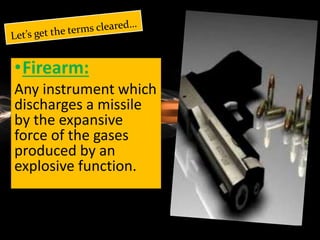
•Firearm:
Any instrument which
discharges a missile
by the expansive
force of the gases
produced by an
explosive function.
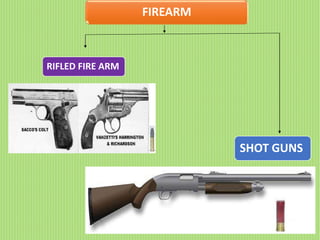
FIREARM
RIFLED FIRE ARM
SHOT GUNS
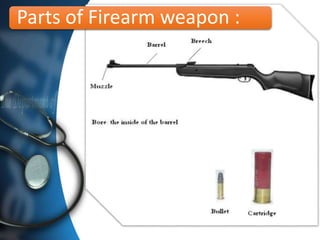
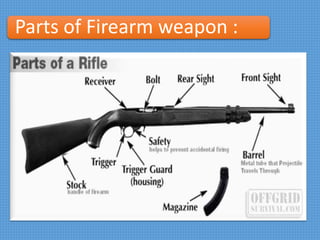
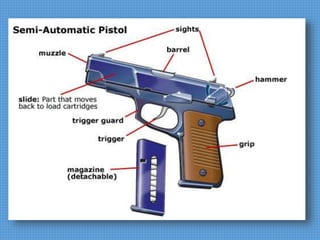
Parts of Firearm weapon :
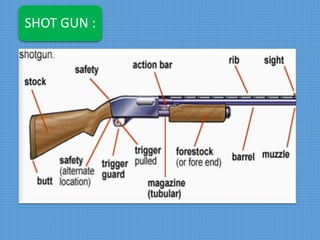
SHOT GUN :
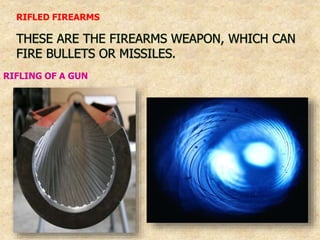
RIFLED FIREARMS
RIFLING OF A GUN
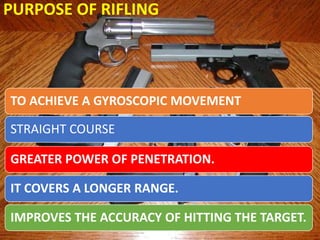
TO ACHIEVE A GYROSCOPIC MOVEMENT
STRAIGHT COURSE
GREATER POWER OF PENETRATION.
IT COVERS A LONGER RANGE.
IMPROVES THE ACCURACY OF HITTING THE TARGET.
PURPOSE OF RIFLING
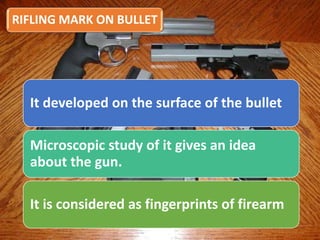
RIFLING MARK ON BULLET
It developed on the surface of the bullet
Microscopic study of it gives an idea
about the gun.
It is considered as fingerprints of firearm
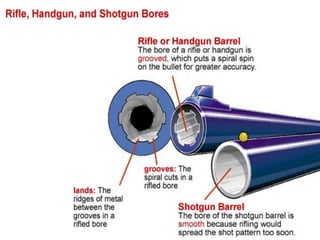
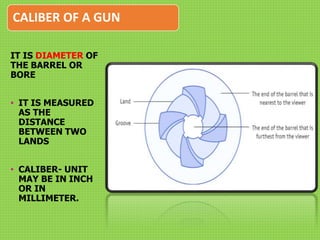
IT IS DIAMETER OF
THE BARREL OR
BORE
• IT IS MEASURED
AS THE
DISTANCE
BETWEEN TWO
LANDS
• CALIBER- UNIT
MAY BE IN INCH
OR IN
MILLIMETER.
CALIBER OF A GUN
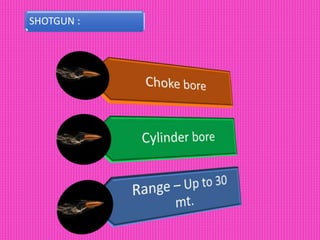
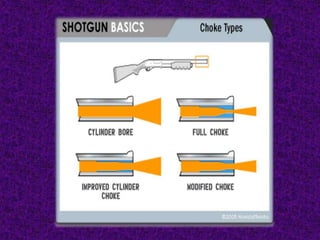
SHOTGUN :
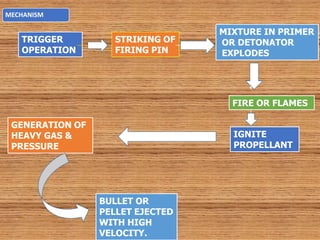
MECHANISM
TRIGGER
OPERATION
STRIKING OF
FIRING PIN
MIXTURE IN PRIMER
OR DETONATOR
EXPLODES
FIRE OR FLAMES
IGNITE
PROPELLANT
GENERATION OF
HEAVY GAS &
PRESSURE
BULLET OR
PELLET EJECTED
WITH HIGH
VELOCITY.
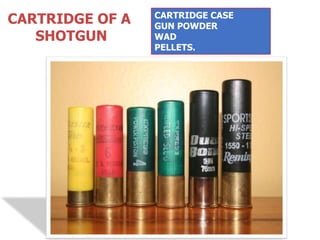
CARTRIDGE OF A
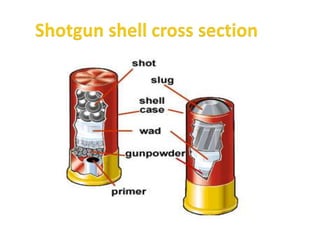
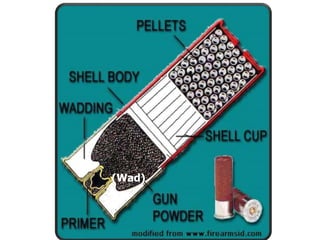
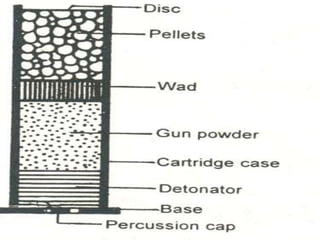
SHOTGUN
CARTRIDGE CASE
GUN POWDER
WAD
PELLETS.
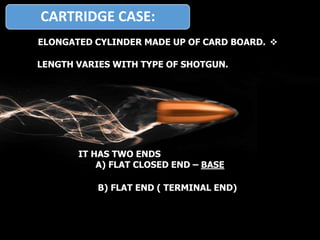
CARTRIDGE CASE:
ELONGATED CYLINDER MADE UP OF CARD BOARD.
LENGTH VARIES WITH TYPE OF SHOTGUN.
IT HAS TWO ENDS
A) FLAT CLOSED END – BASE
B) FLAT END ( TERMINAL END)
• 
(Wad)
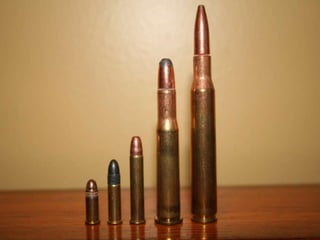
CARTRIDGE OF A RIFFLED GUN
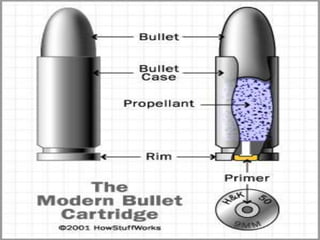
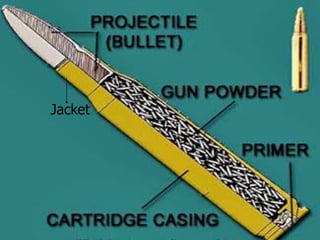
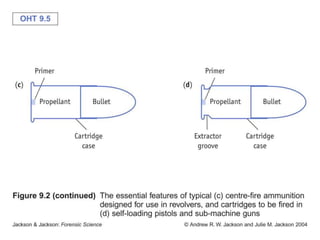
IT IS THE RIFLED FIREARM AMMUNITION.
IT CAN BE LOADED INTO THE CHAMBER OF THE GUN.
IT CAN DISCHARGE THE BULLET ON BEING FIRED.
IT IS MADE UP OF TWO SEGMENT
1. CARTRIDGE CASE
2. BULLET
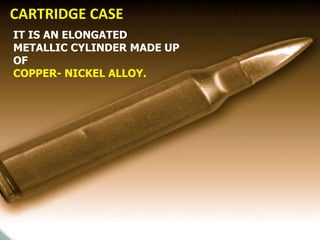
IT IS AN ELONGATED
METALLIC CYLINDER MADE UP
OF
COPPER- NICKEL ALLOY.
CARTRIDGE CASE
Jacket
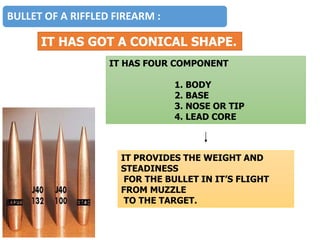
BULLET OF A RIFFLED FIREARM :
IT HAS GOT A CONICAL SHAPE.
IT HAS FOUR COMPONENT
1. BODY
2. BASE
3. NOSE OR TIP
4. LEAD CORE
IT PROVIDES THE WEIGHT AND
STEADINESS
FOR THE BULLET IN IT’S FLIGHT
FROM MUZZLE
TO THE TARGET.
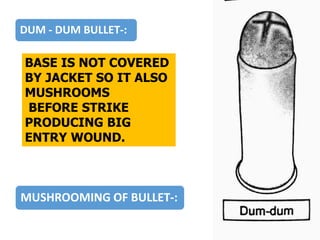
MUSHROOMING OF BULLET-:
DUM - DUM BULLET-:
BASE IS NOT COVERED
BY JACKET SO IT ALSO
MUSHROOMS
BEFORE STRIKE
PRODUCING BIG
ENTRY WOUND.
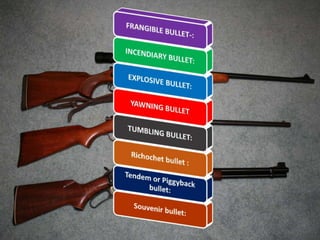
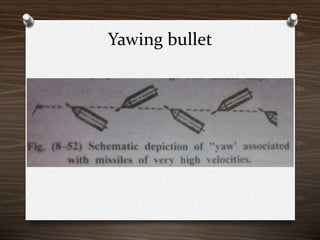
Yawing bullet
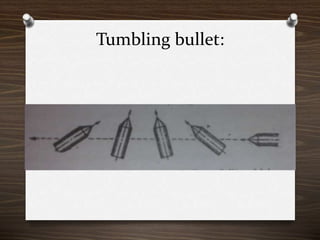
Tumbling bullet:
PLASTIC BULLET-:
BATON ROUND
USED IN SMOOTH BORE WEAPON
USED FOR RIOT CONTROL.
PRIMERS :
•Lead
•Antimony
•Barium
Firearm injury-General Aspects
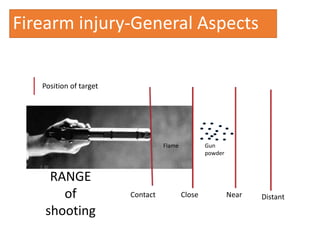
Position of target
Contact Close Near Distant
Gun
powder
Flame
RANGE
of
shooting
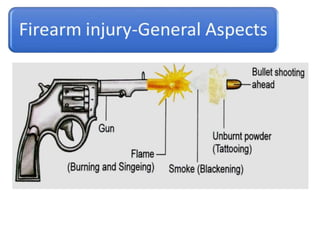
Burning & Singeing :
•Due to flame
•On the skin –
•On the hair –
•Darkening and parchmentization of
burnt area – After death
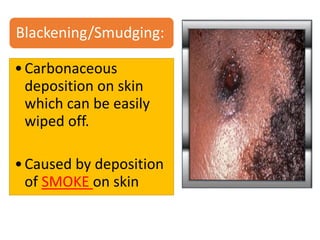
Blackening/Smudging:
•Carbonaceous
deposition on skin
which can be easily
wiped off.
•Caused by deposition
of SMOKE on skin
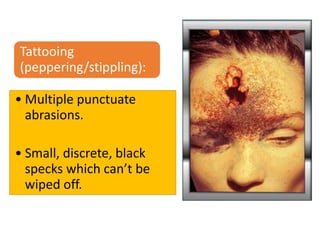
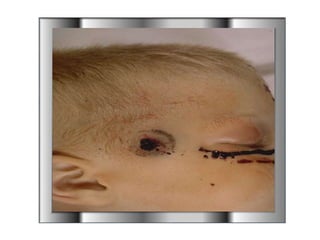
Tattooing
(peppering/stippling):
• Multiple punctuate
abrasions.
• Small, discrete, black
specks which can’t be
wiped off.
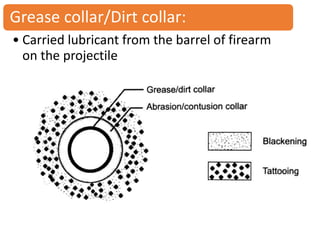
Grease collar/Dirt collar:
• Carried lubricant from the barrel of firearm
on the projectile
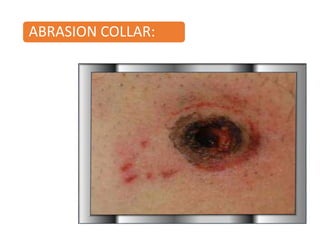
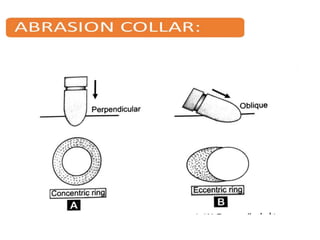
ABRASION COLLAR:
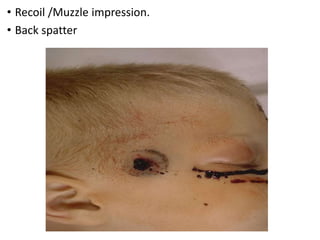
• Recoil /Muzzle impression.
• Back spatter
Rifled Firearm injury :
Contact range
Close range
Near range
Distant range
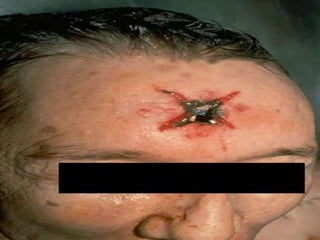
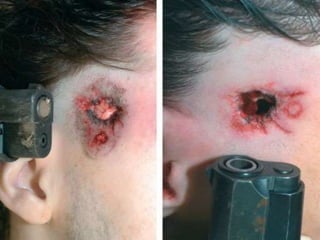
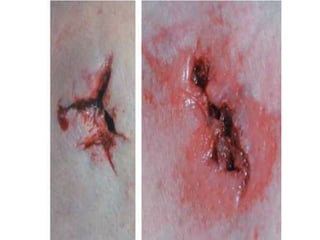
Contact Wounds
• Wound of entry – Large, triangular, stellate or
cruciate shaped.
• Wound track –
• Muzzle imprint.
• Back spatter.
• Corona.
• Burning, blackening and tattooing around the wound
margin – Slight or absent.
• Over the cranial vault –
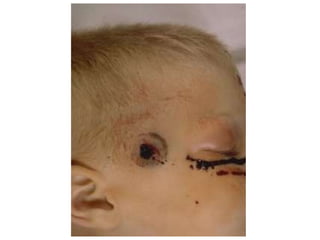
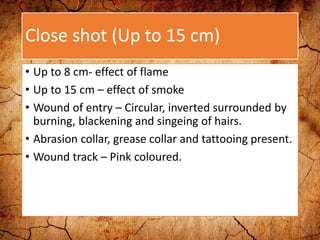
Close shot (Up to 15 cm)
• Up to 8 cm- effect of flame
• Up to 15 cm – effect of smoke
• Wound of entry – Circular, inverted surrounded by
burning, blackening and singeing of hairs.
• Abrasion collar, grease collar and tattooing present.
• Wound track – Pink coloured.
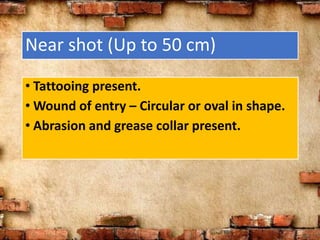
Near shot (Up to 50 cm)
• Tattooing present.
• Wound of entry – Circular or oval in shape.
• Abrasion and grease collar present.
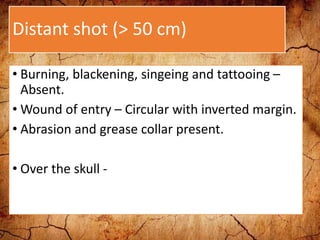
Distant shot (> 50 cm)
• Burning, blackening, singeing and tattooing –
Absent.
• Wound of entry – Circular with inverted margin.
• Abrasion and grease collar present.
• Over the skull -
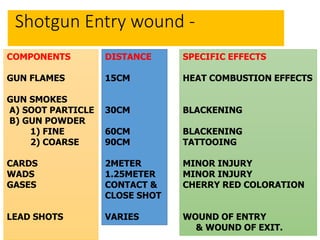
COMPONENTS
GUN FLAMES
GUN SMOKES
A) SOOT PARTICLE
B) GUN POWDER
1) FINE
2) COARSE
CARDS
WADS
GASES
LEAD SHOTS
DISTANCE
15CM
30CM
60CM
90CM
2METER
1.25METER
CONTACT &
CLOSE SHOT
VARIES
SPECIFIC EFFECTS
HEAT COMBUSTION EFFECTS
BLACKENING
BLACKENING
TATTOOING
MINOR INJURY
MINOR INJURY
CHERRY RED COLORATION
WOUND OF ENTRY
& WOUND OF EXIT.
Shotgun Entry wound -
1. Wound of entry – Large irregular and single hole.
2. Burning, blackening, tattooing and singeing of
hairs.
3. Muzzle imprint.
4. Over the skull -
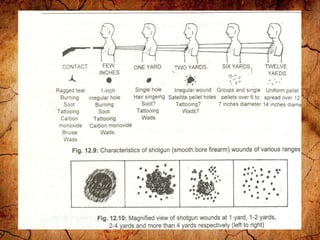
Contact shot :
• Close shot (Up to 1 meter) – Wound of entry
• Short range (1 to 2 meters)
Wound of entry – Single and circular
• Intermediate range ( 2 to 4 meter) –
Individual holes may be detected
• Long range ( > 4 meter)
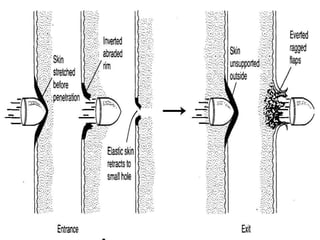
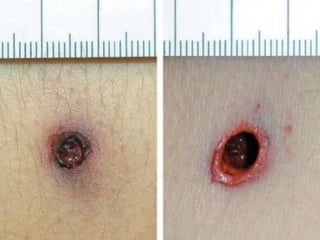
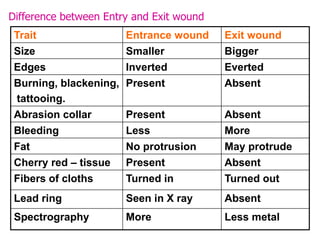
Difference between Entry and Exit wound
Trait Entrance wound Exit wound
Size Smaller Bigger
Edges Inverted Everted
Burning, blackening,
tattooing.
Present Absent
Abrasion collar Present Absent
Bleeding Less More
Fat No protrusion May protrude
Cherry red – tissue Present Absent
Fibers of cloths Turned in Turned out
Lead ring Seen in X ray Absent
Spectrography More Less metal
RAYALSEEMA PHENOMENON
KENNEDY PHENOMENON
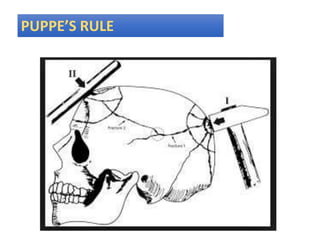
PUPPE’S RULE
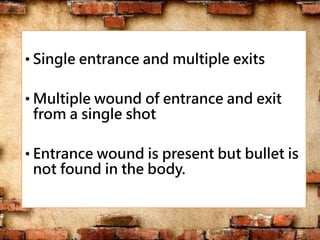
• Single entrance and multiple exits
• Multiple wound of entrance and exit
from a single shot
• Entrance wound is present but bullet is
not found in the body.
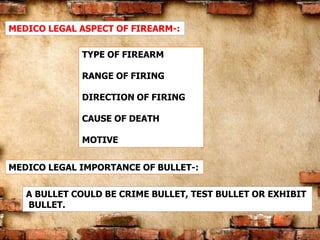
MEDICO LEGAL ASPECT OF FIREARM-:
TYPE OF FIREARM
RANGE OF FIRING
DIRECTION OF FIRING
CAUSE OF DEATH
MOTIVE
MEDICO LEGAL IMPORTANCE OF BULLET-:
A BULLET COULD BE CRIME BULLET, TEST BULLET OR EXHIBIT
BULLET.
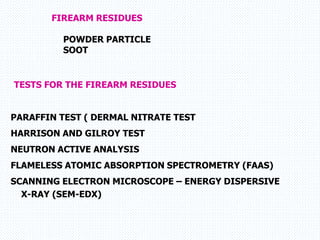
FIREARM RESIDUES
POWDER PARTICLE
SOOT
TESTS FOR THE FIREARM RESIDUES
PARAFFIN TEST ( DERMAL NITRATE TEST
HARRISON AND GILROY TEST
NEUTRON ACTIVE ANALYSIS
FLAMELESS ATOMIC ABSORPTION SPECTROMETRY (FAAS)
SCANNING ELECTRON MICROSCOPE – ENERGY DISPERSIVE
X-RAY (SEM-EDX)
DERMAL NITRATE TEST
THE BASIS OF THE TEST TO
DETECT THE PRESENCE OF
NITRATES IN
HAND USED FOR FIRING.
Manner of injury -
Accidental
Suicidal
Homicidal
Forensic Ballistic

Forensic Ballistic