Accident & Incident
Prevention
&
Investigation

Course Objectives
 Understand the need to investigate
 Know what to investigate
 Determine the causes of accidents
 Identify the methods of investigation
 Understand the need to be thorough and
comprehensive
 Identify prevention methods
 Identify sources of assistance
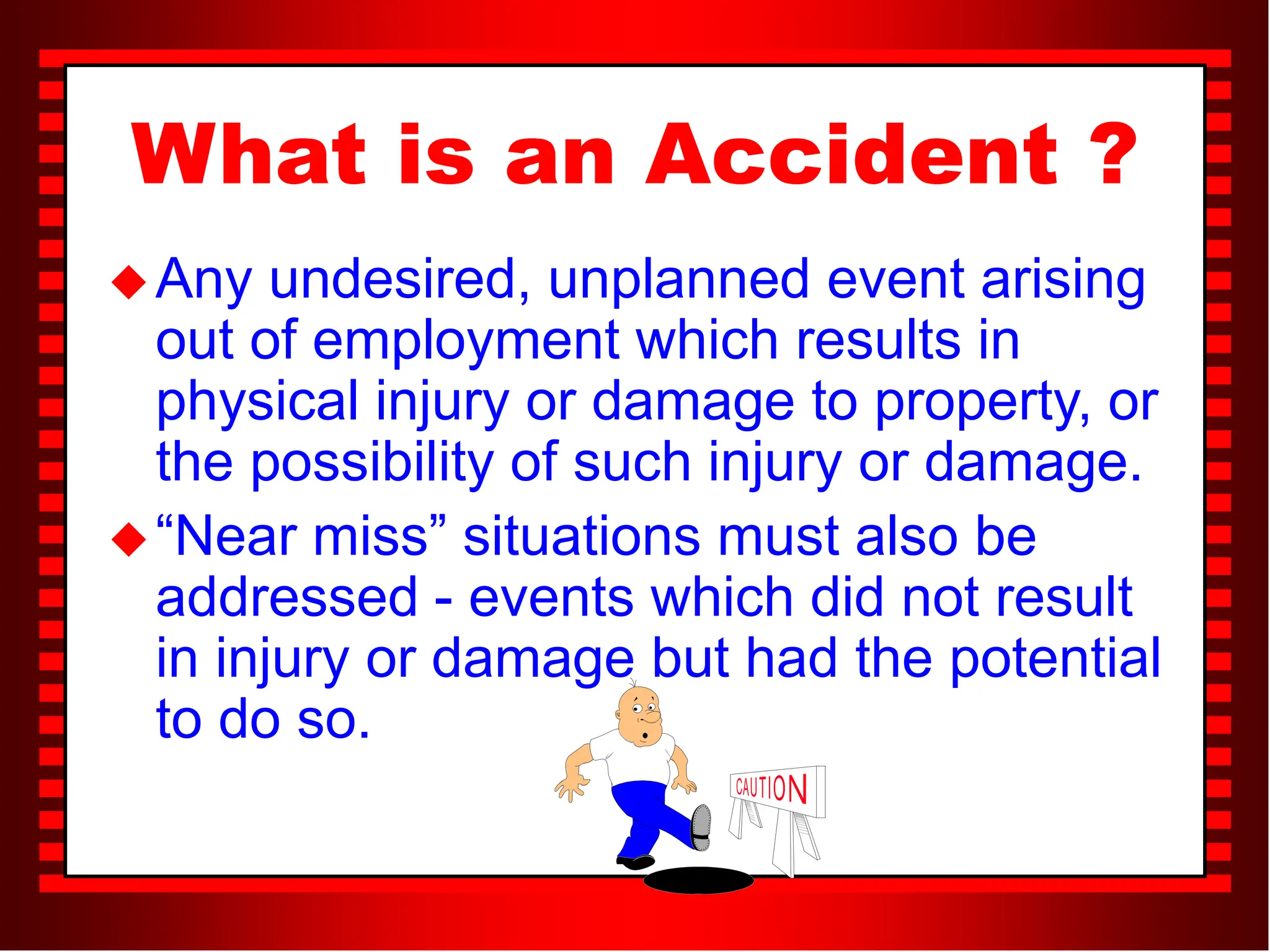
What is an Accident ?
Any undesired, unplanned event arising
out of employment which results in
physical injury or damage to property, or
the possibility of such injury or damage.
“Near miss” situations must also be
addressed - events which did not result
in injury or damage but had the potential
to do so.
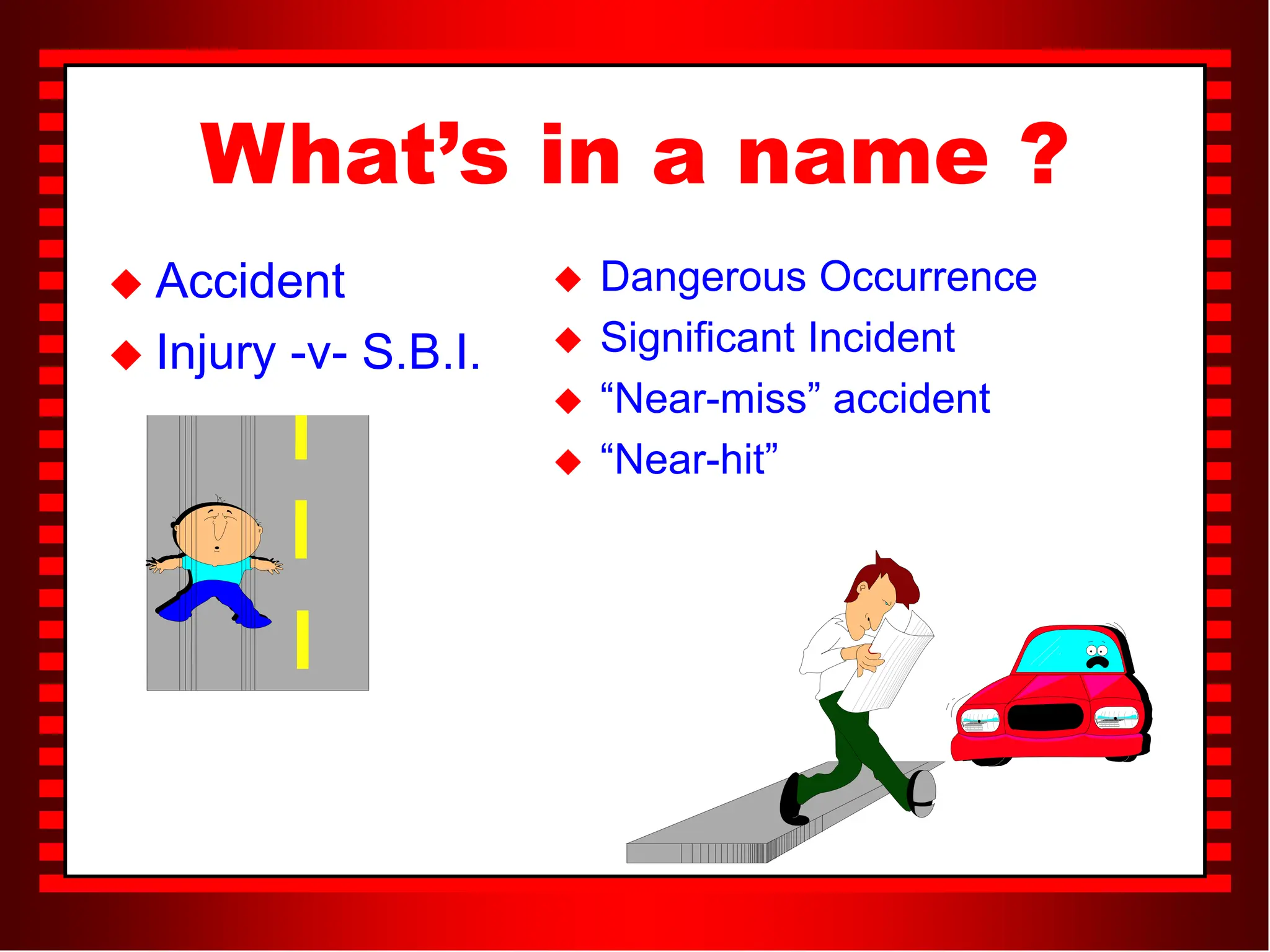
What’s in a name ?
 Accident
 Injury -v- S.B.I.
 Dangerous Occurrence
 Significant Incident
 “Near-miss” accident
 “Near-hit”
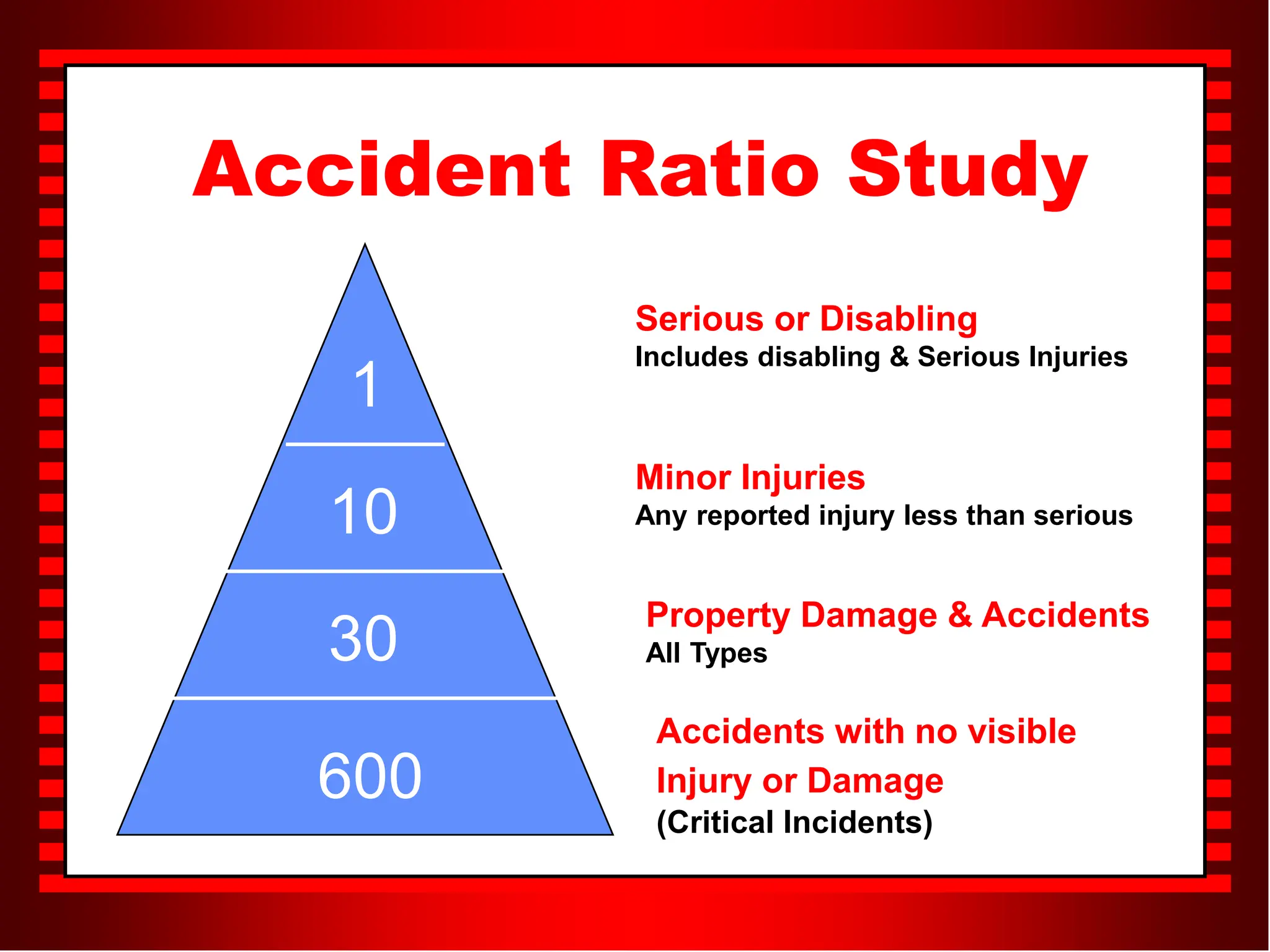
1
10
30
600
Serious or Disabling
Includes disabling & Serious Injuries
Minor Injuries
Any reported injury less than serious
Property Damage & Accidents
All Types
Accidents with no visible
Injury or Damage
(Critical Incidents)
Accident Ratio Study
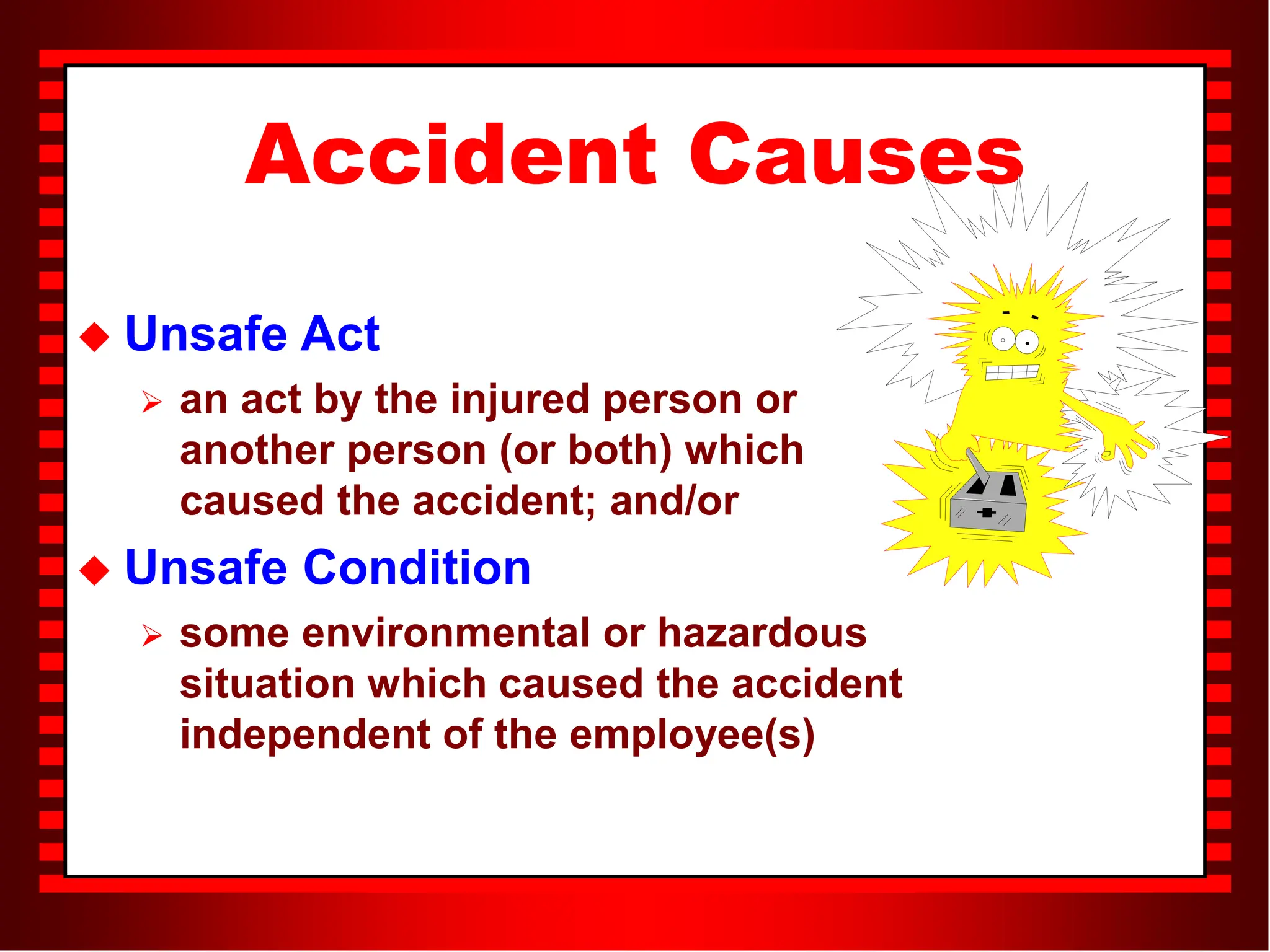
Accident Causes
 Unsafe Act
 an act by the injured person or
another person (or both) which
caused the accident; and/or
 Unsafe Condition
 some environmental or hazardous
situation which caused the accident
independent of the employee(s)
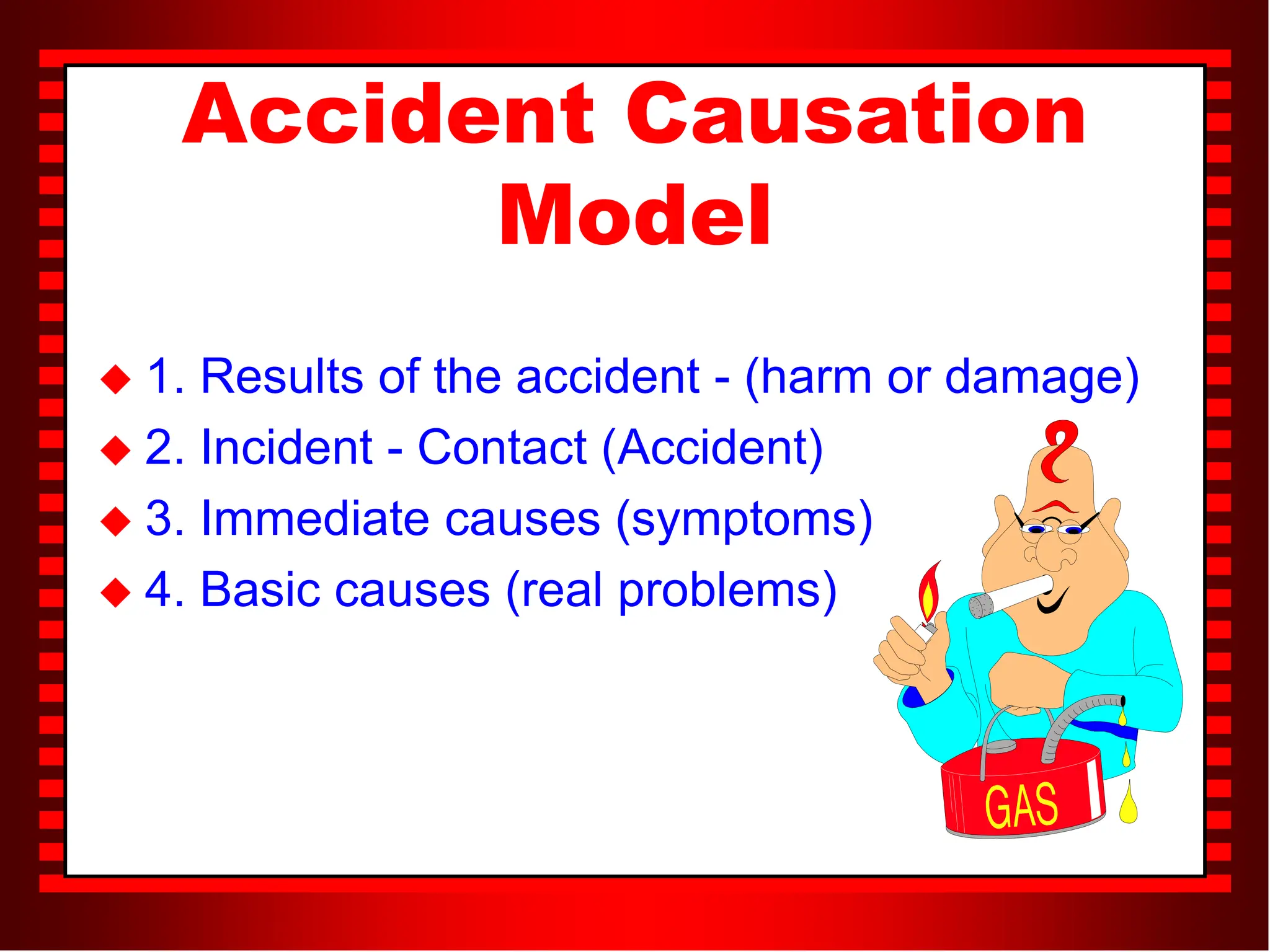
Accident Causation
Model
 1. Results of the accident - (harm or damage)
 2. Incident - Contact (Accident)
 3. Immediate causes (symptoms)
 4. Basic causes (real problems)
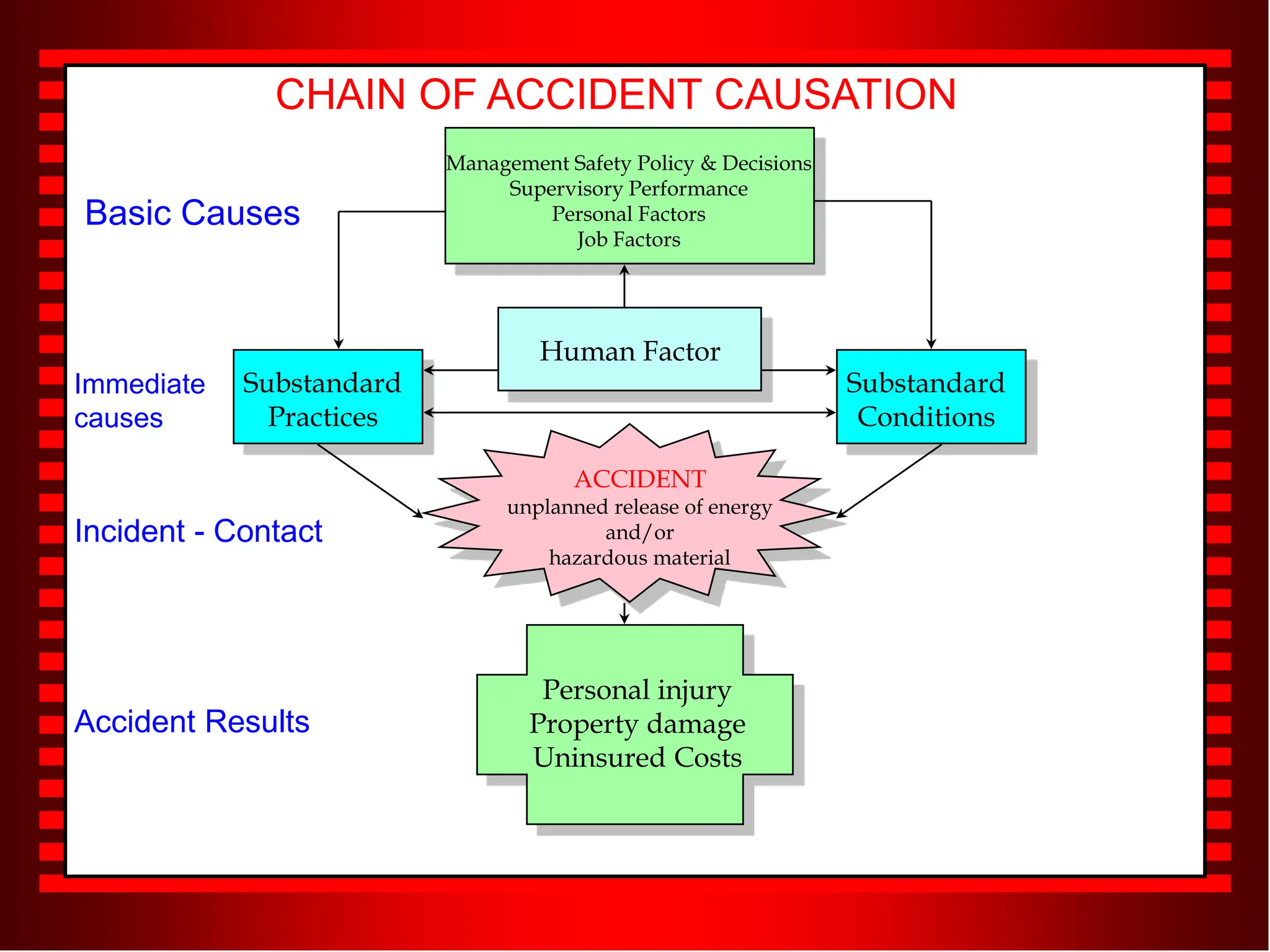
Management Safety Policy & Decisions
Supervisory Performance
Personal Factors
Job Factors
Human Factor
Substandard
Practices
Substandard
Conditions
ACCIDENT
unplanned release of energy
and/or
hazardous material
Personal injury
Property damage
Uninsured Costs
Basic Causes
Immediate
causes
Incident - Contact
Accident Results
CHAIN OF ACCIDENT CAUSATION
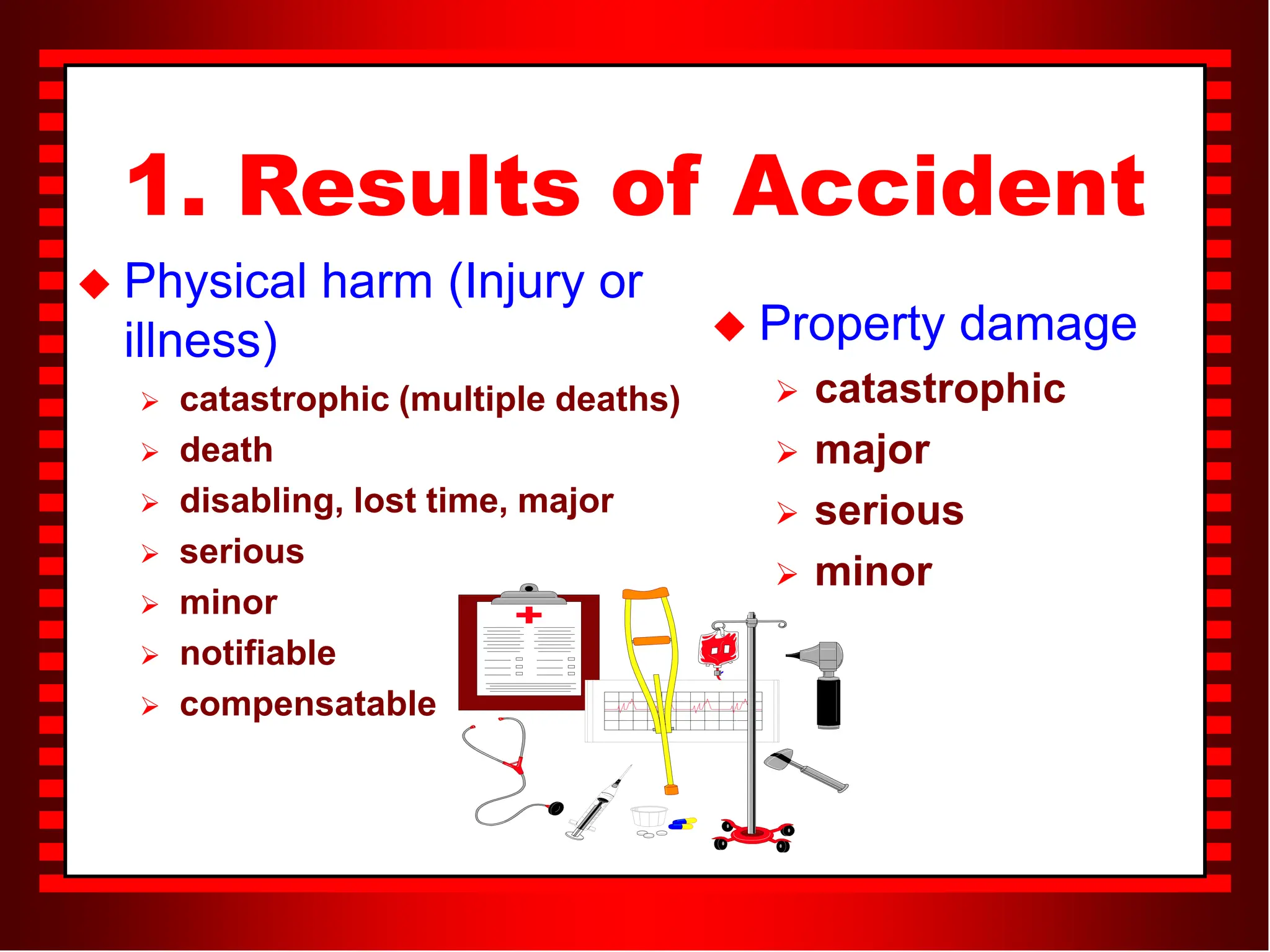
1. Results of Accident
 Physical harm (Injury or
illness)
 catastrophic (multiple deaths)
 death
 disabling, lost time, major
 serious
 minor
 notifiable
 compensatable
 Property damage
 catastrophic
 major
 serious
 minor
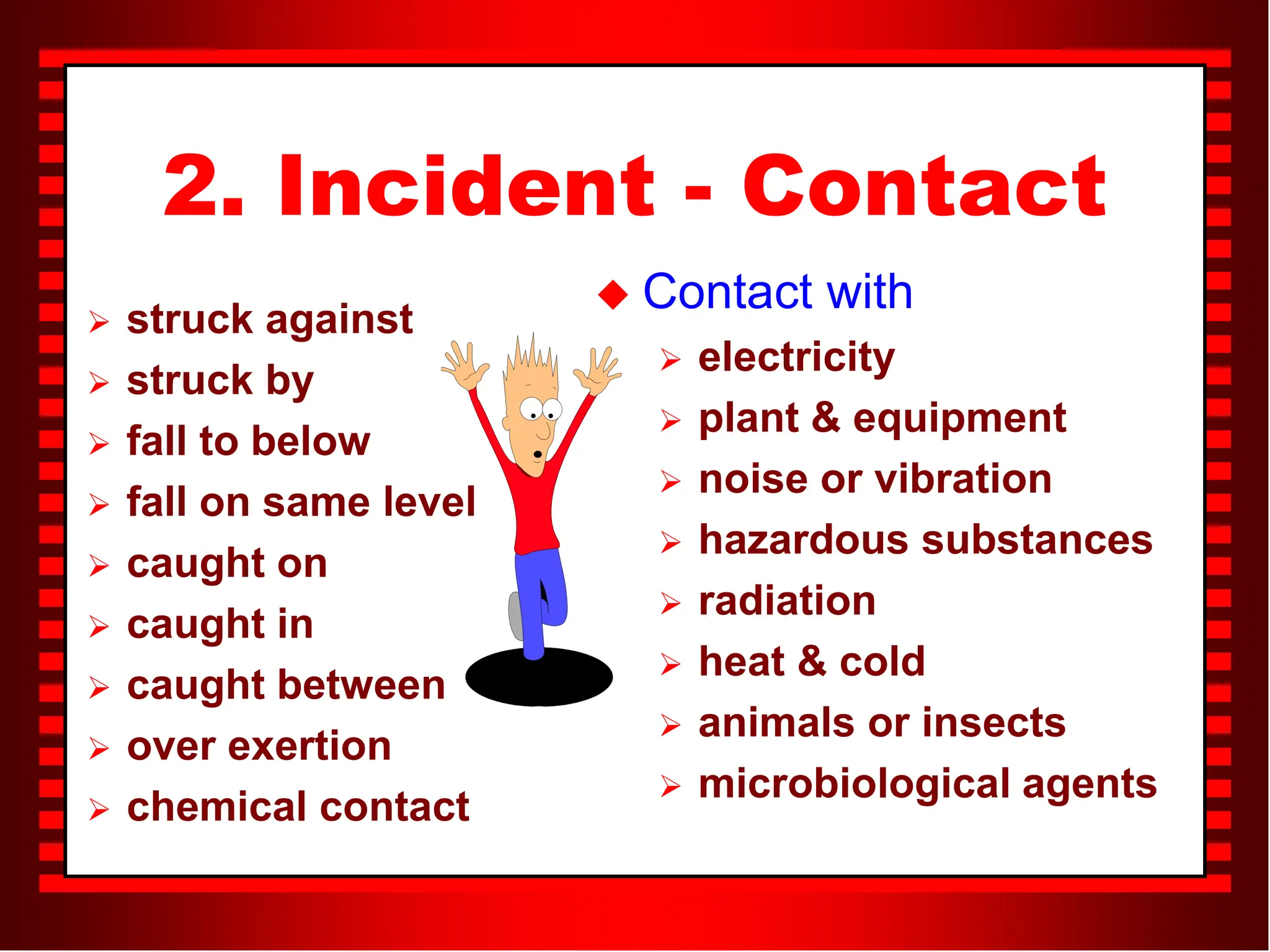
2. Incident - Contact
 struck against
 struck by
 fall to below
 fall on same level
 caught on
 caught in
 caught between
 over exertion
 chemical contact
 Contact with
 electricity
 plant & equipment
 noise or vibration
 hazardous substances
 radiation
 heat & cold
 animals or insects
 microbiological agents
3. Immediate Causes
 Standard Practices
 operating with authority
 use serviceable
equipment
 use equipment properly
 use of PPE where
required
 correct lifting
 no drinking & drugs
 no horseplay
 secure equipment or
warnings
 Standard Conditions
 effective guards & devices
 serviceable tools &
equipment
 adequate warning systems
 good housekeeping
 non polluted environment
 noise
 hazardous substances
 good illumination &
ventilation
 good working, storage &
travelling space
4.Basic Causes
 Personal Factors
 lack of knowledge or skill
 improper motivation
 physical or mental
conditions
 literacy or ability (NESB)
 Job Factors
 physical environment
 sub-standard equipment
 abnormal usage
 wear & tear
 inadequate standards
 design & maintenance
 purchasing standards
 Supervisory Performance
 inadequate instructions
 failure of SOPs
 rules not enforced
 hazards not corrected
 devices not provided
 Management Policy &
Decisions
 set measurable
standards
 measure work in
progress
 evaluate work-v-
standards
 correct performance if
nec
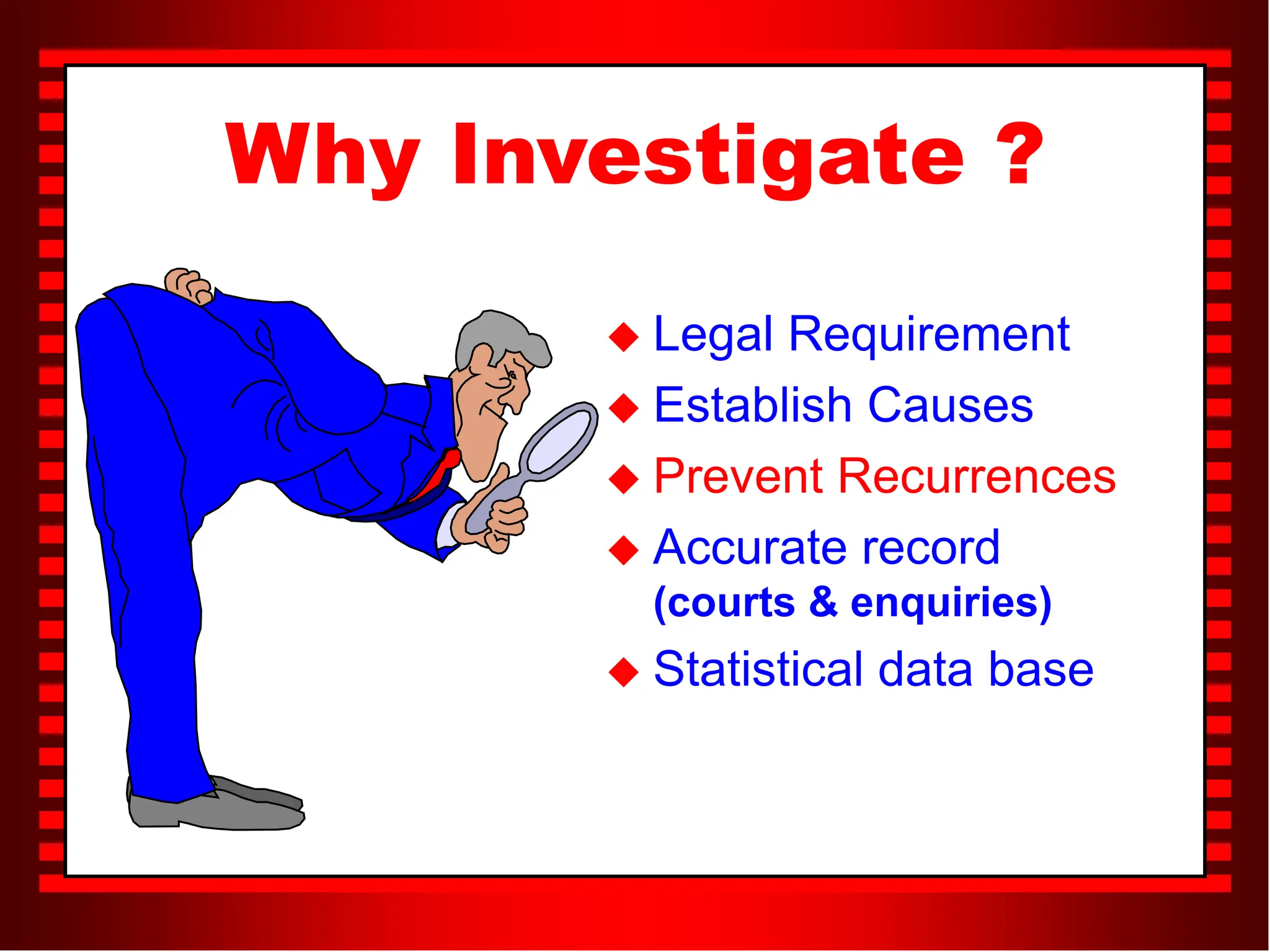
Why Investigate ?
 Legal Requirement
 Establish Causes
 Prevent Recurrences
 Accurate record
(courts & enquiries)
 Statistical data base
Accident Investigation
 A systematic approach to accident investigation, the
identification of causal factors and implementation
of corrective actions is essential to a good H&S
program and management system. Good
procedures:
 provide information needed to determine injury rates,
identify trends or problem areas, permit comparisons and
satisfy Workers Compensation requirements;
 identify, without placing blame, the basic causal factors that
contributed directly or indirectly to each accident;
 identify deficiencies in management systems;
 suggest corrective action alternatives for a given accident;
 suggest corrective action alternatives for the management
system.
What, When & How to
Investigate
 What to Investigate ?
 all accidents & near
misses
 as soon as possible
 scene interference
 survey of scene
 chronology of data
 measurements, maps &
sketches
 eyewitnesses
 reconstruction ?
 statistics & trends
 injury types & groups
 Who should Investigate?
 Supervisor ?
 WH&S Officer?
 WH&S Representative?
 Team?
 Training & Skills
 investigative & recording
skills
 technical knowledge
 interviewing skills
 report writing skills
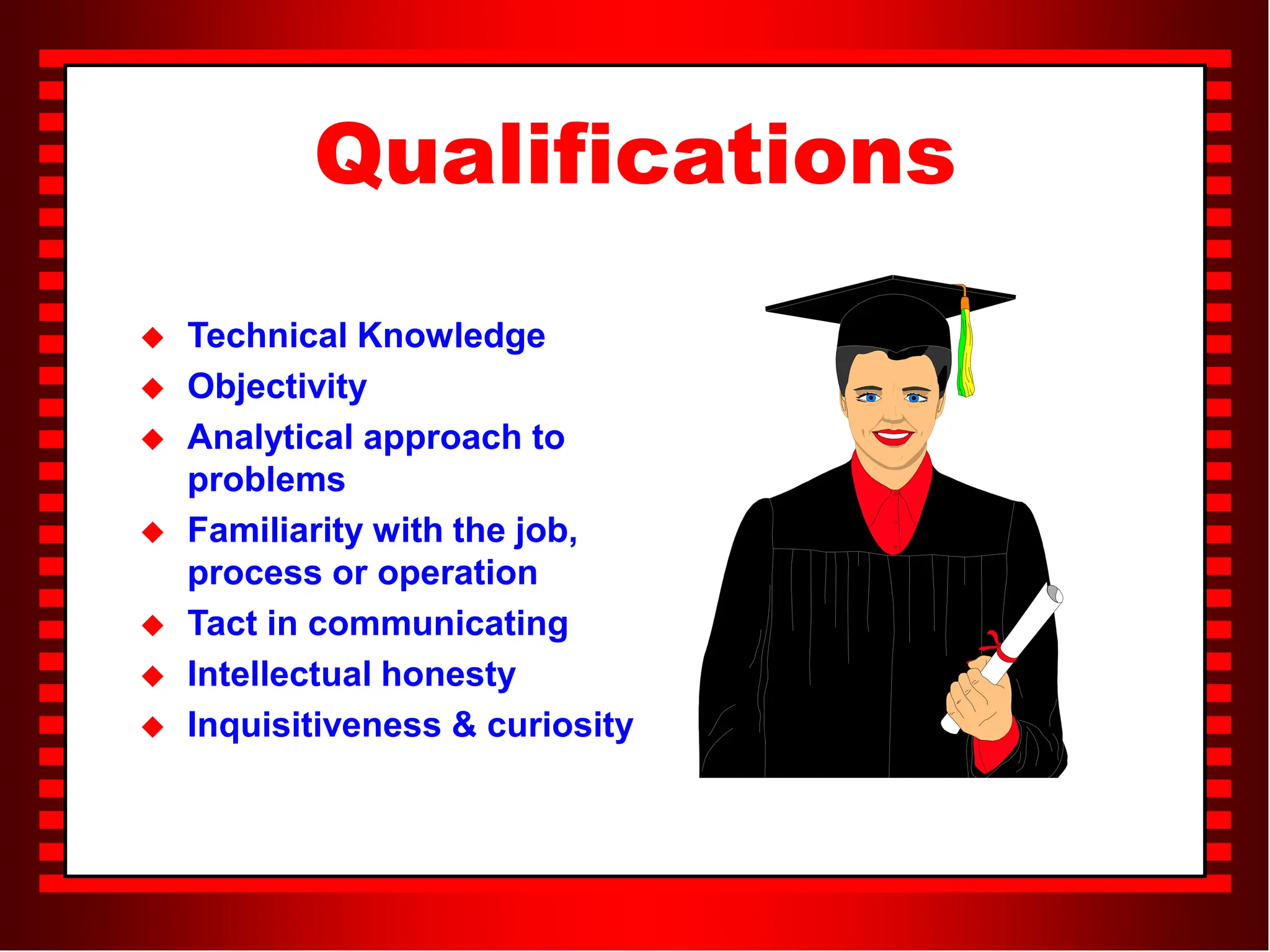
Qualifications
 Technical Knowledge
 Objectivity
 Analytical approach to
problems
 Familiarity with the job,
process or operation
 Tact in communicating
 Intellectual honesty
 Inquisitiveness & curiosity
Tool Kit
 clipboard, paper (incl graph)
pens
 camera & spare films
 tape measure
 cassette recorder & spare
tapes
 reporting forms
 hi-viz barrier tape for scene
preservation
 first aid kit
 identification tags for parts
 gloves (industrial & medical)
 safety helmet
 specimen containers
 magnifying glass
 compass
 danger tags
 yellow crayon
 orange flouro spray paint
 torch with batteries
 hi-viz orange vest
 hearing & eye protection
 plastic containers for
samples
 roll of paper towelling
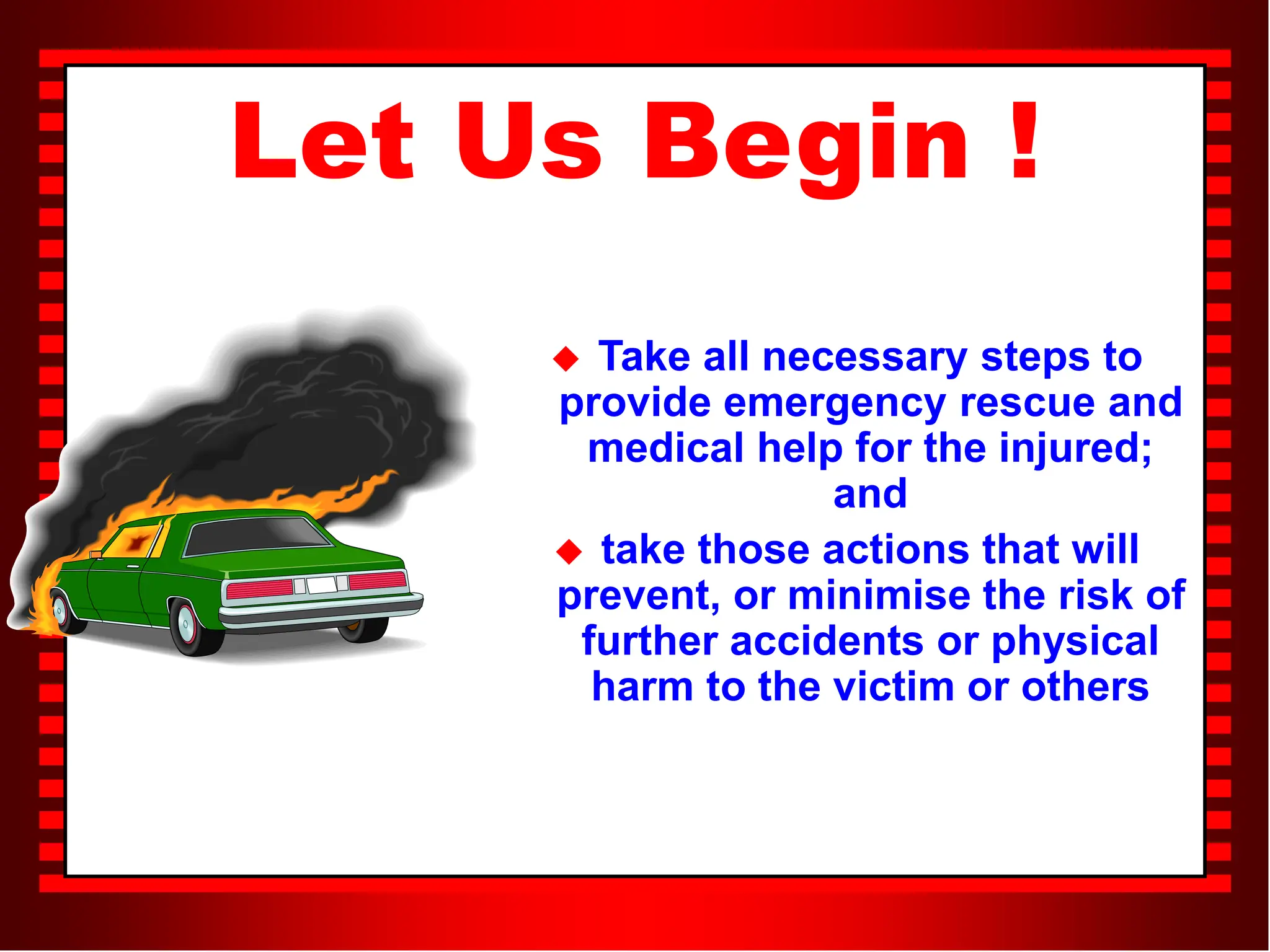
Let Us Begin !
 Take all necessary steps to
provide emergency rescue and
medical help for the injured;
and
 take those actions that will
prevent, or minimise the risk of
further accidents or physical
harm to the victim or others
Action Plan
 Identification of the individual who is in charge
and assigns responsibilities;
 Authority to conduct investigation;
 Securing the accident site for the duration of the
investigation, after rescue and damage control
are complete;
 Photographic support or capability;
 Procedures & equipment to ensure observation
and recording of fragile, perishable or transient
evidence (instrument readings, control panel
settings, weather & other environmental
conditions, chemical spills, stains, skid marks);
 Development of a comprehensive report.
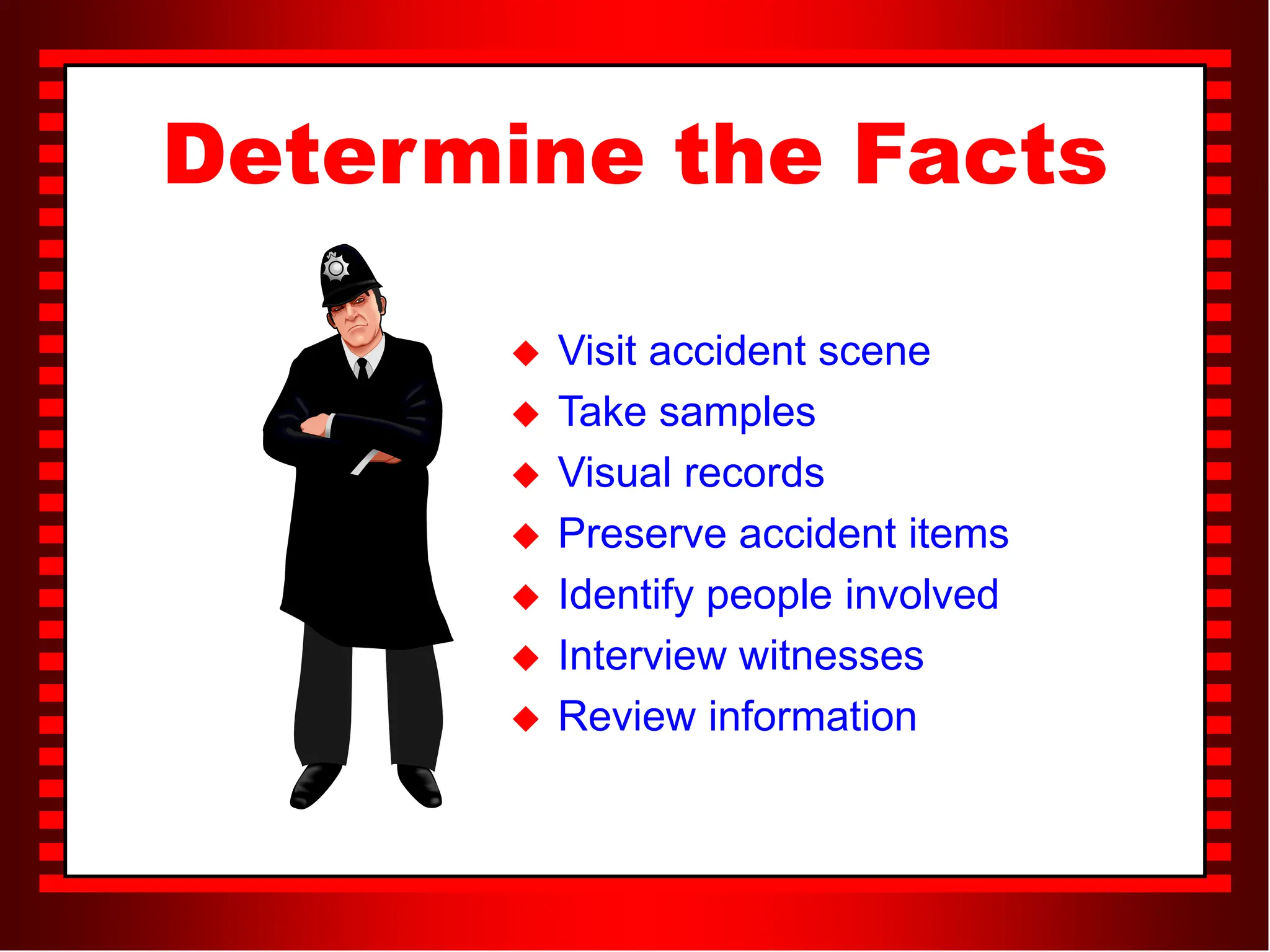
Determine the Facts
 Visit accident scene
 Take samples
 Visual records
 Preserve accident items
 Identify people involved
 Interview witnesses
 Review information
Finding Facts
(logic method)
 What was the exact injury or damage ?
 What was the damaging energy source ?
 What event immediately preceded the damaging
event ?
 What happened before that ?
 What happened even before that ?
 What happened in between ?
 What else was going on at the time of the
accident ?
 Was anyone else involved ?
 Interview witnesses
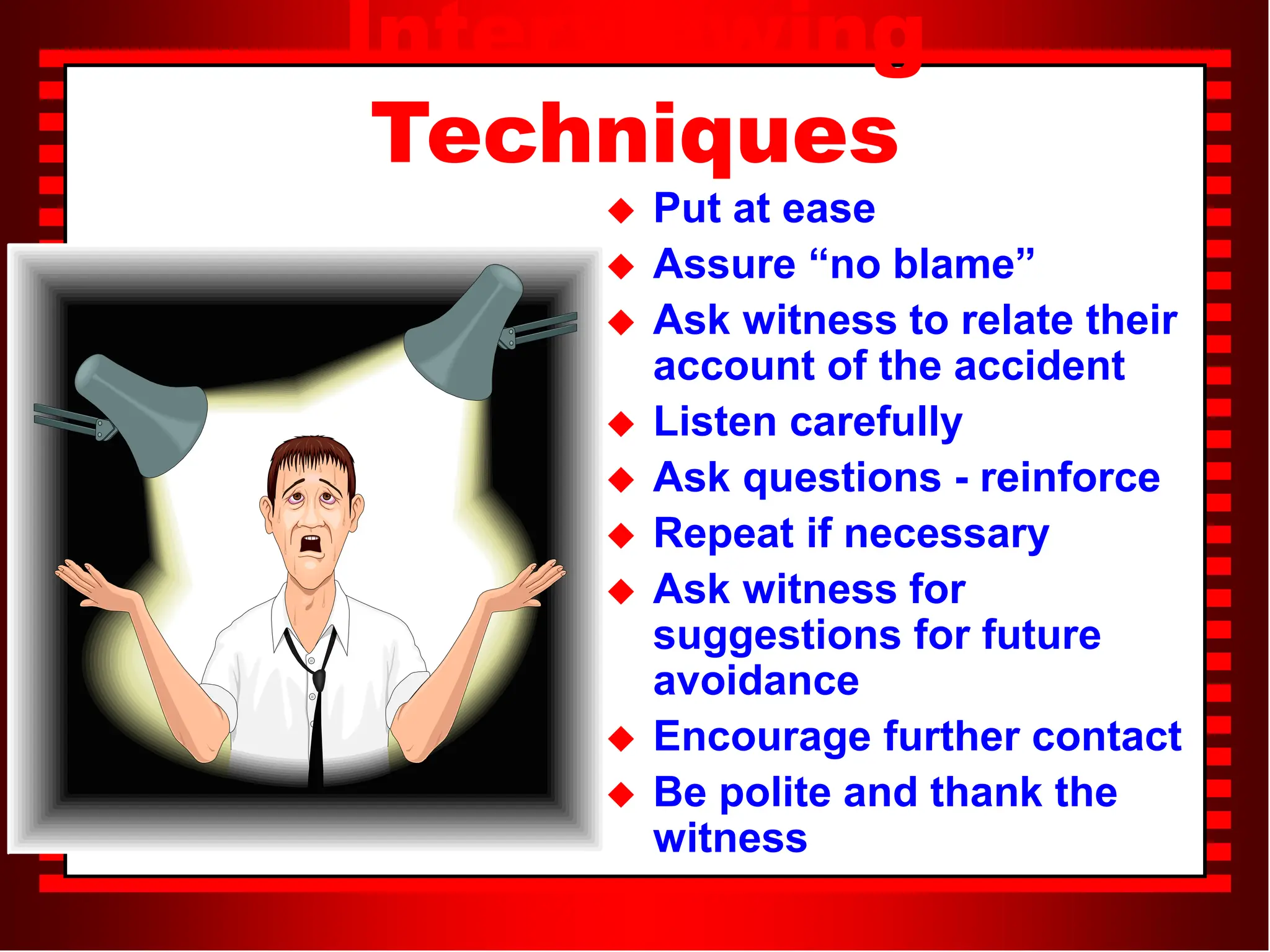
Interviewing
Techniques
 Put at ease
 Assure “no blame”
 Ask witness to relate their
account of the accident
 Listen carefully
 Ask questions - reinforce
 Repeat if necessary
 Ask witness for
suggestions for future
avoidance
 Encourage further contact
 Be polite and thank the
witness
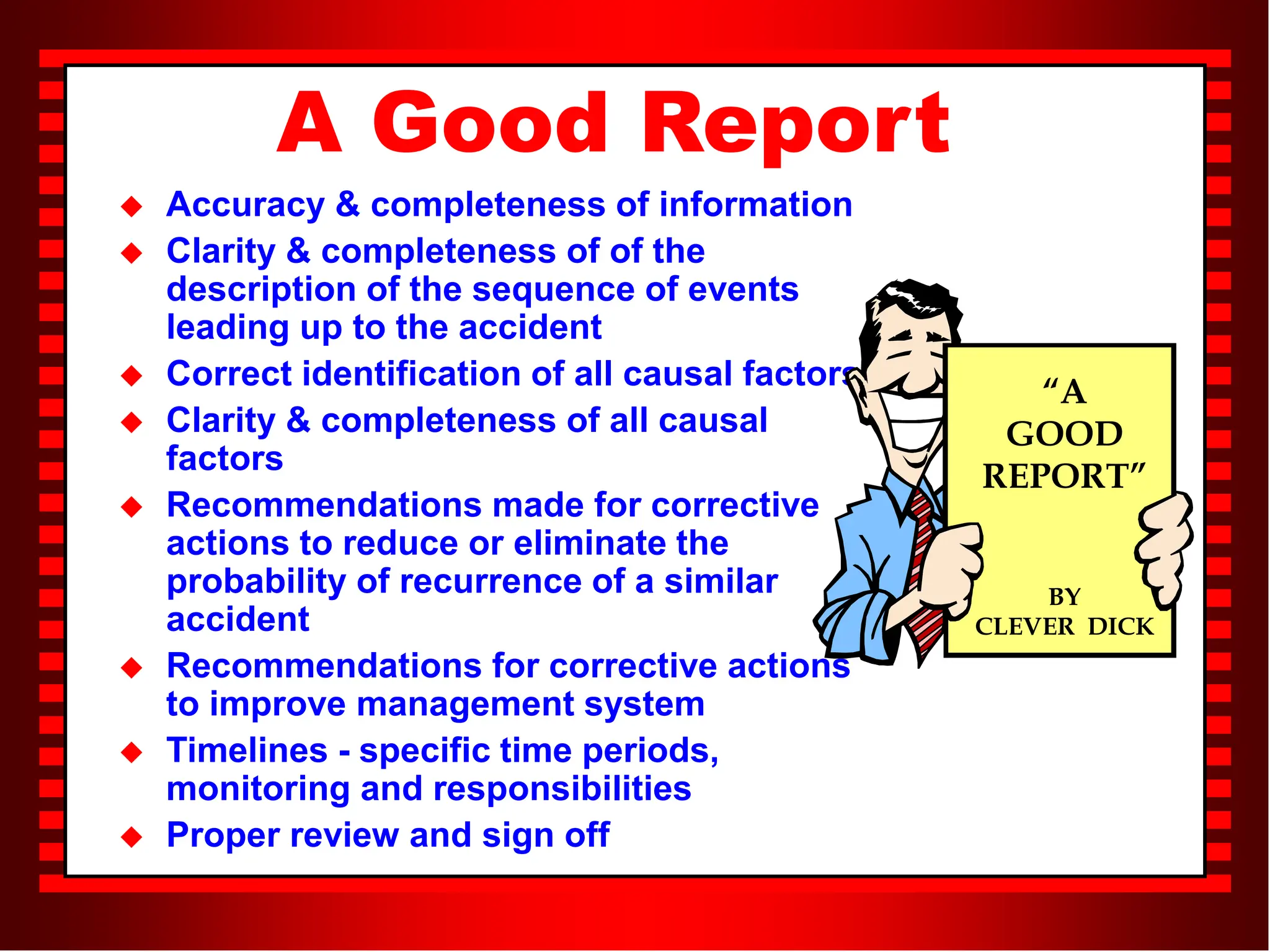
A Good Report
 Accuracy & completeness of information
 Clarity & completeness of of the
description of the sequence of events
leading up to the accident
 Correct identification of all causal factors
 Clarity & completeness of all causal
factors
 Recommendations made for corrective
actions to reduce or eliminate the
probability of recurrence of a similar
accident
 Recommendations for corrective actions
to improve management system
 Timelines - specific time periods,
monitoring and responsibilities
 Proper review and sign off
“A
GOOD
REPORT”
BY
CLEVER DICK
Documentation
 Accident investigation Form
 Witness Statements & Records
of Interview
 Checklists:
 Victim(s)
 Witnesses
 Environment & Locations
 Equipment & Parts
 Documentation
 Accident/Incident Record
Records
 Specified forms
 records maintained
 periods
 Notifiable injury - S.B.I.
 admitted as an “in-patient”
 Times
 S.B.I. - within 24 hours
 death - immediately
Effects of Accidents
 1. On the Victim
 2. On the Supervisor
 3. On the Company
 4. On the Nation
1. The Victim
 Death
 Pain & suffering
 Permanent disability
 Effects on family &
dependants
 Loss of earnings
 Extra expenditure
 Inability to resume
occupation
 Psychological effects
 Feeling of uselessness
 Fear of further injury
 Social effects
 Loss of sports or hobby
2. The Supervisor
 loss of trained worker
 loss of production
 extra work
 investigations & reports
 training new employee
 loss of prestige by:
 management
 other workers
 effects on promotion
 worry (could I have prevented it ?)
 Stress
3. The Company
 loss of trained worker
 loss of production
 damage to machinery
 damage to equipment
 wasted materials
 increased insurance premiums
 prosecutions
 fines
 civil actions
 legal costs
 loss of prestige - customers
4. The Nation
 loss of section of
workforce
 loss of production
 increased cost of
production
 effects on imports
 effects on exports
 effects on balance of trade
 the community pays !
Prevention
 Effective Management & Supervision
 Commitment to Accident Prevention
 Effective Policy & Procedures
 Effective Reporting & Recording
 Regular Consultation & “Toolbox” Meetings
 Risk Assessments
 Specific Training
 Literature & Culture
 Incentive Schemes ?
Warning Signs
 Increases in breaches of safety procedures
 Increase in reportable incidents
 Technical concerns
 Friction or disputes
 ageing or suspect equipment
 Introduction of new procedures or
equipment
 New employees
 Age of employees
 Long periods of work
 Environmental issues
Resources
 Safety Officers
 Bureau of Emergency Services
 Div Workplace Health & Safety
 Workers Compensation Board
 Queensland Health
 Doctors & Specialists
 Rehabilitation Experts
 Consultants
 Psychologists
 Employee Assistance Programs

A risk assessment is a process used to identify potential hazards and analyze what could happen if a disaster or hazard occurs. There are numerous hazards to consider,

  • 1.
  • 2.
    Course Objectives  Understandthe need to investigate  Know what to investigate  Determine the causes of accidents  Identify the methods of investigation  Understand the need to be thorough and comprehensive  Identify prevention methods  Identify sources of assistance
  • 3.
    What is anAccident ? Any undesired, unplanned event arising out of employment which results in physical injury or damage to property, or the possibility of such injury or damage. “Near miss” situations must also be addressed - events which did not result in injury or damage but had the potential to do so.
  • 4.
    What’s in aname ?  Accident  Injury -v- S.B.I.  Dangerous Occurrence  Significant Incident  “Near-miss” accident  “Near-hit”
  • 5.
    1 10 30 600 Serious or Disabling Includesdisabling & Serious Injuries Minor Injuries Any reported injury less than serious Property Damage & Accidents All Types Accidents with no visible Injury or Damage (Critical Incidents) Accident Ratio Study
  • 6.
    Accident Causes  UnsafeAct  an act by the injured person or another person (or both) which caused the accident; and/or  Unsafe Condition  some environmental or hazardous situation which caused the accident independent of the employee(s)
  • 7.
    Accident Causation Model  1.Results of the accident - (harm or damage)  2. Incident - Contact (Accident)  3. Immediate causes (symptoms)  4. Basic causes (real problems)
  • 8.
    Management Safety Policy& Decisions Supervisory Performance Personal Factors Job Factors Human Factor Substandard Practices Substandard Conditions ACCIDENT unplanned release of energy and/or hazardous material Personal injury Property damage Uninsured Costs Basic Causes Immediate causes Incident - Contact Accident Results CHAIN OF ACCIDENT CAUSATION
  • 9.
    1. Results ofAccident  Physical harm (Injury or illness)  catastrophic (multiple deaths)  death  disabling, lost time, major  serious  minor  notifiable  compensatable  Property damage  catastrophic  major  serious  minor
  • 10.
    2. Incident -Contact  struck against  struck by  fall to below  fall on same level  caught on  caught in  caught between  over exertion  chemical contact  Contact with  electricity  plant & equipment  noise or vibration  hazardous substances  radiation  heat & cold  animals or insects  microbiological agents
  • 11.
    3. Immediate Causes Standard Practices  operating with authority  use serviceable equipment  use equipment properly  use of PPE where required  correct lifting  no drinking & drugs  no horseplay  secure equipment or warnings  Standard Conditions  effective guards & devices  serviceable tools & equipment  adequate warning systems  good housekeeping  non polluted environment  noise  hazardous substances  good illumination & ventilation  good working, storage & travelling space
  • 12.
    4.Basic Causes  PersonalFactors  lack of knowledge or skill  improper motivation  physical or mental conditions  literacy or ability (NESB)  Job Factors  physical environment  sub-standard equipment  abnormal usage  wear & tear  inadequate standards  design & maintenance  purchasing standards  Supervisory Performance  inadequate instructions  failure of SOPs  rules not enforced  hazards not corrected  devices not provided  Management Policy & Decisions  set measurable standards  measure work in progress  evaluate work-v- standards  correct performance if nec
  • 13.
    Why Investigate ? Legal Requirement  Establish Causes  Prevent Recurrences  Accurate record (courts & enquiries)  Statistical data base
  • 14.
    Accident Investigation  Asystematic approach to accident investigation, the identification of causal factors and implementation of corrective actions is essential to a good H&S program and management system. Good procedures:  provide information needed to determine injury rates, identify trends or problem areas, permit comparisons and satisfy Workers Compensation requirements;  identify, without placing blame, the basic causal factors that contributed directly or indirectly to each accident;  identify deficiencies in management systems;  suggest corrective action alternatives for a given accident;  suggest corrective action alternatives for the management system.
  • 15.
    What, When &How to Investigate  What to Investigate ?  all accidents & near misses  as soon as possible  scene interference  survey of scene  chronology of data  measurements, maps & sketches  eyewitnesses  reconstruction ?  statistics & trends  injury types & groups  Who should Investigate?  Supervisor ?  WH&S Officer?  WH&S Representative?  Team?  Training & Skills  investigative & recording skills  technical knowledge  interviewing skills  report writing skills
  • 16.
    Qualifications  Technical Knowledge Objectivity  Analytical approach to problems  Familiarity with the job, process or operation  Tact in communicating  Intellectual honesty  Inquisitiveness & curiosity
  • 17.
    Tool Kit  clipboard,paper (incl graph) pens  camera & spare films  tape measure  cassette recorder & spare tapes  reporting forms  hi-viz barrier tape for scene preservation  first aid kit  identification tags for parts  gloves (industrial & medical)  safety helmet  specimen containers  magnifying glass  compass  danger tags  yellow crayon  orange flouro spray paint  torch with batteries  hi-viz orange vest  hearing & eye protection  plastic containers for samples  roll of paper towelling
  • 18.
    Let Us Begin!  Take all necessary steps to provide emergency rescue and medical help for the injured; and  take those actions that will prevent, or minimise the risk of further accidents or physical harm to the victim or others
  • 19.
    Action Plan  Identificationof the individual who is in charge and assigns responsibilities;  Authority to conduct investigation;  Securing the accident site for the duration of the investigation, after rescue and damage control are complete;  Photographic support or capability;  Procedures & equipment to ensure observation and recording of fragile, perishable or transient evidence (instrument readings, control panel settings, weather & other environmental conditions, chemical spills, stains, skid marks);  Development of a comprehensive report.
  • 20.
    Determine the Facts Visit accident scene  Take samples  Visual records  Preserve accident items  Identify people involved  Interview witnesses  Review information
  • 21.
    Finding Facts (logic method) What was the exact injury or damage ?  What was the damaging energy source ?  What event immediately preceded the damaging event ?  What happened before that ?  What happened even before that ?  What happened in between ?  What else was going on at the time of the accident ?  Was anyone else involved ?  Interview witnesses
  • 22.
    Interviewing Techniques  Put atease  Assure “no blame”  Ask witness to relate their account of the accident  Listen carefully  Ask questions - reinforce  Repeat if necessary  Ask witness for suggestions for future avoidance  Encourage further contact  Be polite and thank the witness
  • 23.
    A Good Report Accuracy & completeness of information  Clarity & completeness of of the description of the sequence of events leading up to the accident  Correct identification of all causal factors  Clarity & completeness of all causal factors  Recommendations made for corrective actions to reduce or eliminate the probability of recurrence of a similar accident  Recommendations for corrective actions to improve management system  Timelines - specific time periods, monitoring and responsibilities  Proper review and sign off “A GOOD REPORT” BY CLEVER DICK
  • 24.
    Documentation  Accident investigationForm  Witness Statements & Records of Interview  Checklists:  Victim(s)  Witnesses  Environment & Locations  Equipment & Parts  Documentation  Accident/Incident Record
  • 25.
    Records  Specified forms records maintained  periods  Notifiable injury - S.B.I.  admitted as an “in-patient”  Times  S.B.I. - within 24 hours  death - immediately
  • 26.
    Effects of Accidents 1. On the Victim  2. On the Supervisor  3. On the Company  4. On the Nation
  • 27.
    1. The Victim Death  Pain & suffering  Permanent disability  Effects on family & dependants  Loss of earnings  Extra expenditure  Inability to resume occupation  Psychological effects  Feeling of uselessness  Fear of further injury  Social effects  Loss of sports or hobby
  • 28.
    2. The Supervisor loss of trained worker  loss of production  extra work  investigations & reports  training new employee  loss of prestige by:  management  other workers  effects on promotion  worry (could I have prevented it ?)  Stress
  • 29.
    3. The Company loss of trained worker  loss of production  damage to machinery  damage to equipment  wasted materials  increased insurance premiums  prosecutions  fines  civil actions  legal costs  loss of prestige - customers
  • 30.
    4. The Nation loss of section of workforce  loss of production  increased cost of production  effects on imports  effects on exports  effects on balance of trade  the community pays !
  • 31.
    Prevention  Effective Management& Supervision  Commitment to Accident Prevention  Effective Policy & Procedures  Effective Reporting & Recording  Regular Consultation & “Toolbox” Meetings  Risk Assessments  Specific Training  Literature & Culture  Incentive Schemes ?
  • 32.
    Warning Signs  Increasesin breaches of safety procedures  Increase in reportable incidents  Technical concerns  Friction or disputes  ageing or suspect equipment  Introduction of new procedures or equipment  New employees  Age of employees  Long periods of work  Environmental issues
  • 33.
    Resources  Safety Officers Bureau of Emergency Services  Div Workplace Health & Safety  Workers Compensation Board  Queensland Health  Doctors & Specialists  Rehabilitation Experts  Consultants  Psychologists  Employee Assistance Programs