ACCELERATED STABILITY
       STUDY


                        1
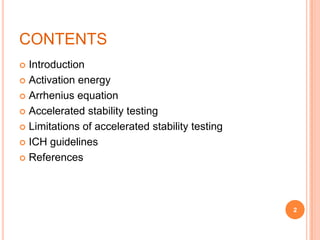
CONTENTS
 Introduction
 Activation energy

 Arrhenius equation

 Accelerated stability testing

 Limitations of accelerated stability testing

 ICH guidelines

 References


                                                 2
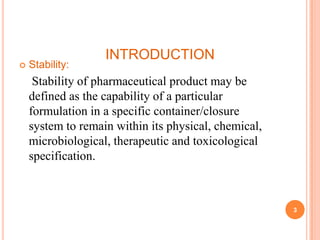
INTRODUCTION
   Stability:
     Stability of pharmaceutical product may be
    defined as the capability of a particular
    formulation in a specific container/closure
    system to remain within its physical, chemical,
    microbiological, therapeutic and toxicological
    specification.


                                                      3
Need for stability testing:
1. Provide evidence as to how the quality of the drug
    product varies with time.
2. Establish shelf life for the drug product.
3. Determine recommended storage conditions.
4. Determine container closure system suitability.
5. Safety point of view of patient.
6. Prevention of economical repercussion.
7. Essential quality attribute.
                                                        4
ACCORDING TO USP TYPES OF
STABILITY
Type                Condition to be
                    maintained
1.Chemical :        Chemical integrity &
                    lebelled potency
2.Physical:         Appearance, palatability,
                    uniformality.
3.Microbiological    Sterility
4.Therapeutic:      Drug action remains
                    unchanged
                                                5
5.Toxicological:    No increase in toxicity
ACTIVATION ENERGY:
It is defined as the energy that must be overcome in order for a
chemical reaction to occur. Activation energy may also be defined
as the minimum energy required to start a chemical reaction.

The activation energy of a reaction is usually denoted by Ea, and
given in units of kilojoules per mole.


                                                              6
ARRHENIUS EQUATION :
Arrhenius equation gives "the dependence of the rate constant
k of chemical reaction on the temperature T (in absolute
temperature, such as Kelvin or degrees Rankine) and activation
energy Ea", as shown below:
                                                 (1)

               Where k=specific rate constant
                      A=frequency factor
                      Ea= activation energy
                      R=ideal gas constant
                      T=absolute temperature
Take log on both sides,
       ln k = ln A –Ea/RT ln e                  (2)
Converting eq. 2 to log 10
       log k = log A – Ea/2.303RT                        7
Estimation of k:
1.Reaction is conducted at several temp.
2.Conc. is determined at different time period.
3.Order of reaction is identified.
4.From slope of line k is calculated.


                                 Fig. Estimation
                                                   8
ESTIMATION OF ACTIVATION ENERGY:
 A graph can be drawn by taking log k on y-axis and
  reciprocal temperature (1/T) on x-axis.
 A straight line is obtained, the slope of the line is
  negative and the magnitude is Ea /2.303 R.
 The intercept corresponds to log A.

 All the constants in the Arrhenius equation can be
  obtained from the graph.


                                                           9

                    Fig. estimation of activation energy
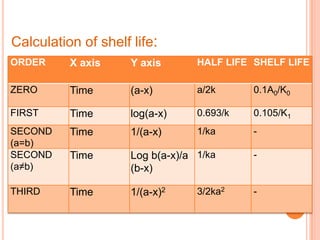
Calculation of shelf life:
ORDER     X axis     Y axis       HALF LIFE SHELF LIFE

ZERO      Time       (a-x)        a/2k      0.1A0/K0

FIRST     Time       log(a-x)     0.693/k   0.105/K1
SECOND    Time       1/(a-x)      1/ka      -
(a=b)
SECOND    Time       Log b(a-x)/a 1/ka      -
(a≠b)                (b-x)

THIRD     Time       1/(a-x)2     3/2ka2    -
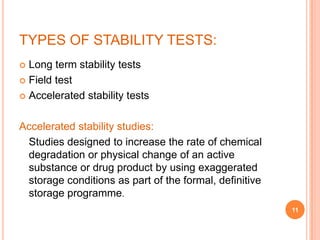
TYPES OF STABILITY TESTS:
 Long term stability tests
 Field test

 Accelerated stability tests


Accelerated stability studies:
 Studies designed to increase the rate of chemical
 degradation or physical change of an active
 substance or drug product by using exaggerated
 storage conditions as part of the formal, definitive
 storage programme.
                                                        11
TESTS AT ELEVATED TEMPERATURE:
 Drug liquid preparation stored at 50, 60, 70,85,100
  and 121˚c.
 Also study performed at R.T. and or refrigerator
  temp.
 Sampling:
  First year- 3 month interval
  Second year- 6 month interval
 Four climatic zones:
  Temperate zone            21˚c/45%RH
  Mediterranean zone        25˚c/60%RH
  Tropical zone             30˚c/70%RH
                                                        12
  Desert zone               30˚c/35%RH
TESTS AT HIGH INTENSITY OF LIGHT:
   Drug substances fade or darken on exposing to light, can be
    controlled by using amber glass or opaque container.

   By exposing drug substance to 400 & 900 (FC)of illumination for 4 &
    2 weeks to light and another sample examined protected from light .

   Results found on appearance and chemical loss may be recorded.

   Comparing color or using diffused reflectance spectroscopy for
    examination.

   e.g. cycloprofen becomes very yellow after five days under 900 foot
    candles of light.
                                                                      13
TESTS AT HIGH PARTIAL PRESSURE OF OXYGEN:

   Sensitivity of the drugs to atmospheric oxygen must
    be evaluated from which it should be packed in
    inert atmospheric condition with antioxidants is
    decided .
   Here, high oxygen tension plays important role to
    investigate stability Usually ,40% of oxygen
    atmosphere allows for rapid evaluation.
   Results were correlated with inert & without inert
                                                          14
    condition .
TESTS AT HIGH RELATIVE HUMIDITY:
   Presence of moisture may cause hydrolysis and
    oxidation.

   These reactions may accelerated by exposing the
    drug to different relative humidities.

   Control humidity by Lab desiccators

   Closed dessicator are placed in an oven to provide
    constant temperature.
                                                         15
LIMITATIONS OF ACCELERATED
STABILITY TESTING
 Valid only when the break down depends on
  temperature.
 The energy of activation obtained in the study
  should be between 10 to 30 kcal/mole.
 It is not useful when degradation is due to:
    • Microbial contamination
    • Photochemical reactions
    • Diffusion
    • Excessive agitation
 When the product looses its physical integrity at
  higher temperatures.
 When the order changes at elevated temperatures.
                                                      16
STABILITY PROTOCOL:
 Containers and closures
 Container orientation

 Sampling interval

 Type, size and number of batches

 Plan of sampling

 Storage conditions

 Test methodology

 Acceptance criteria


                                     17
ICH GUIDELINES ON STRESS
 TESTING:
Standard      Title and reference

ICH Q1A(R2)   Stability Testing of New Drug Substances
              and Products (the parent guideline)

ICH Q1B       Photostability Testing of New Drug
              Substances and Products
ICH Q C       Stability testing of new dosage forms
ICH D         Bracketing and matrixing designs
ICH Q E       Evaluation of stability data
ICH Q F       Stability data package for registration    18
              applications in climatic zone I and IV
REFERENCES
   Patrick J.Sinko , Martin’s Physical Pharmacy and
    Pharmaceutical Sciences.

   Theory and practice of Industrial Pharmacy –
    Lachman

   International Stability Testing Drug stability-
    Cartensen

   C.V.S. Subrahmanyam
                                                       19
   www.ich.org
THANK YOU…


             20
21

Accelerated stability testing

  • 1.
  • 2.
    CONTENTS  Introduction  Activationenergy  Arrhenius equation  Accelerated stability testing  Limitations of accelerated stability testing  ICH guidelines  References 2
  • 3.
    INTRODUCTION  Stability: Stability of pharmaceutical product may be defined as the capability of a particular formulation in a specific container/closure system to remain within its physical, chemical, microbiological, therapeutic and toxicological specification. 3
  • 4.
    Need for stabilitytesting: 1. Provide evidence as to how the quality of the drug product varies with time. 2. Establish shelf life for the drug product. 3. Determine recommended storage conditions. 4. Determine container closure system suitability. 5. Safety point of view of patient. 6. Prevention of economical repercussion. 7. Essential quality attribute. 4
  • 5.
    ACCORDING TO USPTYPES OF STABILITY Type Condition to be maintained 1.Chemical : Chemical integrity & lebelled potency 2.Physical: Appearance, palatability, uniformality. 3.Microbiological Sterility 4.Therapeutic: Drug action remains unchanged 5 5.Toxicological: No increase in toxicity
  • 6.
    ACTIVATION ENERGY: It isdefined as the energy that must be overcome in order for a chemical reaction to occur. Activation energy may also be defined as the minimum energy required to start a chemical reaction. The activation energy of a reaction is usually denoted by Ea, and given in units of kilojoules per mole. 6
  • 7.
    ARRHENIUS EQUATION : Arrheniusequation gives "the dependence of the rate constant k of chemical reaction on the temperature T (in absolute temperature, such as Kelvin or degrees Rankine) and activation energy Ea", as shown below: (1) Where k=specific rate constant A=frequency factor Ea= activation energy R=ideal gas constant T=absolute temperature Take log on both sides, ln k = ln A –Ea/RT ln e (2) Converting eq. 2 to log 10 log k = log A – Ea/2.303RT 7
  • 8.
    Estimation of k: 1.Reactionis conducted at several temp. 2.Conc. is determined at different time period. 3.Order of reaction is identified. 4.From slope of line k is calculated. Fig. Estimation 8
  • 9.
    ESTIMATION OF ACTIVATIONENERGY:  A graph can be drawn by taking log k on y-axis and reciprocal temperature (1/T) on x-axis.  A straight line is obtained, the slope of the line is negative and the magnitude is Ea /2.303 R.  The intercept corresponds to log A.  All the constants in the Arrhenius equation can be obtained from the graph. 9 Fig. estimation of activation energy
  • 10.
    Calculation of shelflife: ORDER X axis Y axis HALF LIFE SHELF LIFE ZERO Time (a-x) a/2k 0.1A0/K0 FIRST Time log(a-x) 0.693/k 0.105/K1 SECOND Time 1/(a-x) 1/ka - (a=b) SECOND Time Log b(a-x)/a 1/ka - (a≠b) (b-x) THIRD Time 1/(a-x)2 3/2ka2 -
  • 11.
    TYPES OF STABILITYTESTS:  Long term stability tests  Field test  Accelerated stability tests Accelerated stability studies: Studies designed to increase the rate of chemical degradation or physical change of an active substance or drug product by using exaggerated storage conditions as part of the formal, definitive storage programme. 11
  • 12.
    TESTS AT ELEVATEDTEMPERATURE:  Drug liquid preparation stored at 50, 60, 70,85,100 and 121˚c.  Also study performed at R.T. and or refrigerator temp.  Sampling: First year- 3 month interval Second year- 6 month interval  Four climatic zones: Temperate zone 21˚c/45%RH Mediterranean zone 25˚c/60%RH Tropical zone 30˚c/70%RH 12 Desert zone 30˚c/35%RH
  • 13.
    TESTS AT HIGHINTENSITY OF LIGHT:  Drug substances fade or darken on exposing to light, can be controlled by using amber glass or opaque container.  By exposing drug substance to 400 & 900 (FC)of illumination for 4 & 2 weeks to light and another sample examined protected from light .  Results found on appearance and chemical loss may be recorded.  Comparing color or using diffused reflectance spectroscopy for examination.  e.g. cycloprofen becomes very yellow after five days under 900 foot candles of light. 13
  • 14.
    TESTS AT HIGHPARTIAL PRESSURE OF OXYGEN:  Sensitivity of the drugs to atmospheric oxygen must be evaluated from which it should be packed in inert atmospheric condition with antioxidants is decided .  Here, high oxygen tension plays important role to investigate stability Usually ,40% of oxygen atmosphere allows for rapid evaluation.  Results were correlated with inert & without inert 14 condition .
  • 15.
    TESTS AT HIGHRELATIVE HUMIDITY:  Presence of moisture may cause hydrolysis and oxidation.  These reactions may accelerated by exposing the drug to different relative humidities.  Control humidity by Lab desiccators  Closed dessicator are placed in an oven to provide constant temperature. 15
  • 16.
    LIMITATIONS OF ACCELERATED STABILITYTESTING  Valid only when the break down depends on temperature.  The energy of activation obtained in the study should be between 10 to 30 kcal/mole.  It is not useful when degradation is due to: • Microbial contamination • Photochemical reactions • Diffusion • Excessive agitation  When the product looses its physical integrity at higher temperatures.  When the order changes at elevated temperatures. 16
  • 17.
    STABILITY PROTOCOL:  Containersand closures  Container orientation  Sampling interval  Type, size and number of batches  Plan of sampling  Storage conditions  Test methodology  Acceptance criteria 17
  • 18.
    ICH GUIDELINES ONSTRESS TESTING: Standard Title and reference ICH Q1A(R2) Stability Testing of New Drug Substances and Products (the parent guideline) ICH Q1B Photostability Testing of New Drug Substances and Products ICH Q C Stability testing of new dosage forms ICH D Bracketing and matrixing designs ICH Q E Evaluation of stability data ICH Q F Stability data package for registration 18 applications in climatic zone I and IV
  • 19.
    REFERENCES  Patrick J.Sinko , Martin’s Physical Pharmacy and Pharmaceutical Sciences.  Theory and practice of Industrial Pharmacy – Lachman  International Stability Testing Drug stability- Cartensen  C.V.S. Subrahmanyam 19  www.ich.org
  • 20.
  • 21.