By-
Prof. Vedanshu Malviya
M.Pharm Pharmaceutics)
P.R. Pote Patil College of Pharmacy, Amravati-444604
CONTENTS
• Introduction
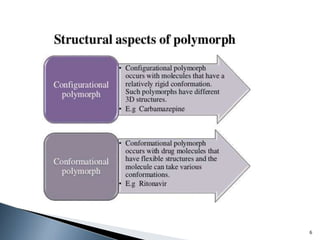
• Structural aspects of polymorphism
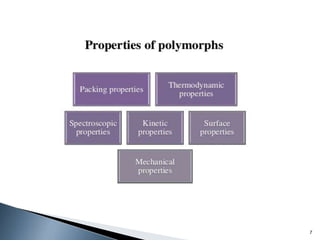
• Properties of polymorphism
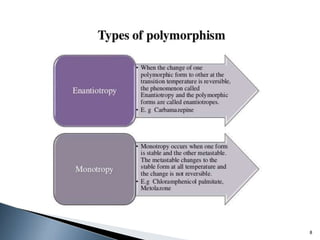
• Types of polymorphism
• Conditions responsible for development of different
polymorphic forms
• Methods of preparation
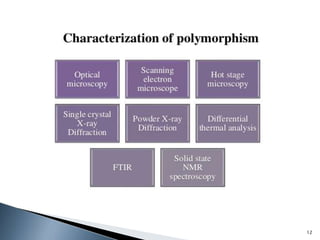
• Characterization of polymorphism
• Factors affecting polymorphism
• Applications
• Conclusion
• References
2
Introduction
• The ability of a substance to occur in two or more different
crystalline forms with a differential arrangements and/or
conformation of the molecules in the crystal lattice is known
as polymorphism
• Polymorphism is relevant to the fields of pharmaceuticals,
agrochemicals, pigments and explosives.
• Differences in the internal structures of polymorphs results in
their distinct physical and chemical properties.
• Polymorph control is important in drug discovery and
development and also in required by regulatory agencies.
3
• The physicochemical properties of active pharmaceutical
ingredients are the key factors for the development of
appropriate dosage forms.
• All the physicochemical properties in solid state are affected
mainly in terms of solubility, dissolution, bioavailability,
processability and stability, it is mandatory to investigate the
polymorphic behavior of active ingredients.
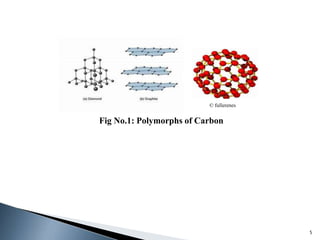
• The element carbon is the most common example exhibiting
polymorphism. It exists in the form of graphite (hexagonal),
diamond (cubic) and as fullerenes (C60, C70), and are shown
in Fig No.1.
4
5
© fullerenes
Fig No.1: Polymorphs of Carbon
6
7
8
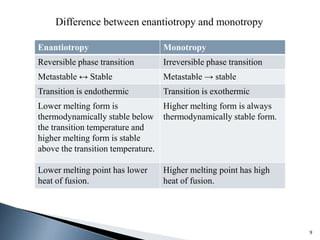
Difference between enantiotropy and monotropy
9
Enantiotropy Monotropy
Reversible phase transition Irreversible phase transition
Metastable ↔ Stable Metastable → stable
Transition is endothermic Transition is exothermic
Lower melting form is
thermodynamically stable below
the transition temperature and
higher melting form is stable
above the transition temperature.
Higher melting form is always
thermodynamically stable form.
Lower melting point has lower
heat of fusion.
Higher melting point has high
heat of fusion.
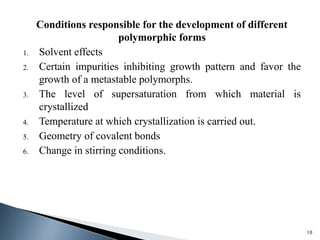
Conditions responsible for the development of different
polymorphic forms
1. Solvent effects
2. Certain impurities inhibiting growth pattern and favor the
growth of a metastable polymorphs.
3. The level of supersaturation from which material is
crystallized
4. Temperature at which crystallization is carried out.
5. Geometry of covalent bonds
6. Change in stirring conditions.
10
11
12
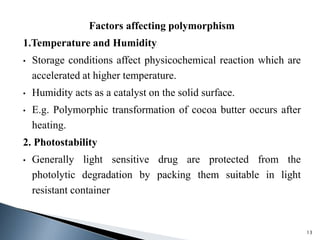
Factors affecting polymorphism
1.Temperature and Humidity
• Storage conditions affect physicochemical reaction which are
accelerated at higher temperature.
• Humidity acts as a catalyst on the solid surface.
• E.g. Polymorphic transformation of cocoa butter occurs after
heating.
2. Photostability
• Generally light sensitive drug are protected from the
photolytic degradation by packing them suitable in light
resistant container
13
• Stable crystalline form resist photochemical degradation and
does not require light resistant system.
• E.g. Acetametacin
3. Effect of solvent
• Solvent can bring dramatic change in growth mechanism and
morphology.
• Kinetic of crystal growing from solution was determined by
two important factors.
1. Degree of molecular roughness
2. Nature of absorption of the solvent from surface.
14
4. Effect of grinding
• Grinding process reduces particle size, so increasing specific
surface area and that why direct effect on dissolution rate and
bioavaibility of the formulation.
• During process solid state polymorphic transformation on to
non crystalline or metastable form is caused by mechanical
action.
• E.g. Dihydrate form is more stable than anhydrous form. With
increasing grinding time compound become unstable because
grinding weakened bonding crystals and water molecules.
15
5. Effect of tablet compression
• Stability and compaction behavior form of the polymorphic
form of drug is important.
• E.g. Phenylbutazone in which form 3 converted to form 2 at
˃2000kg/cm2.
16
17
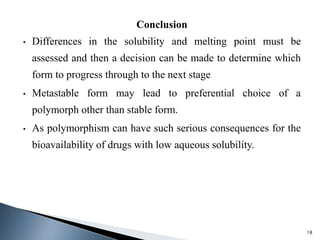
Conclusion
• Differences in the solubility and melting point must be
assessed and then a decision can be made to determine which
form to progress through to the next stage
• Metastable form may lead to preferential choice of a
polymorph other than stable form.
• As polymorphism can have such serious consequences for the
bioavailability of drugs with low aqueous solubility.
18
References
1. Sharma A, Mishra R, Tandon P. Polymorphism in
Pharmaceutical Compounds, Advancements and Futuristic
Trends in Material Science,2011, 40-48.
2. Prasanthi N. L, Sudhir M, Jyothi N, Vajrapriya V.Sri, A
Review on Polymorphism Perpetuates, American Journal of
Advanced Drug Delivery, 2016, 58-63.
3. Raza K, Kumar P, Ratan S, Malik R, Arora S, Polymorphism:
The Phenomenon Affecting the Performance of Drugs, SOJ
Pharm Pharm Sci, 2014,1-10.
19
4. P. H. Karpinski, “Polymorphism of active pharmaceutical
ingredients” Chem. Eng. Technol., 2006,vol. 29(2), pp. 233-237.
5. Harry G. Brittain, Polymorphism in pharmaceutical solids,
Marcel Dekker, Inc, Special Indian edition, 2008, pp.7-19.
20
21

Polymorphism in Pharmacy

  • 1.
    By- Prof. Vedanshu Malviya M.PharmPharmaceutics) P.R. Pote Patil College of Pharmacy, Amravati-444604
  • 2.
    CONTENTS • Introduction • Structuralaspects of polymorphism • Properties of polymorphism • Types of polymorphism • Conditions responsible for development of different polymorphic forms • Methods of preparation • Characterization of polymorphism • Factors affecting polymorphism • Applications • Conclusion • References 2
  • 3.
    Introduction • The abilityof a substance to occur in two or more different crystalline forms with a differential arrangements and/or conformation of the molecules in the crystal lattice is known as polymorphism • Polymorphism is relevant to the fields of pharmaceuticals, agrochemicals, pigments and explosives. • Differences in the internal structures of polymorphs results in their distinct physical and chemical properties. • Polymorph control is important in drug discovery and development and also in required by regulatory agencies. 3
  • 4.
    • The physicochemicalproperties of active pharmaceutical ingredients are the key factors for the development of appropriate dosage forms. • All the physicochemical properties in solid state are affected mainly in terms of solubility, dissolution, bioavailability, processability and stability, it is mandatory to investigate the polymorphic behavior of active ingredients. • The element carbon is the most common example exhibiting polymorphism. It exists in the form of graphite (hexagonal), diamond (cubic) and as fullerenes (C60, C70), and are shown in Fig No.1. 4
  • 5.
    5 © fullerenes Fig No.1:Polymorphs of Carbon
  • 6.
  • 7.
  • 8.
  • 9.
    Difference between enantiotropyand monotropy 9 Enantiotropy Monotropy Reversible phase transition Irreversible phase transition Metastable ↔ Stable Metastable → stable Transition is endothermic Transition is exothermic Lower melting form is thermodynamically stable below the transition temperature and higher melting form is stable above the transition temperature. Higher melting form is always thermodynamically stable form. Lower melting point has lower heat of fusion. Higher melting point has high heat of fusion.
  • 10.
    Conditions responsible forthe development of different polymorphic forms 1. Solvent effects 2. Certain impurities inhibiting growth pattern and favor the growth of a metastable polymorphs. 3. The level of supersaturation from which material is crystallized 4. Temperature at which crystallization is carried out. 5. Geometry of covalent bonds 6. Change in stirring conditions. 10
  • 11.
  • 12.
  • 13.
    Factors affecting polymorphism 1.Temperatureand Humidity • Storage conditions affect physicochemical reaction which are accelerated at higher temperature. • Humidity acts as a catalyst on the solid surface. • E.g. Polymorphic transformation of cocoa butter occurs after heating. 2. Photostability • Generally light sensitive drug are protected from the photolytic degradation by packing them suitable in light resistant container 13
  • 14.
    • Stable crystallineform resist photochemical degradation and does not require light resistant system. • E.g. Acetametacin 3. Effect of solvent • Solvent can bring dramatic change in growth mechanism and morphology. • Kinetic of crystal growing from solution was determined by two important factors. 1. Degree of molecular roughness 2. Nature of absorption of the solvent from surface. 14
  • 15.
    4. Effect ofgrinding • Grinding process reduces particle size, so increasing specific surface area and that why direct effect on dissolution rate and bioavaibility of the formulation. • During process solid state polymorphic transformation on to non crystalline or metastable form is caused by mechanical action. • E.g. Dihydrate form is more stable than anhydrous form. With increasing grinding time compound become unstable because grinding weakened bonding crystals and water molecules. 15
  • 16.
    5. Effect oftablet compression • Stability and compaction behavior form of the polymorphic form of drug is important. • E.g. Phenylbutazone in which form 3 converted to form 2 at ˃2000kg/cm2. 16
  • 17.
  • 18.
    Conclusion • Differences inthe solubility and melting point must be assessed and then a decision can be made to determine which form to progress through to the next stage • Metastable form may lead to preferential choice of a polymorph other than stable form. • As polymorphism can have such serious consequences for the bioavailability of drugs with low aqueous solubility. 18
  • 19.
    References 1. Sharma A,Mishra R, Tandon P. Polymorphism in Pharmaceutical Compounds, Advancements and Futuristic Trends in Material Science,2011, 40-48. 2. Prasanthi N. L, Sudhir M, Jyothi N, Vajrapriya V.Sri, A Review on Polymorphism Perpetuates, American Journal of Advanced Drug Delivery, 2016, 58-63. 3. Raza K, Kumar P, Ratan S, Malik R, Arora S, Polymorphism: The Phenomenon Affecting the Performance of Drugs, SOJ Pharm Pharm Sci, 2014,1-10. 19
  • 20.
    4. P. H.Karpinski, “Polymorphism of active pharmaceutical ingredients” Chem. Eng. Technol., 2006,vol. 29(2), pp. 233-237. 5. Harry G. Brittain, Polymorphism in pharmaceutical solids, Marcel Dekker, Inc, Special Indian edition, 2008, pp.7-19. 20
  • 21.