How Use of Social Media Can Help
You for Self-Advancement
in Research
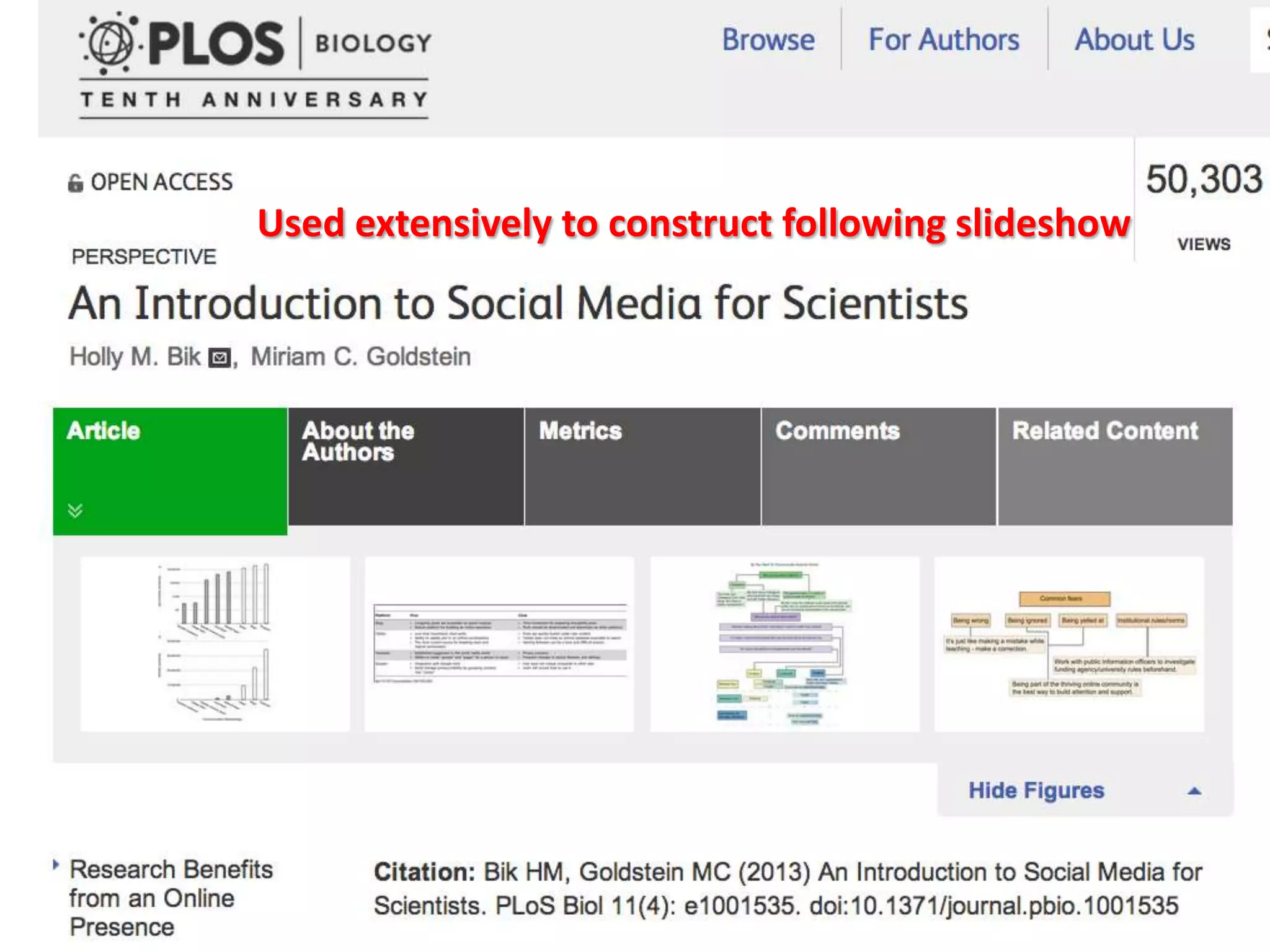
Used extensively to construct following slideshow
Tools 1:
• Blogs - Traditional, long-form online narrative. Eg:
Wordpress and Blogger offer free blog hosting.
• RSS Feeds - Type of URL that allows users to
automatically mine blog/website updates without the
need for a web browser.
• Apps - Software used on mobile devices, especially
useful as mobile social networking platforms
• Twitter - Social networking site that limits posts to 140
characters, useful for in-the-moment conversations,
customized news streams, and building and
maintaining communities.
• Facebook - The most widely used social media site.
Tools 2:
• SlideShare – offers users the ability to upload and share publicly or
privately PowerPoint presentations, Word documents and Adobe
PDF Portfolios
• Tumblr - A microblogging site that can publish any type of media
very easily and quickly. Users post photos, videos, or short quotes
as opposed to long written narratives.
• Pinterest - A photo-only microblogging site where users define
themed “boards” for posting content (e.g., food, art, marine fish).
• Storify - A way to aggregate and organize tweets, videos, blog
posts, and other media. Storify is especially useful for compiling
media on discrete discussions and preserving tweets before they
become archived by Twitter.
• Linking communities - Include Digg, StumbleUpon, MetaFilter -
content aggregation sites that recommend new and interesting
content to subscribers.
Figure 1. Monthly audience by communication methodology shown on A) log scale and B) linear scale.
Bik HM, Goldstein MC (2013) An Introduction to Social Media for Scientists. PLoS Biol 11(4): e1001535. doi:10.1371/journal.pbio.1001535
http://www.plosbiology.org/article/info:doi/10.1371/journal.pbio.1001535
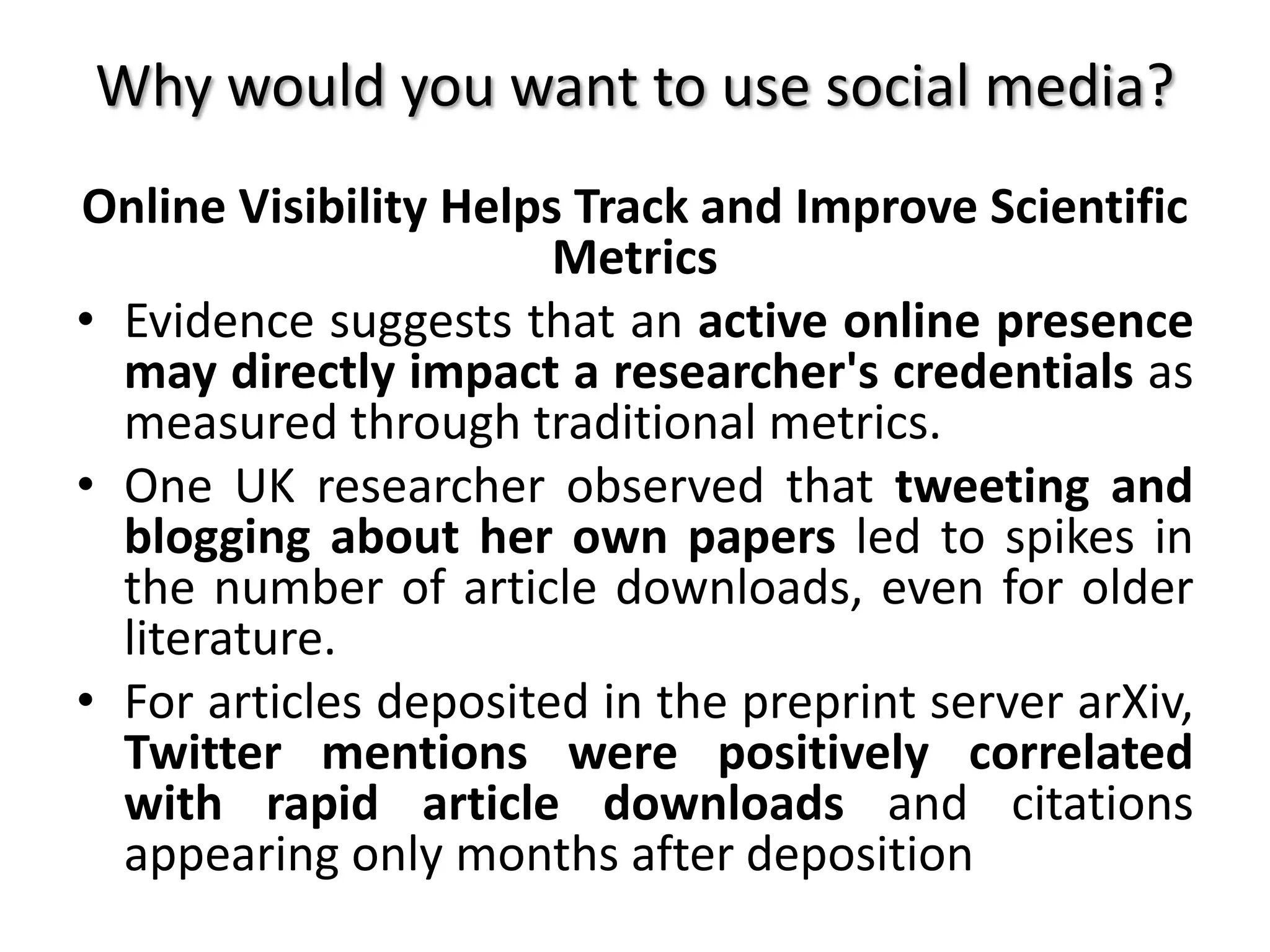
Table 1. Comparison of Online Tools.
Bik HM, Goldstein MC (2013) An Introduction to Social Media for Scientists. PLoS Biol 11(4): e1001535. doi:10.1371/journal.pbio.1001535
http://www.plosbiology.org/article/info:doi/10.1371/journal.pbio.1001535
Why would you want to use social media?
Online Visibility Helps Track and Improve Scientific
Metrics
• Evidence suggests that an active online presence
may directly impact a researcher's credentials as
measured through traditional metrics.
• One UK researcher observed that tweeting and
blogging about her own papers led to spikes in
the number of article downloads, even for older
literature.
• For articles deposited in the preprint server arXiv,
Twitter mentions were positively correlated
with rapid article downloads and citations
appearing only months after deposition
Why would you want to use social media?
Social Media Enhances Professional Networking
• Online discussions can lead to tangible, real-
world social interactions.
• Conversations on Twitter can serve as an
icebreaker once two people finally meet in a
conference or workshop setting.
• Tweeting from conferences can introduce other
scientists to valuable content, and consequently
provide networking opportunities for users who
actively post during meetings.
Advice for New Users
In academia, there is often a particular stigma
attached to online activities: actively maintaining
an online profile and participating in social media
discussions can be seen as a waste of time and a
distraction from research and teaching duties.
However, when used in a targeted and streamlined
manner, social media tools can complement and
enhance a researcher's career.
When exploring online tools for the first time, new
users can maximize their reach by considering the
following points
Advice for New Users - 1
Explore online guides to social media
• The Superfund program at Oregon State
University maintains an exhaustive list of
resources (blog articles, videos, how-to
guides) focused on science and social media:
http://bit.ly/WkdN0G.
Advice for New Users - 2
Establish a professional-looking website
• To establish an online presence, set up a personal
website that lays out specific research projects and
areas of expertise, searchable by colleagues,
journalists, and the public alike.
• Although professional websites can be established
through UCT, external hosts (eg: wordpress.com) offer
more flexibility and are easier to access and maintain –
and can be linked out to from UCT.
• A website can be supplemented with social media
accounts (e.g., Twitter and Google+ profiles), which
will also appear high in Google search results.
• Eg: Scoop.it allows you to create a magazine-like site
for daily updates
Advice for New Users - 3
Locate pertinent online conversations
• Find people with common interests; follow the social
media that they link to and that links to them.
• Use established social networks (e.g., a base of
Twitter or LinkedIn or ResearchGate contacts) or a
means of notification (RSS feeds etc) to get started.
• It can be beneficial to read first without contributing
(“lurking”) to learn logistics and basic etiquette of
different social media platforms.
Advice for New Users - 4
Navigate the deluge of online information
• Maintain and organize online accounts (e.g., grouping
people using Twitter lists and Google+ circles).
• Track and prioritize the most relevant blogs and articles for
reading (e.g., using RSS services that can be accessed and
synced to mobile devices).
• Explore multiple social media tools and related sites/apps
for managing online: consistent use of fewer tools is better
than spreading yourself too thin across too many platforms.
• Don't be afraid to ask for help; there are many friendly and
established communities who are willing and eager to
assist new users
Advice for New Users - 7
Establish a LinkedIn, Academia.edu and/or
ResearchGate profile: this
• Increases your global findability
• Increases your professional exposure
• Allows you to upload material for others to
read
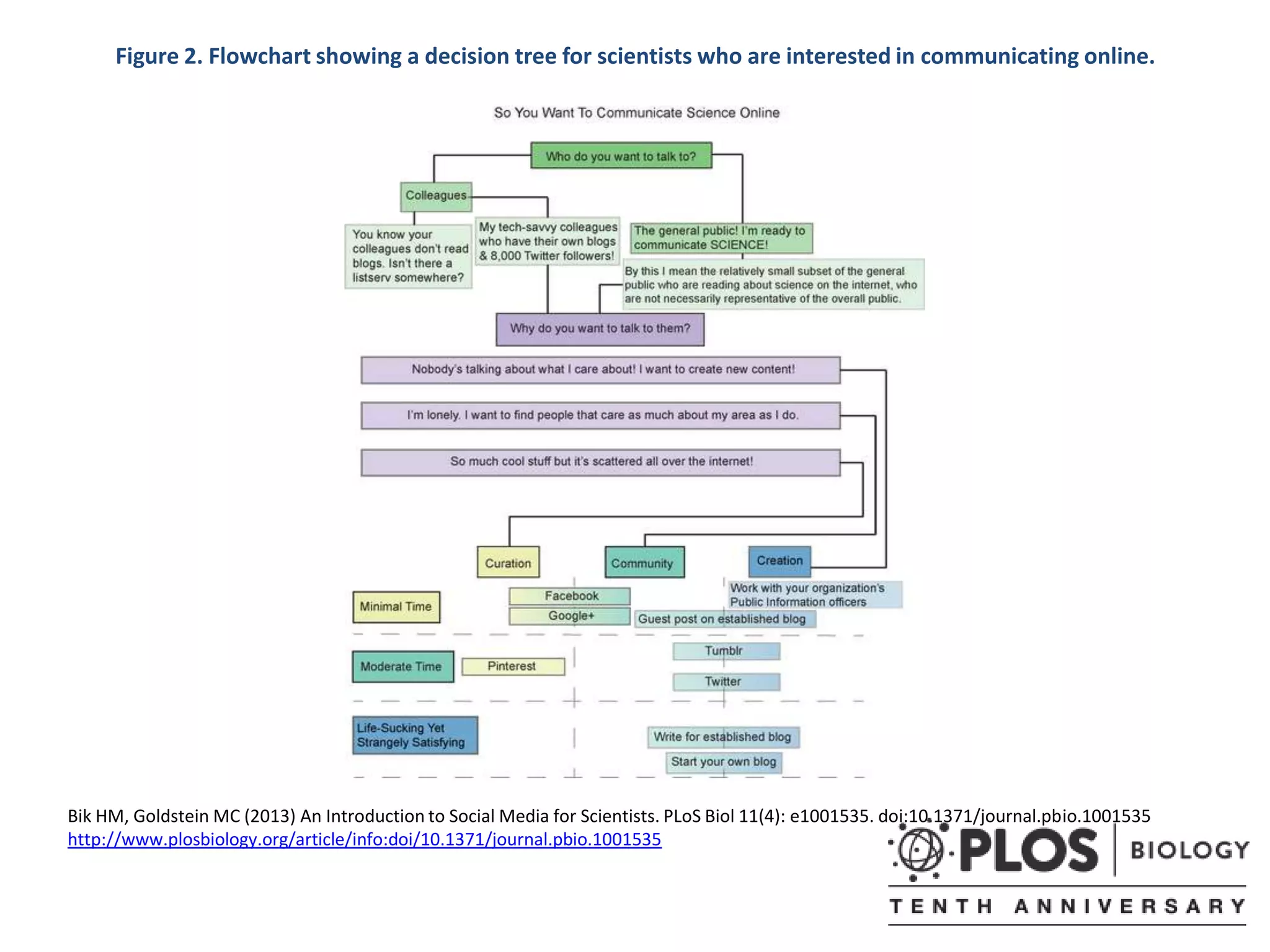
Figure 2. Flowchart showing a decision tree for scientists who are interested in communicating online.
Bik HM, Goldstein MC (2013) An Introduction to Social Media for Scientists. PLoS Biol 11(4): e1001535. doi:10.1371/journal.pbio.1001535
http://www.plosbiology.org/article/info:doi/10.1371/journal.pbio.1001535

Why to use social media, for scientists

  • 1.
    How Use ofSocial Media Can Help You for Self-Advancement in Research
  • 3.
    Used extensively toconstruct following slideshow
  • 4.
    Tools 1: • Blogs- Traditional, long-form online narrative. Eg: Wordpress and Blogger offer free blog hosting. • RSS Feeds - Type of URL that allows users to automatically mine blog/website updates without the need for a web browser. • Apps - Software used on mobile devices, especially useful as mobile social networking platforms • Twitter - Social networking site that limits posts to 140 characters, useful for in-the-moment conversations, customized news streams, and building and maintaining communities. • Facebook - The most widely used social media site.
  • 5.
    Tools 2: • SlideShare– offers users the ability to upload and share publicly or privately PowerPoint presentations, Word documents and Adobe PDF Portfolios • Tumblr - A microblogging site that can publish any type of media very easily and quickly. Users post photos, videos, or short quotes as opposed to long written narratives. • Pinterest - A photo-only microblogging site where users define themed “boards” for posting content (e.g., food, art, marine fish). • Storify - A way to aggregate and organize tweets, videos, blog posts, and other media. Storify is especially useful for compiling media on discrete discussions and preserving tweets before they become archived by Twitter. • Linking communities - Include Digg, StumbleUpon, MetaFilter - content aggregation sites that recommend new and interesting content to subscribers.
  • 6.
    Figure 1. Monthlyaudience by communication methodology shown on A) log scale and B) linear scale. Bik HM, Goldstein MC (2013) An Introduction to Social Media for Scientists. PLoS Biol 11(4): e1001535. doi:10.1371/journal.pbio.1001535 http://www.plosbiology.org/article/info:doi/10.1371/journal.pbio.1001535
  • 7.
    Table 1. Comparisonof Online Tools. Bik HM, Goldstein MC (2013) An Introduction to Social Media for Scientists. PLoS Biol 11(4): e1001535. doi:10.1371/journal.pbio.1001535 http://www.plosbiology.org/article/info:doi/10.1371/journal.pbio.1001535
  • 8.
    Why would youwant to use social media? Online Visibility Helps Track and Improve Scientific Metrics • Evidence suggests that an active online presence may directly impact a researcher's credentials as measured through traditional metrics. • One UK researcher observed that tweeting and blogging about her own papers led to spikes in the number of article downloads, even for older literature. • For articles deposited in the preprint server arXiv, Twitter mentions were positively correlated with rapid article downloads and citations appearing only months after deposition
  • 9.
    Why would youwant to use social media? Social Media Enhances Professional Networking • Online discussions can lead to tangible, real- world social interactions. • Conversations on Twitter can serve as an icebreaker once two people finally meet in a conference or workshop setting. • Tweeting from conferences can introduce other scientists to valuable content, and consequently provide networking opportunities for users who actively post during meetings.
  • 10.
    Advice for NewUsers In academia, there is often a particular stigma attached to online activities: actively maintaining an online profile and participating in social media discussions can be seen as a waste of time and a distraction from research and teaching duties. However, when used in a targeted and streamlined manner, social media tools can complement and enhance a researcher's career. When exploring online tools for the first time, new users can maximize their reach by considering the following points
  • 11.
    Advice for NewUsers - 1 Explore online guides to social media • The Superfund program at Oregon State University maintains an exhaustive list of resources (blog articles, videos, how-to guides) focused on science and social media: http://bit.ly/WkdN0G.
  • 12.
    Advice for NewUsers - 2 Establish a professional-looking website • To establish an online presence, set up a personal website that lays out specific research projects and areas of expertise, searchable by colleagues, journalists, and the public alike. • Although professional websites can be established through UCT, external hosts (eg: wordpress.com) offer more flexibility and are easier to access and maintain – and can be linked out to from UCT. • A website can be supplemented with social media accounts (e.g., Twitter and Google+ profiles), which will also appear high in Google search results. • Eg: Scoop.it allows you to create a magazine-like site for daily updates
  • 13.
    Advice for NewUsers - 3 Locate pertinent online conversations • Find people with common interests; follow the social media that they link to and that links to them. • Use established social networks (e.g., a base of Twitter or LinkedIn or ResearchGate contacts) or a means of notification (RSS feeds etc) to get started. • It can be beneficial to read first without contributing (“lurking”) to learn logistics and basic etiquette of different social media platforms.
  • 14.
    Advice for NewUsers - 4 Navigate the deluge of online information • Maintain and organize online accounts (e.g., grouping people using Twitter lists and Google+ circles). • Track and prioritize the most relevant blogs and articles for reading (e.g., using RSS services that can be accessed and synced to mobile devices). • Explore multiple social media tools and related sites/apps for managing online: consistent use of fewer tools is better than spreading yourself too thin across too many platforms. • Don't be afraid to ask for help; there are many friendly and established communities who are willing and eager to assist new users
  • 15.
    Advice for NewUsers - 7 Establish a LinkedIn, Academia.edu and/or ResearchGate profile: this • Increases your global findability • Increases your professional exposure • Allows you to upload material for others to read
  • 16.
    Figure 2. Flowchartshowing a decision tree for scientists who are interested in communicating online. Bik HM, Goldstein MC (2013) An Introduction to Social Media for Scientists. PLoS Biol 11(4): e1001535. doi:10.1371/journal.pbio.1001535 http://www.plosbiology.org/article/info:doi/10.1371/journal.pbio.1001535