Webometrics
A. Roseline
MLIS, 2ND YEAR,
4TH SEM,
PONDICHERRY UNIVERSITY
INTRODUCTION
 The term webometrics was first coined by Almind and Ingwersen (1997).
 The term, „webometric‟ was coined from two English words i.e. “web” &
“metrics”. The word „web‟ is the short of World Wide Web and „metrics‟ denotes
the mathematical theory of measurement.
 It is also used as a synonym to cybermetrics, which is purely focused on online
environment.
 Webometrics it considers linking, linking relationship, linking volume, and helps
determine linking significance between websites and web publications, both
scholarly and other.
 Webometrics is the child (or sibling) of “bibliometrics” - the encompassing term
for the correlated fields of infometrics, scientometrics.
Definition
 Björneborn and Ingwersen (2004)defined webometrics as
“the study of the quantitative aspects of the construction and use of information
resources, structures and technologies on the web drawing on bibliometrics and
informetrics approaches”.
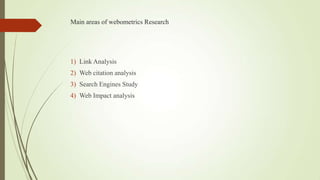
Main areas of webometrics Research
1) Link Analysis
2) Web citation analysis
3) Search Engines Study
4) Web Impact analysis
Link Analysis
 It is quantitative study of hyperlinks between web pages.
 The use of links in bibliometrics was caused by Ingwersen‟s (1998) web impact
factor (WIF), created through analogy to journal impacfactor.t
 The hypothesis underlying early link analysis was that the number of links
targeting an academic web site might be proportional to the research productivity
of the owning organisation, at the level of universities (Thelwal, 2001)
 the main problem with link analysis is that the web is continually changing and
seems to be constantly expanding so that the webometric findings might become
obsolete (Thelwal, 2008).
Web citation analysis
 A number of webometric investigations have focussed not on websites but on
academic publications, using the web to count how often journal articles are cited.
 The rationale behind this is partly to see if the web can produce evidence of the
wider use of research, including informal scholarly communication and for
commercial applications.
Search engines studies
 A main portal to the web for most users since the early days.
 It has been logical to assess how much of the web they cover.
 Two audiences for webometrics search engine research
i. Researchers who use the engines for data gathering
ii. Web searchers wanting to understand
Web Impact Analysis
 It provides evidence for the impact or the spread of ideas, brands organizations,
ect.
 The web by measuring and analyzing the URLs retrieved by commercial search
engines in response to a specific query.
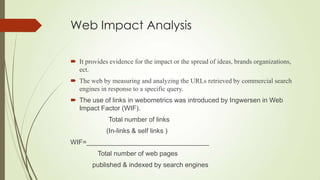
 The use of links in webometrics was introduced by Ingwersen in Web
Impact Factor (WIF).
Total number of links
(In-links & self links )
WIF=_________________________________
Total number of web pages
published & indexed by search engines
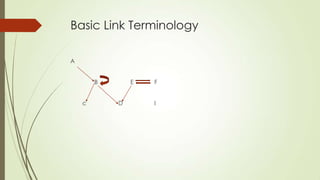
Basic link terminology
 Inlink: A link to a web document from a web page not included within the web
document.
 Outlink: A link from a web document to a web page outside the web document.
 Self-link: A link from a web page in a web document to the same or another web
page in the same web document.
Basic Link Terminology
A
B E F
c D I
Thank You!

Webometrics

  • 1.
    Webometrics A. Roseline MLIS, 2NDYEAR, 4TH SEM, PONDICHERRY UNIVERSITY
  • 2.
    INTRODUCTION  The termwebometrics was first coined by Almind and Ingwersen (1997).  The term, „webometric‟ was coined from two English words i.e. “web” & “metrics”. The word „web‟ is the short of World Wide Web and „metrics‟ denotes the mathematical theory of measurement.  It is also used as a synonym to cybermetrics, which is purely focused on online environment.  Webometrics it considers linking, linking relationship, linking volume, and helps determine linking significance between websites and web publications, both scholarly and other.  Webometrics is the child (or sibling) of “bibliometrics” - the encompassing term for the correlated fields of infometrics, scientometrics.
  • 3.
    Definition  Björneborn andIngwersen (2004)defined webometrics as “the study of the quantitative aspects of the construction and use of information resources, structures and technologies on the web drawing on bibliometrics and informetrics approaches”.
  • 4.
    Main areas ofwebometrics Research 1) Link Analysis 2) Web citation analysis 3) Search Engines Study 4) Web Impact analysis
  • 5.
    Link Analysis  Itis quantitative study of hyperlinks between web pages.  The use of links in bibliometrics was caused by Ingwersen‟s (1998) web impact factor (WIF), created through analogy to journal impacfactor.t  The hypothesis underlying early link analysis was that the number of links targeting an academic web site might be proportional to the research productivity of the owning organisation, at the level of universities (Thelwal, 2001)  the main problem with link analysis is that the web is continually changing and seems to be constantly expanding so that the webometric findings might become obsolete (Thelwal, 2008).
  • 6.
    Web citation analysis A number of webometric investigations have focussed not on websites but on academic publications, using the web to count how often journal articles are cited.  The rationale behind this is partly to see if the web can produce evidence of the wider use of research, including informal scholarly communication and for commercial applications.
  • 7.
    Search engines studies A main portal to the web for most users since the early days.  It has been logical to assess how much of the web they cover.  Two audiences for webometrics search engine research i. Researchers who use the engines for data gathering ii. Web searchers wanting to understand
  • 8.
    Web Impact Analysis It provides evidence for the impact or the spread of ideas, brands organizations, ect.  The web by measuring and analyzing the URLs retrieved by commercial search engines in response to a specific query.  The use of links in webometrics was introduced by Ingwersen in Web Impact Factor (WIF). Total number of links (In-links & self links ) WIF=_________________________________ Total number of web pages published & indexed by search engines
  • 9.
    Basic link terminology Inlink: A link to a web document from a web page not included within the web document.  Outlink: A link from a web document to a web page outside the web document.  Self-link: A link from a web page in a web document to the same or another web page in the same web document.
  • 10.
  • 11.