ADITYA PRATAP SINGH
The landscape of science and research is rapidly evolving.
Gone are the days when all members of a university
department would celebrate the successful publication of a
colleague’s paper. Earlier, scientists would simply consider
the number of papers they had published as a measure of
their academic standing. Today, the focus is increasingly
shifting from whether a researcher has published a paper to
where he/she has published it, quality of that research and
the impact that piece of research has on the scientific
community and the world at large.
How can you measure the quality of a research paper? More
importantly, how can you determine whether your research
is making an impact and is considered important? An
objective way is through citation analysis.
Citation analysis is defined as the
evaluation and interpretation of the
citations received by articles,
scientists, universities, countries,
and other aggregates of scientific
activity, used as a measure of
scientific influence and
Productivity.
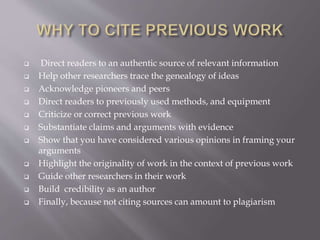
 Direct readers to an authentic source of relevant information
 Help other researchers trace the genealogy of ideas
 Acknowledge pioneers and peers
 Direct readers to previously used methods, and equipment
 Criticize or correct previous work
 Substantiate claims and arguments with evidence
 Show that you have considered various opinions in framing your
arguments
 Highlight the originality of work in the context of previous work
 Guide other researchers in their work
 Build credibility as an author
 Finally, because not citing sources can amount to plagiarism
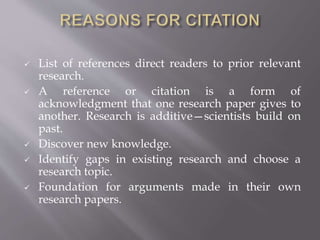
 List of references direct readers to prior relevant
research.
 A reference or citation is a form of
acknowledgment that one research paper gives to
another. Research is additive—scientists build on
past.
 Discover new knowledge.
 Identify gaps in existing research and choose a
research topic.
 Foundation for arguments made in their own
research papers.
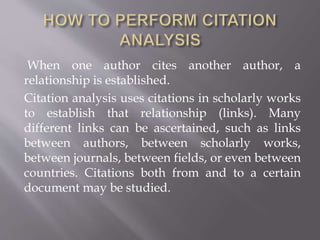
When one author cites another author, a
relationship is established.
Citation analysis uses citations in scholarly works
to establish that relationship (links). Many
different links can be ascertained, such as links
between authors, between scholarly works,
between journals, between fields, or even between
countries. Citations both from and to a certain
document may be studied.
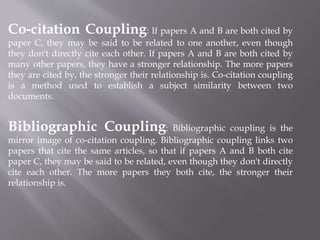
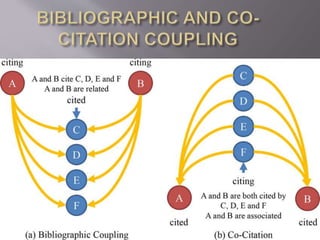
Co-citation Coupling: If papers A and B are both cited by
paper C, they may be said to be related to one another, even though
they don't directly cite each other. If papers A and B are both cited by
many other papers, they have a stronger relationship. The more papers
they are cited by, the stronger their relationship is. Co-citation coupling
is a method used to establish a subject similarity between two
documents.
Bibliographic Coupling: Bibliographic coupling is the
mirror image of co-citation coupling. Bibliographic coupling links two
papers that cite the same articles, so that if papers A and B both cite
paper C, they may be said to be related, even though they don't directly
cite each other. The more papers they both cite, the stronger their
relationship is.
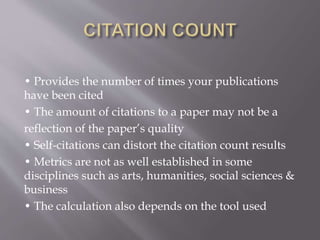
• Provides the number of times your publications
have been cited
• The amount of citations to a paper may not be a
reflection of the paper’s quality
• Self-citations can distort the citation count results
• Metrics are not as well established in some
disciplines such as arts, humanities, social sciences &
business
• The calculation also depends on the tool used
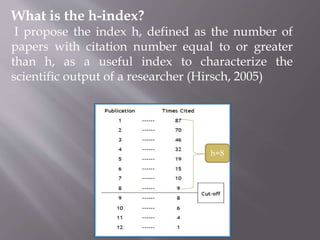
What is the h-index?
I propose the index h, defined as the number of
papers with citation number equal to or greater
than h, as a useful index to characterize the
scientific output of a researcher (Hirsch, 2005)
h=h=8
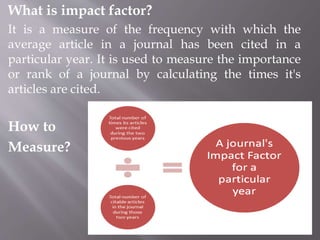
What is impact factor?
It is a measure of the frequency with which the
average article in a journal has been cited in a
particular year. It is used to measure the importance
or rank of a journal by calculating the times it's
articles are cited.
How to
Measure?
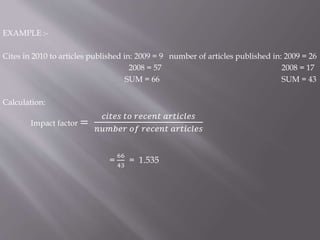
EXAMPLE :-
Cites in 2010 to articles published in: 2009 = 9 number of articles published in: 2009 = 26
2008 = 57 2008 = 17
SUM = 66 SUM = 43
Calculation:
Impact factor =
𝑐𝑖𝑡𝑒𝑠 𝑡𝑜 𝑟𝑒𝑐𝑒𝑛𝑡 𝑎𝑟𝑡𝑖𝑐𝑙𝑒𝑠
𝑛𝑢𝑚𝑏𝑒𝑟 𝑜𝑓 𝑟𝑒𝑐𝑒𝑛𝑡 𝑎𝑟𝑡𝑖𝑐𝑙𝑒𝑠
=
66
43
= 1.535
THANK YOU

citation analysis

  • 1.
  • 2.
    The landscape ofscience and research is rapidly evolving. Gone are the days when all members of a university department would celebrate the successful publication of a colleague’s paper. Earlier, scientists would simply consider the number of papers they had published as a measure of their academic standing. Today, the focus is increasingly shifting from whether a researcher has published a paper to where he/she has published it, quality of that research and the impact that piece of research has on the scientific community and the world at large. How can you measure the quality of a research paper? More importantly, how can you determine whether your research is making an impact and is considered important? An objective way is through citation analysis.
  • 3.
    Citation analysis isdefined as the evaluation and interpretation of the citations received by articles, scientists, universities, countries, and other aggregates of scientific activity, used as a measure of scientific influence and Productivity.
  • 4.
     Direct readersto an authentic source of relevant information  Help other researchers trace the genealogy of ideas  Acknowledge pioneers and peers  Direct readers to previously used methods, and equipment  Criticize or correct previous work  Substantiate claims and arguments with evidence  Show that you have considered various opinions in framing your arguments  Highlight the originality of work in the context of previous work  Guide other researchers in their work  Build credibility as an author  Finally, because not citing sources can amount to plagiarism
  • 5.
     List ofreferences direct readers to prior relevant research.  A reference or citation is a form of acknowledgment that one research paper gives to another. Research is additive—scientists build on past.  Discover new knowledge.  Identify gaps in existing research and choose a research topic.  Foundation for arguments made in their own research papers.
  • 6.
    When one authorcites another author, a relationship is established. Citation analysis uses citations in scholarly works to establish that relationship (links). Many different links can be ascertained, such as links between authors, between scholarly works, between journals, between fields, or even between countries. Citations both from and to a certain document may be studied.
  • 7.
    Co-citation Coupling: Ifpapers A and B are both cited by paper C, they may be said to be related to one another, even though they don't directly cite each other. If papers A and B are both cited by many other papers, they have a stronger relationship. The more papers they are cited by, the stronger their relationship is. Co-citation coupling is a method used to establish a subject similarity between two documents. Bibliographic Coupling: Bibliographic coupling is the mirror image of co-citation coupling. Bibliographic coupling links two papers that cite the same articles, so that if papers A and B both cite paper C, they may be said to be related, even though they don't directly cite each other. The more papers they both cite, the stronger their relationship is.
  • 9.
    • Provides thenumber of times your publications have been cited • The amount of citations to a paper may not be a reflection of the paper’s quality • Self-citations can distort the citation count results • Metrics are not as well established in some disciplines such as arts, humanities, social sciences & business • The calculation also depends on the tool used
  • 11.
    What is theh-index? I propose the index h, defined as the number of papers with citation number equal to or greater than h, as a useful index to characterize the scientific output of a researcher (Hirsch, 2005) h=h=8
  • 12.
    What is impactfactor? It is a measure of the frequency with which the average article in a journal has been cited in a particular year. It is used to measure the importance or rank of a journal by calculating the times it's articles are cited. How to Measure?
  • 13.
    EXAMPLE :- Cites in2010 to articles published in: 2009 = 9 number of articles published in: 2009 = 26 2008 = 57 2008 = 17 SUM = 66 SUM = 43 Calculation: Impact factor = 𝑐𝑖𝑡𝑒𝑠 𝑡𝑜 𝑟𝑒𝑐𝑒𝑛𝑡 𝑎𝑟𝑡𝑖𝑐𝑙𝑒𝑠 𝑛𝑢𝑚𝑏𝑒𝑟 𝑜𝑓 𝑟𝑒𝑐𝑒𝑛𝑡 𝑎𝑟𝑡𝑖𝑐𝑙𝑒𝑠 = 66 43 = 1.535
  • 14.