14/06/2013
Katy Jordan, The Open University
katy.jordan@open.ac.uk
@katy_jordan
Kaleidoscope Conference
31st May 2013
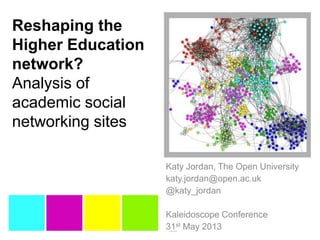
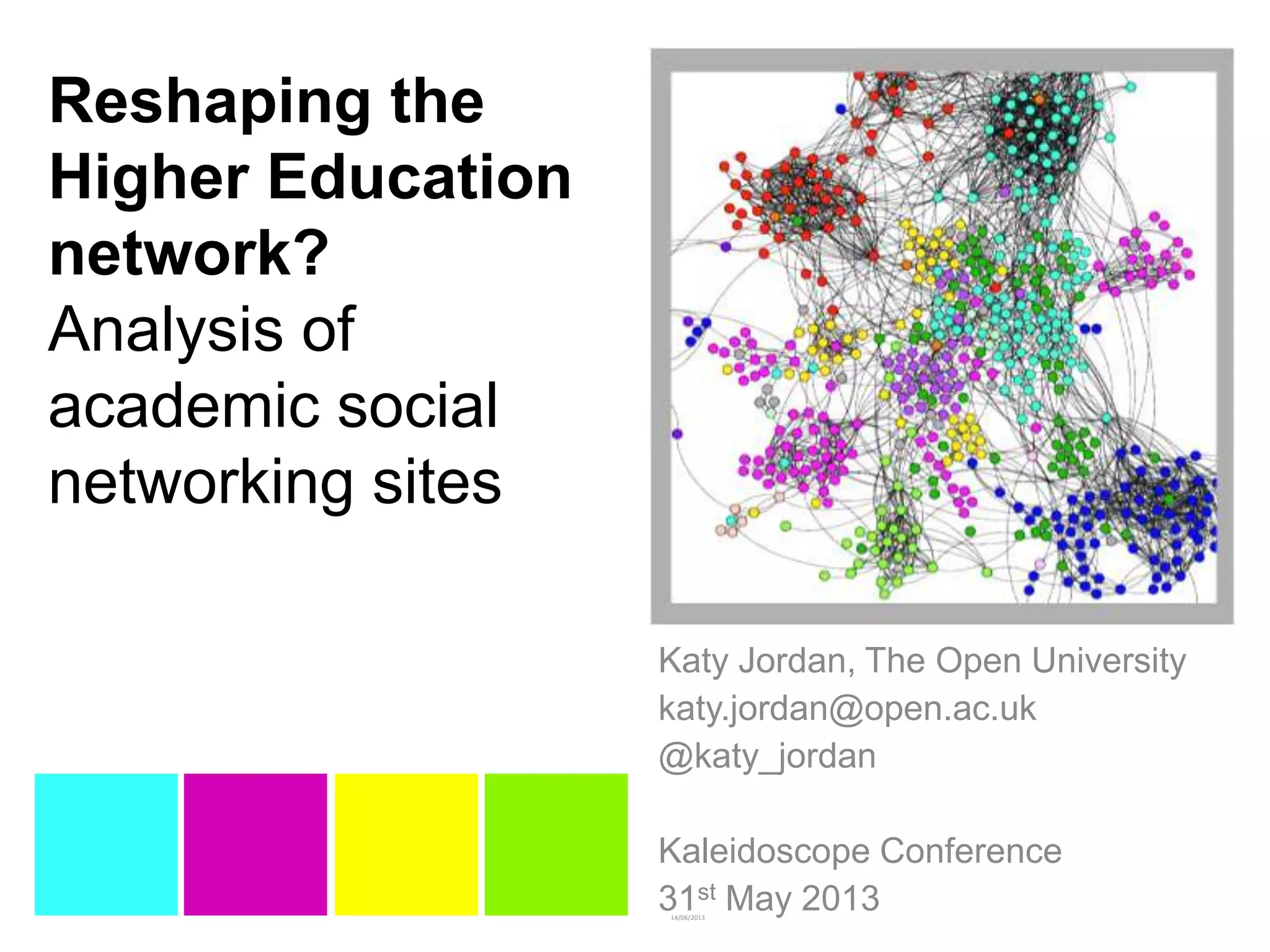
Reshaping the
Higher Education
network?
Analysis of
academic social
networking sites
+
Background
• Stems from my previous experience in e-learning
research in Higher Education
• Research context: Digital scholarship and how the
internet is changing Higher Education
(Weller, 2011; Nentwich & Konig, 2012)
• Social networking sites (SNS) are so popular that
they are synonymous with internet use for some
(Rainie & Wellman, 2012)
• First academic SNS in 2007, 3 years after
Facebook founded (Nentwich & Konig, 2012)
+
Defining academic SNS
“We define social network
sites as web-based services
that allow individuals to (1)
construct a public or semi-
public profile within a
bounded system, (2)
articulate a list of other
users with whom they share
a connection, and (3) view
and traverse their list of
connections and those
made by others within the
system.” (boyd &
Ellison, 2007).
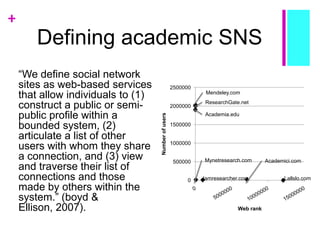
0
500000
1000000
1500000
2000000
2500000
Numberofusers
Web rank
Academia.edu
ResearchGate.net
Mendeley.com
Lallslo.com
Mynetresearch.com
Iamresearcher.com
Academici.com
+
Affordances of academic SNS
• Identity: Constructing an online academic profile
– Almousa, 2011; Menendez, de Angeli &
Menestrina, 2012
• Communication: Discovery and dissemination of
research findings; asking and answering questions.
– Veletsianos, 2011
• Collaboration: Finding similar or different
collaborators; supporting active research
relationships.
– Jeng et al., 2012; Oh & Jeng, 2011
+
Initial research questions
• What is the structure of academic social
networks?
• To what extent do different academic social
networking sites foster similar networks?
• Do factors such as discipline or position correlate
with behaviour in the network?
+
Data collection
• Pilot study focused upon Open University
academics
• Mapped network of connections between OU-
affiliated academics on three main academic SNS
• Categorised according to position and discipline
• Survey carried out on a sub-sample to explore
perceptions about role of academic SNS and
follow up on differences in network structure
based on position and discipline
+
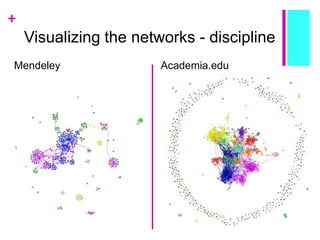
Visualizing the networks - discipline
Mendeley Academia.edu
+
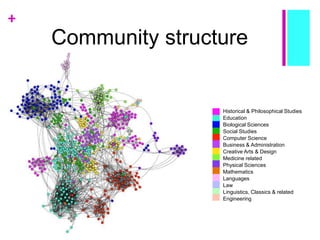
Community structure
Historical & Philosophical Studies
Education
Biological Sciences
Social Studies
Computer Science
Business & Administration
Creative Arts & Design
Medicine related
Physical Sciences
Mathematics
Languages
Law
Linguistics, Classics & related
Engineering
+
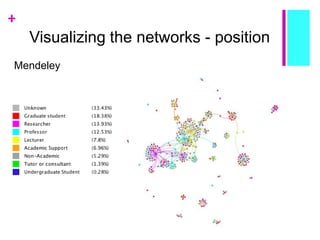
Visualizing the networks - position
Mendeley
+
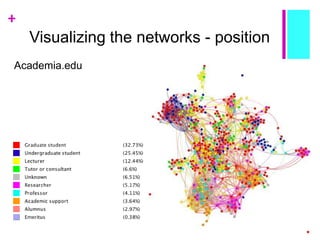
Visualizing the networks - position
Academia.edu
+
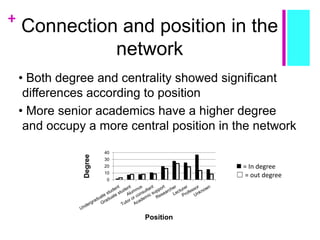
Connection and position in the
network
• Both degree and centrality showed significant
differences according to position
• More senior academics have a higher degree
and occupy a more central position in the network
0
10
20
30
40
Degree
Position
 = In degree
☐ = out degree
+
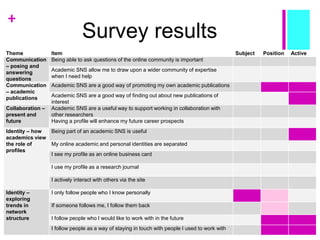
Survey results
Theme Item Subject Position Active
Communication
– posing and
answering
questions
Being able to ask questions of the online community is important
Academic SNS allow me to draw upon a wider community of expertise
when I need help
Communication
– academic
publications
Academic SNS are a good way of promoting my own academic publications
Academic SNS are a good way of finding out about new publications of
interest
Collaboration –
present and
future
Academic SNS are a useful way to support working in collaboration with
other researchers
Having a profile will enhance my future career prospects
Identity – how
academics view
the role of
profiles
Being part of an academic SNS is useful
My online academic and personal identities are separated
I see my profile as an online business card
I use my profile as a research journal
I actively interact with others via the site
Identity –
exploring
trends in
network
structure
I only follow people who I know personally
If someone follows me, I follow them back
I follow people who I would like to work with in the future
I follow people as a way of staying in touch with people I used to work with
+
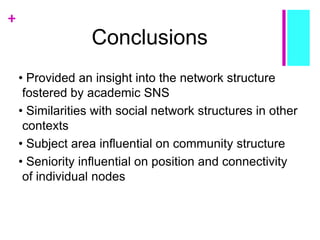
Conclusions
• Provided an insight into the network structure
fostered by academic SNS
• Similarities with social network structures in other
contexts
• Subject area influential on community structure
• Seniority influential on position and connectivity
of individual nodes
+
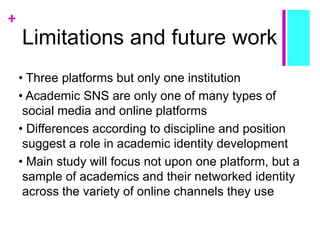
Limitations and future work
• Three platforms but only one institution
• Academic SNS are only one of many types of
social media and online platforms
• Differences according to discipline and position
suggest a role in academic identity development
• Main study will focus not upon one platform, but a
sample of academics and their networked identity
across the variety of online channels they use
+
Acknowledgements
• Thanks to my supervisors, Professor Martin Weller
and Dr. Canan Blake.
• This work was made possible through a doctoral
studentship from the Centre for Research in
Education and Educational Technology at the Open
University, UK.
• Special thanks to all of the Open University
graduate students and academics who took part in
the pilot study.
+
References
• Almousa, O. (2011) Users’ classification and usage-pattern identification in academic
social networks. Proc. AEECT.
• boyd, d.m. & Ellison, N.B. (2007) Social network sites: Definition, history and scholarship.
Journal of Computer-Mediated Communication 13, 1, article 1.
• Jeng, W., He, D., Jiang, J. & Zhang, Y. (2012) Groups in Mendeley: Owners’ descriptions
and group outcomes. Proc. ASIST.
• Menendez, M., de Angeli, A. & Menestrina, Z. (2012) Chapter 4: Exploring the virtual
space of academia. In: J. Dugdale et al. (eds.) From research to practice in the design of
cooperative systems. Springer.
• Nentwich, M. & Konig, R.(2012) Cyberscience 2.0: Research in the age of digital social
networks. Campus Verlag.
• Oh, J.S. & Jeng, W. (2011) Groups in academic social networking services: An exploration
of their potential as a platform for multi-disciplinary collaboration. Proc. SocialCom.
• Rainie, L. & Wellman, B. (2012) Networked: The new social operating system. Cambridge:
MIT Press.
• Veletsianos, G. (2011), Higher education scholars' participation and practices on Twitter.
Journal of Computer Assisted Learning 28(4), 336-349.
• Weller, M. (2011) The Digital Scholar: How technology is transforming scholarly practice.
London: Bloomsbury.

Kaleidoscope conference slides - Academic networking

  • 1.
    14/06/2013 Katy Jordan, TheOpen University katy.jordan@open.ac.uk @katy_jordan Kaleidoscope Conference 31st May 2013 Reshaping the Higher Education network? Analysis of academic social networking sites
  • 2.
    + Background • Stems frommy previous experience in e-learning research in Higher Education • Research context: Digital scholarship and how the internet is changing Higher Education (Weller, 2011; Nentwich & Konig, 2012) • Social networking sites (SNS) are so popular that they are synonymous with internet use for some (Rainie & Wellman, 2012) • First academic SNS in 2007, 3 years after Facebook founded (Nentwich & Konig, 2012)
  • 3.
    + Defining academic SNS “Wedefine social network sites as web-based services that allow individuals to (1) construct a public or semi- public profile within a bounded system, (2) articulate a list of other users with whom they share a connection, and (3) view and traverse their list of connections and those made by others within the system.” (boyd & Ellison, 2007). 0 500000 1000000 1500000 2000000 2500000 Numberofusers Web rank Academia.edu ResearchGate.net Mendeley.com Lallslo.com Mynetresearch.com Iamresearcher.com Academici.com
  • 4.
    + Affordances of academicSNS • Identity: Constructing an online academic profile – Almousa, 2011; Menendez, de Angeli & Menestrina, 2012 • Communication: Discovery and dissemination of research findings; asking and answering questions. – Veletsianos, 2011 • Collaboration: Finding similar or different collaborators; supporting active research relationships. – Jeng et al., 2012; Oh & Jeng, 2011
  • 5.
    + Initial research questions •What is the structure of academic social networks? • To what extent do different academic social networking sites foster similar networks? • Do factors such as discipline or position correlate with behaviour in the network?
  • 6.
    + Data collection • Pilotstudy focused upon Open University academics • Mapped network of connections between OU- affiliated academics on three main academic SNS • Categorised according to position and discipline • Survey carried out on a sub-sample to explore perceptions about role of academic SNS and follow up on differences in network structure based on position and discipline
  • 7.
    + Visualizing the networks- discipline Mendeley Academia.edu
  • 8.
    + Community structure Historical &Philosophical Studies Education Biological Sciences Social Studies Computer Science Business & Administration Creative Arts & Design Medicine related Physical Sciences Mathematics Languages Law Linguistics, Classics & related Engineering
  • 9.
    + Visualizing the networks- position Mendeley
  • 10.
    + Visualizing the networks- position Academia.edu
  • 11.
    + Connection and positionin the network • Both degree and centrality showed significant differences according to position • More senior academics have a higher degree and occupy a more central position in the network 0 10 20 30 40 Degree Position  = In degree ☐ = out degree
  • 12.
    + Survey results Theme ItemSubject Position Active Communication – posing and answering questions Being able to ask questions of the online community is important Academic SNS allow me to draw upon a wider community of expertise when I need help Communication – academic publications Academic SNS are a good way of promoting my own academic publications Academic SNS are a good way of finding out about new publications of interest Collaboration – present and future Academic SNS are a useful way to support working in collaboration with other researchers Having a profile will enhance my future career prospects Identity – how academics view the role of profiles Being part of an academic SNS is useful My online academic and personal identities are separated I see my profile as an online business card I use my profile as a research journal I actively interact with others via the site Identity – exploring trends in network structure I only follow people who I know personally If someone follows me, I follow them back I follow people who I would like to work with in the future I follow people as a way of staying in touch with people I used to work with
  • 13.
    + Conclusions • Provided aninsight into the network structure fostered by academic SNS • Similarities with social network structures in other contexts • Subject area influential on community structure • Seniority influential on position and connectivity of individual nodes
  • 14.
    + Limitations and futurework • Three platforms but only one institution • Academic SNS are only one of many types of social media and online platforms • Differences according to discipline and position suggest a role in academic identity development • Main study will focus not upon one platform, but a sample of academics and their networked identity across the variety of online channels they use
  • 15.
    + Acknowledgements • Thanks tomy supervisors, Professor Martin Weller and Dr. Canan Blake. • This work was made possible through a doctoral studentship from the Centre for Research in Education and Educational Technology at the Open University, UK. • Special thanks to all of the Open University graduate students and academics who took part in the pilot study.
  • 16.
    + References • Almousa, O.(2011) Users’ classification and usage-pattern identification in academic social networks. Proc. AEECT. • boyd, d.m. & Ellison, N.B. (2007) Social network sites: Definition, history and scholarship. Journal of Computer-Mediated Communication 13, 1, article 1. • Jeng, W., He, D., Jiang, J. & Zhang, Y. (2012) Groups in Mendeley: Owners’ descriptions and group outcomes. Proc. ASIST. • Menendez, M., de Angeli, A. & Menestrina, Z. (2012) Chapter 4: Exploring the virtual space of academia. In: J. Dugdale et al. (eds.) From research to practice in the design of cooperative systems. Springer. • Nentwich, M. & Konig, R.(2012) Cyberscience 2.0: Research in the age of digital social networks. Campus Verlag. • Oh, J.S. & Jeng, W. (2011) Groups in academic social networking services: An exploration of their potential as a platform for multi-disciplinary collaboration. Proc. SocialCom. • Rainie, L. & Wellman, B. (2012) Networked: The new social operating system. Cambridge: MIT Press. • Veletsianos, G. (2011), Higher education scholars' participation and practices on Twitter. Journal of Computer Assisted Learning 28(4), 336-349. • Weller, M. (2011) The Digital Scholar: How technology is transforming scholarly practice. London: Bloomsbury.

Editor's Notes

  • #13 Dark pink = 95%, Light pink = 90%