Social media
How it can help you do research
Ross Mounce
@rmounce
http://orcid.org/0000-0002-3520-2046
#PGConf14
Talk structure & content
* A short introduction to the social web
* Simple generic points, widely applicable
* Mode & tool specific tips
- mostly on Blogging, Tweeting & GitHub
Disclaimers (many): This is a 30min talk. I can’t cover everything. What I’m going to say is based mostly upon just opinion.
You can see some of my slides again online at: http://www.slideshare.
net/rossmounce/social-media-for-science
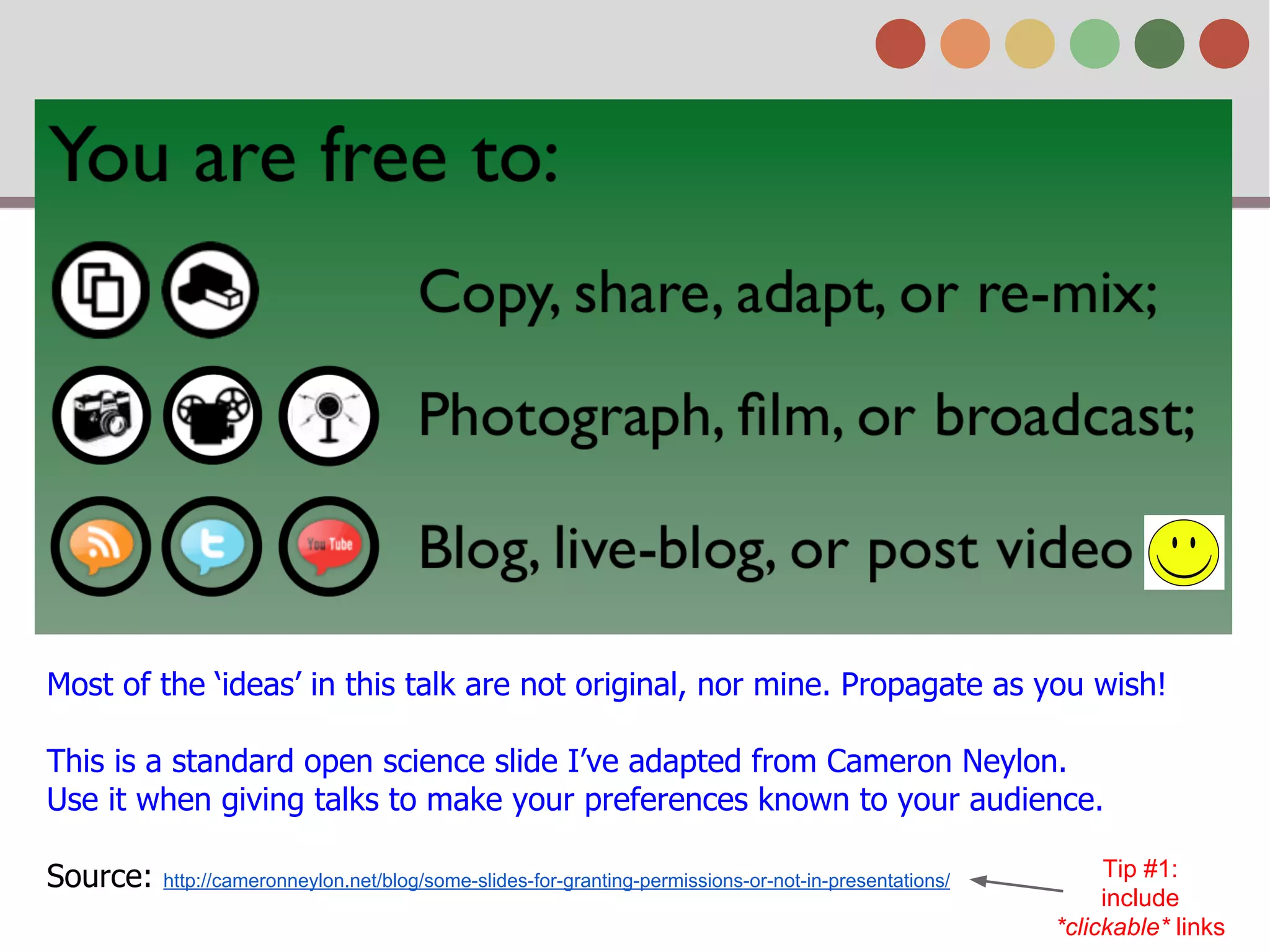
Most of the ‘ideas’ in this talk are not original, nor mine. Propagate as you wish!
This is a standard open science slide I’ve adapted from Cameron Neylon.
Use it when giving talks to make your preferences known to your audience.
Source: http://cameronneylon.net/blog/some-slides-for-granting-permissions-or-not-in-presentations/
Tip #1:
include
*clickable* links
What is social media?
Interaction among people in which they
create, share, and/or exchange information
and ideas in virtual communities and
networks…
...exchange of user-generated content
* Blogging * Social Networking Sites
* Microblogging * Content Communities
Source: http://en.wikipedia.org/wiki/Social_media
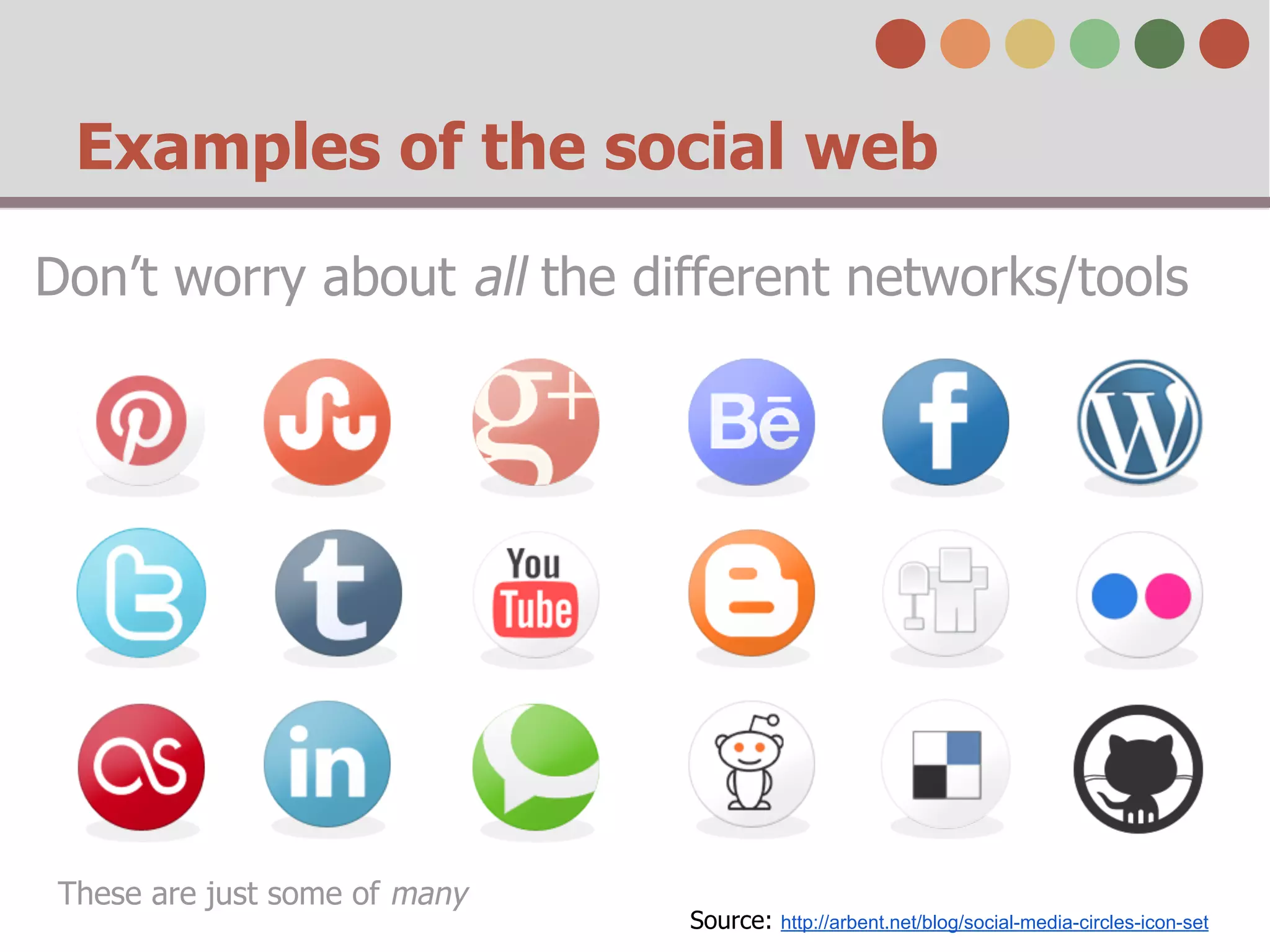
Examples of the social web
Don’t worry about all the different networks/tools
Source: http://arbent.net/blog/social-media-circles-icon-set
These are just some of many
The focus of this talk
Tip #2: Always label/explain images if possible
Many web-users & academics are blind or visually-impaired
Twitter YouTube LinkedIn
Google+ WordPress GitHub
Choose the right tool for the job
Each social network/tool has its strengths and weaknesses:
Twitter is great for quick real-time discussion & sharing links
- but it’s not a platform for detailed debate or lengthy code.
LinkedIn is good for reaching a more senior / higher-up
audience, and also job recruiters. Awful for discussion.
Youtube + Soundcloud are brilliant for second by second
analysis, discussion & sharing of audio/video, but little else.
Different people use things differently
Sounds simple, but it’s important to bear in mind.
1.) Personally, I use Facebook exclusively just for friends.
It’s a closed-ish private-space for me.
2.) But others happily use it as a public-facing profile to
interact with anyone and everyone.
3.) Others still maintain a separate ‘personal’ & ‘public’ fb
persona.
Be conscious that other people may do things differently...
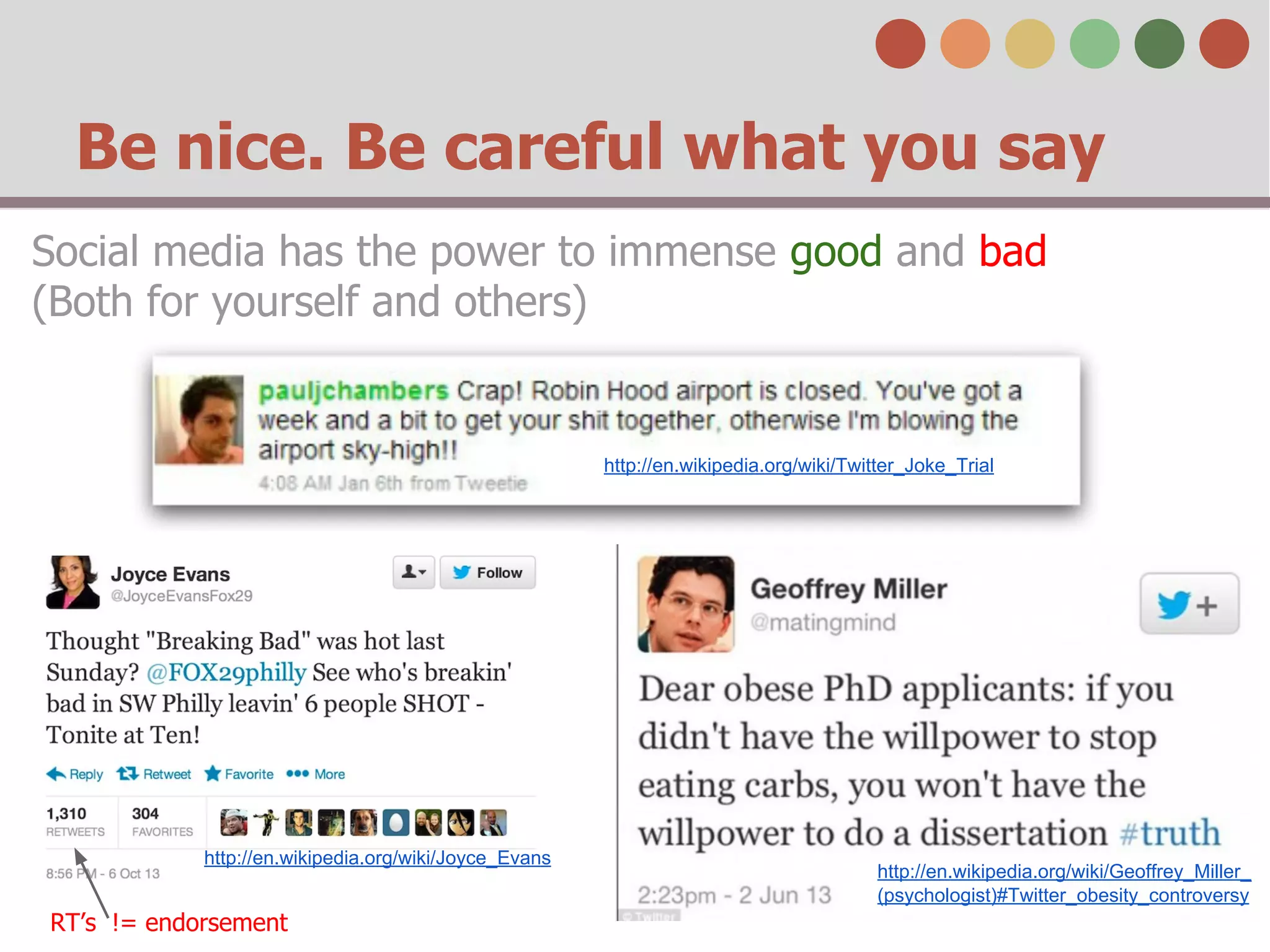
Be nice. Be careful what you say
Social media has the power to immense good and bad
(Both for yourself and others)
http://en.wikipedia.org/wiki/Twitter_Joke_Trial
http://en.wikipedia.org/wiki/Geoffrey_Miller_
(psychologist)#Twitter_obesity_controversy
http://en.wikipedia.org/wiki/Joyce_Evans
RT’s != endorsement
Always remember your purpose
The social web, networks and tools are there to
help people interact and communicate
No one tweets for the sake of tweeting
Or blogs for the sake of blogging
Do it to communicate your work,
and raise your profile. Help and be helped.
Twitter
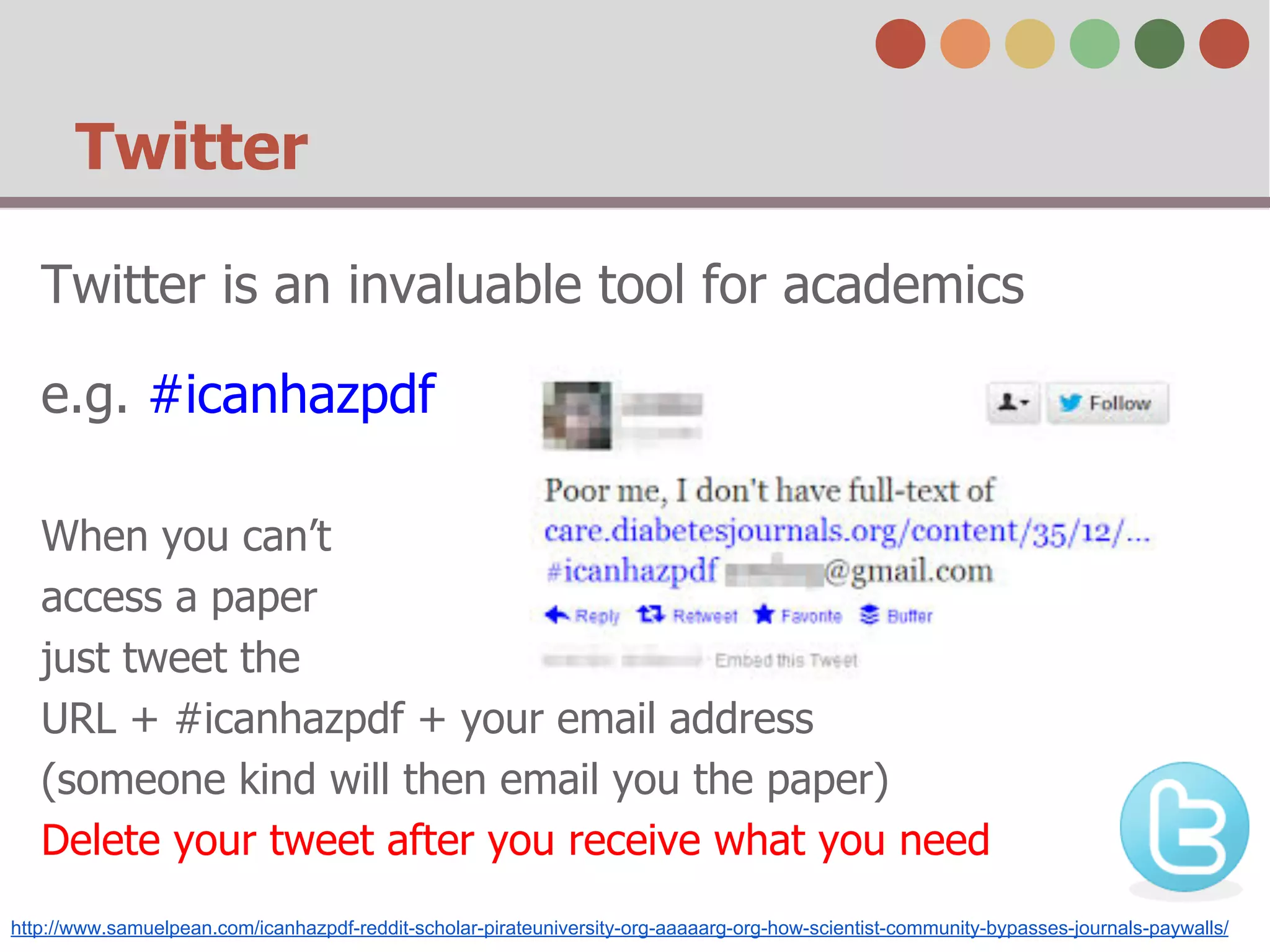
Twitter is an invaluable tool for academics
e.g. #icanhazpdf
When you can’t
access a paper
just tweet the
URL + #icanhazpdf + your email address
(someone kind will then email you the paper)
Delete your tweet after you receive what you need
http://www.samuelpean.com/icanhazpdf-reddit-scholar-pirateuniversity-org-aaaaarg-org-how-scientist-community-bypasses-journals-paywalls/
Twitter
It’s fantastic at meetings & conferences
Send tweets with the meeting hashtag e.g. #MastEcoBES13
so others can find/interact on the meeting ‘tweetstream’
Retweet (RT) things you agree with / or want others to read.
Add your own comment to a RT if there’s space.
Original tweet
My comment on this
Twitter
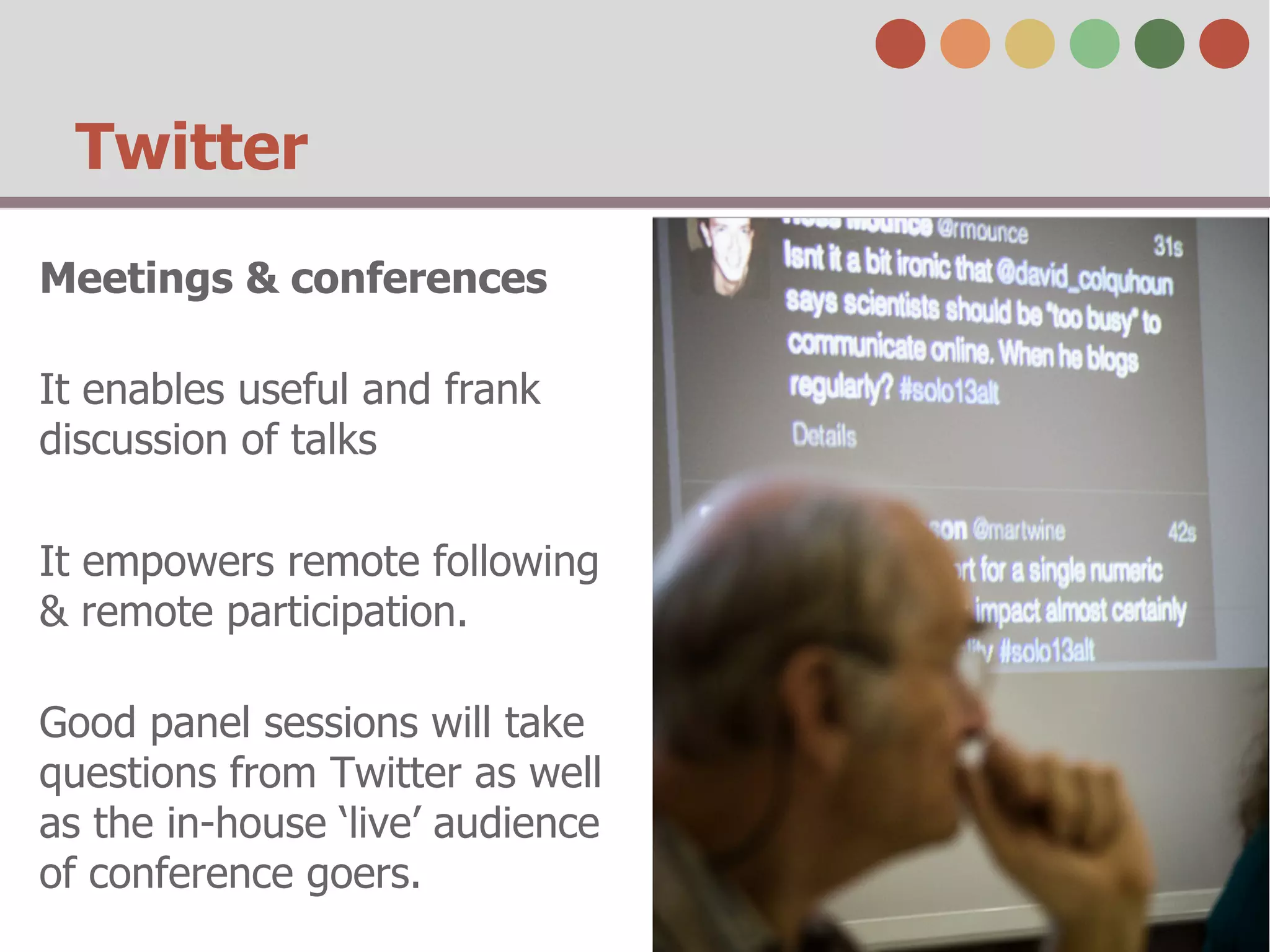
Meetings & conferences
It enables useful and frank
discussion of talks
It empowers remote following
& remote participation.
Good panel sessions will take
questions from Twitter as well
as the in-house ‘live’ audience
of conference goers.
Twitter
Getting help and helping others (mutual benefits!)
A recent example (26th Nov 2013)
I have 10,000+ DOI’s and I want to get BibTeX -> how?
Step 1.) Ask Q on twitter
Step 2.) Read near-instant replies from clever people
Take a bow @neilfws @invisiblecomma @egonwillighagen
Step 3.) Try suggested solutions… Encounter extra problem...
Twitter
Tweet the new problem
(special characters in the DOI were
screwing-up my curl request)
Problem solved!
Important sidenote: Twitter fosters brilliant cross-disciplinary communication.
Dan is a QMUL postdoc at the Centre for Digital Music. w/o Twitter this interaction would NEVER happen
https://twitter.com/rmounce/status/405290108989214720
Twitter
https://twitter.com/mclduk/status/405293960597209088
More than just solving my problem though…
Helping me do that curl
request had mutual benefit
for Dan -> awareness
of an automated method
to get bibdata given DOI’s
...and also two of
Dan’s followers
Twitter
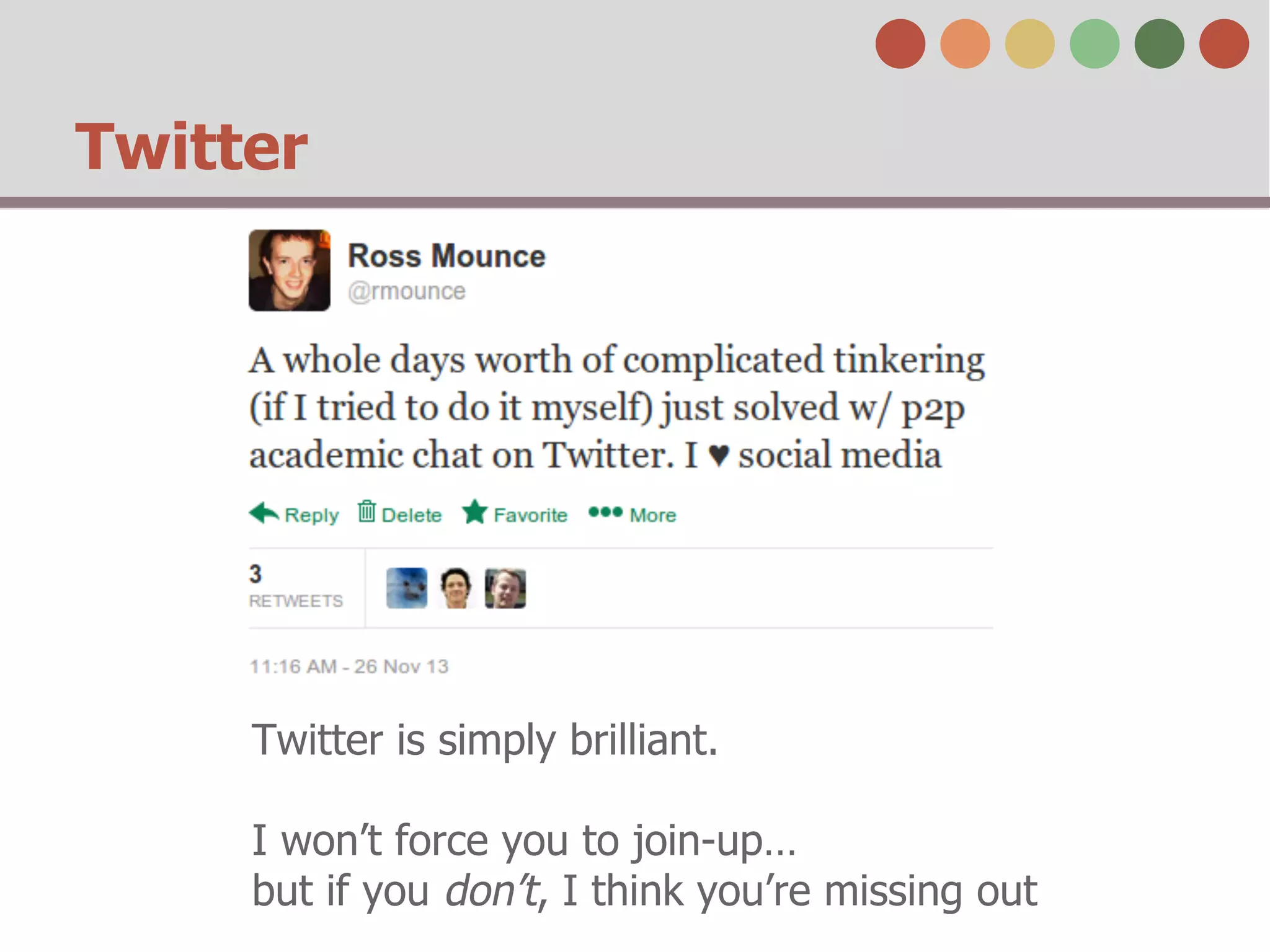
Twitter is simply brilliant.
I won’t force you to join-up…
but if you don’t, I think you’re missing out
Blogging
Twitter is limited to just <140 character messages.
For extended discussion, incorporating multiple media,
the blog post is a much better form and longer lasting
You can embed code, audio, video, pictures, GIF’s…
Try and always include at least 1 picture to break-up your text
Wordpress, Blogger or Tumblr are good platforms to start with
Blogging
Blog posts can be and *are* cited in the literature.
It’s an excellent space to rapidly communicate new ideas.
http://iphylo.blogspot.co.uk/2011/04/dark-taxa-genbank-in-post-taxonomic.html
http://scholar.google.co.uk/scholar?q=%22dark+taxa%22&btnG=&hl=en&as_sdt=0%2C5
(Incidentally, Rod Page first dragged me on to Twitter - thanks Rod!)
Blogging
Impact
Blog posts on popular platforms can receive more attention
than your average Nature News article
Easy steps towards open scholarship Patients leave a microbial mark on hospitals
(LSE Impact of Social Sciences blog) (Nature News, 23 May 2013)
published 24 May 2013
http://blogs.lse.ac.
uk/impactofsocialsciences/2013/05/24/easy-steps-
towards-open-scholarship/
Data source:
http://www.nature.com/news/patients-leave-a-microbial-mark-on-hospitals-1.13057
Google+ & YouTube
Google+ has a lot of critics… “ghost town” etc
But I’ve got 15,000+ followers (circlers) there, so I like it :)
It’s great for paper discussions
Also for journal clubs via Google+ Hangouts
Hangouts can be recorded and automatically made available at
YouTube after the event
https://plus.google.com/u/0/+RossMounce/posts
See here for a 14 comment thread! https://plus.google.com/+RossMounce/posts/BfeU1Tt8oGU
http://breakingbio.com/
e.g. The Phylo / Macro Journal Club http://www.youtube.com/watch?v=Dmf7eKk23Gc
LinkedIn
A horribly creepy network
- be careful what permissions you grant LinkedIn
I suspect it’s one of the few online networks
that more ‘senior’ academics use - so you need a presence here
It’s also really important for keeping connections and
job prospects for beyond academia
Make sure you upload your CV here
http://www.itworld.com/it-managementstrategy/254094/wtf-linkedin-doing-my-data
GitHub
Social coding has arrived! Try it!
Why use Git? ->
Pearse & Purvis. 2013. phyloGenerator: an automated
phylogeny generation tool for ecologists. MEE
http://dx.doi.org/10.1111/2041-210x.12055
Code openly available on GitHub both pre- and post-publication
Enables ‘pull requests’ (suggest code changes) ‘forking’ and ‘issue tracking’
http://www.scfbm.org/content/8/1/7
GitHub
Figshare.com
Zenodo.org
ResearchGate.net
Academia.edu
But see: The Economist article ‘No Peeking’ Jan 11th 2014
http://www.economist.com/news/science-and-technology/21593408-publishing-giant-goes-after-authors-its-journals-papers-no-peeking
Mendeley.com
Used to be cool, but then Elsevier bought it out :(
Prompted many users to delete their data and walk away
#mendelete
See Jason Hoyt’s excellent blog post for more:
Also see http://thecostofknowledge.com/ for why
>14,500 academics are boycotting Elsevier
http://enjoythedisruption.com/post/47527556151/my-thoughts-on-mendeley-elsevier-why-i-left-to-start
Question Time!
Tweet me (@rmounce) a link to *your* online presence
(don’t forget the conference hashtag: #PGConf14 )
If you’re not on Twitter, why not sign-up now ?
Anything you’d like to know about that I haven’t addressed?

Social Media For Researchers

  • 1.
    Social media How itcan help you do research Ross Mounce @rmounce http://orcid.org/0000-0002-3520-2046 #PGConf14
  • 2.
    Talk structure &content * A short introduction to the social web * Simple generic points, widely applicable * Mode & tool specific tips - mostly on Blogging, Tweeting & GitHub Disclaimers (many): This is a 30min talk. I can’t cover everything. What I’m going to say is based mostly upon just opinion. You can see some of my slides again online at: http://www.slideshare. net/rossmounce/social-media-for-science
  • 3.
    Most of the‘ideas’ in this talk are not original, nor mine. Propagate as you wish! This is a standard open science slide I’ve adapted from Cameron Neylon. Use it when giving talks to make your preferences known to your audience. Source: http://cameronneylon.net/blog/some-slides-for-granting-permissions-or-not-in-presentations/ Tip #1: include *clickable* links
  • 4.
    What is socialmedia? Interaction among people in which they create, share, and/or exchange information and ideas in virtual communities and networks… ...exchange of user-generated content * Blogging * Social Networking Sites * Microblogging * Content Communities Source: http://en.wikipedia.org/wiki/Social_media
  • 5.
    Examples of thesocial web Don’t worry about all the different networks/tools Source: http://arbent.net/blog/social-media-circles-icon-set These are just some of many
  • 6.
    The focus ofthis talk Tip #2: Always label/explain images if possible Many web-users & academics are blind or visually-impaired Twitter YouTube LinkedIn Google+ WordPress GitHub
  • 7.
    Choose the righttool for the job Each social network/tool has its strengths and weaknesses: Twitter is great for quick real-time discussion & sharing links - but it’s not a platform for detailed debate or lengthy code. LinkedIn is good for reaching a more senior / higher-up audience, and also job recruiters. Awful for discussion. Youtube + Soundcloud are brilliant for second by second analysis, discussion & sharing of audio/video, but little else.
  • 8.
    Different people usethings differently Sounds simple, but it’s important to bear in mind. 1.) Personally, I use Facebook exclusively just for friends. It’s a closed-ish private-space for me. 2.) But others happily use it as a public-facing profile to interact with anyone and everyone. 3.) Others still maintain a separate ‘personal’ & ‘public’ fb persona. Be conscious that other people may do things differently...
  • 9.
    Be nice. Becareful what you say Social media has the power to immense good and bad (Both for yourself and others) http://en.wikipedia.org/wiki/Twitter_Joke_Trial http://en.wikipedia.org/wiki/Geoffrey_Miller_ (psychologist)#Twitter_obesity_controversy http://en.wikipedia.org/wiki/Joyce_Evans RT’s != endorsement
  • 10.
    Always remember yourpurpose The social web, networks and tools are there to help people interact and communicate No one tweets for the sake of tweeting Or blogs for the sake of blogging Do it to communicate your work, and raise your profile. Help and be helped.
  • 11.
    Twitter Twitter is aninvaluable tool for academics e.g. #icanhazpdf When you can’t access a paper just tweet the URL + #icanhazpdf + your email address (someone kind will then email you the paper) Delete your tweet after you receive what you need http://www.samuelpean.com/icanhazpdf-reddit-scholar-pirateuniversity-org-aaaaarg-org-how-scientist-community-bypasses-journals-paywalls/
  • 12.
    Twitter It’s fantastic atmeetings & conferences Send tweets with the meeting hashtag e.g. #MastEcoBES13 so others can find/interact on the meeting ‘tweetstream’ Retweet (RT) things you agree with / or want others to read. Add your own comment to a RT if there’s space. Original tweet My comment on this
  • 13.
    Twitter Meetings & conferences Itenables useful and frank discussion of talks It empowers remote following & remote participation. Good panel sessions will take questions from Twitter as well as the in-house ‘live’ audience of conference goers.
  • 14.
    Twitter Getting help andhelping others (mutual benefits!) A recent example (26th Nov 2013) I have 10,000+ DOI’s and I want to get BibTeX -> how? Step 1.) Ask Q on twitter Step 2.) Read near-instant replies from clever people Take a bow @neilfws @invisiblecomma @egonwillighagen Step 3.) Try suggested solutions… Encounter extra problem...
  • 15.
    Twitter Tweet the newproblem (special characters in the DOI were screwing-up my curl request) Problem solved! Important sidenote: Twitter fosters brilliant cross-disciplinary communication. Dan is a QMUL postdoc at the Centre for Digital Music. w/o Twitter this interaction would NEVER happen https://twitter.com/rmounce/status/405290108989214720
  • 16.
    Twitter https://twitter.com/mclduk/status/405293960597209088 More than justsolving my problem though… Helping me do that curl request had mutual benefit for Dan -> awareness of an automated method to get bibdata given DOI’s ...and also two of Dan’s followers
  • 17.
    Twitter Twitter is simplybrilliant. I won’t force you to join-up… but if you don’t, I think you’re missing out
  • 18.
    Blogging Twitter is limitedto just <140 character messages. For extended discussion, incorporating multiple media, the blog post is a much better form and longer lasting You can embed code, audio, video, pictures, GIF’s… Try and always include at least 1 picture to break-up your text Wordpress, Blogger or Tumblr are good platforms to start with
  • 19.
    Blogging Blog posts canbe and *are* cited in the literature. It’s an excellent space to rapidly communicate new ideas. http://iphylo.blogspot.co.uk/2011/04/dark-taxa-genbank-in-post-taxonomic.html http://scholar.google.co.uk/scholar?q=%22dark+taxa%22&btnG=&hl=en&as_sdt=0%2C5 (Incidentally, Rod Page first dragged me on to Twitter - thanks Rod!)
  • 20.
    Blogging Impact Blog posts onpopular platforms can receive more attention than your average Nature News article Easy steps towards open scholarship Patients leave a microbial mark on hospitals (LSE Impact of Social Sciences blog) (Nature News, 23 May 2013) published 24 May 2013 http://blogs.lse.ac. uk/impactofsocialsciences/2013/05/24/easy-steps- towards-open-scholarship/ Data source: http://www.nature.com/news/patients-leave-a-microbial-mark-on-hospitals-1.13057
  • 21.
    Google+ & YouTube Google+has a lot of critics… “ghost town” etc But I’ve got 15,000+ followers (circlers) there, so I like it :) It’s great for paper discussions Also for journal clubs via Google+ Hangouts Hangouts can be recorded and automatically made available at YouTube after the event https://plus.google.com/u/0/+RossMounce/posts See here for a 14 comment thread! https://plus.google.com/+RossMounce/posts/BfeU1Tt8oGU http://breakingbio.com/ e.g. The Phylo / Macro Journal Club http://www.youtube.com/watch?v=Dmf7eKk23Gc
  • 22.
    LinkedIn A horribly creepynetwork - be careful what permissions you grant LinkedIn I suspect it’s one of the few online networks that more ‘senior’ academics use - so you need a presence here It’s also really important for keeping connections and job prospects for beyond academia Make sure you upload your CV here http://www.itworld.com/it-managementstrategy/254094/wtf-linkedin-doing-my-data
  • 23.
    GitHub Social coding hasarrived! Try it! Why use Git? -> Pearse & Purvis. 2013. phyloGenerator: an automated phylogeny generation tool for ecologists. MEE http://dx.doi.org/10.1111/2041-210x.12055 Code openly available on GitHub both pre- and post-publication Enables ‘pull requests’ (suggest code changes) ‘forking’ and ‘issue tracking’ http://www.scfbm.org/content/8/1/7
  • 24.
  • 25.
  • 26.
  • 27.
  • 28.
    Academia.edu But see: TheEconomist article ‘No Peeking’ Jan 11th 2014 http://www.economist.com/news/science-and-technology/21593408-publishing-giant-goes-after-authors-its-journals-papers-no-peeking
  • 29.
    Mendeley.com Used to becool, but then Elsevier bought it out :( Prompted many users to delete their data and walk away #mendelete See Jason Hoyt’s excellent blog post for more: Also see http://thecostofknowledge.com/ for why >14,500 academics are boycotting Elsevier http://enjoythedisruption.com/post/47527556151/my-thoughts-on-mendeley-elsevier-why-i-left-to-start
  • 30.
    Question Time! Tweet me(@rmounce) a link to *your* online presence (don’t forget the conference hashtag: #PGConf14 ) If you’re not on Twitter, why not sign-up now ? Anything you’d like to know about that I haven’t addressed?