The Ensemble Project


 Symposium
 CAL 2008, Brighton UK
      March 2009


               http://www.ensemble.ac.uk
www.ensemble.ac.uk

Patrick Carmichael, Uma Patel,
Katy Jordan, Keith Johnstone,
Ben Roberts, Rob MacKinnon,
         Nicola Peart


                   http://www.ensemble.ac.uk
Symposium plan
1. Begin
   – Context the Ensemble project, and the UROP pilot
   – Research questions
   – Semantic technologies
   – More about the pilot
   – Emerging issues and insights
1. Then
   – Applications Katy Explains!
1. Next
   – Show and tell around posters and demos
   – Envision new TEL applications through conversation
1. Ending
   – Responses and open discussion


                                   http://www.ensemble.ac.uk
Context

•   A Project of the ESRC/EPSRC Technology Enhanced Learning
    Programme, 2008-2011

•   Technology Enhanced Learning research difficult to locate with
    single funder ESRC or EPSRC so TLRP-TEL

•   Challenges: research & development, interdisciplinarity,
    engagement and change

•   8 projects funded inc. Semantic Technologies for the
    Enhancement of Case Based Learning start 1st Oct. 2009

•   10 weeks in summer 2009 the pilot part of the Undergraduate
    Research Opportunities Programme (UROP) scheme at
    Cambridge


                                         http://www.ensemble.ac.uk
Ensemble Project and Pilot

•   Cambridge: Patrick            •   Patrick Carmichael, Keith
    Carmichael, Katy Jordan,          Johnstone
    Keith Johnstone
                                  •   Katy Jordan (Leader)
•   City University: Uma Patel,
    Lawrence Solkin               •   Ben Roberts (RA)
•   Stirling: Richard Edwards     •   Rob MacKinnon (UROP-S)
•   UEA: Rob Walker               •   Nicola Peart (UROP-S)
•   UK Data Archive at Essex:     •   Jodie Watson (UROP-S)
    Louise Corti                  •   Megan Davies Wykes
•   MIT – SIMILE Tools                (UROP-S)
•   University of Technology      •   Visitors and Guests
    Sydney


                                       http://www.ensemble.ac.uk
The pilot as a research setting (case)

•   Last summer teachers, students,
    developers and researchers worked with the
    SW ‘Toolkit’ developed by the SIMILE
    Project at MIT
•   Culture of recoding of using SAKAI and wiki
    for tracking work
•   Weekly show and tell meetings with visitors
    and food
•   Different model of UROP - expertise and
    competencies as fluid and negotiated thru
    conversation, collaboration, competition,
    communication, controversy, creation


                                            http://www.ensemble.ac.uk
A glimpse of the vision
•   What are the nature, scope and role of cases and case based learning
    across disciplines in higher education and their relationship to learning
    outcomes and expertise?
•   How do teachers and learners design, develop, describe and
    reconstruct cases, and how do these processes contribute to academic
    and professional outcomes?

•   What are the pedagogical affordances of using semantic web
    technologies in support of case based learning?

•   What new tools can be developed to allow users (learners,
    teachers, researchers) to access, adapt and manage their case
    based learning and that of others?

•   What are the theoretical framings for researching technology enhanced
    learning and informing interdisciplinary dialogues when knowledge,
    technologies and pedagogies are in a state of flux?


                                              http://www.ensemble.ac.uk
Some Research Questions


• What is new here if anything
• What is going on in terms of learning
• What is going on in terms of design and development
• How can we understand technologies in these activities
  (e.g. as affordances, tools, actants, or something else)


  Back to semantic technologies and TEL

                                 http://www.ensemble.ac.uk
Technologies changes things

   Web 1.0           Web 2.0                  Web 3.0
                     Power of social
                                              semantic web
                     Networks
                     Collaborative
                     Authoring
                     Friends
                     Colleagues
                     Family
                     Face book
                     Wikipedia
                     Flicker
                     Twitter
                                             Databases
                     The collective          Machine reasoning
Docs. access/store


                                       http://www.ensemble.ac.uk
One Semantic Web Vision
Tim Berners Lee’s 2001 ‘vision’ of the SW is couched in terms of
personalisation of services through seamless integration of web based
systems …
 “At the doctor's office, Lucy instructed her Semantic Web agent
 through her handheld Web browser. The agent promptly retrieved
 information about Mom's prescribed treatment from the doctor's
 agent, looked up several lists of providers, and checked for the ones
 in-plan for Mom's insurance within a 20-mile radius of her home and
 with a rating of excellent or very good on trusted rating services. It
 then began trying to find a match between available appointment
 times supplied by the agents …”
                                                  Berners-Lee et al, 2001

                              The general tone is not unlike that of
                              upbeat 1950’s films about the promise
                              of futuristic kitchens, full of labour
                              saving devices and intelligent fridges.
  Source: Stellman & Greene
Education Directions?

   •    Reusable Learning Objects…..
         • Few examples of successful deployment
         • Segregated Communities
         • Technology/Education Divide
         • Semantic Web as a CS ‘grand challenge’
   •    versus …
         • a set of useful standards
         • better access to resources
         • improved search tools and ‘portals’                  Indigestible…?

         • interesting demonstrations of ‘closed worlds’
                         “In a teaching and learning environment in which the
                         potential of semantic web technologies had been fully
                         realized, engagement would be fluid, flexible and
                         generative.” (Koper, 2004)
Source: Fox
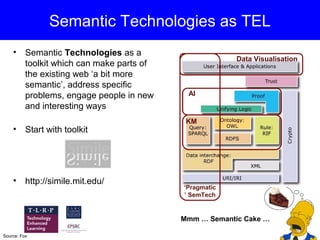
Semantic Technologies as TEL
    •     Semantic Technologies as a
                                                         Data Visualisation
          toolkit which can make parts of
          the existing web ‘a bit more
          semantic’, address specific
          problems, engage people in new     AI
          and interesting ways
                                             KM
    •     Start with toolkit


    •     http://simile.mit.edu/
                                            ‘Pragmatic
                                            ’ SemTech


                                            Mmm … Semantic Cake …

Source: Fox
Back to the pilot

•   Reminder:
    – Aim: (1) develop ‘demonstrator’ projects to evaluate a novel
      semantic web software ‘toolkit’ produced by the SIMILE
      project based at MIT
    – Different model of UROP - expertise and competencies as
      fluid and negotiated thru conversation, collaboration,
      competition, communication, controversy, creation


          Emerging issues for semantic
            technologies and TEL

                                       http://www.ensemble.ac.uk
Emerging Issues: Technical

•   Data quality
                                                 What is it
•   Data formats and conversion
                                                  to be
•   Scaling and workarounds
                                                semantic?
•   Metadata quality and consistency
•   Changing Patterns of access
•   Consensus on Taxonomies and ontologies
•   Composite and complex queries
•   Where does the reasoning sit?
•   What kind of reasoning? Closed/open?
•   Selection according to relevance and context
•   ALSO – Legacy problems in talking about semantic technologies &
    semantic technologies are not obviously transparent in what is going on

                                           http://www.ensemble.ac.uk
Research and Design as Learning

•   ‘Expert learners' perspectives sparks ideas
•   A fluid sense of who is the expert for any particular ‘problem’
•   Take up of practices where ‘experts’ model the process
•   Interpersonal collaborations and competition though sharing
•   Student researchers increasingly took control e.g. links with
    data providers, and invited potential users in co-design activities
•   Emphasise on doing by trial and error & rich and frequent
    feedback
•   Process is fit for purpose and adapted to context i.e. Summer,
    light touch management, freedom to move around, flexible
    working hours, food, fun, perks, rewards, stake in the outcomes


                                          http://www.ensemble.ac.uk
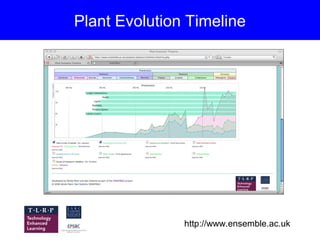
Plant Evolution Timeline


               http://www.ensemble.ac.uk
Plant Evolution Timeline


               http://www.ensemble.ac.uk
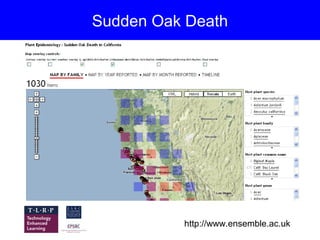
Sudden Oak Death


           http://www.ensemble.ac.uk
Sudden Oak Death


          http://www.ensemble.ac.uk
Essex in the English Civil War


                  http://www.ensemble.ac.uk
Essex in the English Civil War


                  http://www.ensemble.ac.uk
Maths for Engineers


             http://www.ensemble.ac.uk
Maths for Engineers – Improved web interface


                         http://www.ensemble.ac.uk
Show and Tell

• And a chance to see some of the summer
  projects and other prototypes
  –   Plant Evolution Timeline
  –   The Edwardians
  –   Maths for Engineers
  –   Fun with Proteins
  –   Essex in the English Civil War
  –   Plant Distribution and Fieldwork Support


                                http://www.ensemble.ac.uk
Envisioning

• Work in pairs
• Person 1 prompts and writes / person 2
  thinks and envisions. Prompts:
  – Think of an tricky information problem in your work
  – What is really the problem – ‘if only I had..’ ‘if only
    I could’....
  – What have you seen that might help
  – What would be the barriers
• Reverse roles

                                  http://www.ensemble.ac.uk
Discussion

• Live notes


                       http://www.ensemble.ac.uk
www.ensemble.ac.uk


            http://www.ensemble.ac.uk

Semantic technologies for the enhancement of learning in Higher Education

  • 1.
    The Ensemble Project Symposium CAL 2008, Brighton UK March 2009 http://www.ensemble.ac.uk
  • 2.
    www.ensemble.ac.uk Patrick Carmichael, UmaPatel, Katy Jordan, Keith Johnstone, Ben Roberts, Rob MacKinnon, Nicola Peart http://www.ensemble.ac.uk
  • 3.
    Symposium plan 1. Begin – Context the Ensemble project, and the UROP pilot – Research questions – Semantic technologies – More about the pilot – Emerging issues and insights 1. Then – Applications Katy Explains! 1. Next – Show and tell around posters and demos – Envision new TEL applications through conversation 1. Ending – Responses and open discussion http://www.ensemble.ac.uk
  • 4.
    Context • A Project of the ESRC/EPSRC Technology Enhanced Learning Programme, 2008-2011 • Technology Enhanced Learning research difficult to locate with single funder ESRC or EPSRC so TLRP-TEL • Challenges: research & development, interdisciplinarity, engagement and change • 8 projects funded inc. Semantic Technologies for the Enhancement of Case Based Learning start 1st Oct. 2009 • 10 weeks in summer 2009 the pilot part of the Undergraduate Research Opportunities Programme (UROP) scheme at Cambridge http://www.ensemble.ac.uk
  • 5.
    Ensemble Project andPilot • Cambridge: Patrick • Patrick Carmichael, Keith Carmichael, Katy Jordan, Johnstone Keith Johnstone • Katy Jordan (Leader) • City University: Uma Patel, Lawrence Solkin • Ben Roberts (RA) • Stirling: Richard Edwards • Rob MacKinnon (UROP-S) • UEA: Rob Walker • Nicola Peart (UROP-S) • UK Data Archive at Essex: • Jodie Watson (UROP-S) Louise Corti • Megan Davies Wykes • MIT – SIMILE Tools (UROP-S) • University of Technology • Visitors and Guests Sydney http://www.ensemble.ac.uk
  • 6.
    The pilot asa research setting (case) • Last summer teachers, students, developers and researchers worked with the SW ‘Toolkit’ developed by the SIMILE Project at MIT • Culture of recoding of using SAKAI and wiki for tracking work • Weekly show and tell meetings with visitors and food • Different model of UROP - expertise and competencies as fluid and negotiated thru conversation, collaboration, competition, communication, controversy, creation http://www.ensemble.ac.uk
  • 7.
    A glimpse ofthe vision • What are the nature, scope and role of cases and case based learning across disciplines in higher education and their relationship to learning outcomes and expertise? • How do teachers and learners design, develop, describe and reconstruct cases, and how do these processes contribute to academic and professional outcomes? • What are the pedagogical affordances of using semantic web technologies in support of case based learning? • What new tools can be developed to allow users (learners, teachers, researchers) to access, adapt and manage their case based learning and that of others? • What are the theoretical framings for researching technology enhanced learning and informing interdisciplinary dialogues when knowledge, technologies and pedagogies are in a state of flux? http://www.ensemble.ac.uk
  • 8.
    Some Research Questions •What is new here if anything • What is going on in terms of learning • What is going on in terms of design and development • How can we understand technologies in these activities (e.g. as affordances, tools, actants, or something else) Back to semantic technologies and TEL http://www.ensemble.ac.uk
  • 9.
    Technologies changes things Web 1.0 Web 2.0 Web 3.0 Power of social semantic web Networks Collaborative Authoring Friends Colleagues Family Face book Wikipedia Flicker Twitter Databases The collective Machine reasoning Docs. access/store http://www.ensemble.ac.uk
  • 10.
    One Semantic WebVision Tim Berners Lee’s 2001 ‘vision’ of the SW is couched in terms of personalisation of services through seamless integration of web based systems … “At the doctor's office, Lucy instructed her Semantic Web agent through her handheld Web browser. The agent promptly retrieved information about Mom's prescribed treatment from the doctor's agent, looked up several lists of providers, and checked for the ones in-plan for Mom's insurance within a 20-mile radius of her home and with a rating of excellent or very good on trusted rating services. It then began trying to find a match between available appointment times supplied by the agents …” Berners-Lee et al, 2001 The general tone is not unlike that of upbeat 1950’s films about the promise of futuristic kitchens, full of labour saving devices and intelligent fridges. Source: Stellman & Greene
  • 11.
    Education Directions? • Reusable Learning Objects….. • Few examples of successful deployment • Segregated Communities • Technology/Education Divide • Semantic Web as a CS ‘grand challenge’ • versus … • a set of useful standards • better access to resources • improved search tools and ‘portals’ Indigestible…? • interesting demonstrations of ‘closed worlds’ “In a teaching and learning environment in which the potential of semantic web technologies had been fully realized, engagement would be fluid, flexible and generative.” (Koper, 2004) Source: Fox
  • 12.
    Semantic Technologies asTEL • Semantic Technologies as a Data Visualisation toolkit which can make parts of the existing web ‘a bit more semantic’, address specific problems, engage people in new AI and interesting ways KM • Start with toolkit • http://simile.mit.edu/ ‘Pragmatic ’ SemTech Mmm … Semantic Cake … Source: Fox
  • 13.
    Back to thepilot • Reminder: – Aim: (1) develop ‘demonstrator’ projects to evaluate a novel semantic web software ‘toolkit’ produced by the SIMILE project based at MIT – Different model of UROP - expertise and competencies as fluid and negotiated thru conversation, collaboration, competition, communication, controversy, creation Emerging issues for semantic technologies and TEL http://www.ensemble.ac.uk
  • 14.
    Emerging Issues: Technical • Data quality What is it • Data formats and conversion to be • Scaling and workarounds semantic? • Metadata quality and consistency • Changing Patterns of access • Consensus on Taxonomies and ontologies • Composite and complex queries • Where does the reasoning sit? • What kind of reasoning? Closed/open? • Selection according to relevance and context • ALSO – Legacy problems in talking about semantic technologies & semantic technologies are not obviously transparent in what is going on http://www.ensemble.ac.uk
  • 15.
    Research and Designas Learning • ‘Expert learners' perspectives sparks ideas • A fluid sense of who is the expert for any particular ‘problem’ • Take up of practices where ‘experts’ model the process • Interpersonal collaborations and competition though sharing • Student researchers increasingly took control e.g. links with data providers, and invited potential users in co-design activities • Emphasise on doing by trial and error & rich and frequent feedback • Process is fit for purpose and adapted to context i.e. Summer, light touch management, freedom to move around, flexible working hours, food, fun, perks, rewards, stake in the outcomes http://www.ensemble.ac.uk
  • 16.
    Plant Evolution Timeline http://www.ensemble.ac.uk
  • 17.
    Plant Evolution Timeline http://www.ensemble.ac.uk
  • 18.
    Sudden Oak Death http://www.ensemble.ac.uk
  • 19.
    Sudden Oak Death http://www.ensemble.ac.uk
  • 20.
    Essex in theEnglish Civil War http://www.ensemble.ac.uk
  • 21.
    Essex in theEnglish Civil War http://www.ensemble.ac.uk
  • 22.
    Maths for Engineers http://www.ensemble.ac.uk
  • 23.
    Maths for Engineers– Improved web interface http://www.ensemble.ac.uk
  • 24.
    Show and Tell •And a chance to see some of the summer projects and other prototypes – Plant Evolution Timeline – The Edwardians – Maths for Engineers – Fun with Proteins – Essex in the English Civil War – Plant Distribution and Fieldwork Support http://www.ensemble.ac.uk
  • 25.
    Envisioning • Work inpairs • Person 1 prompts and writes / person 2 thinks and envisions. Prompts: – Think of an tricky information problem in your work – What is really the problem – ‘if only I had..’ ‘if only I could’.... – What have you seen that might help – What would be the barriers • Reverse roles http://www.ensemble.ac.uk
  • 26.
    Discussion • Live notes http://www.ensemble.ac.uk
  • 27.
    www.ensemble.ac.uk http://www.ensemble.ac.uk

Editor's Notes

  • #6 University of Cambridge operates an Undergraduate Research Opportunities Programme (UROP) A group of four UROP students were employed along with a part-time research assistant to develop ‘demonstrator’ projects in order to evaluate a novel semantic web software ‘toolkit’ produced by the SIMILE project based at MIT.Complexity, Controversy and Change
  • #7 Intuitions about relationships between learning and technology design: complexity in the activity and network of relationships Student work placements, internships and extended research projects are becoming increasingly common, blurring the distinction between academic and vocational working in higher education. Students and employers often regard these as preparation for employment, and an important current and future need is to identify ways of developing students’ capabilities to tackle complex problems,to draw on a wide range of resources in and beyond the workplace and to manage interdependence with colleagues. different model of UROP deployment was used as part of the pilot work of “Ensemble”, a major ESRC/EPSRC Technology Enhanced Learning project which is exploring the potential of emerging semantic technologies to support and enhance learning in higher education. A group of four UROP students were employed along with a part-time research assistant to develop ‘demonstrator’ projects in order to evaluate a novel semantic web software ‘toolkit’ produced by the SIMILE project based at MIT.
  • #11 Patrick
  • #14 Intuitions about relationships between learning and technology design: complexity in the activity and network of relationships Student work placements, internships and extended research projects are becoming increasingly common, blurring the distinction between academic and vocational working in higher education. Students and employers often regard these as preparation for employment, and an important current and future need is to identify ways of developing students’ capabilities to tackle complex problems,to draw on a wide range of resources in and beyond the workplace and to manage interdependence with colleagues. different model of UROP deployment was used as part of the pilot work of “Ensemble”, a major ESRC/EPSRC Technology Enhanced Learning project which is exploring the potential of emerging semantic technologies to support and enhance learning in higher education. A group of four UROP students were employed along with a part-time research assistant to develop ‘demonstrator’ projects in order to evaluate a novel semantic web software ‘toolkit’ produced by the SIMILE project based at MIT.
  • #17 Data existed in charts and diagrams in seminal textbooks and landmark papers ‘ The graph’ for each concept is presented to students in different lectures or slides Many different plant species illustrate different points – many pictures, no context Compounded by difficulties in grasping the time scale involved
  • #18 This is the new tool. Links to datasets, publications, course materials and images, presented using an interactive timeline visualisation. E.g. here we have numbers of angiosperms and other plant groups, set against geological time, and the points at which different physiological characteristics first evolved. The tool has been used in lectures instead of a series of separate graphs and figures, and we are continuing to observe how it is used throughout the academic year, by students at Cambridge, and around the world.
  • #19 Brief outline of what sudden oak death is and why we used it. The data could already be visualised in an online map. But this was ‘hard coded’ so lacked the ability to bring in other data – or to easily export the data to new applications.
  • #20 The data now reusable, and interface allows enhanced searching and to bring in data from other sources for comparison Although this is possible, data sources available, format and quality may be limited
  • #21 Rich ‘semantic web ready’ data set existed. Transcripts of essays, and RDF files describing roles and relationships between people and locations within them.
  • #22 New tool makes explicit the structure within the RDF and allows navigation through it – e.g. Harbottle Grimston.
  • #23 The information originally existed in a paper booklet This was converted to a nicely designed website But since the navigation mirrored the booklet, students found it hard to search for what they wanted
  • #24 Diverse resources to support learners Aggregated and presented through faceted browser The ontology implicit in the structure of the original website is now made explicit and navigable