Chapter # 2 
DC NETWORK THEOREMS
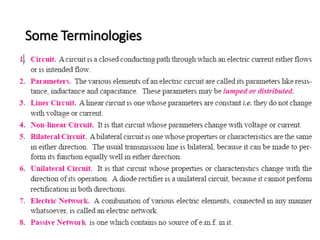
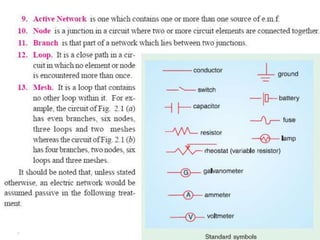
Some Terminologies
Two Approach 
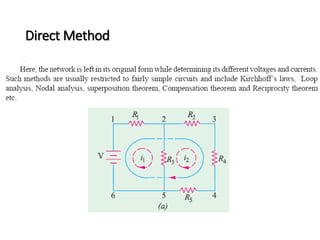
• Direct Method 
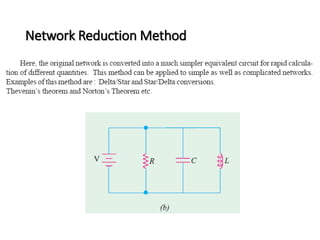
• Network Reduction Method
Direct Method
Network Reduction Method
Kirchhoff’s Law
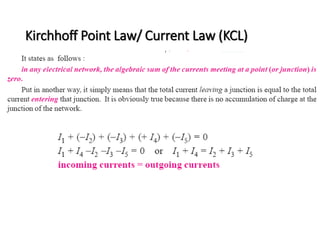
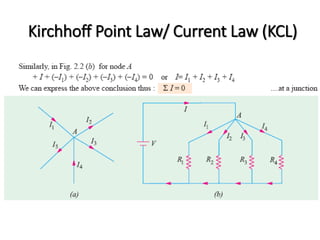
Kirchhoff Point Law/ Current Law (KCL)
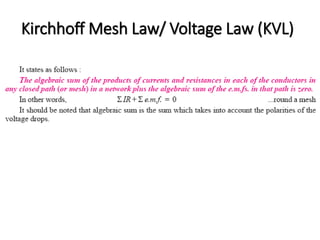
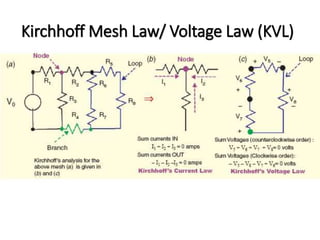
Kirchhoff Mesh Law/ Voltage Law (KVL)
Related Examples 
• 2.3-2.7 
• 2.19
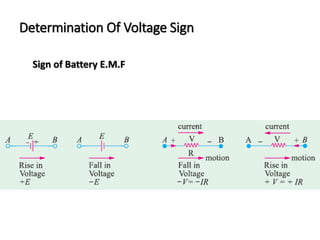
Determination Of Voltage Sign 
Sign of Battery E.M.F
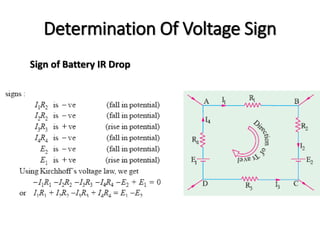
Determination Of Voltage Sign 
Sign of Battery IR Drop
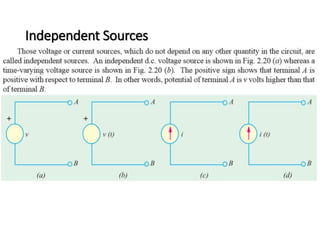
Independent Sources
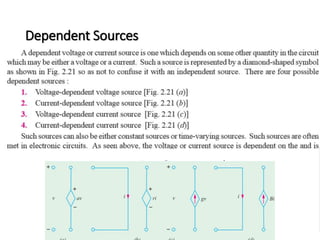
Dependent Sources
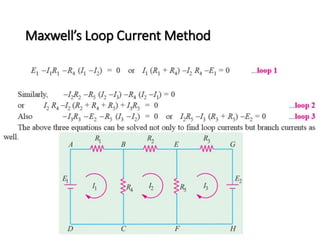
Maxwell’s Loop Current Method
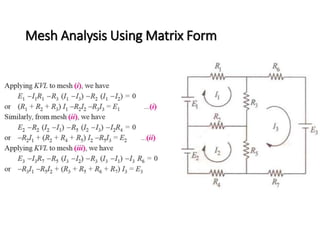
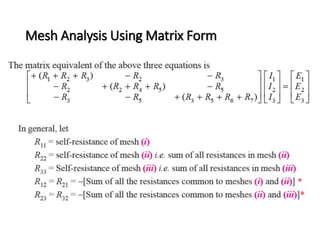
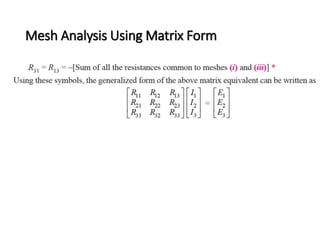
Mesh Analysis Using Matrix Form
Related Examples 
• 2.30 – 2.33
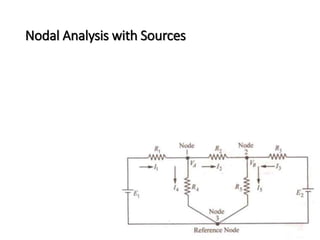
Nodal Analysis with Sources
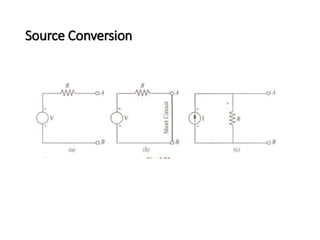
Source Conversion
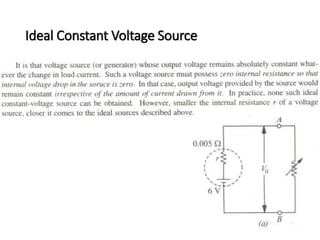
Ideal Constant Voltage Source
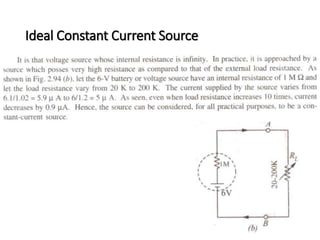
Ideal Constant Current Source
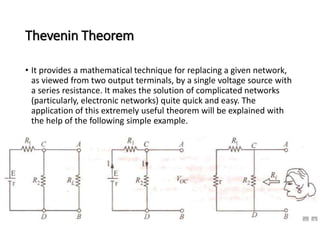
Thevenin Theorem 
• It provides a mathematical technique for replacing a given network, 
as viewed from two output terminals, by a single voltage source with 
a series resistance. It makes the solution of complicated networks 
(particularly, electronic networks) quite quick and easy. The 
application of this extremely useful theorem will be explained with 
the help of the following simple example.
How to Thevenize a Circuit? 
• When Circuit Contains Dependent & Independent Source 
Example 2.81 
• When Circuit contains Dependent sources only 
Example 2.83
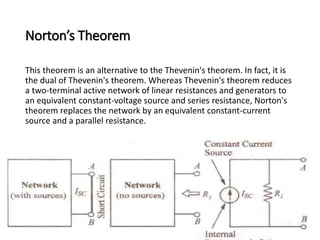
Norton’s Theorem 
This theorem is an alternative to the Thevenin's theorem. In fact, it is 
the dual of Thevenin's theorem. Whereas Thevenin's theorem reduces 
a two-terminal active network of linear resistances and generators to 
an equivalent constant-voltage source and series resistance, Norton's 
theorem replaces the network by an equivalent constant-current 
source and a parallel resistance.
How to Nortonize a Circuit? 
• When Circuit Contains Dependent & Independent Source 
• When Circuit contains Dependent sources only
Node Analysis & Norton Theorem 
• Remaining 
• On white board

Chapter#2