Lecturer
CSMSS college of polytechnic,
A u r a n g a b a d ( M a h a r a s h t r a )
E m a i l i d : s u r a j j a d h a v 7 3 7 5 @ g m a i l . c o m
I n s t a g r a m I d : s u r a j _ j a d h a v _ a c a d e m y
Yo u Tu b e C h a n n e l : S J A c a d e m y
Prof. Suraj T. Jadhav
Magnetic Circuit Prof. Suraj T. Jadhav Lecture 1-1
All Basic Concept related to
Magnetic Circuit
Magnetic Circuit Prof. Suraj T. Jadhav Lecture 1-2
Magnet
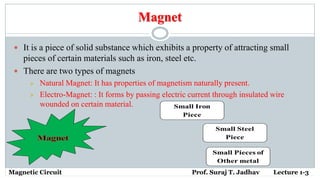
 It is a piece of solid substance which exhibits a property of attracting small
pieces of certain materials such as iron, steel etc.
 There are two types of magnets
➢ Natural Magnet: It has properties of magnetism naturally present.
➢ Electro-Magnet: : It forms by passing electric current through insulated wire
wounded on certain material.
Magnetic Circuit Prof. Suraj T. Jadhav Lecture 1-3
Basic Concepts of Magnetic Circuit
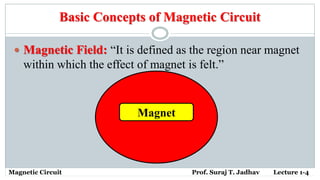
 Magnetic Field: “It is defined as the region near magnet
within which the effect of magnet is felt.”
Magnet
Magnetic Circuit Prof. Suraj T. Jadhav Lecture 1-4
Basic Concepts of Magnetic Circuit
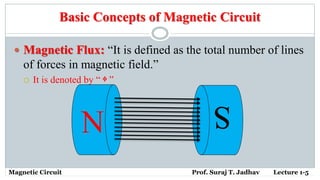
 Magnetic Flux: “It is defined as the total number of lines
of forces in magnetic field.”
 It is denoted by “ ᶲ ”
N
S
Magnetic Circuit Prof. Suraj T. Jadhav Lecture 1-5
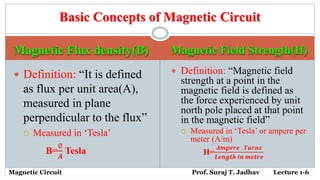
Magnetic Flux density(B) Magnetic Field Strength(H)
 Definition: “It is defined
as flux per unit area(A),
measured in plane
perpendicular to the flux”
 Measured in ‘Tesla’
B=
∅
𝑨
Tesla
 Definition: “Magnetic field
strength at a point in the
magnetic field is defined as
the force experienced by unit
north pole placed at that point
in the magnetic field”
 Measured in ‘Tesla’ or ampere per
meter (A/m)
H=
𝑨𝒎𝒑𝒆𝒓𝒆 . 𝑻𝒖𝒓𝒏𝒔
𝑳𝒆𝒏𝒈𝒕𝒉 𝒊𝒏 𝒎𝒆𝒕𝒓𝒆
Basic Concepts of Magnetic Circuit
Magnetic Circuit Prof. Suraj T. Jadhav Lecture 1-6
Basic Concepts of Magnetic Circuit
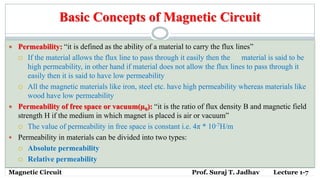
 Permeability: “it is defined as the ability of a material to carry the flux lines”
 If the material allows the flux line to pass through it easily then the material is said to be
high permeability, in other hand if material does not allow the flux lines to pass through it
easily then it is said to have low permeability
 All the magnetic materials like iron, steel etc. have high permeability whereas materials like
wood have low permeability
 Permeability of free space or vacuum(µ0): “it is the ratio of flux density B and magnetic field
strength H if the medium in which magnet is placed is air or vacuum”
 The value of permeability in free space is constant i.e. 4π * 10-7H/m
 Permeability in materials can be divided into two types:
 Absolute permeability
 Relative permeability
Magnetic Circuit Prof. Suraj T. Jadhav Lecture 1-7
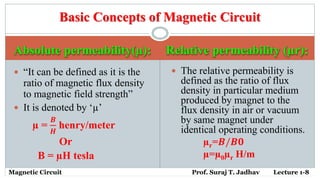
Absolute permeability(µ): Relative permeability (µr):
 “It can be defined as it is the
ratio of magnetic flux density
to magnetic field strength”
 It is denoted by ‘µ’
µ =
𝑩
𝑯
henry/meter
Or
B = µH tesla
 The relative permeability is
defined as the ratio of flux
density in particular medium
produced by magnet to the
flux density in air or vacuum
by same magnet under
identical operating conditions.
µr=𝑩/𝑩𝟎
µ=µ0µr H/m
Basic Concepts of Magnetic Circuit
Magnetic Circuit Prof. Suraj T. Jadhav Lecture 1-8
Basic Concepts of Magnetic Circuit
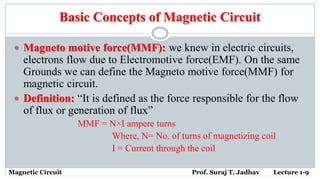
 Magneto motive force(MMF): we knew in electric circuits,
electrons flow due to Electromotive force(EMF). On the same
Grounds we can define the Magneto motive force(MMF) for
magnetic circuit.
 Definition: “It is defined as the force responsible for the flow
of flux or generation of flux”
MMF = N×I ampere turns
Where, N= No. of turns of magnetizing coil
I = Current through the coil
Magnetic Circuit Prof. Suraj T. Jadhav Lecture 1-9
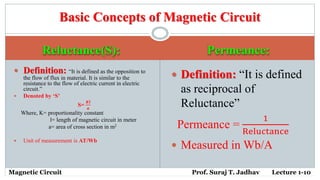
Reluctance(S): Permeance:
 Definition: “It is defined as the opposition to
the flow of flux in material. It is similar to the
resistance to the flow of electric current in electric
circuit.”
 Denoted by ‘S’
S=
𝑲𝒍
𝒂
Where, K= proportionality constant
l= length of magnetic circuit in meter
a= area of cross section in m2
 Unit of measurement is AT/Wb
 Definition: “It is defined
as reciprocal of
Reluctance”
Permeance =
1
Reluctance
 Measured in Wb/A
Basic Concepts of Magnetic Circuit
Magnetic Circuit Prof. Suraj T. Jadhav Lecture 1-10
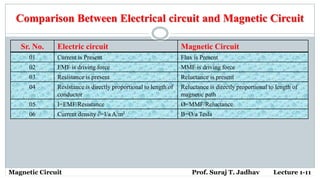
Comparison Between Electrical circuit and Magnetic Circuit
Sr. No. Electric circuit Magnetic Circuit
01 Current is Present Flux is Present
02 EMF is driving force MMF is driving force
03 Resistance is present Reluctance is present
04 Resistance is directly proportional to length of
conductor
Reluctance is directly proportional to length of
magnetic path
05 I=EMF/Resistance Ø=MMF/Reluctance
06 Current density ∂=I/a A/m2 B=Ø/a Tesla
Magnetic Circuit Prof. Suraj T. Jadhav Lecture 1-11
NEXT VIDEO WILL BE ON
“TYPES OF MAGNETIC CIRCUIT”
STAY TUNE ON SJ ACADEMY
Thank You
Magnetic Circuit Prof. Suraj T. Jadhav Lecture 1-12

Lect 1 Magnetic Circuit

  • 1.
    Lecturer CSMSS college ofpolytechnic, A u r a n g a b a d ( M a h a r a s h t r a ) E m a i l i d : s u r a j j a d h a v 7 3 7 5 @ g m a i l . c o m I n s t a g r a m I d : s u r a j _ j a d h a v _ a c a d e m y Yo u Tu b e C h a n n e l : S J A c a d e m y Prof. Suraj T. Jadhav Magnetic Circuit Prof. Suraj T. Jadhav Lecture 1-1
  • 2.
    All Basic Conceptrelated to Magnetic Circuit Magnetic Circuit Prof. Suraj T. Jadhav Lecture 1-2
  • 3.
    Magnet  It isa piece of solid substance which exhibits a property of attracting small pieces of certain materials such as iron, steel etc.  There are two types of magnets ➢ Natural Magnet: It has properties of magnetism naturally present. ➢ Electro-Magnet: : It forms by passing electric current through insulated wire wounded on certain material. Magnetic Circuit Prof. Suraj T. Jadhav Lecture 1-3
  • 4.
    Basic Concepts ofMagnetic Circuit  Magnetic Field: “It is defined as the region near magnet within which the effect of magnet is felt.” Magnet Magnetic Circuit Prof. Suraj T. Jadhav Lecture 1-4
  • 5.
    Basic Concepts ofMagnetic Circuit  Magnetic Flux: “It is defined as the total number of lines of forces in magnetic field.”  It is denoted by “ ᶲ ” N S Magnetic Circuit Prof. Suraj T. Jadhav Lecture 1-5
  • 6.
    Magnetic Flux density(B)Magnetic Field Strength(H)  Definition: “It is defined as flux per unit area(A), measured in plane perpendicular to the flux”  Measured in ‘Tesla’ B= ∅ 𝑨 Tesla  Definition: “Magnetic field strength at a point in the magnetic field is defined as the force experienced by unit north pole placed at that point in the magnetic field”  Measured in ‘Tesla’ or ampere per meter (A/m) H= 𝑨𝒎𝒑𝒆𝒓𝒆 . 𝑻𝒖𝒓𝒏𝒔 𝑳𝒆𝒏𝒈𝒕𝒉 𝒊𝒏 𝒎𝒆𝒕𝒓𝒆 Basic Concepts of Magnetic Circuit Magnetic Circuit Prof. Suraj T. Jadhav Lecture 1-6
  • 7.
    Basic Concepts ofMagnetic Circuit  Permeability: “it is defined as the ability of a material to carry the flux lines”  If the material allows the flux line to pass through it easily then the material is said to be high permeability, in other hand if material does not allow the flux lines to pass through it easily then it is said to have low permeability  All the magnetic materials like iron, steel etc. have high permeability whereas materials like wood have low permeability  Permeability of free space or vacuum(µ0): “it is the ratio of flux density B and magnetic field strength H if the medium in which magnet is placed is air or vacuum”  The value of permeability in free space is constant i.e. 4π * 10-7H/m  Permeability in materials can be divided into two types:  Absolute permeability  Relative permeability Magnetic Circuit Prof. Suraj T. Jadhav Lecture 1-7
  • 8.
    Absolute permeability(µ): Relativepermeability (µr):  “It can be defined as it is the ratio of magnetic flux density to magnetic field strength”  It is denoted by ‘µ’ µ = 𝑩 𝑯 henry/meter Or B = µH tesla  The relative permeability is defined as the ratio of flux density in particular medium produced by magnet to the flux density in air or vacuum by same magnet under identical operating conditions. µr=𝑩/𝑩𝟎 µ=µ0µr H/m Basic Concepts of Magnetic Circuit Magnetic Circuit Prof. Suraj T. Jadhav Lecture 1-8
  • 9.
    Basic Concepts ofMagnetic Circuit  Magneto motive force(MMF): we knew in electric circuits, electrons flow due to Electromotive force(EMF). On the same Grounds we can define the Magneto motive force(MMF) for magnetic circuit.  Definition: “It is defined as the force responsible for the flow of flux or generation of flux” MMF = N×I ampere turns Where, N= No. of turns of magnetizing coil I = Current through the coil Magnetic Circuit Prof. Suraj T. Jadhav Lecture 1-9
  • 10.
    Reluctance(S): Permeance:  Definition:“It is defined as the opposition to the flow of flux in material. It is similar to the resistance to the flow of electric current in electric circuit.”  Denoted by ‘S’ S= 𝑲𝒍 𝒂 Where, K= proportionality constant l= length of magnetic circuit in meter a= area of cross section in m2  Unit of measurement is AT/Wb  Definition: “It is defined as reciprocal of Reluctance” Permeance = 1 Reluctance  Measured in Wb/A Basic Concepts of Magnetic Circuit Magnetic Circuit Prof. Suraj T. Jadhav Lecture 1-10
  • 11.
    Comparison Between Electricalcircuit and Magnetic Circuit Sr. No. Electric circuit Magnetic Circuit 01 Current is Present Flux is Present 02 EMF is driving force MMF is driving force 03 Resistance is present Reluctance is present 04 Resistance is directly proportional to length of conductor Reluctance is directly proportional to length of magnetic path 05 I=EMF/Resistance Ø=MMF/Reluctance 06 Current density ∂=I/a A/m2 B=Ø/a Tesla Magnetic Circuit Prof. Suraj T. Jadhav Lecture 1-11
  • 12.
    NEXT VIDEO WILLBE ON “TYPES OF MAGNETIC CIRCUIT” STAY TUNE ON SJ ACADEMY Thank You Magnetic Circuit Prof. Suraj T. Jadhav Lecture 1-12